
A missed finding on a bitewing X-ray can cost a patient a tooth and a practice a case it should have caught months earlier. A phone that rings out after hours can cost the same practice a new patient who simply calls the next listing. The best ai tools for dentists attack both problems at once, because the category now splits into clinical imaging, voice charting, front desk automation and analytics, and a practice that buys only one side leaves the other side leaking money every week.
This guide compares ten tools on published prices where they exist, the job each one does best and the catch that only shows up after the contract is signed. Most imaging and platform vendors in this category sell by quote, so where a price is reported by a third party roundup rather than published by the vendor, this guide says so. Start with the shortlist, then read the reviews that match the problem your practice feels most.
The Quick Shortlist
The table below matches each common dental job to the single tool that handles it best. Use it to narrow the best ai tools for dentists to two or three candidates before you read the full reviews. Prices are monthly list prices unless noted, and annual billing is usually cheaper than paying month to month.
| Job | Best tool | Why it wins |
|---|---|---|
| X-ray analysis across many imaging brands | Pearl | FDA cleared for 2D and 3D imaging, used in more than 23,000 practices |
| Imaging plus claims for a multi location group | Overjet | Broadest clinical platform, with 12 FDA clearances reported |
| Low cost imaging plus voice charting | Denti.AI | Published price of 49 dollars a month per location |
| Hands free perio charting by voice | Bola AI | Built for perio charting inside Dentrix, Eaglesoft and Open Dental |
| Phones, texting and reminders in one system | Weave | Published Pro price from 249 dollars a month, with an AI receptionist |
| Production and patient analytics | Dental Intelligence | Consolidates analytics and engagement across the main practice systems |
| After hours calls answered and booked | Dentina.AI | Published price from 299 dollars a month billed annually |
| Online scheduling and digital forms | NexHealth | Modern patient intake with verification and payments |
| Recall campaigns that bring patients back | RevenueWell | Built around reactivation and recall revenue |
| Imaging that reads 30 plus conditions | VideaHealth | FDA cleared, with the first pediatric clearance in the category |
How We Judged the Best AI Tools for Dentists
A tool earned a place here only if it does a real dental job in 2026, not if it added an AI label to an old product. The best ai tools for dentists were judged on five things that decide whether a practice keeps paying after the first year.
First, the clinical or front desk job it does, from finding caries on a radiograph to answering the phone at 8 in the evening, because a tool that does one job well beats a platform that does five jobs poorly. Second, whether the price is published or hidden behind a sales call, including setup fees and per provider charges that change the real bill. Third, integration with the practice management system, because a tool that writes back to Open Dental, Dentrix or Eaglesoft saves hours that a tool with export only never will.
Fourth, regulatory standing, because imaging findings carry clinical weight and an FDA clearance is a real line between a diagnostic aid and a demo. Fifth, the catch, from quote only pricing that hides the cost until the demo to per location fees that multiply fast across a group.
| Check before you buy | What to ask | Why it matters |
|---|---|---|
| FDA clearance | Which clearances, and for which image types | Tells you what the AI is cleared to flag |
| Practice system integration | Does it write back, or export only | Write back saves double entry every day |
| Price structure | Per provider, per location, or flat | Per location fees multiply across a group |
| Business associate agreement | Is a signed agreement included | Patient data needs a signed agreement |
| Setup and renewal terms | Setup fee, and what year two costs | Renewal increases are common in this category |
| AI accuracy | Who reviews AI findings before the patient hears them | Every AI finding still needs a dentist review |
The 10 Tools, Reviewed One by One
1. Pearl
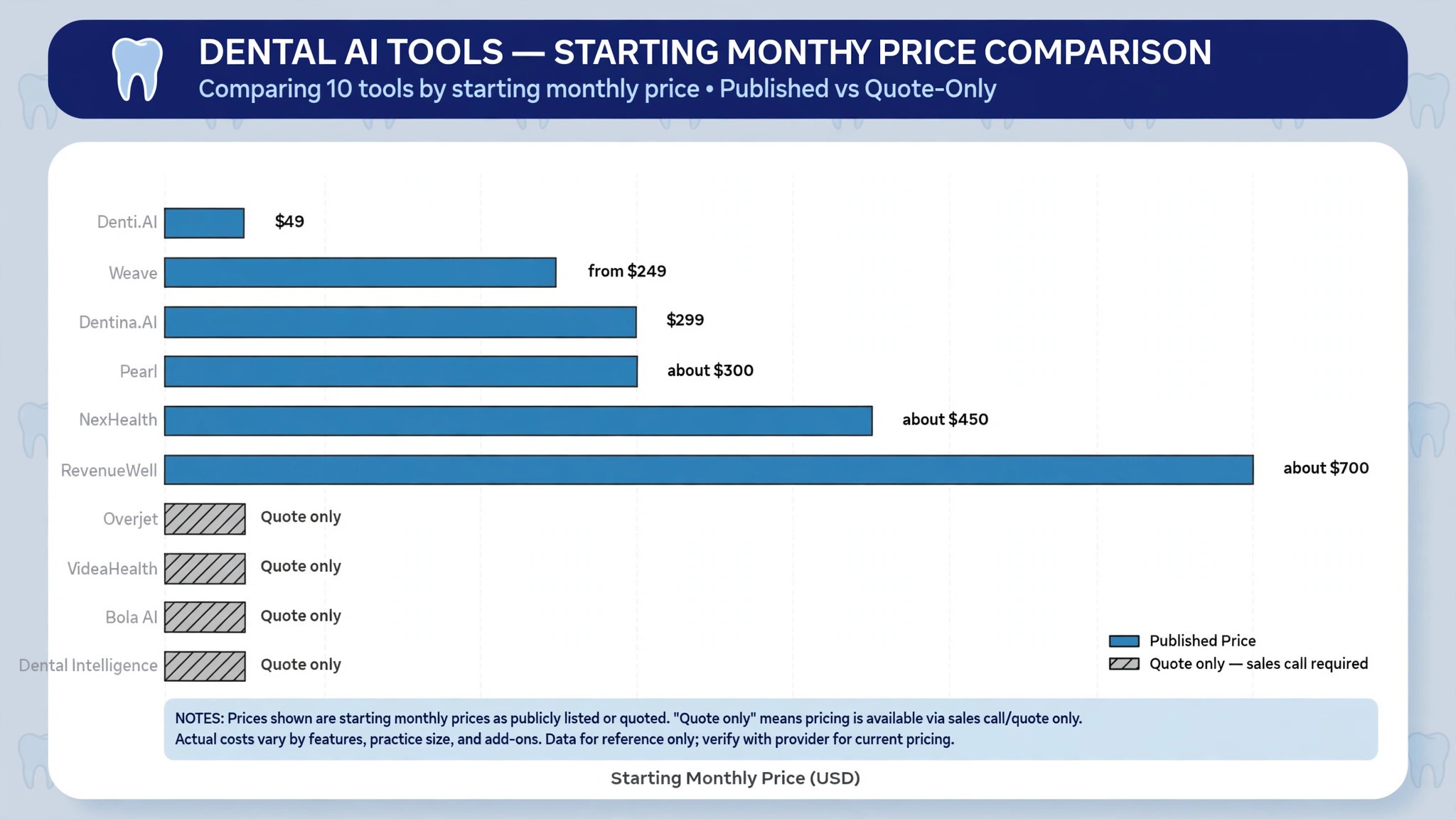
Starting price Reported at about 300 dollars per provider a month for radiograph AI. Best for X-ray analysis across many imaging brands. Watch out The bundled price is reported at about 800 dollars a month, so get the bundle in writing.
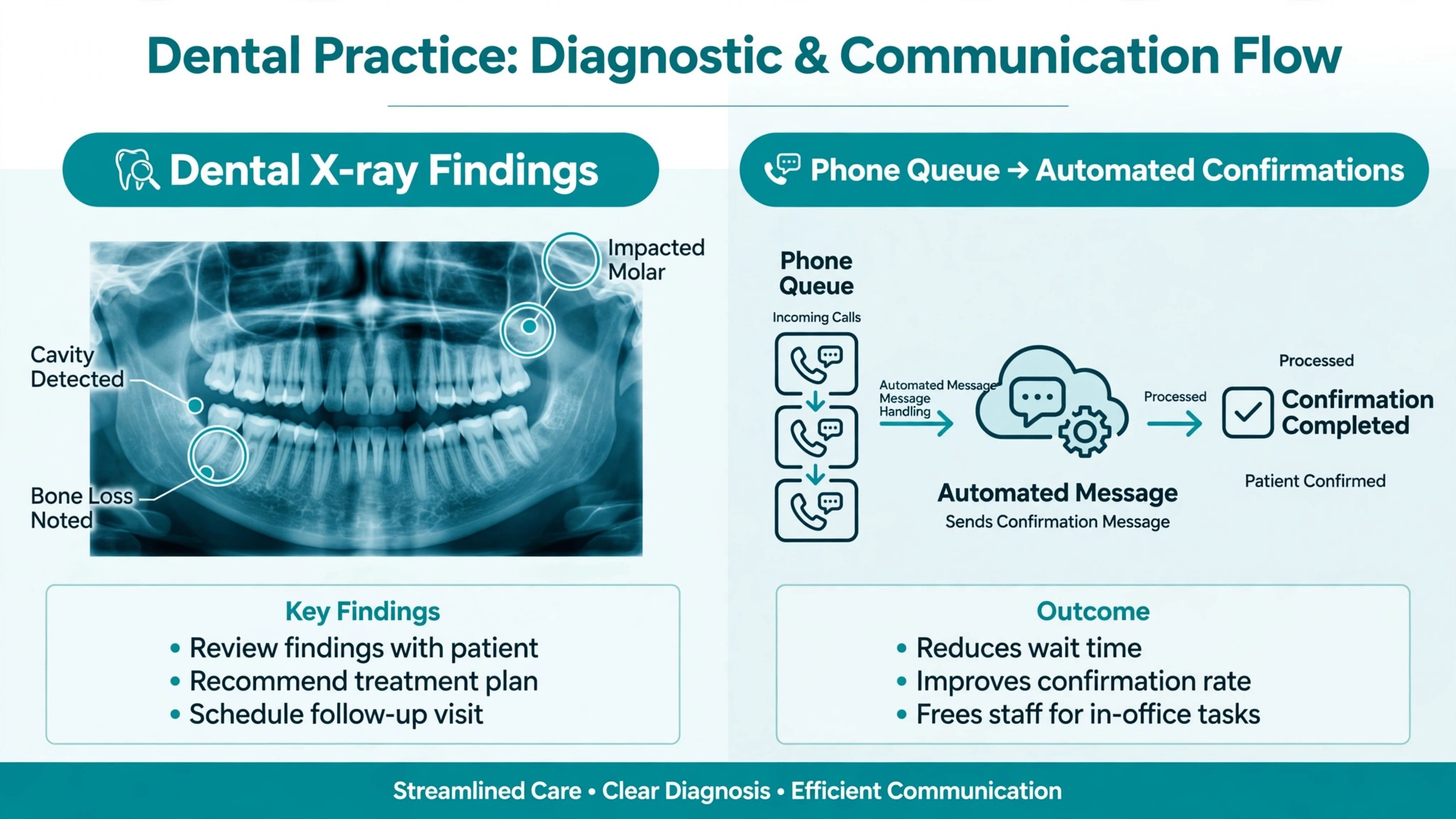
Pearl is the imaging pick for most practices because it works across more than 30 imaging and practice management platforms and it holds clearances for both 2D and 3D imaging. Its Second Opinion product scans bitewing, periapical and panoramic X-rays and flags caries, bone loss, periapical lesions and calculus with confidence scores, and the dentist still makes the diagnosis. The free tier covers 100 radiographs a month, which is enough to test detection quality on your own cases before you pay.
The patient facing value is case acceptance. When a patient can see a highlighted finding on their own X-ray, the conversation about treatment changes from trust me to look here, and practices report that visual evidence moves hesitant patients toward care they need. That is the reason Pearl shows up in more than 23,000 practices across 120 countries, and why groups that prioritize case acceptance start here.
The catch is price transparency. The radiograph AI price is reported rather than published, and the bundled figure is an estimate from third party roundups, so a practice should confirm the current number and the radiograph allowance in writing. Pearl still earns the top spot for practices that want one imaging AI across the systems they already own.
2. Overjet
Starting price Quote only. Best for Imaging plus claims for a multi location group. Watch out Enterprise pricing and annual contracts suit groups, not solo practices.
Overjet is the clinical AI vendor most clearly built for the enterprise buyer, with Vision AI for imaging, IRIS for deeper analysis, a Voice AI Suite for ambient clinical notes and a payer layer that ties claims to clinical findings. Twelve FDA clearances are reported, the most recent in August 2026, and the platform integrates with Open Dental, Dentrix Core, Dentrix Ascend, Denticon and CareStack. For a group that wants one clinical intelligence layer across locations, that breadth is the point.
The claims angle is what separates Overjet from a pure imaging tool. When the clinical finding and the claim share the same evidence, the back office spends less time chasing documentation and the group sees cleaner submissions. Centralized billing teams feel that difference every week, and it is the reason mid to large groups standardize here even though the price takes a sales call to learn.
The catch is that nothing about the cost is public, and a solo practice will find the sales process heavy for what it needs. Overjet is the right pick for a group with centralized billing and a real imaging volume, and the wrong pick for a single chair practice that wants a published price and a quick start.
3. VideaHealth
Starting price Quote only. Best for Imaging that reads 30 plus conditions. Watch out Quote based pricing means the bill depends on practice size and volume.
VideaHealth, known as Videa AI, is the imaging pick for groups that want ambient, no click AI that works in the background while the dentist works. It is FDA cleared for more than 30 conditions, including the first pediatric clearance in the category, and it focuses on detection breadth rather than a single finding type. For a practice that sees children as well as adults, that pediatric clearance is a genuine differentiator.
The workflow is the selling point. The AI reads the image without extra clicks, surfaces findings with annotations and lets the dentist confirm or dismiss each one inside the normal charting flow. That quiet fit matters, because imaging AI that adds five clicks per X-ray gets switched off within a month no matter how good its detection is.
The catch is the same as Overjet. Pricing is custom and quote based, so a buyer cannot budget from the website and must go through a demo to learn the number. VideaHealth earns its place for groups that value detection breadth and a low friction workflow, and buyers should push for a per location figure early in the conversation.
4. Denti.AI
Starting price 49 dollars a month per location for Detect. Best for Low cost imaging plus voice charting. Watch out Voice Perio costs extra at 10 dollars per user a month.
Denti.AI is the value pick in this category because it publishes a flat price that undercuts every imaging rival by a wide margin. Detect costs 49 dollars a month per location, and the bundle folds in Auto-Chart 2, a voice charting product that turns spoken findings into chart entries. For an independent practice that wants imaging AI without an enterprise sales cycle, that published number removes the biggest barrier in the category.
The charting side deserves as much attention as the imaging. Voice charting cuts the time a dentist spends typing after each patient, and Auto-Chart 2 is built for the dental vocabulary rather than general medical dictation. A practice that adopts both sides gets detection help and documentation help for less than most rivals charge for imaging alone.
The catch is scale and polish. Denti.AI does not carry the same clearance count or group tooling as Pearl or Overjet, and a large group may outgrow it. For a single location or a small group, it is the cheapest honest way into dental AI, and the published price makes the trial decision easy.
5. Bola AI
Starting price Quote only, per location. Best for Hands free perio charting by voice. Watch out It is a charting tool, not an imaging tool, so it solves a different problem.
Bola AI does one job and does it in the operatory where the time is actually lost. It listens to the dentist calling perio numbers and writes them straight into Dentrix, Eaglesoft or Open Dental, so the assistant no longer types while the dentist probes. Perio charting is slow, repetitive and error prone when done by hand, and voice capture removes the bottleneck without changing how the dentist works.
The accuracy question matters more here than in most categories, because a wrong perio number becomes part of the permanent record. Bola AI is built for dental vocabulary and for the rhythm of a perio exam, which is why practices that chart perio all day adopt it faster than a general scribe. The integration list is the other strength, since the three main practice systems are covered from the start.
The catch is that pricing is quoted per location and nothing is published, so a buyer must ask for the number and for the contract length. Bola AI earns its place as the best voice perio tool here, and it pairs well with an imaging tool rather than replacing one.
6. Weave
Starting price From 249 dollars a month for Pro. Best for Phones, texting and reminders in one system. Watch out Setup fees and add ons push the real cost higher, with owners reporting 400 to 700 dollars a location a month all in.
Weave is the front desk pick for phone heavy practices because it replaces the phone system while adding the engagement layer on top. Call Pop shows the patient name, next appointment and balance the instant the phone rings, two way texting handles confirmations without a call, and the AI Receptionist can book appointments, answer common questions and take payments without a human on the line. It integrates with more than 20 practice management platforms, including Dentrix, Eaglesoft and Open Dental.
The strength is consolidation. A practice that runs phones, texting, reminders, reviews and payments in five tools can run them in one contract here, and the front desk stops switching tabs between patients. The AI Receptionist matters most after hours, when the calls that used to go to voicemail now get booked, and that is where the return shows up fastest.
The catch is the real bill. The published Pro price is a starting point, Elite and Ultimate are quote only, and third party reporting puts setup at 750 dollars one time with form build fees on top. Renewal increases of 10 to 20 percent in year two are commonly reported. Weave still earns its place for practices that want one front desk system, and buyers should price the all in figure before they sign.
7. Dental Intelligence
Starting price Quote only. Best for Production and patient analytics. Watch out The value depends on acting on the dashboards, not just viewing them.
Dental Intelligence is the analytics pick for owners who run the practice by numbers rather than by feel. It consolidates key performance data across Open Dental, Dentrix, Eaglesoft, Denticon and Fuse, then turns that data into dashboards for production, collections, hygiene reactivation and provider performance. A practice that cannot see which provider is underproducing or which recall list is going stale cannot fix either problem.
The engagement side is what keeps it from being a reporting tool only. The same platform runs patient engagement campaigns, so a gap the dashboard finds can become a recall message the same day. That loop from insight to action is the difference between analytics that get opened once a month and analytics that change the schedule every week.
The catch is that pricing is entirely quote based and the return depends on someone in the practice owning the numbers. A practice that buys dashboards and never acts on them pays for decoration. For an owner or manager who will work the data weekly, Dental Intelligence earns its place as the clearest view of the business.
8. Dentina.AI
Starting price 299 dollars a month billed annually for Standard. Best for After hours calls answered and booked. Watch out The monthly billing price rises to 374 dollars a month, so annual billing matters.
Dentina.AI is a 24 hour AI dental receptionist built by a dentist, and that origin shows in how it handles calls. It answers inbound calls, books appointments and writes the result back to the practice system in real time, covering Open Dental, Dentrix, Eaglesoft, Curve, Denticon and six more systems. Standard starts at 299 dollars a month billed annually, or 374 dollars a month billed monthly, and Premium starts at 399 dollars a month billed annually for up to three providers.
The problem it solves is simple and expensive. A meaningful share of new patient calls arrive outside office hours, and every one that reaches voicemail is a patient who may call the next practice on the list. An AI receptionist that books the appointment instead of taking a message turns those calls into a schedule, and the write back to the practice system means the front desk arrives to a booked day rather than a pile of messages.
The catch is that it is a communication tool, not a full front desk replacement, so a practice still needs its phone system and its reminder flow. Premium at 399 dollars a month billed annually adds capacity for larger teams. For a practice losing after hours calls, Dentina.AI is the most directly priced fix on this list.
9. NexHealth
Starting price Reported at about 450 dollars a month. Best for Online scheduling and digital forms. Watch out Pricing is not published, so confirm the figure and the included features.
NexHealth is the intake pick for practices that want the front door to feel modern. Patients book online in real time, fill digital forms before they arrive, verify insurance and pay through the same flow, and the front desk stops retyping paper forms and chasing missing information. That intake quality matters, because a form completed at home is more accurate than one scribbled in the waiting room.
The verification chain is the deeper value. When insurance verification connects to the appointment and to per procedure cost data, the practice knows before the visit what is covered and what the patient owes, and the awkward money conversation at checkout gets shorter. Practices that run a high volume of new patients feel that difference in the first month.
The catch is price transparency again, since the reported figure comes from third party roundups rather than a published page. NexHealth also works best as part of a modern stack, so a practice on an older system should confirm the integration depth before buying. For a practice rebuilding intake from scratch, it earns its place.
10. RevenueWell
Starting price Reported at about 700 dollars a month. Best for Recall campaigns that bring patients back. Watch out The reported price is a starting point, and the return depends on the recall list being worked.
RevenueWell is the revenue pick for practices with a large inactive patient base, because it is built around recall and reactivation rather than general messaging. It runs recall campaigns, targets patients who have gone quiet, and measures the production that comes back from each campaign, so the practice can see whether the spend is earning its keep. A practice with thousands of dormant records is sitting on revenue that a reminder system alone will not recover.
The campaign logic is what separates it from a basic reminder tool. Instead of sending the same message to everyone, RevenueWell segments by treatment history, time since last visit and value, then targets the patients most likely to return for the care they need. That targeting is why practices credit it with reactivation revenue rather than just fewer no shows.
The catch is that the price is reported rather than published, and a practice with a small or clean recall list will see less return than a large practice with years of dormant records. For a practice that knows its recall list is full of patients who never came back, RevenueWell closes the list as the best tool for turning that list into booked chairs.
Side by Side Comparison
The table below puts the best ai tools for dentists side by side on price, best job and free plan, so you can compare the published prices against the quote only tools at a glance.
| Tool | Starting price | Best for | Free plan |
|---|---|---|---|
| Pearl | Reported about 300 dollars per provider a month | X-ray analysis across many imaging brands | Yes, 100 radiographs a month |
| Overjet | Quote only | Imaging plus claims for a multi location group | No |
| VideaHealth | Quote only | Imaging that reads 30 plus conditions | No |
| Denti.AI | 49 dollars a month per location | Low cost imaging plus voice charting | No |
| Bola AI | Quote only, per location | Hands free perio charting by voice | No |
| Weave | From 249 dollars a month | Phones, texting and reminders in one system | No |
| Dental Intelligence | Quote only | Production and patient analytics | No |
| Dentina.AI | 299 dollars a month billed annually | After hours calls answered and booked | No |
| NexHealth | Reported about 450 dollars a month | Online scheduling and digital forms | No |
| RevenueWell | Reported about 700 dollars a month | Recall campaigns that bring patients back | No |
How to Pick the Right Tool for Your Practice
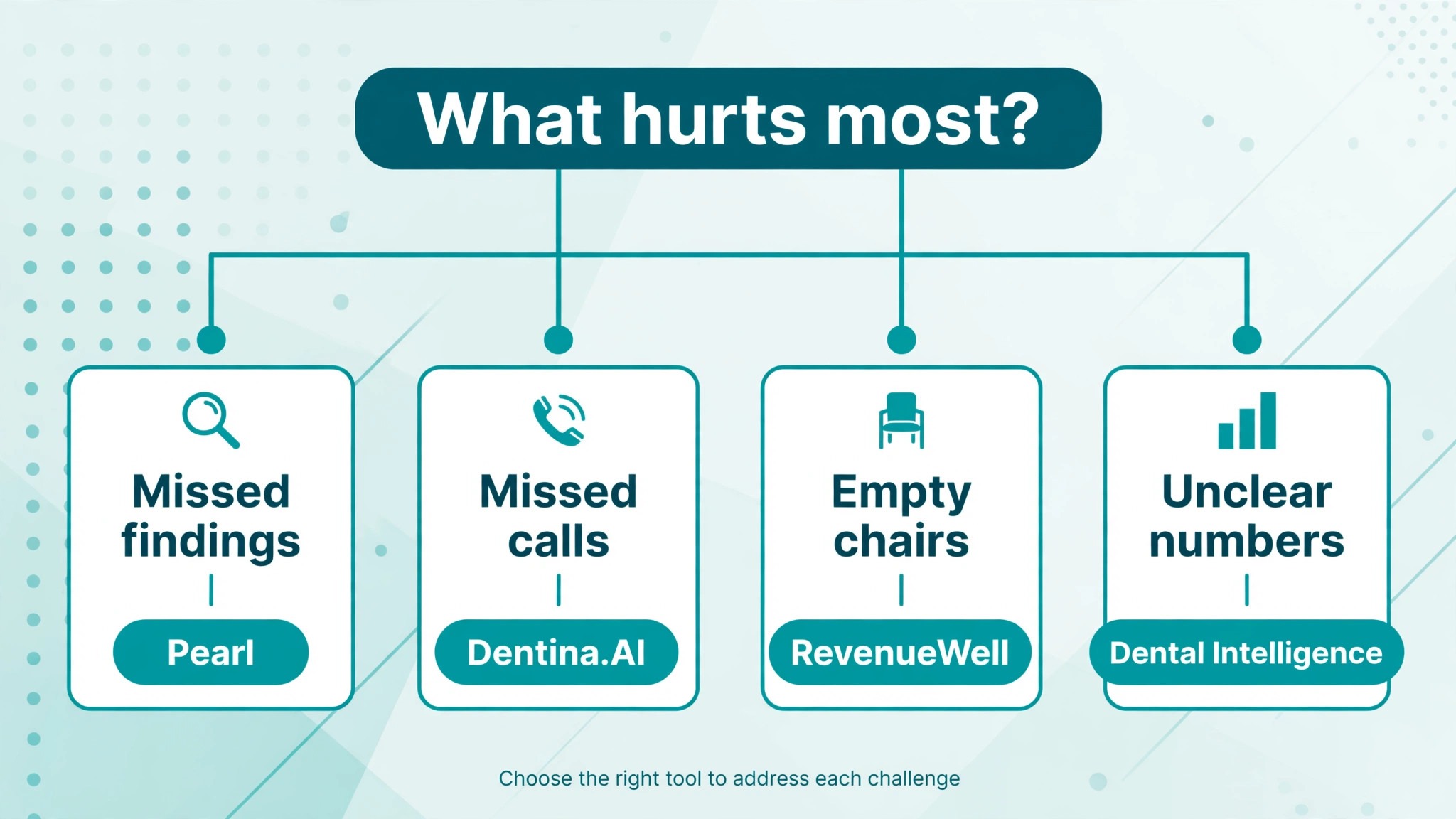
The best ai tools for dentists are not the ones with the longest feature list. They are the ones that fix the leak your practice feels every week. A practice missing findings on X-rays should buy Pearl or Denti.AI. A practice losing after hours calls should buy Dentina.AI or Weave. A practice with a stale recall list should buy RevenueWell. A practice that cannot see its numbers should buy Dental Intelligence. Start from the leak, not from the vendor homepage.
Budget the full bill, not the headline price. The table below shows what a single location practice actually pays in year one for the most common combinations, using published or reported starting prices. Setup fees, per provider charges and renewal increases are the lines that surprise buyers, so ask for them in writing before you sign.
| Stack for one location | Monthly cost | What it covers |
|---|---|---|
| Denti.AI Detect | 49 dollars | Imaging AI plus voice charting |
| Dentina.AI Standard, annual | 299 dollars | After hours receptionist that books |
| Weave Pro | From 249 dollars | Phones, texting, reminders, AI receptionist |
| Pearl plus Dentina.AI | About 599 dollars | Imaging AI plus after hours booking |
| Weave plus Pearl | About 549 dollars | Full front desk plus imaging AI |
Frequently Asked Questions
What is the cheapest good dental AI tool to start with
Denti.AI at 49 dollars a month per location is the cheapest published entry with real imaging and voice charting included, and it needs no sales call to price. Pearl offers a free tier of 100 radiographs a month, which is the cheapest way to test imaging quality on your own cases. For the front desk, Dentina.AI Standard at 299 dollars a month billed annually is the cheapest published AI receptionist on this list. Start with the job that loses you the most money, not with the cheapest tool overall.
Do AI imaging tools diagnose patients
No, and any vendor that implies otherwise should be treated with caution. Imaging AI flags potential findings and presents them with confidence scores, and the licensed dentist reviews every finding and makes the diagnosis. FDA clearance tells you what the tool is cleared to flag, not that it replaces clinical judgment. Keep a dentist review step in the workflow for every AI finding, and treat the AI as a second pair of eyes rather than a decision maker.
Which dental AI tool is best for a multi location group
Overjet is the strongest pick for a group with centralized billing, because its platform covers imaging, voice notes and claims in one system across locations. VideaHealth suits groups that prioritize detection breadth and a low friction workflow. Pearl suits groups that want one imaging AI across many different imaging brands. Price all three by quote, and compare the per location figure rather than the headline, because per location fees multiply fast across a group.
How much should a single location practice budget for dental AI
A realistic year one budget for the best ai tools for dentists is 49 to 300 dollars a month for one imaging or receptionist tool, and 550 to 900 dollars a month once you combine imaging with a front desk system. Setup fees add 750 dollars or more in year one for tools like Weave, and renewal increases of 10 to 20 percent are commonly reported, so budget for year two as well as year one. Quote only tools need a sales call to price, so get the per provider or per location figure in writing before you compare.
Our Verdict
If you buy one tool this quarter, buy Pearl. It covers the most consequential dental job, catching findings on X-rays, across the widest range of imaging systems, with clearances for 2D and 3D imaging and a free tier that lets you test it on your own cases. The best ai tools for dentists earn their keep by finding revenue that was already in the building, and Pearl does that from the first week, whether the revenue is a missed filling or a patient who finally says yes to treatment they can see on screen.
Whatever you pick, start with the leak, trial with real cases, and keep a dentist in the loop on every AI finding for the first month. The best ai tools for dentists on this list all work. The difference is whether the tool matches the job your practice actually needs done, and whether you measure the return in findings caught and chairs filled rather than in features used.