
Pinterest is not a social network, and treating it like one is the fastest way to fail on it. Pinterest is a visual search engine, where people arrive with a plan already in mind, and the numbers show how ready to buy they are. Pinterest reported 619 million global monthly active users in the fourth quarter of 2025, a record high, and about 96 percent of searches on the platform are unbranded, which means users are looking for ideas and products, not for a brand they already know. A small business pinterest marketing strategy turns that open search into shop visits and sales, and this guide lays out the first 90 days of it.
The case for Pinterest is the buying intent. About 85 percent of weekly Pinners have made a purchase based on a Pin from a brand, according to Pinterest business data reported in 2026, and users save more than 1.5 billion Pins each week. A person who saves your Pin is a person who plans to come back to it, and a person who plans to come back is a person who plans to buy. No other platform gives a small business that kind of signal, and no other platform lets a small business win a search without outspending a big brand.
A small business pinterest marketing strategy in 2026 works because Pinterest rewards the small and the specific. A big brand can buy attention on every other platform, but on Pinterest a Pin wins because it answers a search, not because a budget pushed it. A small bakery that pins the exact cake a bride is searching for will beat a national chain that pins a generic dessert photo, because the bride searches for the cake, not for the chain. This guide gives you the boards, the keywords, the weekly plan, and the numbers to watch, so your Pins answer the searches your customers are already running.
What Works on Pinterest in 2026
The first thing that works in 2026 is search, not followers. About 96 percent of Pinterest searches are unbranded, and the top reason users visit is to discover new products, according to Pinterest business data. That means a small business does not need a big following to be found. It needs Pins that match the words people type into the search bar, and boards that organise those Pins the way a shopper thinks. A Pin titled with the exact search phrase will be found by a stranger, and a Pin titled with your brand name will be found by nobody new.
The second thing that works is shopping intent. About 85 percent of weekly Pinners have made a purchase based on a Pin from a brand, and Pinterest reaches 40 percent of United States households earning over 150,000 dollars a year, according to Sprout Social reporting of Pinterest data. Brands running Shopping ads on Pinterest see 15 percent higher return on ad spend and 2.6 times higher conversion rates, according to the same reporting. The audience is affluent, it is planning purchases, and it is open to new brands, which is the combination a small business needs most.
The third thing that works is the long life of a Pin. A post on most social platforms disappears in a day, and a Pin can bring traffic for months, because Pinterest is a search engine and a search result does not expire. A Pin you publish in January can still be found in June, and a Pin that ranks for a popular search will bring visitors every week without any further work. That long life is why Pinterest rewards consistency over volume, and why a small business that pins steadily for 90 days builds an asset, not a feed.
The fourth thing that works is the audience shift. Gen Z is now the fastest growing group on Pinterest, making up about 42 percent of the user base, and about 39 percent of Gen Z uses the platform, ahead of Millennials at 32 percent, according to Sprout Social survey data. Women still make up about 70 percent of the global user base, but the growing Gen Z share means Pinterest is no longer only a platform for home decor and weddings. It is a platform for fashion, food, travel, DIY, and small business discovery, and a small business that speaks to a younger buyer will find them here first.
The fifth thing that works is planning ahead. Pinterest users plan life events, and they search weeks and months before they buy. A wedding Pin published in January reaches brides planning a June wedding, and a holiday Pin published in October reaches shoppers planning December. The Pinterest Predicts report, which forecasts trends from search data, has an accuracy rate of about 80 percent, according to Pinterest, which tells you how predictable the planning cycle is. A small business pinterest marketing strategy that publishes 45 to 60 days before the season will be found when the searching starts, and a business that publishes during the season will be too late.
Set Up the Business Account and Boards Before You Pin
Set up the foundation in the first week, because a strategy built on a personal account and a messy board list will not convert. Start with a Pinterest business account, which is free, and confirm it is set to business, because a business account gives you analytics, Rich Pins, and the ability to run ads, and a personal account gives you none of those. Claim your website in the account settings, because a claimed website lets Pinterest verify you own it, and lets your Pins link back to it with confidence.
Set up your profile next, because the profile is where a searcher decides whether to trust you. Use a clear logo or a clear photo, write a profile name that says what you do and where you are, and write a bio that says who you serve and what you sell in one sentence. Add your website link, and confirm it works, because a broken link on the profile is a lost sale before the customer ever sees a Pin.
Create 8 to 10 boards, and organise them the way a shopper thinks, not the way your shop is organised. A bakery should have boards for wedding cakes, birthday cakes, gluten free baking, and cake decorating ideas, because those are the searches a customer runs. A board named Products is a board nobody searches for, and a board named Wedding Cake Ideas for a Small Ceremony is a board a bride will find. Write a board description for every board, using the words your customers use, because board descriptions help Pinterest understand what the board is about, and they help it rank.
Set up Rich Pins if you sell products, because Rich Pins pull the price and the availability from your website onto the Pin itself, and a Pin that shows a price is a Pin that a shopper can act on. Connect your product catalogue if you have one, because a connected catalogue lets Pinterest create Product Pins automatically, and lets shoppers buy without leaving the platform. Set up the analytics too, because Pinterest analytics show impressions, saves, outbound clicks, and top Pins, and you will need those numbers to judge what works.
Choose your first 50 Pin ideas in week one, and choose them from real customer questions and real product searches, not from a list of generic ideas. Open your inbox, your messages, and your search console, and list the 20 questions customers ask you most often, and the 20 products they ask about most. Those 40 ideas are your first 40 Pins, and they are better topics than any content calendar template, because they are questions real customers asked, in their own words.
The Weekly Plan for Your Small Business Pinterest Marketing Strategy
A small business pinterest marketing strategy needs a plan a busy owner can actually keep, and this one takes about three hours a week. Publish 5 to 7 new Pins a week, spread across the week, and spend the rest of the time on keywords, boards, and engagement. Pinterest rewards steady publishing over bursts, because a steady flow of new Pins keeps the account fresh in search, and a burst followed by silence tells the platform the account is abandoned.
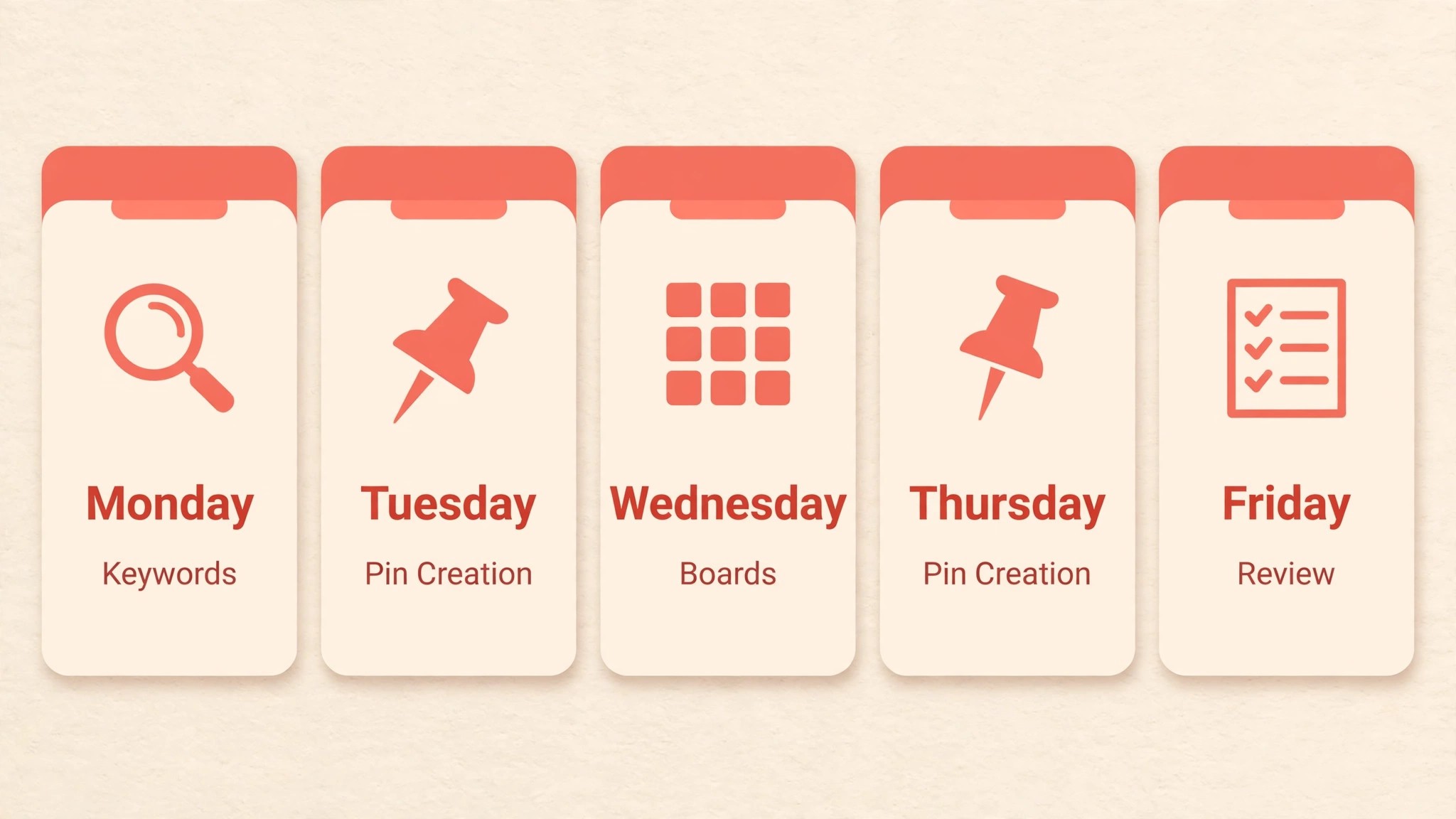
Monday is the keyword and planning day. Spend 45 minutes in the Pinterest search bar, typing the words your customers use, and writing down the suggestions Pinterest offers, because those suggestions are real searches from real users. Pick five search phrases for the week, and plan one Pin for each one. Check which of last week Pins earned the most saves and clicks, and plan a second Pin on the best performing topic, from a different angle, because a topic that worked once will work again.
Tuesday and Thursday are the creation days. Spend 60 minutes making three Pins, using a simple template with a clear title on the image, a clean photo, and your brand colours. A Pin image should be vertical, at a 2 to 3 ratio, which is 1000 by 1500 pixels, because vertical Pins take up more space in the feed and earn more clicks. Put the title on the image in large readable text, because most users scroll fast, and a Pin with no title on the image is a Pin nobody stops for. Write the Pin title and description with the search phrase in both, because the title and the description are what Pinterest reads to rank the Pin.
Wednesday is the board and website day. Spend 30 minutes adding the new Pins to the right boards, checking that every Pin links to the right page on your website, and fixing any Pin that links to a homepage when it should link to a product page. A Pin that links to the product it shows will earn clicks and sales, and a Pin that links to a homepage will earn a bounce, because the shopper has to search again for the product they just saw. Check your website too, and confirm every product page has a clear photo, a price, and a way to buy, because a Pin that brings a visitor to a weak page wastes the click.
Friday is the review day. Spend 30 minutes in Pinterest analytics, looking at impressions, saves, and outbound clicks for the week, and writing down the top three Pins and the bottom three. Plan next week around the top three, and stop repeating the format of the bottom three. Spend 15 minutes engaging, by saving a few Pins from other creators in your trade, and by replying to any comments on your Pins, because engagement tells Pinterest the account is active.
| Day | Task | Time |
|---|---|---|
| Monday | Keyword research, plan five Pins, review last week | 45 minutes |
| Tuesday | Create and publish three Pins | 60 minutes |
| Wednesday | Add Pins to boards, check links, fix product pages | 30 minutes |
| Thursday | Create and publish three Pins | 60 minutes |
| Friday | Review analytics, engage with other creators | 45 minutes |
| Weekly total | Six new Pins, keywords, boards, and review | About 3 hours |
Pin Types That Earn Clicks and Sales
Use five Pin types, and rotate them through the month, so the account never feels repetitive. The first type is the product Pin, which shows one product, with a clear photo, the price on the Pin or in the description, and a link to the exact product page. A jeweller pins a necklace with the price and a link to the necklace page. A furniture maker pins a chair with the wood type and a link to the chair page. Product Pins earn sales, because a shopper who clicks a product Pin is a shopper who is ready to buy.
The second type is the idea Pin, which shows a finished result and the steps to get there. A bakery pins a finished cake with a short recipe in the description. A gardener pins a finished garden bed with the planting steps in the description. Idea Pins earn saves, because readers save ideas they plan to use later, and a save is the strongest signal Pinterest reads. Use real photos of real work, because stock photos earn nothing and real work earns trust.
The third type is the list Pin, which shows a collection in one image. A clothing shop pins five outfits for a weekend trip. A home store pins seven ways to style a small living room. List Pins earn clicks, because a reader who wants one item from the list will click to see them all, and a reader who wants the whole list will save it. Keep the list to five to seven items, because a longer list is hard to read on a phone, and most Pinterest users are on a phone.
The fourth type is the comparison Pin, which shows two options side by side. A paint shop pins two colours on the same wall. A kitchen store pins two knife sets with the price and the use for each. Comparison Pins earn clicks, because a shopper who is choosing between two options wants to see them together, and a Pin that helps them choose is a Pin that earns a visit. Name the best choice by situation in the description, because a shopper who gets an answer is a shopper who trusts you.
The fifth type is the seasonal Pin, which is published 45 to 60 days before the season it serves. A gift shop pins holiday gift ideas in October. A garden centre pins spring planting ideas in February. Seasonal Pins earn the most traffic of any type, because Pinterest users plan ahead, and a Pin published early will rank by the time the searching starts. Plan your seasons in advance, and publish the seasonal Pins before your competitors do, because the first Pin to rank for a seasonal search keeps the traffic all season.
Keywords, Boards, and the Search Engine
Pinterest is a search engine, and keywords are the whole game. A Pin without keywords is a Pin nobody will find, no matter how beautiful the image is. Put the main search phrase in the Pin title, because the title is the strongest signal Pinterest reads. Put the same phrase, and two or three related phrases, in the Pin description, written as a normal sentence, not as a list of hashtags, because Pinterest reads descriptions as text, and a description that reads naturally ranks better than one stuffed with keywords.
Use the search bar as your keyword tool, because it is free and it shows real searches. Type a word your customers use, and write down the suggestions Pinterest offers, because those suggestions are searches real users ran. That research is the core of a small business pinterest marketing strategy, because a Pin without the right keywords is a Pin nobody will find. Type the same word with a different ending, and write down the new suggestions, because each variation is a new search phrase to target. Check the related searches too, because Pinterest shows related phrases under the search results, and those are the phrases your competitors are targeting.
Organise your boards around keywords, not around your shop departments. A board titled Wedding Cake Ideas for a Small Ceremony will rank for wedding cake searches, and a board titled Products will rank for nothing. Write a board description for every board, using the search phrases that board serves, because board descriptions help Pinterest understand the board, and they help it rank the Pins inside it. Create a board for every product line, every customer problem, and every season you serve, and keep the board count at 8 to 12, because a focused set of boards ranks better than a scattered set of 30.
Check your keywords every month, because searches change with the seasons and with trends. A phrase that worked in spring may not work in autumn, and a phrase that nobody searched last year may be popular this year. Look at the search terms that brought visitors to your Pins in Pinterest analytics, and plan new Pins around the terms that already work, because a search term that already brings clicks is a term worth a second Pin.
Numbers to Track, and What Good Looks Like
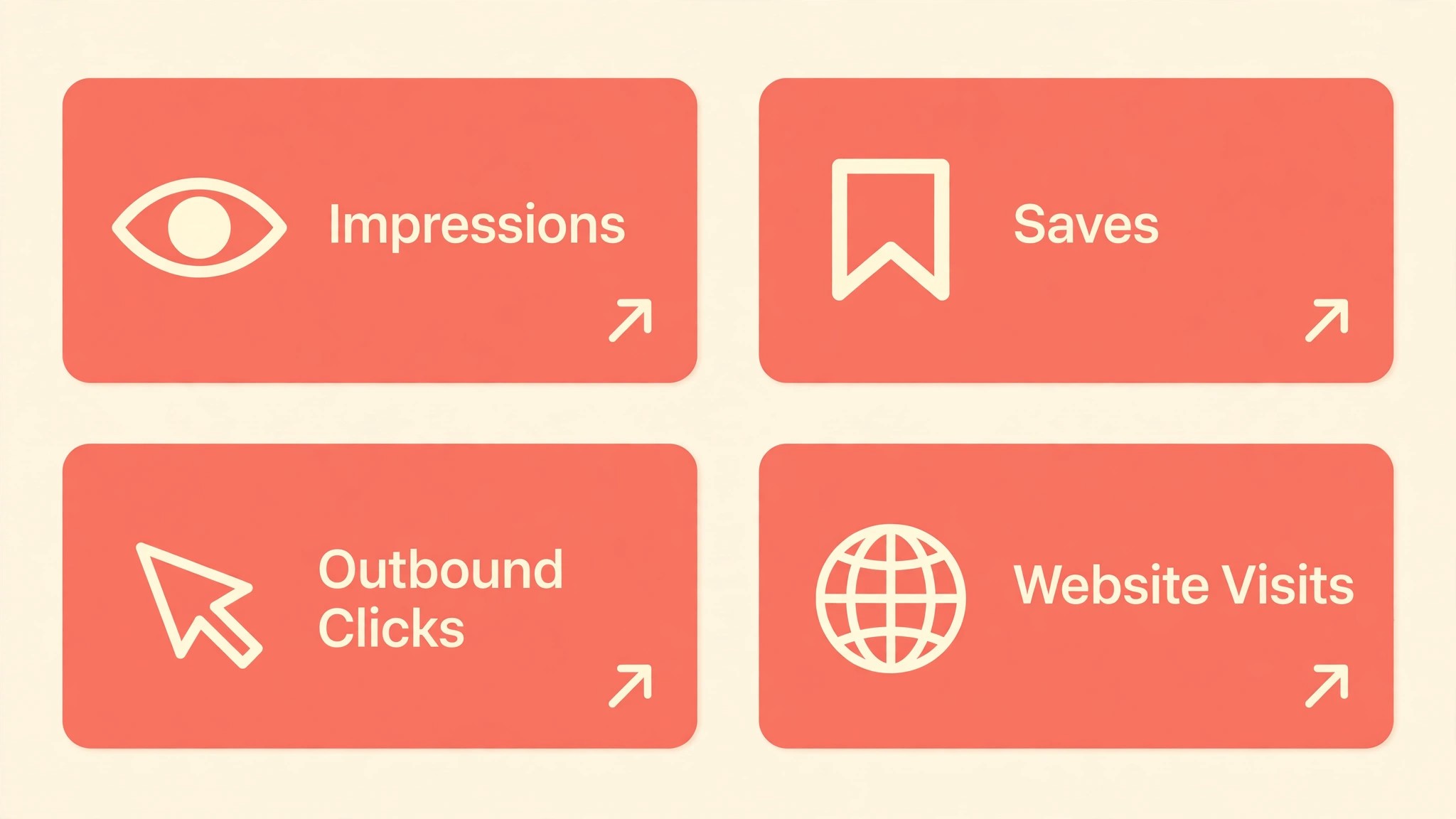
Track these numbers every Monday, and compare them week to week, not day to day, because daily numbers jump around, and weekly numbers show the trend. The numbers that matter are impressions, saves, outbound clicks, and profile visits, because those four tell you whether the strategy is working, and where it is failing.
| Metric | Where to find it | Good for a small business |
|---|---|---|
| Impressions | Pinterest analytics, impressions | Growing week to week, with a rise after each new Pin |
| Saves | Pinterest analytics, saves | At least 5 percent of impressions saved in the first 90 days |
| Outbound clicks | Pinterest analytics, outbound clicks | At least 1 percent of impressions clicking through |
| Profile visits | Pinterest analytics, profile visits | Rising week to week, with a spike after a viral Pin |
| Top Pin clicks | Pinterest analytics, top Pins | At least one Pin with more than 50 clicks per month |
| Website visits from Pinterest | Website analytics, referral traffic | At least 50 visits per month by day 90 |
| Sales from Pinterest | Ask customers, use a discount code for Pinterest | At least 1 sale per week by day 90 |
A good first month for a small business is 20 new Pins, at least one Pin with more than 1,000 impressions, a save rate above 3 percent, and the first outbound clicks to the website. A good second month is 40 Pins, at least one Pin with more than 5,000 impressions, a save rate above 5 percent, and at least 50 website visits from Pinterest. A good third month is 60 Pins, at least three Pins with more than 5,000 impressions, at least 100 website visits from Pinterest, and the first sales you can trace to a Pin.
If the numbers are below those levels, the fix is usually a clearer title on the image, a better keyword in the Pin title, or a link that goes to the product page instead of the homepage, not more Pins. A Pin that earns impressions but no saves is a Pin with a weak image, and a Pin that earns saves but no clicks is a Pin with a weak link or a weak description. Fix the image, fix the keyword, and fix the link, in that order.
Common Mistakes to Avoid
The first mistake is treating Pinterest like a social network, by posting personal photos, text only images, and links with no keywords. Pinterest is a search engine, and a Pin without a keyword is a Pin nobody will find. Every Pin needs a search phrase in the title, a description written as a normal sentence, and a link to the page the Pin shows. A Pin that does none of those three is a Pin that does no work.
The second mistake is linking every Pin to the homepage, because a shopper who clicks a product Pin and lands on a homepage has to search again, and most will not bother. Link every Pin to the exact page it shows, whether that is a product page, a recipe page, or a guide page, because a Pin that lands on the right page earns a sale, and a Pin that lands on the homepage earns a bounce.
The third mistake is publishing all your Pins at once and then going silent, because Pinterest rewards steady publishing over bursts. A burst of 20 Pins in one day, followed by a month of silence, tells the platform the account is abandoned, and the Pins stop ranking. Publish 5 to 7 Pins a week, every week, for 90 days, and the account will keep growing long after the burst accounts have gone quiet.
The fourth mistake is using horizontal images, because Pinterest is a vertical platform, and a horizontal Pin takes up less space in the feed and earns fewer clicks. Use vertical images at a 2 to 3 ratio, which is 1000 by 1500 pixels, with the title on the image in large readable text, because a vertical Pin with a clear title is a Pin a scroller will stop for, and a horizontal Pin with no title is a Pin a scroller will pass.
The fifth mistake is ignoring the seasons, because Pinterest users plan 45 to 60 days ahead, and a Pin published during the season is too late. Publish holiday Pins in October, spring Pins in February, and wedding Pins in January, because the Pin needs time to rank before the searching starts. A small business pinterest marketing strategy that plans seasons in advance will be found when the searching starts, and a business that publishes during the season will be found by nobody.
The sixth mistake is never checking the numbers, because Pinterest analytics show exactly which Pins work and which do not, and a business that never looks at them keeps repeating the format that fails. Check the numbers every Monday, plan next week around the top three Pins, and stop repeating the format of the bottom three, because the data is the strategy.
Frequently Asked Questions
How often should a small business post on Pinterest?
Publish 5 to 7 new Pins a week, spread across the week, with fresh Pins rather than the same image repeated. A steady flow of new Pins keeps the account fresh in search, and a burst followed by silence tells the platform the account is abandoned. Six Pins a week for 90 days builds a library of more than 70 Pins, which is a real asset.
How long does Pinterest marketing take to work for a small business?
Expect the first impressions in the first week, the first saves in the first month, and the first website visits and sales in 60 to 90 days. That is the normal pace for a small business pinterest marketing strategy, and a good first month is 20 new Pins, at least one Pin with more than 1,000 impressions, and a save rate above 3 percent. A good third month is 60 Pins, at least 100 website visits from Pinterest, and the first sales you can trace to a Pin.
Do small businesses need Pinterest ads to get results?
No. Organic Pins can rank in search and bring traffic for months without any ad spend, because about 96 percent of searches are unbranded and users are looking for ideas, not for brands they already know. Ads can help a good Pin reach more people faster, and brands running Shopping ads see 15 percent higher return on ad spend, but ads are not needed to start, and a Pin that does not work organically will not work as an ad either.
What size should Pinterest Pin images be?
Use vertical images at a 2 to 3 ratio, which is 1000 by 1500 pixels, with the title on the image in large readable text. Vertical Pins take up more space in the feed and earn more clicks, while horizontal Pins take up less space and earn fewer. Put the title on the image, because most users scroll fast, and a Pin with no title on the image is a Pin nobody stops for.
How do I find keywords for Pinterest?
Use the Pinterest search bar, because it is free and it shows real searches. Type a word your customers use, and write down the suggestions Pinterest offers, because those suggestions are searches real users ran. Check the related searches under the results too, and check Pinterest analytics each month for the search terms that already bring visitors to your Pins, because those terms are worth a second Pin.
Verdict
A small business pinterest marketing strategy works when the business treats Pinterest as a search engine, not a social network, and publishes Pins that answer the searches its customers are already running. Start with a business account, claim your website, and create 8 to 10 boards organised the way a shopper thinks. Publish 5 to 7 vertical Pins a week, with the search phrase in the title and the description, and a link to the exact page the Pin shows.
Plan your seasons 45 to 60 days ahead, because Pinterest users plan before they buy, and a Pin published early will rank by the time the searching starts. Measure impressions, saves, outbound clicks, and website visits every Monday, and fix the image, the keyword, or the link when the numbers are low. Expect saves in the first month, website visits in the second, and sales in the third, and keep pinning through the quiet weeks. A Pin can bring traffic for months, and a library of 60 good Pins will still be selling for you long after a social post has disappeared.