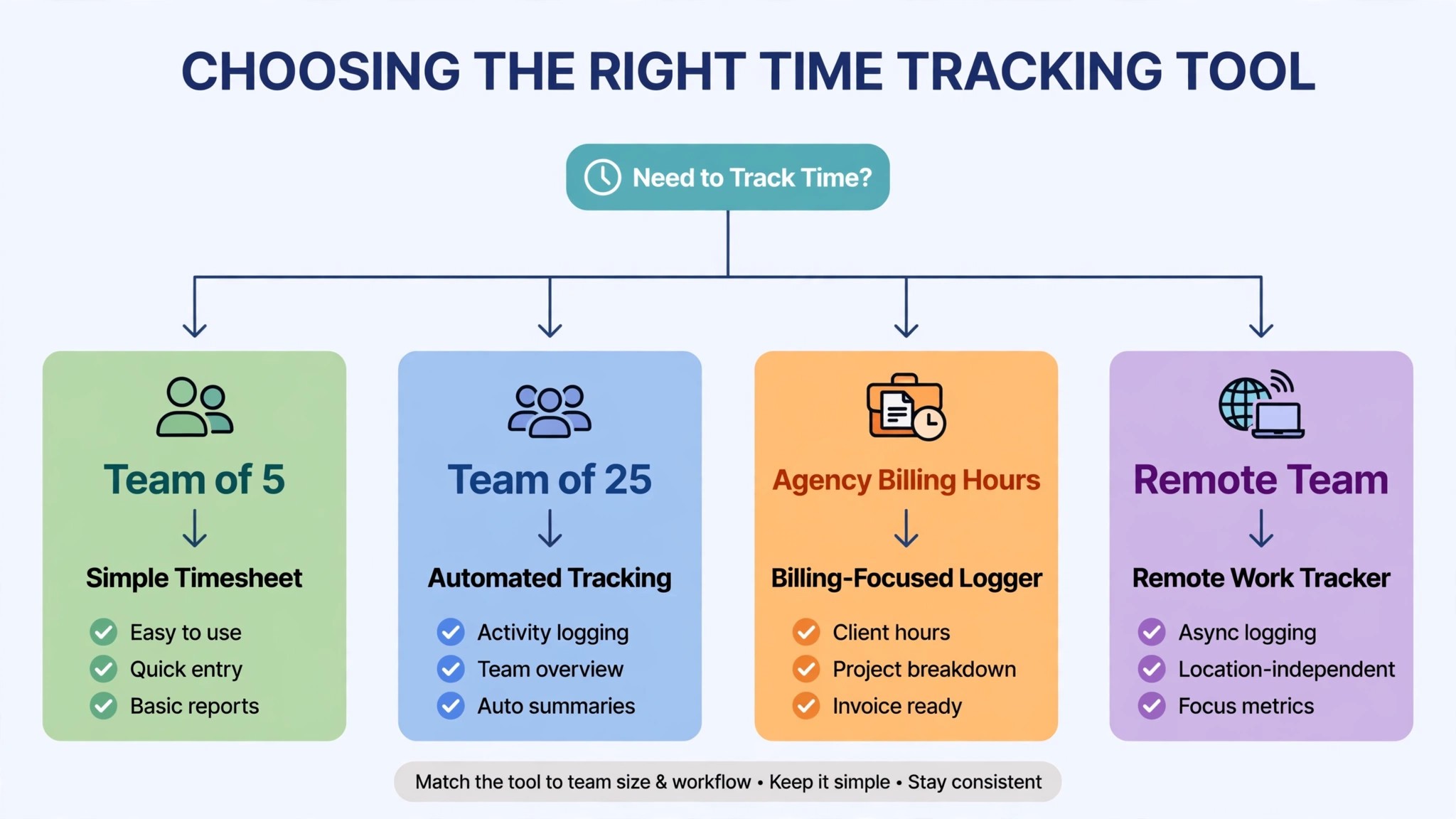
A five person team pays 19.95 dollars a month on the cheapest paid plan in this guide, and 270 dollars a month on the dearest, for the same five timers. The difference is not the timer. It is the pricing shape. One tool charges per user, one charges a flat fee for the first 30 users, and one charges a base fee before the first user clocks in. Time tracking software pricing for small business is decided by that shape, and by the free plan underneath it, more than by the headline price.
Most owners compare the per user price and stop there. A plan at 3.99 dollars per user looks cheap next to one at 9 dollars per user, until the cheap plan caps its free tier at 5 users and the dear plan covers 3 users free, and the team of 4 pays nothing on one and 36 dollars a month on the other. A flat plan at 29 dollars a month looks dear for a team of 3, and cheap for a team of 25, because the price does not move when you add a person.
That shape is the first thing time tracking software pricing for small business asks you to check.
Prices in this guide are US list prices checked in November 2026, per user per month unless noted, on annual billing, before tax. The monthly billing rate is shown beside it where it is published, because monthly billing runs about 17 to 20 percent higher. Where a vendor charges a base fee plus a per user fee, both parts are shown, because the base fee is the part most buyers miss.
The ten tools in this guide are Clockify, Toggl Track, Harvest, Hubstaff, Time Doctor, Everhour, QuickBooks Time, Connecteam, actiTIME and DeskTime. They cover the range from a free timer for a team of 5 to a monitoring platform with screenshots and payroll, from a flat fee for 30 users to a base fee plus a per user fee. The table below gives the free plan, the entry paid price, what you get, and the per user cost, for each one.
Time Tracking Software Pricing at a Glance
The table below is the short answer.
| Tool | Free plan | Entry paid price | What you get | Per user cost |
|---|---|---|---|---|
| Clockify | Free for up to 5 users | Basic 3.99 dollars, 4.99 monthly | Unlimited projects, clients and tracking | 3.99 dollars per user |
| Toggl Track | Free for up to 3 users | Starter 9 dollars, 12 monthly | Billable rates, project estimates, team scheduling | 9 dollars per user |
| Harvest | Free for 1 seat and 2 projects | Teams 9 dollars per seat, 11 monthly | Time to invoice, budgets, expenses | 9 dollars per seat, plus usage fees on Flex billing |
| Hubstaff | 14 day trial only | Starter 4.99 dollars, 7 monthly | Time tracking, screenshots, payroll | 4.99 dollars per seat, 2 seat minimum |
| Time Doctor | 14 day trial only | Basic 6.67 dollars, 8 monthly | Screenshots, activity monitoring, payroll | 6.67 dollars per user |
| Everhour | Free for up to 5 seats | Team 8.50 dollars, 10 monthly | Budgets inside Asana, Trello and ClickUp | 8.50 dollars per seat, 5 seat minimum |
| QuickBooks Time | 30 day trial only | Premium 20 dollars base plus 10 dollars per user | GPS clock in, scheduling, QuickBooks payroll | 10 dollars per user plus base fee |
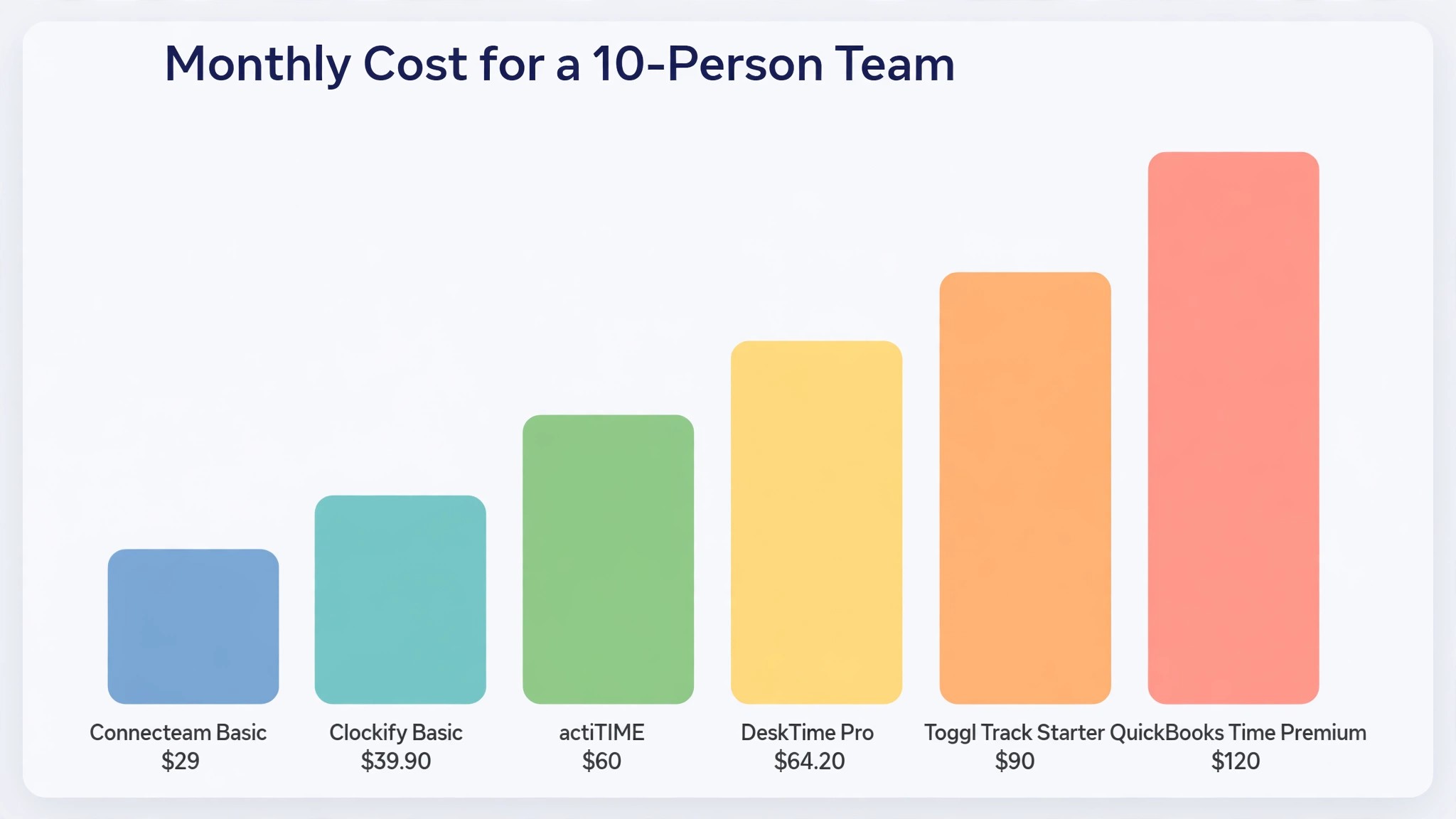
| Connecteam | Free for up to 10 users | Basic 29 dollars a month, 35 monthly | Time tracking, scheduling and communication, first 30 users | Flat 29 dollars a month, not per user |
| actiTIME | Free for up to 3 users | 6 dollars, 7 monthly | Approvals, budgets, invoicing, PTO tracking | 6 dollars per user |
| DeskTime | 14 day trial only | Pro 6.42 dollars, 7 monthly | Passive tracking, productivity reports | 6.42 dollars per user |
Read the free plan column first, because a free plan that covers your whole team costs nothing and a paid plan that covers the same team costs hundreds of dollars a year. Clockify covers 5 users free, Connecteam covers 10 users free, and Toggl Track covers 3 users free. A team of 4 pays nothing on Clockify and 36 dollars a month on Toggl Track Starter, for the same four timers.
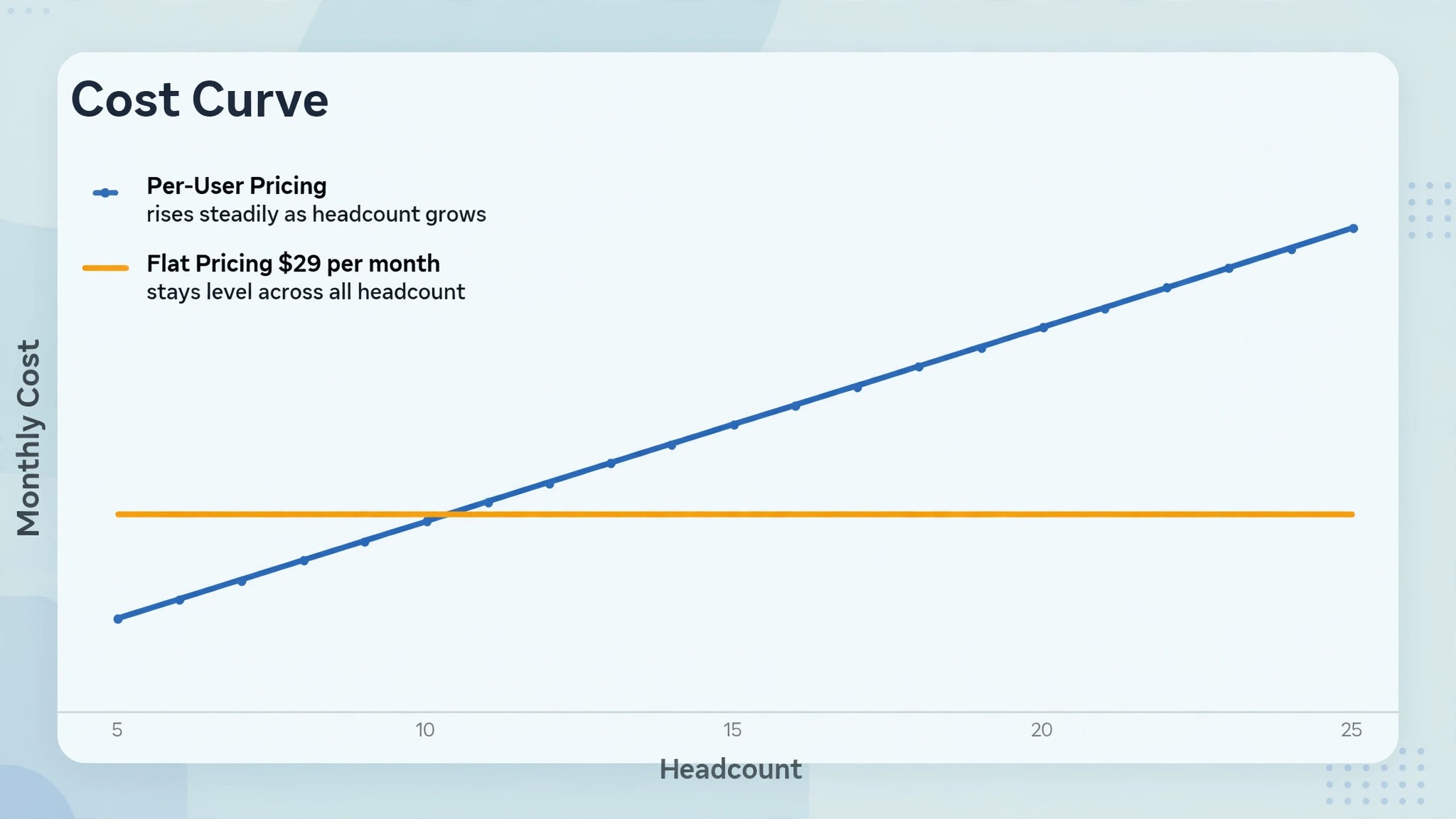
Read the pricing shape second, because a per user price grows with headcount and a flat price does not. A 25 person team pays 99.75 dollars a month on Clockify Basic, 225 dollars a month on Toggl Track Starter, and 29 dollars a month on Connecteam Basic. The flat plan is the cheapest at 25 users by a wide margin, and the dearest at 3 users, because the price does not fall when the team is small.
That flip is the core of time tracking software pricing for small business, and it is why the team size decides the ranking.
Clockify
Clockify is the budget pick in this guide, and its pricing is a per user price with the most generous free tier. Free covers up to 5 users, with unlimited projects, clients and tracking. Basic costs 3.99 dollars per user per month billed annually, or 4.99 dollars billed monthly. Standard costs 5.49 dollars per user per month billed annually, and adds invoicing and timesheet approvals. Pro costs 7.99 dollars per user per month billed annually, and adds more features.
Worked cost for a team of 5 people. Free covers all 5 users, so the cost is nothing a month. A team of 10 people pays 39.90 dollars a month on Basic at 3.99 dollars per user, which is 478.80 dollars a year. A team of 10 people on Standard pays 54.90 dollars a month, which is 658.80 dollars a year, and the extra cost buys invoicing and approvals. The per user cost is 3.99 dollars, which is the lowest paid per user price in this guide.
Clockify fits a budget conscious team that wants solid tracking for free or for a low per user price. It does not fit a team that needs monitoring with screenshots, because Clockify does not sell surveillance features.
Toggl Track
Toggl Track is the pick for a team that wants a polished timer and no surveillance, and its pricing is a per user price with a small free tier. Free covers up to 3 users. Starter costs 9 dollars per user per month billed annually, or 12 dollars billed monthly, and adds billable rates, project time estimates and team scheduling. Premium costs 16 dollars per user per month billed annually, or 24 dollars billed monthly, and adds more features.
Worked cost for a team of 5 people. Free covers 3 users, so the team needs Starter for 5 users at 9 dollars each, which is 45 dollars a month, or 540 dollars a year. A team of 10 people pays 90 dollars a month on Starter, which is 1,080 dollars a year. A team of 3 people pays nothing a month, because the free plan covers them. The per user cost is 9 dollars, which is more than twice the Clockify price, and the extra cost buys the timer experience, not more tracking.
Toggl Track fits a small knowledge work team that bills client hours and wants a timer that is pleasant to use. It does not fit a team that needs screenshots or GPS, because Toggl Track does not sell those features.
Harvest
Harvest is the pick for agencies that want tracked hours to turn into invoices, and its pricing is a per seat price with a small free tier. Free covers 1 seat and 2 projects. Teams costs 9 dollars per seat per month billed annually, or 11 dollars billed monthly. Enterprise costs 14 dollars per seat per month billed annually, or 17.50 dollars billed monthly. Harvest was acquired by Bending Spoons in July 2025, and the shift to Flex usage based billing means activity linked fees sit on top of the seat price for some customers.
Worked cost for an agency with 5 people that bills 400 hours a month. Free covers 1 seat, so the agency needs Teams for 5 seats at 9 dollars each, which is 45 dollars a month, or 540 dollars a year. The seat price is the floor, not the total, because Flex billing can add usage fees on top, and some long time users have reported large renewal increases. Check the Flex terms before you commit, because the renewal can rise without a single seat being added.
Harvest fits a consultancy or agency that bills clients by the hour and wants invoicing close to the timer. It does not fit a team that wants a fixed price, because the Flex billing makes the total harder to predict.
Hubstaff
Hubstaff is the pick for remote and field teams that need proof of work for clients or payroll, and its pricing is a per seat price with no free plan. Starter costs 4.99 dollars per seat per month billed annually, or 7 dollars billed monthly, with a 2 seat minimum. Grow costs 7.50 dollars per seat per month billed annually. Team costs 10 dollars per seat per month billed annually. There is a 14 day free trial, and Hubstaff sells six add ons at 1.67 dollars to 3.33 dollars per seat.
Worked cost for a team of 5 remote workers. Starter costs 4.99 dollars per seat, which is 24.95 dollars a month, or 299.40 dollars a year. A team of 10 people pays 49.90 dollars a month on Starter, which is 598.80 dollars a year. Add ons sit on top of that price, so a team that buys two add ons at 2 dollars each pays 4 dollars more per seat, which is 20 dollars more a month for a team of 5. The per seat cost is low, and the add ons are where the bill grows.
Hubstaff fits a remote team that needs screenshots, activity levels and payroll in one product. It does not fit a team that wants a free plan, because there is none, and it does not fit a team that dislikes monitoring, because screenshots are the core of the product.
Time Doctor
Time Doctor is the pick for a team that needs detailed productivity evidence, and its pricing is a per user price with no free plan. Basic costs 6.67 dollars per user per month billed annually, or 8 dollars billed monthly, and includes screenshots and activity monitoring. Standard costs 11.67 dollars per user per month billed annually, and adds payroll and scheduling. Premium costs 16.70 dollars per user per month billed annually, and adds video screen recording. There is a 14 day free trial.
Worked cost for a team of 5 people. Basic costs 6.67 dollars per user, which is 33.35 dollars a month, or 400.20 dollars a year. A team of 10 people pays 66.70 dollars a month on Basic, which is 800.40 dollars a year. Time Doctor charges 3 dollars per user for its AI add ons, and 200 dollars a month for each HRIS or payroll integration, so a team that buys both pays much more than the sticker price. Check the add on prices before you commit, because they are the hidden part of the bill.
Time Doctor fits a distributed team that needs auditable hours and productivity analytics. It does not fit a team that wants a free plan, because there is none, and it does not fit a team that wants a simple timer, because the monitoring is the product.
Everhour
Everhour is the pick for a team that lives inside a project tool, and its pricing is a per seat price with a 5 seat minimum. Free covers up to 5 seats, with limited features and no integrations. Team costs 8.50 dollars per seat per month billed annually, or 10 dollars billed monthly, and includes every feature. The timers appear inside Asana, Trello, ClickUp, Jira, Basecamp and Linear, so hours attach to tasks without opening a second app.
Worked cost for a team of 5 people. Free covers 5 seats, but without the integrations that make Everhour worth using, so the team needs Team at 8.50 dollars per seat, which is 42.50 dollars a month, or 510 dollars a year. A team of 2 people still pays for 5 seats, which is 42.50 dollars a month, because the minimum is 5 seats. A team of 10 people pays 85 dollars a month, which is 1,020 dollars a year. The 5 seat minimum is the catch, and it punishes a team of 2 or 3.
Everhour fits a team that already works in Asana or Jira and wants budgets and estimates inside the task. It does not fit a team of 2 people, because the minimum makes it dear, and it does not fit a team that does not use a project tool, because the integrations are the product.
QuickBooks Time
QuickBooks Time is the pick for a business already running QuickBooks that wants time flowing into payroll, and its pricing is a base fee plus a per user fee. Premium costs 20 dollars a month base plus 10 dollars per user per month, and Elite costs 40 dollars a month base plus 12 dollars per user per month. The per user fee rose from 8 dollars on July 1, 2026, so the price is higher than older guides show. QuickBooks Time also requires a QuickBooks Online account, which is billed separately.
Worked cost for a team of 5 people. Premium costs 20 dollars base plus 50 dollars for 5 users, which is 70 dollars a month, or 840 dollars a year. A team of 10 people pays 20 dollars base plus 100 dollars for 10 users, which is 120 dollars a month, or 1,440 dollars a year. A team of 25 people pays 20 dollars base plus 250 dollars for 25 users, which is 270 dollars a month. The base fee means the cost per person is 14 dollars at 5 users, and 10.80 dollars at 25 users, because the base fee spreads across more people.
QuickBooks Time fits a business that runs payroll and accounting on QuickBooks, because GPS stamped clock in, geofencing and scheduling reach the payroll run without a file in between. It does not fit a business that does not use QuickBooks, because the product requires it.
Connecteam
Connecteam is the flat price pick in this guide, and its pricing is per hub, not per user. The Small Business Plan is free for life for up to 10 users, with full access to all hubs. Basic costs 29 dollars a month billed annually, or 35 dollars billed monthly, per hub, covering the first 30 users. Advanced costs 49 dollars a month, and Expert costs 99 dollars a month. One hub buys one set of features, so a team that needs Operations plus HR pays for two hubs.
Worked cost for a team of 5 people. Free covers all 5 users, so the cost is nothing a month. A team of 10 people also pays nothing a month on the free plan. A team of 25 people pays 29 dollars a month on Basic, which is 348 dollars a year, and the price does not rise when the team grows from 11 to 30 users. A team of 10 people on Clockify Basic pays 39.90 dollars a month, so Connecteam is cheaper at 10 users, and much cheaper at 25 users.
Connecteam fits a frontline or field team that wants scheduling, time tracking and communication in one app, and that grows past 10 users. It does not fit a team that wants a single price for the whole platform, because each hub is priced separately.
actiTIME
actiTIME is the pick for a project team that bills or costs hours, and its pricing is a single paid plan with every feature included. Free covers up to 3 users, without approvals, overtime, the QuickBooks integrator or the Chrome extension. The paid plan costs 6 dollars per user per month billed annually, or 7 dollars billed monthly, for 1 to 40 users, and 5 dollars per user per month billed annually for 41 to 200 users. There is a 30 day free trial.
Worked cost for a team of 5 people. Free covers 3 users, so the team needs the paid plan for 5 users at 6 dollars each, which is 30 dollars a month, or 360 dollars a year. A team of 10 people pays 60 dollars a month, which is 720 dollars a year. A team of 50 people pays 5 dollars per user, which is 250 dollars a month. The price falls as the team grows, which is rare in this guide, and the single plan means there is no tier to climb when you need a feature.
actiTIME fits a project team that wants approvals, budgets, invoicing and PTO tracking in one plan, without paying more for the next tier. It does not fit a team that wants a free plan for more than 3 users, because the free tier is small.
DeskTime
DeskTime is the pick for an office or hybrid team that wants passive, always on time data, and its pricing is a per user price with no free plan. Pro costs 6.42 dollars per user per month billed annually, or 7 dollars billed monthly. Premium costs 9.17 dollars per user per month billed annually, or 10 dollars billed monthly. There is a 14 day free trial. DeskTime tracks time passively, so the team does not start and stop a timer.
Worked cost for a team of 5 people. Pro costs 6.42 dollars per user, which is 32.10 dollars a month, or 385.20 dollars a year. A team of 10 people pays 64.20 dollars a month on Pro, which is 770.40 dollars a year. Premium costs 9.17 dollars per user, which is 45.85 dollars a month for a team of 5, and 91.70 dollars a month for a team of 10. The passive tracking means the data is complete, because no one forgets to start the timer.
DeskTime fits an office team that wants productivity reports without asking staff to log time by hand. It does not fit a team that wants a free plan, because there is none, and it does not fit a field team, because the product is built for desk work.
What the Per User Price Hides in Time Tracking Software Pricing for Small Business
What the Per User Price Hides
The per user price is only the start of time tracking software pricing for small business, and the three costs below are the ones that move the total.
The per user price is the sticker, not the total. Base fees, seat minimums, add ons and free plan caps are where the money goes. QuickBooks Time charges a 20 dollar base fee before the first user clocks in, so a team of 5 pays 14 dollars per person, not 10 dollars. Everhour charges a 5 seat minimum, so a team of 2 pays for 5 seats. Hubstaff sells add ons at 1.67 dollars to 3.33 dollars per seat, so a team that buys two add ons pays 4 dollars more per seat.
Free plan caps are the second hidden cost. A team of 6 pays nothing on Connecteam and 23.94 dollars a month on Clockify Basic, for the same six timers. Count your team before you choose, and pick the plan that covers your team today and the team you will have in six months, not the team you had last year.
Add ons are the third hidden cost, and they are the hardest to spot. Time Doctor charges 3 dollars per user for its AI add ons, and 200 dollars a month for each HRIS or payroll integration. Toggl Track charges 2 dollars per user for Time Off Pro, and 5 dollars for Capacity Management. A team that buys the add ons it needs can pay twice the sticker price, so list the add ons before you sign up.
Cheapest for Each Use Case
| Use case | Cheapest fit | Monthly cost for a team of 5 |
|---|---|---|
| Team of 5 or fewer, free plan | Connecteam free, or Clockify free | Nothing a month |
| Team of 10, lowest paid price | Connecteam Basic | 29 dollars a month |
| Team of 10, lowest per user price | Clockify Basic | 39.90 dollars a month |
| Freelancer or team of 3, best timer | Toggl Track free, or Starter | Nothing to 45 dollars a month |
| Agency billing hours by the hour | Harvest Teams | 45 dollars a month |
| Remote team needing proof of work | Hubstaff Starter | 24.95 dollars a month |
| Team needing productivity evidence | Time Doctor Basic | 33.35 dollars a month |
| Team living in Asana or Jira | Everhour Team | 42.50 dollars a month |
| Field team already on QuickBooks | QuickBooks Time Premium | 70 dollars a month |
| Project team billing hours, full features | actiTIME | 30 dollars a month |
| Office team wanting passive tracking | DeskTime Pro | 32.10 dollars a month |
Use this table as the shortlist for time tracking software pricing for small business, then work out the total for your team size before you choose. Read the table by use case, not by price alone. The cheapest tool for a team of 25 is not the cheapest tool for a team of 3, because the pricing shape flips the ranking as the team grows.
Frequently Asked Questions
Is there a truly free time tracking tool?
Yes. Clockify is free for up to 5 users, Connecteam is free for up to 10 users, Toggl Track is free for up to 3 users, Harvest is free for 1 seat, Everhour is free for up to 5 seats, and actiTIME is free for up to 3 users. Those free plans cover real work for a small team.
How much does time tracking software cost per month?
A small team should expect to pay nothing a month on a free plan, 19.95 dollars to 45 dollars a month for a team of 5 on a paid plan, and 29 dollars to 120 dollars a month for a team of 10. Per user prices run from 3.99 dollars to 9 dollars a month on annual billing, and monthly billing runs about 17 to 20 percent higher. A team of 5 should budget about 25 dollars to 70 dollars a month, depending on the features it needs.
That range is the honest answer to time tracking software pricing for small business, because it includes the base fees and add ons most guides leave out.
Which time tracking tool is cheapest for a small business?
It depends on the team size. For a team of 5 or fewer, Connecteam and Clockify cost nothing a month on their free plans. For a team of 10, Connecteam Basic at 29 dollars a month is the cheapest paid plan, and Clockify Basic at 39.90 dollars a month is the cheapest per user plan. For a team of 25, Connecteam Basic at 29 dollars a month is still the cheapest, because the flat price does not rise with headcount.
At that size, time tracking software pricing for small business comes down to the pricing shape, not the per user rate.
Do free plans cover real work?
Yes, for a small team. Clockify free covers 5 users with unlimited projects, and Connecteam free covers 10 users with full access to all hubs. Those two free plans cover a real small business. Toggl Track free covers 3 users, and Harvest free covers 1 seat, so they cover a freelancer or a very small team.
Which time tracking tool is best for a small business that bills clients?
Harvest is best for a firm that bills clients by the hour, because time tracking, budgets and invoicing sit in the same product. Everhour is best for a team that bills inside Asana or Jira, because the budgets sit inside the task. Clockify Standard adds invoicing at 5.49 dollars per user a month, which is the cheapest way to get invoicing in a time tool.
Verdict
For most small businesses, the best value is Connecteam free for a team of up to 10 users, or Clockify free for a team of up to 5 users. Both cover real work at no monthly cost, and the paid upgrade can wait until the team grows past the free cap. A team that needs a paid plan should look at Connecteam Basic at 29 dollars a month, because the flat price covers the first 30 users and does not rise when you add a person.
For a team that bills client hours, Harvest Teams at 9 dollars per seat a month is the best pick, and that is the simplest read on time tracking software pricing for small business for an agency, because the invoices it produces save more time than the plan costs. For a team that wants the cheapest per user price, Clockify Basic at 3.99 dollars per user a month is the best pick, because no other tool in this guide charges less per user.
The right tool is the one that fits the team size, the pricing shape and the features at the size you will be in six months, not at the entry price, because the entry price buys a free cap or a per user rate that may not cover a real team. Work out the total for your team size, including base fees and add ons, and the cheapest fit will be clear.
That team size test is the last step in time tracking software pricing for small business, and it is the one that saves the most money.