
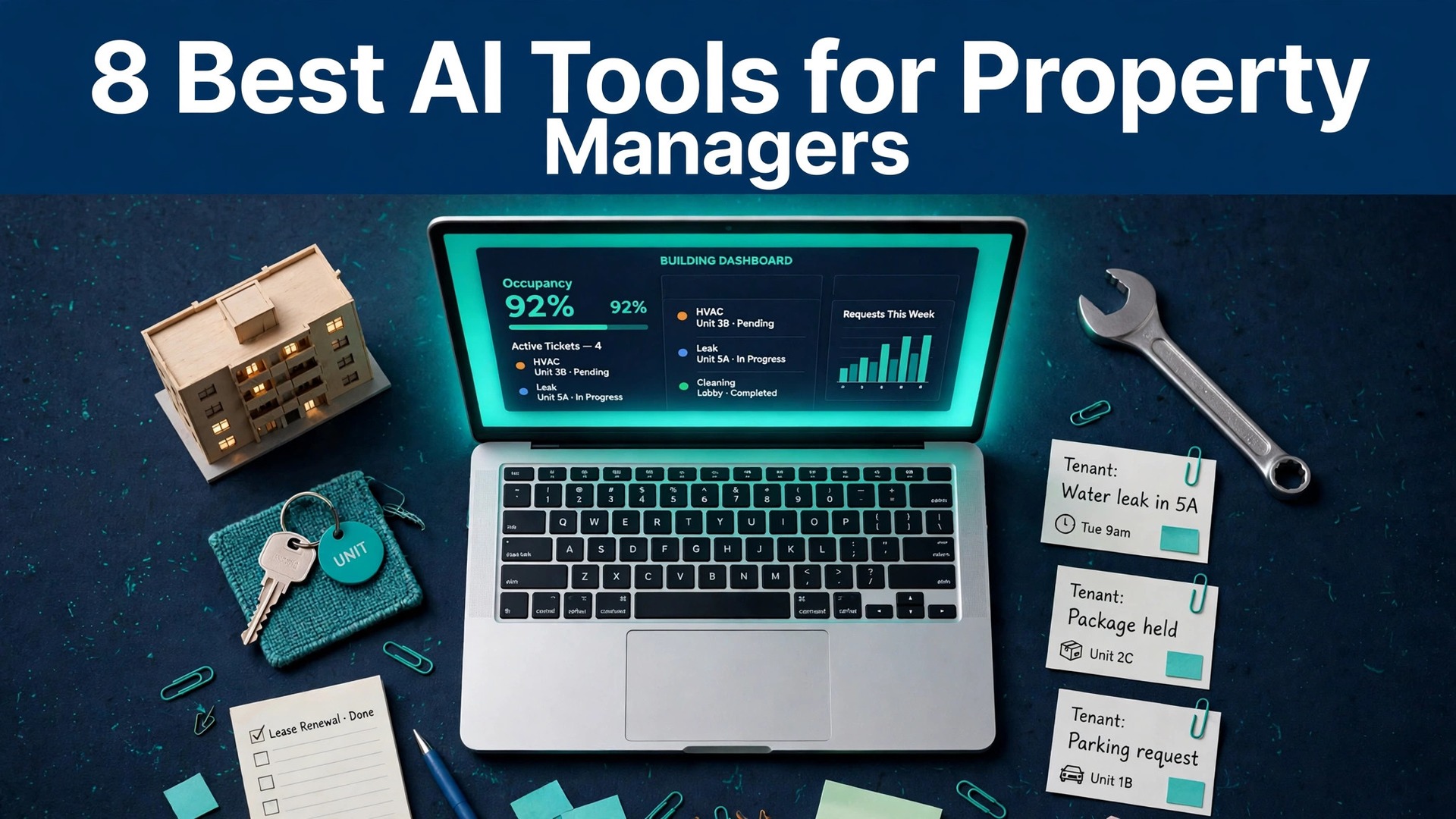
Buildium asked more than 930 property management professionals in May 2026, and a third of companies said they already use AI or automation. Adoption among property management companies jumped from 20 percent to 58 percent in a single year, while only 8 percent have fully automated any process. That gap is the opportunity. The best ai tools for property managers do not replace the manager. They answer the 11pm tenant message, triage the maintenance request, chase the late rent and schedule the showing, so the manager spends the day on owners, vendors and the units that actually need a human.
This guide compares the best ai tools for property managers on real prices, the job each one does best and the catch that only shows up after the trial. Prices come from vendor pricing pages and independent roundups checked in November 2026, and where a vendor sells by quote only, this guide says so instead of guessing. Start with the shortlist table, then read the reviews that match your portfolio size and your biggest weekly headache.
The Quick Shortlist
The table below matches each common management job to the single tool that handles it best. Use it to narrow the best ai tools for property managers to two or three candidates before you read the full reviews. Prices are monthly list prices unless noted, and annual billing is usually cheaper than paying month to month.
| Job | Best tool | Why it wins |
|---|---|---|
| All in one platform with AI inside | AppFolio | The most mature AI feature set in the category, Core from 1.49 dollars a unit a month |
| Small to mid sized portfolios | Buildium | AI Assistant on the Essential plan, from 62 dollars a month |
| Modern platform with an AI receptionist | DoorLoop | AI Assistant plus an agent that answers residents, from 199 dollars a month minimum |
| Leasing and showings | Showdigs | An AI agent that answers prospects and books tours, from 1.20 dollars a unit a month |
| Maintenance triage and coordination | Property Meld | AI triage that routes every request to the right vendor, from 1.60 dollars a unit a month |
| After hours maintenance calls | Latchel | A 24 hour maintenance line with AI triage, from 99 dollars a month |
| Independent landlords | TurboTenant | Free tier plus AI lease generation, premium from 17 dollars a month |
| Multifamily leasing at scale | EliseAI | AI leasing and resident communication built for large portfolios, quote only |
What AI Actually Does in Property Management
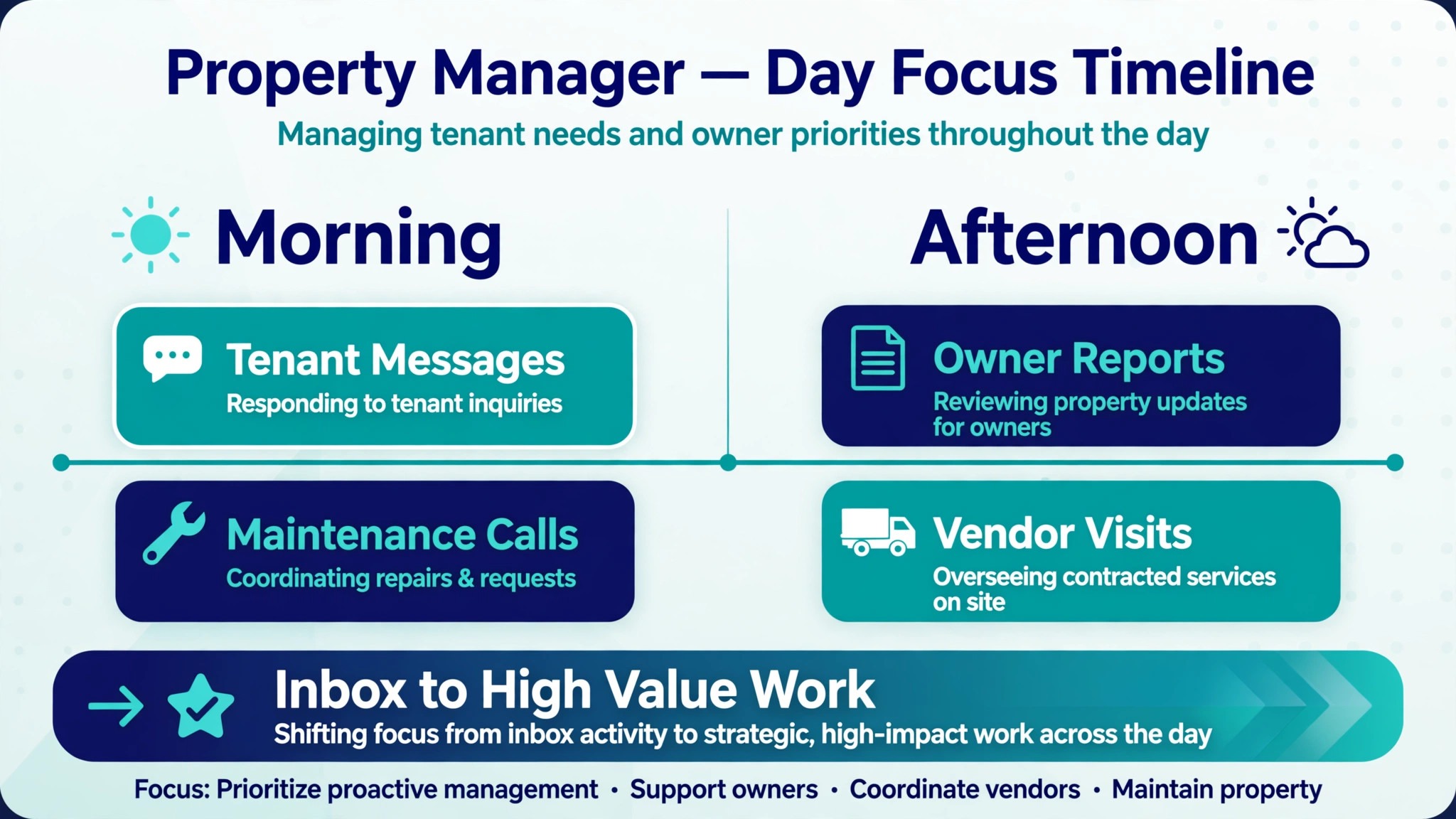
The highest return AI jobs in property management are leasing, maintenance triage and tenant communication, and it helps to understand each one before you buy. Leasing AI answers the prospect inquiry within seconds, qualifies the caller and books the showing, which matters because the prospect who waits an hour for a reply has already toured another unit. Maintenance triage AI reads the tenant’s message, works out whether it is an emergency, and routes it to the right vendor with the right priority, which cuts the emergency callback rate and stops a leaking pipe becoming a flooded unit.
Tenant communication AI handles the routine questions, the rent reminders and the portal messages, which is the volume that buries a manager’s inbox every Monday.
The numbers behind the shift are strong. Portfolios using AI powered screening tools report vacancy time down by 35 percent and bad debt write offs down by 22 percent, according to industry reporting, while maintenance coordination through AI cuts emergency callback rates by 41 percent. Rent optimization algorithms add 4 to 7 percent in revenue per unit within the first year. Those figures come from vendor and industry reports, so treat them as direction rather than a guarantee, but the pattern is consistent. The portfolios that adopt AI early fill units faster, fix things sooner and keep owners happier.
The trap is buying AI that does not connect to your system of record. An AI leasing agent that books showings but never writes to your property management software creates double entry. An AI maintenance tool that triages requests but cannot reach your vendors creates a second inbox. The best ai tools for property managers are the ones that write back to the platform you already run, or that are the platform itself. That is why the first four tools on this list are full platforms with AI inside, and the rest are specialists that integrate with them.
How We Chose the Best AI Tools for Property Managers
A tool earned a place here only if it does a real management job in 2026, not if it added an AI button to an old product. The best ai tools for property managers prove their value in the first month, not in a demo. We judged each one on five things that decide whether a manager keeps paying after the trial.
First, the job it does, from answering a tenant at 11pm to triaging a maintenance request to screening an applicant, because a tool that does one job well beats a platform that does five jobs poorly. Second, the starting price a manager can actually buy, including whether a free plan exists and what the paid plan really includes.
Third, where it fits in the portfolio, because a tool that writes back to your property management software saves more time than one that needs a new tab and a new login. Fourth, the quality of its AI output, from showing bookings that actually happen to maintenance triage a vendor can trust. Fifth, the catch, from per unit minimums that quietly set a floor on the bill to quote only pricing that hides the real cost until the sales call.
| Check before you buy | What to ask | Why it matters |
|---|---|---|
| Unit minimum | How many units before the price starts | A 50 unit minimum means a 30 unit portfolio pays for 50 |
| Per unit or flat rate | Does the bill grow with every door you add | Stops a 62 dollar plan becoming a 400 dollar plan |
| PMS integration | Does it write back to AppFolio, Buildium or DoorLoop | No write back means double entry forever |
| After hours coverage | Who answers the 11pm call, and what does it cost | A tool that sleeps at night misses the emergencies |
| Emergency triage accuracy | How does it decide what is urgent | A missed emergency is a flooded unit and a lost owner |
| Contract terms | Month to month, or annual only | Quote only tools often mean annual contracts |
The 8 Tools, Reviewed One by One
1. AppFolio
Starting price Core from 1.49 dollars a unit a month. 50 unit minimum and minimum spend apply. Best for All in one platform with AI inside. Watch out The 50 unit minimum and the minimum spend mean a small portfolio pays more than the per unit headline suggests.
AppFolio is the best overall AI property management platform, and it earns that position with the most mature AI feature set in the category. Its leasing AI assistant, Lisa, answers prospect inquiries, qualifies leads and books showings around the clock, while its maintenance AI triages requests and dispatches the right vendor. AI generated lease summaries help a manager read a fifty page lease in two minutes, and the Realm-X assistant answers questions about the portfolio in plain language. For a professional manager with 50 to 5,000 units, that combination covers more of the working day than any other tool here.
The strength is that the AI lives inside the system of record. A showing booked by Lisa appears in the same calendar the leasing team uses. A maintenance request triaged by the AI lands in the same workflow the coordinator works from. An owner report drafted by the AI pulls from the same ledger the accountant closes. That integration is the difference between AI that saves time and AI that creates a second inbox, and it is why AppFolio leads this list.
The catch is the entry point. Core starts at 1.49 dollars a unit a month, but a 50 unit minimum and a minimum spend apply, so a manager with 30 units pays for 50. AppFolio also publishes no rates for its higher tiers, which means a demo and a sales conversation before you can compare totals. For a professional portfolio above 50 units, it is the right pick. For a smaller landlord, Buildium or TurboTenant costs less.
2. Buildium
Starting price Essential from 62 dollars a month. Growth 192 dollars a month. Premium 400 dollars a month. 14 day free trial, no credit card. Best for Small to mid sized portfolios. Watch out The full AI and Automations suite sits on the higher tiers, so the Essential plan carries only part of the AI story.
Buildium is the best pick for small and mid sized managers who want AI without switching platforms, because it puts its AI Assistant on the Essential plan from 62 dollars a month. The assistant helps with billing, communications, leasing, maintenance and reporting, and the newer Lumina AI Workforce extends that into a set of agents that work across the portfolio. A manager with 50 to 500 units can run the whole operation in Buildium, from applicant screening to owner statements, with AI helping at each step.
The strength is the fit for growing portfolios. Buildium handles residential, HOA and mixed use properties in one system, and the AI tenant screening, lease document generation and maintenance request routing all work on the data the manager already keeps. The 14 day free trial needs no credit card, so a manager can test it on a live portfolio before committing. At 62 dollars a month, Essential is also the cheapest published entry point for a full platform with AI named on its pricing page.
The catch is the tier split. The full AI and Automations suite sits on the higher tiers, and the Lumina AI Workforce is priced per account rather than published, so the real cost of the complete AI story needs a sales conversation. Buildium is also a generalist, so a manager who needs the deepest leasing AI or the most advanced maintenance triage will still want a specialist alongside it. For a growing portfolio that wants one solid system, it is the best value here.
3. DoorLoop
Starting price One at 2.50 dollars a unit a month, 1.50 dollars a unit above 100 units, 199 dollar minimum. Connect 4.00 dollars a unit. Multiply 5.00 dollars a unit. Best for Modern platform with an AI receptionist. Watch out The 199 dollar minimum means a small portfolio pays more than the per unit rate implies.
DoorLoop is the modern platform pick for small to mid sized landlords who want a cleaner interface than the legacy systems, with AI features that actually show up on the pricing page. Its AI Assistant helps across the portfolio, and its Receptionist Agent answers tenant texts, calls and portal messages, including after hours. A manager who is tired of a clunky legacy interface will feel the difference on the first day, because the workflow is faster and the AI is visible rather than hidden in a submenu.
The strength is the receptionist. DoorLoop is one of only two platforms on this list that sells an agent to answer a resident at 11pm, and that coverage is what stops the after hours emergencies from becoming morning disasters. The AI lease drafting, maintenance coordination and tenant communication all sit in the same clean interface, so a small team can run a portfolio without a training manual.
The catch is the minimum. The One plan at 2.50 dollars a unit a month carries a 199 dollar minimum, so a manager with 40 units pays 199 dollars, not 100. The higher tiers at 4.00 and 5.00 dollars a unit also add up fast as the portfolio grows. DoorLoop suits a manager who values a modern interface and after hours coverage enough to pay the minimum, and it pairs well with a specialist leasing tool for larger portfolios.
4. Showdigs
Starting price 1.20 dollars a unit a month, 120 dollar minimum. AI powered Plus 2.00 dollars a unit a month, 200 dollar minimum. Best for Leasing and showings. Watch out The 100 unit minimum means a small landlord pays the floor, not the per unit rate.
Showdigs is the AI leasing agent for single family and small multifamily portfolios, and it solves the showing problem that eats a leasing team’s week. Its AI Leasing Agent answers prospect calls and texts, qualifies the caller and books the tour, then follows up after the showing. A prospect who inquires at 9pm gets a booked tour by 9.05, while the competitor’s prospect waits until Monday morning for a callback.
The strength is the speed to tour. Leasing is a speed game, and the portfolio that books the tour first usually signs the lease first. Showdigs also handles the coordination, from the showing agent to the lockbox, so the manager does not have to run the logistics by hand. At 1.20 dollars a unit a month, it is a modest cost for a tool that directly fills vacant units.
The catch is the minimum. The standard plan carries a 120 dollar minimum and a 100 unit floor, and the AI powered Plus plan at 2.00 dollars a unit carries a 200 dollar minimum. A landlord with 20 units pays the floor either way. Showdigs also focuses on leasing, so it will not run the rest of the portfolio. Pair it with Buildium or AppFolio and it covers the leasing half of the job brilliantly.
5. Property Meld
Starting price 1.60 dollars a unit a month, with a 200 dollar a month spend minimum. Best for Maintenance triage and coordination. Watch out The 200 dollar a month spend minimum sets a floor that a small portfolio will feel.
Property Meld is the maintenance triage specialist, and it earns its place because maintenance is where property managers lose the most time and the most owners. Its AI reads the tenant’s request, works out what is wrong and how urgent it is, then routes it to the right vendor with the right priority. A leaking water heater gets a same day plumber. A squeaky door gets scheduled with the next routine visit. That triage is the difference between a coordinated maintenance operation and a phone that never stops ringing.
The strength is the vendor coordination. Property Meld does not just log the request. It manages the scheduling, the vendor communication and the resident updates, so the manager stops being the middleman in every maintenance conversation. The result is fewer emergency callbacks, faster repairs and owners who hear about a fix before they ask. For a portfolio where maintenance is the daily fire, it is the most valuable specialist here.
The catch is the minimum spend. At 1.60 dollars a unit a month with a 200 dollar a month floor, a manager with 80 units pays 200 dollars, not 128. Property Meld is also a specialist, so it needs a property management platform alongside it for leasing, accounting and owner reporting. Buy it when maintenance is the bottleneck, and pair it with Buildium or AppFolio for the rest.
6. Latchel
Starting price 99 to 299 dollars a month flat rate. Additional per ticket fees of 1 to 5 dollars only for tickets over the monthly limit. Best for After hours maintenance calls. Watch out Per ticket fees over the monthly limit add up in a heavy month, so track volume.
Latchel is the 24 hour maintenance line, and it solves the call that every property manager dreads, the one at 2am. Its AI triages the tenant’s call, decides whether it is an emergency, and either dispatches the on call vendor or schedules the repair for the morning. A tenant with a burst pipe gets help in minutes. A tenant with a dripping tap gets a scheduled visit and a clear message about when to expect it.
The strength is the coverage. A manager cannot answer the phone at 2am, and a voicemail that waits until morning is how a small leak becomes a flooded unit and a lost owner. Latchel’s flat rate from 99 to 299 dollars a month is also easy to budget, and the per ticket fees of 1 to 5 dollars only apply over the monthly limit. It integrates with Slack, Teams and Zapier, so the triage notes land where the team already works.
The catch is the volume math. A portfolio with a heavy maintenance month can push past the included ticket limit, and the per ticket fees add up. Latchel is also a maintenance specialist, so it will not handle leasing or rent collection. Buy it when after hours maintenance is the gap, and pair it with a full platform for the rest of the portfolio.
7. TurboTenant
Starting price Free tier available. Premium from 17 dollars a month. Best for Independent landlords. Watch out It is built for landlords with a handful of units, so a professional portfolio will outgrow it.
TurboTenant is the free tier plus AI lease generation for independent landlords with 1 to 10 units, and it is the cheapest way into AI property management. It covers tenant screening, lease generation and online rent collection, with AI helping draft the lease and screen the applicant. A landlord with a few units can run the whole rental in one place without paying anything to start, and Premium at 17 dollars a month adds the features a growing landlord needs.
The strength is the price. Free is hard to beat, and for a landlord with a handful of units, TurboTenant covers the jobs that matter, screening, leasing and rent collection, without a monthly bill. More than a million landlords use it, which means the workflows are tested and the support is real. The AI lease generation is also genuinely useful, because a correct lease is the document that protects the landlord when things go wrong.
The catch is the ceiling. TurboTenant is built for independent landlords, not professional managers, and a portfolio above 50 units will outgrow it. It also has no AI receptionist, no maintenance triage and no owner reporting, so a manager who needs those will still need a specialist. For a landlord starting out, it is the best first step on this list.
8. EliseAI
Starting price Quote only. No published rates. Best for Multifamily leasing at scale. Watch out The price needs a sales conversation, so budget a range and get the full quote in writing before you compare it to anything else.
EliseAI is the AI leasing and resident communication platform built for multifamily portfolios, and it is the pick for leasing teams buried in inquiries. Its AI answers prospect messages across every channel, qualifies leads, books tours and follows up after the showing, and it handles resident communication with the same speed. A multifamily team with hundreds of units and thousands of inquiries a month cannot answer them all by hand, and EliseAI is built for exactly that volume.
The strength is the scale. Where a general AI assistant handles one conversation at a time, EliseAI runs thousands, with the leasing logic and the resident workflows built in. The result is faster response times, more tours booked and fewer leads lost to a slow reply. For a multifamily operator, that speed translates directly into occupancy, which is the number the whole business runs on.
The catch is the price opacity. EliseAI publishes no rates and requires a demo, so a manager cannot compare totals without a sales conversation. It is also an enterprise tool, which means the price will reflect that, and a small portfolio will not justify it. EliseAI earns its place for large multifamily operators, and for those operators it is the best leasing AI on this list.
Side by Side Comparison
| Tool | Starting price | Best for | Free plan |
|---|---|---|---|
| AppFolio | Core from 1.49 dollars a unit a month | All in one platform with AI inside | No |
| Buildium | Essential from 62 dollars a month | Small to mid sized portfolios | Trial only |
| DoorLoop | From 199 dollars a month minimum | Modern platform with an AI receptionist | No |
| Showdigs | From 1.20 dollars a unit a month | Leasing and showings | No |
| Property Meld | From 1.60 dollars a unit a month | Maintenance triage and coordination | No |
| Latchel | From 99 dollars a month | After hours maintenance calls | No |
| TurboTenant | Free tier, Premium 17 dollars a month | Independent landlords | Yes |
| EliseAI | Quote only | Multifamily leasing at scale | No |
How to Pick the Right Tool for Your Portfolio
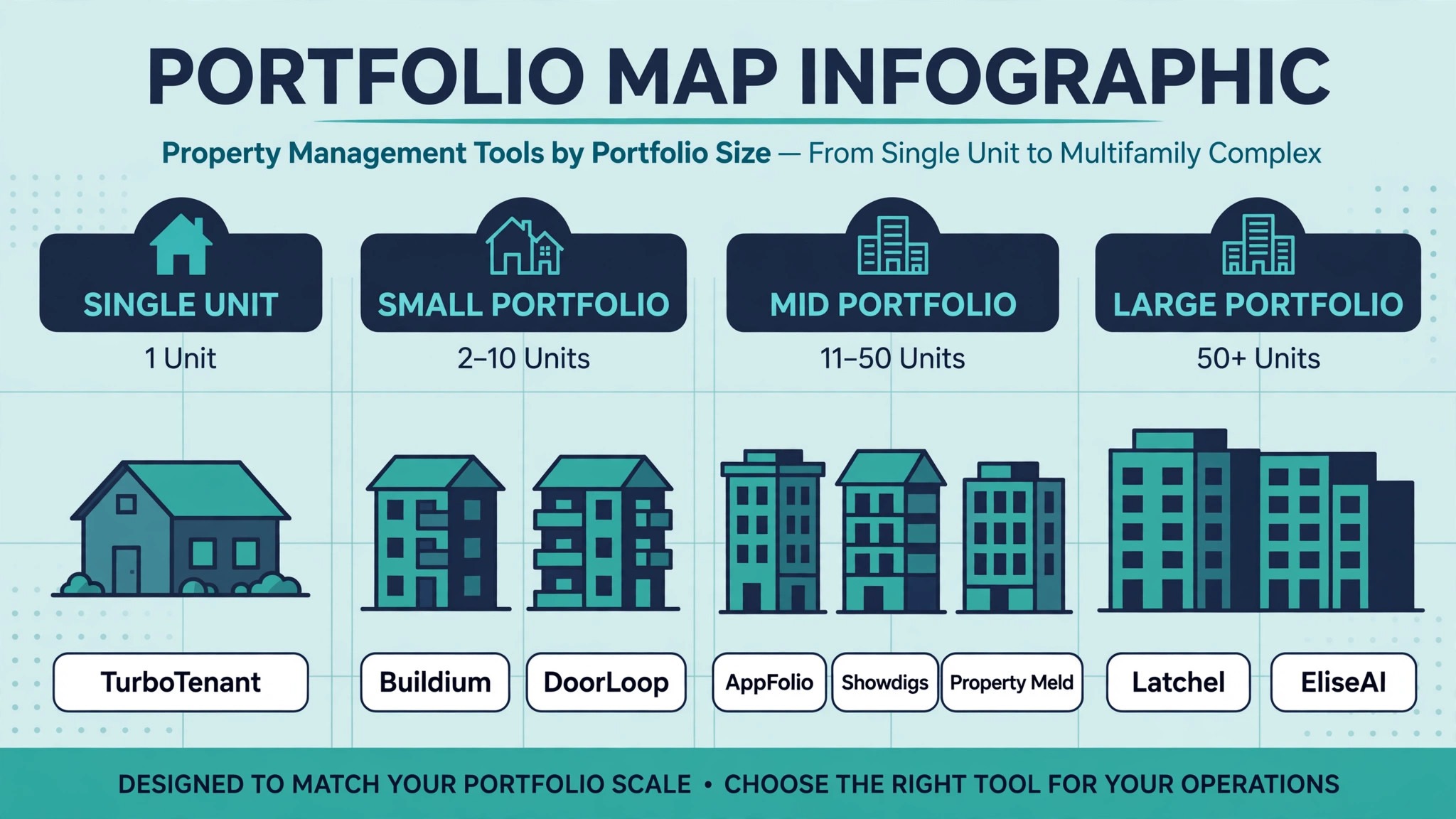
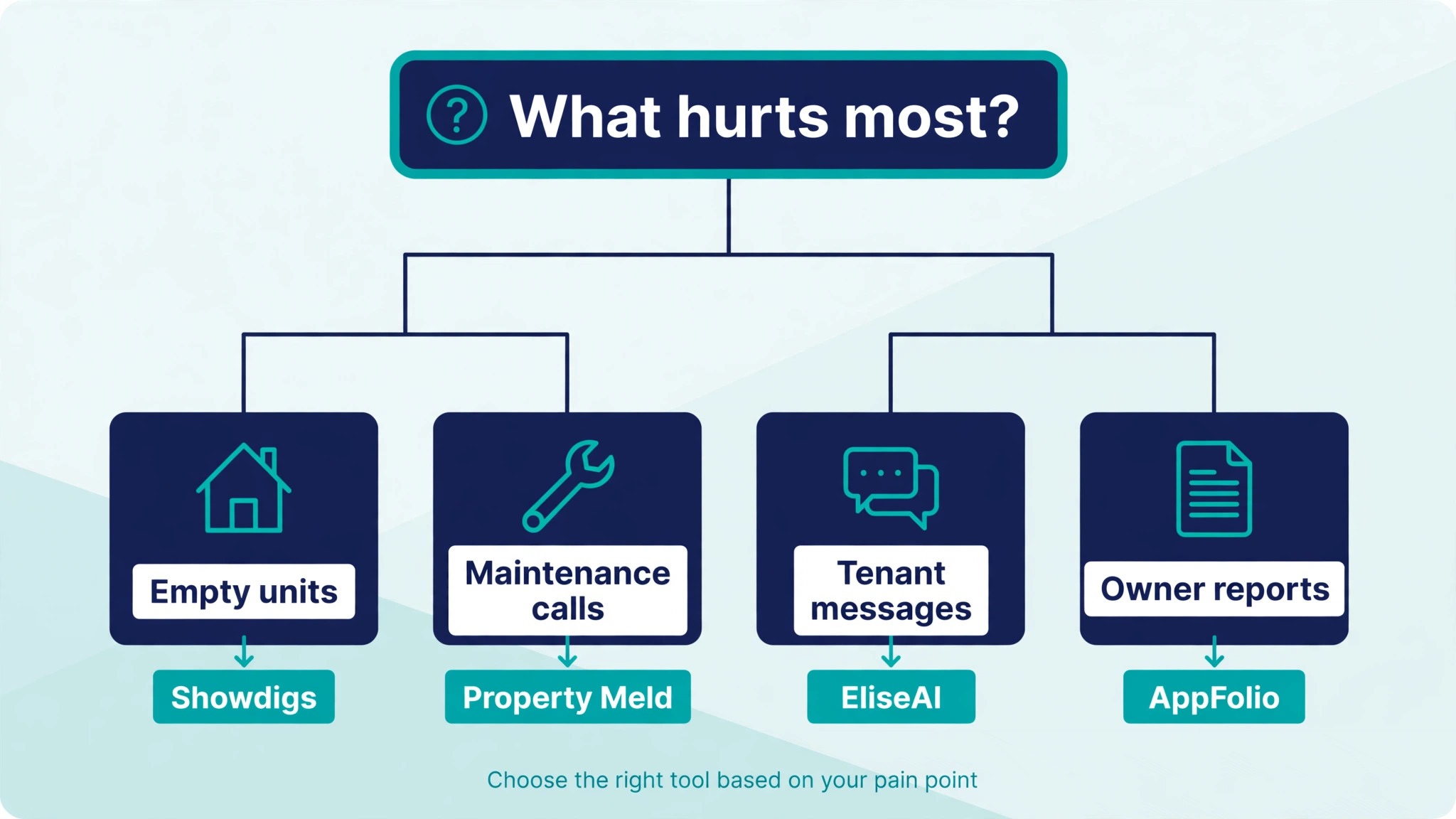
The best ai tools for property managers are not the ones with the longest feature list. They are the ones that fix the bottleneck your portfolio feels every week. A manager who misses showings should buy Showdigs or EliseAI. A manager who drowns in maintenance calls should buy Property Meld or Latchel. A manager who needs one system for everything should buy AppFolio or Buildium. A landlord with a few units should buy TurboTenant. Start from the bottleneck, not from the vendor homepage.
Budget the full stack, not the headline price. The table below shows what a 100 unit portfolio actually pays in year one for the most common combinations, using starting prices. Unit minimums and per ticket fees are the lines that surprise buyers, so ask for them in writing before you sign.
| Stack for a 100 unit portfolio | Monthly cost | What it covers |
|---|---|---|
| Buildium Essential plus Latchel | 161 dollars | Full platform plus after hours maintenance |
| AppFolio Core, 100 units | 149 dollars | Platform, leasing AI and maintenance triage |
| Buildium Essential plus Showdigs | 182 dollars | Platform plus AI leasing and tours |
| DoorLoop One, 100 units | 250 dollars | Platform plus AI receptionist |
| Buildium Essential plus Property Meld | 222 dollars | Platform plus maintenance triage |
| TurboTenant Premium plus Latchel | 116 dollars | Landlord tools plus after hours cover |
Frequently Asked Questions
What is the cheapest good AI tool for a property manager
TurboTenant is free to start and Premium runs from 17 dollars a month, which makes it the cheapest entry with a real free tier behind it. Buildium Essential from 62 dollars a month is the cheapest full platform with AI named on its pricing page. The cheapest stack that actually works is usually TurboTenant for a small landlord, or Buildium Essential plus Latchel for a growing portfolio, which costs less than 165 dollars a month for 100 units.
Do AI tools replace property managers
No, and the managers who treat them as replacements get the worst results. AI replaces the answering, triaging, chasing and logging work that sits around managing a portfolio, which is roughly a third of a manager’s week. The owner relationships, the vendor judgment and the difficult tenant conversation still belong to a person. Buy AI to give each manager more hours on the work that needs a human, not to cut heads, and measure the return in occupancy and owner retention rather than in seats saved.
Which tool is best for leasing and showings
Showdigs is the best single tool for most single family and small multifamily portfolios, because its AI agent answers prospects and books tours around the clock. EliseAI is better when the portfolio is large multifamily with thousands of inquiries a month. AppFolio is better when you want the leasing AI inside the platform you already run. Pick Showdigs if you manage single family homes, EliseAI if you run large multifamily, and AppFolio if you want one system.
How much should a 100 unit portfolio budget for AI tools
A realistic year one budget for the best ai tools for property managers is 150 to 250 dollars a month for a 100 unit portfolio using self serve tools, and 400 dollars a month or more once you add a full platform plus a maintenance specialist. Per unit minimums and per ticket fees can push the bill higher in heavy months, so set a monthly cap and review usage in the first 90 days. Quote only tools need a sales call to price, so budget a range and get the minimum spend in writing.
Is it safe to let AI answer tenant calls at night
Yes, with the right guardrails. AI can triage a maintenance call, book a showing and answer a routine question, but an emergency needs a clear escalation path to a human and a vendor. Set the tool to dispatch the on call vendor for true emergencies, log every after hours conversation, and review the logs each morning in the first month. The risk is not the AI being wrong once. It is the AI missing an emergency while nobody checks.
Our Verdict
If you buy one tool this quarter, buy Buildium. It covers the most of the management job at a published price a growing portfolio can afford, and it is the fastest way to find out whether AI inside your platform works for your doors. The best ai tools for property managers earn their keep by keeping units full and tenants answered, and Buildium does that from the first month, without an enterprise contract or a platform switch.
Whatever you pick, start with the bottleneck, trial with a real portfolio, and keep a human in the loop on anything a tenant or an owner will read for the first month. The best ai tools for property managers on this list all work. The difference is whether the tool matches the job your portfolio actually needs done, and whether you measure the return in occupancy and owner retention rather than in features used.