
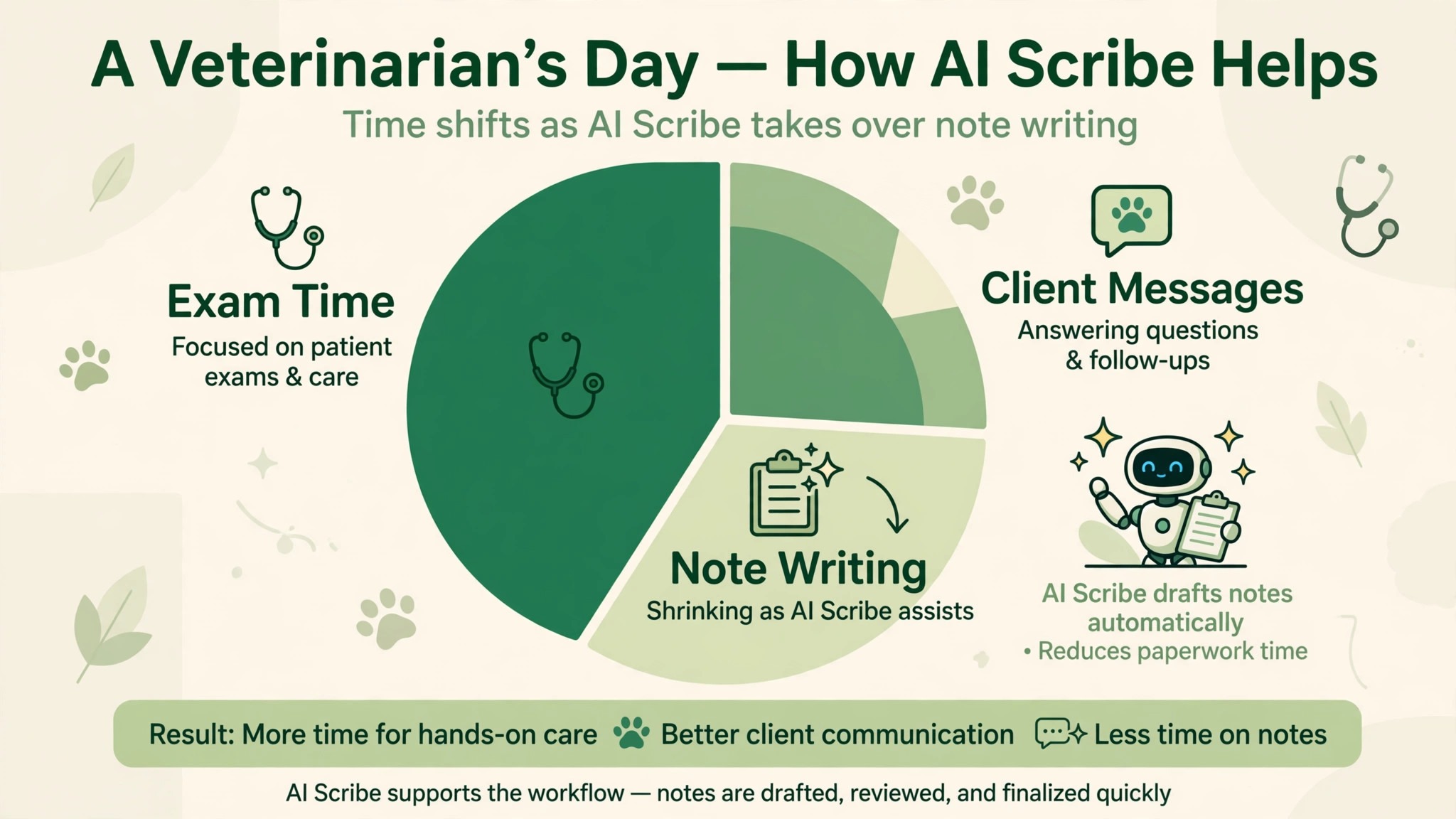
A veterinarian who sees twenty patients in a day and writes every SOAP note after hours is not working a full day, she is working a full day plus an evening. The notes are the bottleneck, and they are also the record the next visit depends on, the invoice depends on and the client recap depends on. The best ai tools for veterinarians attack that bottleneck first, because a scribe that drafts the note while the exam is still happening gives the evening back without asking the veterinarian to type faster.
This guide compares five tools on published prices, the job each one does best and the catch that only shows up after the trial. Prices come from vendor pricing pages and third party roundups checked in November 2026, and where a vendor does not publish a price, this guide says so instead of guessing. Four of the five are scribes, because scribing is where the hours are, and the fifth is the client communication platform that stops the phones from undoing the time the scribe saved.
The clinic that buys well here does not buy the most features. It buys the scribe that fits its practice management system, its note volume and its budget, then it protects the saved hours with reminders and messages that keep clients coming back. Start with the shortlist, then read the reviews that match the way your clinic actually works.
The Quick Shortlist
The table below matches each common clinic job to the single tool that handles it best. Use it to narrow the best ai tools for veterinarians to two candidates before you read the full reviews. Prices are monthly list prices unless noted, and annual billing is usually cheaper than paying month to month.
| Job | Best tool | Why it wins |
|---|---|---|
| Deepest standalone scribe with dental charts | ScribbleVet | Essential from 40 dollars a month, with Plumb’s integration |
| Enterprise scribe for multi site groups | VetRec | 99 dollars per vet a month billed annually, with SOC 2 Type II |
| Lowest risk start with a real free tier | Scribenote | Free plan with unlimited notes, Pro from 79 dollars a month |
| Best value per vet for unlimited notes | PawfectNotes | 59 dollars per vet a month billed annually for unlimited sessions |
| Reminders, booking and messages in one app | PetDesk | Reported at about 249 dollars a month, largest standalone install base |
How a Scribe Earns Its Place Among the Best AI Tools for Veterinarians
A tool earned a place here only if it does a real veterinary job in 2026, not if it added an AI label to an old product. The best ai tools for veterinarians were judged on five things that decide whether a clinic keeps paying after the trial.
First, the note itself, because a scribe that produces a clean SOAP draft in under a minute beats one that produces a transcript the veterinarian must rewrite. The draft has to filter exam room chatter, keep the clinical facts straight and land in the right sections, or the time saved on typing is lost on editing. Second, the practice management integration, since a scribe that pushes the note into ezyVet, Pulse, Vetspire or Cornerstone saves the copy paste step that a standalone scribe leaves behind.
Third, the starting price a clinic can actually buy, including whether a free plan exists and what the paid plan really includes. Fourth, compliance and consent, because recording an exam room carries duties that vary by state, and eleven states need every party consent before a recording starts. Fifth, the catch, from per vet pricing that multiplies across a team to note limits that quietly cap the busiest doctors.
The recording question deserves a paragraph of its own, because it is the one buyers forget until a client asks. An AI scribe records the visit, and the clinic needs a consent process that fits its state law, a data policy that says whether the vendor trains models on clinic audio, and a review step before any note goes to a client. The tools below differ on all three, so ask each vendor directly and get the answer in writing. A scribe that cannot answer the data question clearly is not ready for your exam rooms.
| Check before you buy | What to ask | Why it matters |
|---|---|---|
| Note quality | How fast is the draft, and how much editing does it need | Editing time eats the time the scribe saves |
| Practice system integration | Does it push the note in, or export only | Push in saves copy paste every visit |
| Recording consent | How does the tool handle consent in your state | Eleven states need every party consent |
| Data use | Does the vendor train models on your audio | Your exam audio is patient data |
| Price structure | Per vet, per user, or flat | Per vet pricing multiplies across a team |
| Note limits | How many notes, and what happens over the limit | A busy vet hits a cap fast |
The 5 Tools, Reviewed One by One
1. ScribbleVet
Starting price 40 dollars a month per user for Essential. Best for Deepest standalone scribe with dental charts. Watch out Unlimited notes need Unleashed at 150 dollars per vet a month billed annually.
ScribbleVet is the deepest standalone AI scribe on this list, and it earns that position by filtering exam room chatter into a SOAP note in under a minute. It records the appointment, separates the clinical conversation from the small talk, and drafts a structured note the veterinarian can review and send to systems such as ezyVet, Pulse or Vetspire. It also handles dental charts and integrates with Plumb’s, which matters to practices that do a lot of dental work and need the chart to match the note.
The 2026 story around ScribbleVet is the acquisition. Instinct Science acquired ScribbleVet in January 2026, with the stated plan to build AI scribing directly into a practice management platform, and that backing gives the product a longer runway than a standalone scribe usually gets. For a clinic choosing a scribe it will still be using in three years, that backing is worth weighing alongside the feature list.
The pricing is published and tiered, which makes the decision easier than with most rivals. Essential costs 40 dollars a month per user and covers 150 SOAP notes a month, while Unleashed costs 200 dollars a month per vet, or 150 dollars a month billed annually, with unlimited notes and support staff included free. A 14 day trial needs no card, so a clinic can test the note quality on its own cases before it pays.
The catch is the jump between tiers. A busy veterinarian who writes more than 150 notes a month will outgrow Essential fast, and the Unleashed price is a real step up from the entry tier. ScribbleVet still earns the top spot for clinics that want the deepest scribe and are willing to pay for unlimited notes, and it is the best choice for dental heavy practices.
2. VetRec
Starting price 99 dollars per vet a month billed annually. Best for Enterprise scribe for multi site groups. Watch out Monthly billing rises to 150 dollars per vet a month, so annual billing matters.
VetRec is the scribe for multi site groups that need enterprise compliance credentials behind the note. It carries SOC 2 Type II and GDPR backing, integrates with more than ten practice management systems across cloud and on premise, and bundles a receptionist and a records recap alongside the scribe. For a group that has to answer a compliance questionnaire before it buys software, those credentials are not a nice extra, they are the reason the purchase gets approved.
The workflow covers more than the exam room. The scribe drafts the SOAP note, the receptionist handles client contact, and the records recap pulls the history together before the visit, so the veterinarian walks in with the context already assembled. Support staff are included in the price, which matters for a group where technicians and receptionists also need access without a per seat charge multiplying the bill.
The price is published at 99 dollars per vet a month billed annually, with a 14 day free trial, and the monthly price rises to 150 dollars per vet a month. That annual discount is steep enough that a group should budget for the annual commitment from the start rather than drifting onto monthly billing. VetRec earns second place for groups that need compliance, scale and a scribe that covers the whole visit rather than the note alone.
3. Scribenote
Starting price Free plan, with Pro at 79 dollars per vet a month billed annually. Best for Lowest risk start with a real free tier. Watch out The free plan uses the standard AI tier, so the most advanced features sit on Pro.
Scribenote is the lowest risk way into veterinary AI scribing, because its free plan is a real free tier with unlimited notes rather than a short trial. A solo veterinarian or a small clinic can adopt it, learn whether a scribe fits the way they consult, and only pay when the volume or the features justify it. Pro costs 79 dollars a month per vet billed annually, or 99 dollars a month billed monthly, and a two week free period of Pro lets a clinic test the paid tier before committing.
The adoption story is the strength. Scribenote works through a desktop widget that sits over any practice management system, so there is no integration project and no waiting for a vendor to build a connector. A clinic can install it, use it in the next appointment and judge the note quality on real cases within a day, which is a faster test than any rival on this list offers.
The catch is the tier split. The free plan runs the standard AI tier, so a clinic that wants the best note quality will need Pro, and the per vet price still multiplies across a team. Scribenote still earns its place as the best starting point, especially for solo vets and small clinics that want to prove the value before they spend, and it is the scribe to try first if you are unsure whether scribing fits your style.
4. PawfectNotes
Starting price 29 dollars per vet a month billed annually for 100 sessions. Best for Best value per vet for unlimited notes. Watch out The 100 session tier caps at 100 sessions a month, so busy vets need the unlimited tier.
PawfectNotes is the best value scribe for most practices, because it pairs a free tier that never expires with the lowest unlimited price on this list. The free plan covers 50 sessions a month every month with no card required, StarterNotes costs 29 dollars per vet a month billed annually, or 39 dollars billed monthly, for 100 sessions, and UnlimitedNotes costs 59 dollars per vet a month billed annually, or 69 dollars billed monthly, for unlimited sessions. It supports 41 languages, including mixed language conversations, and integrates with 19 practice management systems.
The language support is a genuine differentiator for clinics with multilingual clients and staff. A visit that switches between two languages still produces one clean note, and that matters in practices where the exam room conversation is rarely in one language from start to finish. The browser extension route also keeps the setup light, since the scribe works across more than 20 practice systems through the extension rather than needing a native connector for each one.
The free tier deserves a closer look, because it is the most generous on this list. Fifty sessions a month free, every month, is enough for a part time veterinarian or a low volume clinic to use the scribe without paying at all, and it is enough for any clinic to run a real trial on live cases rather than a demo. That generosity is why PawfectNotes wins the value ranking even though its brand is younger than ScribbleVet.
The catch is the session math. A full time veterinarian who sees more than 100 patients a month will need UnlimitedNotes at 59 dollars a month billed annually, which is still the cheapest unlimited price here but is double the entry tier. PawfectNotes earns its place as the best value pick, and it is the scribe to choose when the budget is tight and the note volume is high.
5. PetDesk
Starting price Reported at about 249 dollars a month. Best for Reminders, booking and messages in one app. Watch out The AI scribe is priced on request, so the full stack needs a quote.
PetDesk is the client communication pick on this list, and it earns its place because the hours a scribe saves are wasted if the phones and the reminders do not work. More than 12,000 veterinary practices use PetDesk for appointment reminders, client communication and online booking, and that install base makes it the largest standalone engagement app in veterinary medicine. Two way texting, reminders, a client app and booking through Vetstoria sit in one system, and the breadth of practice system compatibility is the widest on this list.
The AI direction is staff facing rather than client facing. PetDesk has moved toward AI call summaries and an AI scribe, with the AI drafting replies and summaries for a staff member to review before anything goes to the client. That human review step is the right design for a clinic, since a message sent to a worried pet owner should never go out unreviewed, and it keeps the AI inside the workflow rather than in front of the client.
The price is reported at about 249 dollars a month on a Capterra listing, with third party reporting putting the core app nearer 389 dollars a month, so a buyer should confirm the current figure and the included features. The scribe itself is priced on request, which means the full stack needs a sales conversation. PetDesk closes the list as the best communication platform here, and it pairs with any scribe above it rather than replacing one.
A Week With a Scribe, Hour by Hour
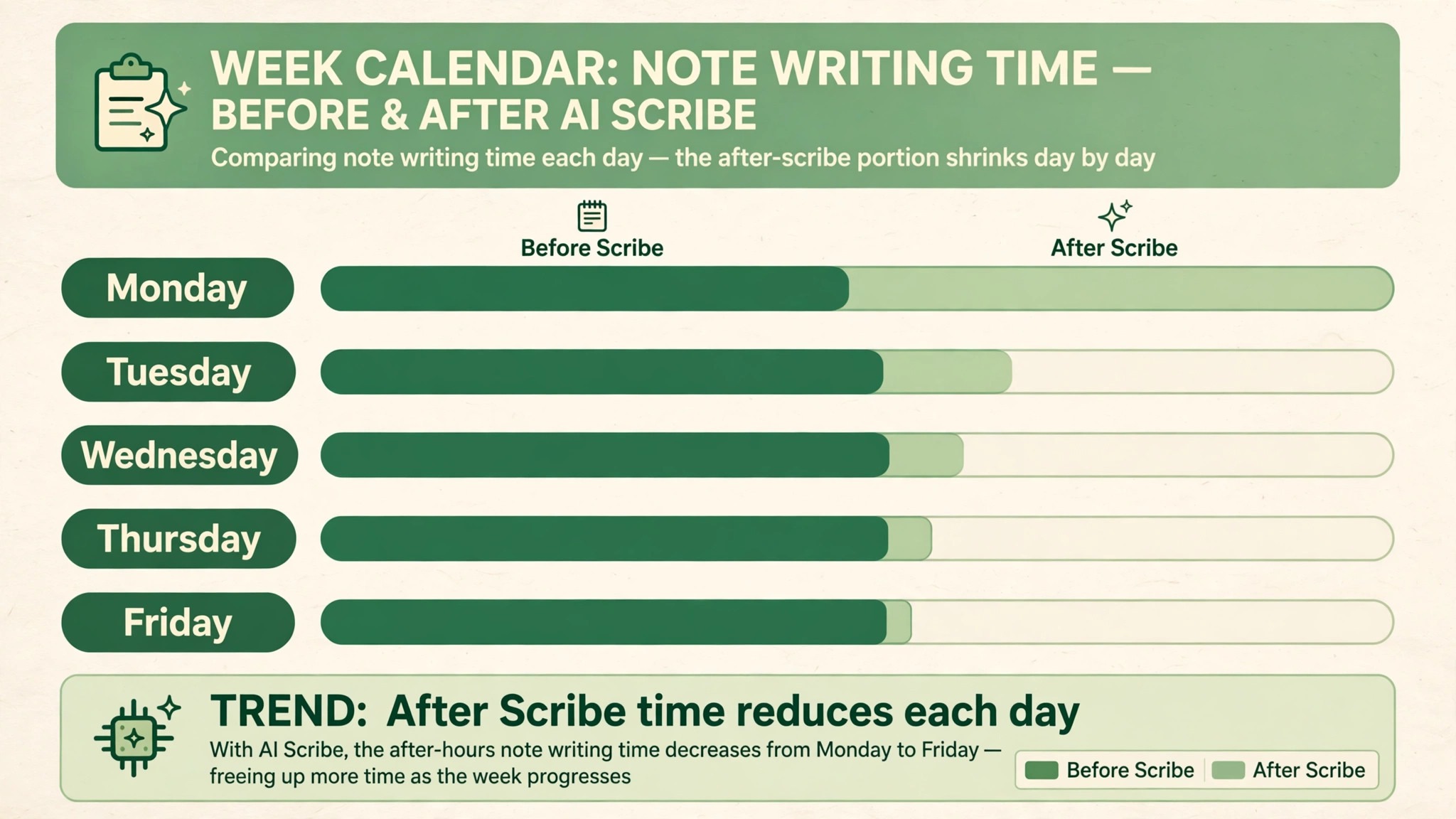
The best ai tools for veterinarians earn their keep in ordinary weeks, not in demos, so it helps to picture what changes. On Monday the veterinarian sees a full list, and the scribe drafts each note before the next patient walks in, so the lunch break is a break rather than a catch up session. On Tuesday a dental case runs long, and the scribe keeps the chart and the note in step without the veterinarian staying late to reconcile them. On Wednesday a client calls about a recheck, and the receptionist finds the recap in seconds instead of asking the veterinarian to remember a visit from last month.
By Friday the pattern is clear. The notes are done when the day ends, the invoices match the notes because the charge capture came from the same visit, and the client recaps went out the same day rather than piling up for the weekend. That is the return a clinic should measure in the trial, and it is why a scribe trial needs real cases over a full week rather than a single demo appointment. A tool that saves an hour a day is worth more than a tool with a longer feature list that saves twenty minutes.
The trial itself needs a plan. Pick one veterinarian, run the scribe on every appointment for two weeks, and count three things at the end of each day, the minutes spent editing notes, the minutes spent after hours, and the notes still unfinished at close. If all three fall, the scribe earns its keep. If only one falls, the problem may be the workflow rather than the tool, and the clinic should fix the workflow before it pays for a year.
What the Trial Should Prove
The best ai tools for veterinarians are bought on claims, and a clinic should test the claims that matter before it signs. The first claim is time. Vendors talk about hours saved per week, and the honest range depends on note volume, editing speed and how clean the exam room audio is. A clinic that writes twenty notes a day will save more than a clinic that writes five, and a clinic with noisy exam rooms will save less than a quiet one. No randomized controlled study had measured time saved by veterinary AI scribes as of August 2026, so treat every vendor time claim as a marketing figure until your own trial proves it.
The second claim is accuracy. A scribe that drafts a clean note nine times out of ten still needs a review step for the tenth, and the review step is where the accuracy is actually decided. During the trial, have the reviewing veterinarian mark every correction the draft needed, and count the corrections per note. If the corrections are small wording fixes, the scribe is working. If the corrections are wrong doses, wrong weights or missing findings, the scribe is not ready for your exam rooms, no matter how fast it is.
The third claim is the one vendors rarely make, and it matters most. A scribe only saves time if the note it produces is the note that goes into the record, the invoice and the client recap without rework. During the trial, follow five notes all the way from the exam room to the client inbox and count how many times each note was retyped, copied or corrected. If the answer is once, the scribe earns its keep. If the answer is three times, the workflow needs fixing before the tool gets blamed.
Side by Side Comparison
The table below puts the best ai tools for veterinarians side by side on price, best job and free option, so a clinic can compare the published prices against the quote only tools before shortlisting.
| Tool | Starting price | Best for | Free plan |
|---|---|---|---|
| ScribbleVet | 40 dollars a month per user | Deepest standalone scribe with dental charts | 14 day trial |
| VetRec | 99 dollars per vet a month, annual | Enterprise scribe for multi site groups | 14 day trial |
| Scribenote | Free, Pro 79 dollars a month | Lowest risk start with a real free tier | Yes, unlimited notes |
| PawfectNotes | 29 dollars per vet a month, annual | Best value per vet for unlimited notes | Yes, 50 sessions a month |
| PetDesk | Reported about 249 dollars a month | Reminders, booking and messages in one app | No |
How to Pick the Right Tool for Your Clinic
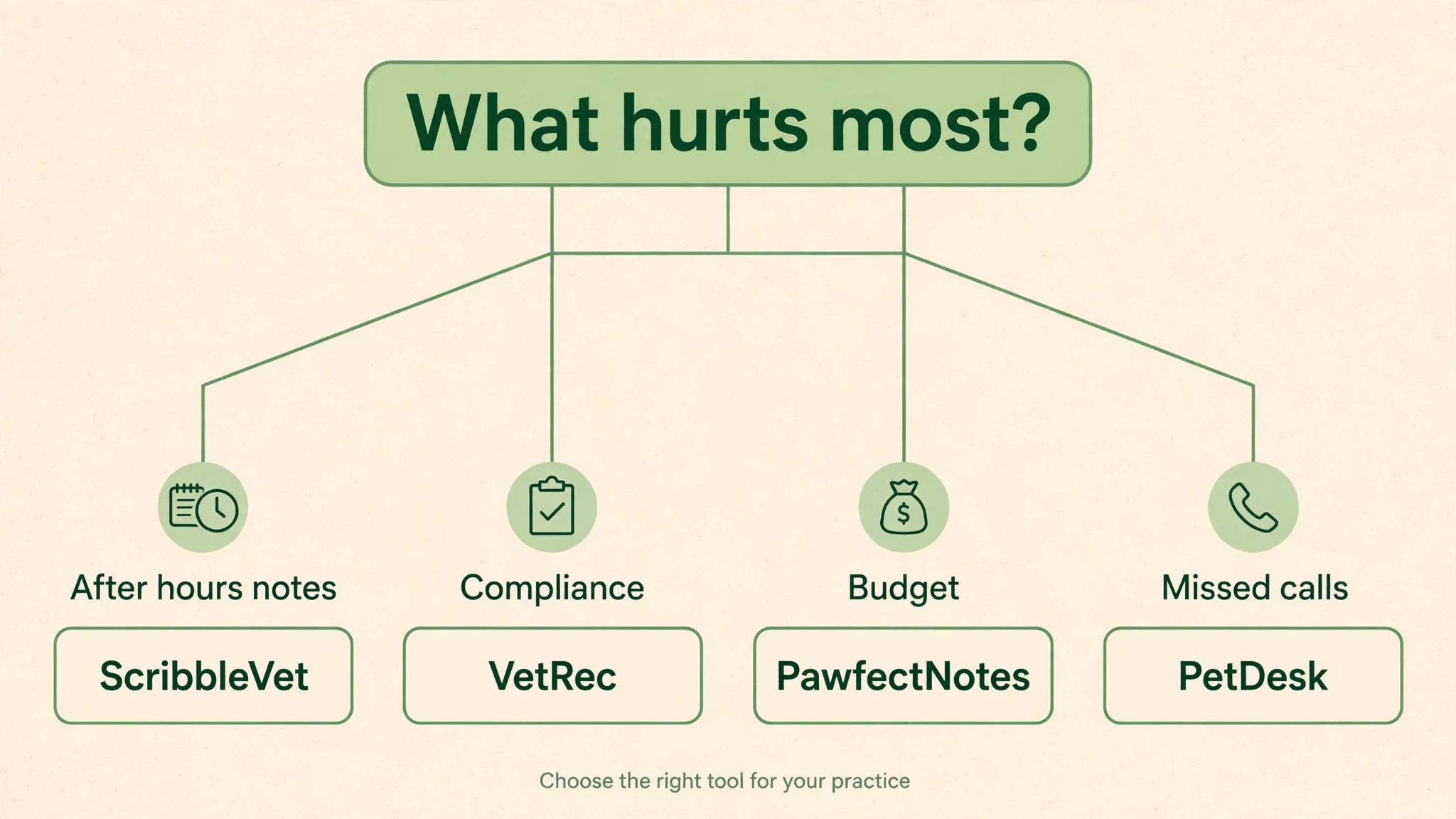
The best ai tools for veterinarians are not the ones with the longest feature list. They are the ones that fit the way your clinic already works. A solo vet who wants to test scribing for free should start with Scribenote. A clinic that wants the cheapest unlimited notes should buy PawfectNotes. A dental heavy practice should buy ScribbleVet. A multi site group that needs compliance credentials should buy VetRec. A clinic whose phones are the bottleneck should buy PetDesk first and add a scribe second. Start from the bottleneck, not from the vendor homepage.
Budget the full bill, not the headline price. The table below shows what a three vet clinic actually pays in year one for the most common combinations, using starting annual prices. Per vet pricing multiplies fast, so a three vet clinic pays three times the headline on every per vet tool, and that multiplication is the line that surprises buyers most.
| Stack for a three vet clinic | Monthly cost, annual billing | What it covers |
|---|---|---|
| PawfectNotes Unlimited, 3 vets | 177 dollars | Unlimited scribe sessions for the whole team |
| Scribenote Pro, 3 vets | 237 dollars | Scribe with a free tier behind it |
| ScribbleVet Essential, 3 users | 120 dollars | Deep scribe, 150 notes per user |
| VetRec, 3 vets | 297 dollars | Enterprise scribe with receptionist and recap |
| PawfectNotes plus PetDesk | About 426 dollars | Scribe plus reminders, booking and messages |
Frequently Asked Questions
What is the cheapest good veterinary AI scribe
PawfectNotes is the cheapest route to unlimited notes, at 59 dollars per vet a month billed annually, with a free tier of 50 sessions a month that never expires. Scribenote is the cheapest route to start, with a free plan that covers unlimited notes on the standard AI tier and Pro at 79 dollars a month. The cheapest stack that actually works for a small clinic is usually Scribenote free to test, then PawfectNotes Unlimited once the volume justifies it, which costs less than 200 dollars a month for a three vet clinic.
Do AI scribes replace the veterinarian review
No, and the clinics that treat them as replacements get the worst results. The scribe drafts the note, and the veterinarian reviews every draft before it becomes part of the record, because the AI can mishear a dose, a weight or a finding. Treat every AI generated note, radiograph read or client message as a draft for your veterinarian to review, not a diagnosis to act on unreviewed. Keep the review step in the workflow for the first month and after, and measure the return in editing minutes rather than in notes skipped.
Which scribe is best for a multi location group
VetRec is the best single scribe for most groups, because it combines enterprise compliance credentials with integration across more than ten practice systems and support staff included in the price. ScribbleVet is better when the group does a lot of dental work and needs dental charts plus Plumb’s integration. Pick VetRec if compliance and scale decide the purchase, and ScribbleVet if dental depth decides it, and trial both on real cases before you sign a group contract.
Can a scribe work with any practice management system
It depends on the scribe. Scribenote works through a desktop widget over any system, so it needs no connector at all. PawfectNotes works across more than 20 systems through a browser extension. ScribbleVet and VetRec name their integrations, with ezyVet, Pulse, Vetspire and Cornerstone among them, and a clinic on a system outside that list should confirm the connection before buying. PetDesk covers the widest range of systems for client communication. Check your system against the vendor list in writing before you trial, because a scribe that cannot push the note into your system leaves a copy paste step on every visit.
How much should a three vet clinic budget for veterinary AI
A realistic year one budget for the best ai tools for veterinarians is 177 to 297 dollars a month for a scribe across three vets on annual billing, and about 426 dollars a month once you add PetDesk for reminders, booking and messages. Per vet pricing is the line that surprises buyers, so multiply the headline by your vet count before you compare. Quote only tools need a sales call to price, so budget a range and get the per vet figure in writing.
Our Verdict
If you buy one tool this quarter, buy PawfectNotes Unlimited. It covers the job that eats the most hours, drafting SOAP notes, at the lowest unlimited price on this list, with a free tier that lets any clinic prove the value on live cases before it pays. The best ai tools for veterinarians earn their keep by giving the evening back, and PawfectNotes does that from the first week, without an enterprise contract or an integration project.
Whatever you pick, trial with real cases for two full weeks, count the editing minutes and the after hours minutes, and keep a veterinarian review step on every note. The tools on this list all work. The difference is whether the scribe matches the way your clinic already works, and whether you measure the return in hours saved rather than in features used.