A small restaurant spends more on card processing than on POS software, and most owners never see that line clearly. The software costs 0 to 69 dollars a month per location, the hardware costs 299 to 1,500 dollars upfront, and the card fees take 2.4 to 2.9 percent of every sale. That question is the heart of restaurant pos pricing for small restaurants, and it is the number this guide works out for every system.
A system that sells software for 0 dollars a month and a system that charges 69 dollars a month are not selling the same thing. The first makes its money on card processing, and the second charges for the software and lets the owner keep more of each sale. A cafe that takes 10,000 dollars a month in cards pays less with the free software, and a full-service restaurant that takes 60,000 dollars a month pays less with the system that charges for software but takes a smaller card rate. The monthly sales volume decides the bill more than the headline price does.
The third thing to check is the hardware. Most POS systems need a terminal, a printer and a cash drawer, and the hardware bill lands before the first sale. Square Terminal costs 299 dollars, a Toast starter bundle runs 799 to 1,500 dollars, and a Clover Station setup runs 850 to 2,650 dollars. Knowing restaurant pos pricing for small restaurants means knowing what the first month actually costs, not just what the plan costs.
Prices in this guide are US list prices checked in November 2026, before tax. Monthly prices are per month, with the hardware cost beside the software price where the vendor publishes one. Where a vendor hides its prices behind a quote, this guide says so instead of guessing.
At a Glance. restaurant pos pricing for small restaurants in One Table
The table below is the short answer. Prices are in US dollars, before tax. Free means free to start, and the paid column is what it costs to run one location for a month.
| System | Free plan | Entry paid price | What you get | Card rate |
|---|---|---|---|---|
| Square for Restaurants | Free 0 dollars a month | Plus 49 dollars a month per location | Course management, kitchen display, multi-location | 2.6 percent plus 15 cents in person |
| Toast | Starter Kit 0 dollars a month | Point of Sale from 69 dollars a month | 1 location, up to 2 terminals on Starter | Around 2.49 percent plus 15 cents |
| Lightspeed Restaurant | No free plan | Starter 69 dollars a month | Inventory, reporting, iPad based | Not published, quote only |
| Clover | No free plan | Restaurant bundles from 179 dollars a month | Hardware and software bundle, 36-month term | 2.3 percent plus 10 cents tapped or swiped |
| TouchBistro | No free plan | Point of Sale 69 dollars a month | iPad based, full service, tables and coursing | Not published, quote only |
| Otter | No free plan | Starter 79 dollars a month | Software and hardware bundled, delivery built in | 2.79 percent card present on Starter |
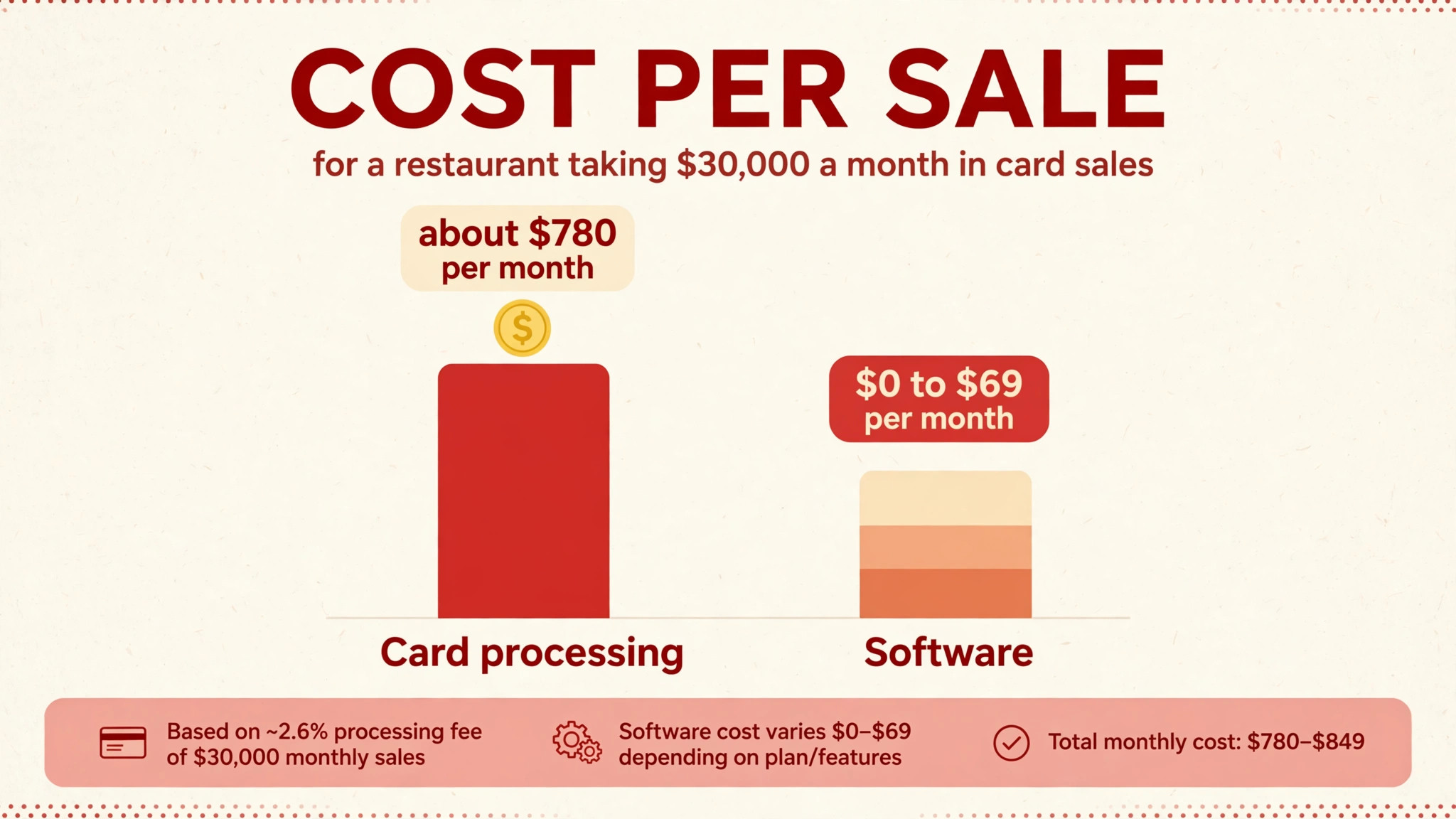
Read the card rate column first, because processing is the largest POS cost a restaurant pays. A restaurant that takes 30,000 dollars a month in cards pays 780 dollars a month at 2.6 percent, and 690 dollars at 2.3 percent, a gap of 90 dollars a month that dwarfs the software price. That gap between the software price and the processing price is the oldest trick in restaurant pos pricing for small restaurants, and every system in this table plays it in some form.
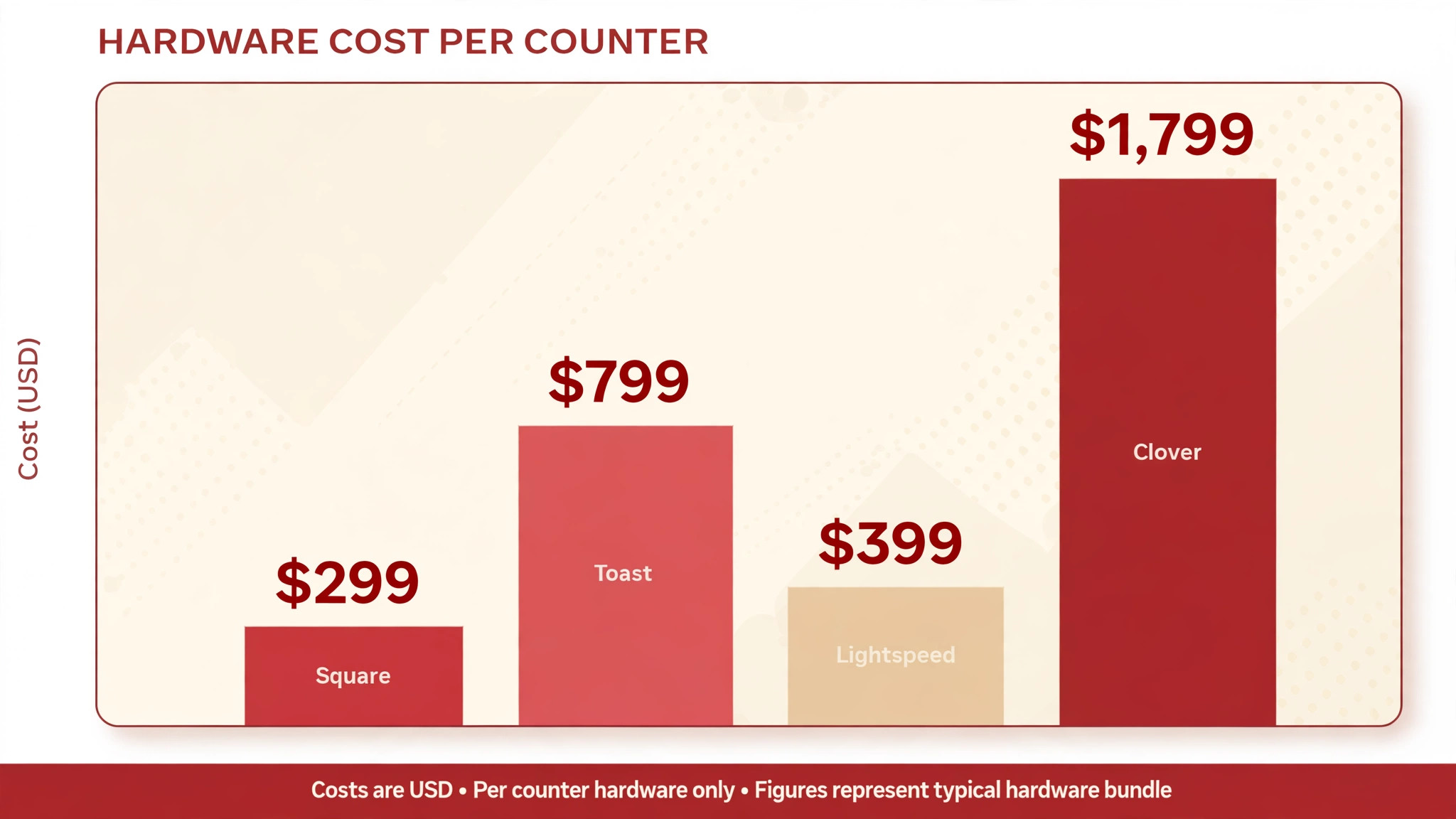
Read the hardware column second, because the first month is the expensive one. Square Terminal costs 299 dollars, a Toast starter bundle runs 799 to 1,500 dollars, and a Clover setup runs 850 to 2,650 dollars. Otter bundles hardware into the monthly price, so the first month costs 79 dollars and nothing else. The hardware bill, not the software price, decides what a new restaurant pays to open.
1. Square for Restaurants
Square for Restaurants is the cheapest start in this guide, and its pricing is the clearest to read. The Free plan costs 0 dollars a month and includes basic ordering and one location. Plus costs 49 dollars a month per location, and Premium costs 149 dollars a month per location. In-person processing costs 2.6 percent plus 15 cents on Free, 2.5 percent plus 15 cents on Plus, and 2.4 percent plus 15 cents on Premium. A compact card reader costs 59 dollars, and Square Terminal costs 299 dollars, or 27 dollars a month.
Worked cost for 30,000 dollars a month in card sales. Free costs 0 dollars in software plus 780 dollars in processing, or 780 dollars a month in total. Plus costs 49 dollars in software plus 750 dollars in processing, or 799 dollars a month in total. A cafe that takes 30,000 dollars a month pays less on Free than on Plus, because the processing saving does not cover the software fee. That is the whole trade, and it is an honest one.
Square earns its price with the free tier. A new cafe can open, take cards and print tickets without paying a dollar in software, and the hardware starts at 59 dollars for a reader. The weakness is the ceiling, because the free plan lacks course management and a kitchen display, so a full-service restaurant needs Plus at 49 dollars a month before the first dinner service.
2. Toast
Toast is the full-service pick in this guide, and its pricing starts free and climbs fast. The Starter Kit costs 0 dollars a month for one location and up to two terminals, with Toast payment processing required. Point of Sale starts at 69 dollars a month, and the higher tiers run to 165 dollars a month per terminal. Processing runs around 2.49 to 2.99 percent plus 15 cents, and Toast does not publish a fixed rate, so the quote decides the bill. A starter hardware bundle runs 799 to 1,500 dollars, and a KDS-equipped full-service setup runs 3,000 dollars and up.
Worked cost for 30,000 dollars a month in card sales. Starter Kit costs 0 dollars in software plus about 747 dollars in processing at 2.49 percent, or about 747 dollars a month in total. Point of Sale at 69 dollars a month costs 69 dollars in software plus about 747 dollars in processing, or about 816 dollars a month in total. A small full-service restaurant pays less on Starter Kit than on Point of Sale, because the software fee buys features the starter already covers. That is the whole trade, and it is an honest one.
Toast earns its price with depth. The kitchen display, the table management and the coursing are built for full-service restaurants, not adapted from retail, and the Starter Kit is genuinely free. The weakness is the quote, because Toast does not publish its processing rate, so two restaurants can pay different rates for the same plan.
3. Lightspeed Restaurant
Lightspeed Restaurant is the inventory pick in this guide, and its pricing is published in full. Starter costs 69 dollars a month, Essential costs 189 dollars a month, and Premium costs 399 dollars a month, with an Enterprise tier by quote. A kitchen display screen costs 30 dollars a month each. Processing runs around 2.6 percent plus 10 cents with Lightspeed Payments, though the vendor does not publish a fixed rate. The system is iPad based, so the owner supplies the iPad and buys printers and a cash drawer separately.
Worked cost for 30,000 dollars a month in card sales. Starter costs 69 dollars in software plus about 780 dollars in processing, or about 849 dollars a month in total. Essential costs 189 dollars in software plus about 780 dollars in processing, or about 969 dollars a month in total. A restaurant that needs deep inventory and reporting pays 120 dollars a month more for Essential, and the bill is honest about it. That is the whole trade, and it is an honest one.
Lightspeed earns its price with inventory. The stock tracking, the recipe costing and the multi-location reporting are the deepest in this guide, and the iPad hardware keeps the upfront cost low. The weakness is the entry price, because 69 dollars a month is the floor, so a cafe that only needs a till pays more than it would on Square Free.
4. Clover
Clover is the hardware pick in this guide, and its pricing runs through banks and resellers, so the quote decides the bill. Restaurant bundles run about 179 dollars a month for Starter, 239 dollars for Standard and 354 dollars for Advanced on 36-month terms, or 1,799 to 4,447 dollars upfront for hardware plus 89.95 to 129.85 dollars a month. Processing costs 2.3 percent plus 10 cents for tapped, swiped or inserted cards, and 3.5 percent plus 10 cents for keyed cards. Hardware runs 850 to 2,650 dollars by model, from the compact Mini to the full Station Duo.
Worked cost for 30,000 dollars a month in card sales. A Starter bundle at 179 dollars a month costs 179 dollars in software plus 690 dollars in processing at 2.3 percent, or about 869 dollars a month in total. The processing rate is the lowest in this guide, but the bundle price is the highest, so the saving only appears at high volume. That is the whole trade, and it is an honest one.
Clover earns its price with hardware choice. The Mini, the Flex and the Station Duo give a restaurant a terminal for every counter, and the app marketplace adds hundreds of add-ons. The weakness is the reseller, because the price varies by bank and by relationship, so two restaurants can pay different prices for the same bundle.
5. TouchBistro
TouchBistro is the iPad pick in this guide, and its pricing is simple to read. Point of Sale costs 69 dollars a month, and the Essentials Bundle costs 119 dollars a month, with add-ons by quote and a custom setup tier for larger restaurants. Processing is not published, so the rate comes from a quote. The system is iPad based and built for small and mid-size full-service restaurants, with tables, coursing and floor plans included.
Worked cost for 30,000 dollars a month in card sales. Point of Sale at 69 dollars a month costs 69 dollars in software plus processing at a quoted rate, so the total depends on the quote. A restaurant that takes 30,000 dollars a month should get the processing rate in writing before signing, because the software price is only half the bill. That is the whole trade, and it is an honest one.
TouchBistro earns its price with the iPad workflow. The floor plan, the table management and the coursing are built for full-service dining, and the 69 dollar entry price matches Lightspeed Starter. The weakness is the unpublished rate, because a restaurant cannot compare the total cost without a quote, and the quote can change with the volume.
6. Otter
Otter is the delivery pick in this guide, and its pricing bundles hardware into the monthly fee. Starter costs 79 dollars a month, Advanced costs 178 dollars a month, and Professional costs 278 dollars a month, with software and hardware bundled at every tier. Processing costs 2.79 percent card present on Starter, falling to 2.39 percent on Professional, and 3.29 percent plus 30 cents for card-not-present orders on any tier. Delivery integration is native and built into every plan.
Worked cost for 30,000 dollars a month in card sales. Starter at 79 dollars a month costs 79 dollars in software plus 837 dollars in processing at 2.79 percent, or about 916 dollars a month in total. The total is the highest in this guide for in-person sales, but the hardware is included and the delivery tools are native, so a delivery-heavy restaurant saves the cost of a separate delivery aggregator. That is the whole trade, and it is an honest one.
Otter earns its price with delivery. A restaurant that takes half its orders through delivery apps gets the integration built in, without paying a separate aggregator fee. The weakness is the card rate, because 2.79 percent is the highest in-person rate in this guide, so a dine-in restaurant pays more for delivery tools it never uses.
Total Cost of Ownership
The monthly software price is not the total cost, because a POS system lives on hardware and card fees. A small restaurant that takes 30,000 dollars a month in cards pays 690 to 837 dollars a month in processing, and 0 to 179 dollars a month in software, so the processing is four to ten times the software. A restaurant that picks a system for the software price and ignores the card rate picks the wrong number.
The second hidden cost is the hardware. Square Terminal costs 299 dollars, a Toast starter bundle runs 799 to 1,500 dollars, and a Clover setup runs 850 to 2,650 dollars. Otter bundles hardware into the monthly price, so the first month costs 79 dollars and nothing else. A restaurant that opens with two terminals and a kitchen display can spend 3,000 dollars before the first sale, which is three years of the cheapest software plan.
The third hidden cost is the contract. Clover bundles run on 36-month terms, Toast requires two-year contracts on some plans, and the processing rate can change with the volume. A restaurant that signs a three-year bundle and then grows out of it pays the exit fee or the higher rate. Read the term before signing, because the monthly price is only the first line of the contract.
Add the three lines together before buying. The software, the hardware and the processing are the real total, and the cheapest software is not always the cheapest total. A 0 dollar plan with a 2.79 percent card rate costs more than a 69 dollar plan with a 2.3 percent rate once the monthly sales pass 15,000 dollars. That is the lesson of restaurant pos pricing for small restaurants, and it is the number that matters.
Cheapest by Situation
The cheapest system depends on the job, because each plan is built for a different restaurant. A new cafe with one counter and one reader should start with Square Free at 0 dollars a month, add a 59 dollar reader, and pay 2.6 percent plus 15 cents per sale. A food truck with one terminal should buy Square Terminal for 299 dollars and run the Free plan until the volume grows.
A small full-service restaurant with tables and coursing should start with Toast Starter Kit at 0 dollars a month, because the kitchen display and the table management are built in, and the hardware bundle runs 799 to 1,500 dollars. A restaurant that needs deep inventory and multi-location reporting should buy Lightspeed Starter at 69 dollars a month, and add a kitchen display at 30 dollars a screen.
A restaurant that buys through its bank should get a Clover quote, because the 2.3 percent processing rate is the lowest in this guide, and the bundle price can be negotiated. A restaurant that takes half its orders through delivery should buy Otter Starter at 79 dollars a month, because the hardware is bundled and the delivery integration is native. A restaurant that runs on iPads should buy TouchBistro Point of Sale at 69 dollars a month. Match the system to the service model first, and the price will follow.
How to Read a POS Quote
Most restaurant POS quotes hide the real number, because the software price is only the first line. A quote that says 69 dollars a month can mean 69 dollars plus processing, plus hardware, plus a contract, and the total can be three times the headline. Reading a quote properly is the most valuable skill in restaurant pos pricing for small restaurants, and it takes ten minutes.
The first line to check is the processing rate. A quote that says “rates from 2.49 percent” means the rate starts there and rises with the card type, the volume and the month. Ask for the rate in writing, for the exact card types the restaurant takes most, and for the per-transaction fee beside the percentage. A restaurant that takes mostly debit cards pays a different rate than one that takes mostly credit cards, and the quote should say so.
The second line to check is the hardware. A quote that says “hardware included” should list every item: the terminal, the printer, the cash drawer, the kitchen display and the cables. A quote that says “hardware from 799 dollars” should say what 799 dollars buys and what costs extra. A restaurant that needs two terminals and a kitchen display should get the price for all three in writing, before signing, because the second terminal is where the bill grows.
The third line to check is the contract term. A quote that says 36 months means the restaurant pays for three years, and the exit fee can be hundreds of dollars. A quote that says month to month means the restaurant can leave any time, and the price can rise any time. Ask for the term, the exit fee and the price rise clause in writing, and compare them across vendors. A cheap monthly price on a three-year term can cost more than an expensive monthly price with no term.
The fourth line to check is the add-on list. A quote that lists online ordering, loyalty, payroll and gift cards as included should be believed, and a quote that lists them as add-ons should show the price of each one. A restaurant that needs online ordering and loyalty will pay for both, so the quote should include them from the start. Add the add-ons to the software price before comparing vendors, because a 49 dollar plan with 40 dollars of add-ons costs more than a 69 dollar plan with everything included.
The fifth line to check is the support. A quote that promises 24-hour support should say whether it is phone, chat or email, and whether it costs extra. A restaurant that breaks down on a Friday night needs a phone number that answers, not a help article. Ask for the support hours, the support channel and the response time in writing, because a system that cannot be fixed at dinner time is a system that costs the night takings.
There is one more line that most owners miss: the payment processing lock-in. Toast requires Toast processing, Clover locks the restaurant into Fiserv, and Lightspeed pushes Lightspeed Payments. A restaurant that signs with one of these cannot switch processors without switching systems, so the processing rate is locked in for the life of the contract. A restaurant that wants to negotiate its own rate should pick a system that lets it bring its own processor, such as Square or WooCommerce-style open setups. That lock-in is the most expensive line on any quote, and it is the one to read twice.
Put the five lines together and the real total appears. The software, the hardware, the processing, the add-ons and the term are the quote, and the headline price is only the first of them. A restaurant that reads all five lines picks the cheapest system. A restaurant that reads only the first line picks the cheapest headline, and pays for it for three years. That is the practical side of restaurant pos pricing for small restaurants, and it is the check to run before signing anything.
Frequently Asked Questions
How much does a restaurant POS cost per month?
Between 0 and 179 dollars a month in software for a small restaurant, plus 2.3 to 2.79 percent of card sales in processing. Square Free and Toast Starter Kit cost 0 dollars a month in software, Lightspeed Starter and TouchBistro cost 69 dollars a month, and Clover bundles start at about 179 dollars a month. A restaurant that takes 30,000 dollars a month in cards pays 690 to 837 dollars a month in processing, which is far more than the software.
How much does restaurant pos pricing for small restaurants vary by system?
A lot. The software runs from 0 to 179 dollars a month, the hardware runs from 59 dollars to 2,650 dollars, and the card rate runs from 2.3 to 2.79 percent. The gap comes from the service model, the hardware and the processing rate, not from the software alone. Compare the total cost at your own monthly sales volume, not the headline price, and the right system will be obvious.
Do I need to buy hardware separately?
It depends on the system. Square sells the Terminal for 299 dollars and the reader for 59 dollars, Toast bundles hardware from 799 dollars, and Clover hardware runs 850 to 2,650 dollars. Otter bundles hardware into the monthly price, so there is no upfront hardware bill. Lightspeed and TouchBistro are iPad based, so the owner supplies the iPad and buys printers and a cash drawer separately.
Is Toast or Square cheaper for a small restaurant?
Square is cheaper at low volume, because the Free plan costs 0 dollars a month and the processing rate is published. Toast Starter Kit also costs 0 dollars a month, but the processing rate is quote-only, so the total depends on the quote. A cafe that takes under 20,000 dollars a month in cards should start with Square Free. A full-service restaurant that needs a kitchen display should start with Toast Starter Kit and compare the quoted rate against Square Plus.
Which POS is best for a small restaurant?
Square for Restaurants Free is the best pick for most small restaurants, because it costs 0 dollars a month, the hardware starts at 59 dollars, and the rate is published. A full-service restaurant should pick Toast Starter Kit for the kitchen display and table management. A restaurant that needs deep inventory should pick Lightspeed Starter at 69 dollars a month. Match the service model first, and the choice makes itself.
Verdict
Buy Square for Restaurants Free if the restaurant is new, small and counter-service, because it costs 0 dollars a month and the hardware starts at 59 dollars. Buy Toast Starter Kit if the restaurant is full-service and needs a kitchen display, because the software is free and the table tools are built in. Buy Lightspeed Starter at 69 dollars a month if the restaurant needs deep inventory and reporting. Buy TouchBistro Point of Sale at 69 dollars a month if the restaurant runs on iPads.
Do not buy Clover bundles unless the bank quote beats the published alternatives, because the 36-month term locks the restaurant in and the bundle price is the highest in this guide. Do not buy Otter Starter at 79 dollars a month unless delivery is half the business, because the 2.79 percent card rate is the highest in this guide. And do not sign any contract without the processing rate in writing, because the card fees are the largest line on the bill.
One last check before signing: run the system for a full weekend service on the trial or the free plan, with real orders, real cards and real staff. A system that survives a busy Saturday will survive the year, and a system that fails on a trial will fail on a Friday night. The trial is free, the weekend is real, and the test is the cheapest insurance a restaurant can buy.
The cheapest system is the one that matches the service model, keeps the card rate low, and includes the hardware. That is the whole lesson of restaurant pos pricing for small restaurants, and it is the number to remember before signing anything.