
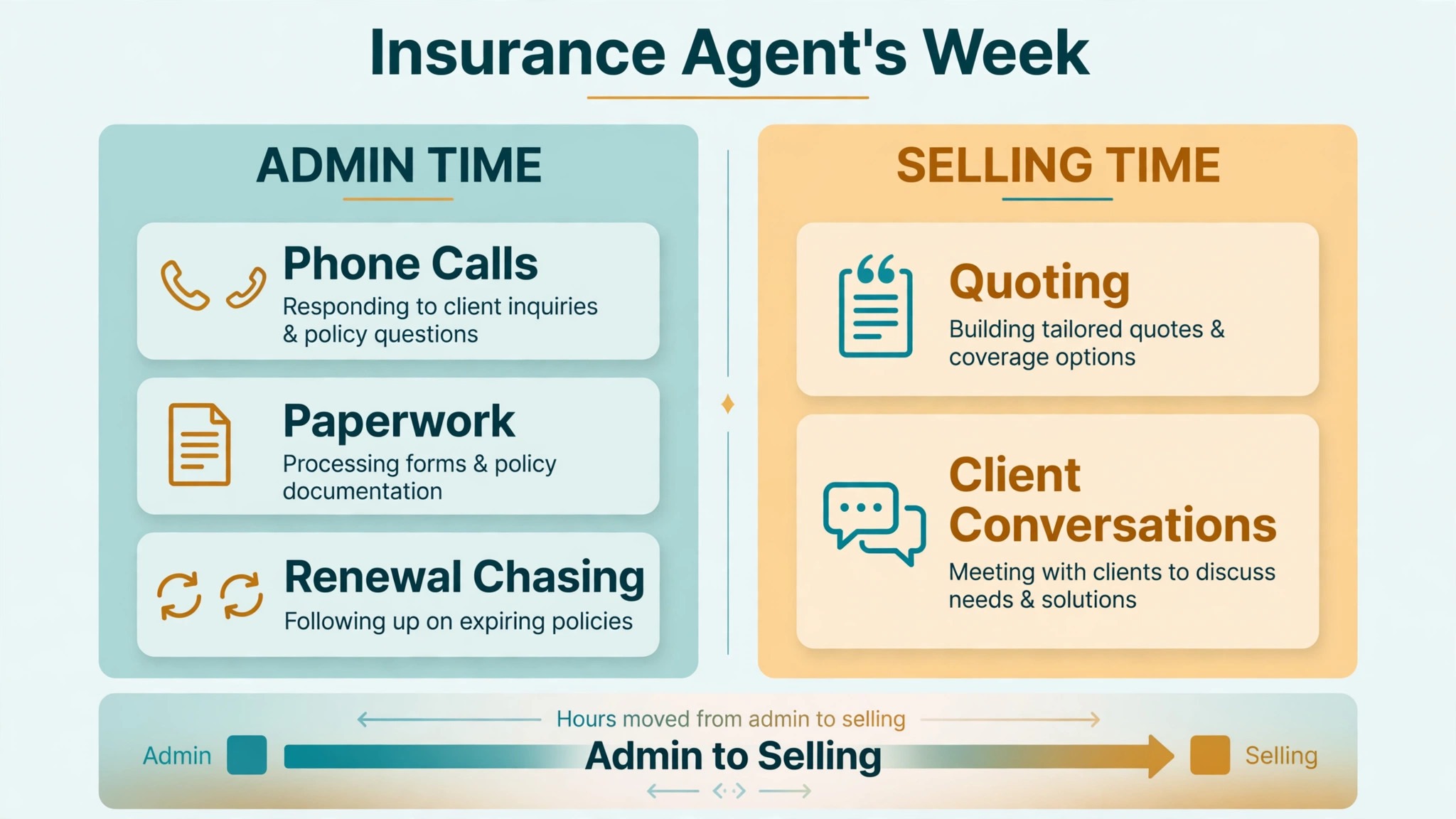
A Liberty Mutual survey of more than 1,100 independent agency principals and staff found that 65 percent of agents used AI for work in the past year, up from 37 percent the year before, and 41 percent now use it weekly. The agencies pulling ahead are not the ones with the biggest budgets. They are the ones that stopped paying producers to retype dec pages, chase renewal paperwork and return the same five phone calls. The best ai tools for insurance agents take those jobs off the desk, so producers spend their hours quoting, advising and closing.
This guide compares the best ai tools for insurance agents on real prices, the job each one does best and the catch that only shows up after the trial. Prices come from vendor pricing pages and independent roundups checked in November 2026, and where a vendor sells by quote only, this guide says so instead of guessing. One warning up front. AI output is not compliance reviewed. Anything a tool drafts for a client still needs a licensed producer and state regulation review before it goes out, and anything it says about coverage needs a human check.
The Quick Shortlist
The table below matches each common agency job to the single tool that handles it best. Use it to narrow the best ai tools for insurance agents to two or three candidates before you read the full reviews. Prices are monthly list prices unless noted, and annual billing is usually cheaper than paying month to month.
| Job | Best tool | Why it wins |
|---|---|---|
| Agency CRM with AI built in | AgencyZoom | AI follow up inside the system your producers already open, from 149 dollars a month |
| Comparative rating and quoting | EZLynx | Real time rating across more than 330 carriers |
| AI receptionist built for insurance | GAIL | Answers calls, texts and chat around the clock, from 40 dollars a person a month |
| Client data intake without the chase | Canopy Connect | Prospects share carrier data themselves, from 100 dollars a month |
| AI call answering and claims intake | Frontdesk | Qualifies quote calls and logs claims, from 79 dollars a month billed annually |
| Human backed call answering | Smith.ai | Live receptionists plus AI, from 300 dollars a month |
| Call notes and summaries | Fathom | Accurate meeting notes with a free plan, Premium from 16 dollars a month billed annually |
| Meeting transcripts for the team | Fireflies.ai | Shared call memory from 10 dollars a seat a month billed annually |
| Everyday drafting and research | ChatGPT | The general assistant every producer already knows, Plus from 20 dollars a month |
| Policy document summaries | Claude | Long document reading and careful drafting, Pro from 17 dollars a month billed annually |
| Client retention and referrals | Levitate | Keeps past clients warm with personal outreach, reported from around 150 dollars a month |
| Marketing and content automation | Runable | Insurance workflows out of the box, free tier with Pro from 20 dollars a month |
How We Judged the Best AI Tools for Insurance Agents
A tool earned a place here only if it does a real agency job in 2026, not if it added an AI button to an old product. The best ai tools for insurance agents prove their value in the first 30 days, not in a demo. We judged each one on five things that decide whether an agency keeps paying after the trial.
First, the job it does, from answering the phone to rating a quote to chasing a renewal, because a tool that does one job well beats a platform that does five jobs poorly. Second, the starting price a small agency can actually buy, including whether a free plan exists and what the paid plan really includes.
Third, where it fits in the stack, because a tool that writes back to your agency management system saves more time than one that needs a new tab and a new login. Fourth, the quality of its AI output, from call summaries a producer can trust to quote data that arrives structured instead of as a blurry photo. Fifth, the catch, from per minute charges that quietly double the bill to quote only pricing that hides the real cost until the sales call.
| Check before you buy | What to ask | Why it matters |
|---|---|---|
| AMS integration | Does it write back to Applied Epic, EZLynx, HawkSoft or AgencyZoom | No write back means double entry forever |
| Per call and per minute charges | What burns minutes, and what happens over the limit | Stops a 99 dollar plan becoming a 300 dollar plan |
| Compliance review | Who checks AI drafts before they reach a client | Unreviewed coverage advice creates E and O risk |
| Carrier coverage | Which carriers and lines does it rate or pull data from | A rater without your carriers is a demo, not a tool |
| Free plan limits | How many calls, minutes or seats before you pay | Tells you if the trial is a real test |
| Contract terms | Month to month, or annual only | Quote only tools often mean annual contracts |
The 12 Tools, Reviewed One by One
1. AgencyZoom
Starting price From 149 dollars a month, 7 seats included. Best for Agency CRM with AI built in. Watch out The AI features sit on top of a full CRM, so the value depends on your team actually living in it.
AgencyZoom is where most independent agencies should start, because it is the system producers already open every morning, now with AI doing the follow up work inside it. The platform combines CRM, sales automation, texting and email, and its AI drafts follow up messages, scores leads and flags the renewals that need attention before they slip. A producer who used to keep a spreadsheet of stale quotes now gets a prioritized list of who to call and what to say.
The strength is that nothing needs syncing. The AI works on the same book your team already manages, so a follow up text goes out with the right policy context and the reply lands on the same record. For an agency of five to twenty producers, that native fit saves more hours than any standalone tool, because there is no integration to break and no second login to open.
The catch is adoption. AgencyZoom only pays off if producers work their pipelines inside it every day. If half the team still tracks renewals in personal spreadsheets, the AI has nothing to work with. At 149 dollars a month with seven seats included, the price is fair for a team that commits. Buy it when you are ready to run the agency out of one system, not when you want a quick add on.
2. EZLynx
Starting price Quote only, with third party reports around 200 to 600 dollars a month. Best for Comparative rating and quoting. Watch out Pricing is opaque, so get the full quote in writing before you compare it to anything else.
EZLynx is the quoting platform personal lines agents measure everything else against, and its AI assistant, EVA, now helps inside the rating workflow. The platform offers real time comparative rating across more than 330 carriers, so a producer can quote a household across multiple carriers in one screen instead of logging into five carrier portals. That speed is the difference between winning a quote and losing it to the agent who called back first.
The AI adds a second layer. EVA answers questions about the book, summarizes policy information and helps producers find what they need without digging through menus. For an agency writing personal lines at volume, the combination of fast rating and an assistant that knows the book is hard to replace.
3. GAIL
Starting price GailGPT from 40 dollars a person a month. Gail Agent from 425 dollars a month including 5 users. Best for AI receptionist built for insurance. Watch out The full agent plan is a serious monthly commitment, so start with the lighter tier and measure missed calls first.
GAIL is the best AI receptionist for insurance agents in 2026 because it was built specifically for insurance and financial services, and it publishes its pricing. It answers the phone, text, chat and email around the clock, takes first notice of loss details, books appointments and qualifies new business callers before a producer ever picks up. An agency that misses calls after hours stops losing those callers to the next agency in the search results.
The strength is insurance fluency. GAIL understands the shape of an insurance conversation, from a caller reporting a fender bender to a prospect asking about a homeowners quote, and it captures the structured details a producer needs to quote. That matters more than a generic voice agent, which can answer a call but cannot tell a claim from a quote request.
The catch is the step up in price. GailGPT at 40 dollars a person a month covers the lighter assistant work, while the full Gail Agent at 425 dollars a month is a real line item. For a one or two person agency, start with GailGPT and track how many after hours calls it catches. For a growing agency, the Agent plan pays for itself the first month it catches a handful of quotes that would have gone to voicemail.
4. Canopy Connect
Starting price From 100 dollars a month billed annually. Best for Client data intake without the back and forth. Watch out Prospects still have to log in to their carrier account, so some will prefer the old photo of a dec page.
Canopy Connect fixes one of the most tedious jobs in an agency. Instead of chasing a prospect for dec pages, it lets the prospect share their current insurance information by logging into their existing carrier account, or by uploading dec pages the platform parses. Coverages, limits and drivers arrive structured, ready to quote, instead of as blurry phone photos that a producer has to retype.
The value is speed to quote. A producer who gets clean data in minutes can quote the same day, while the agency still waiting on a faxed dec page quotes three days later. That gap decides a surprising number of new business wins, especially in personal auto and homeowners where the buyer is comparing three quotes at once.
5. Frontdesk
Starting price 99 dollars a month, or 79 dollars a month billed annually, including 200 voice minutes. Best for AI call answering and claims intake. Watch out Minutes over the included 200 cost extra, so track usage in heavy months.
Frontdesk answers calls, takes claims intake, qualifies quote calls and books the producer call, with integrations for Applied Epic, Vertafore AMS360, EZLynx and HawkSoft. It is the practical middle ground between a generic voice agent and a full human answering service. A caller gets a capable conversation, and the producer gets a structured summary instead of a voicemail to decode.
The strength is the insurance specific workflow. Frontdesk knows the difference between a first notice of loss and a billing question, and it routes each one correctly. Claims intake that arrives structured saves the producer the ten minute phone tag that usually follows a claim call, and quote qualification means producers only take calls from prospects who are actually ready to talk numbers.
6. Smith.ai
Starting price Receptionist plans from 300 dollars a month for 30 calls. Best for Human backed call answering. Watch out Per call charges over the included block add up fast in a busy month.
Smith.ai is the pick for agencies that want a human voice on the phone, backed by AI. Its receptionist plans combine live agents with AI handling, so callers talk to a person who can qualify, schedule and take messages, while the AI layer keeps the intake consistent and the notes structured. For an agency whose brand is personal service, that human first impression matters more than any automation feature.
The strength is the handoff. A caller who needs a producer gets one, a caller who needs a quote gets qualified, and a caller with a claim gets the right intake path. The notes arrive in the agency’s system the same day, so nothing depends on a producer remembering a voicemail. Smith.ai also offers outbound calling for lead follow up, which turns it from a cost into a revenue tool for agencies with stale lead lists.
7. Fathom
Starting price Premium 20 dollars a month, or 16 dollars a month billed annually. Free forever plan available. Best for Call notes and summaries. Watch out The free plan limits AI summaries, so heavy users need the paid tier.
Fathom records, transcribes and summarizes client calls, then turns them into notes a producer can trust. A producer who takes six client calls a day stops writing notes after each one, and the summary captures the coverage discussion, the agreed next step and the follow up date. That record matters in insurance more than in most industries, because what was said about coverage can matter months later.
The strength is accuracy and simplicity. Fathom’s summaries are consistently rated among the best in its category, and the free forever plan lets a single producer test it on real client calls before paying. The paid Premium plan at 20 dollars a month, or 16 on annual billing, removes the limits that a busy producer hits quickly.
8. Fireflies.ai
Starting price Pro 10 dollars a seat a month billed annually. Free forever plan available. Best for Meeting transcripts for the team. Watch out Storage and AI summary limits on the free plan push a busy team to paid quickly.
Fireflies.ai records, transcribes and summarizes sales and client calls, then turns them into searchable notes the whole agency can use. Its AI assistant answers questions about past calls, pulls out action items and syncs notes to the CRM. A producer who quoted a client three months ago can search the call before the renewal conversation instead of guessing what was promised.
The strength is sharing. A call summary is not trapped in one producer’s notebook. It lives in a shared workspace where the next producer on the account can read it before the follow up call, and the CRM record updates without manual entry. Pro at 10 dollars a seat a month billed annually is the plan most teams buy, and a free plan exists for a single user to test.
9. ChatGPT
Starting price Plus 20 dollars a month. Free tier available. Best for Everyday drafting and research. Watch out It will invent policy details if you let it, so never send its output on coverage without a human check.
ChatGPT is the general assistant every producer already knows, and in an agency it earns its keep on the writing jobs that fill a producer’s day. It drafts client emails, rewrites renewal letters in plain language, summarizes long carrier bulletins and turns a rough set of notes into a clean follow up message. A producer who writes twenty client emails a day can cut that time in half without hiring anyone.
The strength is flexibility. No insurance specific tool can match a general model for the odd jobs, from drafting a LinkedIn post about a new product to explaining a deductible change in language a client actually understands. The paid Plus plan at 20 dollars a month brings stronger data controls and the better model, which matters when client information is involved.
The catch is the one that applies to every general model. ChatGPT does not know your carriers, your state rules or your client’s policy unless you tell it, and it will produce confident sounding coverage statements that are wrong. Keep a human review step on anything a client will read, and never paste unredacted client data into a free tier. Used with those guardrails, it is the cheapest productivity gain on this list.
10. Claude
Starting price Pro 20 dollars a month, or 17 dollars a month billed annually. Free plan available. Best for Policy document summaries. Watch out Pro usage limits apply on heavy days, so check the plan before a big document project.
Claude is the tool producers reach for when a draft has to read like a person wrote it, and when the document is long. Its long context window handles full policy documents, carrier contracts and renewal packets in one pass, and it summarizes them with fewer errors than most models. A producer comparing two carrier proposals can ask Claude to lay out the coverage differences side by side instead of reading forty pages twice.
The strength is careful drafting. Claude follows detailed style instructions well, which matters when an agency wants every client email to sound like the agency, not like a chatbot. It also handles long form writing, from a client newsletter to a coverage explainer, with a steadier tone than its rivals. Pro at 20 dollars a month, or 17 on annual billing, is the plan most producers buy.
11. Levitate
Starting price No public pricing. Third parties report from around 150 dollars a month billed annually. Best for Client retention and referrals. Watch out The price is reported, not verified on the vendor site, so confirm it on a demo before you budget.
Levitate keeps past clients warm with personal outreach, and in insurance that is where the money is. Most agencies lose more revenue to quiet attrition than to lost quotes, because a client who never hears from their agent shops at renewal. Levitate drafts personalized check ins, birthday messages and referral asks, timed to the relationship, so the agent stays visible without writing every message by hand.
The strength is the retention math. Keeping an existing client costs far less than winning a new one, and a steady stream of small personal touches is what stops a client from taking the first cheaper quote they see online. Levitate’s outreach reads like it came from the agent, not from a marketing platform, which is the difference between a message that gets read and one that gets deleted.
The catch is the pricing opacity. The vendor does not publish rates, and third party reports put the entry point around 150 dollars a month on annual billing. That is a real commitment for a small agency, and it only pays off if the team actually uses the outreach cadence. Ask for a trial, measure reply rates for a month, and judge it on renewals retained rather than on messages sent.
12. Runable
Starting price Free tier. Pro 20 dollars a month, Max 100 dollars a month. Best for Marketing and content automation. Watch out It is a general AI agent with insurance workflows, not an agency management system, so it will not replace your CRM.
Runable is the best AI tool for insurance agents’ marketing, content and client communication automation, because it is the only general AI agent on this list with a native insurance workflow category. It automates the marketing jobs that agencies usually leave undone, from social posts and client newsletters to follow up sequences, with workflows built for insurance rather than adapted from a generic template.
The strength is the starting price. A free tier lets a small agency test the workflows before paying, and Pro at 20 dollars a month is the cheapest paid entry on this list. For a one or two person agency that cannot afford a marketing hire, Runable covers the content and communication work that keeps the agency visible between renewals.
Side by Side Comparison
| Tool | Starting price | Best for | Free plan |
|---|---|---|---|
| AgencyZoom | From 149 dollars a month | Agency CRM with AI built in | Trial only |
| EZLynx | Quote only, reported 200 to 600 dollars a month | Comparative rating and quoting | No |
| GAIL | From 40 dollars a person a month | AI receptionist built for insurance | No |
| Canopy Connect | From 100 dollars a month, annual | Client data intake without the chase | No |
| Frontdesk | 79 dollars a month, annual | AI call answering and claims intake | Trial only |
| Smith.ai | From 300 dollars a month | Human backed call answering | No |
| Fathom | 16 dollars a month, annual | Call notes and summaries | Yes |
| Fireflies.ai | 10 dollars a seat a month, annual | Meeting transcripts for the team | Yes |
| ChatGPT | 20 dollars a month | Everyday drafting and research | Yes |
| Claude | 17 dollars a month, annual | Policy document summaries | Yes |
| Levitate | Reported from around 150 dollars a month | Client retention and referrals | No |
| Runable | Free tier, Pro 20 dollars a month | Marketing and content automation | Yes |
How to Pick the Right Tool for Your Agency
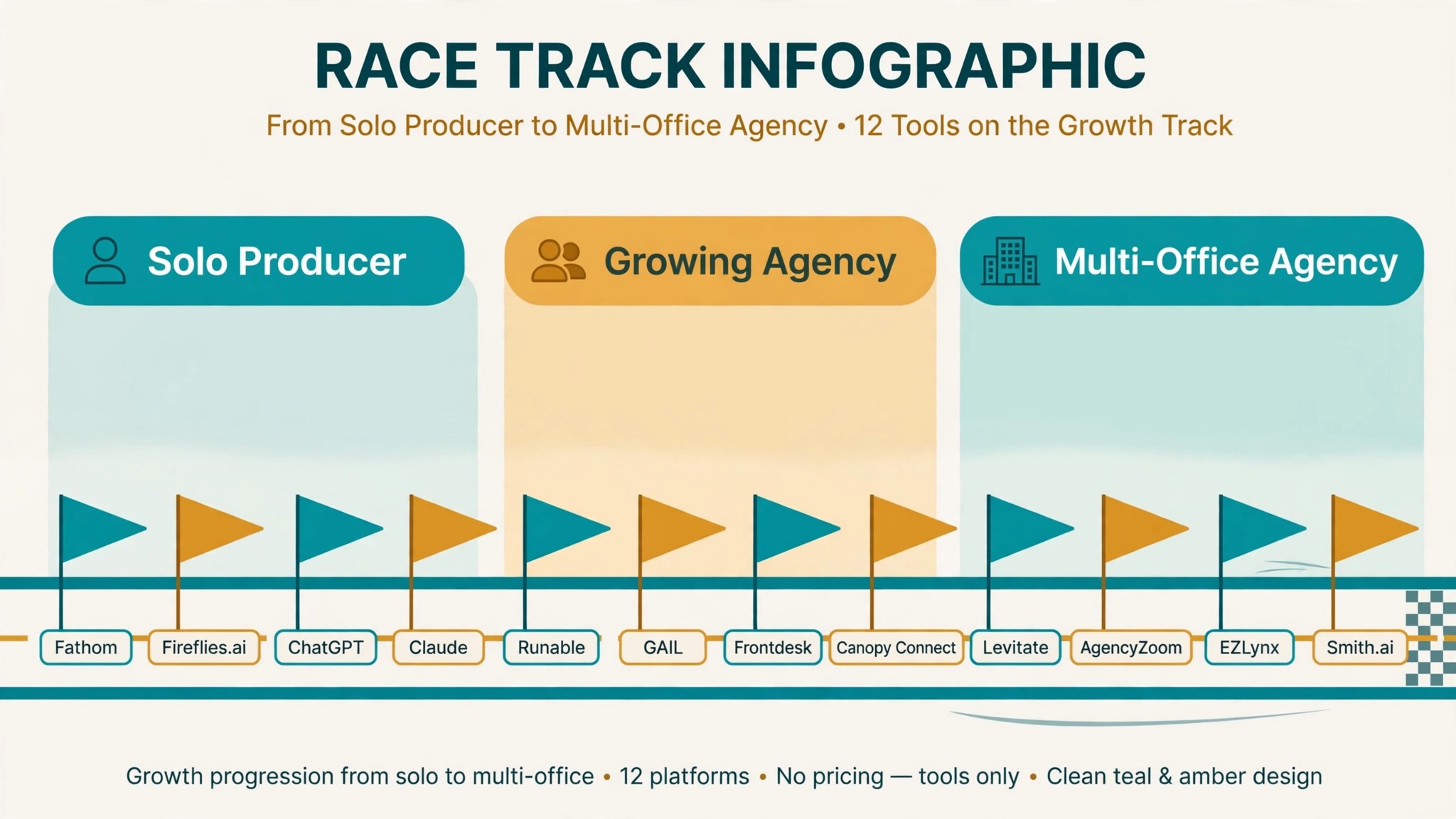
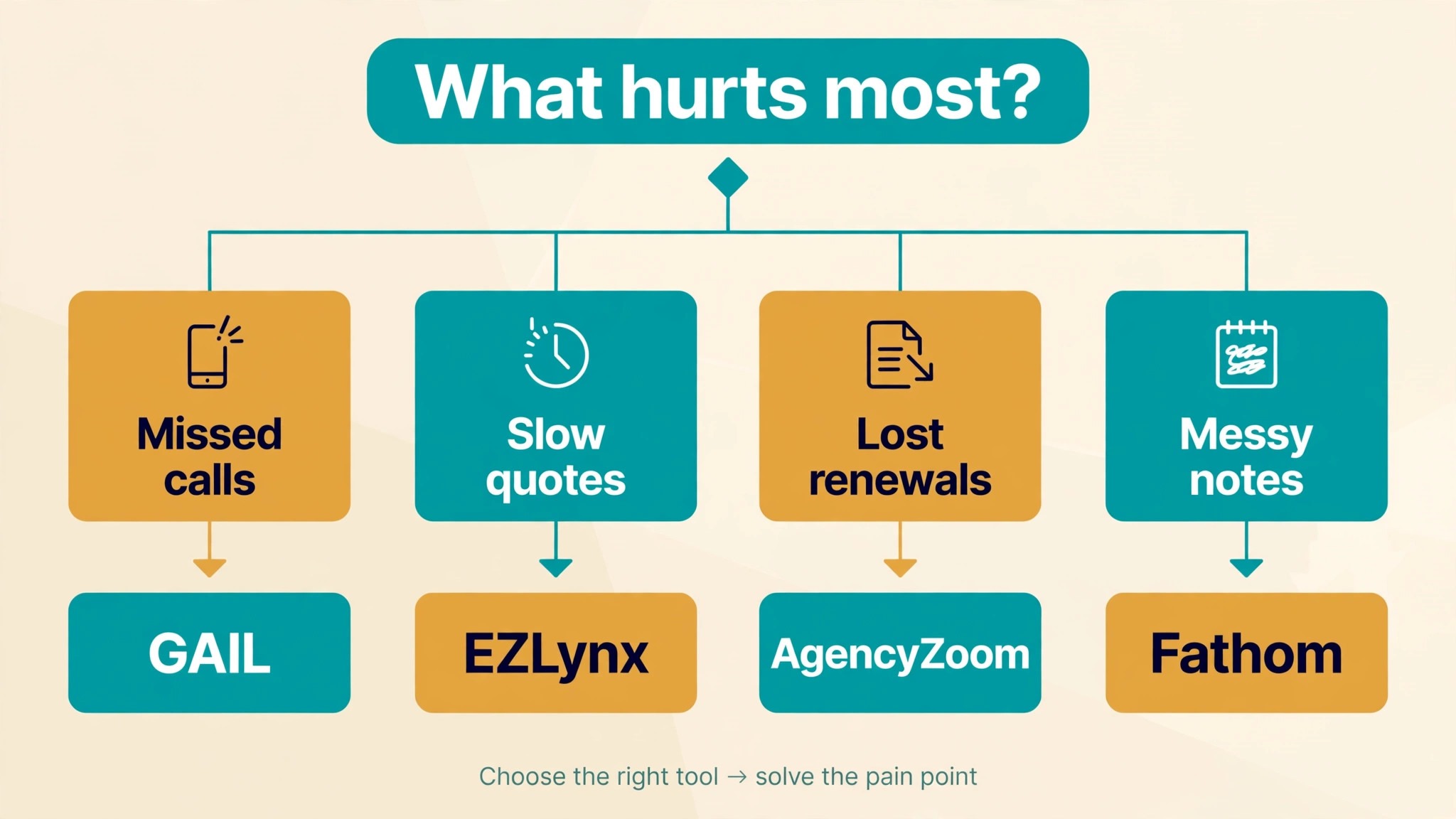
The best ai tools for insurance agents are not the ones with the longest feature list. They are the ones that fix the bottleneck your agency feels every week. An agency that misses calls should buy GAIL or Frontdesk. An agency that loses quotes to slow turnaround should buy EZLynx and Canopy Connect. An agency that loses clients at renewal should buy Levitate and AgencyZoom. An agency that drowns in notes and emails should buy Fathom and ChatGPT. Start from the bottleneck, not from the vendor homepage.
Budget the full stack, not the headline price. The table below shows what a five producer agency actually pays in year one for the most common combinations, using starting annual prices. Per minute charges, platform fees and add ons are the lines that surprise buyers, so ask for them in writing before you sign.
| Stack for a five producer agency | Monthly cost, annual billing | What it covers |
|---|---|---|
| AgencyZoom, 7 seats included | 149 dollars | CRM, follow up, texting, AI drafting |
| AgencyZoom plus Fathom, 5 seats | 229 dollars | CRM plus accurate call notes |
| Frontdesk plus Canopy Connect | 179 dollars | Call answering plus fast data intake |
| GAIL Agent plus ChatGPT Plus | 445 dollars | Full receptionist plus everyday drafting |
| Runable Pro plus Fireflies.ai, 5 seats | 70 dollars | Marketing plus shared call memory |
| EZLynx, reported range | 200 to 600 dollars | Comparative rating across 330 carriers |
Frequently Asked Questions
What is the cheapest good AI tool for an insurance agency
Runable Pro at 20 dollars a month and ChatGPT Plus at 20 dollars a month are the cheapest useful paid entries, and both have free tiers to test first. Fathom Premium at 16 dollars a month billed annually is the cheapest call note tool with a free plan behind it. The cheapest stack that actually works is usually Runable for marketing plus Fathom for call notes, which costs less than 40 dollars a month for a solo producer.
Do AI tools replace insurance agents
No, and the agencies that treat them as replacements get the worst results. AI replaces the retyping, chasing, logging and drafting work that sits around selling insurance, which is roughly a third of a producer’s week. The advice, the coverage judgment and the relationship still belong to a licensed person. Buy AI to give each producer more selling hours, not to cut heads, and measure the return in quotes written and renewals kept rather than in seats saved.
Which tool is best for quoting and comparative rating
EZLynx is the best single tool for most personal lines agencies, because it rates across more than 330 carriers in one screen and its EVA assistant works inside the rating workflow. Canopy Connect is the best companion, because it gets clean client data in minutes instead of days. Pick EZLynx if you quote personal lines every day, and add Canopy Connect if slow data intake is what delays your quotes.
How much should a five producer agency budget for AI tools
A realistic year one budget for the best ai tools for insurance agents is 150 to 300 dollars a month for a small agency using self serve tools, and 500 dollars a month or more once you add a full AI receptionist like GAIL Agent or a comparative rater like EZLynx. Per minute and per call charges can push the bill higher in heavy months, so set a monthly cap and review usage in the first 90 days. Quote only tools need a sales call to price, so budget a range and get the platform fee in writing.
Is it safe to let AI talk to clients about coverage
Only with a human in the loop. AI can answer routine questions, take a claim report and book an appointment, but anything it says about what a policy covers needs a licensed producer’s review. Set the tool to escalate coverage questions to a person, log every client facing conversation, and review the logs weekly in the first month. The risk is not the AI being wrong once. It is the AI being wrong quietly, at scale, while nobody checks.
Our Verdict
If you buy one tool this quarter, buy AgencyZoom. It covers the most of the agency job at a published price a small team can afford, and it is the fastest way to find out whether AI follow up works for your book. The best ai tools for insurance agents earn their keep by giving producers selling hours back, and AgencyZoom does that from the first week, without an enterprise contract or a platform switch.
Whatever you pick, start with the bottleneck, trial with real clients, and keep a human in the loop on anything a client will read for the first month. The best ai tools for insurance agents on this list all work. The difference is whether the tool matches the job your agency actually needs done, and whether you measure the return in policies written and renewals kept rather than in features used.