

The weekly issue used to take a whole afternoon, and for many newsletter writers it still does, because the work is spread across spreadsheets, chat apps and a tool that only does half the job. The top 10 ai tools for newsletter writing in this guide pull that work into one place, so the routine parts run themselves and the skilled parts get the time they deserve.
Every price below is the published starting price as of late 2026, with annual billing noted where it changes the newsletter drafting number. Use the shortlist first, then read the reviews that match the newsletter drafting jobs newsletter writing do most. Nobody needs all 10 tools on this list. One general tool plus one specialist covers most of the newsletter drafting work, and a third tool only earns its place when it fixes a specific weekly pain.
The reviews below say plainly which newsletter drafting job each tool does, so you can pick two and stop shopping. The top 10 ai tools for newsletter writing are not ranked by price alone, because the cheapest tool that cannot do your job is the most expensive mistake on this list.
The Shortlist at a Glance
The table below matches each common weekly issue to the single tool that handles it best. Use it to narrow the top 10 ai tools for newsletter writing to two or three candidates before you read the full reviews. Prices are monthly list prices unless noted, and annual billing usually beats monthly billing for newsletter teams.
| Job | Best tool | Why it wins |
|---|---|---|
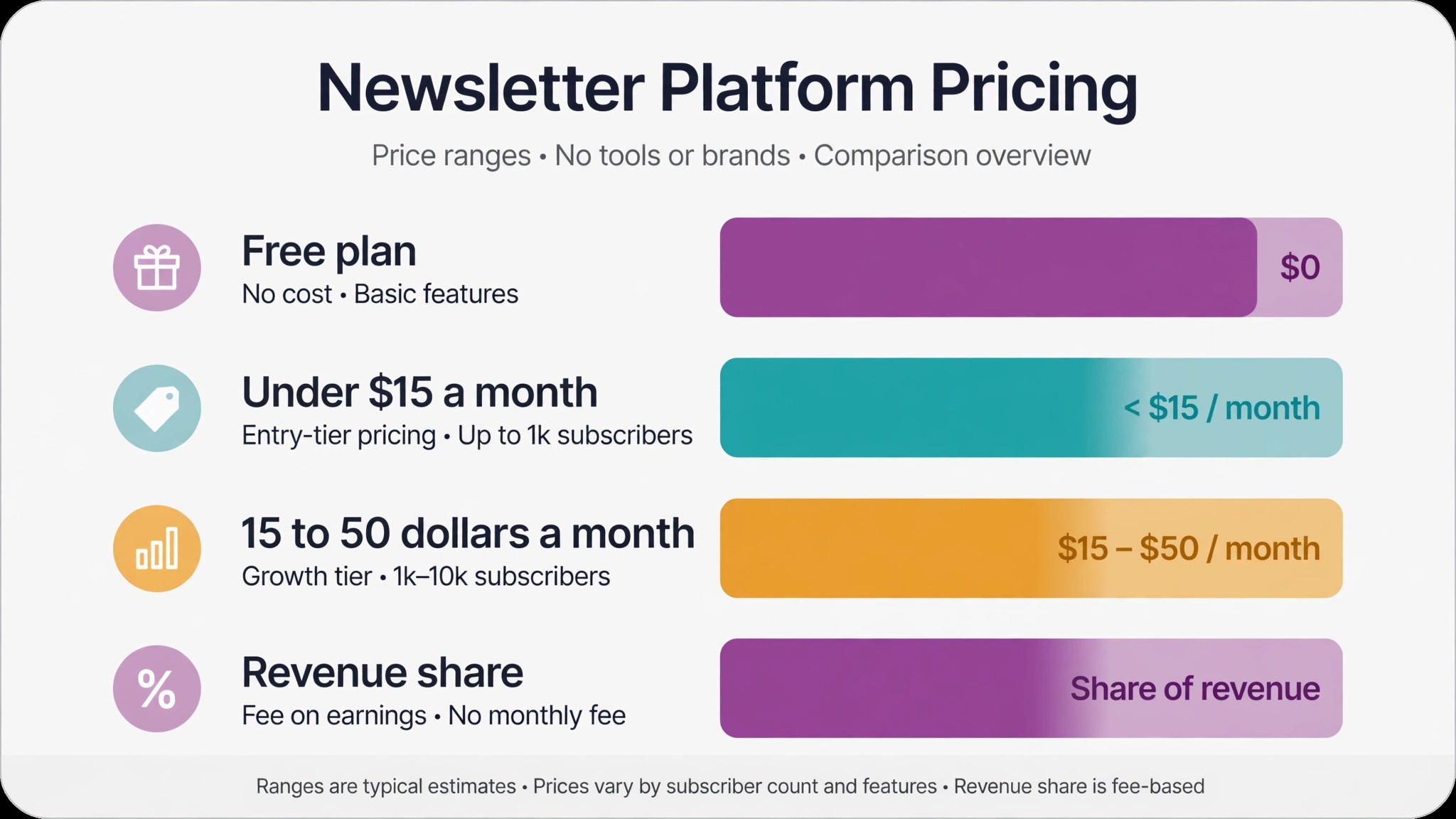
| Newsletter businesses that want growth plus monetisation. | beehiiv | Free plan to 2,500 subscribers, then Lite from 49 dollars a month billed annually. |
| Writers who want a free start and a built-in audience. | Substack | Free to start, with Substack taking 10 percent of paid subscription revenue plus card fees. |
| Creators who sell products alongside the newsletter. | Kit | Free plan to 10,000 subscribers, then Creator from 33 dollars a month billed annually at 1,000 subscribers. |
| Businesses that need general email marketing, not just a publication. | Mailchimp | Free plan to 250 contacts, then Essentials from 13 dollars a month. |
| Small teams that want good design at a low price. | MailerLite | Free plan to 250 subscribers, then Comfort from 12 dollars a month. |
| Publishers who want a real website and zero revenue cut. | Ghost | No free hosted plan, then Publisher from 29 dollars a month billed annually on Ghost(Pro). |
| Writers who want a minimal, fast newsletter tool. | Buttondown | Free plan to 100 subscribers, then 9 dollars a month at 1,000 subscribers. |
| Small senders who want the cheapest built-in AI. | Brevo | Free plan with 300 emails a day, then Starter from 9 dollars a month. |
| Ecommerce stores that send newsletters plus product emails. | Omnisend | Free plan, then Standard from 16 dollars a month, with Pro from 59 dollars a month. |
| Businesses that want a cheap, simple newsletter. | Mailercloud | Free plan to 1,000 subscribers, then 10 dollars a month for 5,000 subscribers. |
How We Chose the Top 10 AI Tools for Newsletter Writing
A tool earned a place here only if it does a real weekly issue in 2026, not if it added an AI label to an old product. The top 10 ai tools for newsletter writing were judged on five things that decide whether a team keeps paying after the first year.
First, the job, because newsletter teams get more from a tool that does one newsletter drafting format well than from a platform that does five poorly. Second, published pricing and scaling, including per-seat charges that change the real bill as newsletter writing grow. Third, output quality, because errors cost newsletter teams more in lost trust than the subscription saves.
Fourth came workflow fit, since newsletter writing need the tool inside their existing newsletter drafting process, not a rebuild of it. Fifth came the catch, from free plans that watermark exports to template libraries that repeat the same ten newsletter drafting designs. Those five checks become the questions in the table below, for newsletter teams to ask before buying.
| Check before you buy | What to ask | Why it matters |
|---|---|---|
| Real job fit | Does it do my weekly job well | A poor fit wastes the subscription |
| Published price | What does year two cost | Hidden rises break the budget |
| Output quality | Is the result good enough to ship | Errors cost trust with clients |
| Workflow fit | Does it connect to my other tools | A disconnected tool adds manual work |
| Free plan limits | What is locked behind the paywall | A locked export cannot be used |
| Contract terms | Monthly or annual, and what changes | Annual billing locks the price, not the need |
The Reviews in Full
1. beehiiv
Starting price Free plan to 2,500 subscribers, then Lite from 49 dollars a month billed annually. Best for Newsletter businesses that want growth plus monetisation. Watch out The bill scales with subscribers, so a fast-growing list gets expensive.
beehiiv is built for people whose newsletter is the business. It includes a hosted website, a recommendation network that grows the list, paid subscriptions and an ad network that pays for sponsor placements. The editor is clean, the analytics show which issues earn, and beehiiv takes 0 percent of paid subscription revenue on paid plans.
The strength is monetisation built in. A writer can grow with recommendations, sell subscriptions and run ads without bolting on three extra tools. The catch is the price curve: Lite at 49 dollars a month billed annually is fair at 1,000 subscribers, but the bill rises with the list. For newsletter-first publishers, beehiiv earns its place.
2. Substack
Starting price Free to start, with Substack taking 10 percent of paid subscription revenue plus card fees. Best for Writers who want a free start and a built-in audience. Watch out The 10 percent cut grows with revenue, and the design is Substack’s, not yours.
Substack is the simplest way to start a paid newsletter: write, publish, charge readers, and let the platform handle payments and delivery. Its app puts your publication in front of readers who already browse Substack, which is discovery no other tool here offers. There is no monthly fee at any list size.
The strength is the zero monthly bill and the built-in audience. A writer can test a paid newsletter without spending a dollar. The catch is the 10 percent revenue cut, which overtakes a flat subscription fee once revenue grows, and the limited design control. For writers testing paid subscriptions, Substack earns its place.
3. Kit
Starting price Free plan to 10,000 subscribers, then Creator from 33 dollars a month billed annually at 1,000 subscribers. Best for Creators who sell products alongside the newsletter. Watch out Paid plans charge a transaction fee on sales, and the page design is plain.
Kit, formerly ConvertKit, is built for creators who sell. It combines newsletters with landing pages, automations and a shop for digital products, so a reader can go from an issue to a purchase without leaving the system. The free plan covers up to 10,000 subscribers, which is the most generous free tier on this list.
The strength is creator commerce. A writer who sells courses, templates or paid newsletters gets the store and the email in one account. The catch is the 3.5 percent plus 30 cents fee on each transaction, which adds up on product sales. For creators who sell, Kit earns its place.
4. Mailchimp
Starting price Free plan to 250 contacts, then Essentials from 13 dollars a month. Best for Businesses that need general email marketing, not just a publication. Watch out The free plan is small, and the best AI sits on the Standard plan from 20 dollars a month.
Mailchimp is the mass-market email platform, with templates, automations, segmentation and more than 300 integrations. Its Intuit Assist AI drafts email copy, suggests subject lines and writes preview text, and send-time optimisation picks the hour each subscriber opens. For a business that sends newsletters plus promotions and receipts, one account covers all of it.
The strength is the ecosystem. A shop, a CRM and an email tool that all talk to each other saves more time than a prettier editor. The catch is the free plan, cut to 250 contacts, and the AI features that only unlock on Standard. For businesses that email for many reasons, Mailchimp earns its place.
5. MailerLite
Starting price Free plan to 250 subscribers, then Comfort from 12 dollars a month. Best for Small teams that want good design at a low price. Watch out The free plan is small, and the AI writing assistant sits on a higher tier.
MailerLite is the affordable everyday option, with a drag-and-drop editor, landing pages, automations and a clean reporting view. Its AI writing assistant drafts subject lines and body copy, and the templates look modern without a designer. At 1,000 subscribers the Comfort plan is among the cheapest paid steps on this list.
The strength is value. A small team gets a polished newsletter tool for about 12 dollars a month, with an editor that non-designers learn fast. The catch is the 250-subscriber free plan and the AI features that need the Growing Business tier. For small teams on a budget, MailerLite earns its place.
6. Ghost
Starting price No free hosted plan, then Publisher from 29 dollars a month billed annually on Ghost(Pro). Best for Publishers who want a real website and zero revenue cut. Watch out No free hosted tier, and self-hosting needs technical setup.
Ghost is an open publishing platform with newsletters built in. A publication gets a real website with any theme, memberships, paid subscriptions and 0 percent platform fees, with Stripe handling payments. The editor is a pleasure to write in, and the site is yours to design, unlike the walled gardens on this list.
The strength is ownership. Publisher at 29 dollars a month billed annually buys a website, a newsletter and paid memberships with no cut of revenue. The catch is that the hosted plan has no free tier, and self-hosting is free but technical. For publishers who want their own site, Ghost earns its place.
7. Buttondown
Starting price Free plan to 100 subscribers, then 9 dollars a month at 1,000 subscribers. Best for Writers who want a minimal, fast newsletter tool. Watch out Minimal features mean no landing-page builder or ad network.
Buttondown is the minimalist of this list: a fast editor, simple archives, paid subscriptions and an API, with nothing extra. It suits writers who want to send a clean email every week without learning a platform. The price is low, the interface is fast, and the focus stays on the writing.
The strength is focus and price. At 9 dollars a month for 1,000 subscribers, it is the cheapest paid step here, and the tool never gets in the way of the writing. The catch is scope: there is no website builder, no ad network and no growth network. For writers who want less tool, Buttondown earns its place.
8. Brevo
Starting price A free plan covering 300 emails a day, with Starter starting at 9 dollars a month. Best for Small senders who want the cheapest built-in AI. Watch out Pricing scales by emails sent, not subscribers, which confuses budgeting.
Brevo started as an email platform and now covers SMS and marketing automation too. Its AI content generator writes email copy and subject lines, and at 9 dollars a month on Starter it is the cheapest built-in AI on this list. The free plan sends 300 emails a day, which covers a small weekly newsletter.
The strength is the AI price. A writer gets subject-line and copy help for less than ten dollars a month, with automations included. The catch is the billing model: Brevo charges by emails sent, so a growing list with frequent sends costs more than the subscriber count suggests. For budget senders, Brevo earns its place.
9. Omnisend
Starting price Free plan, then Standard from 16 dollars a month, with Pro from 59 dollars a month. Best for Ecommerce stores that send newsletters plus product emails. Watch out Built for shops, so pure writers pay for features they never use.
Omnisend is built for ecommerce stores, combining newsletters with product recommendations, abandoned-cart emails and SMS. Its free AI subject-line generator and copy tools work on the free plan, which is rare on this list. Segments build from purchase behaviour, so a newsletter can target buyers of a specific product.
The strength is the free AI. A store gets subject lines, copy help and segmentation without paying, and the paid plans add automation depth. The catch is fit: the tool is built for shops, so a writer with no store pays for commerce features. For stores that publish a newsletter, Omnisend earns its place.
10. Mailercloud
Starting price Free plan to 1,000 subscribers, then 10 dollars a month for 5,000 subscribers. Best for Businesses that want a cheap, simple newsletter. Watch out A smaller ecosystem than Mailchimp, with fewer integrations.
Mailercloud is the quiet value pick: free for 1,000 subscribers with 12,000 emails a month, then 10 dollars a month for 5,000 subscribers with unlimited sends. It covers templates, automations and reporting without the complexity of the big platforms, and the price at 5,000 subscribers undercuts most rivals by a wide margin.
The strength is the price at scale. A business newsletter at 5,000 subscribers costs 10 dollars a month here against 49 dollars or more elsewhere. The catch is the smaller integration library, so a team with an unusual stack should check compatibility first. For businesses that want cheap and simple, Mailercloud earns its place.
The Top 10 AI Tools for Newsletter Writing Side by Side
The table below puts the top 10 ai tools for newsletter writing side by side on price, best job and free plan, so you can compare the published prices at a glance. Check the best-for column before the price, since a five-dollar tool that fails the newsletter drafting job costs newsletter writing more than a dearer tool that does it well.
| Tool | Starting price | Best for | Free plan |
|---|---|---|---|
| beehiiv | Free plan to 2,500 subscribers, then Lite from 49 dollars a month billed annually. | Newsletter businesses that want growth plus monetisation. | Yes |
| Substack | Free to start, with Substack taking 10 percent of paid subscription revenue plus card fees. | Writers who want a free start and a built-in audience. | Yes |
| Kit | Free plan to 10,000 subscribers, then Creator from 33 dollars a month billed annually at 1,000 subscribers. | Creators who sell products alongside the newsletter. | Yes |
| Mailchimp | Free plan to 250 contacts, then Essentials from 13 dollars a month. | Businesses that need general email marketing, not just a publication. | Yes |
| MailerLite | Free plan to 250 subscribers, then Comfort from 12 dollars a month. | Small teams that want good design at a low price. | Yes |
| Ghost | No free hosted plan, then Publisher from 29 dollars a month billed annually on Ghost(Pro). | Publishers who want a real website and zero revenue cut. | No |
| Buttondown | Free plan to 100 subscribers, then 9 dollars a month at 1,000 subscribers. | Writers who want a minimal, fast newsletter tool. | Yes |
| Brevo | Free plan with 300 emails a day, then Starter from 9 dollars a month. | Small senders who want the cheapest built-in AI. | Yes |
| Omnisend | Free plan, then Standard from 16 dollars a month, with Pro from 59 dollars a month. | Ecommerce stores that send newsletters plus product emails. | Yes |
| Mailercloud | Free plan to 1,000 subscribers, then 10 dollars a month for 5,000 subscribers. | Businesses that want a cheap, simple newsletter. | Yes |
Best Pick by Job
The top 10 ai tools for newsletter writing are not the ones with the longest feature list. They are the ones that fix the slowest part of the newsletter drafting week. Begin with the slowest newsletter drafting job, not the vendor homepage, and price the full bill, not the headline.
Check the export second, for newsletter writing. A flawless editor result that exports with a watermark is unusable, and a single-format export covers one newsletter drafting channel only. Read the export formats on the pricing page before paying, since the format decides where each newsletter drafting result can travel.
| Stack for one person | Monthly cost | What it covers |
|---|---|---|
| beehiiv plus Substack | See prices above | General tool plus specialist |
| beehiiv alone | See price above | The strongest single pick |
| Buttondown plus a free plan | Low cost | Budget start with room to grow |
The 14-Day Trial, Step by Step
Score the trial against the checklist below, for newsletter writing. Five of six checks passed means the newsletter drafting tool is worth paying for, while failing the first two ends the trial in week one.
| Trial check | Pass means | Fail means |
|---|---|---|
| Real work test | It handles your actual weekly job | It only works on sample data |
| Export test | The result exports cleanly | Watermarks or locked formats |
| Speed test | The job finishes faster than before | It adds steps instead of removing them |
| Team test | A colleague learns it in a day | Only the buyer can use it |
| Price test | Year-two cost is clear in writing | The renewal price is a surprise |
| Support test | Help answers within a day | No answer before the trial ends |
Run the trial on a real weekly issue, not on sample data, because sample data hides the problems that real data exposes. Check the export before paying, because a tool that cannot export newsletter drafting work cleanly owns the work. Get the per-seat price in writing, with year two included, since the headline price rarely covers the full newsletter drafting bill. Time the slowest part of the newsletter drafting week before the trial and after it, because the difference is the only return that matters.
Let the daily user test the newsletter drafting tool, not just the person signing the contract, for newsletter teams. Agree the data rules before importing for newsletter teams, since a cleanup done twice costs more than one done once. One general tool plus one specialist is enough, because five newsletter drafting tools become a second job. Read the cancellation terms first, so a bad fit ends with a click, not a negotiation, for newsletter writing.
Run the trial on a real weekly issue, not on sample data, because sample data hides the problems that real data exposes. Test the export first, since a newsletter drafting tool that cannot hand back clean work owns it for newsletter writing. Ask for the per-seat price in writing, including what year two costs, because the headline price is rarely the full newsletter drafting bill. Clock the slowest newsletter drafting job before and after the trial, since the gap is the only return that matters for newsletter writing.
Let the daily user test the newsletter drafting tool, not just the person signing the contract, for newsletter teams. Agree the data rules before importing for newsletter teams, since a cleanup done twice costs more than one done once. One general tool plus one specialist is enough, because five newsletter drafting tools become a second job. Read the cancellation terms first, so a bad fit ends with a click, not a negotiation, for newsletter writing.
Run the trial on a real weekly issue, not on sample data, because sample data hides the problems that real data exposes. Check the export before paying, because a tool that cannot export newsletter drafting work cleanly owns the work. Get the per-seat price in writing, with year two included, since the headline price rarely covers the full newsletter drafting bill. Time the slowest part of the newsletter drafting week before the trial and after it, because the difference is the only return that matters.
Let the daily user test the newsletter drafting tool, not just the person signing the contract, for newsletter teams. Agree the data rules before importing for newsletter teams, since a cleanup done twice costs more than one done once. One general tool plus one specialist is enough, because five newsletter drafting tools become a second job. Read the cancellation terms first, so a bad fit ends with a click, not a negotiation, for newsletter writing.
Run the trial on a real weekly issue, not on sample data, because sample data hides the problems that real data exposes. Test the export first, since a newsletter drafting tool that cannot hand back clean work owns it for newsletter writing. Ask for the per-seat price in writing, including what year two costs, because the headline price is rarely the full newsletter drafting bill. Clock the slowest newsletter drafting job before and after the trial, since the gap is the only return that matters for newsletter writing.
Let the daily user trial the newsletter drafting tool, not just the buyer who signs for newsletter writing.
Frequently Asked Questions
What is the cheapest good newsletter drafting option to start with
Buttondown is the cheapest credible start, at 9 dollars a month at 1,000 subscribers, and it covers the core job without a long setup. When a free plan exists, newsletter writing should test it first, since the trial shows whether the newsletter drafting workflow fits before money moves. Start with the newsletter drafting job done most each week, and add a specialist only when the general tool cannot do a job you are paid to do. That is the cheapest way to build a newsletter drafting stack without paying for features never opened.
Is there a free newsletter drafting plan worth using
Several tools here offer a free plan or tier that is genuinely usable for newsletter drafting, not just a demo. The catch is usually a limit on volume, exports or seats for newsletter teams, so a free plan that works for one person may not work for newsletter teams. When you compare the top 10 ai tools for newsletter writing, check what the free tier actually includes, because a free plan that covers your weekly volume is worth more than a cheap paid plan that does not.
Which tool suits small newsletter teams best
beehiiv is the strongest pick for most small teams, because it covers the core job well and the price scales fairly as the team grows. Buy one general tool first, and add a specialist only when a weekly newsletter drafting pain appears that the general tool cannot handle, for newsletter writing. That keeps the newsletter drafting stack to two tools and the bill easy to defend.
How long does newsletter drafting setup take
Most tools on this list take about an evening to set up properly, including importing existing data and connecting the tools you already use. The slow part is the habit change: getting newsletter teams to use the new workflow every day instead of falling back to the old spreadsheet for newsletter drafting. Plan a trial on real newsletter drafting, not on sample data, because a trial on real work shows the true setup cost.
What is the biggest mistake newsletter drafting buyers make
The biggest mistake is buying for the feature list instead of the slowest hour of the week, and the second is ignoring a platform fee that grows faster than the list. Fifty features mean nothing for newsletter writing when the slow part of the newsletter drafting week stays slow, and five features that fix it win. Before paying, name the one newsletter drafting job that costs the most time, then buy the tool that does that job best.
Can newsletter teams switch newsletter drafting tools later without losing work
Yes, in most cases, because the tools on this list export data in standard formats, and the top 10 ai tools for newsletter writing all support common export options. Templates, automations and saved settings rarely move cleanly, so the newsletter drafting workflow is the harder part, and a few days of rebuilding is normal. Export the newsletter drafting data before the trial ends, and keep a copy outside the tool, so a switch is a choice rather than a rescue.
What We Would Buy
If you buy one tool this quarter, buy beehiiv. It is the strongest all-round pick on this list, with the best balance of price, quality and workflow fit for most newsletter writers. The top 10 ai tools for newsletter writing all work, and the difference is whether the tool matches the weekly issue you actually do, and whether you measure the return in hours saved rather than in features used.
Start with the slowest newsletter drafting job of the week, trial on real work, and check every result by eye before it ships, for newsletter teams. These tools earn their place by returning the hours manual newsletter drafting work used to eat, and that return is the test each purchase must pass.