
The problem with best brand style guide tools shows up on an ordinary working day. A customer asks for the right file, a teammate uses last years version, and nobody can say which one is current. The work itself is fine. The system around it is not. That gap is where the right tool earns its keep, and it is also where the wrong tool wastes money for a year.
Most teams do not set out to buy a bad tool. They buy the one with the loudest demo, the longest feature list, or the lowest first month price. Then the daily work starts, and the gaps appear. The export is wrong, the sharing link confuses a client, or the plan that looked cheap turns out to cap the one feature the team uses most.
This guide fixes that by starting with the work, not the marketing. Every tool below was judged on what it does on a normal day, how it charges, who it fits, and where it falls short. The goal is a short list you can act on, with the trade offs stated plainly so the choice survives contact with real work.
The best pick by job
Start here if you are short on time. The table below matches the most common jobs to the tool that handles each one best, so you can find your fit without reading every entry. The best brand style guide tools in this table were ranked on the core job first, then on price and ease of use.
| Job | Best tool |
|---|---|
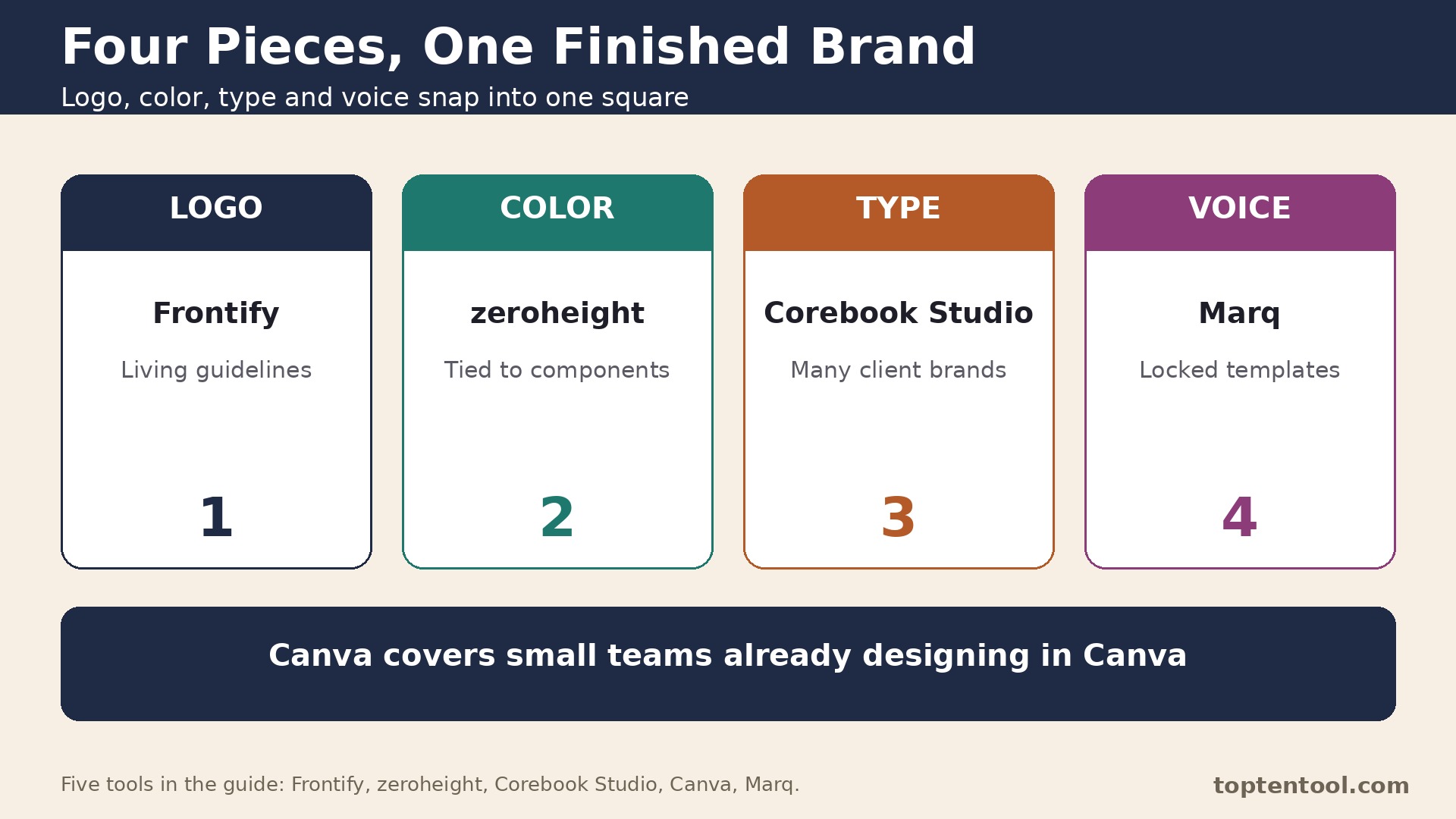
| Large brand teams that need living guidelines | Frontify |
| Design teams that want style guides tied to real components | zeroheight |
| Studios delivering brand work for many clients | Corebook Studio |
| Small teams that already design in Canva | Canva |
| Teams that need locked templates for non designers | Marq |
If your job is not in the table, read the full entries for the two tools closest to your situation. The comparison table later in this guide covers price and best fit for every tool, so a quick scan there will narrow the list to two or three names.
What the best brand style guide tools do differently
A style guide only works if people open it. The prettiest PDF in the company drive helps nobody when the sales team keeps using last years logo from a random folder. Pick a tool your whole team can open in a browser, search in seconds, and trust as the current version. If the guide lives behind a designer login, it will go stale.
Start with the parts of your brand that cause the most mistakes. For most teams that means the logo files, the exact color values, the fonts, and the rules for tone. A tool that handles those four well beats a platform with fifty features nobody touches. Add templates and asset analytics only after the basics are solid.
Think about who edits and who only reads. Some tools charge per editor and let viewers read free, while others charge for every active user. Count your editors honestly, then count the readers who will open the guide in a busy month. The pricing model matters more than the headline number.
Test the sharing flow before you pay. Send the guide link to a colleague who has never seen the brand and ask them to find the right logo and the right color for a social post. If they find both in under a minute, the tool is doing its job. If they ask you where the files live, keep looking.
The best brand style guide tools in this guide were judged on real daily work, not on a demo. Price, fit, and the quality of the core job mattered more than the length of the feature list.
Side by side comparison
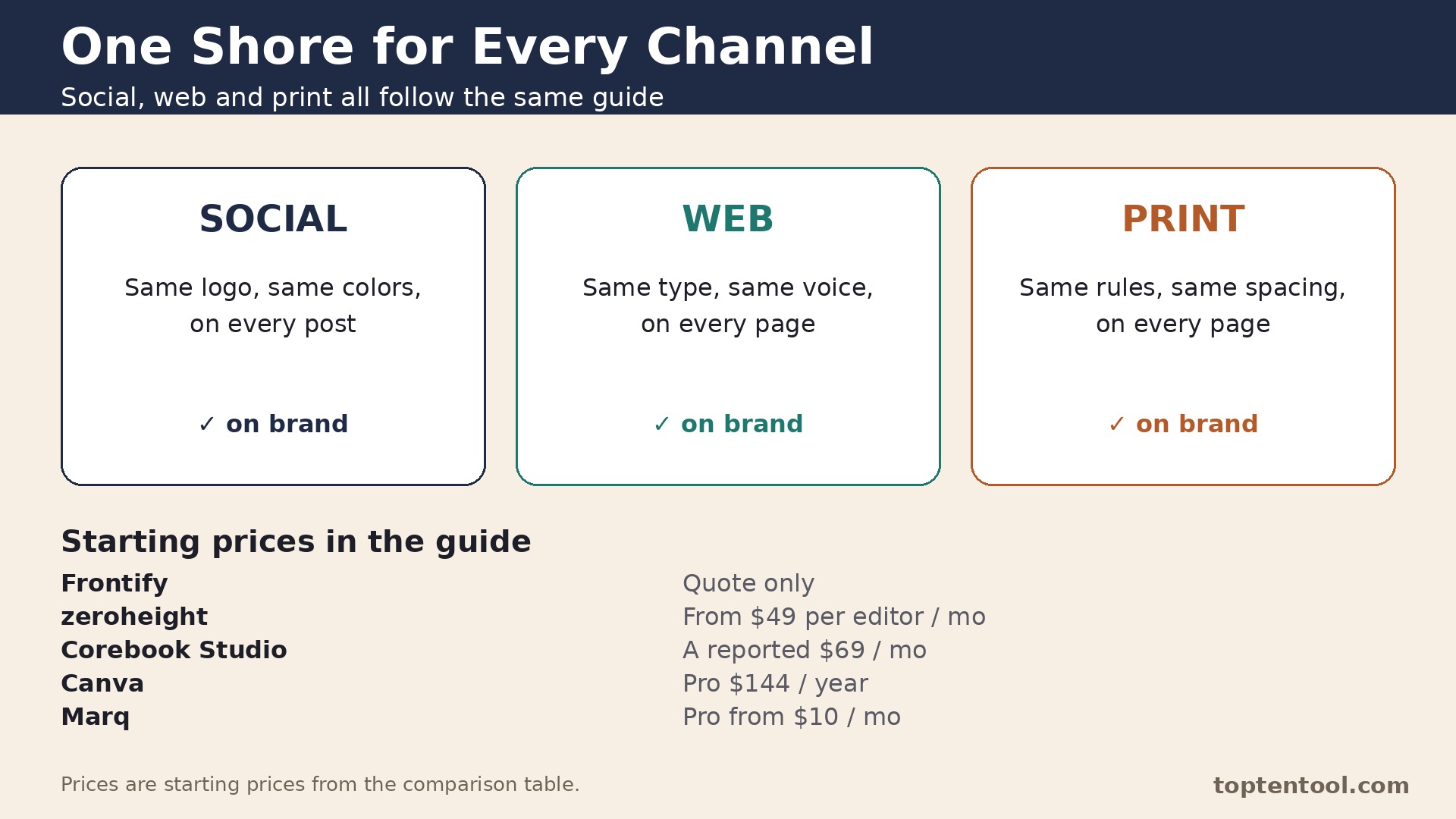
The table below puts price and best fit side by side, so the trade offs are easy to see. The best brand style guide tools that look cheapest on the first line are not always cheapest in real use, since shipment caps, per user fees and add ons change the total. Read the price column together with the best fit column before you rank the tools.
| Tool | Starting price | Best for |
|---|---|---|
| Frontify | Quote only | Large teams, living guidelines |
| zeroheight | From a reported 49 dollars per editor per month | Design system teams |
| Corebook Studio | A reported 69 dollars per month | Studios with many clients |
| Canva | Pro 144 dollars per year | Small teams already in Canva |
| Marq | Pro from 10 dollars per month | Locked templates for non designers |
The tools in detail
1. Frontify
Frontify is built for large brand teams that need living guidelines. Guidelines publish as a searchable site that covers logos, colors, type, imagery, voice and templates. The tool earns its place on this list because it handles the core job well on a normal working day, not just in a demo. Teams that use it daily tend to praise the same things, which are the reliability of the basics and the clarity of the workflow.
The asset library and locked templates sit underneath the same guidelines, so a change in one place flows everywhere. Built in stats show which assets teams actually use, and translation tools carry the same rules across regions. Those two strengths work together, since the first makes the daily job faster and the second makes the result easier to share or hand over. A tool that only does one of those well will slow a team down in the other half of the work.
Pricing is Quote only, priced per monthly active user. That figure is the starting point, so check what sits behind it before you commit. Some plans cap the features that matter most, while others add fees for extra users, locations or volume. The cheapest plan on the page is worth little if it leaves out the feature your team uses every day.
Frontify fits large brand teams that need living guidelines best. Pricing is quote only and the per user model means every person who opens the guidelines in a month counts toward the bill. That drawback matters more for some teams than others, so weigh it against your own situation. If the drawback touches the job you do most often, look at the next tool on the list. If it touches a job you rarely do, the strengths may outweigh it.
2. zeroheight
zeroheight is built for design teams that want style guides tied to real components. Style guides connect directly to design system components, so tokens and specs stay in step with the work. The tool earns its place on this list because it handles the core job well on a normal working day, not just in a demo. Teams that use it daily tend to praise the same things, which are the reliability of the basics and the clarity of the workflow.
Editors can publish updates without rebuilding the whole guide from scratch. Version history makes it easy to see what changed and roll back a mistake. Those two strengths work together, since the first makes the daily job faster and the second makes the result easier to share or hand over. A tool that only does one of those well will slow a team down in the other half of the work.
Pricing is Starter from a reported 49 dollars per editor per month, with two styleguides on that plan. That figure is the starting point, so check what sits behind it before you commit. Some plans cap the features that matter most, while others add fees for extra users, locations or volume. The cheapest plan on the page is worth little if it leaves out the feature your team uses every day.
zeroheight fits design teams that want style guides tied to real components best. The Starter plan allows only two styleguides, so a studio with many clients outgrows it fast. That drawback matters more for some teams than others, so weigh it against your own situation. If the drawback touches the job you do most often, look at the next tool on the list. If it touches a job you rarely do, the strengths may outweigh it.
3. Corebook Studio
Corebook Studio is built for studios delivering brand work for many clients. One flat price covers unlimited brand projects, which suits a studio with a full client list. The tool earns its place on this list because it handles the core job well on a normal working day, not just in a demo. Teams that use it daily tend to praise the same things, which are the reliability of the basics and the clarity of the workflow.
Guides look polished without a designer rebuilding the layout for every brand. Client handover is simple, with a finished guide the client can open and share. Those two strengths work together, since the first makes the daily job faster and the second makes the result easier to share or hand over. A tool that only does one of those well will slow a team down in the other half of the work.
Pricing is A reported 69 dollars per month for unlimited brand projects, or a reported 1100 dollars for a one time permanent licence. That figure is the starting point, so check what sits behind it before you commit. Some plans cap the features that matter most, while others add fees for extra users, locations or volume. The cheapest plan on the page is worth little if it leaves out the feature your team uses every day.
Corebook Studio fits studios delivering brand work for many clients best. It is a focused guidelines tool, so teams that also need a large asset library will pair it with another system. That drawback matters more for some teams than others, so weigh it against your own situation. If the drawback touches the job you do most often, look at the next tool on the list. If it touches a job you rarely do, the strengths may outweigh it.
4. Canva
Canva is built for small teams that already design in Canva. Brand Kits store logos, colors and fonts inside the editor where the team already works. The tool earns its place on this list because it handles the core job well on a normal working day, not just in a demo. Teams that use it daily tend to praise the same things, which are the reliability of the basics and the clarity of the workflow.
Templates pull the right brand assets in automatically, which cuts the chance of an old logo slipping out. Sharing is simple, since most teammates already know the editor. Those two strengths work together, since the first makes the daily job faster and the second makes the result easier to share or hand over. A tool that only does one of those well will slow a team down in the other half of the work.
Pricing is Pro at 144 dollars per year for one person. That figure is the starting point, so check what sits behind it before you commit. Some plans cap the features that matter most, while others add fees for extra users, locations or volume. The cheapest plan on the page is worth little if it leaves out the feature your team uses every day.
Canva fits small teams that already design in Canva best. Guidelines depth is lighter than a dedicated platform, and the rules live inside a design tool rather than a standalone brand home. That drawback matters more for some teams than others, so weigh it against your own situation. If the drawback touches the job you do most often, look at the next tool on the list. If it touches a job you rarely do, the strengths may outweigh it.
5. Marq
Marq is built for teams that need locked templates for non designers. Templates lock the parts that must not change while leaving text and images editable. The tool earns its place on this list because it handles the core job well on a normal working day, not just in a demo. Teams that use it daily tend to praise the same things, which are the reliability of the basics and the clarity of the workflow.
Smart fields pull in the right details for each use, which keeps local versions accurate. Brand Guardian checks work against the rules before it goes out. Those two strengths work together, since the first makes the daily job faster and the second makes the result easier to share or hand over. A tool that only does one of those well will slow a team down in the other half of the work.
Pricing is Free plan available, Pro from 10 dollars per month billed annually. That figure is the starting point, so check what sits behind it before you commit. Some plans cap the features that matter most, while others add fees for extra users, locations or volume. The cheapest plan on the page is worth little if it leaves out the feature your team uses every day.
Marq fits teams that need locked templates for non designers best. The free plan is limited, and the strongest controls sit on higher tiers. That drawback matters more for some teams than others, so weigh it against your own situation. If the drawback touches the job you do most often, look at the next tool on the list. If it touches a job you rarely do, the strengths may outweigh it.
Mistakes to avoid
Most buyers in this category make the same few mistakes, and the tools that look best on paper are often the ones that punish those mistakes most. A short list of the common errors will save more money than a long feature comparison.
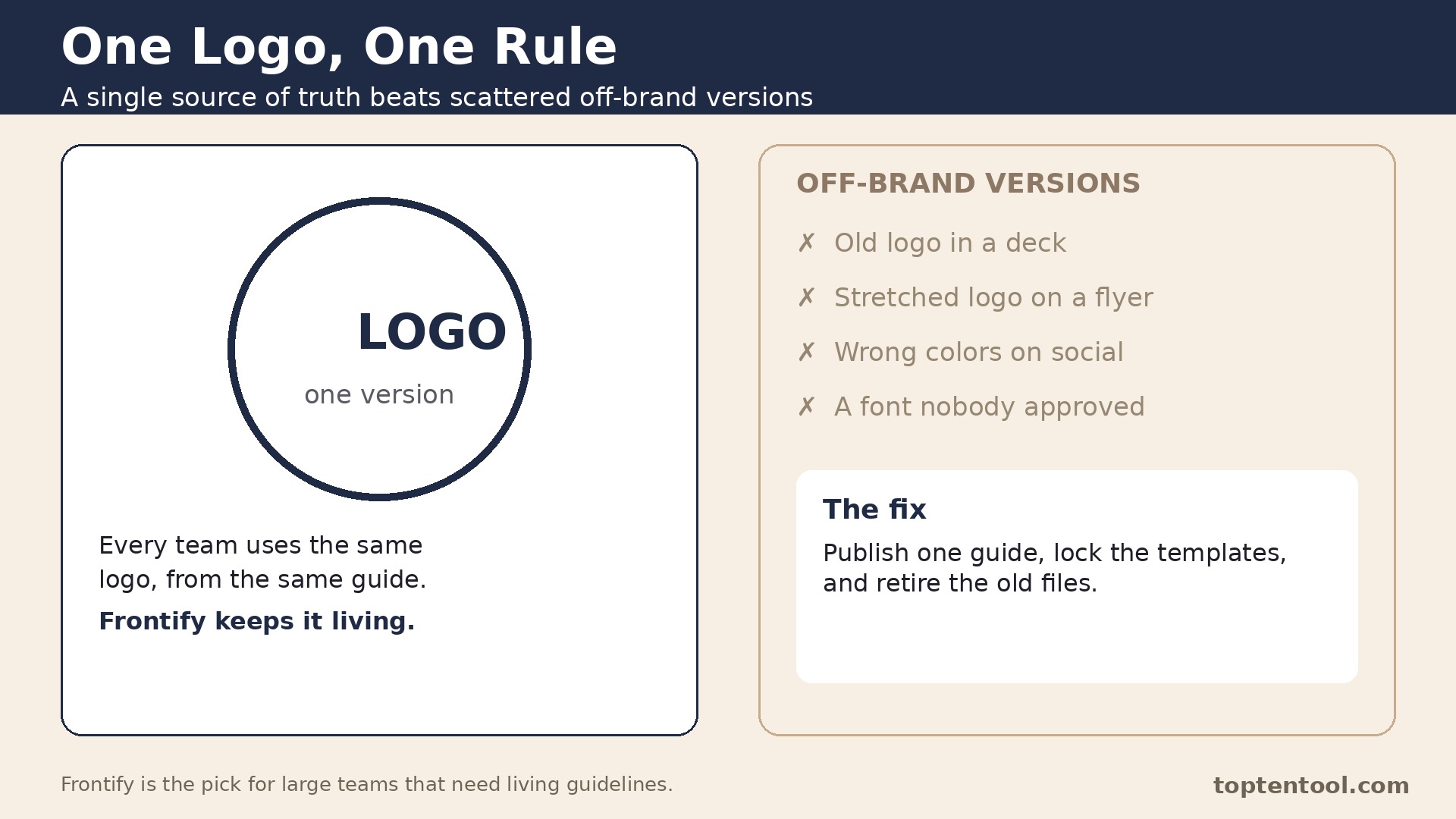
The most common mistake is writing a guide that describes the brand instead of showing it. A page of adjectives about being bold and friendly tells a new hire nothing. Show the exact logo files, the exact hex values, the exact fonts, and one good and one bad example for each rule. People copy examples. They skim adjectives.
Another mistake is letting the guide live in three places at once. The PDF on the drive, the slides from last year, and the new online guide will disagree within a month. Pick one home for the brand and retire the others. When someone asks where the logo lives, the answer should be one link.
The third mistake is never updating the guide after launch. Brands change, products change, and a guide that still shows a retired logo trains the team to ignore it. Put one person in charge of updates and review the guide every quarter. A small update on time beats a big rebuild a year late.
A simple decision checklist
Use this checklist before you pay for any of the best brand style guide tools above. It takes ten minutes and it catches the errors that turn a good tool into a bad purchase.
- Write down the one job the tool must do well every day, and test that job first.
- Count the real users, locations or volume the plan must cover, including the busy season.
- Check the price of the tier that includes the features you need, not the cheapest tier on the page.
- Test the tool with a real task from your own work, not the sample data in the demo.
- Read the contract terms, the renewal rules and the cancellation process before you sign.
Frequently asked questions
These are the questions buyers ask most often about best brand style guide tools. The answers are short, and each one points back to the comparison above so you can check the detail for yourself.
How much should a small business pay for a brand style guide tool?
A small team can start free or near free with Canva or Marq, then move to a dedicated tool when the brand has more than a handful of people using it. The jump to a platform like Frontify only makes sense when several teams and partners need the same rules every day.
What should a brand style guide include?
At minimum it needs the logo files and usage rules, the exact color values, the fonts, the tone of voice, and image guidance. Add templates and examples once the basics are set. A guide that covers those five areas prevents most of the mistakes a growing team makes.
Are online guidelines better than a PDF?
Yes, for most teams. An online guide can be searched, updated in one place, and linked to the live asset files. A PDF goes stale the moment it is downloaded. Keep a PDF only as a snapshot for a client handover, and keep the online version as the source of truth.
Do I need a style guide tool if I already use Canva?
Not always. If your whole team designs in Canva and your brand rules are simple, Brand Kits may be enough. Move to a dedicated tool when you need deeper rules, version history, or a guide that people outside the design team must follow.
Who should own the brand style guide?
One person should own it, usually the brand or marketing lead. That person approves changes and keeps the guide current. Everyone else can suggest changes, but a single owner stops the guide from drifting into several conflicting versions.
One more point deserves attention before you choose. Frontify leads this list for a reason, but the lead is narrow, and the second and third tools each win on a specific job. A buyer who reads only the ranking will miss those wins. Read the best fit column again with your own job in mind, and let that decide the shortlist rather than the order of the entries.
Support quality is easy to overlook until something breaks. zeroheight and Frontify both have a reputation for answering quickly, while some of the cheaper tools in this list rely on email support with slower replies. If your team depends on the tool every day, the speed of support is worth real money, and it should count in the decision alongside price.
Training time is a real cost too. A tool that takes a week to learn will cost more than a tool with a slightly higher monthly price that the team learns in a day. Ask each vendor for a short trial with your own data, and watch how long it takes a new user to finish a routine task without help. That test tells you more than any feature list.
Integration with the tools you already use matters more as the stack grows. A platform that connects cleanly to your current system will save hours of manual copying, while a tool that needs workarounds will add a weekly chore. Check the integration list for the two or three apps your team opens every day, and confirm the connection works on the plan you would actually buy.
Finally, remember that the best tool is the one the team will keep using. A powerful platform that sits unused is worse than a simple tool that everyone opens daily. Involve the people who will use it in the trial, listen to what frustrates them, and choose the tool they reach for without being told. That habit is what turns a purchase into a result.
Think about the second year, not just the first month. A tool with a low entry price and a steep renewal can cost more over two years than a pricier tool with stable pricing. Ask about renewal rates, price changes on higher tiers, and what happens when the team grows past the current plan. A vendor that answers those questions plainly is easier to trust with a long term commitment.
Data export is a quiet test of a good vendor. Before you commit, check how your work leaves the platform if you ever decide to move. A tool that exports cleanly to standard formats respects your business, while a tool that locks data inside is betting that you will never leave. The export test takes five minutes and it is worth doing on every shortlisted tool.
Seasonal peaks deserve a specific check. A tool that handles a normal week well can still struggle in the busiest month of the year, when volume doubles and the team is under pressure. Ask the vendor how the plan behaves at peak volume, whether limits can be raised temporarily, and what the cost of that extra capacity looks like. The answer will tell you whether the tool is built for real business cycles.
Security and privacy checks belong on the shortlist too. Ask where data is stored, who can access it, and how the vendor handles a request to delete it. A tool that handles customer or employee data should answer those questions without hesitation. If the answers are vague, treat that as a warning sign rather than a detail to check later.
Start small even when the plan allows a big rollout. Pick one team, one project or one location, run the tool there for a month, and measure the result before you roll it out everywhere. A pilot catches the problems that a demo hides, and it gives the team a success story to share when the wider rollout begins. That careful start is how a good tool becomes part of the daily routine instead of another unused subscription.
Measure the result after the first month with numbers you already track. Time saved per order, per call or per project is the clearest test, followed by the cost per order and the number of errors or rework. If the tool has not moved at least one of those numbers in thirty days, the problem is either the tool or the way the team uses it, and both are worth a frank review before the next payment.
Keep the decision record simple. Write down why you chose the tool, what it must do in the first ninety days, and what would make you switch. That short note stops the team from drifting into a tool that no longer fits, and it makes the next review a fact based conversation instead of a debate about feelings. A good purchase is one you can explain a year later.
Talk to a current user before you buy, not just to the sales team. A short call with a business of a similar size will reveal the daily friction that a demo never shows, like a slow mobile app, a confusing setting, or a support queue that only answers quickly before the sale. Most vendors will arrange a reference call if you ask, and the ones that refuse are telling you something.
The verdict
For most teams, the right pick depends on size. A small team already working in Canva should start there and add Marq when locked templates matter. A design team with a real component library will get the most from zeroheight. A studio with many clients should look hard at Corebook Studio, since the flat price removes the per client worry. And a large brand with teams in several regions should talk to Frontify, because living guidelines with usage stats are built for that scale.
Before you sign, run a small test with one real project. Build a short guide for a single product launch, share it with two people outside the design team, and watch where they get stuck. If they find the right logo and the right color without asking for help, the tool is doing its job. If they message the design team anyway, the guide is either too thin or too hard to find, and that tells you more than a sales demo ever will.
Budget for the work around the tool as well as the subscription. Someone has to write the rules, gather the approved assets, and keep the guide current when the brand changes. A tool with no owner and no fresh content will go stale within a year, no matter how good the platform is. Set a quarterly review in the calendar now, so the guide stays a living document instead of a file everyone ignores.
That is the honest summary for best brand style guide tools in 2026. Start with the tool that matches your situation, use the free trial or free plan to test it on real work, and only then commit to a paid plan. A tool that fits the job will feel obvious within a week, and a tool that does not will show its gaps just as fast.