
Instagram gives a brand account about 0.45 percent engagement, and TikTok gives the same kind of account about 2.5 percent, more than five times as much, on the same kind of post. That gap is the whole case for TikTok in one comparison, and it is why a small business with no budget and no followers can still reach thousands of people on TikTok in its first month, while the same business would need a year to reach the same people on Instagram. A small business TikTok marketing strategy built on that gap starts with useful videos, not with followers, and this guide lays out the first 30 days.
A small business TikTok marketing strategy in 2026 is not about dancing, and it is not about going viral. It is about posting useful, honest videos about the work you do, every day, and turning the viewers who watch them into customers who walk through the door. This guide gives you a 90 day plan to do exactly that, with the setup, the first 30 days, the scaling phase, the templates, and the numbers to watch.
TikTok has about 1.9 billion monthly active users, and about 135.79 million of them are in the United States. More than 5 million US businesses use TikTok, and most of them are small and medium sized businesses. About 37 percent of US adults use TikTok, according to Pew Research in 2025, and 49 percent of consumers use TikTok as a search engine, a figure that rises to 65 percent among Gen Z.
Users spend an average of 95 minutes a day on the app, and they open it about 10 times a day. Those numbers matter for one reason. Your customers are already on TikTok, they are already searching there, and they are already discovering new brands there, whether you post or not.
Why a Small Business TikTok Marketing Strategy Matters Now
TikTok is a discovery engine, not a follower engine, and that distinction is the reason a small business can win there. The For You feed shows videos based on what people watch, like, share, and rewatch, not on who they follow, so a video from an account with 12 followers can reach 10,000 people if the first viewers watch it to the end. Instagram rewards the accounts people already follow. TikTok rewards the video people actually watch. A small business that makes a useful video about a real problem, and makes it well, gets distribution it could never buy on another platform.
Search is the second reason a small business TikTok marketing strategy matters now. Almost half of consumers use TikTok as a search engine, and two thirds of Gen Z do, which means a customer who wants a plumber, a bakery, a hair salon, or a gift shop in their town is increasingly likely to search TikTok first, not Google. A video titled with the words a customer would search, such as best birthday cake in Austin, or how to fix a leaking tap, can rank in TikTok search for months, and every view is a customer who was already looking to buy. A small business TikTok marketing strategy that ignores search is leaving the most valuable traffic on the table.
The third reason a small business TikTok marketing strategy matters now is cost. Organic reach on TikTok is still real, and a business can post five videos a week for the cost of a phone and an hour a day. Paid ads are optional, not required, and a business that proves a video organically can put 20 dollars behind it and reach a local audience with precision. Compare that with Google Ads, where a single click in a competitive local market can cost 5 dollars or more, and the case for starting on TikTok is clear. The platform is not free, because your time is not free, but it is the cheapest attention a small business can buy in 2026.
Phase 1. Setup in Week 1
Set up the account properly in the first week, because a sloppy setup costs you followers and sales for months. Create a Business Account, not a personal account, because a Business Account gives you analytics, a website link, and access to the commercial music library, and it lets you run ads later. Choose a username that matches your business name as closely as possible, and use the same name and logo you use everywhere else, so a customer who finds you on TikTok can find you on Google too.
Write a bio that says what you sell, who it is for, and where you are, in one line each. A bakery bio that says fresh sourdough baked daily in Austin, order for pickup or delivery, is better than a bio that says welcome to our page, because the first one tells a customer whether you can help them, and the second one tells them nothing.
Add a link to your website, your booking page, or your online store, and make sure the link works on a phone, because most TikTok traffic is mobile. Add a location to the profile if you serve a local area, and turn on the business contact options, so a customer can email or call you without leaving the app.
Set up TikTok Shop only if you sell products that ship, and set it up after the first month, not before, because a Shop with no videos and no followers will not sell. For a service business, the booking link matters more than the Shop, and for a local shop, the address and the opening hours matter more than either. Connect the account to your other channels, and add the TikTok link to your website, your Google profile, and your email signature, so every customer you already have can find you on TikTok.
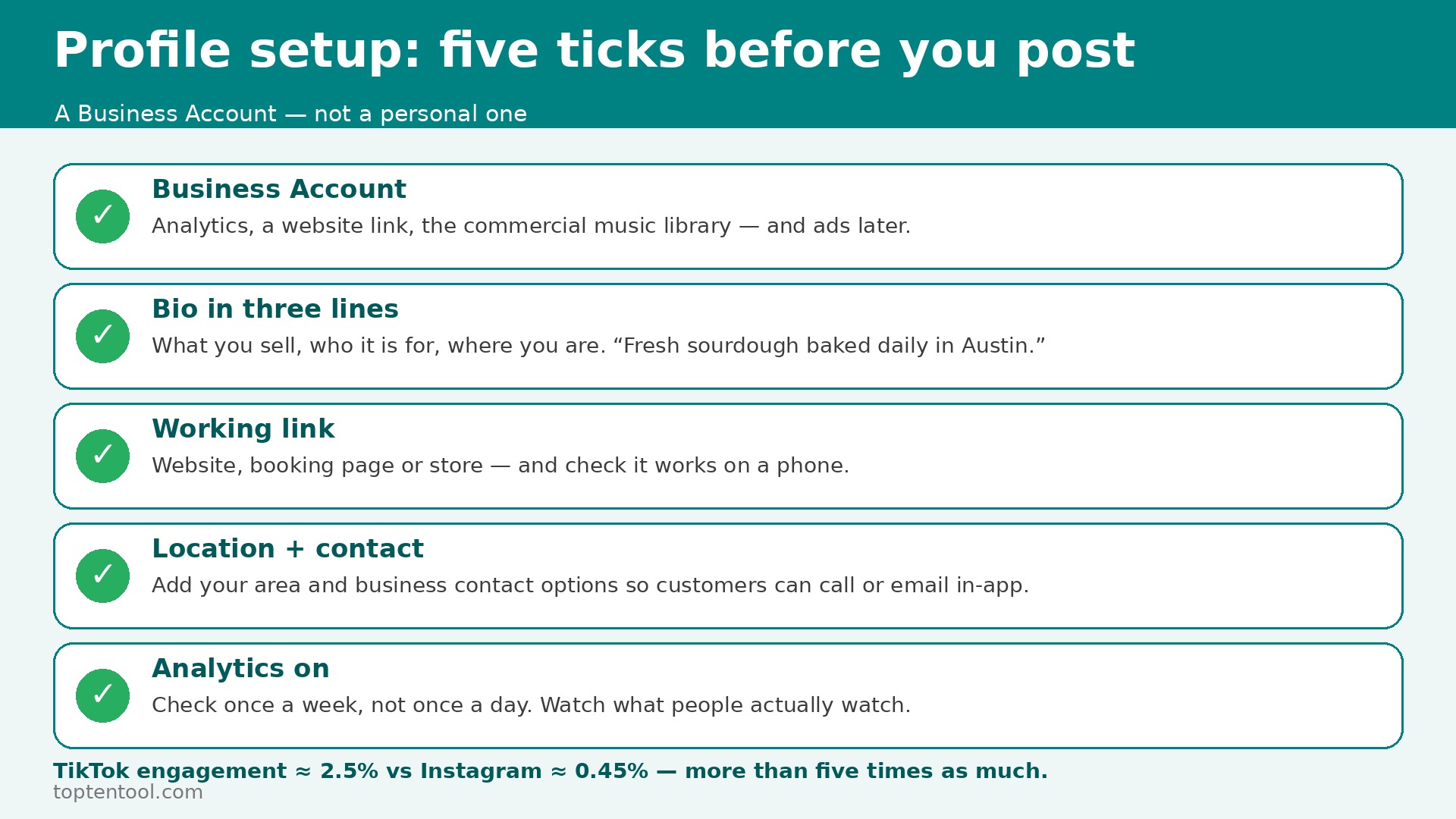
Week 1 setup checklist
- Create a Business Account with your business name, logo, and location.
- Write a bio with what you sell, who it is for, and where you are.
- Add a working link to your website, booking page, or store.
- Turn on analytics, and check them once a week, not once a day.
- Follow 20 local businesses and 20 creators in your niche, and watch what they post.
- Save 10 videos you like, and note what made you watch each one to the end.
- Film five short test videos, and post the best one, so the account is live before week two.
Phase 2. The First 30 Days
Post five videos a week for the first 30 days, and post them at the same time each day, so the algorithm and your audience both learn when to expect you. The goal of the first month is not sales. It is learning what your audience watches, and building a library of videos that search can find. A business that posts 20 videos in 30 days learns more about its customers than a business that posts four perfect videos in the same period, because 20 videos give you 20 data points, and four videos give you four.
A small business TikTok marketing strategy uses four content pillars, and you rotate them through the week, so the account never feels repetitive. The first pillar is the work itself, a video of you making, fixing, cooking, cutting, or delivering what you sell, filmed in real time, with no script. The second pillar is the answer, a 30 second video that answers the most common question customers ask you, in plain words, looking at the camera.
The third pillar is the proof, a before and after, a customer result, or a behind the scenes look at a job well done. The fourth pillar is the offer, a video that tells viewers what to buy, how much it costs, and how to order it, posted once a week, not every day.
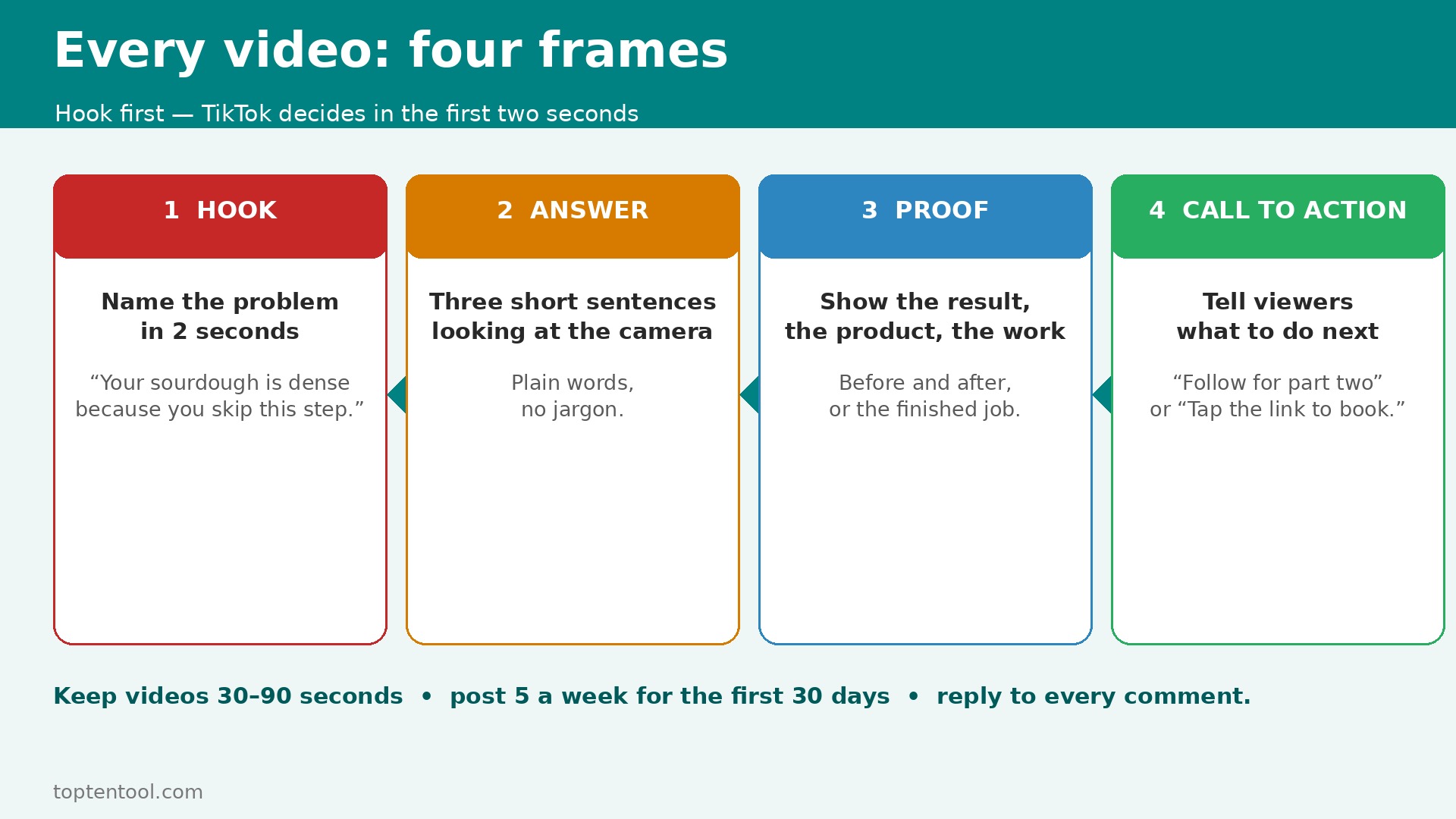
Every video needs a hook in the first two seconds, because TikTok decides whether to show a video to more people based on whether the first viewers keep watching. A hook is a sentence that names the problem, such as your sourdough is dense because you are skipping this one step, or this is why your tap keeps leaking, and it works because it speaks to a person who already has that problem.
Film the hook first, then the answer, then a call to action that tells the viewer what to do next, such as follow for part two, or tap the link to book. Keep videos between 30 and 90 seconds, because a video that is too long loses viewers, and a video that is too short cannot answer the question.
The first 30 day posting calendar
| Week | Focus | Videos | Goal |
|---|---|---|---|
| Week 1 | Setup and first posts | 5 test videos | Account live, first data |
| Week 2 | Answer videos | 5 question answers | Learn which questions get views |
| Week 3 | Work videos | 5 process videos | Show the work, build trust |
| Week 4 | Proof and offer | 4 proof videos, 1 offer video | First sales, first bookings |
Reply to every comment in the first 30 days, within a few hours, because comments are the strongest signal TikTok uses to decide whether a video deserves more distribution, and because a reply is a conversation with a customer who is already interested. Pin the best comment to the top of each video, and answer the most common questions with a new video, because a video answer reaches more people than a text reply, and it gives you content for the next day. Save every video that performs well, and make a second version of it the following week, with a different hook and the same answer, because a proven idea deserves a second chance.
Phase 3. Scaling From Day 31 to Day 90
After 30 days, you have data, and the scaling phase is about doing more of what worked and less of what did not. Open analytics, sort your videos by watch time and by shares, and list the top five. Those five videos are your strategy for the next 60 days. Make a second version of each one, with a new hook, a new example, and the same core answer, and post one per week. Make a series from the best one, such as part two, part three, and part four, because a series gives viewers a reason to follow, and a follow is worth more than a single view.
Start posting daily in the scaling phase, if the first month proved you can sustain five videos a week, because daily posting compounds, and a daily account grows faster than a weekly account. If daily posting is too much, stay at five videos a week, and spend the saved time on replies, on duets, and on stitching videos from creators in your niche, because a duet with a larger creator can reach their audience, and a stitch that answers a popular video can reach people who never saw your account before.
Collaborate with one local creator per month, a food blogger, a local guide, or a complementary business, and film a video together, because a collaboration shares both audiences, and it costs nothing but time.
Test paid ads only after you have a proven organic video, because an ad that amplifies a video people already watch will perform far better than an ad built from scratch. Put 20 dollars behind your best video, target your town and your customer age range, and run it for three days. If the cost per click is under a dollar, and the clicks turn into bookings or orders, increase the budget to 50 dollars and run it for a week.
If the cost per click is above two dollars, stop the ad, and fix the video first, because a bad video with paid distribution is still a bad video. TikTok Shop, Spark Ads, and creator partnerships all belong in this phase, not in the first month, because they work best when the account already has proof that people watch.
Scaling checklist for days 31 to 90
- List your top five videos by watch time and shares, and make a second version of each one.
- Turn the best video into a series, and post part two, part three, and part four.
- Post daily if you can sustain it, or stay at five videos a week and spend the time on replies and duets.
- Collaborate with one local creator per month, and film a video together.
- Put 20 dollars behind your best video, target your town, and measure the cost per click.
- Add a booking link or a Shop link to your best videos, and track which videos drive sales.
- Review analytics every Monday, and plan the week around the top performing topic.
Templates You Can Copy
Use these templates to write your next 20 videos without staring at a blank screen. Each template is a structure, not a script, and the best videos fill the structure with real details from real work.
Template 1. The answer video
Hook. Name the question a customer asked you this week, in their words. Answer. Give the answer in three short sentences, looking at the camera, with no jargon. Proof. Show the result, the product, or the work that proves the answer. Call to action. Tell the viewer to follow for the next answer, or to tap the link to book. Example. A plumber films a 40 second video that starts with why does my tap drip at night, answers it in three sentences, shows the worn washer that caused it, and ends with follow for one plumbing tip a week.
Template 2. The process video
Hook. Show the finished result for two seconds, before you show the work. Process. Film the work in real time, with no music and no narration, or with a short voiceover that explains one step. Result. Show the finished result again, side by side with the before. Call to action. Tell the viewer to comment with what they want to see next. Example. A bakery films a 60 second video that starts with a finished loaf, shows the dough being shaped, shows the loaf coming out of the oven, and ends with comment with the bread you want us to bake next.
Template 3. The offer video
Hook. Name the offer and the price in the first sentence. Details. Say what is included, who it is for, and how long the offer lasts. Proof. Show a customer using the offer, or show the product in a customer hands. Call to action. Tell the viewer to tap the link to order, and to order before the offer ends. Example. A gift shop films a 30 second video that starts with our Mother Day hamper is 49 dollars this week, shows what is inside the hamper, shows a customer opening one, and ends with tap the link to order before Sunday.
Template 4. The mistake video
Hook. Name the mistake in the first sentence, such as most people ruin their sourdough by doing this. Mistake. Show the mistake, and explain why it fails. Fix. Show the correct way, in three steps. Call to action. Tell the viewer to save the video, so they can find it when they need it. Example. A hair salon films a 45 second video that starts with this is why your hair color fades in a week, shows the wrong shampoo, shows the right one, and ends with save this for your next wash.
Keep a running list of questions customers ask you, and turn each question into an answer video. Keep a running list of mistakes customers make, and turn each mistake into a mistake video. Those two lists are a year of content, and they never run out, because customers keep asking the same questions, and new customers keep making the same mistakes.
Measurement. Which Metrics Matter, and What Good Looks Like
Watch time matters more than views, because a video with 1,000 views and an average watch time of 80 percent will reach more people than a video with 10,000 views and an average watch time of 20 percent. Shares matter more than likes, because a share means the viewer thought the video was worth sending to someone else, and a share is the strongest distribution signal TikTok has. Comments matter more than followers, because a comment is a conversation, and a conversation is a customer who is already interested. Followers matter last, because a follower who never watches is worth less than a viewer who watches every video.
Track these numbers every Monday, and compare them week to week, not day to day, because daily numbers jump around, and weekly numbers show the trend. A good first month for a small business is 20 videos, an average watch time above 50 percent, at least one video above 1,000 views, and at least five comments per video.
A good second month is a video above 5,000 views, a follower count that grows every week, and the first booking or order that came from TikTok. A good third month is a video above 10,000 views, a steady stream of profile visits, and at least one sale per week that you can trace to TikTok. If the numbers are below those levels, the fix is usually a stronger hook, a shorter video, or a clearer answer, not more posting.
| Metric | Where to find it | Good for a small business |
|---|---|---|
| Average watch time | Video analytics, watch time | Above 50 percent |
| Shares per video | Video analytics, shares | At least 5 shares on a good video |
| Comments per video | Video analytics, comments | At least 5 comments, and you reply to all |
| Profile visits | Account analytics, profile views | Growing week to week |
| Link clicks | Account analytics, link clicks | At least 10 per week by month two |
| Followers | Account analytics, followers | Growing every week, even slowly |
| Sales from TikTok | Ask customers, use a discount code | At least 1 per week by month three |
Use a discount code that only appears on TikTok, such as TIKTOK10, so you can trace sales to the platform, and ask every new customer where they found you. A code and a question are more reliable than any analytics dashboard, because they tell you what actually sold, not what was merely watched.
Common Mistakes to Avoid
The first mistake is posting like a television advert, with polished visuals, a script, and a sales message, because TikTok viewers skip adverts, and they watch real people doing real work. Film on your phone, in your shop, in your own voice, and let the video feel honest. The second mistake is posting once a week, because once a week is too slow for the algorithm to learn what your audience likes, and too slow for an audience to remember you.
Post five times a week, or do not start. The third mistake is copying a viral trend that has nothing to do with your business, because a trend that brings views but no customers is a waste of time, and a trend that confuses your audience hurts the account.
The fourth mistake is ignoring comments, because a comment is a customer who took the time to speak to you, and ignoring it tells TikTok the video is not worth distributing, and tells the customer you do not care. The fifth mistake is buying followers, because bought followers never watch, never comment, and never buy, and they drag down the watch time and engagement that TikTok uses to decide whether to show your videos.
The sixth mistake is spending money on ads before you have a proven organic video, because an ad that amplifies a video nobody watches will burn money, and the fix is a better video, not a bigger budget. The seventh mistake is giving up after two weeks, because the first 20 videos are an experiment, and the account that posts 20 videos and quits learns nothing, while the account that posts 60 videos in 90 days learns what its customers want.
Budget and Time Table
A small business TikTok marketing strategy costs time before it costs money, and the time is the real budget. Plan for one hour a day, five days a week, for the first 90 days, and spend it filming, editing, replying, and reviewing analytics. A phone tripod costs about 25 dollars. A ring light costs about 30 dollars. A lapel microphone costs about 20 dollars. Those three items, plus the phone you already own, are the whole equipment budget, and they will serve you for a year.
| Item | Cost | Time per week |
|---|---|---|
| Phone tripod | About 25 dollars once | None |
| Ring light | About 30 dollars once | None |
| Lapel microphone | About 20 dollars once | None |
| Filming and editing | 0 dollars | 3 hours |
| Replying to comments | 0 dollars | 1 hour |
| Reviewing analytics and planning | 0 dollars | 1 hour |
| Paid ads, from day 31, optional | 20 dollars per test, up to 200 dollars a month | 30 minutes |
| Creator collaboration, from day 31 | 0 dollars, or a free product | 1 hour per month |
Total cash cost for 90 days is about 75 dollars for equipment, plus up to 400 dollars for ads if you choose to test them, and the total time cost is about 60 hours. A single new customer per week, at an average order value of 50 dollars, returns 600 dollars in 90 days, which covers the whole budget, and the videos keep working after the 90 days are over, because search and the For You feed can surface an old video months after you post it.
Frequently Asked Questions
How often should a small business post on TikTok?
Post five videos a week for the first 30 days, and daily from day 31 if you can sustain it. Five videos a week gives the algorithm enough data to learn what your audience likes, and daily posting compounds faster. Posting once a week is too slow, and the account will not grow.
How long does it take for TikTok marketing to work for a small business?
Expect the first signs in 30 days, the first sales in 60 days, and a steady stream in 90 days. A good first month is 20 videos, an average watch time above 50 percent, and at least one video above 1,000 views. A business that posts 60 videos in 90 days will know what its customers want, and will have a library of videos that search can find.
Do small businesses need to pay for TikTok ads?
No, not at first. Organic reach on TikTok is still real, and a business can grow without ads. Test ads only after you have a proven organic video, put 20 dollars behind it, target your town, and measure the cost per click. If the cost per click is under a dollar, and the clicks turn into bookings or orders, increase the budget. If it is above two dollars, fix the video first.
What should a small business post on TikTok?
Post four kinds of video, and rotate them through the week. The work itself, a video of you making, fixing, cooking, or delivering what you sell. The answer, a 30 second video that answers the most common question customers ask you. The proof, a before and after, or a customer result. And the offer, a video that tells viewers what to buy, how much it costs, and how to order it, posted once a week.
How do I turn TikTok viewers into customers?
Give every video a clear next step, such as tap the link to book, or comment to order, or follow for part two. Use a discount code that only appears on TikTok, so you can trace sales to the platform. Reply to every comment, because a reply is a conversation with a customer who is already interested. Add a booking link or a Shop link to your best videos, and track which videos drive sales.
Verdict
A small business TikTok marketing strategy works when the business posts useful videos, every day, about real work, real questions, and real results. Set up a Business Account in week one, with a bio that says what you sell and where you are. Post five videos a week for 30 days, using the four pillars, and learn which topics your audience watches. Scale from day 31, by making second versions of your best videos, turning the best one into a series, and testing 20 dollars of ads behind a proven video.
Measure watch time, shares, and comments every Monday, and fix the hook, the length, or the answer when the numbers are low. Budget one hour a day and about 75 dollars for equipment, and expect the first sales in 60 days and a steady stream in 90. TikTok rewards the video people actually watch, not the account with the most followers, and that is why a small business with a phone and an hour a day can win there.