

Etsy charges 20 cents per listing plus a 6.5 percent transaction fee on the order total, so every listing has to earn its place. That is why the best AI tools for Etsy sellers matter in 2026. They cut the hours spent on titles, tags, photos and messages, and they help a small shop look like a much bigger one without hiring anyone.
Search demand on Etsy moves fast. Wall art decor searches rose 110 percent and gallery prints rose 80 percent in Etsy trend data reported in early 2026, while crochet clothing sales rose 36 percent. Sellers who spot a rising phrase early can ride it. Sellers who guess usually pay for the lesson with dead listings.
This guide compares 12 tools across the jobs that actually fill an Etsy working week. Keyword research, listing copy, product photos, mockups, social promotion and shop admin all get covered. Prices were checked against vendor pages and current roundups in November 2026, so confirm the live price before you pay.
How we judged each tool
We scored every tool on four questions. Does it use real Etsy search data or only generic web data. Does it save measurable time on a repeating job. Does its price fit a shop that may earn a few hundred dollars a month. And does it work without a marketing degree.
Keyword tools earned extra credit when they showed search volume and competition side by side, because a high volume phrase you cannot rank for is a trap. Writing tools earned credit when they kept your voice instead of flattening every listing into the same cheerful paragraph. Photo tools earned credit when they handled backgrounds and mockups in batches, since one listing photo at a time does not scale.
The best AI tools for Etsy sellers are not always the most expensive ones. A free keyword plan plus a 20 dollar writing assistant often beats a single 50 dollar subscription that does one job well and three jobs badly. Keep that in mind as you read the prices below.
The best AI tools for Etsy sellers at a glance
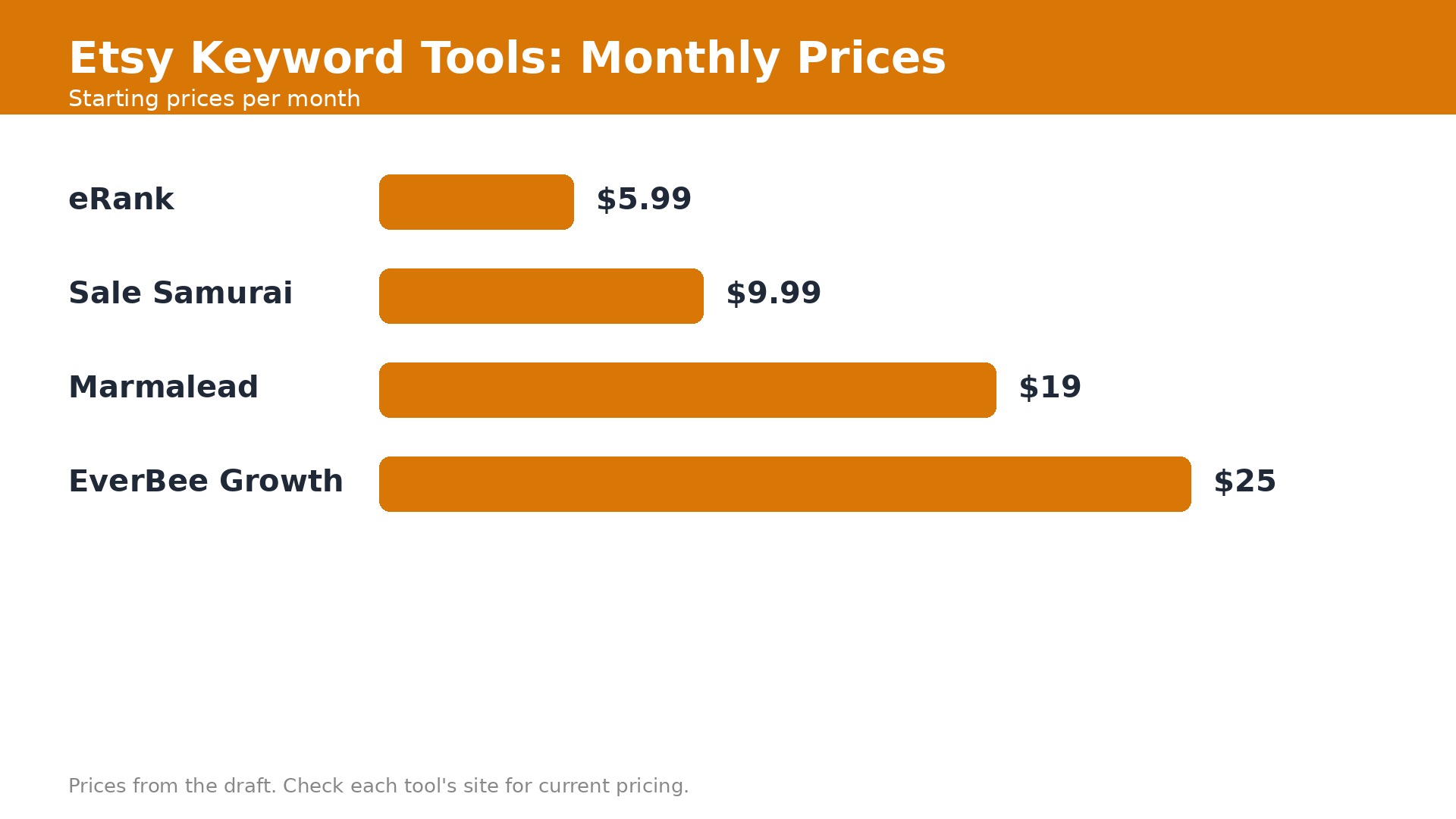
Use this table to narrow the field fast, then read the full review of the two or three tools that match your biggest bottleneck.
| Tool | Starting price | Best for | Watch out |
|---|---|---|---|
| eRank | Free, paid from $5.99/mo | Etsy keyword research on a budget | Search volume is estimated, not exact |
| Marmalead | $19/mo | Deep keyword strategy and trend curves | No free plan, only a trial |
| EverBee | Free, Growth $25/mo | Product research and spotting what sells | AI actions are metered monthly |
| Alura | Free, paid from $13.99/mo | Live listing scores inside Etsy | Smaller keyword database than eRank |
| Sale Samurai | $9.99/mo | Simple keyword research at a low price | Fewer advanced features than rivals |
| ChatGPT | Free, Plus $20/mo | Listing copy, policies and buyer messages | Copy needs editing or it sounds generic |
| Claude | Free, Pro $20/mo | Natural sounding listing copy | No Etsy data built in |
| Canva | Free, Pro $12.99/mo | Mockups, listing images and social posts | AI background tools need Pro |
| Midjourney | From $10/mo | Digital art and print designs | Commercial terms vary by plan |
| Photoroom | Free, Pro $12.99/mo | Clean product photos and backgrounds | Watermark on the free plan |
| Tailwind | From $19.99/mo | Pinterest and social scheduling | Pinterest first, other networks second |
| Copy.ai | From $24/mo | Marketing copy workflows at volume | Pricier than a general chatbot |
1. eRank
Starting price. Free plan. Paid plans run Basic 5.99 dollars a month, Pro 9.99 dollars and Expert 29.99 dollars a month.
eRank is the default starting point for Etsy search data, and more than one million sellers use it. It shows which phrases shoppers type, how competitive each phrase is, and whether a niche is trending up or fading. Its AI Listing Helper writes titles, tags and descriptions next to that data, so the copy and the keywords come from the same screen.
The free plan is genuinely usable, with a daily allowance of keyword lookups and one shop connected. Paid plans raise the daily AI Helper allowance from once a day on free to 10 times on Basic, 20 on Pro and 100 on Expert. That ladder matters. A shop listing five products a week can live on Basic, while a shop refreshing 200 listings needs Pro or Expert.
The weakness is precision. eRank search volume figures are estimates drawn partly from Google data, and rival tools disagree with them. Treat the numbers as a ranking of phrases, not as exact counts. Verify a phrase by checking the live Etsy results for it before you rebuild a listing around it.
Pick it when you are starting out or refreshing listings every week and want real Etsy data for almost no money.
Skip it when you need trend data weeks before the crowd sees it, since eRank trends arrive later than sales based tools.
2. Marmalead
Starting price. 19 dollars a month, 190 dollars a year, or a 300 dollar one off lifetime plan. A 14 day trial is available and there is no ongoing free plan.
Marmalead is the oldest dedicated Etsy SEO tool, and it goes deeper than eRank on trends. Its Storm mode fans one product idea out into dozens of related phrases with search volume and competition attached. Seasonality curves show whether demand for a phrase is climbing or has already peaked, which is the difference between listing early and listing late.
The AI description critique reviews a listing and suggests fixes, and it drafts FAQ suggestions for the listing page. The interface is calmer and more guided than eRank, which suits sellers who want a workflow rather than a wall of data. One study cited by Marmalead found sellers using it earned seven times the annual revenue of the average shop, though that figure is old and self reported, so read it as marketing rather than proof.
The price is the hurdle. Nineteen dollars a month is steep for a shop with ten listings and two sales a week. It only pays when keyword research is a weekly habit and the shop is big enough that better rankings move real money.
Pick it when you treat keywords as a system and you research phrases every week before you list.
Skip it when your shop is brand new and you have not yet proved that anyone wants the product.
3. EverBee
Starting price. Free Hobby plan. Growth costs about 25 dollars a month billed annually, 299 dollars a year, with 100 AI actions a month. Business costs more.
EverBee answers one question faster than any other tool here. Is this niche already selling. Its Chrome extension overlays estimated monthly revenue, sales volume and review counts directly on Etsy search results, so you can judge a product idea without opening twenty listings.
The paid plans add a monthly allowance of AI actions for listing help and research. Growth at about 25 dollars a month billed annually includes 100 AI actions, which is enough for a shop testing a few new products a month. The free Hobby plan lets you try the research overlay before paying anything.
Estimated revenue is still an estimate, and a listing with high revenue and two hundred competitors is not an opportunity. Use EverBee to shortlist ideas, then check the competition yourself. Also watch the AI action meter. A month of heavy testing can burn the allowance before the month ends.
Pick it when you are choosing what to sell next and want sales evidence before you invest in stock or materials.
Skip it when you already know your niche and only need keyword help for listings you have.
4. Alura
Starting price. Free limited plan. Essential costs 13.99 dollars a month and Pro costs 19.99 dollars a month.
Alura scores your listing while you edit it, which makes it different from tools that only report after the fact. It checks titles, tags and descriptions against live Etsy data and tells you what to fix before you publish. That live feedback loop suits sellers who would rather fix one listing well than read a long audit report.
It also covers product research and review request emails, so it reaches further into shop operations than a pure keyword tool. The Essential plan at 13.99 dollars a month is cheaper than Marmalead and close to eRank Pro, which makes it a fair middle choice for a growing shop.
The keyword depth is thinner than Marmalead, and the research data is not as deep as eRank on some niches. Alura is best as a listing quality tool with research attached, not as your only research source if you compete in a crowded category.
Pick it when you want a score on every listing as you write it, not a monthly report.
Skip it when you need the deepest trend data for a highly competitive niche.
5. Sale Samurai
Starting price. 9.99 dollars a month.
Sale Samurai keeps keyword research simple. It shows search volume, competition and tag ideas for Etsy listings at 9.99 dollars a month, which is the same price as eRank Pro but with a different feel. Sellers who find eRank busy often prefer it.
It is a solid second tool rather than a first. Pair it with a writing assistant and you have cheap coverage of the two jobs that matter most, finding phrases and writing listings around them. There is little here you cannot get elsewhere, but the price and the clean interface are the point.
The trade off is depth. You will not get Storm style brainstorming or seasonality curves, and the tool does not try to be a full shop platform. If you outgrow it, the move to Marmalead or eRank Expert is natural.
Pick it when you want one simple keyword tool at a flat ten dollars and nothing else to learn.
Skip it when you need trend forecasting or listing scoring built in.
6. ChatGPT
Starting price. Free plan. Plus costs 20 dollars a month.
ChatGPT is the highest time saver in most Etsy shops because it covers so many jobs. Listing descriptions, shop policies, buyer message drafts, social captions and gift note wording all come from the same place. Give it your keyword list from eRank and a few details about materials and sizing, and a first draft appears in seconds.
Plus at 20 dollars a month removes the free plan limits and gives steadier access at busy times. For a shop answering ten buyer messages a day, that alone can pay for itself. It also drafts variations, so you can test a shorter title against a longer one without starting from a blank page.
The risk is sameness. Unedited ChatGPT copy has a recognizable rhythm, and Etsy shoppers notice it. Always rewrite the opening line in your own words, check every material and size claim, and never let it invent care instructions or shipping times you do not offer.
Pick it when you write a lot of copy every week and want one assistant for all of it.
Skip it when you only need a few listings a month, since the free plan covers that.
7. Claude
Starting price. Free plan. Pro costs 20 dollars a month, or about 17 dollars a month billed annually.
Claude is the writing alternative for sellers who find ChatGPT copy too polished. Its drafts read closer to how a real shop owner talks, which helps on Etsy, where buyers choose handmade over mass produced and want to feel the maker behind the listing.
It handles the same jobs, descriptions, policies, message drafts and social captions, and it is strong at following a style guide. Paste three of your best listings and ask it to match their tone, and the results stay much closer to your voice than a generic prompt produces.
Claude has no Etsy search data, so it cannot tell you which keywords matter. It also needs the same fact checking as any AI writer. Use it with a keyword tool, never instead of one, and keep it away from pricing and shipping claims unless you check them.
Pick it when your listings need to sound like you, not like a template.
Skip it when you want keyword data and writing in one tool.
8. Canva
Starting price. Free plan. Pro costs 12.99 dollars a month billed monthly, or less on annual billing.
Canva is the photo and promotion workhorse for most Etsy shops. Its background remover cleans up product photos, its mockup templates show a print on a wall or a mug on a desk, and its social templates turn one listing into a week of posts. The AI writing helper drafts captions to match.
Pro unlocks the background remover and the full template library, which is where the time saving lives. A seller photographing twenty products can batch clean backgrounds in an afternoon instead of paying a designer or learning photo editing software.
Canva is not a photo editor for fine work. Color accuracy on prints and fabric needs a real editor, and Canva templates can look familiar if you use them straight out of the box. Change the fonts and colors to match your shop, and keep your best photos out of heavy filters.
Pick it when you need mockups and social images every week without hiring a designer.
Skip it when your photos need exact color work for art prints or fabric.
9. Midjourney
Starting price. Basic plan from 10 dollars a month. No free plan.
Midjourney generates digital art from text prompts, and it powers a large share of Etsy digital product shops. Sellers use it for wall art, clipart, patterns, coloring pages and printable designs that would take hours to draw by hand.
The Basic plan from 10 dollars a month is the cheapest way into serious image generation. The quality on illustration and painterly styles is high, and a seller who learns prompting well can build a whole printable catalog around a few strong styles.
The rules matter more than the art. Commercial use terms depend on your subscription tier, and they have changed before, so read the current terms on the Midjourney site before you sell anything. Also check ownership and licensing for the plan you buy, and never sell an image you have not inspected at full size.
Pick it when you sell digital downloads and want original art without drawing every piece.
Skip it when you sell physical handmade goods and only need photos, not generated art.
10. Photoroom
Starting price. Pro costs 12.99 dollars a month billed monthly. A free plan with a watermark is available.
Photoroom removes backgrounds, stages products in AI generated scenes and batch edits photos. For a seller photographing jewelry, candles or small crafts on a kitchen table, it turns uneven home photos into clean listing images in minutes.
The batch tools are the reason to pay. Editing one photo is free almost everywhere. Editing forty photos with the same background and size is where Photoroom earns its 12.99 dollars a month. It also resizes for Etsy, social and your own site from the same file.
It cannot fix a bad photo. Blurry images, harsh shadows and wrong colors stay wrong after a background swap. Spend the saved time on better lighting, and use Photoroom for cleanup, not rescue.
Pick it when you photograph small products at home and need clean consistent listing photos.
Skip it when you already shoot on clean backgrounds or you pay a photographer.
11. Tailwind
Starting price. Pro plan from 19.99 dollars a month.
Tailwind schedules Pinterest and Instagram posts and uses AI to suggest posting times and draft captions. Pinterest is a major traffic source for many Etsy shops, especially in home decor, weddings and crafts, so a tool that keeps it fed matters.
Its SmartSchedule and content suggestions reduce the daily decision of what to post and when. A seller can queue a week of pins from new listings in one sitting, which is far more realistic than posting by hand every day.
Tailwind is Pinterest first. If your buyers come from Instagram or TikTok, other schedulers fit better. It also costs 19.99 dollars a month before it proves itself, so track Pinterest clicks for a month before you renew.
Pick it when Pinterest brings you traffic and you want it scheduled without daily effort.
Skip it when your buyers come from TikTok or Instagram and rarely from Pinterest.
12. Copy.ai
Starting price. Chat plan costs 29 dollars a month, or 24 dollars a month billed annually.
Copy.ai turns listing and marketing copy into repeatable workflows. Instead of one off prompts, you build a flow that takes a product, a keyword list and a tone, then produces a title, a description, social captions and an email blurb in one run. That structure suits shops listing in batches.
It is stronger than a general chatbot at brand consistency, because workflows reuse your rules every time. A shop with fifty similar products can keep descriptions consistent without rewriting the same instructions daily.
The price is the question. At 29 dollars a month it costs more than ChatGPT Plus and does less outside copy. It only earns its place when you produce copy in real volume and the workflow saves you several hours a week.
Pick it when you list products in batches and want the same copy workflow every time.
Skip it when you list a few products a month and a general chatbot covers your copy.
Match the Tool to the Work
Match the tool to the job, not to the hype. These are the picks we would make first for each part of running an Etsy shop, and the best AI tools for Etsy sellers change with the job at hand.
| Job to be done | Best pick | Why it wins |
|---|---|---|
| Finding keywords on a budget | eRank | Free plan is usable and Pro is 9.99 dollars a month |
| Deep trend research | Marmalead | Seasonality curves and Storm brainstorming |
| Choosing what to sell next | EverBee | Sales estimates overlaid on live search results |
| Writing listings that sound human | Claude | Closest to a real shop owner voice |
| Writing copy in volume | ChatGPT Plus | Covers listings, messages and policies for 20 dollars |
| Product photos at home | Photoroom | Batch background removal for 12.99 dollars a month |
| Mockups and social images | Canva Pro | Templates plus background removal in one place |
| Digital art products | Midjourney | Original art from 10 dollars a month |
| Pinterest traffic | Tailwind | Scheduling built around Pinterest habits |
What a sensible starter stack costs
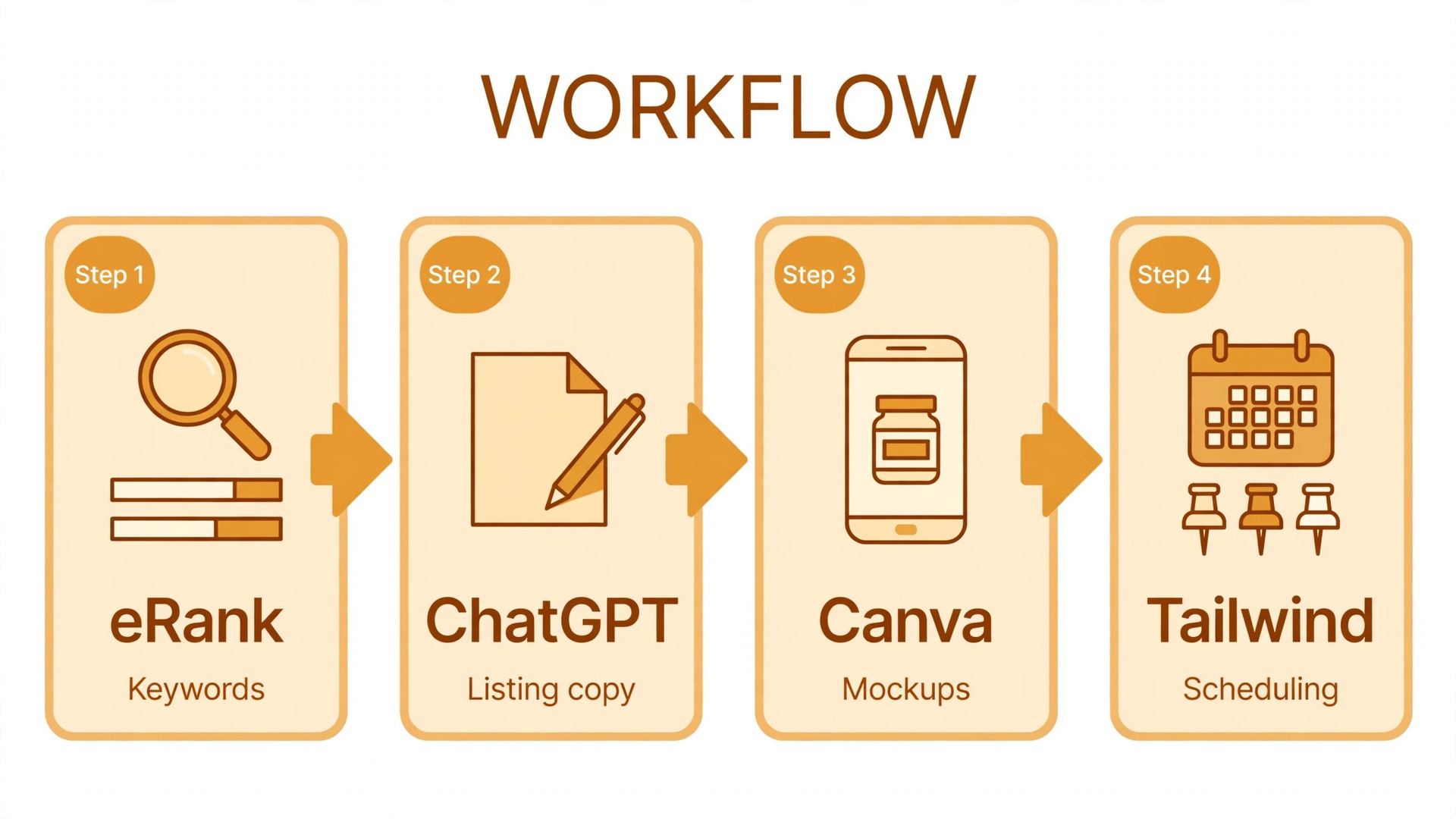
Start with eRank free and ChatGPT free, then add Canva Pro at 12.99 dollars a month when mockups become a weekly job. That stack costs under 13 dollars a month and covers keywords, copy and images. Add eRank Pro at 9.99 dollars when you refresh listings weekly, which brings the total to about 23 dollars a month.
A growing shop doing steady sales can justify Marmalead at 19 dollars plus ChatGPT Plus at 20 dollars, about 39 dollars a month before photo tools. That is the point where keyword depth and copy volume both matter. Beyond that, add tools one at a time and only when a specific job is slow. A tool that saves no measurable hour is a cost, not an investment.
Watch the meters. EverBee AI actions, eRank AI Helper uses and Midjourney image generations all have limits. A plan that looks cheap can cost double if you hit the cap mid month and upgrade in a hurry. Check your usage after the first month, then decide whether the next tier is worth it.
Mistakes that waste money on AI tools
The most common mistake is buying three tools that do the same job. ChatGPT, Claude and Copy.ai overlap heavily. Pick one writer and learn it well. The second mistake is trusting AI keyword volume without checking live Etsy results. A phrase can look strong in a tool and return pages of established sellers you cannot beat.
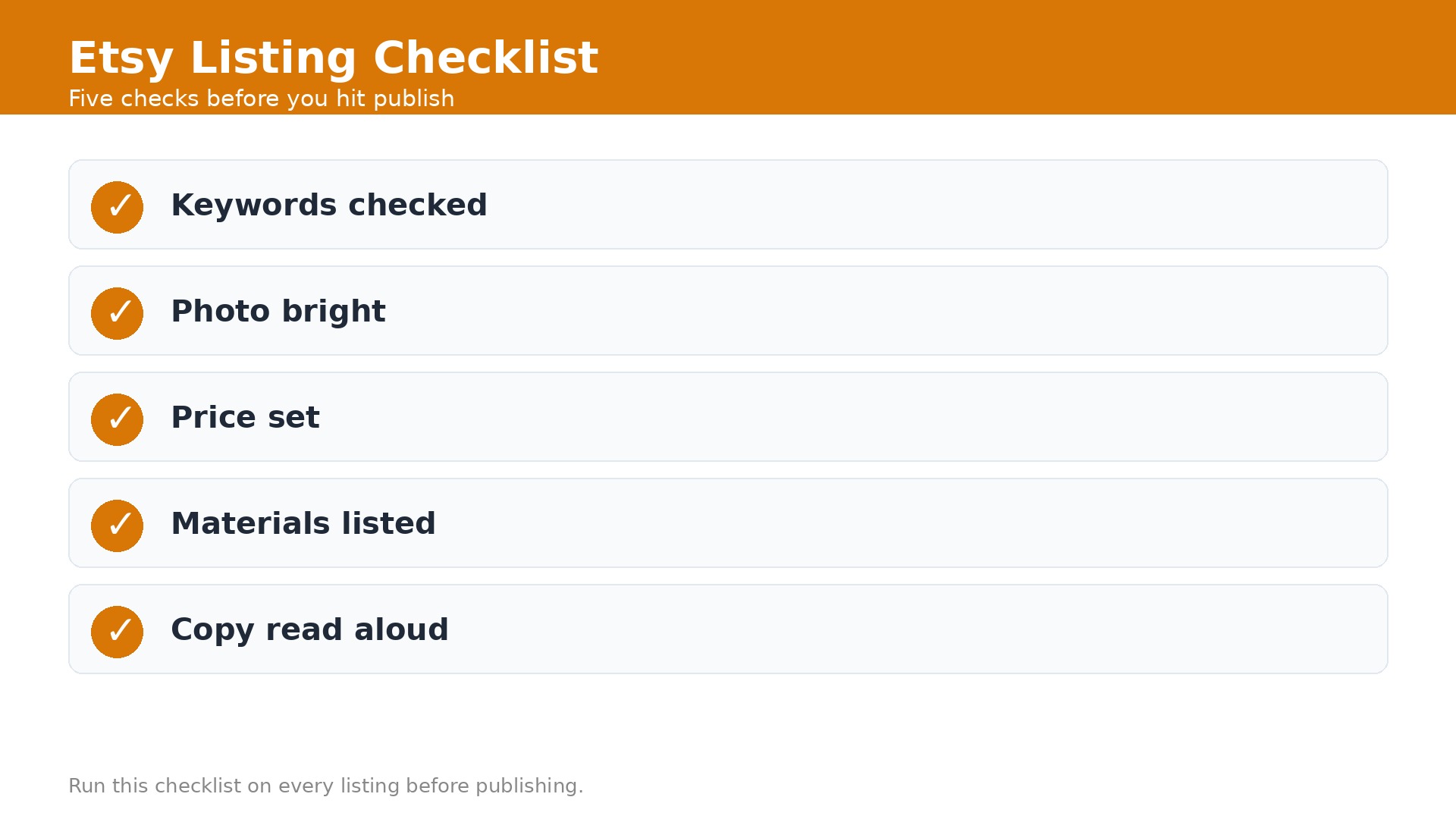
The third mistake is publishing AI copy without reading it. Wrong materials, wrong sizes and invented care instructions lead to buyer messages and bad reviews that cost far more than the time saved. Read every listing once, out loud if needed, before it goes live. The fourth mistake is ignoring photos. A perfect title cannot save a dark blurry photo, and buyers decide in seconds.
What the full stack costs in real life
A solo seller can run a capable setup for about 23 to 43 dollars a month, depending on whether keyword research or copy volume is the bigger job. That is eRank Pro plus Canva Pro at the low end, or Marmalead plus ChatGPT Plus at the higher end. Add Photoroom at 12.99 dollars when home photography is a weekly task, and the total stays under 60 dollars a month.
Compare that with the cost of the time saved. If a tool saves three hours a week and your time is worth even 15 dollars an hour, that is 180 dollars a month of value. The math only fails when a tool sits unused. Cancel anything you have not opened in two weeks, and recheck every subscription once a quarter. The best AI tools for Etsy sellers earn their renewal every month or they go.
Seasonal planning with AI tools
Etsy demand moves with the seasons, and AI tools help you move first. Use Marmalead seasonality curves in August to plan autumn listings, and use eRank trend data in October to catch rising phrases before the holiday rush. A listing published two weeks early beats a listing published on the day demand peaks.
Batch the work by season. Photograph and mock up the next season products while the current season sells, write the listings with your writing assistant in one sitting, and schedule Pinterest pins with Tailwind two weeks ahead. A shop that plans by season never scrambles, and scrambling is where mistakes and missed sales live.
The Deciding Factors
Start with eRank free for keywords and ChatGPT free for copy, then add Canva Pro when mockups become routine. That trio is the short version of the best AI tools for Etsy sellers, and it covers the three jobs that decide whether a listing gets seen, gets clicked and gets bought. Move to Marmalead when keyword research becomes a weekly habit, and add Photoroom when home photos are the bottleneck.
No single tool here does everything well, and that is fine. Etsy success comes from a small stack where each tool owns one job. Pick the tools that match your slowest hour, cancel the rest, and spend the saved time on products buyers actually want.
Frequently Asked Questions
Do I need a paid AI tool to sell on Etsy?
No. You can start with free plans from eRank, ChatGPT, Claude and Canva, which cover keywords, copy and basic images. Paid plans become worth it when a job takes several hours a week. Pay for the bottleneck first, not for the tool with the longest feature list.
Which tool is best for Etsy SEO?
eRank is the best starting point among the best AI tools for Etsy sellers because it uses real Etsy search data and has a usable free plan. Marmalead goes deeper on trends and seasonality for sellers who research weekly. Use one of them as your source of truth, and check live Etsy results before you trust any volume figure.
Can AI write my Etsy listings for me?
AI can draft them, but it should not publish them untouched. Drafts often invent details, repeat the same phrases and sound generic. Give the tool your keywords, materials and sizes, then rewrite the opening line yourself and check every fact. The best listings read like a maker wrote them, because one did.
Are AI generated images allowed on Etsy?
Yes for digital products, with conditions. You must follow the image tool terms for commercial use, and Etsy requires sellers to be honest about how digital items are made. Check Midjourney terms for your plan, inspect every image at full size, and never sell art you have not reviewed.
How much should a small Etsy shop spend on AI tools?
A sensible range for the best AI tools for Etsy sellers is 23 to 60 dollars a month for a shop with steady sales. Start near zero with free plans, add one paid tool at a time, and cancel anything unused for two weeks. If a tool does not save at least an hour a week, it is not earning its price.
Does AI help with Etsy photos?
Yes, mainly for backgrounds and consistency. Photoroom and Canva clean up home photos and batch edit them, which saves hours. They cannot fix blurry photos or wrong colors, so good lighting still matters more than any editing tool. Photograph well first, then let AI clean up.