
A realistic small business marketing stack costs 100 to 150 dollars a month. That covers a writing assistant, email, design and scheduling, with free tiers filling the gaps. The mistake is spending 300 dollars or more on five tools that overlap, then wondering why marketing still feels hard. The best AI tools for small business marketing are the ones that own one job each and prove their value in leads or sales every month.
Marketers using AI save an average of 6.1 hours a week, according to HubSpot AI Trends 2026 research. That saving only matters if the hours go into work that brings customers. A tool that writes ten blog posts nobody reads is not saving time. It is producing inventory.
This guide compares 15 tools across content, email, social, SEO, ads and automation, with prices checked in November 2026. Each review states the real starting price, the job it owns, and when to pick it or skip it. Build your stack by job, not by brand, and cancel anything that does not earn its renewal.
How we picked this list
We picked one tool per job where possible, and we favored tools a small team can afford without a finance meeting. Free tiers earned credit when they were genuinely usable, not just demos. Tools that hide pricing behind a sales call lost points, since a small business cannot budget for a quote.
We also checked the overlap. Jasper, ChatGPT, Claude and Copy.ai all write copy, but they serve different volumes and controls. Mailchimp, Brevo and ActiveCampaign all send email, but they suit different list sizes and automation needs. The reviews below say plainly when two tools compete, so you buy one, not both.
The best AI tools for small business marketing share one trait. They turn a repeating task into a measurable result, such as an email sent, a post published, a lead captured or a ranking gained. A tool that only produces reports you never act on is not on this list.
The best AI tools for small business marketing at a glance
Scan the table for your job, then read the full review. Prices are starting prices checked in November 2026.
| Tool | Starting price | Best for | Watch out |
|---|---|---|---|
| Jasper | From $39/mo | Brand consistent marketing copy | Pricier than a general chatbot |
| HubSpot Marketing Hub | Free, Starter $20/seat | CRM plus marketing in one place | Professional tier is very expensive |
| Mailchimp | Free, Essentials $13/mo | Email for teams starting out | Costs rise steeply with list size |
| Canva | Free, Pro $12/mo | Marketing design without a designer | AI tools need Pro for full use |
| Buffer | Free, Essentials $5/channel | Simple social scheduling | Priced per channel, not per account |
| Semrush | From $139.95/mo | SEO, competitor research and AI visibility | Expensive for a business that does little SEO |
| Ahrefs | From $129/mo | Backlinks and content gaps | AI tracking is a pricey add on |
| Brevo | Free, Starter $9/mo | Cheap email and SMS at scale | Fewer AI features than Mailchimp |
| ActiveCampaign | From $15/mo | Email automation that branches | Pricing varies by contacts and tier |
| ChatGPT | Free, Plus $20/mo | General marketing writing and ideas | Copy needs editing or it sounds generic |
| Claude | Free, Pro $20/mo | Natural sounding marketing copy | No SEO or email data built in |
| Copy.ai | From $24/mo | Copy workflows at volume | Pricier than a general chatbot |
| Frase | From $39/mo | Optimizing articles to rank | Narrow focus, only for content SEO |
| Zapier | Free, Professional $19.99/mo | Connecting marketing tools together | Tasks are metered monthly |
| Meta Advantage+ | Free in Ads Manager | AI ad targeting and creative | Less control over audiences |
1. Jasper
Starting price. Creator costs 39 dollars a month billed annually, or 49 dollars billed monthly. Pro costs 59 dollars a month billed annually, or 69 dollars billed monthly.
Jasper is built for marketing teams that need brand consistent copy at volume. It learns your brand voice, works across blog posts, emails, ads and social, and offers more than 100 marketing workflows. Content Pipelines connect research, writing and distribution into one flow, which suits a business publishing every week.
Creator at 39 dollars a month billed annually covers one seat and one brand voice. Pro at 59 dollars a month billed annually adds team features and higher limits. A 7 day free trial lets you test the voice matching before paying.
Jasper costs more than ChatGPT Plus and does less outside copy. It earns its price only when you produce marketing copy in real volume and consistency matters. A business writing two posts a month should use a general chatbot instead.
Pick it when you publish marketing copy weekly and need it to sound like your brand every time.
Skip it when you write a little copy and a general chatbot covers it for less.
2. HubSpot Marketing Hub
Starting price. Free for up to 2 users. Starter costs 20 dollars a seat a month. Professional jumps to about 800 dollars a month.
HubSpot puts CRM, email, landing pages and campaigns in one system, with Breeze AI assisting across planning, content and prospecting. Breeze Studio agents moved to GPT-5 in January 2026, and AI usage is credit based, with 5,000 credits a month on Starter and 10,000 on Professional.
The free tier covers up to 2 users with basic AI features, which is enough for a small business to prove the system works. Starter at 20 dollars a seat a month adds more marketing features at a fair price. The jump to Professional at about 800 dollars a month is steep, and it is where many small businesses stop.
HubSpot suits businesses that want marketing, sales and service under one roof. If you only need email, it is too much tool. Pick it when the CRM is the center of your marketing, not when you want a simple newsletter sender.
Pick it when you want CRM, email and campaigns together with AI throughout.
Skip it when you only send a newsletter, since Mailchimp or Brevo cost far less.
3. Mailchimp
Starting price. Free plan covers 250 contacts and 500 emails a month. Essentials starts at 13 dollars a month for 500 contacts. Standard starts at 20 dollars a month.
Mailchimp is the email starting point for most small businesses. Its Intuit Assist helps write subject lines, optimize send times and personalize content, while the Customer Journey Builder runs automations for welcome, abandoned cart and post purchase emails. The free plan covers 250 contacts and 500 emails a month.
Essentials at 13 dollars a month for 500 contacts adds A/B testing and more sends. Standard at 20 dollars a month unlocks AI send time optimization, predictive segmentation and multi step automation. Those two steps cover most small businesses well.
The price rises steeply as the list grows, reaching roughly 100 to 135 dollars a month at 5,000 to 10,000 contacts. Clean inactive subscribers regularly, and move to Brevo or ActiveCampaign when the bill outgrows the revenue email brings.
Pick it when you are building your first list and want email that just works.
Skip it when your list is large and automation branching matters more than simplicity.
4. Canva
Starting price. Free plan. Pro costs 12 dollars a month billed annually, or 18 dollars a month billed monthly.
Canva produces marketing assets without a designer. Social posts, ads, flyers, presentations and email headers all come from templates, while Magic Write drafts copy and the background remover cleans product photos. A small team can keep every channel fed from one app.
Pro at 12 dollars a month billed annually unlocks the full template library, brand kit and AI features. That is cheap for the volume it produces, and the free plan covers basic design well enough to start. The brand kit keeps colors, fonts and logos consistent across everything you publish.
Templates are also the weakness. A design made straight from a popular template looks like a hundred other businesses. Change the fonts and colors to match your brand, and keep your best work out of heavy filters. Canva makes the asset. You make it yours.
Pick it when you need social, ad and email visuals every week without hiring a designer.
Skip it when you already have a designer or need print exact work.
5. Buffer
Starting price. Free plan for 3 channels with AI Assistant. Essentials costs 5 dollars per channel a month billed annually, or about 6 dollars billed monthly.
Buffer schedules posts across social channels from one dashboard, with an AI Assistant that drafts and rewrites posts. The free plan covers 3 channels, which is enough for a business on Facebook, Instagram and LinkedIn to test whether scheduling actually saves time.
Essentials at 5 dollars per channel a month billed annually keeps costs tied to how many channels you run. A business on three channels pays about 15 dollars a month, which is fair. Team plans add approvals and unlimited users for larger teams.
Buffer is simple by design. It will not replace a full social suite with listening, inbox management and deep analytics. Pick it when scheduling and consistency are the job, and look elsewhere when social becomes a full time channel with customer service attached.
Pick it when you want simple scheduling across a few channels at a low price.
Skip it when you need social listening, inbox and deep analytics in one tool.
6. Semrush
Starting price. Pro costs 139.95 dollars a month. Guru costs 249.95 dollars a month. Business costs 499.95 dollars a month. Annual billing saves about 17 percent.
Semrush covers keyword research, rank tracking, site audits, competitor analysis and AI visibility in one subscription. Its AI Visibility Toolkit tracks how a brand appears in ChatGPT, Gemini, Perplexity and Google AI Overviews, which is now a real part of search for small businesses.
Pro at 139.95 dollars a month is the entry point, and it is a single user price, with extra seats costing 45 to 100 dollars a month each. That is a serious cost for a small business, and it only pays when SEO is a real channel, not a hobby. The SEO plan at 139 dollars a month includes AI search tracking and custom prompt monitoring.
Cheaper tools cover keyword basics, so Semrush must earn its price through competitor insight and rank tracking you actually use weekly. If nobody on your team opens it every week, cancel it and spend the money on content or email instead.
Pick it when SEO brings you customers and you track rankings and competitors weekly.
Skip it when you do little SEO, since the price will not pay for itself.
7. Ahrefs
Starting price. Lite starts at 129 dollars a month. Brand Radar AI tracking costs from 199 dollars a month as an add on.
Ahrefs is the backlink and content gap specialist. Its index shows who links to competitors, which pages earn traffic, and which keywords your rivals rank for that you do not. For a business building authority in a niche, that data is hard to replace.
Lite at 129 dollars a month is the entry point, and AI visibility tracking through Brand Radar costs from 199 dollars a month on top, with prompt packages from 50 dollars a month. That makes the full AI tracking stack over 300 dollars a month, which is too much for most small businesses.
Pick Ahrefs when links and content gaps decide your rankings. Pick Semrush when you want SEO plus AI visibility in one bill. Running both is a waste for a small team, so choose the one that matches the job you actually do each week.
Pick it when backlinks and competitor content gaps are your SEO bottleneck.
Skip it when you want AI visibility tracking included, since Ahrefs charges extra for it.
8. Brevo
Starting price. Free plan with up to 300 emails a day. Starter costs 9 dollars a month.
Brevo is the budget email pick for small businesses with growing lists. The free plan allows 300 emails a day, and Starter at 9 dollars a month is the cheapest paid email plan on this list. It also handles SMS and transactional email, which suits businesses that need more than newsletters.
The trade off is AI depth. Brevo has fewer AI writing and optimization features than Mailchimp, and its templates are plainer. For a business that writes its own copy and wants reliable sending at a low price, that trade is worth making.
Brevo suits lists that outgrew Mailchimp free tier but do not need advanced automation. When branching automation becomes the job, ActiveCampaign is the next step. Until then, Brevo keeps the bill small while the list grows.
Pick it when you need cheap reliable email for a growing list.
Skip it when you want strong AI writing and optimization inside your email tool.
9. ActiveCampaign
Starting price. Paid plans from 15 dollars a month at 1,000 contacts. Plus costs 59 dollars a month at 1,000 contacts in some 2026 listings.
ActiveCampaign is the automation first email platform. Its visual builder creates branching flows that react to opens, clicks, purchases and site visits, which suits businesses with a real funnel rather than a simple newsletter. A 14 day free trial lets you test it with no card.
Paid plans from 15 dollars a month at 1,000 contacts cover the basics, while Plus at 59 dollars adds deeper automation and CRM features. Pricing scales with contacts, so a large list costs more, but the automation usually earns it back through better targeting.
The learning curve is real. A business that sends one newsletter a month will find ActiveCampaign heavy. Pick it when your funnel has branches, segments and follow ups that Mailchimp cannot express cleanly.
Pick it when your email needs branching automation and segments that drive sales.
Skip it when you send a simple newsletter, since Mailchimp or Brevo cost less.
10. ChatGPT
Starting price. Free plan. Plus costs 20 dollars a month.
ChatGPT is the general marketing assistant for most small businesses. It drafts blog posts, emails, ads, social captions and product descriptions, and it helps outline campaigns before you commit budget. Give it your brand details and a few examples, and the first draft appears in seconds.
Plus at 20 dollars a month removes free plan limits and gives steadier access. For a business producing content weekly, that is the cheapest writing help available. It also drafts variations, so you can test three subject lines or three ad angles instead of one.
The risk is sameness. Unedited ChatGPT copy has a recognizable rhythm, and customers notice it. Always rewrite the hook in your own words, check every claim, and bring a real opinion to the content. AI writes the draft. You supply the point of view.
Pick it when you need a flexible writing assistant for many marketing jobs.
Skip it when you need strict brand voice controls, since Jasper does that better.
11. Claude
Starting price. Free plan. Pro costs 20 dollars a month, or about 17 dollars a month billed annually.
Claude is the writing alternative for businesses that find ChatGPT copy too polished. Its drafts read closer to how a real person talks, which helps for newsletters, about pages and customer emails where trust matters more than volume.
Pro at 20 dollars a month, or about 17 dollars on annual billing, covers strategy, writing and full marketing workflows. It is strong at following a style guide. Paste your best pages and ask it to match their tone, and the results stay much closer to your voice than a generic prompt produces.
Claude has no SEO data, email sending or scheduling built in. It is a writer, not a platform. Pair it with Semrush for research and Mailchimp or Brevo for sending, and keep it away from pricing claims unless you check them.
Pick it when your marketing needs to sound like a person, not a template.
Skip it when you want research and writing in one tool.
12. Copy.ai
Starting price. Chat plan costs 29 dollars a month, or 24 dollars a month billed annually.
Copy.ai turns marketing copy into repeatable workflows. Instead of one off prompts, you build a flow that takes a product, a keyword list and a tone, then produces a title, a description, social captions and an email blurb in one run. That structure suits businesses producing copy in batches.
It is stronger than a general chatbot at brand consistency, because workflows reuse your rules every time. A business with many similar products can keep descriptions consistent without rewriting the same instructions daily.
At 29 dollars a month it costs more than ChatGPT Plus and does less outside copy. It only earns its place when you produce copy in real volume and the workflow saves several hours a week.
Pick it when you produce marketing copy in batches and want the same workflow every time.
Skip it when you write a little copy and a general chatbot covers it.
13. Frase
Starting price. From 49 dollars a month, or 39 dollars a month billed annually.
Frase optimizes one article at a time. It researches the top ranking pages, builds a brief, scores your draft against competitors and tracks AI visibility. For a business that writes blog posts to rank, that focus is valuable.
From 49 dollars a month, or 39 dollars on annual billing, it is cheaper than Semrush and deeper than a general writer for on page work. It suits a business publishing a few strong articles a month rather than many thin ones.
Frase does not do email, social or ads. It is a single job tool, and it should be judged on whether your articles rank better after three months. If rankings do not move, the tool is not the problem. The topics or the content quality are.
Pick it when you write articles to rank and want each one scored against competitors.
Skip it when you rarely publish blog content, since the tool will sit unused.
14. Zapier
Starting price. Free plan with 100 tasks a month. Professional costs 19.99 dollars a month for 750 tasks.
Zapier connects your marketing tools so work flows between them without manual copying. A new lead in a form can go to your CRM, trigger a welcome email and add a row to a sheet, all without anyone touching it. AI features help build and describe those flows.
The free plan gives 100 tasks a month, which covers a small business testing one or two automations. Professional at 19.99 dollars a month gives 750 tasks, which is enough for a business with several live flows. Team plans add shared workspaces for larger teams.
Tasks are the meter to watch. A busy form or a chatty integration can burn the allowance fast, and a flow that runs on every email will cost more than one that runs on new leads only. Design flows to trigger on real events, not on every action.
Pick it when your tools do not talk to each other and manual copying wastes hours.
Skip it when you use one platform for everything, since there is nothing to connect.
15. Meta Advantage+
Starting price. Free inside Meta Ads Manager. You pay only for the ads themselves.
Meta Advantage+ is the AI inside Meta ads, and it is free in Ads Manager. It automates audiences, budgets, placements and creative testing, which suits small businesses without a media buyer. For a business already advertising on Facebook and Instagram, it is the cheapest AI in this list, because it costs nothing beyond ad spend.
The trade off is control. Advantage+ decides who sees your ads and how budget moves between them, and it will not explain every decision. Test it against a manual campaign with the same budget, and keep the winner. Many small businesses find Advantage+ wins on time saved even when results are similar.
Creative still matters. Advantage+ cannot save a weak ad, and it will spend budget testing variations you should have rejected yourself. Review every creative before it runs, and keep your best performing human made ads as the benchmark.
Pick it when you advertise on Meta and want AI to handle targeting and testing.
Skip it when you do not run paid social, since the tool earns nothing without ad spend.
The Right Tool for the Work You Do
One tool per job keeps the stack cheap and the results measurable. These are our first picks for each marketing job, and the best AI tools for small business marketing are the ones that own exactly one job each.
| Job to be done | Best pick | Why it wins |
|---|---|---|
| Writing copy in volume | Jasper | Brand voice from 39 dollars a month annual |
| General writing and ideas | ChatGPT Plus | Flexible assistant for 20 dollars a month |
| Natural sounding copy | Claude Pro | Closest to a human voice for 20 dollars |
| CRM plus marketing | HubSpot | Free to start, Starter 20 dollars a seat |
| Email for beginners | Mailchimp | Free to 250 contacts, Essentials 13 dollars |
| Cheap email at scale | Brevo | Free 300 a day, Starter 9 dollars |
| Email automation | ActiveCampaign | Branching flows from 15 dollars a month |
| Design without a designer | Canva Pro | Assets and brand kit for 12 dollars a month |
| Social scheduling | Buffer | Free 3 channels, Essentials 5 dollars a channel |
| SEO and competitors | Semrush Pro | Full research for 139.95 dollars a month |
| Backlinks | Ahrefs Lite | Link data from 129 dollars a month |
| Optimizing articles | Frase | Briefs and scoring from 39 dollars a month |
| Connecting tools | Zapier | Automations from 19.99 dollars a month |
| Meta ads | Meta Advantage+ | Free inside Ads Manager |
| Copy workflows | Copy.ai | Repeatable flows from 24 dollars a month annual |
Three stacks for three budgets
A zero dollar stack covers a new business well. ChatGPT free, Canva free, Mailchimp free, Buffer free and Google Analytics free handle writing, design, email, scheduling and measurement. Add Brevo free when the list grows past 250 contacts. That stack costs nothing and teaches you which job hurts first.
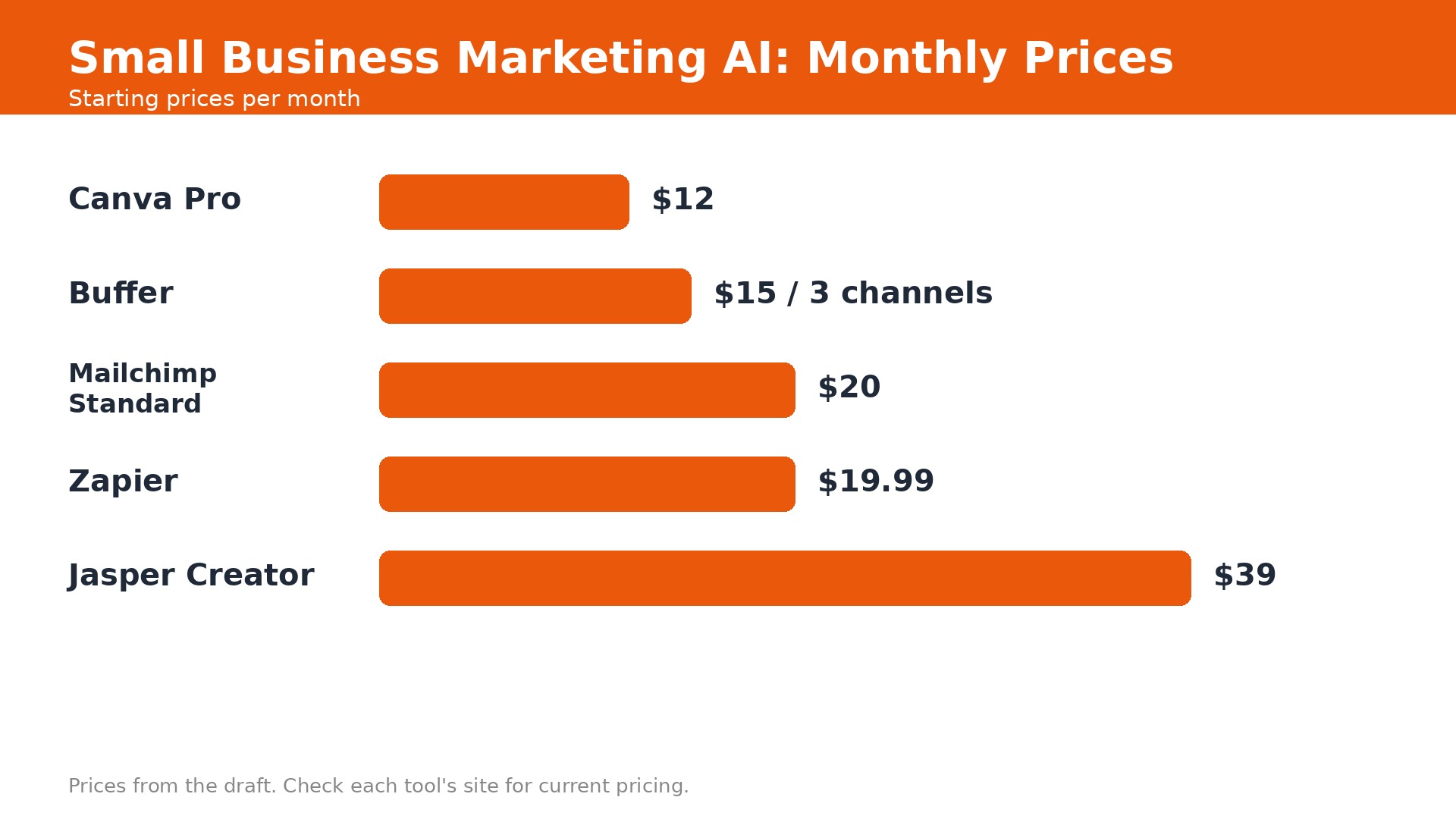
A 100 to 150 dollar stack suits a business with steady sales. That is Jasper Creator at 39 dollars, Mailchimp Standard at 20 dollars, Canva Pro at 12 dollars, Buffer Essentials at 15 dollars for three channels and Zapier Professional at 19.99 dollars. The total is about 106 dollars a month, and it covers content, email, design, social and automation.
A 300 dollar stack adds Semrush Pro at 139.95 dollars for SEO and Frase at 39 dollars for article optimization. That only pays when search brings real customers. If SEO is not a channel yet, spend the money on email or ads instead, where the return is faster to measure.
Mistakes that waste money on marketing AI
The first mistake is buying three writers. Jasper, ChatGPT, Claude and Copy.ai overlap heavily. Pick one writer and learn it well. The second mistake is buying Semrush before anyone does SEO weekly. A 139.95 dollar tool that nobody opens is a cost, not an investment.
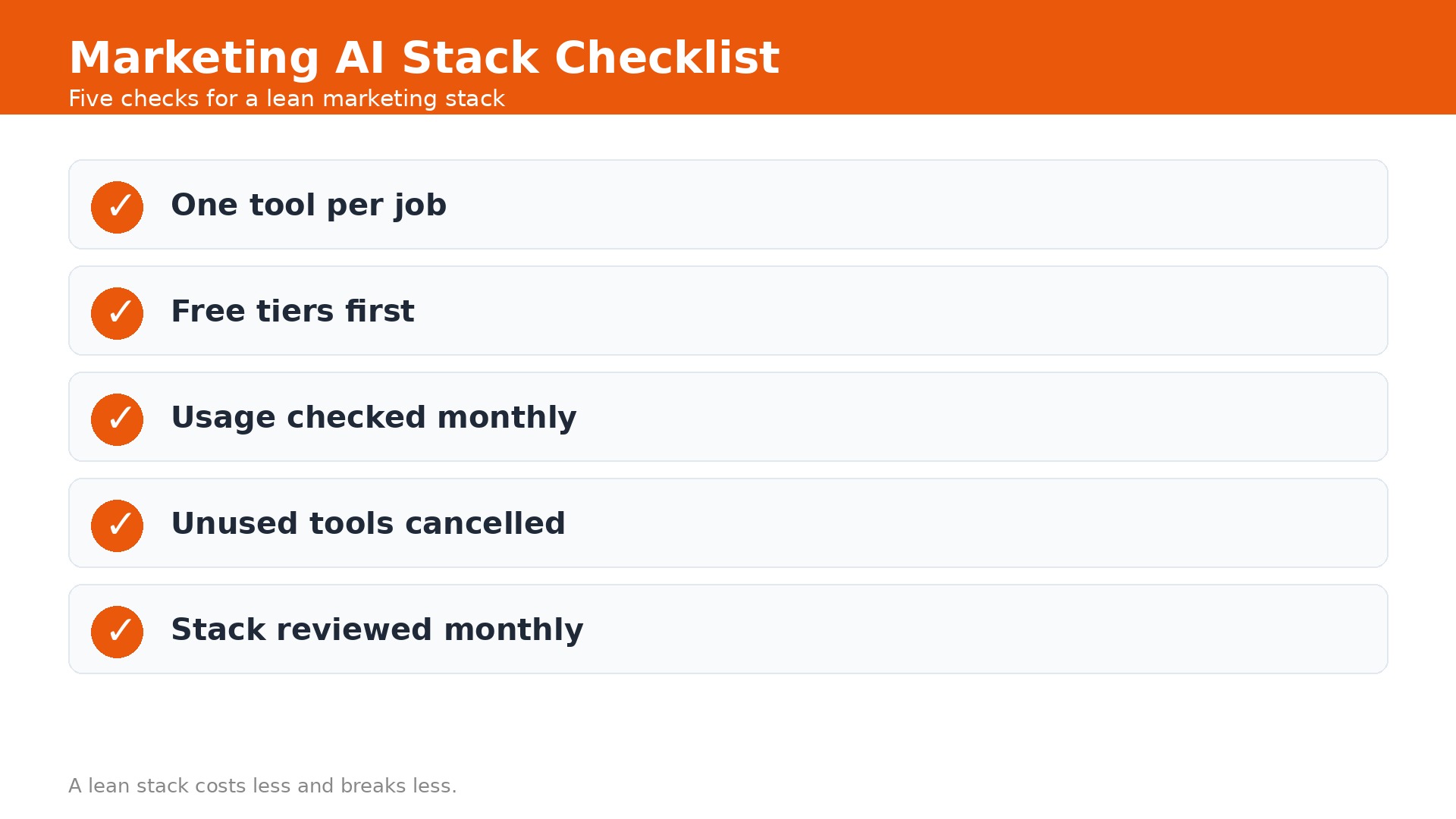
The third mistake is publishing AI copy without reading it. Wrong claims, generic phrasing and invented facts damage trust faster than any tool saves time. The fourth mistake is ignoring the meters. Credits, contacts, channels and tasks all cap monthly use, so check usage after the first month and cancel anything that did not earn its price.
What Your Stack Costs Monthly
A new business can market for zero dollars a month using free tiers across writing, design, email, scheduling and analytics. That stack is enough to make the first sales and learn which channel works. Add the first paid tool only when a job takes more than three hours a week or clearly loses sales.
A business with steady sales should budget 100 to 150 dollars a month, and a business investing in search should budget 250 to 300 dollars with Semrush included. The best AI tools for small business marketing pay for themselves in hours saved or leads gained, and any tool that does neither should be cancelled at the next renewal.
The Summary Call
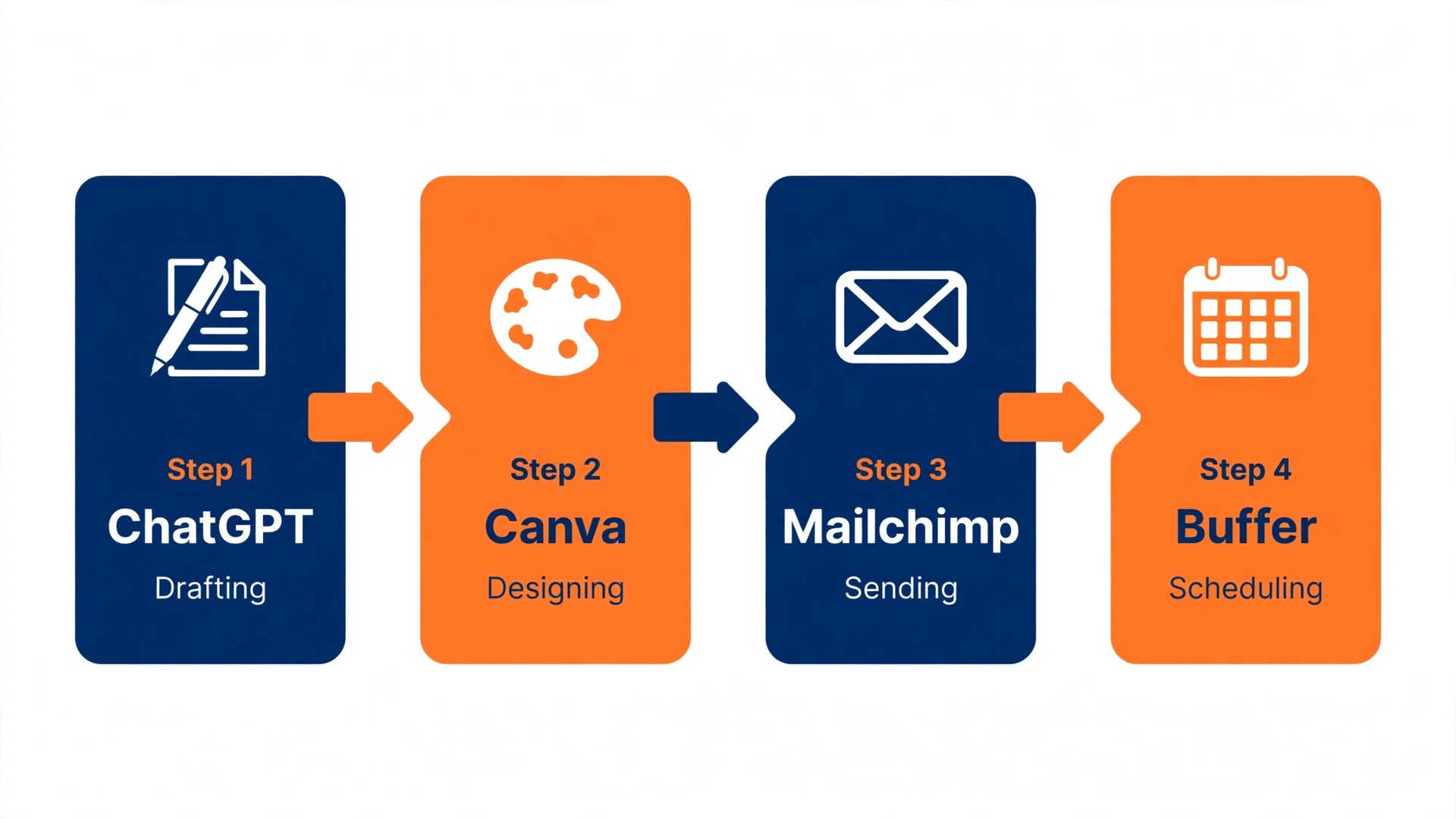
Start free with ChatGPT, Canva, Mailchimp and Buffer, then add Jasper when copy volume grows and Mailchimp Standard when email becomes a revenue channel. That is the short version of the best AI tools for small business marketing, and it works because each tool owns one job. Add Semrush only when SEO is a weekly job with real customers behind it.
Keep the stack small and measured. One tool per job, one metric per tool, and a quarterly audit to cancel what stopped earning. Marketing AI should return hours and customers, not subscriptions.
Frequently Asked Questions
What is the best AI marketing tool for a small business?
It depends on the job. Among the best AI tools for small business marketing, Jasper leads brand consistent copy, Mailchimp leads beginner email, Canva leads design and Buffer leads scheduling. Start with the job that costs the most hours, and add one tool at a time rather than buying a full suite at once.
How much should a small business spend on AI marketing tools?
A new business using the best AI tools for small business marketing can start free. A business with steady sales should budget 100 to 150 dollars a month. Add Semrush only when SEO brings real customers, which lifts the budget to 250 to 300 dollars a month. Cancel anything unused for two weeks.
Can AI do all my marketing for me?
No. AI drafts copy, schedules posts, segments email and analyzes data, but it cannot set strategy, understand customers or build trust. The businesses that gain most use AI for repeating tasks and spend the saved hours on customers, products and real relationships.
Is Jasper or ChatGPT better for small business marketing?
ChatGPT Plus at 20 dollars a month is better for flexibility and general writing across many jobs. Jasper from 39 dollars a month is better when brand voice consistency matters and you publish copy in volume. Most small businesses should start with ChatGPT and move to Jasper only when volume justifies it.
Which email tool is best for a small business?
Mailchimp is best for beginners with its free plan to 250 contacts and simple automations. Brevo is best for cheap sending at scale from 9 dollars a month. ActiveCampaign is best when branching automation and segments drive sales. Pick the one that matches your list size and funnel.
Do AI marketing tools replace a marketer?
No. They replace repeating tasks such as drafting, scheduling, segmenting and reporting. Strategy, positioning, customer insight and creative judgment still need a human. A small business that pairs one person with three good AI tools usually outperforms a business that buys ten tools and no thinking.