
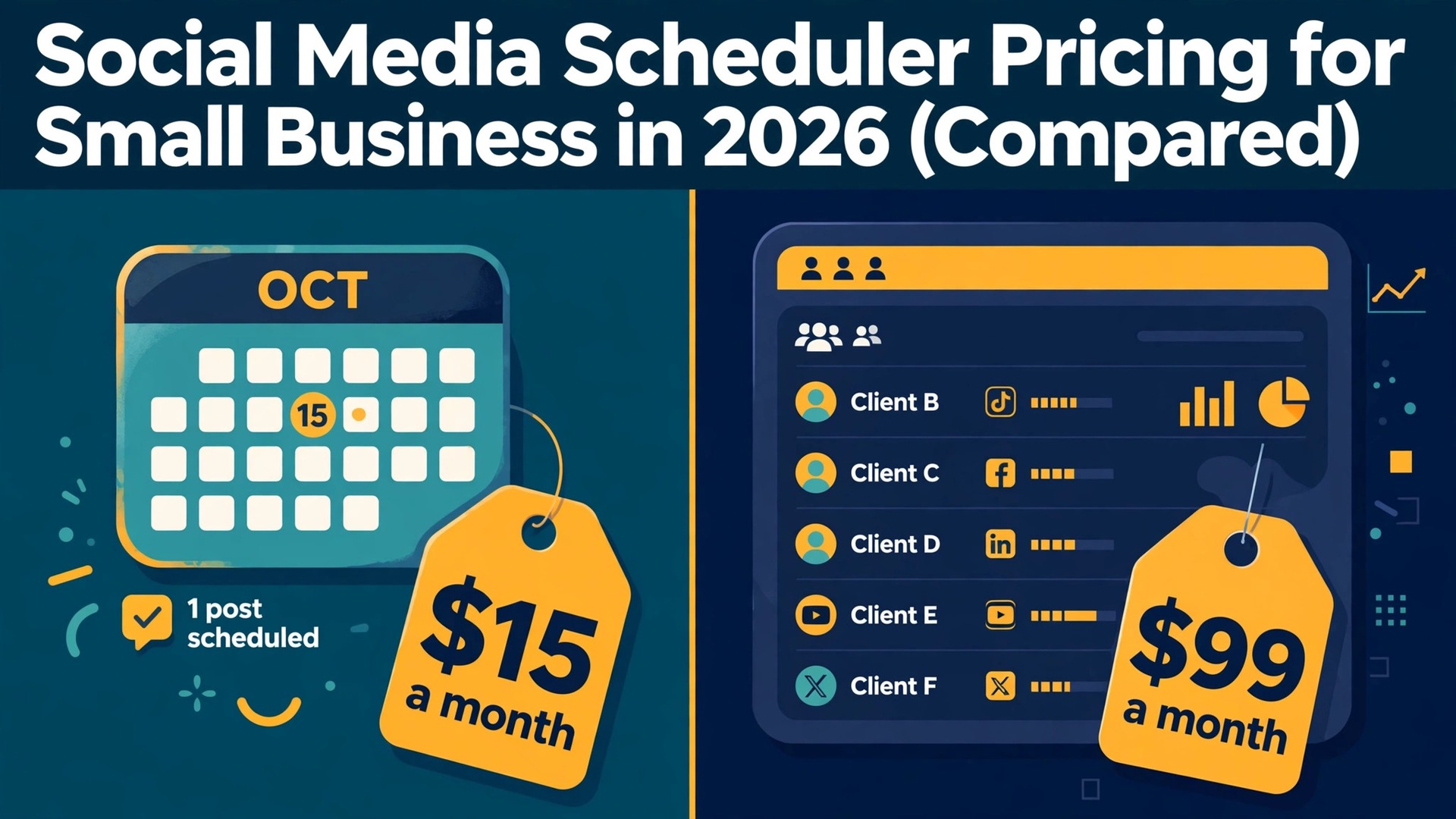
The gap between the cheapest and the most expensive way to schedule social posts is now wider than most small businesses expect. One owner can pay $15 a month billed yearly for three channels on Buffer, while a team on Hootsuite Standard pays $99 per user a month billed yearly for a similar set of accounts. That spread is the reason social media scheduler pricing for small business deserves a careful look before you enter card details, because the headline price rarely tells the full story.
Most buyers compare only the starting price, and that is where the mistakes begin. One tool charges per channel, another charges per user, and a third charges per social set, so two tools that look $20 apart can land $80 apart once your real account count is applied. Add annual billing, seat limits, AI caps and transaction style add ons, and the cheapest plan on the pricing page is often not the cheapest plan for your business.
This guide compares the real published prices for six leading tools, checked against vendor pricing pages and current roundups in November 2026. Every figure is in US dollars and excludes tax. Prices change, so treat this as a buying map rather than a quote, and confirm the final number on the vendor page before you pay. The goal is simple, to show what each plan costs at one seat, at five seats, and at the point where growth forces an upgrade.
How pricing works in this category
Every tool in this comparison charges for a different unit, and that unit decides your bill more than the headline price does. Per channel billing means you pay for each connected account. Per seat billing means you pay for each person who logs in. Per workspace billing means you pay a flat rate for a band of seats. Per sale billing means the platform takes a cut of every order, which can dwarf the subscription at higher volumes.
Annual billing is the second lever. Most vendors cut the monthly rate by 15 to 25 percent when you pay for a year up front, but that saving only helps if you stay for the full year. A tool that costs $25 a month on monthly billing and $18.75 a month billed yearly saves $75 a year, yet it locks $225 up front. For a new business that is still testing a channel, monthly billing is often the cheaper real choice even when the annual rate looks better on the page.
Free trials and free plans are not the same thing. A free plan has no end date but strict limits, while a trial gives you full features for 7 to 30 days and then asks for payment. Trials are useful for testing the workflow with real work, but they hide the long term cost of the limits you will hit in month two. Start with the free plan where one exists, and use a trial only when you have a real project ready to run through it.
Limits are the third lever, and vendors place them in different places. One tool limits scheduled posts, another limits seats, a third limits products or contacts, and a fourth limits AI credits. The limit that matters is the one you will hit first, so count your accounts, your team, your products and your monthly volume before you compare prices. A plan that looks generous on posts can be tight on seats, and the upgrade that fixes seats may double the bill.
In social media scheduler pricing for small business, the diagnosis comes first, because the billing unit decides the bill before any feature does.
What social media scheduler pricing for small business costs in 2026
The table below puts the six tools on the same basis, so the billing unit is visible in every row. Read across each row before you compare down a column, because a low starting price with a narrow billing unit can cost more than a higher starting price with a wide one. All prices are the published entry paid plan, with the free tier shown where one exists.
| Tool | Free tier | Starting paid price | What the price covers | Hidden fees and watch outs |
|---|---|---|---|---|
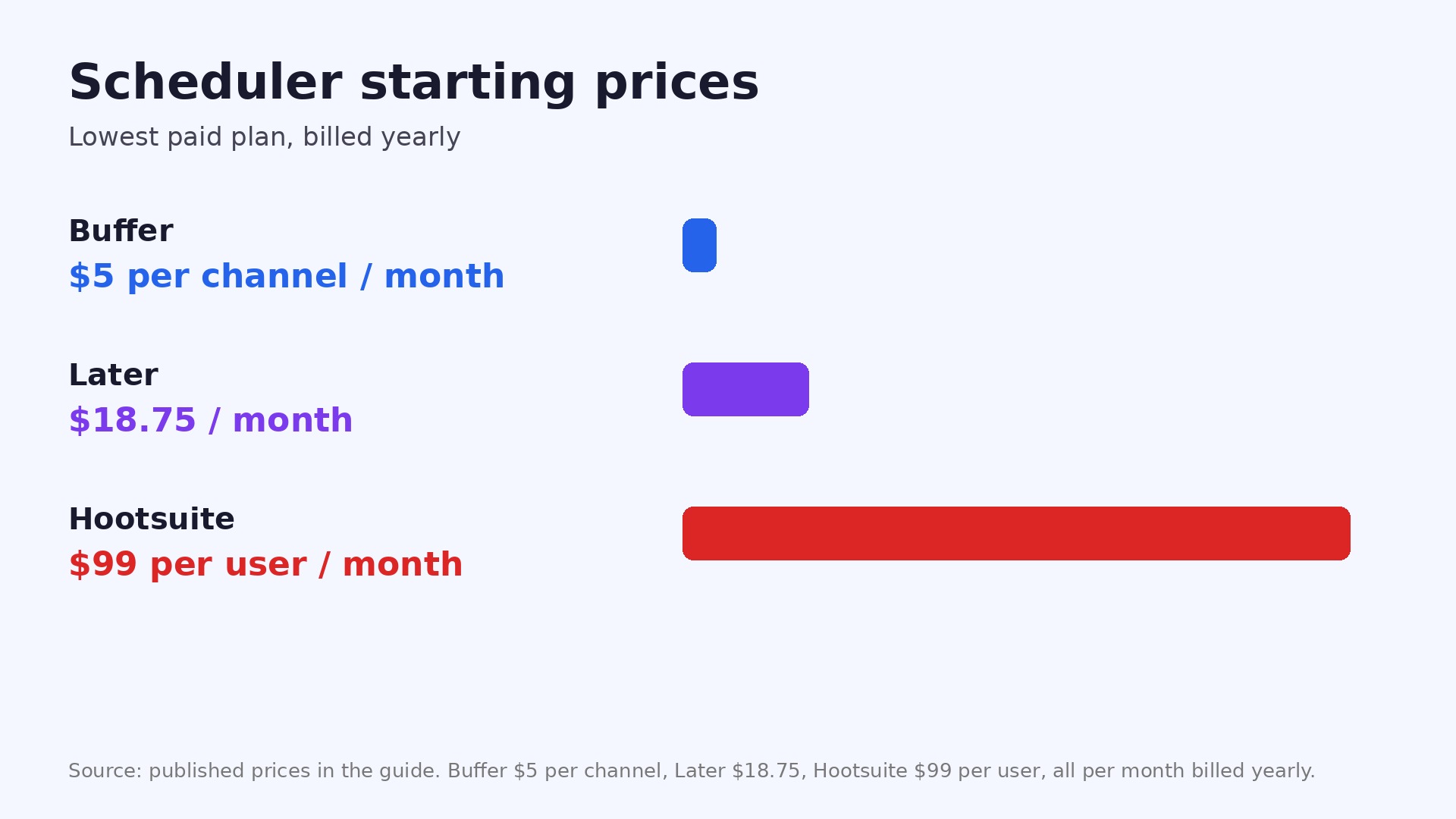
| Buffer | Free plan with 3 channels and 10 scheduled posts per channel | $6 per channel a month, or $5 a channel a month billed yearly | Unlimited scheduling, AI assistant and analytics on Essentials | Per channel billing grows fast. Three channels cost $18 a month, or $15 a month billed yearly. |
| Later | No free plan, 14 day trial | $25 a month, or $18.75 a month billed yearly | 1 social set with 8 profiles, 1 user, 30 posts per profile on Starter | Extra social sets cost $15 each and extra users cost $5 each. AI credits are capped per plan. |
| Hootsuite | No free plan, 14 day trial | $99 per user a month billed yearly, or $149 month to month | Up to 10 social accounts, scheduling and OwlyWriter AI on Standard | Advanced costs $249 per user a month billed yearly, or $399 month to month. Enterprise is quote only. |
| Sprout Social | No free plan, 30 day trial | $249 per seat a month billed yearly | 5 profiles, publishing, engagement and analytics on Standard | Listening and premium analytics cost extra. Per seat billing grows fast as the team grows. |
| Metricool | Free plan with 1 brand and 20 posts a month | $25 a month, or $20 a month billed yearly | Scheduling, analytics and reporting for 1 brand on Starter | The free plan excludes LinkedIn and X. Advanced costs $67 a month, or $53 a month billed yearly. |
| SocialPilot | No free plan, 14 day trial | $30 a month billed yearly on Professional | 10 social accounts, scheduling and analytics for 3 users | Higher tiers add client approval and white label features. Monthly billing costs more than yearly billing. |
Two patterns stand out in that table. First, the free tier is strongest where the vendor wants solo users to grow into a paid plan, and weakest where the vendor sells to teams from day one. Second, the most expensive tools bundle the most, which only saves money when you would otherwise buy those bundled features separately. If you need only one job done well, the cheapest focused tool usually wins. If you need three jobs done, a bundle can be cheaper than three separate bills.
A buyer who works through social media scheduler pricing for small business with real numbers will rarely pick the most expensive plan on the page.
The cheapest option for each kind of business
Price only makes sense against a situation, so this table matches five common situations to the cheapest sensible pick. It uses the published annual rate where one exists, and it assumes the team size and volume stated in the situation. If your situation sits between two rows, read both per tool sections and cost them with your real numbers before you choose.
| Situation | Cheapest sensible pick | Monthly cost to expect |
|---|---|---|
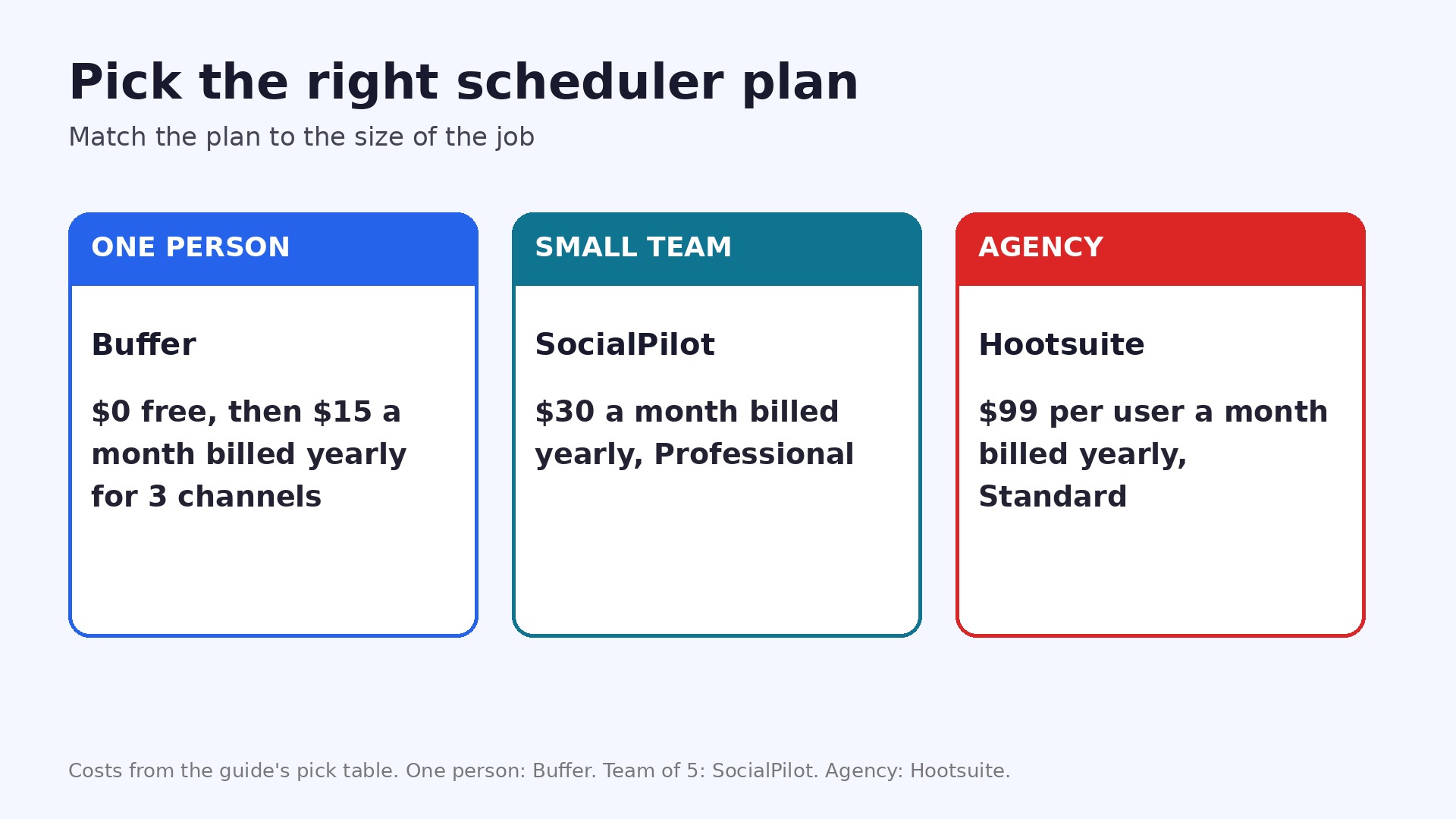
| One person, 3 channels | Buffer free, then Essentials | $0, then $15 a month billed yearly for 3 channels |
| Visual brand on Instagram first | Later Starter | $18.75 a month billed yearly |
| Team of 5, many accounts | SocialPilot Professional | $30 a month billed yearly |
| Agency with reporting needs | Hootsuite Standard | $99 per user a month billed yearly |
| Tight budget, many networks | Metricool free, then Starter | $0, then $20 a month billed yearly |
Notice how often the free plan is the right first step. A solo owner does not need to pay for features built for a team of ten, and a creator with ten sales a month does not need a platform built for a thousand. Start free where you can, measure the limit you hit first, and upgrade only for that limit. That habit saves more money over a year than any discount code, because it stops you paying for capacity you never use.
The rest of social media scheduler pricing for small business keeps every price grounded in published rates, not in marketing claims.
Free plans, tested the honest way
A free plan is worth testing with real work, not with a demo post. Connect the accounts you actually use, schedule a full week of real content or answer real customer messages, and watch where the plan stops you. The limit you hit in that week is the limit that will shape your bill, whether it is post count, seat count, product count or conversation count.
Free plans also reveal how a vendor treats small customers. Some vendors keep support, analytics and exports open on the free tier, while others lock the features that make the tool useful and only unlock them on the highest tier. That is a fair business choice, but it changes the value of the free plan. If the free tier cannot do the core job, it is a trial with no end date, not a real plan, and you should cost the paid tier from the start.
Watch the upgrade path as well. A tool with a gentle step from free to $5 or $19 a month is easy to grow with, while a tool that jumps from free to $99 a month forces a hard decision the moment you outgrow the free tier. The best free plan is the one whose next paid step matches the size you expect to be in six months, not the size you are today.
Finally, check what happens to your data if you leave a free plan. Some tools keep your scheduled posts, your chat history or your course content when you downgrade, while others delete or lock it. Export a copy of anything important before you test a downgrade, and keep your own backup of customer lists and course files outside any single platform.
When you revisit social media scheduler pricing for small business in three months, compare the bill with the note you made on the day you bought.
Each tool in detail
Buffer pricing in detail
Buffer starts with free plan with 3 channels and 10 scheduled posts per channel. The entry paid plan is $6 per channel a month, or $5 a channel a month billed yearly, and it covers Unlimited scheduling, AI assistant and analytics on Essentials. That combination suits a buyer who needs the core job done without paying for a wider suite, and it is the plan most small businesses should test first before they look at higher tiers.
The cost to watch is Per channel billing grows fast. Three channels cost $18 a month, or $15 a month billed yearly. The upgrade that follows is usually triggered by a limit, not by a missing feature, so count your accounts, seats, products or sales before you commit. If the limit is far away, the entry plan is good value. If you are already close to it, cost the next tier now, because the real price of this tool is the tier you will be on in three months, not the tier you start on.
Later pricing in detail
Later starts with no free plan, 14 day trial. The entry paid plan is $25 a month, or $18.75 a month billed yearly, and it covers 1 social set with 8 profiles, 1 user, 30 posts per profile on Starter. That combination suits a buyer who needs the core job done without paying for a wider suite, and it is the plan most small businesses should test first before they look at higher tiers.
The cost to watch is Extra social sets cost $15 each and extra users cost $5 each. AI credits are capped per plan. The upgrade that follows is usually triggered by a limit, not by a missing feature, so count your accounts, seats, products or sales before you commit. If the limit is far away, the entry plan is good value. If you are already close to it, cost the next tier now, because the real price of this tool is the tier you will be on in three months, not the tier you start on.
Hootsuite pricing in detail
Hootsuite starts with no free plan, 14 day trial. The entry paid plan is $99 per user a month billed yearly, or $149 month to month, and it covers Up to 10 social accounts, scheduling and OwlyWriter AI on Standard. That combination suits a buyer who needs the core job done without paying for a wider suite, and it is the plan most small businesses should test first before they look at higher tiers.
The cost to watch is Advanced costs $249 per user a month billed yearly, or $399 month to month. Enterprise is quote only. The upgrade that follows is usually triggered by a limit, not by a missing feature, so count your accounts, seats, products or sales before you commit. If the limit is far away, the entry plan is good value. If you are already close to it, cost the next tier now, because the real price of this tool is the tier you will be on in three months, not the tier you start on.
Sprout Social pricing in detail
Sprout Social starts with no free plan, 30 day trial. The entry paid plan is $249 per seat a month billed yearly, and it covers 5 profiles, publishing, engagement and analytics on Standard. That combination suits a buyer who needs the core job done without paying for a wider suite, and it is the plan most small businesses should test first before they look at higher tiers.
The cost to watch is Listening and premium analytics cost extra. Per seat billing grows fast as the team grows. The upgrade that follows is usually triggered by a limit, not by a missing feature, so count your accounts, seats, products or sales before you commit. If the limit is far away, the entry plan is good value. If you are already close to it, cost the next tier now, because the real price of this tool is the tier you will be on in three months, not the tier you start on.
Metricool pricing in detail
Metricool starts with free plan with 1 brand and 20 posts a month. The entry paid plan is $25 a month, or $20 a month billed yearly, and it covers Scheduling, analytics and reporting for 1 brand on Starter. That combination suits a buyer who needs the core job done without paying for a wider suite, and it is the plan most small businesses should test first before they look at higher tiers.
The cost to watch is The free plan excludes LinkedIn and X. Advanced costs $67 a month, or $53 a month billed yearly. The upgrade that follows is usually triggered by a limit, not by a missing feature, so count your accounts, seats, products or sales before you commit. If the limit is far away, the entry plan is good value. If you are already close to it, cost the next tier now, because the real price of this tool is the tier you will be on in three months, not the tier you start on.
SocialPilot pricing in detail
SocialPilot starts with no free plan, 14 day trial. The entry paid plan is $30 a month billed yearly on Professional, and it covers 10 social accounts, scheduling and analytics for 3 users. That combination suits a buyer who needs the core job done without paying for a wider suite, and it is the plan most small businesses should test first before they look at higher tiers.
The cost to watch is Higher tiers add client approval and white label features. Monthly billing costs more than yearly billing. The upgrade that follows is usually triggered by a limit, not by a missing feature, so count your accounts, seats, products or sales before you commit. If the limit is far away, the entry plan is good value. If you are already close to it, cost the next tier now, because the real price of this tool is the tier you will be on in three months, not the tier you start on.
The cheapest plan in social media scheduler pricing for small business is the one that fits the limit you will hit first, not the lowest headline price.
Annual billing against monthly billing
Annual billing saves 15 to 25 percent on most tools in this comparison, and that saving is real money over a year. A plan that costs $25 a month on monthly billing and $18.75 a month billed yearly saves $75 a year, while a plan that costs $99 a month on monthly billing and $79 a month billed yearly saves far more. The catch is the up front commitment, because you pay twelve months at once and most vendors do not refund the unused months if you leave early.
Monthly billing is the safer choice for a new tool, a new channel, or a business with uneven cash flow. It costs more per month, but it lets you leave after one month if the tool does not fit, and it keeps cash in the business while you test. Use monthly billing for the first two or three months, then switch to annual billing once the tool has proved itself with real work and you know which tier you will stay on.
One more check matters before you pick a billing term. Confirm whether the annual price is charged up front or spread monthly, whether the renewal price is the same as the introductory price, and whether seats added mid year are charged at a prorated rate or at full price. Those three answers decide whether the annual saving is real, and they are worth an email to support before you pay for a year.
Use social media scheduler pricing for small business as a checklist, not as a ranking, because the right tool depends on your size and your volume.
Hidden fees and limits to check before you pay
The fees that surprise buyers are rarely on the pricing page headline. AI charges are the most common, because several tools now bill per resolution, per credit or per session on top of the seat price, and heavy use can double the bill in a busy month. social media scheduler pricing for small business is a good example of a category where AI billing now sits beside seat billing, so ask for the AI rate in writing and estimate it from your real volume.
Add ons are the second surprise. Listening, advanced analytics, white label features, extra seats, extra accounts and priority support are often sold separately, and each one adds $20 to $100 a month. List the add ons you need before you buy, and add their cost to the entry price, because the plan that looked cheapest can become the most expensive once two add ons are included.
Limits on history, storage, exports and support also shape the real cost. A plan with 60 days of chat history forces an upgrade when you need a full year of records. A plan with a product or contact cap forces an upgrade when your catalogue grows. A plan with email only support costs time when something breaks on a deadline. Read the plan comparison page line by line, not just the headline features, and note the limits that touch your daily work.
Taxes, currency and renewal terms are the final checks. Prices in this guide exclude tax, and some vendors charge in US dollars even when you pay from another country, so your bank may add a conversion fee. Renewal prices can rise after an introductory period, and some vendors raise prices for existing customers with 30 days notice. Set a calendar reminder for the renewal date, and review the bill against the features you actually used.
How to pick the right plan in one afternoon
Start by writing down your real numbers, not your hopes. Count the accounts you will connect, the people who need a login, the products or contacts you hold, and the volume you handle in a normal month. Then cost each tool at those numbers, not at the one seat example on the pricing page. That single step removes most of the guesswork, because the cheapest tool at one seat is often not the cheapest at your size.
Next, run a short trial with real work. Pick the two tools that look closest on price, and use each one for a full week with the same task. Measure the time it takes, the limits you hit, and the features you actually used. A tool that saves an hour a week is worth $40 a month to most small businesses, while a tool that adds friction is expensive at any price, because the cost shows up in lost time rather than on the invoice.
Then check the exit before you enter. Export your data, confirm you can cancel without a phone call, and confirm whether your content stays accessible after cancellation. A tool that locks your data is a risk, even at a low price, because switching later costs far more than the monthly saving. Keep your customer list and your core content in a format you control, whatever tool you choose.
Finally, set a review date for three months after you buy. Note the tier you chose, the price you pay, and the limit you expect to hit first. When the review date arrives, check the actual bill against that note, and upgrade or downgrade on evidence rather than habit. That review is the cheapest habit in this whole guide, and it is the one most buyers skip.
Notes to Keep
Keep a simple log of what you decided and what happened next, because the log is what turns a one off purchase or fix into a habit you can repeat. Note the date, the price you paid or the fix you tried, and the result you measured a month later. After three months the log will show whether the choice saved money, whether the problem returned, and whether the next decision should be the same or different. That evidence is worth more than any review you read before you started, because it is about your business and your customers, not about an average user.
Test one change at a time, and give each change enough time to show a real result. A price test, a subject line test, a format test and a keyword test each need at least two weeks of data, because a single week can be skewed by a holiday, a quiet day, or a single large order. Changing three things at once makes the result unreadable, and you will end up keeping a change that hurt and dropping a change that helped, simply because you could not tell them apart.
Review the numbers on a fixed day each week, at the same time, and write the three numbers that matter in the same place every week. A review that takes ten minutes will catch a rising bill, a falling engagement rate, or a fix that stopped working, weeks before a monthly review would. The fixed time matters more than the tool, because a review without a time will be pushed aside by the urgent work of the day, and the problem will grow while nobody is watching it.
Keep your own copy of anything important, outside the tool that created it. Export your customer list, your course files, your designs and your campaign settings, and store them in a place you control. A tool can change its price, close your account, or lose your data, and the export you made last month is the difference between a bad week and a lost business. Set a monthly reminder to export, and test the export by opening it, because a backup you cannot open is not a backup.
Frequently Asked Questions
What is the cheapest social media scheduler for a small business?
Buffer is the cheapest paid option for most solo owners, at $5 per channel a month billed yearly, with a free plan for 3 channels. A one person business with three channels pays $15 a month billed yearly. Metricool free is also strong for a single brand with 20 posts a month.
Is Hootsuite worth $99 a month for a small business?
Hootsuite Standard is worth $99 per user a month billed yearly only when you need up to 10 accounts, team reporting and listening in one place. Most small businesses with three or four accounts get the same scheduling job done for far less on Buffer, Later or SocialPilot.
Does Buffer really cost $5 a month?
Buffer Essentials costs $5 per channel a month billed yearly, or $6 per channel a month on monthly billing. That price is per channel, so three channels cost $15 a month billed yearly. The free plan covers 3 channels with 10 scheduled posts per channel.
What is the catch with free scheduler plans?
Free plans limit channels, posts or networks. Buffer free covers 3 channels with 10 posts each, while Metricool free covers 1 brand with 20 posts a month and excludes LinkedIn and X. The catch is the limit you hit first, so test with real work before you rely on it.
Should I pay yearly or monthly for a scheduler?
Pay monthly for the first two or three months while you test the tool, then switch to yearly once you know the tier you will stay on. Yearly billing saves 15 to 25 percent, but it locks a full year of payment up front.
How many accounts do I need to connect?
Count every profile you post to each week, including the ones you post to rarely. A tool that charges per channel gets expensive fast when you add a fifth or sixth account, while a tool that charges per social set stays flat until you add a whole new set.