
A small business website that goes down on a Saturday morning does not wait until Monday. Customers who click a broken contact form do not come back to try again, and a site that loads slowly after an update does not get a second chance from Google. The bill for keeping a site running is small next to the cost of a site that stops working, and that gap is why website maintenance pricing for small business deserves a careful read before anyone signs a monthly plan.
Maintenance is not one job. It is six jobs that happen to share a monthly invoice, and a plan that covers four of them is not the same as a plan that covers all six. Hosting and renewals keep the domain and the server paid. Updates keep WordPress, themes, and plugins current. Security and backups keep the site safe and recoverable. Fixes repair what breaks. Content changes keep the pages current. Tracking checks keep the analytics and the forms working. Most quotes cover four of those six, and the two that are missing are usually the ones that cost the most when they fail.
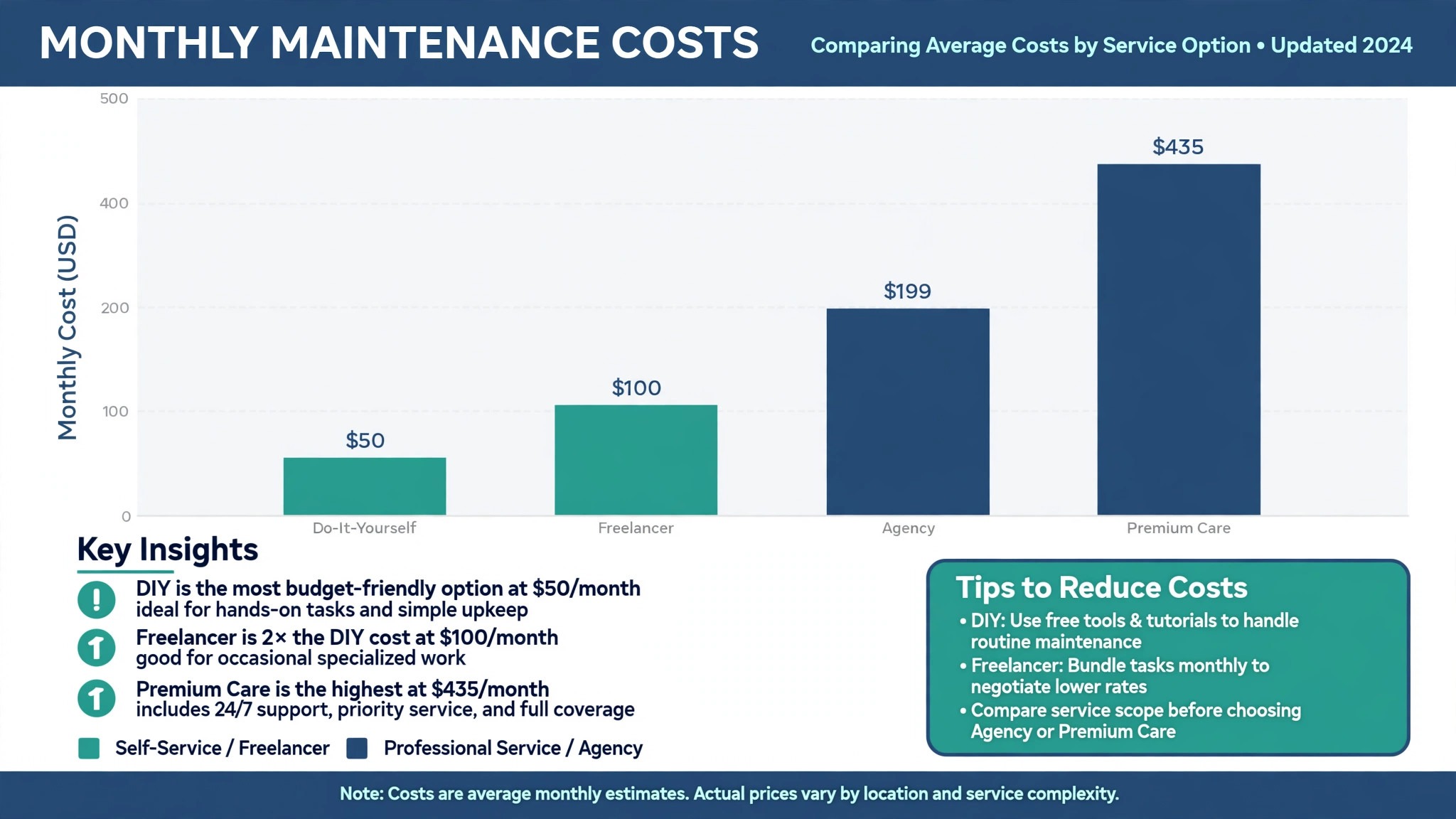
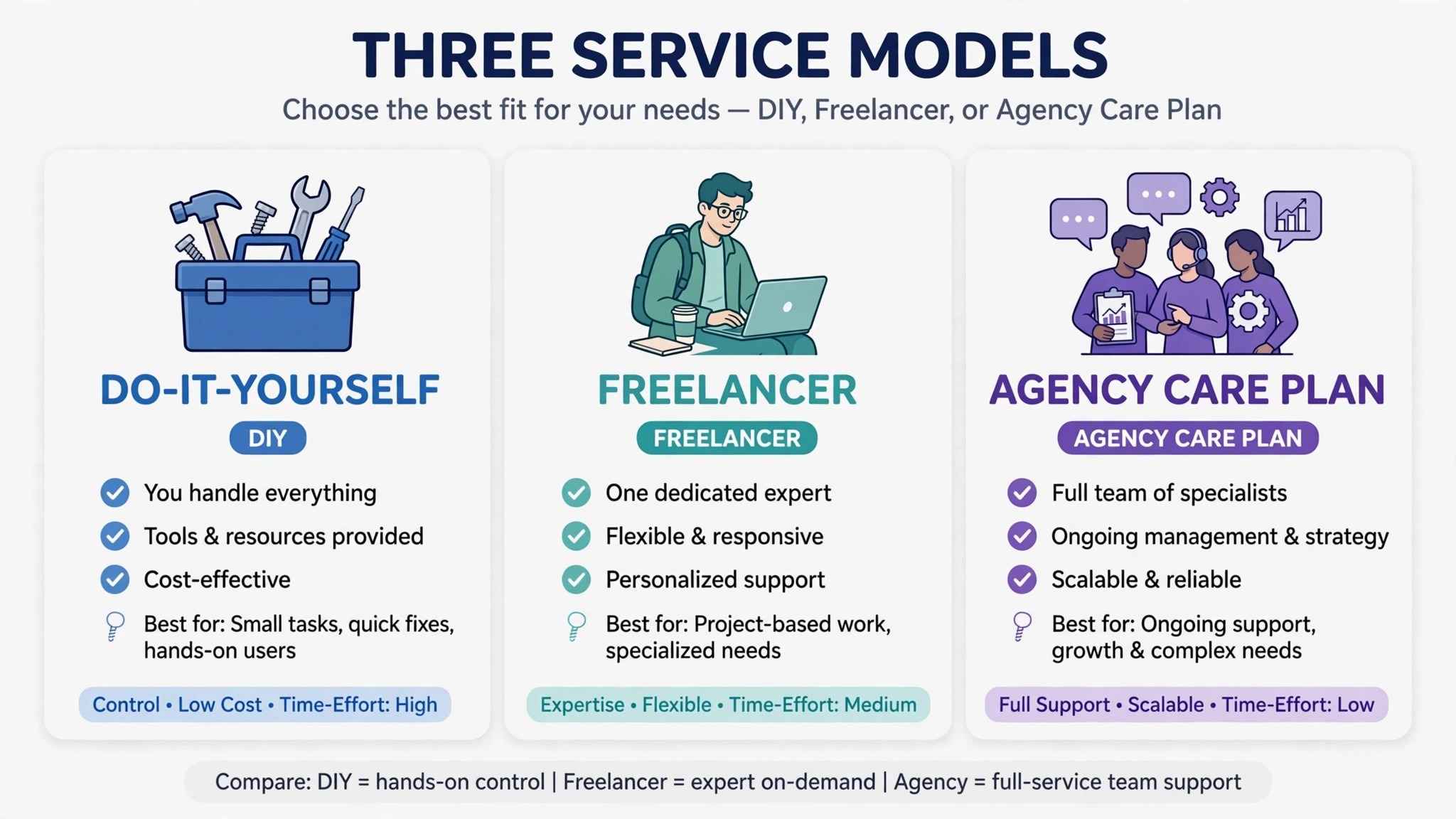
The price also depends on who does the work. A do it yourself stack costs 30 to 75 dollars a month in tools and no human ever looks at the site. A freelancer retainer costs 50 to 150 dollars a month and one person runs the updates. An agency care plan costs 100 to 500 dollars a month and a process runs the updates, with staging, reporting, and a real response time. This guide works through website maintenance pricing for small business across all three, with published prices checked in November 2026.
Prices below are US list prices before tax unless stated. Monthly prices are per month, with the annual billing rate beside the monthly rate where the vendor publishes one. Where a vendor hides its price behind a quote, this guide says so instead of guessing.
At a Glance. website maintenance pricing for small business in One Table
The table below is the short answer. Prices are in US dollars a month before tax, for one small business site unless stated.
| Option | Monthly price | What you get | Who does the work |
|---|---|---|---|
| Do it yourself tool stack | 30 to 75 dollars | Hosting, automated updates, backups, uptime monitor | Nobody, tools only |
| Freelancer retainer | 50 to 150 dollars | Monthly updates, backups, small edits | One freelancer |
| GoWP Pro | 39 dollars per site | Updates, backups, 15 AI edits a month | Automated plus AI edits |
| WP Buffs Maintain | 89 dollars | Weekly updates, backups 4 times a day, 24/7 support | Care team, no edits |
| WP Buffs Protect | 179 dollars | Maintain plus unlimited edits, security | Care team |
| WP Buffs Perform | 239 dollars | Protect plus malware removal, speed work | Care team |
| SiteCare Gold | 435 dollars | Hosting, staging updates, 5 edits, hack cleanup | Managed care team |
| SiteCare Diamond | 2,190 dollars | Gold plus 10 edits, 10 hour expert block | Managed care team |
| Agency care plan, typical | 100 to 500 dollars | Updates, backups, security, reporting, edits | Agency process |
Read the work column first, because it decides what happens at 2 in the morning when the site breaks. A tool stack sends an alert and waits for the owner to act. A freelancer acts when they wake up and see the message. An agency care plan has a person on call and a staging site to test the fix before it goes live. That difference is the heart of website maintenance pricing for small business, and it matters more than the headline price.
Read the edits column second, because edits are where cheap plans turn expensive. A plan with no edits looks cheap until the owner needs a phone number changed, a photo swapped, and a new page added, and each change is billed by the hour. A plan with unlimited edits looks dear until the owner adds up the hours. Count the changes the business actually makes each month before picking a tier.
Do It Yourself
The do it yourself route is the cheapest honest way to keep a small site running, and it costs 30 to 75 dollars a month in tools. Managed WordPress hosting with automated updates and backups sits at the centre, with an uptime monitor and a security plugin beside it. A typical WordPress site costs about 30 dollars for managed hosting, 30 dollars for premium plugins, and 50 dollars of update time if that time is counted, which puts the real running cost near 110 dollars a month once the owner time is priced honestly.
Worked cost for one year. Tools at 50 dollars a month cost 600 dollars a year, and the owner spends roughly an hour a month on updates, backups, and checks. At a modest value of 50 dollars an hour for owner time, that is another 600 dollars a year, so the true cost is about 1,200 dollars a year. A business that enjoys the work and has the time will call that a saving. A business that resents the work will call it a second job.
Do it yourself earns its place with control and with cost. The owner sees every update, every backup, and every plugin, and nothing is hidden behind a report. The weakness is the single point of failure. When the owner is on holiday, nobody updates the site, and when a plugin breaks the site, the owner is the support team. A business with a simple brochure site and an owner who likes the tools should stay here. A business with bookings, a shop, or a form that feeds a CRM should not.
Freelancer Retainer
A freelancer retainer is the middle step, and it costs 50 to 150 dollars a month for a person to run updates monthly, keep backups, and handle small edits. The quality varies with the individual, and the common risks are the bus factor, which is one person with no cover during holidays, and drift, which is the checklist quietly shrinking once things feel stable. Reporting is rare at this band, so the owner should ask for a short monthly note on what was updated and what was backed up.
Worked cost for one year. A retainer at 100 dollars a month costs 1,200 dollars a year, and it buys roughly an hour of a real person each month plus the tools. Emergency work is usually billed separately, and a malware cleanup routinely runs 600 dollars or more per incident, which is more than half a year of the retainer. A business should ask in writing what counts as included and what counts as an emergency before signing.
A freelancer earns their place with a human who knows the site. That person remembers which plugin caused trouble last time and which page the owner edits most, and that memory is worth more than any dashboard. The weakness is cover. One person cannot be on call every night, and a site that breaks on a Friday evening may wait until Monday. A business with a simple site and a trusted freelancer should stay here. A business that cannot wait until Monday should move up a tier.
GoWP
GoWP is the automated pick in this guide, and its pricing is per site per month with AI edits built in. The Free plan costs nothing per site and includes 5 AI edits a month. Pro costs 39 dollars per site a month and includes 15 AI edits. Business costs 99 dollars per site a month and includes 50 AI edits plus 5 human edits of about 30 minutes each. A white label dashboard costs an extra 49 dollars a month flat for agencies.
Worked cost for one site for one year. Pro at 39 dollars a month costs 468 dollars a year, and it covers updates, monitoring, and 15 AI edits a month, which is enough for text changes and small fixes. Business at 99 dollars a month costs 1,188 dollars a year, and it adds the human edits that AI cannot do safely. A business that needs a human to check every change should take Business. A business happy with AI edits for routine text should take Pro.
GoWP earns its place with price and with scale. At 39 dollars a month it is the cheapest published care plan from a named provider in this guide, and the per site model makes it easy to budget. The weakness is that AI edits are not human edits, and a complex change still needs a person. A business with a WordPress site and routine changes should test GoWP first.
WP Buffs
WP Buffs is the care plan pick in this guide, and its pricing is the clearest published ladder in the market. Maintain costs 89 dollars a month and includes weekly WordPress updates, 24/7 emergency support, uptime monitoring, and cloud backups four times a day, with no website edits and no malware removal. Protect costs 179 dollars a month and adds unlimited website edits. Perform costs 239 dollars a month and adds speed and image optimization, ecommerce plugin management, and complete malware removal. Custom costs 359 dollars a month and adds safe updates on staging and custom functionality monitoring.
Worked cost for one site for one year. Maintain at 89 dollars a month costs 1,068 dollars a year, and it keeps the site updated and backed up without touching the content. Protect at 179 dollars a month costs 2,148 dollars a year, and it covers the edits that most small businesses make every month. Perform at 239 dollars a month costs 2,868 dollars a year, and it is the tier a WooCommerce store needs, because the vendor says stores require Perform. A business should pick the tier by the work it needs, not by the price it likes.
WP Buffs earns its place with clarity and with coverage. The plans are published, the backups run four times a day, and the support is 24/7, so a site that breaks at night gets a person. The weakness is that staging tested updates only arrive on the 359 dollar Custom plan, so lower tiers update the live site directly. A business that cannot risk a broken live site should ask about that gap before signing.
SiteCare
SiteCare is the managed pick in this guide, and its pricing sits above the mainstream care plans. Simple maintenance on an existing host starts with Silver at 95 dollars a month. Gold costs 435 dollars a month, or 4,680 dollars a year if paid annually, and includes CoreSpeed hosting, staging tested updates, uptime monitoring, backups, security protection, visual regression testing, a rapid response team, 5 content edits, and 5 quick fixes. Diamond costs 2,190 dollars a month, or 23,880 dollars a year, and includes 10 content edits, endless quick fixes, and a 10 hour block of expert time.
Worked cost for one site for one year. Gold at 435 dollars a month costs 5,220 dollars a year on monthly billing, or 4,680 dollars a year on annual billing, a saving of 540 dollars for paying up front. Diamond at 2,190 dollars a month costs 26,280 dollars a year, which is more than most small businesses spend on their whole website. Gold is the tier a growing business site should compare. Diamond is the tier a store with a one hour response commitment should compare, and most small businesses should not.
SiteCare earns its place with process. Staging tested updates with visual regression testing catch the break before the customer sees it, and the rapid response team is the closest thing to an in house team in this guide. The weakness is price. Gold costs almost five times WP Buffs Maintain, and the extra money buys process that a simple brochure site does not need. A business with a site that earns real revenue every day should test SiteCare Gold. A brochure site should not.
WPCare and FixRunner
WPCare and FixRunner are the budget care picks in this guide, and their pricing shows how far the entry tier has fallen. WPCare Basic costs 39 dollars a month, with Premium at 89 dollars a month adding about 30 minutes of small edits, and Enterprise at 159 dollars a month adding about 60 minutes. FixRunner plans start near 99 dollars a month in third party roundups, with a yearly billing rate near 89 dollars a month. Both are month to month, so a business can leave without a contract fight.
Worked cost for one site for one year. WPCare Basic at 39 dollars a month costs 468 dollars a year, the same as GoWP Pro, and it buys updates and monitoring without edits. Premium at 89 dollars a month costs 1,068 dollars a year, the same as WP Buffs Maintain, and it adds the half hour of edits that most small sites need. A business should compare Premium against WP Buffs Maintain on the edit time, not on the price, because the price is the same and the edit time is the difference.
These providers earn their place with a low entry price and a simple offer. The weakness is that the cheapest tier buys no human time at all, so a business that needs a change will pay by the hour on top. A business with a stable site and almost no changes should test WPCare Basic. A business with monthly changes should take Premium or a plan with edits included.
Agency Care Plans
Agency care plans are the process pick in this guide, and they cost 100 to 500 dollars a month for most established small businesses. A 2026 index of 72 US care plan providers found a median entry plan of 99 dollars a month, a median mid tier of 224 dollars, and a median top tier of 450 dollars, with a median across all tiers of 199 dollars. That index is the best anchor in this guide, because it is built from published prices rather than a single vendor page.
Worked cost for one site for one year. A median plan at 199 dollars a month costs 2,388 dollars a year, and it typically buys verified backups, staged updates, SEO monitoring, real reporting, and one to three hours of edits. A top tier plan at 450 dollars a month costs 5,400 dollars a year, and it typically buys faster response, more hours, and scheduled content. A business should ask for the response time in writing, because a plan that answers in two business days is not the same as a plan that answers in one hour.
An agency earns its place with a process instead of a person. Verified backups, staged updates, and a monthly report that a human actually reads are worth more than any single feature, because they catch the slow failures that a checklist misses. The weakness is that a plan promising unlimited everything for 99 dollars a month is describing a queue, not a promise, and the work will arrive when the queue allows. A business whose site is a lead channel should shop in the 100 to 500 dollar band. A business whose site is a brochure should not.
What Maintenance Does Not Include
No maintenance plan at any price includes redesigns, new feature builds, or large content projects. Those are scoped projects, and a plan that promises them inside a monthly fee is promising work it cannot do at that price. A plan also does not include hosting in every case, so a business should check whether the monthly fee covers hosting or whether hosting is a separate bill. A plan that includes hosting, like SiteCare Gold, is not directly comparable to a plan that does not, like WP Buffs Maintain.
Worked cost of the gap. A redesign costs thousands of dollars as a project, a new booking system costs hundreds, and a content project costs by the page. A business that budgets only the monthly plan and then asks for a redesign will be quoted a project fee on top, and that fee is not a surprise if the contract says so. Read the contract before signing, and ask what counts as maintenance and what counts as a project.
The other gap is tracking. Most quotes cover four of the six maintenance jobs, and the two that are missing are usually content changes and tracking checks. A form that stops sending leads to the CRM is a maintenance failure, and a tracking code that breaks after an update is a maintenance failure, but neither shows up on a plan that only lists updates and backups. Ask whether form testing and analytics checks are included, and get the answer in writing.
Total Cost of Ownership
The sticker price is not the total cost, and a buyer that budgets on the sticker price will be surprised in month two. The total cost includes the plan, the hosting if it is separate, the premium plugins, the edits that fall outside the plan, and the emergency cleanup when something breaks. A 39 dollar plan that needs 600 dollars of malware cleanup costs 639 dollars in the month it breaks, which is more than half a year of the plan. A 239 dollar plan that includes malware removal costs 239 dollars in the same month. That difference is the heart of website maintenance pricing for small business, and it only shows up when the site breaks.
Add the hidden costs to every option. A do it yourself stack at 50 dollars a month costs 600 dollars a year in tools plus the owner time. A freelancer at 100 dollars a month costs 1,200 dollars a year plus emergency work. An agency plan at 199 dollars a month costs 2,388 dollars a year and usually includes the emergency work. A business should add one emergency a year to every plan that does not include cleanup, because one emergency a year is a realistic planning number for a site with plugins.
The rule is simple. Take the published monthly price, add hosting and plugins if they are separate, add the edits the business actually makes, add one emergency cleanup if the plan does not include it, and that is the real yearly cost. That figure is the number that decides the value in website maintenance pricing for small business, not the entry price on the pricing page.
Cheapest by Situation
| Situation | Best value | Why it wins |
|---|---|---|
| Simple brochure site, owner likes tools | Do it yourself | 30 to 75 dollars a month in tools |
| Stable WordPress site, no edits | GoWP Pro or WPCare Basic | 39 dollars a month, updates and monitoring |
| Small site, monthly edits needed | WP Buffs Protect | 179 dollars a month, unlimited edits |
| WordPress site, human edits wanted | GoWP Business | 99 dollars a month, 5 human edits |
| WooCommerce store | WP Buffs Perform | 239 dollars a month, malware removal included |
| Growing business site, staging needed | SiteCare Gold | 435 dollars a month, staging and visual checks |
| Site is a lead channel | Agency care plan, median | 199 dollars a month, process and reporting |
| Enterprise store, one hour response | SiteCare Diamond | 2,190 dollars a month, expert block included |
| Tightest budget, first year | Do it yourself | 30 dollars a month in tools, owner time extra |
Read the table by situation, not by price alone. The cheapest plan for a brochure site is not the cheapest plan for a store, because the store needs malware removal and staging that the brochure site does not. A buyer that chooses the cheapest plan and then discovers it lacks edits will pay by the hour on top, and a buyer that chooses the dearest plan for a brochure site will pay for process it never uses. That situation test is the core of website maintenance pricing for small business. A business that buys the plan that fits the site it has will not pay twice.
Frequently Asked Questions
How much does website maintenance cost per month?
Most small business sites pay 50 to 500 dollars a month, or 600 to 6,000 dollars a year, according to published 2026 guides. A do it yourself stack costs 30 to 75 dollars a month in tools. A freelancer retainer costs 50 to 150 dollars a month. An agency care plan costs 100 to 500 dollars a month, with a median entry plan of 99 dollars and a median top tier of 450 dollars in a 2026 index of 72 providers. The range is wide because the work inside the price is wide.
What should website maintenance include?
It should include hosting and renewals, updates, security and backups, fixes, content changes, and tracking checks. Most quotes cover four of those six, so a business should ask which two are missing before signing. Backups should run at least daily, updates should be tested before they go live on a site that earns revenue, and the plan should state a response time for a broken site in writing.
Is a 39 dollar maintenance plan enough?
It is enough for a stable WordPress site with almost no changes, where the owner only needs updates, monitoring, and backups. It is not enough for a site that needs monthly edits, a store that needs malware removal, or a site that cannot risk a broken update going live. A 39 dollar plan buys no human time, so every change is billed separately, and a buyer should add that cost before calling it cheap.
How much does a hacked website cost to fix?
Emergency remediation routinely runs 600 dollars or more per incident, plus days of downtime while it happens, which is more than a year of an entry level plan. A plan that includes malware removal, like WP Buffs Perform at 239 dollars a month, covers that cost inside the monthly fee. A plan that does not include it leaves the owner to pay the cleanup as a separate bill, and that bill arrives at the worst possible time.
Should I pay monthly or yearly for maintenance?
Yearly billing usually saves about two months, as WP Buffs offers two months free on yearly plans and SiteCare Gold costs 4,680 dollars a year against 5,220 dollars on monthly billing. A business should only pay yearly once it has tried the provider for a month or two and trusts the work, because a yearly plan is harder to leave if the service is poor. Month to month is the right start, and yearly is the right renewal.
Verdict
For most small businesses, the best value is WP Buffs Protect at 179 dollars a month, because it buys weekly updates, backups four times a day, 24/7 support, and unlimited edits in one published price, and that combination covers the work a real small site needs every month. A business with a stable site and no edits should pay 39 dollars a month for GoWP Pro or WPCare Basic and stop there. For a business whose site is a lead channel, the median agency plan at 199 dollars a month is the best pick, because the process and the reporting catch the slow failures that a checklist misses.
For a WooCommerce store, WP Buffs Perform at 239 dollars a month is the best pick, because it is the tier the vendor requires for stores and it includes the malware removal a store cannot live without. For a growing business site that needs staging, SiteCare Gold at 435 dollars a month is the best pick. The right plan is the one that fits the site, the edit volume, and the response time the business needs in six months, not at the entry price, because the entry price buys a plan that may not include the edits or the cleanup. That is the honest read on website maintenance pricing for small business in 2026.