
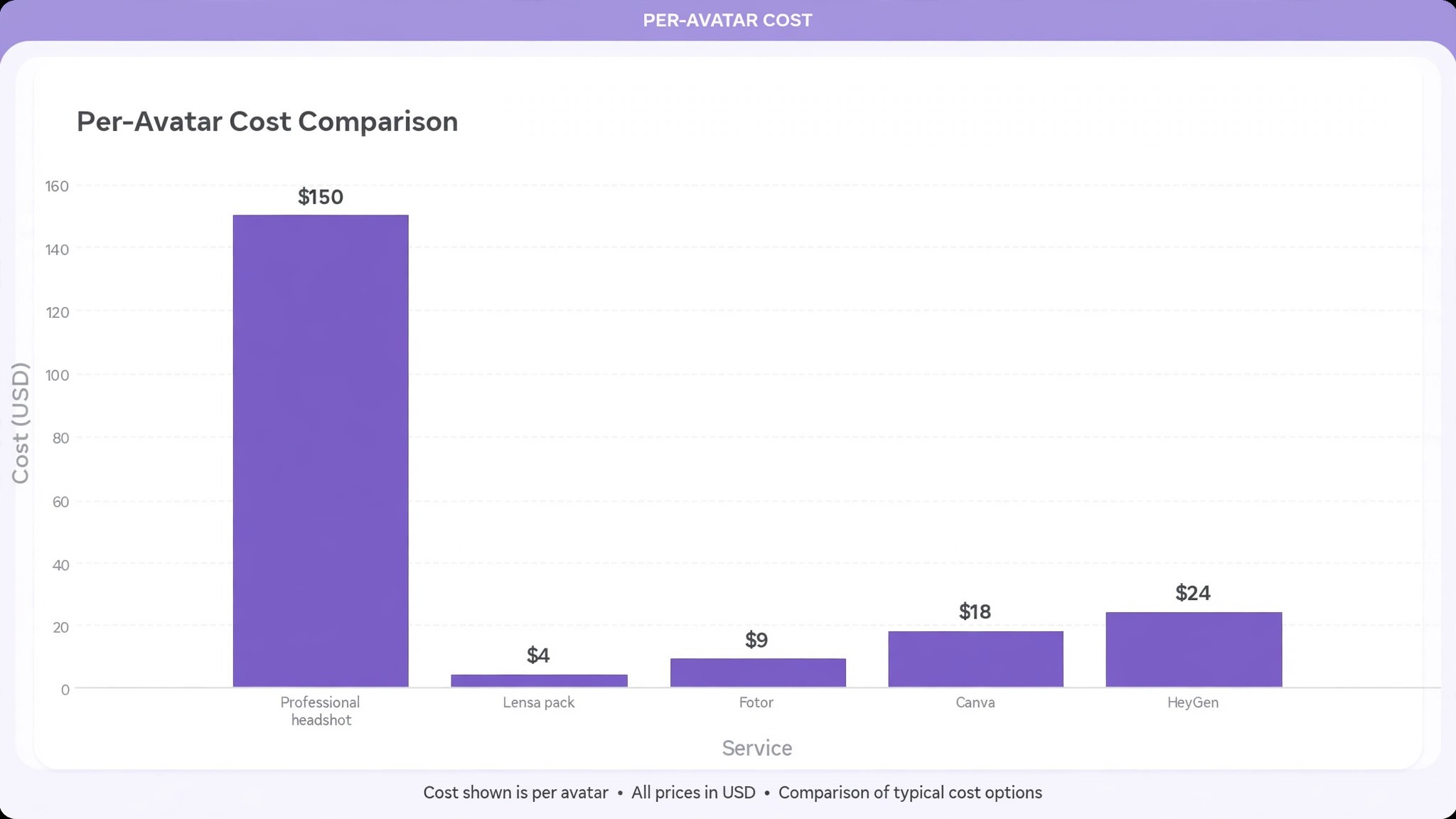
A professional headshot costs 150 to 400 dollars, and a designer charges more again for a stylised portrait. An AI avatar generator charges nothing to try and a few dollars for a pack of fifty, and that gap is the reason most people start with AI. The gap also hides the real question, which is not whether AI is cheaper, because it is, but what the purchase actually buys. That question is the heart of ai avatar generator pricing, and it is the number this guide works out for every tool.
A tool that sells avatar packs for 4 dollars and a tool that charges 29 dollars a month are not selling the same thing. The first sells a batch of still portraits. The second sells a video avatar that talks, plus a studio that keeps making them. A person who needs one profile picture pays less with the pack, and a creator who needs a new video avatar every week pays less with the plan that counts nothing per avatar. The billing model decides the bill more than the headline price does.
The third thing to check is the billing cycle. Most avatar apps sell weekly subscriptions, and a weekly plan renews four or more times a month, so a 7 dollar week is really a 30 dollar month. A pack that costs 4 dollars once is cheaper than a subscription that renews every Friday, even when the weekly price looks smaller. Knowing ai avatar generator pricing means knowing what a month of avatars actually costs, not just what the first week costs.
Prices in this guide are US list prices checked in November 2026, before tax. Monthly prices are per month, with the annual billing rate beside the monthly rate where the vendor publishes one. Where a vendor hides its prices behind an app store listing that changes by region, this guide says so instead of guessing.
At a Glance. ai avatar generator pricing in One Table
The table below is the short answer. Prices are in US dollars, before tax. Free means free to generate and preview, and the paid column is what it costs to download a clean avatar without limits.
| Tool | Free plan | Entry paid price | What you get | Per avatar cost |
|---|---|---|---|---|
| Lensa | Free, limited filters | Packs 3.99 to 7.99 dollars, Premium about 7.99 dollars a month | 50 to 200 stylised portraits per pack | About 8 cents per avatar in a pack |
| Remini | Free, ads and daily limits | Personal 6.99 dollars a week | AI portraits plus photo and video enhancement | About 7 dollars a week, unlimited in the week |
| Fotor | Free Basic plan | Pro 8.99 dollars a month, or 39.99 dollars a year | AI portraits plus full photo editing | About 9 dollars a month, unlimited |
| Canva | Free plan | Pro 18 dollars a month, or 144 dollars a year | Magic Media avatars plus full design suite | About 18 dollars a month, unlimited |
| HeyGen | Free, limited credits | Creator 29 dollars a month, or 24 dollars a month billed annually | Talking video avatars, 30 credits a month | About 1 dollar per video minute |
| Synthesia | No free tier | Starter 29 dollars a month | Video avatars, 10 minutes a month | About 3 dollars per video minute |
| D-ID | Free trial credits | Lite from 4.70 dollars a month billed annually | Talking head videos from a photo | About 5 dollars a month, limited minutes |
| Gemini | Free plan | AI Pro 19.99 dollars a month | Image generation plus the full Google AI suite | About 20 dollars a month, unlimited images |
Read the per avatar column first, because an avatar generator without a clear unit price is a generator that stops being cheap mid month. Lensa sells packs of 50 avatars for about 4 dollars, so one avatar costs about 8 cents, while HeyGen sells video minutes, so one talking avatar costs about a dollar a minute. That gap between the still pack and the video minute is the oldest trick in ai avatar generator pricing, and every tool in this table plays it in some form.
Read the billing column second, because a pack and a subscription behave differently as the volume grows. Lensa at 4 dollars a pack covers fifty avatars, so a hundred avatars cost 8 dollars, or about 8 cents each. Remini Personal at 6.99 dollars a week covers unlimited portraits for the week, so a hundred avatars cost 6.99 dollars, or about 7 cents each, but the bill renews every week. The billing model, not the headline price, decides what a month of avatars costs.
How the Billing Models Work
Avatar generators sell in three ways, and the model matters more than the price. Packs sell a fixed batch for a fixed price, so a Lensa pack of 50 avatars for 3.99 dollars is the cheapest honest price in this guide for a person who needs one profile picture. Subscriptions sell a month of access for a monthly price, so Fotor Pro at 8.99 dollars a month is the cheapest honest price for a person who makes avatars every week. Weekly billing sells the same subscription in seven day slices, so Remini at 6.99 dollars a week is really about 30 dollars a month, and a buyer who forgets to cancel pays four times.
The second thing to check is what counts as one avatar. A still portrait costs one credit or one slot in a pack, while a talking video avatar costs credits per minute, so a two minute video can cost more than fifty still portraits. HeyGen Creator at 24 dollars a month billed annually includes 30 credits, and a one minute video uses about one credit, so thirty short videos cost 24 dollars. A buyer who needs still portraits should never pay a video price, and a buyer who needs video should never count still packs.
The third thing to check is the consent rule. Every reputable platform now requires verified consent from the person being cloned, and the EU AI Act transparency rules that took effect in August 2026 require deepfake content to be disclosed. A tool that lets you clone a face without consent is a tool to avoid, whatever the price, because the legal risk costs more than the subscription saves. That consent check is part of ai avatar generator pricing, because a cheap tool that breaks the rules is not cheap at all.

1. Lensa
Lensa is the cheapest stylised avatar pick in this guide, and its pricing is a mix of packs and a subscription. Magic Avatars packs cost 3.99 to 7.99 dollars for a batch of 50 to 200 stylised portraits, with a 50 avatar pack at about 3.99 dollars. Premium costs about 7.99 dollars a month, or 29.99 dollars a year, and adds filters, retouching and a recurring avatar allowance. Prices vary by region and by app store promotion, so check the app before you buy.
Worked cost for 50 avatars. A pack at 3.99 dollars covers 50 avatars, so 50 avatars cost 3.99 dollars in total, or about 8 cents per avatar. A person who needs one profile picture pays 3.99 dollars and keeps 49 spare portraits, which is the cheapest honest price in this guide for a still avatar. A person who makes avatars every week should pay the annual Premium at 29.99 dollars, or about 2.50 dollars a month, because the allowance covers the regular use.
Lensa earns its price with the packs. It made stylised avatars mainstream in 2022, and it is still the cheapest way to get a batch of them, with more than 30 styles from a single selfie. A person who wants a new profile picture should test Lensa first, because 4 dollars buys fifty portraits. The weakness is the mobile only app, because there is no web generator, and the subscription does not include unlimited packs.
2. Remini
Remini is the phone pick in this guide, and its pricing is a weekly subscription with a free taste. The free plan gives daily enhancement credits with watermarked exports and ads. Personal costs 6.99 dollars a week for photo and video enhancement, and Business costs 9.99 dollars a week for unlimited photo enhancements, bulk upload and commercial use rights. A monthly option at 9.99 dollars also exists, and the App Store listing shows Pro Weekly at 9.99 dollars and Lite Weekly from 4.99 dollars.
Worked cost for 50 avatars. Personal at 6.99 dollars a week covers unlimited portraits for the week, so 50 avatars cost 6.99 dollars in total, or about 14 cents per avatar, but the bill renews every week. A person who needs avatars for one week pays 6.99 dollars and stops there, which is fair, but a person who leaves the subscription running pays about 30 dollars a month. That weekly renewal is the catch to watch.
Remini earns its price with face quality. Its face model rebuilds a soft selfie into a sharp portrait, and the video enhancement is included on paid plans, which suits creators who want avatars and video in one app. A person who wants a sharp avatar from a blurry selfie should test Remini first, because the face work is the best on a phone. The weakness is the weekly billing, because the price looks small until the month adds up.
3. Fotor
Fotor is the budget all rounder in this guide, and its pricing is the simplest of all. The free Basic plan covers AI portraits with limits, and Pro costs 8.99 dollars a month, or 39.99 dollars a year, with the full photo editing suite included. The tool handles AI portraits, background removal and photo enhancement in one place, and the free tier is genuinely free forever.
Worked cost for 50 avatars. Pro at 39.99 dollars a year covers unlimited portraits, so 50 avatars cost about 3.33 dollars in total on the annual rate, or about 7 cents per avatar. A person who needs avatars every month should pay the annual rate, because 39.99 dollars a year beats every monthly plan in this guide for the same job. That is the whole trade, and it is an honest one.
Fotor earns its place with value. A full year of Pro costs less than six weeks of Remini on weekly billing, and the photo editing is stronger than most avatar tools, which suits a person who also edits photos. A person who wants avatars plus editing should test Fotor first, because 8.99 dollars a month buys both. The weakness is depth, because the avatar styles are fewer than Lensa and the video tools are weaker than HeyGen.
4. Canva
Canva is the design suite pick in this guide, and its pricing is a subscription with a free taste. The free plan covers Magic Media avatars with limits, and Pro costs 18 dollars a month, or 144 dollars a year, with brand kits, templates and the full design suite included. The tool turns an avatar into a profile picture, a banner and a social post in one sitting, which no avatar only app can do.
Worked cost for 50 avatars. Pro at 144 dollars a year covers unlimited avatars, so 50 avatars cost 12 dollars in total on the annual rate, or about 24 cents per avatar. A person who only needs avatars should buy Lensa instead, because 4 dollars beats 12 dollars for the same fifty portraits. A person who also designs banners, posts and presentations should pay Canva, because the suite replaces three tools.
Canva earns its price with the suite. An avatar made in Canva goes straight into a LinkedIn banner, a resume and a social post without exporting and reuploading, and the brand kits keep every design on message. A creator who designs every week should test Canva first, because 18 dollars a month buys the best design suite in this guide. The weakness is the price, because Pro has risen twice since 2024 and the avatar tools alone do not justify it.
5. HeyGen
HeyGen is the video avatar pick in this guide, and its pricing is a credit system with a free tier. The free plan gives limited credits to test the studio, and Creator costs 29 dollars a month, or 24 dollars a month billed annually, with 30 credits a month. Higher tiers add more credits, longer videos and team features, and the studio covers talking avatars, translation and video templates in one place.
Worked cost for 10 video avatars. Creator at 24 dollars a month billed annually covers 30 credits, and a one minute video uses about one credit, so 10 one minute videos cost about 8 dollars in total, or about 80 cents per video. A creator who makes a video avatar every week should pay Creator, because 24 dollars a month beats hiring a presenter for the same ten videos. That is the price of video, and a creator that publishes video should count it before buying.
HeyGen earns its price with realism. Its talking avatars look and sound like a presenter, with lip sync that holds up on a full minute of video, and the translation covers dozens of languages, which suits creators with an audience in more than one country. A creator who needs a presenter without a camera should test HeyGen first, because 24 dollars a month buys the best video avatar in this guide. The weakness is the credit cap, because 30 credits is a hard limit, and a heavy month burns through it fast.
6. Synthesia
Synthesia is the enterprise video pick in this guide, and its pricing is a subscription with no free tier. Starter costs 29 dollars a month, with 10 video minutes a month, and Creator costs about 64 dollars a month billed annually, with more minutes and more avatars. The platform covers training videos, product explainers and internal communications, with templates built for business rather than social fun.
Worked cost for 10 video avatars. Starter at 29 dollars a month covers 10 minutes, so 10 one minute videos cost 29 dollars in total, or about 2.90 dollars per video. A business that needs training videos should pay Synthesia, because the templates and the brand controls suit corporate work. A solo creator should buy HeyGen instead, because 24 dollars a month buys three times the minutes for less money.
Synthesia earns its price with the business fit. The avatars are professional, the templates cover onboarding and compliance, and the collaboration tools keep a team on message. A business that makes training videos every month should test Synthesia first, because 29 dollars a month buys the most corporate video avatar in this guide. The weakness is the price per minute, because 10 minutes a month is a small allowance for the money.
7. D-ID
D-ID is the cheapest video avatar pick in this guide, and its pricing is a subscription with a trial. The free trial gives credits to test the talking head videos, and Lite costs from 4.70 dollars a month billed annually, with limited minutes. Higher tiers add more minutes, more avatars and API access, and the tool turns a single photo into a talking video in minutes.
Worked cost for 10 video avatars. Lite at 4.70 dollars a month billed annually covers a small minute allowance, so 10 short videos cost about 4.70 dollars in total, or about 47 cents per video. A creator who needs short talking head clips should test D-ID first, because it is the cheapest way into video avatars. A creator who needs long videos should buy HeyGen instead, because the Lite allowance runs out fast.
D-ID earns its price with the entry point. A single photo becomes a talking video without a studio, a camera or a presenter, which suits a creator testing video for the first time. A small business that wants a spokesperson on its homepage should test D-ID first, because 4.70 dollars a month buys the cheapest talking avatar in this guide. The weakness is the minute cap, because the Lite plan is built for testing, not for volume.
8. Gemini
Gemini is the suite pick in this guide, and its pricing is a subscription with a free taste. The free plan covers image generation with limits, and AI Pro costs 19.99 dollars a month, with the stronger image model, higher limits and the full Google AI suite included. The tool generates avatars from a text prompt, edits them in conversation, and works inside Google Docs, Gmail and Drive.
Worked cost for 50 avatars. AI Pro at 19.99 dollars a month covers unlimited images, so 50 avatars cost 19.99 dollars in total, or about 40 cents per avatar. A person who only needs avatars should buy Lensa instead, because 4 dollars beats 20 dollars for the same fifty portraits. A person who already uses Google tools every day should pay Gemini, because the suite replaces several subscriptions.
Gemini earns its price with the suite. An avatar made in Gemini goes straight into a document, an email signature and a presentation without exporting, and the image model handles damage repair and style changes in the same conversation. A Google user who makes images every week should test Gemini first, because 19.99 dollars a month buys the best Google AI suite in this guide. The weakness is the avatar focus, because the styles are fewer than Lensa and the video tools are weaker than HeyGen.
Free vs Paid
The free tier is the first thing to check, and the free plans in this guide are not equal. Lensa free covers limited filters, Remini free gives daily credits with ads and watermarks, Fotor free covers basic portraits, Canva free covers Magic Media with limits, HeyGen free gives limited credits, D-ID free gives trial credits, and Gemini free covers image generation with limits. Synthesia has no free tier at all, so the buyer pays before testing properly.
The paid tier is the second thing to check, and the cheapest honest price for a still avatar is Lensa at 4 dollars a pack, while the cheapest honest price for a video avatar is D-ID at 4.70 dollars a month billed annually. A buyer who needs one profile picture should pay the pack and stop there, because a subscription renews whether it is used or not. A buyer who makes avatars every week should pay the annual subscription, because the monthly rate costs about twenty percent more over a year.
The rule is simple. Count the avatars the buyer makes in a month, divide the price by that count, and that is the per avatar cost. That per avatar figure is the heart of ai avatar generator pricing, and it is the number that decides the value.
Total Cost of Ownership
The sticker price is not the total cost, and a buyer that budgets on the sticker price will be surprised in month two. The total cost includes the subscription, the extra packs, the higher tier when the credits run out, and the cost of an avatar that cannot be used. A 6.99 dollar a week plan costs about 30 dollars a month, not 7 dollars, so the real price of a weekly subscription is four times the number on the screen. A 3.99 dollar pack costs 3.99 dollars forever, and that certainty is worth money to a buyer that makes avatars once.
Add the hidden costs to every tool. An avatar that needs regenerating because the face looks wrong costs another pack, which wipes out the saving from the cheapest tool. An avatar that uses a model that invents a different face costs a reprint later, which is the most expensive outcome in this guide. A subscription that renews at a higher rate, such as Remini at 9.99 dollars a week against 6.99 dollars for Personal, costs 43 percent more, so check the plan name before paying, never by accident.
The output rights are the second hidden cost. A free avatar with a watermark cannot be used as a profile picture, and a Business plan that includes commercial use rights costs more than a Personal plan that does not. Remini Business at 9.99 dollars a week includes commercial use, while Personal does not, so a business that uses an avatar in an ad must pay the higher tier. A buyer who discovers that after making fifty avatars must redo them all.
The rule is simple. Take the published price, work out the cost per avatar at the volume the buyer actually needs, add the renewal, and that is the real yearly cost. That per avatar figure is the heart of ai avatar generator pricing, and it is the number that decides the value.
Cheapest by Situation
| Situation | Best value | Why it wins |
|---|---|---|
| One profile picture, zero fuss | Lensa pack | 3.99 dollars for 50 avatars |
| Avatars every week, still images | Fotor Pro annual | 39.99 dollars a year, unlimited |
| Sharp faces from blurry selfies | Remini Personal | 6.99 dollars a week, best face model |
| Avatars plus full design suite | Canva Pro annual | 144 dollars a year, whole suite |
| Talking video avatars | HeyGen Creator | 24 dollars a month annual, 30 credits |
| Corporate training videos | Synthesia Starter | 29 dollars a month, business templates |
| Cheapest talking head clips | D-ID Lite | 4.70 dollars a month annual |
| Avatars inside Google tools | Gemini AI Pro | 19.99 dollars a month, full suite |
Read the table by situation, not by price alone. The cheapest tool for one avatar is not the cheapest tool for a hundred avatars, because the billing model flips the math. A buyer that chooses the cheapest tool and then discovers it cannot make the video the job needs will pay twice, once for the cheap avatar and once for the replacement. That situation test is the core of ai avatar generator pricing. A buyer that buys the avatar tool it needs for the job it has, with the allowance that job requires, will not pay twice.
Frequently Asked Questions
Is there a truly free AI avatar generator?
Yes, with limits. Lensa free covers limited filters, Fotor free covers basic portraits, Canva free covers Magic Media with limits, and Gemini free covers image generation with limits. Remini free gives daily credits with ads and watermarks, and HeyGen free gives limited credits. Synthesia has no free tier. That split between free generation and paid clean downloads is the first thing ai avatar generator pricing teaches a new buyer.
How much does one AI avatar cost?
One still avatar costs about 8 cents in a Lensa pack at 3.99 dollars for 50 avatars, and about 7 cents on Fotor Pro at 39.99 dollars a year for unlimited portraits. One talking video avatar costs about 80 cents on HeyGen Creator at 24 dollars a month billed annually for 30 credits, and about 2.90 dollars on Synthesia Starter at 29 dollars a month for 10 minutes. Count the avatars the buyer makes, divide by the allowance, and that is the per avatar cost.
Do I own the avatar an AI generator makes?
Ownership depends on the tool and the tier. Lensa, Fotor, Canva and Gemini give the buyer full rights to the avatars they make on paid plans, and the exports are standard JPG or PNG files. Remini Business includes commercial use rights, while Personal does not, so a business that uses an avatar in an ad must pay the higher tier. Read the licence on the pricing page before paying, because an avatar the buyer cannot use commercially is an avatar that will need replacing.
How much does an AI avatar generator cost in 2026?
An AI avatar generator costs 4 to 29 dollars a month on a subscription, depending on the tool and the allowance included. A professional headshot costs 150 to 400 dollars, and a designer charges more again for a stylised portrait. The AI price buys pixels and files, and the photographer price buys judgment and craft. A person that needs a clean profile picture fast should pay the AI price. A person that needs a portrait nobody else has should pay the photographer price.
Which AI avatar generator is best for a small business?
It depends on the job. Lensa is best for a single profile picture at 3.99 dollars a pack. Fotor Pro is best for still avatars every week at 39.99 dollars a year. HeyGen Creator is best for talking video avatars at 24 dollars a month billed annually. Canva Pro is best for avatars plus a full design suite at 144 dollars a year. A small business that needs ten avatars a month should choose Lensa or Fotor. A small business that needs video avatars should choose HeyGen or D-ID.
Verdict
For most people, the best value is a Lensa pack at 3.99 dollars for 50 avatars, because it is the cheapest honest price in this guide for a still avatar that looks good, and the pack never renews. A person that needs one profile picture should pay 3.99 dollars and stop there. For a person that makes avatars every week, Fotor Pro at 39.99 dollars a year is the best pick, because the annual rate covers unlimited portraits for less than a month of Remini on weekly billing.
For video, HeyGen Creator at 24 dollars a month billed annually is the best pick for talking avatars, and D-ID Lite at 4.70 dollars a month billed annually is the best pick for short clips on a budget. For a zero budget, the free plans on Lensa, Fotor, Canva and Gemini all hand over a usable avatar with no payment. The right tool is the one that fits the volume, the format need, and the budget at the tier the buyer will use in six months, not at the entry price, because the entry price buys avatars that may not cover the job. That is the honest read on ai avatar generator pricing in 2026.