

A clinic that books 25 eye exams a day loses money in small leaks. A missed recall here, a frame order written on paper there, an insurance claim sent back for one wrong code, and a no show that nobody chased. Add those leaks across a month and the loss is larger than the software bill most owners argue about. The best software for optometry clinics exists to close those leaks in one place, so the exam, the glasses order, the recall and the claim all move through the same record.
This guide compares eight systems on real published prices, the work each one does best, and the catch that only appears after the demo. Prices come from vendor pricing pages and third party roundups checked in November 2026, and where a vendor sells by quote only, this guide says so instead of guessing. Start with the shortlist table, then read the reviews that match your clinic size and your billing mix.
The Quick Shortlist
The table below matches each common clinic job to the single system that handles it best. Use it to narrow the best software for optometry clinics to two or three candidates before you read the full reviews. Prices are monthly list prices unless noted, and annual billing is usually cheaper than paying month to month.
| Job | Best tool | Why it wins |
|---|---|---|
| Cloud EHR plus practice management for an independent clinic | RevolutionEHR | Optometry native charting from 319 dollars a month reported |
| Vision plan billing for a VSP heavy practice | Eyefinity Encompass | Essential plan from 340 dollars a month |
| All in one EHR and optical for a small clinic | Crystal PM | Essentials from 150 dollars a doctor a month reported |
| Multi location charting and optical POS | MaximEyes | Reported from 325 dollars a month |
| Simple EHR with patient engagement | iTRUST | From 199 dollars a doctor a location a month |
| Deep clinical and billing control | Compulink Advantage | Reported from 400 dollars a provider a month |
| Large retail optical with deep inventory | My Vision Express | Quote only |
| A free start for a new optical shop | Visilion | Free Basic plan |
How We Judged the Best Software for Optometry Clinics
A system earned a place here only if it does real clinic work in 2026, not if it added a patient portal to an old billing tool. We judged each one on five things that decide whether a clinic keeps paying after the first year. The best software for optometry clinics has to pass all five, because a system that charts well but bills badly still costs the clinic money every week.
First, the clinical job, from exam charting to prescription writing to imaging, because a system that slows the doctor down in the exam room will be fought by the whole team. Second, the optical job, from frame inventory to lab orders to the sale at the front desk, because the dispensary is where much of the revenue sits. Third, the billing job, from vision plan claims to eligibility checks to patient balances, because a clean claim is the difference between paid in two weeks and paid in two months.
Fourth, the starting price a small clinic can actually buy, including whether a free plan or trial exists and what the paid plan really includes. Fifth, the catch, from quote only pricing that hides the real cost until the sales call to implementation fees that double the first year bill. Every review below names that catch in plain words.
| Check before you buy | What to ask | Why it matters |
|---|---|---|
| Vision plan support | Which plans are built in, and how are claims filed | VSP and EyeMed workflows decide billing speed |
| Exam charting speed | How many clicks to finish a routine exam | Slow charting eats the schedule |
| Optical inventory | Serial tracking, frame data and lab ordering | Stops lost frames and duplicate orders |
| Recall automation | Who gets reminded, and how often | Recalls fill next quarter |
| Contract terms | Annual only, or monthly available | Quote only tools often mean annual contracts |
| Implementation cost | Training, data migration and setup fees | The first year bill is rarely the sticker price |
Switching systems is a project, not a purchase, and the clinics that switch well treat it that way. Data migration takes time because old charts, frame records and patient balances rarely move cleanly, and the team needs a quiet week to learn the new exam flow. A clinic that runs the old system in parallel for the first fortnight catches the errors before they reach a patient, and a clinic that trains the front desk first catches the billing errors before they reach a claim. The cost of that parallel week is real, but it is smaller than the cost of a month of denied claims.
The 8 Tools, Reviewed One by One
1. RevolutionEHR
Starting price 319 dollars a month reported for exam only or optical only locations. Best for Cloud EHR plus practice management for an independent clinic. Watch out Higher tiers climb to 830 dollars a month reported for Premium, so price the full bundle before you sign.
RevolutionEHR is the cloud system most independent clinics shortlist first, because it was built for optometry from the start rather than adapted from general medicine. Scheduling, intake, exam charting, e-prescribing, billing and patient engagement run in one browser login, with no server in the back office to maintain. The exam only or optical only entry at 319 dollars a month reported gives a single doctor clinic a real starting point, and bundling EHR with practice management earns a discount of 15 to 20 percent for new customers according to third party comparisons.
The charting is the reason clinics stay. Templates follow the flow of a routine eye exam, imaging and test results sit beside the chart, and the optical module connects the prescription to the frame order without retyping. Recall tools chase the patients who are due, and the billing side handles claims and coding in the same record. For a one to three doctor clinic that wants one system and no server, that combination is hard to beat.
The catch is the tier climb. Premium at 830 dollars a month reported is a long way from the entry figure, and the plan you need depends on how many providers and locations you run. Get a written quote for your exact provider count and module list, and trial the charting with a real exam before you commit. RevolutionEHR still earns the top spot for independent clinics that want a cloud EHR built for eye care.
2. Eyefinity Encompass
Starting price 340 dollars a month for Essential, for one location and one doctor in the first year of a one year contract. Best for Vision plan billing for a VSP heavy practice. Watch out Enhanced starts at 758 dollars a month, and the Essential price requires EncompassPay.
Eyefinity Encompass is the VSP Global family system, and that ownership is the whole story. OfficeMate, ExamWRITER and the newer cloud Encompass platform sit inside the same ecosystem that processes vision plan claims for millions of patients. If your clinic takes a large share of VSP patients, the eligibility checks, claim filing and plan rules live where the work happens, and that saves the front desk hours every week. Essential at 340 dollars a month is a published starting point, which is rare in this market.
The platform bundles practice management, EHR, patient engagement and analytics in three plans. Enhanced at 758 dollars a month adds more of the popular combinations, and Enterprise is priced by conversation. The analytics help an owner see which services earn money and which exam slots sit empty, and the patient engagement tools handle reminders and online scheduling. For a clinic that lives on vision plans, that depth is worth real money.
The catch is the contract shape. Essential pricing applies to one location and one doctor for the first year of a one year contract and requires EncompassPay, and onboarding fees sit outside the monthly figure. Third party reports put the older OfficeMate plus ExamWRITER stack at 400 to 700 dollars a provider a month plus implementation of 2,000 to 8,000 dollars. Price the full first year, not the headline month, before you choose Eyefinity.
3. Crystal PM
Starting price 150 dollars a doctor a month reported for Essentials, with Plus at 210 dollars and Pro at 290 dollars. Best for All in one EHR and optical for a small clinic. Watch out The per doctor price climbs with each tier, so a three doctor clinic pays three times the headline figure.
Crystal PM serves more than 8,000 independent optometry providers, and its appeal is honesty about price in a market where most vendors hide it. The system combines practice management, EHR and optical point of sale in one package, with cloud or in office hosting to suit the clinic. Essentials at 150 dollars a doctor a month reported, Plus at 210 dollars and Pro at 290 dollars, gives an owner a real ladder to budget against, and the ONC certification behind the EHR matters for clinics that need it.
The optical module is the strength. Frame inventory, lab ordering, dispensing and the sale connect to the exam record, so the front desk never retypes a prescription. Claims management, automated scheduling and inventory tools sit in the same login, and the system scales from a single doctor room to a multi location group. For an independent clinic that wants EHR plus optical without an enterprise contract, Crystal PM is the most transparent pick on this list.
The catch is multiplication. Every tier is per doctor, so a three doctor clinic on Pro pays 870 dollars a month before add ons, and the add on pricing for extra modules needs a written quote. Confirm which modules sit in your tier and which cost extra, and trial the optical workflow with a real frame order. Crystal PM still earns third place for small clinics that want one honest system.
4. MaximEyes
Starting price 325 dollars a month reported, with third party listings at 350 dollars a month. Best for Multi location charting and optical POS. Watch out Pricing is tailored by practice size and user count, and a one time implementation fee sits on top.
MaximEyes, from First Insight Corporation, is the system multi location groups choose when they want clinical documentation, scheduling, insurance management and optical point of sale under one login. It covers optometry and ophthalmology, so a group that mixes both specialties does not need two charting systems. The starting figure of 325 dollars a month reported gives a mid size practice a budget anchor, and the imaging and clinical tools are deeper than the simpler cloud systems on this list.
The strength is the single interface for exam and dispensing. A doctor charts the exam, the optical team sees the prescription at once, and the front desk bills from the same record. Appointment scheduling, insurance checks and inventory run together, which matters when three locations share stock and staff. For a group that outgrew a single location tool, that shared record is the point of the move.
The catch is the tailored quote. The monthly figure moves with practice size and user count, and the one time implementation fee is quoted per clinic, so two similar groups can pay different amounts. Ask for the implementation fee in writing, and check how long data migration takes for your existing charts. MaximEyes earns its place for groups that need one system across locations.
5. iTRUST
Starting price 199 dollars a doctor a location a month, with no long term contracts reported. Best for Simple EHR with patient engagement. Watch out The per doctor per location model adds up fast for a group, so price every location separately.
iTRUST is the straightforward pick for a mid size practice that wants a clean EHR without a long contract. The price of 199 dollars a doctor a location a month is published and simple, with no long term contracts or hidden setup fees reported by third party comparisons. Patient engagement, telemedicine, claims and billing sit in the same system, and the interface is built for eye care rather than general practice.
The engagement tools are the reason clinics pick it. Automated reminders, online intake and telemedicine visits reduce no shows and phone time, and the billing side handles claims without a separate clearinghouse login. For a practice that loses patients to missed recalls and missed calls, that engagement layer pays for itself in kept appointments.
The catch is the location math. A two doctor clinic across two locations pays four times the headline figure, because the price is per doctor per location. Confirm how the vendor counts a part time doctor and a second room, and trial the telemedicine flow with a real patient before you rely on it. iTRUST still earns its place for clinics that want simple pricing and strong engagement.
6. Compulink Advantage
Starting price 400 dollars a provider a month reported. Best for Deep clinical and billing control. Watch out The price is a reported starting point, and the full cost depends on modules and users.
Compulink Advantage, also sold as SMART Practice, is the system for clinics that want control over every part of the clinical and billing workflow. It combines EHR, practice management and optical tools with deep configuration, so a clinic can shape templates, billing rules and reports to its own habits rather than adapting to the software. The reported starting price of 400 dollars a provider a month puts it at the higher end of this list, and the depth is the reason.
The billing control is the standout. Claims, coding, eligibility and patient balances can be tuned in detail, and the reporting shows where claims stall and where revenue leaks. For a clinic with a complex payer mix or a high volume of medical eye care, that control is worth more than a simpler interface. The clinical side handles detailed exam documentation and imaging alongside the optical sale.
The catch is complexity and cost. A reported price is not a published price, and the final figure depends on which modules you buy and how many users you add. Implementation takes longer than a simple cloud signup, and the team needs training to use the depth well. Compulink earns its place for clinics that will use the control, and it is too much system for a clinic that wants to start this week.
7. My Vision Express
Starting price Quote only, with third party estimates around 1,250 dollars a month for a 10 user practice. Best for Large retail optical with deep inventory. Watch out No published price, and implementation runs 60 to 90 days reported.
My Vision Express, often shortened to MVE, combines practice management, EHR and optical point of sale into a single system for larger eye care businesses. It is the pick for a retail heavy optical group that needs deep inventory, multi location stock control and a dispensary that runs like a store. The system handles the exam, the frame sale and the lab order in one record, and the reporting suits an owner who manages several sites.
The strength is scale. A group with several locations and a large frame inventory needs stock counts, transfers and purchasing that a small clinic tool cannot handle, and MVE was built for that volume. The optical point of sale is deeper than the cloud systems aimed at single clinics, and the EHR keeps the clinical side in the same system. For a large group, that scale is the whole decision.
The catch is the quote and the wait. No price is published anywhere, third party estimates put a 10 user practice near 1,250 dollars a month, and implementation is reported at 60 to 90 days. That is a project, not a signup, and the contract needs a careful read. MVE earns its place for large groups only, and a small clinic should not start here.
8. Visilion
Starting price Free Basic plan, with Pro at under 5 dollars a month reported. Best for A free start for a new optical shop. Watch out It is not a clinical EHR and it does not file United States insurance claims.
Visilion is the outlier on this list, because it is an optical shop system rather than a full EHR. The Basic plan is free, Pro costs under 5 dollars a month reported, and a lifetime Ultra plan is reported at 299 dollars one time. That price makes it the cheapest way for a new optical shop to start with digital records, prescription scanning and frame inventory, without a sales call or a contract.
The value is speed. A new shop can set up in a day, scan prescriptions with the built in tool, track frames and take orders, and learn what it actually needs before it pays for a full EHR. For a shop that does not file vision claims itself, or that refers the clinical side elsewhere, Visilion covers the retail job well. It is also a useful second system for a clinic that wants a simple optical front end.
The catch is the limit. Visilion is not a clinical EHR and it does not file United States insurance claims, so a clinic that needs exam charting and VSP billing must pair it with a real EHR. Do not buy it expecting a full clinic system. As a free start for optical retail, it earns the last place on this list, and it is the right pick for a new shop with a small budget.
Side by Side Comparison
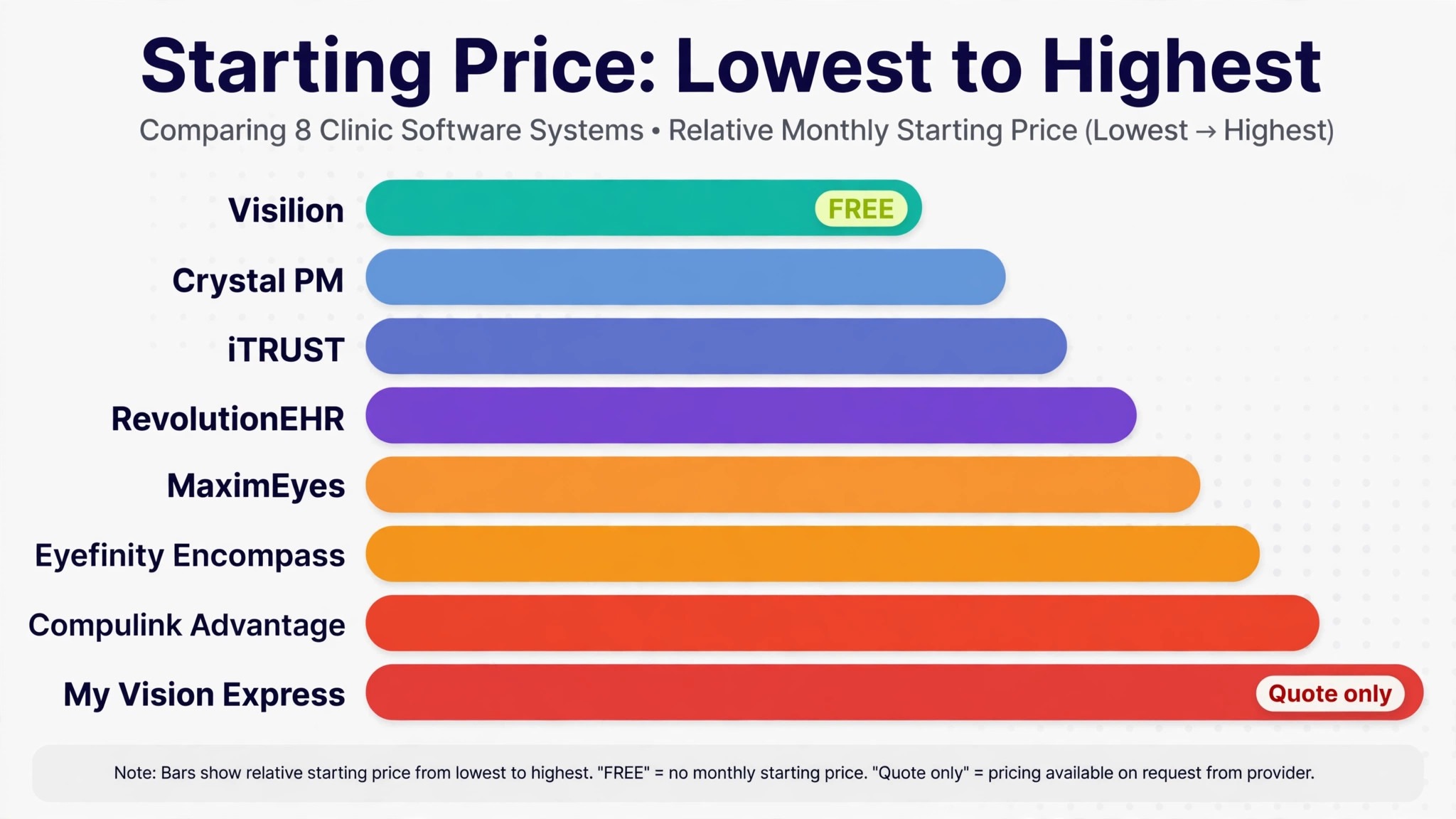
The table below puts the whole list on one page, so you can compare the best software for optometry clinics side by side before you trial two or three of them. Prices are starting prices unless noted, and the free plan column tells you whether you can test the system without paying first. Use the table to cut the list, then read the reviews for the systems that survive the cut.
| Tool | Starting price | Best for | Free plan |
|---|---|---|---|
| RevolutionEHR | 319 dollars a month reported | Cloud EHR for an independent clinic | No |
| Eyefinity Encompass | 340 dollars a month | Vision plan billing | No |
| Crystal PM | 150 dollars a doctor a month reported | All in one EHR and optical | No |
| MaximEyes | 325 dollars a month reported | Multi location charting | No |
| iTRUST | 199 dollars a doctor a location a month | Simple EHR with engagement | No |
| Compulink Advantage | 400 dollars a provider a month reported | Deep billing control | No |
| My Vision Express | Quote only | Large retail optical | No |
| Visilion | Free | A free start for optical retail | Yes |
How to Pick the Right System for Your Clinic
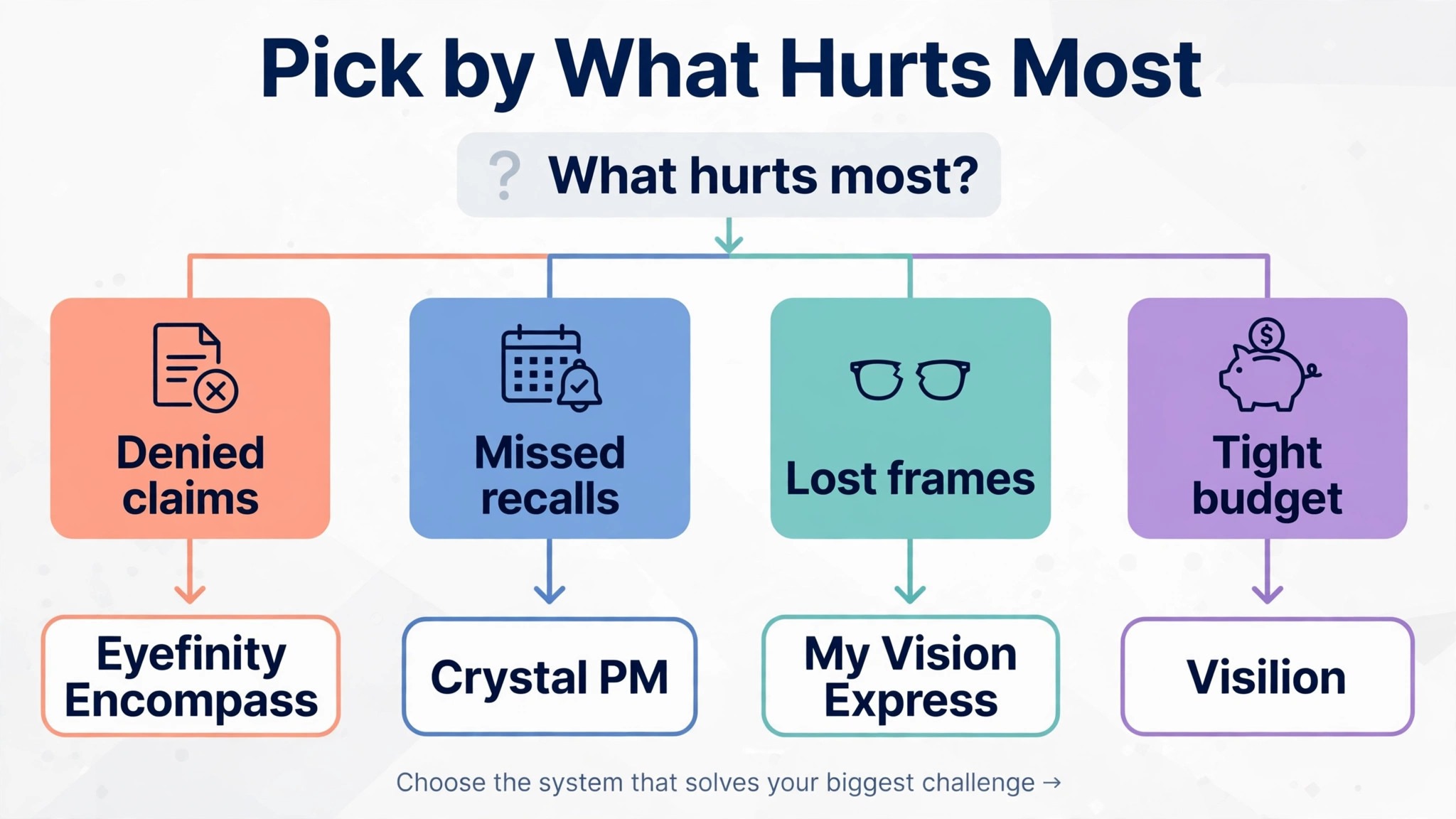
The best software for optometry clinics is not the one with the longest feature list. It is the one that fixes the leak your clinic feels every week. A clinic that loses money on denied claims should buy Eyefinity Encompass or Compulink Advantage. A clinic that loses patients to missed recalls should buy iTRUST or RevolutionEHR. A clinic whose dispensary loses frames should buy Crystal PM or MaximEyes. A new shop with no budget should start on Visilion and move up when the volume justifies it. Start from the leak, not from the vendor homepage.
Budget the full first year, not the headline month. The table below shows what a two doctor clinic actually pays in year one for the most common choices, using starting prices and reported implementation ranges. Training, data migration and onboarding are the lines that surprise buyers, so ask for them in writing before you sign.
| Choice for a two doctor clinic | Monthly cost | First year note |
|---|---|---|
| RevolutionEHR, exam only | 638 dollars reported | Bundle discount may apply |
| Eyefinity Encompass Essential | 680 dollars | Onboarding fees extra |
| Crystal PM Essentials | 300 dollars reported | Per doctor, so two doctors double it |
| iTRUST, one location | 398 dollars | No long term contract reported |
| MaximEyes | 325 dollars reported | Implementation fee extra |
| Visilion Pro | Under 5 dollars a month reported | No EHR or claims, so pair it with a clinical system |
A second cost that owners miss is the time the doctor spends learning new templates. A template that looks fast on a demo can slow a routine exam by two minutes, and two minutes across 25 exams a day is nearly an hour of lost slots. Trial the charting with a full clinic day, not with a single demo exam, and ask the doctor who will use it every day, not just the owner who signs the contract. The right system feels faster on day five than it did on day one, because the templates match the way the clinic actually works.
Frequently Asked Questions
What is the cheapest real system for a small clinic
Crystal PM Essentials at 150 dollars a doctor a month reported is the cheapest full EHR and optical system with a published per doctor figure, and iTRUST at 199 dollars a doctor a location a month is close behind with simple terms. Visilion is free, but it is not a full EHR, so it does not count as a clinic system on its own. The cheapest stack that actually works for a one doctor clinic is usually Crystal PM for the clinic plus a separate recall tool only if the built in recalls fall short.
The best software for optometry clinics that fits a small shop best is usually the one with the clearest starting price and the shortest setup, because a shop that can start this week learns faster than a shop that waits for a sales call.
Do I need a separate system for the optical shop
No, not if you pick a system with a real optical module. Crystal PM, MaximEyes, My Vision Express and RevolutionEHR all connect the prescription to the frame order and the lab, so the front desk never retypes it. A separate optical system only makes sense if your dispensary is a large retail store with its own staff and stock, or if your EHR has no optical module at all. Check the lab ordering and frame data before you assume the module is enough.
How long does it take to switch systems
A cloud system like RevolutionEHR or iTRUST can go live in weeks if the data is clean, while a large system like My Vision Express is reported at 60 to 90 days. The slow part is rarely the software. It is the data migration, the chart templates and the team training. Plan a quiet week for the switch, run the old system in parallel for the first fortnight, and do not switch in the middle of a busy recall month.
Which system is best for VSP billing
Eyefinity Encompass is the strongest pick for a VSP heavy clinic, because it sits inside the VSP Global family and the plan rules live where the claims are filed. The best software for optometry clinics with a heavy vision plan mix still needs a clean front desk process, because no system fixes a claim filed with the wrong code. Trial the eligibility check and the claim flow with real patients before you commit to a contract.
Our Verdict
If you buy one system this quarter, buy RevolutionEHR. It covers the most of the clinic job at a published starting price a small clinic can afford, and it is the fastest way to find out whether a cloud EHR built for eye care fits your exam flow. The best software for optometry clinics earns its keep by closing the small leaks that add up across a month, and RevolutionEHR does that from the first week, without a server or an enterprise contract.
Whatever you pick, start with the leak, trial with real exams, and keep a human check on insurance claims for the first month. The systems on this list all work. The difference is whether the system matches the job your clinic actually needs done, and whether you measure the return in kept appointments and paid claims rather than in features used.