

Two ways to solve this problem sit side by side, and they look alike until you use them. One way is a single platform that tries to do everything, with one login and one bill. The other way is a small set of focused tools, each doing one job well, with a little extra work to keep them in step. That is the question this guide answers for best software for construction companies, with every tool tested against real work rather than a sales page.
The single platform wins on simplicity. One place to log in, one place to search, and one support team to call. The focused set wins on depth, since a tool built for one job usually does that job better than a module inside a larger system. The right answer depends on how your team works and how much complexity it will tolerate.
This guide compares both approaches across the tools that matter in 2026. Each entry covers what the tool does, what it costs, who it fits, and where it falls short. By the end you should know not only which tool leads, but which approach fits your team.
The best pick by job
Start here if you are short on time. The table below matches the most common jobs to the tool that handles each one best, so you can find your fit without reading every entry. The best software for construction companies in this table were ranked on the core job first, then on price and ease of use.
| Job | Best tool |
|---|---|
| Large commercial general contractors running complex projects | Procore |
| Home builders and remodelers | Buildertrend |
| Small and mid sized contractors who want an affordable all in one | Contractor Foreman |
| Design build teams with heavy BIM and document needs | Autodesk Construction Cloud |
| Budget conscious contractors who want strong estimating and job costing | JobTread |
| Field teams that need plans, tasks and punch lists on site | Fieldwire |
| Remodelers and design build firms that want leads plus project tools | Houzz Pro |
| Small contractors who need job costing and progress billing | Knowify |
If your job is not in the table, read the full entries for the two tools closest to your situation. The comparison table later in this guide covers price and best fit for every tool, so a quick scan there will narrow the list to two or three names.
What the best software for construction companies do differently
Construction software fails when it is chosen for the office and forced onto the field. A tool that looks perfect on a desktop can be unusable on a phone in sunlight with gloves on. The first test is always the field app, which means plans, punch lists and daily logs from the job site.
Start with the money. Estimates, budgets, change orders and job costing are where a project is won or lost, and a tool that tracks costs clearly will pay for itself on one job. If the software cannot show whether a job is making money today, it is not doing the core job.
Check the accounting integration before anything else. QuickBooks Online, Xero or a full ERP connection decides whether the books stay accurate or become a second job. A tool that syncs cleanly saves hours every week, while a tool that needs manual entry will drift out of date.
Count the users honestly. Per user pricing can turn a cheap tool expensive when the whole crew needs access, while a flat rate or unlimited user plan suits a large field team. Price the tool for the crew that will actually use it, not just the office staff.
The best software for construction companies in this guide were judged on real daily work, not on a demo. Price, fit, and the quality of the core job mattered more than the length of the feature list.
Side by side comparison
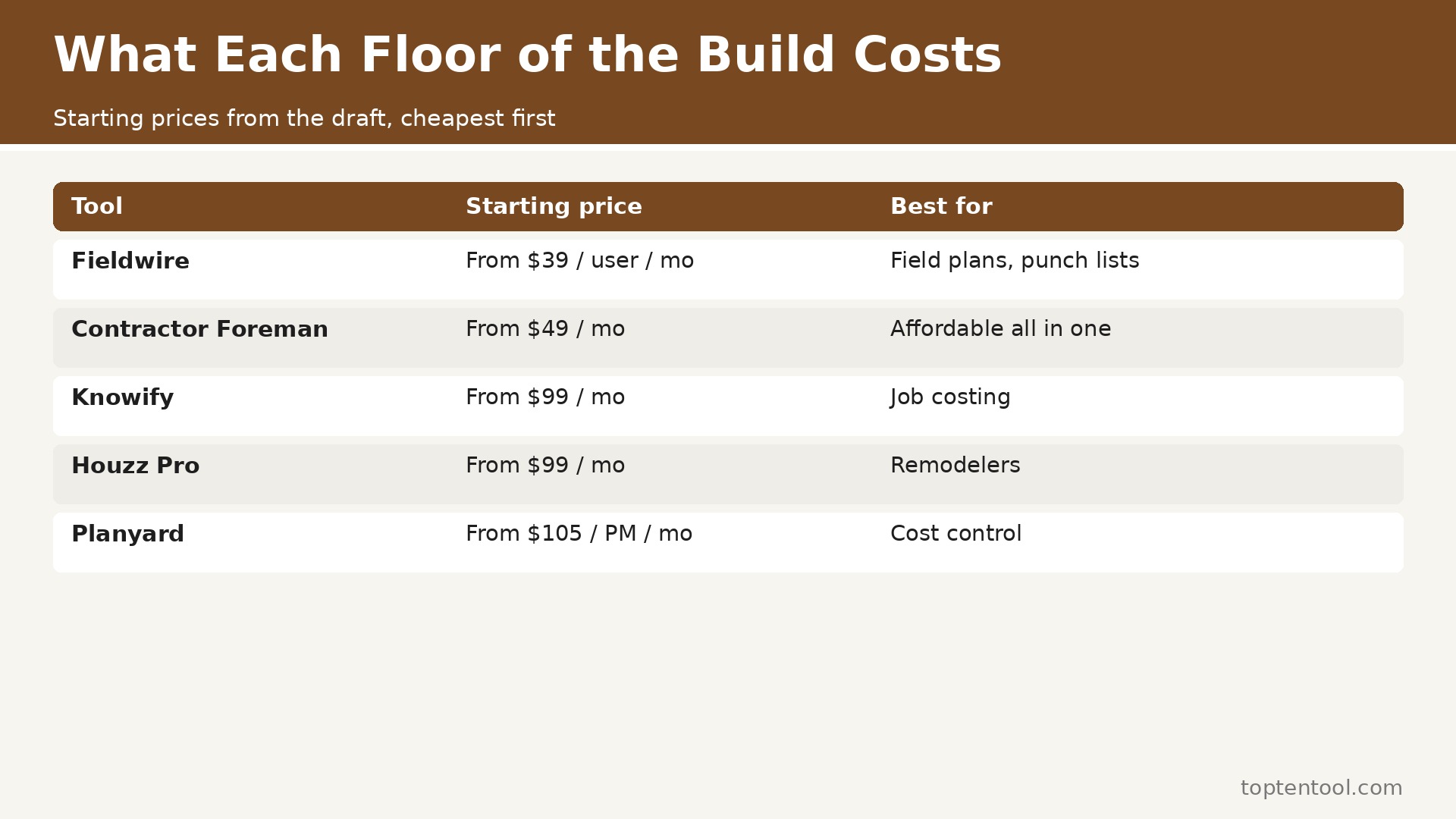
The table below puts price and best fit side by side, so the trade offs are easy to see. The best software for construction companies that look cheapest on the first line are not always cheapest in real use, since shipment caps, per user fees and add ons change the total. Read the price column together with the best fit column before you rank the tools.
| Tool | Starting price | Best for |
|---|---|---|
| Contractor Foreman | From 49 dollars per month | Affordable all in one |
| JobTread | From 159 dollars per month annual | Budgeting and estimating |
| Buildern | From 225 dollars per month | Modern all in one |
| Buildertrend | From 499 dollars per month last published | Residential builders |
| Procore | Quote only, typically from 10000 dollars per year | Large commercial GCs |
| Fieldwire | From 39 dollars per user per month | Field plans and punch lists |
| Houzz Pro | From 99 dollars per month | Remodelers |
| Knowify | From 99 dollars per month | Job costing |
| Planyard | From 105 dollars per project manager per month | Cost control and accounting sync |
The tools in detail
1. Procore
Procore is built for large commercial general contractors running complex projects. Project execution, financials, quality, safety and closeout share one platform. Budgets, commitments, change events and progress billing cover the financial side in depth.
Unlimited users and storage come with every plan, which suits large teams. Pricing is Quote only, with real deals typically from 10000 dollars per year and scaling by annual construction volume. Procore fits large commercial general contractors running complex projects best. The price puts it out of reach for small contractors, and the platform needs real setup time.
2. Buildertrend
Buildertrend is built for home builders and remodelers. Sales, CRM, proposals and a client portal cover the front of the job. Scheduling, change orders, daily logs and job costing cover the build itself.
The client portal keeps homeowners informed without constant phone calls. Pricing is From 499 dollars per month on last published plans, now quote based, with unlimited users. Buildertrend fits home builders and remodelers best. Pricing is no longer published, so a quote is needed, and the platform is built for residential work first.
3. Contractor Foreman
Contractor Foreman is built for small and mid sized contractors who want an affordable all in one. Estimates, scheduling, project management, time tracking and invoicing share one flat rate system. The price is the lowest on this list for a real all in one platform.
Unlimited users on higher tiers suit a growing field crew. Pricing is From 49 dollars per month billed annually. Contractor Foreman fits small and mid sized contractors who want an affordable all in one best. The interface is simpler than Procore, so very large projects may need more depth.
4. Autodesk Construction Cloud
Autodesk Construction Cloud is built for design build teams with heavy BIM and document needs. Autodesk Build connects design, planning and field work in one cloud platform. Document management, RFIs, submittals and issue tracking are built for large teams.
BIM integration keeps the model and the field in step. Pricing is Autodesk Forma Build from 100 dollars per user per month. Autodesk Construction Cloud fits design build teams with heavy BIM and document needs best. Per user pricing adds up fast across a large crew, and the platform needs training to use well.
5. JobTread
JobTread is built for budget conscious contractors who want strong estimating and job costing. Estimates, budgets and job costing are the core strength, with clear cost tracking. Scheduling, change orders and client communication sit beside the financial tools.
The flat rate suits a small team that wants predictable pricing. Pricing is From 159 dollars per month billed annually, 199 dollars monthly. JobTread fits budget conscious contractors who want strong estimating and job costing best. The feature set is narrower than Procore for enterprise needs, and the mobile app is lighter.
6. Fieldwire
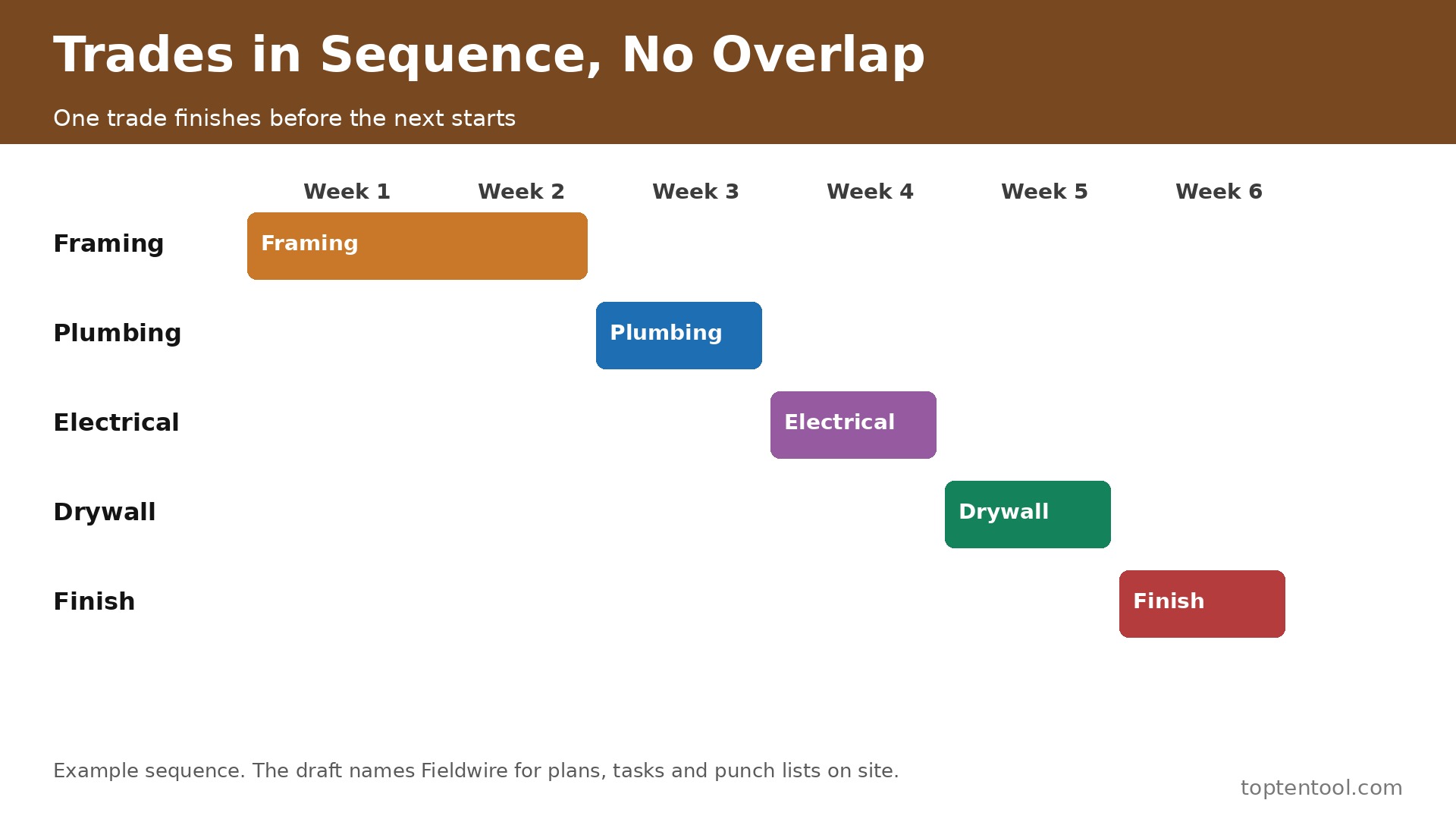
Fieldwire is built for field teams that need plans, tasks and punch lists on site. Plans, tasks, photos and punch lists work well on a phone or tablet in the field. Version control keeps every worker on the current drawing.
The interface is simple enough for a crew to learn in a day. Pricing is From 39 dollars per user per month billed annually. Fieldwire fits field teams that need plans, tasks and punch lists on site best. It is a field tool first, so estimating and accounting need another system.
7. Houzz Pro
Houzz Pro is built for remodelers and design build firms that want leads plus project tools. Leads, proposals, estimates and project management share one platform built for remodelers. The client portal and 3D floor planner help sell the job before it starts.
Marketing tools bring in new work as well as managing current jobs. Pricing is From 99 dollars per month. Houzz Pro fits remodelers and design build firms that want leads plus project tools best. The lead quality varies by region, and the platform is built for residential work.
8. Knowify
Knowify is built for small contractors who need job costing and progress billing. Job costing, progress billing and change orders cover the money side clearly. Purchase orders and time tracking connect costs to the right job.
The interface is straightforward for a small office without an IT team. Pricing is From 99 dollars per month. Knowify fits small contractors who need job costing and progress billing best. The feature set is narrower than a full project management platform, so scheduling is lighter.
9. Jobber
Jobber is built for home service and small trade contractors. Scheduling, dispatch, invoicing and client communication cover the daily job. Quotes turn into jobs and invoices in a few taps.
The mobile app suits a crew that works from the truck, not the office. Pricing is Pricing varies by plan, with a free trial to start. Jobber fits home service and small trade contractors best. It is built for service work, so large construction projects need a heavier platform.
10. Buildern
Buildern is built for contractors who want estimating, scheduling and budgeting in one modern tool. Estimating, scheduling, budgeting and project management share one clean interface. The workflow is modern and easy to learn for a small team.
Client and subcontractor portals keep everyone informed. Pricing is From 225 dollars per month. Buildern fits contractors who want estimating, scheduling and budgeting in one modern tool best. It is newer than the established names, so integrations and community support are thinner.
11. Planyard
Planyard is built for project managers who need accounting sync and cost control. Budgets, change orders, progress billing and retainage are handled with accounting in mind. QuickBooks Online and Xero integrations keep the books in step with the job.
The estimating only plan suits a team that just needs accurate quotes. Pricing is From 105 dollars per project manager per month, with estimating only from 52 dollars. Planyard fits project managers who need accounting sync and cost control best. Per project manager pricing can add up, and field tools are lighter than Fieldwire.
12. Projul
Projul is built for contractors who want flat rate pricing without per user fees. Estimating, job costing, scheduling and project management share one flat rate. No per user fees means a large field crew does not raise the price.
The interface is built by a former general contractor, so the workflow feels practical. Pricing is From 199 dollars per month billed annually. Projul fits contractors who want flat rate pricing without per user fees best. It is newer than Procore or Buildertrend, so the integration list is shorter.
13. Buildr
Buildr is built for general contractors who need preconstruction, CRM and estimating together. Preconstruction, CRM, estimating and workforce planning share one platform. Unlimited seats mean the whole team can use it without per user costs.
The preconstruction focus suits contractors who win work on accurate bids. Pricing is Quote only, with unlimited seats at every tier. Buildr fits general contractors who need preconstruction, CRM and estimating together best. Pricing is quote only, so a sales conversation is needed for a number.
14. Sage 300 Construction
Sage 300 Construction is built for mid sized and large contractors who need deep accounting. Job costing, payroll, accounting and project management are built for construction finance. The accounting depth suits firms where the books drive the business.
Integration with Sage products keeps finance and operations together. Pricing is Quote only, with pricing by deployment. Sage 300 Construction fits mid sized and large contractors who need deep accounting best. The interface is dated next to newer tools, and implementation takes time and training.
15. Jonas Construction
Jonas Construction is built for contractors who need an all in one ERP for construction. Accounting, job costing, project management, payroll and service management share one ERP. The platform is built for construction from the ground up, not adapted from general software.
Service and maintenance work sits beside project work in the same system. Pricing is Quote only, with pricing by deployment. Jonas Construction fits contractors who need an all in one ERP for construction best. The price and implementation effort suit mid sized and larger firms, not a small contractor.
Mistakes to avoid
Most buyers in this category make the same few mistakes, and the tools that look best on paper are often the ones that punish those mistakes most. A short list of the common errors will save more money than a long feature comparison.
The most common mistake is buying a platform for the biggest job you might win, instead of the jobs you actually run. A small residential builder does not need enterprise software, and an enterprise tool will slow the team down. Match the tool to the jobs on the books today.
Another mistake is skipping the field test. Office staff can love a tool that the crew hates, and a tool the crew hates will not get used. Put the app in the hands of a foreman for a week before you buy.
The third mistake is ignoring change orders. Most projects lose money on changes that were never tracked, not on the original estimate. A tool that makes change orders easy to log, price and approve will protect margin on every job.
A simple decision checklist
Use this checklist before you pay for any of the best software for construction companies above. It takes ten minutes and it catches the errors that turn a good tool into a bad purchase.
- Write down the one job the tool must do well every day, and test that job first.
- Count the real users, locations or volume the plan must cover, including the busy season.
- Check the price of the tier that includes the features you need, not the cheapest tier on the page.
- Test the tool with a real task from your own work, not the sample data in the demo.
- Read the contract terms, the renewal rules and the cancellation process before you sign.
Frequently asked questions
These are the questions buyers ask most often about best software for construction companies. The answers are short, and each one points back to the comparison above so you can check the detail for yourself.
How much does construction management software cost?
Small contractor platforms start at 49 dollars a month for Contractor Foreman, mid range tools run 159 to 499 dollars a month, and enterprise platforms like Procore are quote only and typically start at 10000 dollars a year. Per user tools add 39 to 100 dollars per user per month.
What is the best software for a small construction company?
Contractor Foreman is the best affordable all in one at 49 dollars a month, JobTread is the best for budgeting and estimating at 159 dollars a month, and Jobber is the best for home service and trade work. The right pick depends on whether the work is residential, commercial or service based.
Do I need Procore for a small construction business?
No, for most small businesses. Procore is built for large commercial general contractors running multi million dollar projects, and the price and setup reflect that. A small contractor will get more value from Contractor Foreman, JobTread or Buildertrend.
What should construction software include?
At minimum it needs estimates, scheduling, job costing, change orders, daily logs and client communication. Accounting integration, document management and a usable field app turn a good tool into one the whole team will actually use.
Can construction software help a project finish on budget?
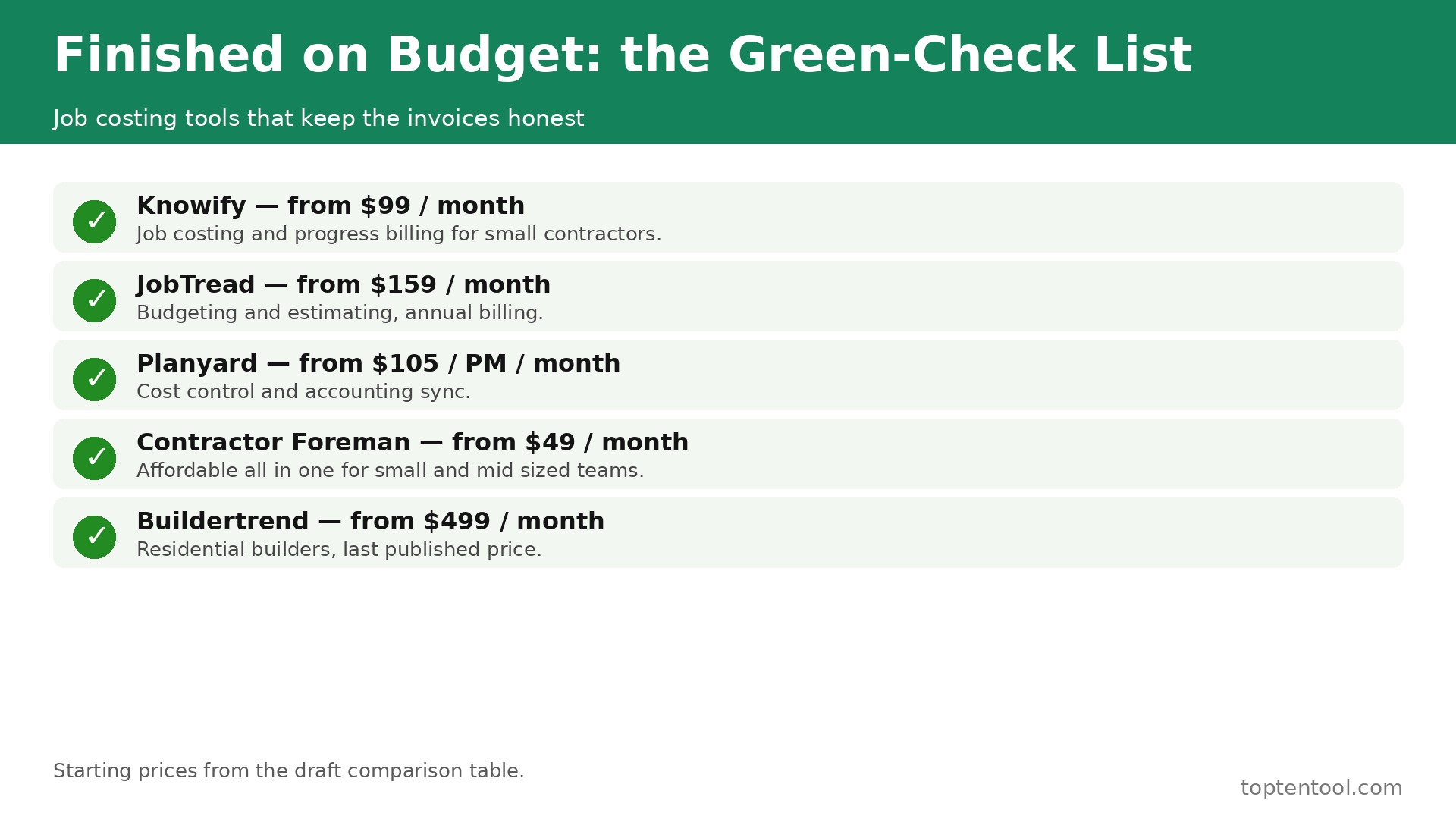
Yes, when job costing is tracked in real time. A tool that shows actual costs against the budget every week lets a manager catch overruns early, approve change orders properly, and adjust before a small gap becomes a large loss.
One more point deserves attention before you choose. Procore leads this list for a reason, but the lead is narrow, and the second and third tools each win on a specific job. A buyer who reads only the ranking will miss those wins. Read the best fit column again with your own job in mind, and let that decide the shortlist rather than the order of the entries.
Support quality is easy to overlook until something breaks. Buildertrend and Procore both have a reputation for answering quickly, while some of the cheaper tools in this list rely on email support with slower replies. If your team depends on the tool every day, the speed of support is worth real money, and it should count in the decision alongside price.
Training time is a real cost too. A tool that takes a week to learn will cost more than a tool with a slightly higher monthly price that the team learns in a day. Ask each vendor for a short trial with your own data, and watch how long it takes a new user to finish a routine task without help. That test tells you more than any feature list.
Integration with the tools you already use matters more as the stack grows. A platform that connects cleanly to your current system will save hours of manual copying, while a tool that needs workarounds will add a weekly chore. Check the integration list for the two or three apps your team opens every day, and confirm the connection works on the plan you would actually buy.
Finally, remember that the best tool is the one the team will keep using. A powerful platform that sits unused is worse than a simple tool that everyone opens daily. Involve the people who will use it in the trial, listen to what frustrates them, and choose the tool they reach for without being told. That habit is what turns a purchase into a result.
Think about the second year, not just the first month. A tool with a low entry price and a steep renewal can cost more over two years than a pricier tool with stable pricing. Ask about renewal rates, price changes on higher tiers, and what happens when the team grows past the current plan. A vendor that answers those questions plainly is easier to trust with a long term commitment.
Data export is a quiet test of a good vendor. Before you commit, check how your work leaves the platform if you ever decide to move. A tool that exports cleanly to standard formats respects your business, while a tool that locks data inside is betting that you will never leave. The export test takes five minutes and it is worth doing on every shortlisted tool.
Seasonal peaks deserve a specific check. A tool that handles a normal week well can still struggle in the busiest month of the year, when volume doubles and the team is under pressure. Ask the vendor how the plan behaves at peak volume, whether limits can be raised temporarily, and what the cost of that extra capacity looks like. The answer will tell you whether the tool is built for real business cycles.
Security and privacy checks belong on the shortlist too. Ask where data is stored, who can access it, and how the vendor handles a request to delete it. A tool that handles customer or employee data should answer those questions without hesitation. If the answers are vague, treat that as a warning sign rather than a detail to check later.
Start small even when the plan allows a big rollout. Pick one team, one project or one location, run the tool there for a month, and measure the result before you roll it out everywhere. A pilot catches the problems that a demo hides, and it gives the team a success story to share when the wider rollout begins. That careful start is how a good tool becomes part of the daily routine instead of another unused subscription.
Measure the result after the first month with numbers you already track. Time saved per order, per call or per project is the clearest test, followed by the cost per order and the number of errors or rework. If the tool has not moved at least one of those numbers in thirty days, the problem is either the tool or the way the team uses it, and both are worth a frank review before the next payment.
Keep the decision record simple. Write down why you chose the tool, what it must do in the first ninety days, and what would make you switch. That short note stops the team from drifting into a tool that no longer fits, and it makes the next review a fact based conversation instead of a debate about feelings. A good purchase is one you can explain a year later.
Talk to a current user before you buy, not just to the sales team. A short call with a business of a similar size will reveal the daily friction that a demo never shows, like a slow mobile app, a confusing setting, or a support queue that only answers quickly before the sale. Most vendors will arrange a reference call if you ask, and the ones that refuse are telling you something.
Check what happens when the team changes. A tool that is easy to join should also be easy to leave, with clear steps for removing a user, moving their work, and keeping the history. Staff turnover is normal, and a platform that makes offboarding painful will cost time on every departure. Ask about that process during the trial, while you still have a choice.
Look at the roadmap with a skeptical eye. A vendor that promises every feature on your wish list is selling a future, not a product. Buy the tool for what it does today, and treat the roadmap as a bonus. If the core job is not covered now, no promised update should change the decision.
The verdict
For most small construction companies, Contractor Foreman is the best place to start, with a real all in one platform at 49 dollars a month. JobTread is the pick when estimating and job costing matter most, and Buildertrend is the pick for residential builders who need a client portal. Procore remains the standard for large commercial work, and Fieldwire is the pick for field first teams. The right software is the one the crew will use on site, the office will trust for costs, and the client will see working from the first day.
Walk the site with the software before you buy it. A tool that looks perfect in the office can fail on a dusty site with weak signal, gloves on, and a phone screen in bright sun. Take the trial to a real job, log a photo, file a daily report, and check a cost code from the field. If the crew can finish those three jobs without calling the office for help, the tool will survive real work. If they cannot, no office feature will save it.
Keep the cost codes simple enough for the crew to use without thinking. A list of two hundred codes will be ignored, and costs will land in the wrong bucket every week. Start with the twenty codes that cover most of the spend, train the foremen on those, and add new codes only when a real job needs one. Clean cost data from the field is what makes the office reports trustworthy, and it starts with codes the crew will actually pick.
That is the honest summary for best software for construction companies in 2026. Start with the tool that matches your situation, use the free trial or free plan to test it on real work, and only then commit to a paid plan. A tool that fits the job will feel obvious within a week, and a tool that does not will show its gaps just as fast.