
Pet sitting is a business built on trust, and trust breaks fast when a visit gets missed, a key goes missing, or a client cannot tell whether their dog was actually walked. Recent industry surveys put the United States pet sitting and dog walking market above 2 billion dollars in annual revenue, with thousands of small operators competing in every metro area. The difference between the sitters who stay booked out and the ones who stall is rarely the quality of care. It is the system behind the care, and that is exactly what the best software for pet sitting businesses is built to fix.
A good platform does far more than hold a calendar. It takes bookings online, sends confirmations without a phone call, gives sitters a mobile checklist for every visit, records GPS arrival and departure times, shares photos with the owner in real time, and invoices the moment the job is done. The result is fewer no shows, fewer billing arguments, and a client experience that feels professional from the first enquiry to the final receipt. For a solo sitter, that polish wins repeat bookings. For a team of ten walkers, it is the only way the owner keeps control without spending every evening on admin.
This guide compares eight real platforms that pet care businesses actually run on in 2026. Prices were checked against vendor pricing pages and independent 2026 comparisons, and every price below is flagged with its source. Where a vendor only quotes on a sales call, that is stated plainly instead of guessed. The ranking weighs scheduling depth, visit reporting, payments, staff tools, and value for money at each team size, because the right choice for a solo sitter is rarely the right choice for a company with a dozen walkers on the road.
Best Pick by Job
| Job | Best pick | Why it wins |
|---|---|---|
| Solo sitter starting out | PetPocketbook | Flat 25 dollars a month for every feature, any team size |
| Growing team of walkers | Time To Pet | Strongest visit reports, GPS tracking, and client apps |
| Budget team with flat costs | Pet Sitter Plus | Flat team rate that stays low as staff numbers grow |
| Finding new clients fast | Rover | Largest marketplace of pet owners looking for sitters |
| On demand walks in big cities | Wag | Instant demand and simple onboarding for walkers |
| Boarding and daycare mixed in | Gingr | Built for facilities that also offer sitting and daycare |
| Grooming plus sitting | MoeGo | Combines grooming bookings with pet care scheduling |
| Automation heavy operation | Precise Petcare | Deep automation for reminders, invoicing, and follow up |
How the Best Software for Pet Sitting Businesses Was Compared
Every platform in this guide was judged on the same six tests. Scheduling had to handle recurring visits, overnight stays, and last minute changes without double booking a sitter. Visit reporting had to prove the visit happened, with time stamps, GPS, photos, and notes the owner can see. Payments had to cover deposits, tips, and invoices without forcing the owner to chase money by text. Staff tools had to cover hiring, routing, and payroll basics. Client experience had to feel modern, with online booking and a portal or app. Price had to make sense at one sitter, five sitters, and ten sitters, because a per staff fee that looks small at first can double the bill within a year.
The scoring also punished lock in. A platform that exports client lists, visit history, and invoices cleanly scored higher than one that holds data hostage. Support quality mattered too, because a scheduling failure at 7 in the morning on a holiday weekend cannot wait for a ticket queue.
What Good Pet Sitting Software Must Do in 2026
The baseline has moved. Five years ago, a shared calendar and a payment link counted as software. In 2026, clients expect the same visibility they get from a food delivery order. They want to know when the sitter arrived, how long the visit lasted, what the dog did, and when the next visit is scheduled, all without sending a single message. Platforms that cannot show that proof now lose bookings to platforms that can, and owners notice the difference within weeks.
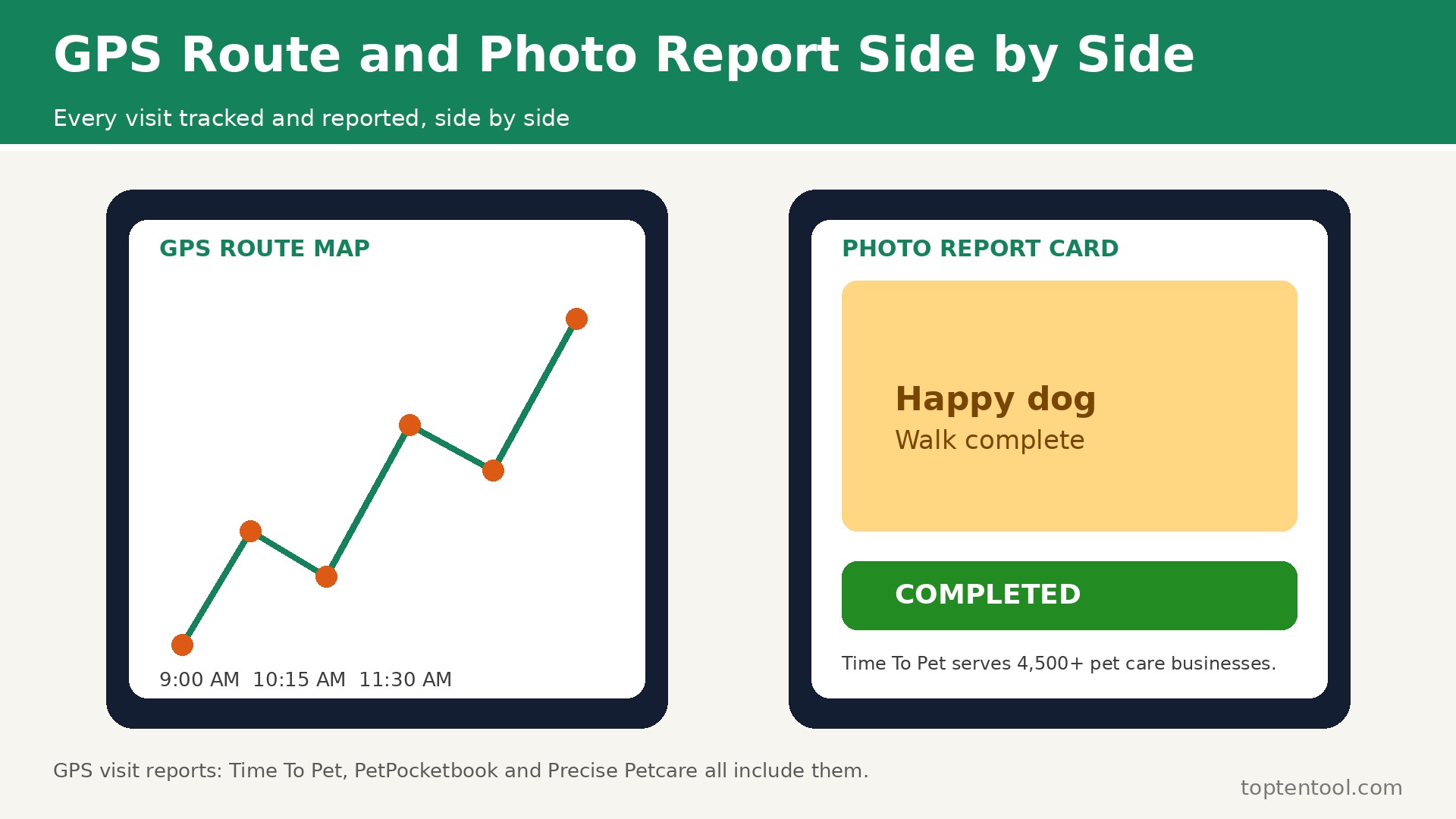
GPS visit tracking sits at the center of that shift. A sitter taps start on arrival, the app records the location and time, and the owner sees a report with photos before the sitter has left the driveway. That single feature ends most billing disputes, because the record is automatic rather than remembered. It also protects the sitter, since a time stamped log proves the visit happened even when the owner is travelling and cannot answer the door.
Online booking is the second baseline feature. Owners book at midnight, change a date on a Sunday, and pay a deposit without a phone call. Software that still requires a call or an email for every booking quietly loses the clients who book after hours, and those clients are often the highest value ones. A client portal or app, automated reminders, and card on file payments turn booking from a chore into a background process that runs while the owner is out walking dogs.
The Real Cost of Running a Pet Sitting Business on Software
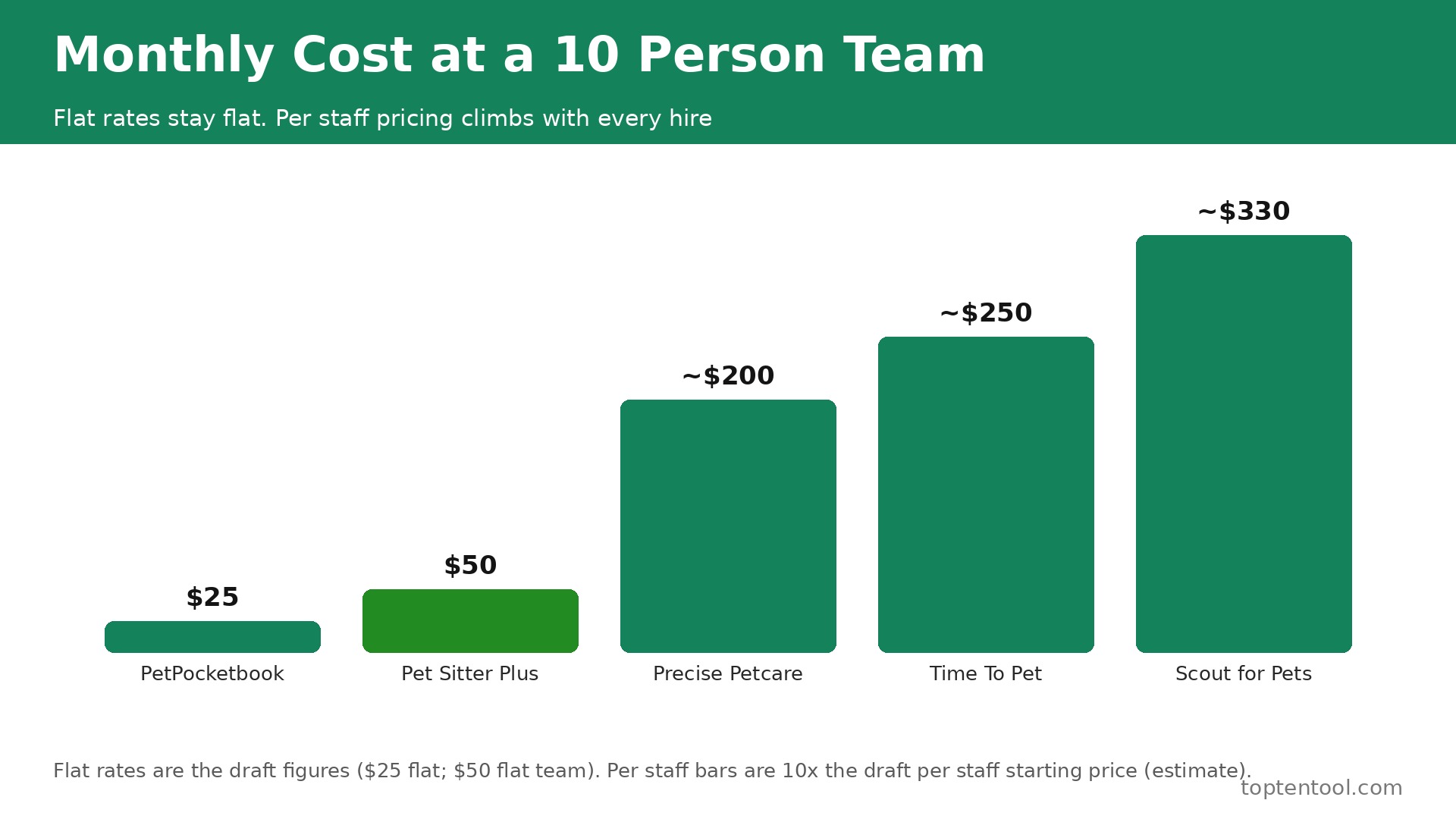
Price comparisons in this category mislead because vendors price in different units. Time To Pet charges per active staff member, Scout charges a base plus a per staff fee, Pet Sitter Plus charges a flat team rate, and PetPocketbook charges one flat rate for any team size. At one sitter the numbers look close. At ten sitters they spread by hundreds of dollars a month, and the cheapest solo option can become the most expensive team option within a year of hiring.
The worked example makes the point clearly. Independent pricing research from September 2026 calculated the monthly cost of five leading tools at a ten person team. Time To Pet landed near 200 dollars a month, Scout near 183 dollars, Precise Petcare at 90 dollars on its staff band, Pet Sitter Plus at 50 dollars flat, and PetPocketbook at 25 dollars flat plus a 5 percent fee on payments made through the platform. The same research noted that Pet Sitter Plus advertises a 15 dollar solo rate that is a first year promotion, with the standard rate at 30 dollars. Those details matter, because a first year discount hides the real long term price.
1. Time To Pet
Time To Pet is the most complete pet sitting platform in this guide, and the default recommendation for any team that wants professional visit reports without building its own system. It serves more than 4,500 pet care businesses, according to its own published figures, and it shows in the polish. Clients get their own app, sitters get a separate app, and the owner gets a dashboard that shows every visit, invoice, and message in one place.
Scheduling covers recurring visits, overnight care, daycare, and dog walking in a single calendar, with drag and drop changes and automatic conflict warnings. Visit reports include GPS arrival and departure stamps, photos, videos, and notes, and they go to the owner automatically. Invoicing runs from the same record, so a completed visit becomes a bill without retyping anything. QuickBooks Online integration, Zapier, calendar sync, and email marketing campaigns sit on the higher solo plan and on team plans.
Pricing starts with Lite at 25 dollars a month for basic scheduling and invoicing, and Solo at 50 dollars a month, which adds videos, integrations, and email marketing. Team plans start at 40 dollars a month plus 16 dollars per active staff member, with active staff counted automatically each billing period. That formula means a five person team pays about 120 dollars a month, and a ten person team about 200 dollars. A 14 day free trial needs no credit card.
The drawback is the per staff price curve. A growing team watches the bill rise with every hire, and there is no flat cap. The platform is also deeper than a solo sitter needs, so the first week involves more setup than a simpler tool. For a team of three or more walkers who live on visit reports, it is still the strongest choice in this guide. For a solo sitter on a tight budget, the flat priced options below deserve a closer look.
2. PetPocketbook
PetPocketbook takes the opposite approach to Time To Pet, and that is its entire appeal. One plan, 25 dollars a month flat, every feature included, any team size. Scheduling, visit tracking, rebooking, invoicing, and client management all come in the single plan, with no tiers to climb and no per staff meter running in the background. For a business that hires seasonally or runs a large casual team, the flat price removes the penalty for growing.
The visit workflow is simple and fast. Sitters see their day on mobile, check in and out of visits, add photos and notes, and the owner sees the completed record. Invoicing and payments run through the platform, with a 5 percent fee on client payments made through it by default. That fee is the real cost to watch. On low volume it is trivial. On high volume it can exceed the cost of a per staff subscription, so run the numbers on your own monthly bookings before committing.
The drawback is depth. PetPocketbook does not match Time To Pet on client app polish, marketing tools, or integrations, and teams that want advanced automation will feel the limits. It also ties the payment fee to the platform, so owners who already have a preferred processor may prefer a tool that keeps payments separate. For a cost conscious team that wants every feature for one predictable price, it is hard to beat.
3. Precise Petcare
Precise Petcare is the long running automation specialist in this category, built for companies that want reminders, invoicing, and follow up to run themselves. It has served pet care businesses for years, and its strength is the depth of its scheduling and client communication automation rather than a flashy mobile app. Recurring schedules, service reminders, late payment chases, and review requests can all be set once and left to run.
Pricing starts around 20 dollars a month for a solo operator, with banded pricing as staff numbers grow. Independent research from September 2026 put the 6 to 10 staff band at 90 dollars a month, which makes it one of the cheaper options at team scale. That banded model is friendlier than a straight per staff charge, because adding one more walker does not always raise the bill. Confirm the current band boundaries on the pricing page before buying, since bands change.
The drawback is the interface, which feels older than the newest tools in this guide. New staff need more training, and clients do not get the same polished app experience as Time To Pet offers. For an owner who values automation and low team costs over a modern look, Precise Petcare earns its place. For a brand led business where the client app is part of the pitch, look at the top two first.
4. Scout for Pets
Scout for Pets combines online booking, staff scheduling, invoicing, and mobile visit tools in a clean package aimed at growing pet care companies. Clients book online, the office assigns visits to available sitters, and the sitter app handles check in, photos, and notes. The workflow feels modern without the setup burden of the largest platforms, which makes it a good middle ground for a team moving off spreadsheets for the first time.
Pricing starts around 33 dollars a month flat for a solo operator, then moves to a base plus 15 dollars per active staff member on team plans. Independent research calculated a ten person team at about 183 dollars a month on that formula. That puts Scout in the same price band as Time To Pet at team scale, so the choice between them comes down to workflow preference rather than cost. Try both free trials with a real week of bookings before deciding, because the daily feel matters more than the feature list.
The drawback is brand recognition with clients. Scout is less well known than the market leaders, so owners sometimes have to explain the client portal to new customers. Its integration list is also shorter than Time To Pet. For a team that wants a modern tool without the top tier price of the biggest name, Scout is a genuine contender and deserves a trial.
5. Pet Sitter Plus
Pet Sitter Plus is the flat rate team tool, and its pricing is the reason most owners shortlist it. The standard solo rate is 30 dollars a month, with a 15 dollar first year promotion often advertised, and the team rate is 50 dollars a month flat for 2 to 25 staff. That flat team rate is the cheapest team pricing in this guide by a wide margin, and it does not rise when a seasonal walker joins for the summer. Independent pricing research from September 2026 confirmed the 50 dollar flat team figure and flagged the first year promotion clearly.
Features cover scheduling, client management, invoicing, sitter apps, and reporting, with enough depth for a real team. It lacks some of the marketing polish of Time To Pet, and the interface is functional rather than beautiful, but the daily workflow is solid. Owners who run a team of five or more walkers and watch every dollar should put this at the top of the trial list, because the savings against a per staff tool can fund a pay rise or a marketing campaign.
The drawback is the promotion trap. The advertised 15 dollar solo price doubles to 30 dollars after the first year, and the same 50 percent framing applies to team tiers. Budget on the standard rate, not the promotion, and the tool still wins on price. Also confirm the current staff cap and feature set on the pricing page, since flat rate plans sometimes limit advanced features to higher tiers.
6. Rover
Rover is not back office software in the same sense as the tools above. It is a marketplace, and that distinction decides whether it belongs in your stack. Rover connects pet owners with sitters, handles booking, messaging, and payments, and takes a fee for the privilege. For a new sitter with no client base, it is the fastest way to get booked. For an established business, it is a lead channel that sits alongside the real scheduling software, not a replacement for it.
The numbers explain the trade. Rover is free to join, and sitters set their own prices by service and market, with typical boarding around 35 to 90 dollars per night depending on the city. The fee stack runs around 31 percent in total, combining a 20 percent sitter fee and an 11 percent owner booking fee, according to 2026 comparison research. That is a heavy cut, and it limits direct brand control, since the client relationship lives inside Rover. The Rover Guarantee and background checks add protection, including up to 25,000 dollars in vet care reimbursement for eligible claims.
Use Rover to fill empty slots and win first time clients, then move repeat clients onto your own booking system where you keep the full rate. Never build the whole business on a marketplace that can change its fees or ranking without warning. As a client acquisition tool, Rover is unmatched in this guide. As a business system, it is incomplete by design.
7. Wag
Wag is the on demand option, built for walkers who want instant bookings rather than a client list of their own. Owners request a walk, nearby walkers accept, and the app handles GPS tracking, payment, and a report card with photos. The onboarding is fast, the demand in large cities is real, and a walker can earn from the first week without any marketing. For a sitter testing whether pet care suits them, Wag is the lowest friction start in this guide.
The trade is control and income. Wag sets much of the pricing and takes its cut, walkers have limited ability to build a repeat client base inside the app, and the work is less predictable than a booked schedule. It also suits dog walking far better than overnight sitting or complex multi pet households, where a dedicated platform with detailed care instructions wins. Treat Wag as a flexible income top up or a trial run, not as the system for a business you plan to grow.
The drawback that matters most is dependence. A walker who relies on Wag alone has no client list, no brand, and no pricing power. Use it to learn the work and earn while you build a private client base on one of the scheduling tools above. The moment repeat clients start asking for you by name, move them to your own booking page.
8. MoeGo
MoeGo rounds out this list because many pet care businesses mix sitting with grooming, and running two systems for one client list wastes time. MoeGo started in grooming and now covers pet care scheduling more broadly, with online booking, client profiles, reminders, and payments in one place. A business that grooms on weekdays and sits on weekends can keep one calendar, one client record, and one invoice history instead of stitching two tools together.
Pricing is not published as a simple flat rate on the public site, so request a quote and compare it against the flat priced tools above before committing. The value case depends on how much grooming you actually do. If grooming is a small side line, a sitting specialist plus a simple grooming add on may cost less. If grooming is half the revenue, one system wins on admin time alone, and the quote is worth getting.
The drawback is focus. MoeGo is not the deepest sitting specialist in this guide, and its visit reporting is lighter than Time To Pet or Scout. Teams that only do sitting should pick a sitting first tool. Mixed businesses that want one system for grooming and sitting will find MoeGo the most practical fit of the eight.
Side by Side Comparison of the Best Software for Pet Sitting Businesses
| Tool | Starting price | Pricing model | GPS visit reports | Best for |
|---|---|---|---|---|
| Time To Pet | 25 dollars a month Lite | Per active staff | Yes | Growing teams |
| PetPocketbook | 25 dollars a month flat | Flat, plus 5 percent on payments | Yes | Solo sitters on a budget |
| Precise Petcare | Around 20 dollars a month | Banded by staff count | Yes | Automation heavy teams |
| Scout for Pets | Around 33 dollars a month | Base plus per staff | Yes | Modern mid size teams |
| Pet Sitter Plus | 30 dollars a month standard | Flat team rate | Yes | Large teams watching costs |
| Rover | Free to join | About 31 percent fee stack | Limited | Finding new clients |
| Wag | Free to join | Commission on walks | Limited | On demand walking |
| MoeGo | Quote only | Quote based | Basic | Grooming plus sitting |
Prices change often, so confirm the current figure on each vendor pricing page before buying. The table is a snapshot from 2026 research, not a quote.
Fee Breakdown Before You Choose
The subscription is only the first line of the bill. A realistic monthly total for a small team includes the subscription, card processing at roughly 2.6 percent plus a small per transaction fee, text message bundles, and any marketplace commission. A solo sitter processing 3,000 dollars a month through cards pays about 80 dollars in processing alone, which can exceed the software subscription. A team processing 15,000 dollars a month pays close to 400 dollars in processing, and a 5 percent platform fee on the same volume adds 750 dollars.
Also watch for text message limits and extra charges for additional branches or locations, and ask each vendor for a written total for your exact team size and volume before the trial ends. A written quote also makes it easier to compare the best software for pet sitting businesses on total cost, not just the headline subscription.
How to Choose in One Afternoon
Start with team size, not features. A solo sitter should trial PetPocketbook and Time To Pet Lite side by side for one week, using real bookings. That side by side trial is the fastest way to judge the best software for pet sitting businesses for your own workload, because daily feel matters more than any feature list. A team of three to five should trial Time To Pet, Scout, and Pet Sitter Plus with the same week of bookings, and compare the visit reports the owners receive. A team of ten or more should trial Pet Sitter Plus and Precise Petcare first, because the price gap at that size funds real marketing.
Next, test the sitter app in the field, not at a desk. Send a walker out with each trial app, and ask them which one was faster at check in, photo upload, and notes. A tool that saves the office ten minutes but costs each sitter five minutes per visit is a net loss. Then test the owner experience by booking as a fake client, paying a deposit, and reading the confirmation and visit report as if you were the pet owner. The tool that feels most professional to the client wins the booking.
Finally, check the exit. Ask how to export clients, visit history, and invoices, and actually run the export during the trial before you move a hundred clients onto any platform.
Frequently Asked Questions
What is the best software for pet sitting businesses for a solo sitter?
For most solo sitters, PetPocketbook is the best value, because one flat 25 dollar monthly rate includes every feature with no per staff meter. Time To Pet Lite at the same 25 dollars is the better pick if you want the most polished client app and plan to hire soon, since upgrading inside the same system is easier than migrating later. Trial both with real bookings before paying.
How much does pet sitting software cost per month?
Solo plans start around 20 to 33 dollars a month, and team plans range from 50 dollars flat to about 200 dollars at ten staff on per staff pricing. Marketplace options like Rover are free to join but take around 31 percent in combined fees. Add card processing and text bundles to the subscription before comparing, because those lines often exceed the subscription itself.
Does pet sitting software include GPS tracking?
Most dedicated platforms in this guide include GPS arrival and departure stamps, including Time To Pet, Scout, Precise Petcare, Pet Sitter Plus, and PetPocketbook. Marketplace apps like Rover and Wag offer more limited tracking tied to the walk itself. If GPS proof matters to your clients, confirm it is included on the plan you buy, not only on the top tier.
Can I use Rover instead of pet sitting software?
Rover works well for finding clients, but it is a marketplace rather than a business system. You do not control the client relationship, the branding, or the fees, and the fee stack runs around 31 percent. Most established sitters use Rover for new clients and run their repeat business on a dedicated platform where they keep the full rate and own the client list.
What should I check before switching pet sitting software?
Export a test file of clients, visit history, and invoices from your current tool, and confirm the new tool imports them cleanly. Run both systems side by side for two weeks, migrate a small group of friendly clients first, and only move the full list once visit reports and invoices match. Keep the old system read only for one month after the switch so no history is lost.
Verdict
The best software for pet sitting businesses depends on team size, and the honest answer changes as you hire. For a solo sitter, start with PetPocketbook for its flat 25 dollar price and complete feature set. For a growing team that lives on visit reports and client experience, Time To Pet is the strongest all round choice, and its per staff price is fair while the team is small. For a team of five or more walkers, Pet Sitter Plus is the smart money pick, because its flat 50 dollar team rate leaves hundreds of dollars a month for marketing or pay.
Use Rover and Wag as lead channels, not as your business system, and move repeat clients onto your own booking page as soon as they trust you. Whichever platform you choose, commit to it fully. Use the GPS reports on every visit, send the photos on time, invoice the same day, and review the numbers monthly. The best software for pet sitting businesses only works when the habits behind it are consistent, and the sitters who combine good care with a good system are the ones whose calendars stay full.