
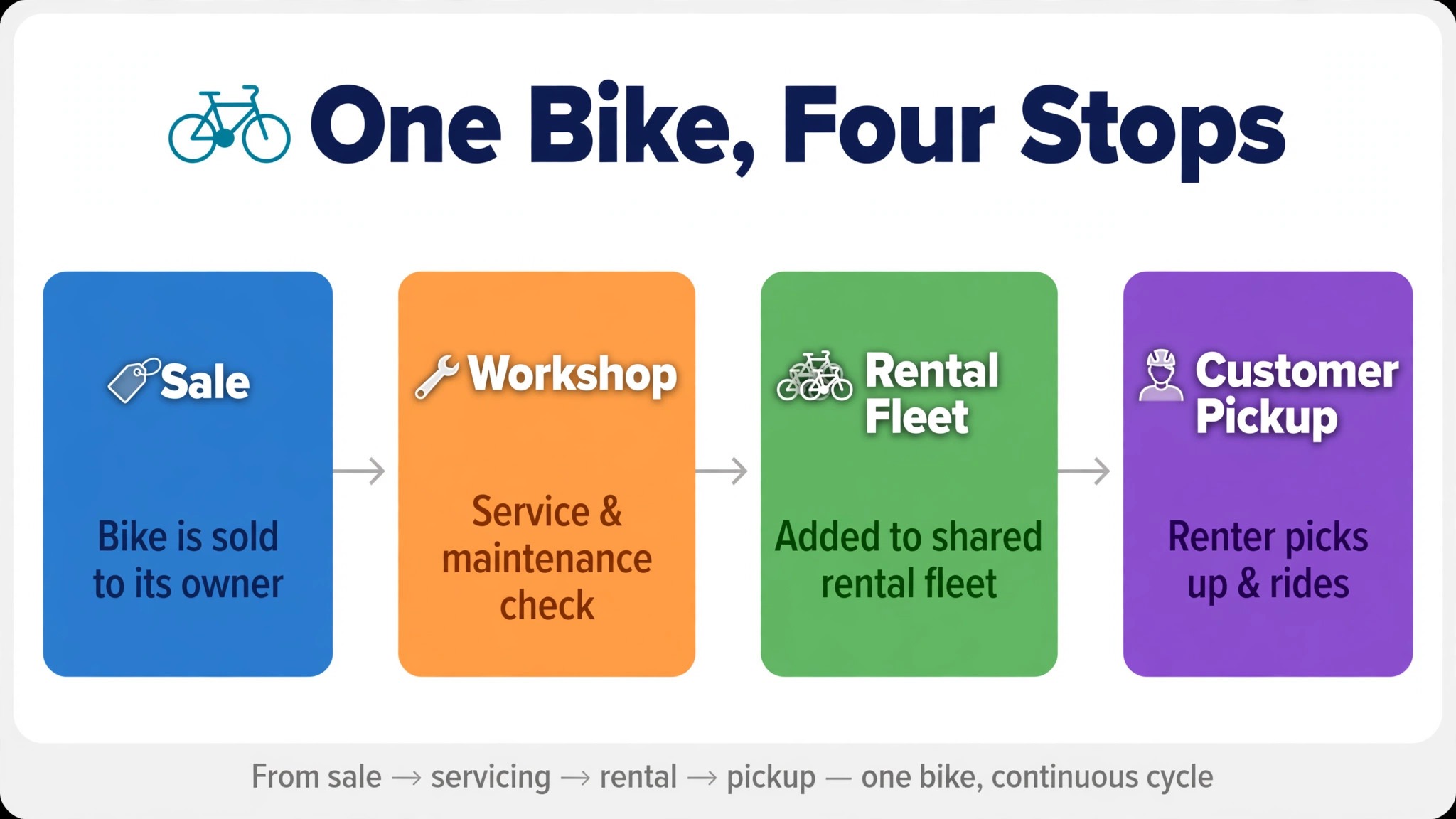
A bike shop is three businesses in one building. The front sells bikes, parts and clothing. The back repairs bikes, builds custom orders and tracks warranties. The side rents bikes, runs tours and takes deposits. A general till can sell a bike, but it cannot tell you which bike is in the workshop, which part is on order, which rental is due back at four, and which customer is waiting for a call. The best software for bike shops keeps those three businesses in one record, so the sale, the repair and the rental never fight each other.
This guide compares eight systems on real published prices, the job each one does best, and the catch that only appears after the demo. Prices come from vendor pricing pages and third party roundups checked in November 2026, and where a vendor sells by quote only, this guide says so instead of guessing. Start with the shortlist table, then read the reviews that match your shop size and your mix of retail, service and rental work.
The Quick Shortlist
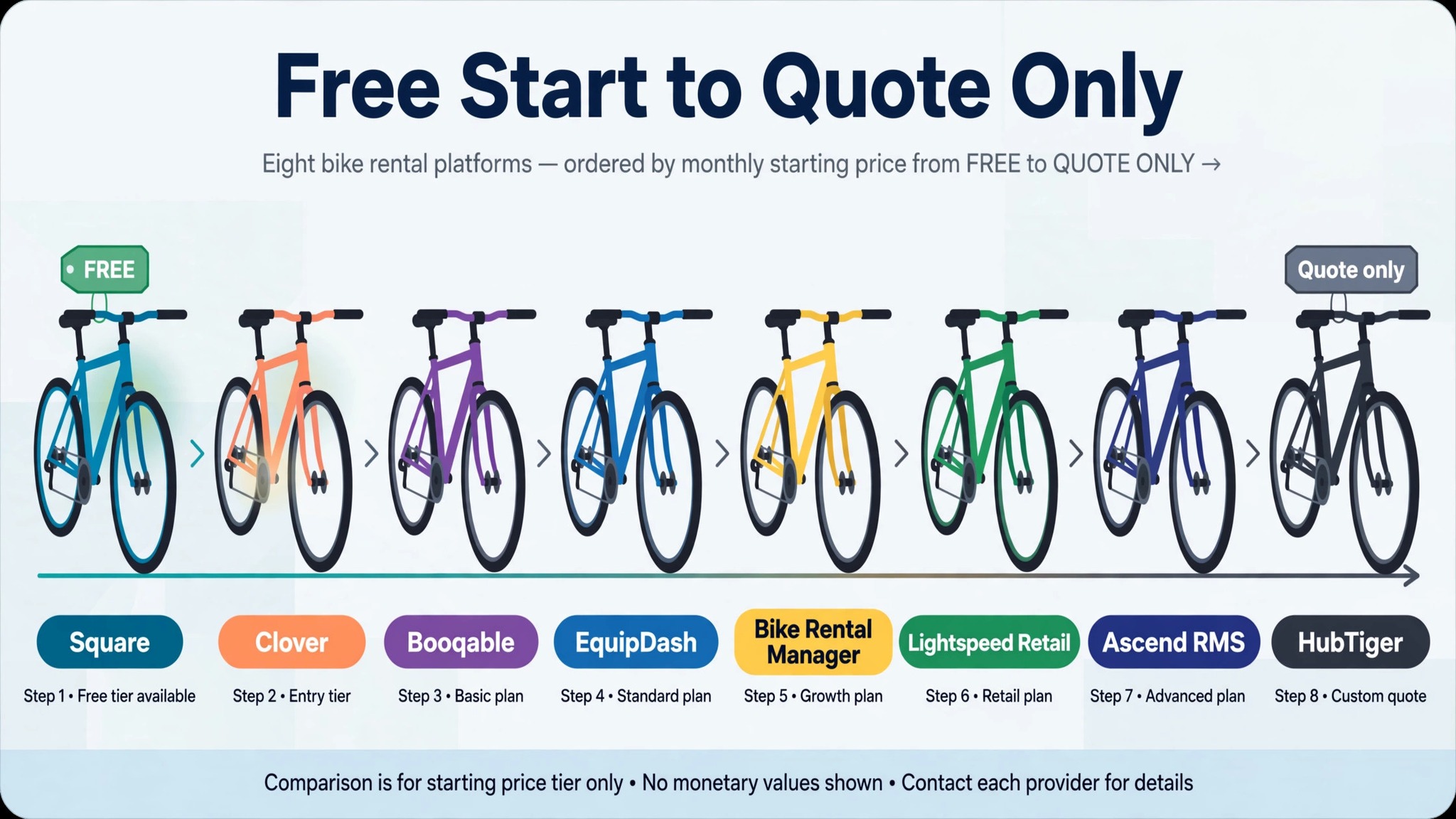
The table below matches each common bike shop job to the single system that handles it best. Use it to narrow the best software for bike shops to two or three candidates before you read the full reviews. Prices are monthly list prices unless noted, and annual billing is usually cheaper than paying month to month.
| Job | Best tool | Why it wins |
|---|---|---|
| Inventory heavy retail plus service | Lightspeed Retail | Basic from 89 dollars a month |
| Trek dealer with direct ordering | Ascend RMS | Reported from 89 dollars a month |
| Free POS for a small startup shop | Square | Free POS, paid plans available |
| Cheap POS with hardware options | Clover | Starter from 13 dollars a month reported for 36 months |
| Rentals, repairs and tours in one system | Bike Rental Manager | Bronze from 859 dollars a year |
| General rentals alongside bikes | Booqable | Start from 29 dollars a month annual |
| Rentals and guided rides from one fleet | EquipDash | From 29 dollars a month, or 23 dollars a month annual |
| Rental bookings for a Lightspeed shop | HubTiger | Quote only |
How We Judged the Best Software for Bike Shops
A system earned a place here only if it does real bike shop work in 2026, not if it added a work order field to a general till. We judged each one on five things that decide whether a shop keeps paying after the first year. The best software for bike shops has to pass all five, because a system that sells well but loses a repair ticket still costs the shop money and trust every week.
First, the retail job, from matrix inventory for sizes and colours to serialized bikes to purchase orders, because a bike shop cannot sell what it cannot find. Second, the service job, from work orders to parts to customer updates, because the workshop is where much of the profit and the reputation sit. Third, the rental job, from availability by frame size to waivers to deposits, because a rental fleet that double books is a fleet that loses a customer.
Fourth, the starting price a small shop can actually buy, including whether a free plan or trial exists and what the paid plan really includes. Fifth, the catch, from a pricing maze of add ons to a system that needs a second tool for rentals to a quote only price that hides the real cost. Every review below names that catch in plain words.
| Check before you buy | What to ask | Why it matters |
|---|---|---|
| Work order depth | Parts, labour, status updates and warranty tracking | A repair without a ticket is a lost bike |
| Matrix inventory | Size and colour variants that stay in sync | Stops selling a size you do not have |
| Rental availability | Live stock by bike and frame size | Stops double booking a rental |
| Vendor catalogs | Direct ordering from Trek and other brands | Saves hours of data entry |
| E-commerce sync | Website and in store stock in one count | Stops selling out of stock bikes online |
| Contract terms | Annual or monthly, and what add ons cost | The best price often needs an annual contract |
Switching systems is a project, not a purchase, and the shops that switch well treat it that way. Data migration takes time because old stock counts, customer records and open work orders rarely move cleanly, and the team needs a quiet week to learn the new till and ticket flow. A shop that runs the old system in parallel for the first fortnight catches the errors before they reach a customer, and a shop that trains the workshop first catches the ticket errors before they reach a bike. The cost of that parallel week is real, but it is smaller than the cost of a month of lost repairs.
The 8 Tools, Reviewed One by One
1. Lightspeed Retail
Starting price 89 dollars a month for Basic on annual billing, with Core at 149 dollars and Plus at 289 dollars. Best for Inventory heavy retail plus service. Watch out The pricing structure is a maze of add ons, and the advertised price climbs fast once you add e-commerce or loyalty.
Lightspeed Retail is the inventory first system that many bike shops graduate to, because it handles the stock complexity that a simple till cannot. Basic at 89 dollars a month on annual billing covers POS, payments and core inventory with purchase orders and low stock alerts. Core at 149 dollars adds multi location transfers and advanced reporting, and Plus at 289 dollars adds loyalty, analytics and accounting integrations.
The strength is the matrix inventory. A bike shop sells the same model in many sizes and colours, with parts, clothing and accessories beside it, and Lightspeed keeps those variants in sync across the shop and the website. Work orders, warranties, rentals and consignment sit in the same system, and vendor catalog imports feed purchasing directly. For a shop with real stock depth, that inventory control is the point.
The catch is the add on maze. The advertised price balloons once you add the essential modules, and the best price needs an annual contract. Setup takes real work compared with Square, and the team needs training to use the depth well. Lightspeed still earns the top spot for inventory heavy shops that will use the reporting.
2. Ascend RMS
Starting price 89 dollars a month reported. Best for Trek dealer with direct ordering. Watch out The interface is dated, and a non Trek shop will find better modern options for the same money.
Ascend RMS is the system for an independent bicycle retailer, and it is the pick that Trek dealers put up with for one reason. The direct Trek B2B integration automates ordering and syncs SKU data, saving staff from hours of data entry that a general POS would force on them. The service and repair module is purpose built for bike shops, and it handles work orders reliably for a busy service department.
The strength is the dealer workflow. A Trek dealer can order from the vendor catalog, sync the product data, and keep the service ticket beside the sale, all in one login. The work order management covers repairs, custom builds and warranty tracking, and the system is stable enough for a shop that runs on it every day. For a Trek dealer, that integration is the entire decision.
The catch is the age. The interface looks dated beside Lightspeed or Square, and a shop that is not a Trek dealer will find better modern options. The price of 89 dollars a month reported is also a third party figure, so confirm it with the vendor before you budget. Ascend earns second place for Trek dealers, and a non Trek shop should look elsewhere first.
3. Square
Starting price Free POS, with paid plans available for more features. Best for Free POS for a small startup shop. Watch out Square lacks work order management, rental management, repairs and consignment tools, so a busy workshop needs a second system.
Square is the top pick for a small bike shop starting out, because the free POS is real and the setup takes an afternoon. A new shop can sell bikes, parts and clothing, take card payments, and keep a customer record without a monthly bill. Square Online adds a website, and the paid plans add more retail features as the shop grows. For a startup with one counter and a small workshop, that free start is the whole decision.
The strength is the simplicity. Staff can learn the till in an hour, the hardware is cheap and widely available, and the payments are built in. A shop that sells mostly over the counter, with a few repairs a week, can run on Square without a training project. The customer record and the sales reporting are enough for a shop finding its feet.
The catch is the service gap. Square lacks work order management, rental management, repairs and consignment tools, so a shop whose workshop is as busy as its counter will need a second system for tickets and parts. The paid plans also climb, and the e-commerce plan is a separate cost. Square earns third place as the best free start, not as a full bike shop system.
4. Clover
Starting price 13 dollars a month reported for Starter, for 36 months. Best for Cheap POS with hardware options. Watch out The low Starter price is a promotional term, and the retail features a bike shop needs sit on higher plans.
Clover is the cheap POS with a wide hardware range, and it suits a small bike shop that wants a counter system without a large monthly bill. Starter at 13 dollars a month reported for 36 months gives a shop a real entry point, with a virtual terminal, invoicing and custom orders beside the till. The hardware options suit a shop that wants a counter terminal, a mobile reader and a website in one system.
The strength is the flexibility. A shop can choose the terminal that fits the counter, add a mobile reader for a market stall or a race day, and keep the sale and the customer in one place. The app store adds inventory, loyalty and reporting tools, though they cost extra. For a small shop that sells mostly over the counter, Clover covers the day at a low price.
The catch is the tier climb. The Starter price is a promotional term, and the retail features a bike shop needs, such as advanced inventory and work orders, sit on higher plans that cost far more. Confirm the price after the promotional term ends, and check which features sit in your plan. Clover earns its place as a cheap POS start for a small shop.
5. Bike Rental Manager
Starting price 859 dollars a year for Bronze, billed yearly, for up to 50 items and 38,000 dollars of revenue. Best for Rentals, repairs and tours in one system. Watch out Annual billing only, and the Lightspeed sync works with cloud Lightspeed, not the on site or iPad versions.
Bike Rental Manager, often shortened to BRM, is the system for a bike shop that rents, repairs and runs tours from one fleet. Bronze at 859 dollars a year covers up to 50 items and 38,000 dollars of revenue, and above that ceiling it charges 2.5 percent on revenue. The system covers rentals, repairs, tours, bike fitting and selling ex rental bikes in one login, with repair scheduling and a service history per bike.
The strength is the single fleet record. A bike can move from the rental fleet to the workshop to a tour to a sale, and the system knows where it is at every step. Delivery, barcode scanning and waivers sit beside the booking, and the two way sync with Lightspeed keeps the retail stock and the rental fleet in step. For a shop on Lightspeed with a busy workshop, that sync is the point.
The catch is the billing shape. Annual billing only means the shop pays 859 dollars up front, and the 2.5 percent charge above the revenue ceiling can add up in a busy summer. No published trial exists, so the shop must book a demo. Bike Rental Manager earns its place for Lightspeed shops with a busy rental and repair mix.
6. Booqable
Starting price 29 dollars a month billed annually for Start, or 35 dollars a month billed monthly. Best for General rentals alongside bikes. Watch out It is a general rental platform, so bike specific repair and tour work needs another system or workarounds.
Booqable is the general rental platform that many bike shops use when they rent bikes alongside other gear. Start at 29 dollars a month billed annually covers unlimited items and orders, with no commission on bookings, and Grow and Scale tiers add more features for larger operations. A 14 day free trial needs no card, and the setup takes a day.
The strength is the rental flow. Live availability by bike and frame size, online booking and payment, walk in workflows, mobile point of sale, e-signatures, barcode scanning, scheduled downtime and security deposit authorization all sit in one system. A shop can see which bikes are out, which are due back, and which are in the workshop, without a spreadsheet. For a shop that rents bikes as one part of a wider rental business, that flow is enough.
The catch is the generalist scope. Booqable was not built for bike repair tickets, tours or bike fitting, so a shop whose workshop is as busy as its rental counter will need a second system. The pricing is also shown in local currency, so confirm the figure in your currency before you budget. Booqable earns its place for general rental shops.
7. EquipDash
Starting price 29 dollars a month, or 23 dollars a month billed yearly. Best for Rentals and guided rides from one fleet. Watch out Direct online bookings carry a 1 to 2 percent fee, which can be passed to the customer, and card processing sits on top.
EquipDash is the rental system for a bike shop that runs rentals and guided rides from one fleet. The price of 29 dollars a month, or 23 dollars a month billed yearly, buys online booking, fleet availability, waivers and guided ride scheduling in one login, with a 21 day free trial and no card. The system was built for bike rental, so the fleet view matches how a rental shop actually works.
The strength is the shared fleet. A bike can be booked for a rental in the morning and a guided ride in the afternoon, and the system knows it cannot be in two places at once. Walk ins at the counter, online bookings and guided rides all draw from the same availability, so the shop never double books. For a shop near a trail or a tourist town, that shared fleet is the whole business.
The catch is the booking fee. Direct online bookings carry a 1 to 2 percent fee, which the shop can pass to the customer, and card processing fees sit on top of the plan. A shop with a high online volume should price the fee into its rental rates. EquipDash earns its place for rental and tour shops that share one fleet.
8. HubTiger
Starting price Quote only. Best for Rental bookings for a Lightspeed shop. Watch out No published price, and it is a rental add on, so the shop still pays for Lightspeed as well.
HubTiger is the rental partner that Lightspeed points bike shops to, because Lightspeed has no rental booking of its own. The system handles online rental bookings, availability, waivers and deposits, and it syncs with Lightspeed so the rental fleet and the retail stock stay in step. For a shop already on Lightspeed that rents only a few bikes, HubTiger is the natural add on.
The strength is the Lightspeed fit. A shop that already runs its counter on Lightspeed does not need to learn a second POS, and the rental bookings flow into the same customer record. The booking page is clean, the waiver flow is simple, and the deposit handling suits a rental business. For a Lightspeed shop that wants rentals without a second till, that fit matters.
The catch is the quote and the extra bill. HubTiger publishes no price, so the shop must ask for a quote, and the rental tool is an extra cost on top of Lightspeed. A shop that rents a large fleet may find a full rental system like Bike Rental Manager cheaper overall. HubTiger closes the list as the best rental add on for a Lightspeed shop, not as a standalone system.
Side by Side Comparison
The table below puts the whole list on one page, so you can compare the best software for bike shops side by side before you trial two or three of them. Prices are starting prices unless noted, and the free plan column tells you whether you can test the system without paying first. Use the table to cut the list, then read the reviews for the systems that survive the cut.
| Tool | Starting price | Best for | Free plan |
|---|---|---|---|
| Lightspeed Retail | 89 dollars a month | Inventory heavy retail plus service | No |
| Ascend RMS | 89 dollars a month reported | Trek dealer ordering | No |
| Square | Free POS | Free POS for a startup shop | Yes |
| Clover | 13 dollars a month reported | Cheap POS with hardware | No |
| Bike Rental Manager | 859 dollars a year | Rentals, repairs and tours | No |
| Booqable | 29 dollars a month annual | General rentals alongside bikes | Trial |
| EquipDash | 29 dollars a month | Rentals and guided rides | Trial |
| HubTiger | Quote only | Rental bookings for Lightspeed | No |
How to Pick the Right System for Your Shop
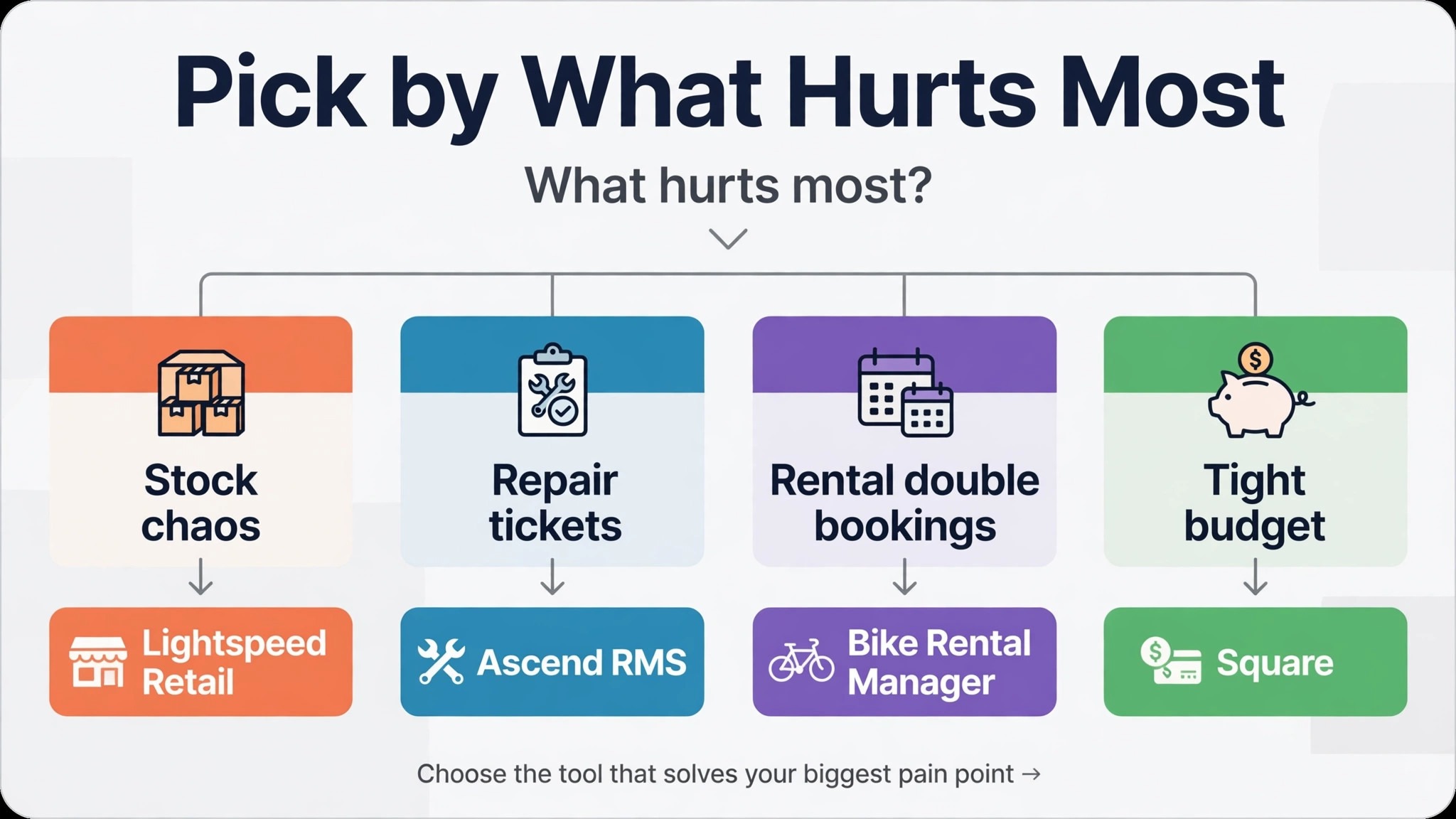
The best software for bike shops is not the one with the longest feature list. It is the one that fixes the job your shop feels every week. A shop whose counter is the business should buy Lightspeed Retail. A Trek dealer should buy Ascend RMS. A startup with no budget should start on Square and move up when the workshop fills. A shop that rents and tours should buy Bike Rental Manager or EquipDash. A shop that rents alongside other gear should buy Booqable. Start from the job, not from the vendor homepage.
Budget the full stack, not the headline plan price. The table below shows what a small shop actually pays in a normal month for the most common choices, using starting prices. Add ons, card processing and a second rental tool are the lines that surprise buyers, so ask for them in writing before you sign.
| Choice for a small shop | Monthly cost | What it covers |
|---|---|---|
| Square, free POS | 0 dollars | Till, payments, customer record |
| Lightspeed Basic, annual | 89 dollars | POS, inventory, work orders, one register |
| Ascend RMS, reported | 89 dollars reported | Trek ordering, work orders, retail |
| Clover Starter, reported | 13 dollars reported | Till, invoicing, custom orders |
| Booqable Start, annual | 29 dollars | Rentals, unlimited items, no commission |
| EquipDash, annual | 23 dollars a month | Rentals and guided rides from one fleet |
| Bike Rental Manager Bronze | 72 dollars a month equivalent | Rentals, repairs, tours, Lightspeed sync |
A second cost that owners miss is the time the mechanic spends learning new work order screens. A screen that looks fast on a demo can slow a routine service by a few minutes, and a few minutes across a dozen bikes a day is an hour of lost bench time. Trial the work order flow with a full shop day, not with a single demo repair, and ask the mechanic who will use it every day, not just the owner who signs the contract. The right system feels faster on day five than it did on day one, because the tickets match the way the shop actually works.
Ask the vendor how the system handles a trade in, because a used bike taken in part exchange needs a cost, a condition note and a resale price in the same record, and a system that treats it as a simple purchase will lose the margin.
Frequently Asked Questions
What is the cheapest good system for a small bike shop
Square is free and covers the till, payments and customer record, which is enough for a startup with a small workshop. Clover Starter at 13 dollars a month reported is the cheapest paid POS with hardware options. Lightspeed Basic at 89 dollars a month is the cheapest full system with matrix inventory and work orders. The cheapest stack that actually works for a shop with a busy workshop is usually Lightspeed for the shop plus Bike Rental Manager only if rentals are a daily job.
The best software for bike shops that fits a small shop best is usually the one with the clearest starting price and the shortest setup, because a shop that can start this week learns faster than a shop that waits for a sales call.
Do I need a separate system for rentals
No, not if you pick a system with a real rental workflow. Bike Rental Manager, Booqable and EquipDash all handle availability by bike and frame size, waivers and deposits in one login. Lightspeed has no rental booking of its own, so a Lightspeed shop needs HubTiger or Bike Rental Manager as a second tool. A separate rental system only makes sense if rentals are a large share of revenue, or if your POS has no rental module at all.
How much should a small bike shop budget
A realistic monthly budget for the best software for bike shops is 0 to 13 dollars a month for a startup on a free or cheap POS, 29 to 89 dollars a month for a shop on a full retail or rental system, and 89 to 149 dollars a month once you add a second tool for rentals or repairs. Card processing sits on top of every plan, and add ons can lift the bill fast. Always budget the first year, not the first month, and confirm any reported price with the vendor.
Which system is best for bike repairs
Lightspeed Retail is the best single system for most shops, because work orders, parts, warranties and vendor catalogs sit beside the retail sale in one login. Ascend RMS is better for a Trek dealer, because the direct ordering and the service module were built for that workflow. Bike Rental Manager is better when the workshop shares a fleet with rentals and tours. Pick Lightspeed if you want one login, Ascend if you are a Trek dealer, and Bike Rental Manager if rentals and repairs share the same bikes.
Our Verdict
If you buy one system this quarter, buy Lightspeed Retail. It covers the most of the bike shop job at a published price a small shop can afford, and it is the fastest way to move from a till that only sells to a system that sells, repairs and tracks stock in one place. The best software for bike shops earns its keep by keeping the sale, the repair and the rental in one record, and Lightspeed does that from the first week, without a second system for the workshop.
Whatever you pick, start with the job, trial with real bikes, and keep a human check on work orders and rental returns for the first month. The systems on this list all work. The difference is whether the system matches the work your shop actually does, and whether you measure the return in kept repairs and rented bikes rather than in features used.