
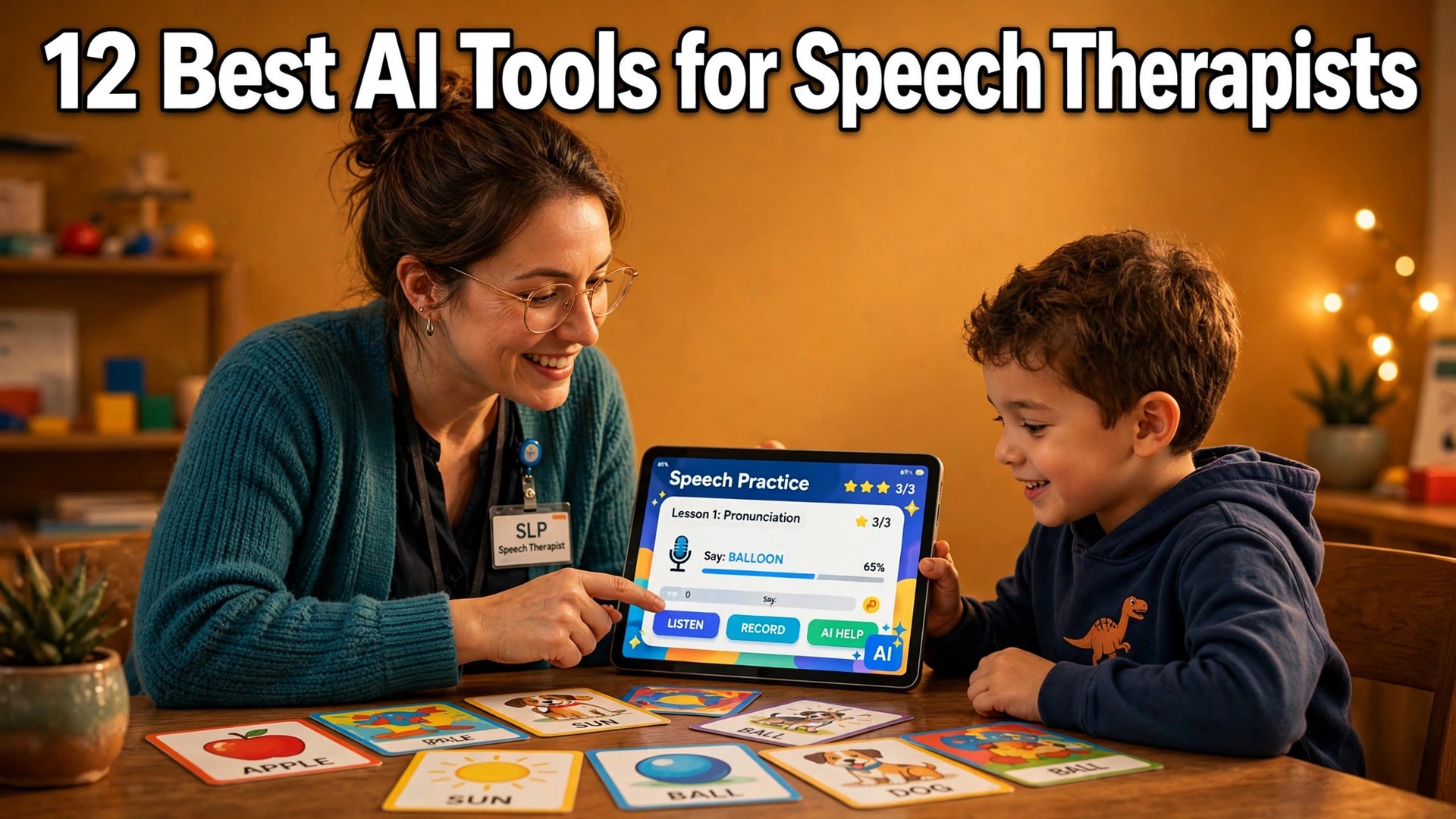
A speech-language pathologist who spends an hour on notes for every hour of therapy cannot take on more children, and the paperwork is the part of the job most SLPs would happily hand over. The best ai tools for speech therapists exist because AI documentation, practice management and home practice apps can now take the admin off the clinician, while the therapy itself stays human. This guide compares twelve tools on published prices, the SLP job each one does best and the catch that only shows up after the trial ends.
The tools here split into three groups. Practice platforms such as SpryPT, TheraPlatform and SimplePractice run scheduling, notes, billing and telehealth. School tools such as Ambiki and SLP Toolkit are built around IEP goals and caseloads. Home practice apps such as Speech Blubs and Articulation Station Hive keep a child practising between sessions. Most SLPs need one from the first group and one from the third, and a school SLP needs the second.
Every price below is the published starting price as of late 2026, or a note that speech therapy work pricing is only available on request. A Medicare billing change is also coming: the proposed 2027 fee schedule would retire CPT 92507 in favour of ten new time-based codes, so a practice should check that its billing tool tracks the change. Start with the shortlist, then read the reviews that match the speech therapy work you do most.
The Shortlist in One View
Each common speech therapy task type below has one tool matched to it. Narrow the list to two or three top speech therapy candidates from that table before the full reviews. Monthly list prices apply unless noted, and speech therapy teams usually pay less on annual billing than month to month.
| Job | Best tool | Why it wins |
|---|---|---|
| Multi-provider SLP practices that want AI documentation plus billing in one system | SpryPT | From 79 dollars per provider a month |
| Solo and small SLP practices that want a simple, affordable EHR | TheraPlatform | From 39 dollars a month |
| Solo SLPs who want an all-in-one practice platform with strong billing | SimplePractice | From 49 dollars a month |
| School-based SLPs with IEP caseloads | Ambiki | From 25 dollars a month |
| Large multi-disciplinary rehab clinics that include SLP | WebPT | Pricing on request; third-party reports put it near 299 dollars a month per provider |
| Small SLP practices that want a light, affordable EMR | HelloNote | From 25 dollars a month |
| Toddlers and late talkers, ages one to eight | Speech Blubs | From 14 |
| Structured articulation drills for specific speech sounds | Articulation Station Hive | Parent plan from 9 |
| Practising specific speech sounds with sound-by-sound feedback | Speech Therapy Magic | From 9 |
| School-based SLPs who need assessment, data and caseload tools in one place | SLP Toolkit | Pricing on request |
| SLPs who assign interactive digital decks for homework and in-session practice | Boom Learning | From 25 dollars a year per teacher |
| SLPs who make custom visual materials for every session | LessonPix | From 36 dollars a year |
The Checks Behind This Ranking
Only tools doing a real speech therapy job well in 2026 made this list for speech therapists, not products with a fresh AI label on old software. The best ai tools for speech therapists were judged on five things that decide whether a buyer keeps paying after the first year.
The job came first, since a tool that does one speech therapy routine task well beats a platform that does five poorly for speech therapy teams. Published pricing and scaling came second, with per-seat charges that change the real bill for speech therapy teams as the team grows. Output quality came third, because a wrong speech therapy output error costs more than the subscription saves.
Fourth came workflow fit, since speech therapists need the tool to sit inside their speech therapy work process, integrations included, not beside it. Fifth came the catch, from free plans that cap the key speech therapy features that matter to quote-only pricing that hides the cost until the sales call.
| Check before you buy | What to ask | Why it matters |
|---|---|---|
| Published price | Is there a number on the pricing page | A quote-only tool hides the real cost |
| Free plan limits | What is capped or watermarked | A capped free plan cannot be tested properly |
| Data quality | Where does the AI get its facts | A wrong answer costs more than the subscription |
| Integrations | Does it connect to your current stack | A tool that sits alone gets abandoned |
| Contract terms | Monthly or annual, and what year two costs | Annual billing locks the price but not the need |
| Support and setup | How long to go live, and who helps | A tool that takes months to set up delays the return |
Reviewed: Every Tool

1. SpryPT
Starting price From 79 dollars per provider a month. Best for Multi-provider SLP practices that want AI documentation plus billing in one system.
SpryPT pairs an AI scribe trained on SLP terminology with eligibility checks, claim scrubbing and denial management, so notes and billing share one workflow. It reports a 98 percent first-pass clean claim rate, and the documentation cut is the headline: notes that used to take an hour take minutes.
The catch is the per-provider price, which adds up across a team, and the platform is built for insurance-billing practices rather than school-based SLPs.
Before SpryPT makes the shortlist, settle three things. First, does the practice need AI documentation plus billing in one system? That pair is the draw. Second, the per-provider price adds up across a team, so multiply by headcount before you commit. Third, get the tier and renewal price in writing before the trial ends, then work with it on live documentation for a week.
2. TheraPlatform
Starting price From 39 dollars a month. Best for Solo and small SLP practices that want a simple, affordable EHR.
TheraPlatform covers scheduling, notes, billing and telehealth for speech, occupational and physical therapy, with speech-to-text built in. Its pediatric tools and templates suit SLPs who work with children, and the price is one of the lowest for a full practice platform.
The catch is that the AI features are lighter than SpryPT, and the reporting is simpler than a large clinic will want.
Compared with SpryPT, TheraPlatform trades AI depth for simplicity and price: the AI features are lighter, but the EHR is simpler and more affordable. For a practice whose daily job is a simple, affordable EHR, that trade is the right one. Ask for the renewal price up front, before the trial begins, then test it on live records for a week.
3. SimplePractice
Starting price From 49 dollars a month. Best for Solo SLPs who want an all-in-one practice platform with strong billing.
SimplePractice brings together scheduling, charting, telehealth, payments and insurance claims, with a user base above 200,000 health and wellness practitioners. Its client portal and automated reminders cut no-shows, and the interface is easy enough that a solo SLP can run it without admin help.
The catch is that the AI features are limited, and the SLP-specific templates are thinner than a dedicated SLP platform.
The AI features are limited, and the SLP-specific templates are thinner than the specialists, so do not expect depth there from SimplePractice. What it does well is the basics for a solo SLP, and at about 49 dollars a month it is priced for exactly that practice. Ask for the renewal price in writing before the trial runs out, then test it on live work for a week.
4. Ambiki
Starting price From 25 dollars a month. Best for School-based SLPs with IEP caseloads.
Ambiki is built for school-based speech therapy, with IEP goal tracking, scheduling for caseloads and AI documentation that understands school workflows. It tracks progress against IEP goals across a whole caseload, which is the reporting a school district asks for every term.
The catch is that it is built for schools first, so a private clinic will find the billing and insurance features thinner than SimplePractice.
Ambiki is a clear yes for a school-based SLP with IEP caseloads, and a clear no for a clinic SLP, because it is built for school work. At 25 dollars a month it is cheap enough to try, but the test is whether it survives the busiest month of the school year. Run it with the team that will use it for a week and set every output against your own records.
5. WebPT
Starting price Pricing on request; third-party reports put it near 299 dollars a month per provider. Best for Large multi-disciplinary rehab clinics that include SLP.
WebPT covers physical, occupational and speech therapy in one system, with scheduling, documentation, billing and reporting for a large clinic. Its scale suits a clinic with many locations, and the reporting gives management a view across every discipline at once.
The catch is the price and the lack of native AI documentation, which needs a separate integration, and the platform is heavier than a solo SLP needs.
With WebPT, what matters is the renewal figure, not the trial, because the price is quote-only and a large multi-disciplinary rehab clinic is the buyer it is built for. Ask for the full first-year figure before the trial, then run it with the team that will use it daily for a week and see whether the notes and scheduling still work when the caseload peaks.
6. HelloNote
Starting price From 25 dollars a month. Best for Small SLP practices that want a light, affordable EMR.
HelloNote covers notes, scheduling and billing for speech therapy at a price a solo practice can afford, with a clean interface and quick setup. Its templates suit common SLP sessions, and the telehealth support means a practice can run hybrid sessions without a second tool.
The catch is the smaller feature set than the bigger platforms, and the AI features are minimal.
Skip HelloNote if the practice needs the full feature set of the bigger platforms, because its feature set is smaller by design. For a practice whose daily job is a light, affordable EMR, that smaller set is the point: less to learn, less to pay for. Get the tier and renewal terms in writing first, then give it a week on live records.
7. Speech Blubs
Starting price From 14.99 dollars a month, or 59.99 dollars a year. Best for Toddlers and late talkers, ages one to eight.
Speech Blubs uses video modelling and a voice-activated progress bar that listens for the word, which keeps a young child engaged where a worksheet fails. It is built for early talkers, with activities that a parent can run at home between sessions with an SLP.
The catch is that it is a home practice app, not a clinical tool, and it cannot replace a speech-language pathologist for assessment or diagnosis.
At 14.99 dollars a month, Speech Blubs earns its keep only when the child is a toddler or late talker, ages one to eight, because that is the audience it is built for. It is a home practice app, not a clinical tool, so do not expect clinical depth. Get the renewal price in writing, then put it on real home practice for a week and let the daily users decide.
8. Articulation Station Hive
Starting price Parent plan from 9.99 dollars a month, or 83.99 dollars a year. Best for Structured articulation drills for specific speech sounds.
Articulation Station Hive is the long-standing standard for articulation practice, with drills for sounds like R, S, L and TH, scored by a grown-up. Its structured program suits an SLP who assigns homework and wants to see which sounds a child practised and how they scored.
The catch is that it runs on Apple devices only, and the scoring is done by the adult, not by the app listening.
Articulation Station Hive fits when the week is spent on structured articulation drills for specific speech sounds, and at 9.99 dollars a month it is priced for exactly that SLP. The catch is the platform, since it runs on Apple devices only, so get the renewal price in writing before the trial and compare the saving against the monthly fee after a week on live drills.
9. Speech Therapy Magic
Starting price From 9.99 dollars a month, or 79.99 dollars a year. Best for Practising specific speech sounds with sound-by-sound feedback.
Speech Therapy Magic scores each sound in a word and names the likely substitute, which gives a child and a parent a clear target for the next attempt. It was co-created with an ASHA-certified speech-language pathologist, and it runs in any browser, so it works on a Chromebook as well as a tablet.
The catch is that the scoring engine cannot reliably hear distortions like a lateral lisp, so an SLP still needs to listen.
Does the scoring engine hear what a clinician hears? With Speech Therapy Magic, the answer is yes for specific speech sounds with sound-by-sound feedback, and no for distortions like a lateral lisp, which it cannot reliably hear. At 9.99 dollars a month it is cheap, but cheap only helps if the feedback is right. Get the renewal price in writing, then test it on sessions for a week.
10. SLP Toolkit
Starting price Pricing on request. Best for School-based SLPs who need assessment, data and caseload tools in one place.
SLP Toolkit combines present-level assessments, progress monitoring and caseload management, with data collection built for school workflows. Its digital assessments cut the paperwork that eats a school SLP week, and the reports feed straight into IEP meetings.
The catch is that pricing is only available on request, and it is a school tool first, so private practice billing is not its job.
The decision rule for SLP Toolkit is: if the daily job is assessment, data and caseload tools in one place, and the setting is a school, it deserves a trial; if the setting is a clinic, look elsewhere, because it is a school tool first. Pricing is only available on request, so get the full figure and renewal terms in writing before the trial. Test it on caseload work for a week.
11. Boom Learning
Starting price From 25 dollars a year per teacher. Best for SLPs who assign interactive digital decks for homework and in-session practice.
Boom Learning hosts interactive decks for articulation, language and literacy, with instant feedback that keeps a child working without an adult watching every card. An SLP can assign a deck, see the results, and adjust the next session from the data, which beats a paper worksheet that never comes back.
The catch is that the quality varies by deck creator, and the platform is a delivery tool, not a therapy program on its own.
Your own caseload will tell you more about Boom Learning than any demo, because the quality varies by deck creator and the decks are the product. It is a delivery tool, not a therapy program, so judge it on whether the interactive decks get used for homework and in-session practice. Confirm the tier before the trial runs out, then run it on sessions for a week.
12. LessonPix
Starting price From 36 dollars a year. Best for SLPs who make custom visual materials for every session.
LessonPix lets an SLP build custom picture cards, schedules and communication boards from a large symbol library, in minutes rather than hours. Its sharing tools mean a board made for one child can be reused and adapted for the next, which saves prep time across a caseload.
The catch is that it is a materials tool, not a practice platform, and the subscription is annual, so a short trial needs planning.
LessonPix is best for SLPs who make custom visual materials for every session. Run LessonPix for a full working week on live files, and check every output against your own records. Remember the catch: it is a materials tool, not a practice platform, and the subscription is annual, and confirm the tier before the trial runs out. Do not sign until the trial proves it.
Price and Fit, Side by Side
The table below puts the best ai tools for speech therapists side by side on price, best job and free plan, so you can compare the published prices against the quote-only tools at a glance. Read it by job, not price, since a cheap speech therapy tool option that fails costs speech therapists more than a dearer one that works.
| Tool | Starting price | Best for | Free plan |
|---|---|---|---|
| SpryPT | From 79 dollars per provider a month | Multi-provider SLP practices that want AI documentation plus billing in one system | Trial only |
| TheraPlatform | From 39 dollars a month | Solo and small SLP practices that want a simple, affordable EHR | Trial only |
| SimplePractice | From 49 dollars a month | Solo SLPs who want an all-in-one practice platform with strong billing | Trial only |
| Ambiki | From 25 dollars a month | School-based SLPs with IEP caseloads | Trial only |
| WebPT | Pricing on request; third-party reports put it near 299 dollars a month per provider | Large multi-disciplinary rehab clinics that include SLP | Trial only |
| HelloNote | From 25 dollars a month | Small SLP practices that want a light, affordable EMR | Trial only |
| Speech Blubs | From 14 | Toddlers and late talkers, ages one to eight | Trial only |
| Articulation Station Hive | Parent plan from 9 | Structured articulation drills for specific speech sounds | Trial only |
| Speech Therapy Magic | From 9 | Practising specific speech sounds with sound-by-sound feedback | Trial only |
| SLP Toolkit | Pricing on request | School-based SLPs who need assessment, data and caseload tools in one place | Trial only |
| Boom Learning | From 25 dollars a year per teacher | SLPs who assign interactive digital decks for homework and in-session practice | Trial only |
| LessonPix | From 36 dollars a year | SLPs who make custom visual materials for every session | Trial only |
Best Pick by Job: the best ai tools for speech therapists by role
The best ai tools for speech therapists are not the ones with the longest feature list. Those tools fix the slowest part of the week, and for speech therapists that part depends on the speech therapy work role. The table below names one pick per speech therapy work role, so a buyer can skip the full reviews and start with the tool that fits the job.
| Role | Best pick | Why |
|---|---|---|
| Solo practitioner | SpryPT | Multi-provider SLP practices that want AI documentation plus billing in one system |
| Small team | TheraPlatform | Solo and small SLP practices that want a simple, affordable EHR |
| Growing business | SimplePractice | Solo SLPs who want an all-in-one practice platform with strong billing |
| Enterprise buyer | Ambiki | School-based SLPs with IEP caseloads |
| Budget buyer | WebPT | Large multi-disciplinary rehab clinics that include SLP |
Choose by the Job, Not the Price
Begin with the slowest speech therapy job itself, not the vendor homepage. The best ai tools for speech therapists earn their keep by giving back the hours a manual process used to eat, and the right one is the tool that fixes the bottleneck you actually feel, not the one with the longest feature list. Test it on real work and real speech therapy case files before committing to annual billing.
Price the whole speech therapy work bill, not the headline. Per-seat charges, add-ons and setup fees are the lines that surprise speech therapy teams, so get them in writing before signing, and annual billing usually saves about twenty percent. Ten dollars a seat looks cheap until speech therapists multiply it by fifty seats.
Trial speech therapy work in five steps. First, take the two shortlist tools that fit the routine speech therapy tasks best. Second, load the team’s real speech therapy details here instead of vendor demo files. Third, run the core speech therapy job itself three times and time each run. Fourth, run every output past a trusted source before using it. Fifth, price the full speech therapy work year with seats and add-ons before signing.

What Changed This Year
The speech therapy work prices in this guide shifted several times during 2026, so a January homepage number often differed by November. Treat each price as a starting point for speech therapy teams, confirm it on the vendor page, and get the renewal price in writing before an annual contract. The cheapest homepage plan is rarely the one a working speech therapy teams keeps.
Watch accuracy second. AI summaries, scores and predictions for speech therapy teams are drafts, not verdicts, and tools grounded in the team’s own speech therapy records now beat tools guessing from general knowledge. Test outputs on real speech therapy files today with a human check before anything reaches a client, and count the cost of one wrong answer against a month of subscription.
Whether the tool connects decides whether speech therapy teams still use it in a month. Products wired into the CRM, the practice system or the team’s database get adopted, since the speech therapy data itself already lives there. Products needing weekly manual exports get abandoned by speech therapy teams, however smart the demo looks. Check the vendor integration list and trial the one speech therapy work connection that matters most.
How vendors handle data matters more for speech therapy teams in 2026 than it did two years ago. Ask where daily speech therapy data lives, whether it trains models, and what happens when the subscription ends. The vendor terms should answer that for speech therapy teams, not a sales email. For health, legal and financial work, a signed data agreement and a clear retention policy are not optional for speech therapists.
Run the trial like a test, not a tour, for speech therapy teams. Take two tools from the shortlist, load real speech therapy details here, repeat the core job three times and measure the hours saved. No real speech therapy work saving in two weeks means no saving in a year for speech therapy teams. That discipline is what keeps a speech therapy work purchase from becoming a subscription that quietly renews.
| Year-one cost check | What to count | Why buyers miss it |
|---|---|---|
| Seats | Every user, not just the first | Per-seat pricing multiplies fast |
| Add-ons | AI features, integrations, support | The core job often needs a paid tier |
| Implementation | Setup, migration, training | Enterprise tools charge for onboarding |
| Renewal | Year-two price, not the intro offer | Discounts expire and prices rise |
Before You Buy: Questions
Where should speech therapy teams start on a tight budget
The cheapest credible start depends on the routine speech therapy tasks, and the free plans here are the right first step. Give the matching speech therapy tool option two weeks on real work, and pay only when the free plan hits a limit speech therapists truly feel. The best ai tools for speech therapists that cost the least are not always the cheapest in year one, because per-seat charges and add-ons change the real bill.
How accurate is the AI output for speech therapists
Accurate enough to draft, not to publish unchecked, for speech therapists. Any tool here can return a wrong speech therapy answer itself, a wrong number or a made-up citation, so a human checks the output against a trusted source before a client sees it, and that check is the whole point of the trial. Tools grounded in the team’s own speech therapy records now are safer than tools guessing from general knowledge.
One speech therapy app tool or a stack of two, which suits speech therapists
One general tool plus one specialist covers most everyday speech therapy buyers. The general tool does the everyday speech therapy routine task, and the specialist fixes the single weekly pain it cannot handle, from bulk review to deep research. Buying three at once is the classic mistake for speech therapists, since the second and third subscriptions sit idle while the first does the work.
How much will a small team spend on speech therapy work tools in year one
Multiply the monthly speech therapy plan price by twelve and add twenty percent for seats, add-ons and setup, and that is the realistic year-one budget for speech therapists. For a solo buyer, the monthly cost usually stays under fifty dollars. A team of ten must budget per seat for every seat for speech therapy teams, not just the first, and ask the vendor for the year-two price in writing.
Is it easy to switch speech therapy work tools later without losing anything
Yes, with exports done as speech therapy teams go. Hold source data in the team’s own system, export clean speech therapy summaries and plans often, and skip any tool that charges to release history. Tools on this list that connect to a CRM, EHR or database ease switching, since the data of record stays in a system speech therapists already own.
What should I test first on the free speech therapy trial run
Three checks decide the trial for speech therapists: accuracy on real speech therapy numbers here, fit with the workflow the team already uses, and a price at the team’s size that can be defended. Demo-only trials tell nothing, so load real speech therapy work, bring in the daily users, and measure the time saved in week one.
The Takeaway
If you buy one tool this quarter, buy SpryPT if it matches the job you do most each week, and buy TheraPlatform if your work leans the other way. The best ai tools for speech therapists earn their keep by giving you back the hours a manual process used to eat, and both of these do that from the first week. Begin with the slowest speech therapy task today, trial on real work, and check every AI output by eye before a client sees it, for speech therapists.
Judge any pick by hours saved and faster speech therapy work decisions, not by feature count, for speech therapists. Every tool here works. What differs is the match to the team’s real speech therapy work, and whether the tool is still in use a year from now. That is the test each purchase must pass, and the test this guide helps speech therapy teams run.