

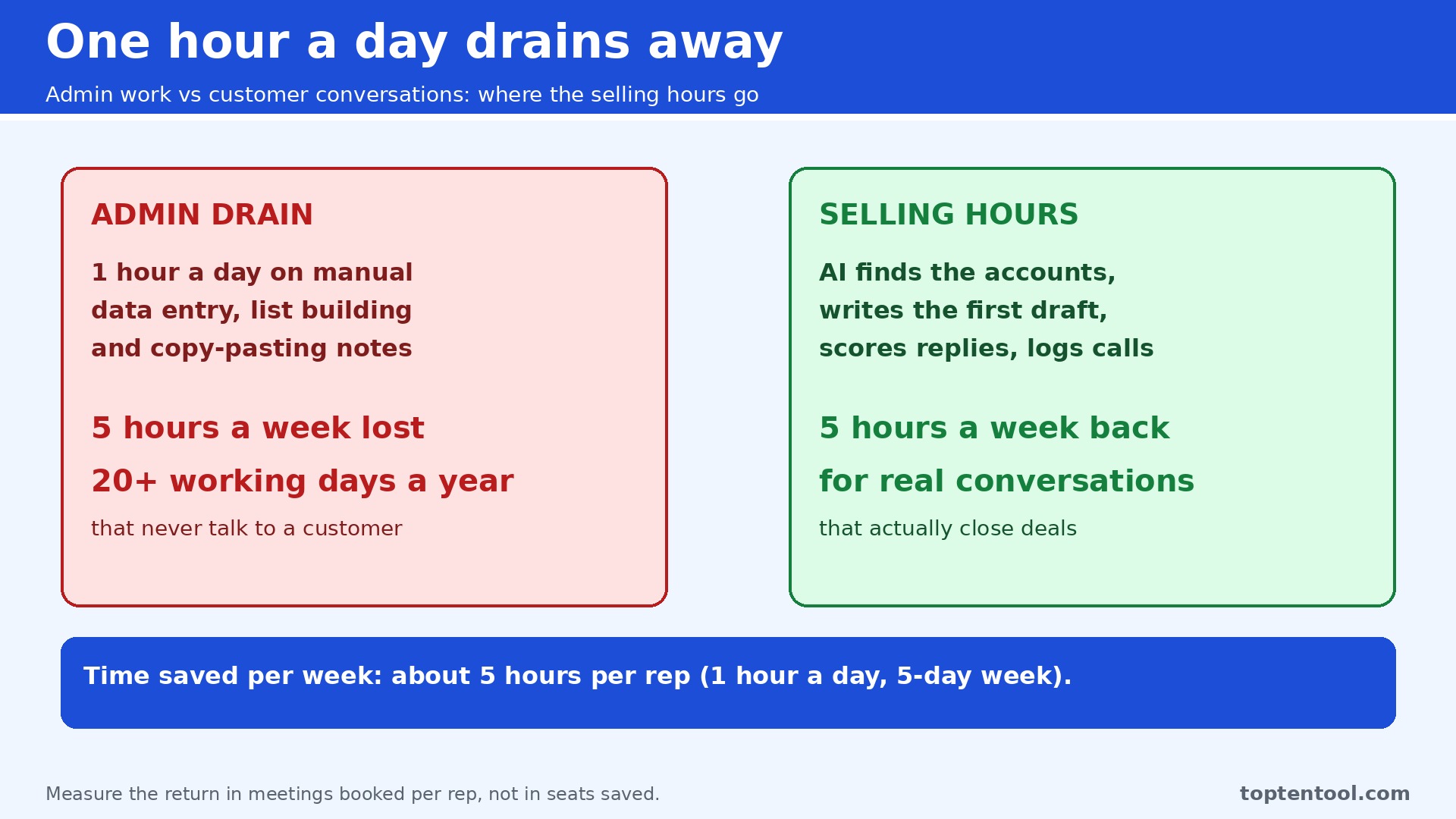
A sales rep who spends one hour a day on manual data entry, list building and copy pasting notes loses more than 20 working days a year to work that never talks to a customer. That arithmetic is the reason AI moved from a nice extra to a core part of the modern sales stack. The best AI tools for sales teams now find the accounts, write the first draft, score the replies, log the call and flag the deal that quietly went cold, and the rep spends the saved hours on conversations that actually close.
This guide compares the best AI tools for sales teams on real prices, the job each one does best and the catch that only shows up after the trial. Prices come from vendor pricing pages and third party roundups checked in November 2026, and where a vendor sells by quote only, this guide says so instead of guessing. Start with the shortlist table, then read the reviews that match your team size and your pipeline problem.
The Quick Shortlist
The table below matches each common sales job to the single tool that handles it best. Use it to narrow the best AI tools for sales teams to two or three candidates before you read the full reviews. Prices are monthly list prices unless noted, and annual billing is usually cheaper than paying month to month.
| Job | Best tool | Why it wins |
|---|---|---|
| Prospecting and outbound in one login | Apollo.io | Contact data plus sequences from 49 dollars a seat a month |
| CRM native selling for a small team | HubSpot Sales Hub | AI inside a CRM your team already knows, from 20 dollars a seat a month |
| Coaching and deal risk on calls | Gong | Every call becomes searchable coaching evidence |
| Enterprise sequencing at scale | Outreach | Deepest cadence engine for large outbound teams |
| Forecasting for a leadership team | Salesloft | Unified engagement and forecast after the Clari merger |
| Custom enrichment and research | Clay | No code research agents across more than 100 data sources |
| Sharper cold email before you send | Lavender | Real time email scoring from 29 dollars a month |
| Call notes and shared meeting memory | Fireflies.ai | Business plan from 19 dollars a seat a month |
| A CRM with AI built in from day one | Close | Growth plan from 99 dollars a user a month |
| AI written sequences for lean teams | Regie.ai | AI prospecting and sequences from 49 dollars a month |
How We Judged the Best AI Tools for Sales Teams
A tool earned a place here only if it does a real sales job in 2026, not if it added an AI button to an old product. We judged each one on five things that decide whether a team keeps paying after the trial.
First, the job it does, from finding accounts to coaching calls to forecasting the quarter, because a tool that does one job well beats a platform that does five jobs poorly.
Second, the starting price a small team can actually buy, including whether a free plan exists and what the paid plan really includes. Third, where it fits in the stack, because a tool that lives inside your CRM saves more time than one that needs a new tab and a new login. Fourth, the quality of its AI output, from email drafts that sound human to call summaries a manager can trust. Fifth, the catch, from credit limits that quietly double the bill to quote only pricing that hides the real cost until the sales call.
| Check before you buy | What to ask | Why it matters |
|---|---|---|
| Credit model | What burns credits, and do they expire | Stops a 49 dollar plan becoming a 150 dollar plan |
| Free plan limits | How many seats, contacts and sequences | Tells you if the trial is a real test |
| CRM sync | Two way sync or one way export | One way sync means double entry forever |
| AI accuracy | Who reviews AI drafts before they send | Bad drafts sent at scale damage your domain |
| Contract terms | Annual only, or monthly available | Quote only tools often mean annual contracts |
| Data consent | Call recording consent by state and country | Recording without consent creates legal risk |
The 10 Tools, Reviewed One by One
1. Apollo.io
Starting price 49 dollars a seat a month billed annually for Basic. Best for Prospecting and outbound in one login. Watch out Credits expire each cycle, so heavy exporters can double the effective cost.
Apollo.io is where most small teams should start, because it removes the two tool problem. One login gives you a contact database of more than 275 million contacts, search and enrichment, email sequences, a dialer and AI assistance. The free plan gives you 50 credits and two sequences, which is enough to judge data quality in your market before you pay. Basic at 49 dollars a seat a month includes 30,000 credits per seat per year, and AI research costs one credit per run.
The strength is the combination. A rep can find an account, enrich the contacts, build a sequence and start sending without exporting a list to a second tool. AI scoring helps prioritize the accounts most likely to reply, and the built in analytics show which steps in a sequence actually earn meetings. For a founder building outbound from zero, that combination is hard to beat at the price.
The catch is the credit model. Exports, enrichments and phone numbers burn credits, and unused credits do not roll over in the way a buyer hopes. Audit credit use after the first month and set export limits before the invoice teaches you to. Apollo.io still earns the top spot for teams that want data and outreach together without an enterprise contract.
2. HubSpot Sales Hub
Starting price 20 dollars a seat a month for Starter. Best for CRM native selling for a small team. Watch out AI agents are billed per outcome on higher tiers, so check the usage terms.
HubSpot Sales Hub is the easiest AI sales tool to adopt, because the AI lives inside a CRM your team already knows. Breeze, the HubSpot AI layer, drafts emails, summarizes calls, scores leads and enriches company records without a rep leaving the contact page. Starter at 20 dollars a seat a month is the cheapest self serve entry on this list with a real free plan behind it, and the free CRM covers up to two users before you pay at all.
The advantage is that nothing needs syncing. The call summary lands on the deal record. The email draft pulls in the contact history. The lead score updates the list your reps work from each morning. For a team of two to ten reps that already runs on HubSpot, that native fit saves more hours than any standalone tool, because there is no integration to break and no second login to open.
The catch is that the most powerful AI agents, like the prospecting agent and the customer agent, are billed per resolved conversation or per qualified lead on Pro and Enterprise plans, not bundled flat into the tier. That outcome based pricing can be fair, but it is a different bill from the seat price, so get the per outcome rate in writing. HubSpot still earns second place for small teams that want AI inside the CRM they already run.
3. Gong
Starting price Quote only. Best for Coaching and deal risk on calls. Watch out Per seat fees plus a platform fee punish small teams, and contracts are annual.
Gong is the standard for conversation intelligence, and it earns that position by turning every recorded call into evidence a manager can use. It records, transcribes and analyzes sales calls, then tells you what is actually happening in your pipeline. Which deals are stalling, which competitors keep appearing, which talk tracks correlate with wins, and which champion went quiet after the demo. Deal boards flag the silent risks that a forecast spreadsheet never shows.
The coaching value is the real return. A manager can search every call for a specific objection, pull the three best answers the team has given, and coach a new rep with real examples instead of theory. New reps ramp faster because they can listen to winning calls instead of shadowing for a month. For a team of twenty or more reps, that shared memory is worth more than any single feature.
The catch is the price structure. Pricing is quote based, with per user fees plus a platform fee, and third party reporting puts typical costs well above 1,000 dollars per user per year before the platform fee. Recording calls also carries consent duties that vary by state and country, so check your legal position before you switch it on. Gong is the best coaching tool here, but it is priced for teams that can spread the platform fee across many seats.
4. Outreach
Starting price Quote only, with third party reports around 100 to 160 dollars per user a month. Best for Enterprise sequencing at scale. Watch out AI credits sit on top of seats, so get the credit allotment in writing.
Outreach is the sequencing platform large outbound teams standardize on, and its AI now drafts and personalizes steps inside sequences, prioritizes the day’s tasks, and layers agent features on top of a very solid cadence engine. Sequences run across email, calls and LinkedIn tasks with conditional branching, and the reporting shows which sequences, templates and reps actually produce pipeline. For a team running hundreds of sequences at once, that depth of control is the point.
The AI adds two things that matter at scale. First, it personalizes outreach using account and contact data without a rep writing every line by hand. Second, it builds a daily priority list, so a rep with 200 accounts knows which ten to call before lunch. Meeting prep agents and brand safe knowledge bases extend the same idea to the call itself.
The catch is cost and complexity. Nothing is published on price, third party data clusters around 100 to 160 dollars per user a month on annual contracts, plus platform fees, implementation and AI credit packs. The 2026 pricing model adds a consumption layer of AI credits on top of seats, so a team that leans hard on AI agents can see a second bill grow. Outreach is the right pick for enterprise outbound, and the wrong pick for a team of five that needs to start this week.
5. Salesloft
Starting price Quote only, with third party data around 75 to 165 dollars per user a month. Best for Forecasting for a leadership team. Watch out The dialer and conversation add ons cost extra, so the headline seat price is not the full bill.
Salesloft, now combined with Clari under one brand, is the forecasting pick for leaders whose number keeps missing. The platform pairs sales engagement with Clari Forecast, so the cadence data, the conversation data and the forecast live in one story instead of three tools. A sales leader can see which deals have real activity behind them and which ones are forecast on hope, then coach on the gap before the quarter ends.
The engagement side is strong on its own. Sequences, a dialer, conversation intelligence and deal management come in three Amplify tiers, with AI agents for meeting prep and workflow automation. The merger with Clari in late 2025 reshaped the packaging toward a unified forecasting story, and since September 2026 Salesloft is the single brand, with Clari Forecast the only product still carrying the Clari name.
The catch is the add on math. Third party data puts typical deals at 75 to 165 dollars per user a month, the dialer runs roughly 300 to 400 dollars per user per year extra, and Conversations adds 20 to 40 percent on top. Evaluate Salesloft as one platform story with Clari, not as two vendors, and price the full stack before you sign. For a leadership team that needs a forecast it can defend, it earns its place.
6. Clay
Starting price 167 dollars a month billed annually for Launch. Best for Custom enrichment and research at scale. Watch out The learning curve is steep, and credit costs need active management.
Clay is the enrichment tool for teams that want to build their own research workflows instead of buying a fixed database. It pulls from more than 100 data providers, runs an AI research agent called Claygent against the results, and lets a non technical user build enrichment waterfalls with no code. In March 2026 Clay overhauled its pricing, replacing three tiers with two and splitting credits into data credits and actions, which cut data marketplace costs by 50 to 90 percent for many buyers.
The power is in the workflow. A team can take a list of target accounts, enrich each one with funding news, hiring signals, tech stack data and recent posts, then write a first line of outreach that references something real about that account. That is the difference between a generic sequence and one that earns replies, and it is why Clay shows up in almost every serious outbound stack in 2026.
The catch is that Clay is a builder’s tool. A rep who wants a simple list and a send button will find it slow at first, and the credit model rewards careful design. Launch at 167 dollars a month billed annually is the entry point, with a free tier to learn on. Give it to the person on your team who enjoys building systems, and let them feed the rest of the team.
7. Lavender
Starting price 29 dollars a month. Best for Sharper cold email before you send. Watch out It improves email, it does not find the accounts or run the sequence.
Lavender is the smallest tool on this list and one of the most useful, because it fixes the exact moment where most outbound fails. It scores a cold email in real time before you hit send, flags lines that hurt reply rates, and suggests rewrites that sound like a person wrote them. It works inside Gmail and Outlook, so a rep gets coaching on every draft without opening a new tool.
The catch is scope. Lavender does not find accounts, run sequences or log calls. It is a writing coach, not a platform, so it only pays off if the rest of your stack already works. At 29 dollars a month it is also one of the cheapest paid tools here, which makes it an easy add on for a team that already sends cold email every day.
8. Fireflies.ai
Starting price 19 dollars a seat a month billed annually for Business. Best for Call notes and shared meeting memory. Watch out The free plan limits AI summaries and storage, so heavy users need the paid tier.
Fireflies.ai records, transcribes and summarizes sales calls, then turns them into searchable notes the whole team can use. AskFred, its AI assistant, answers questions about past calls, pulls out action items and syncs notes to the CRM. A rep who takes six calls a day stops writing notes after each one, and a manager can search a month of calls for every mention of a competitor in seconds.
The strength is sharing. A call summary is not trapped in one rep’s notebook. It lives in a shared workspace where the next rep on the account can read it before the follow up call, and the CRM record updates without manual entry. Business at 19 dollars a seat a month billed annually is the plan most teams buy, and a free plan exists for a single user to test.
The catch is that the free plan limits AI summaries and storage, so a team that records every call will outgrow it fast. Accuracy is also good but not perfect, so a rep should still check the summary before it goes to a customer. For the price, Fireflies.ai is the best shared call memory for a growing team, and it pairs well with any CRM on this list.
9. Close
Starting price 99 dollars a user a month billed annually for Growth. Best for A CRM with AI built in from day one. Watch out It is a full CRM switch, so the migration cost is real.
Close is a sales CRM with AI and workflows built in, not bolted on, and it suits teams that want one system for calls, emails, SMS and pipeline. Reps can call, email and text from inside the CRM, and the AI drafts follow ups, summarizes calls and automates the routine steps that usually need a rep to remember them. Growth at 99 dollars a user a month billed annually is the plan most small teams buy, and a free trial needs no card.
The advantage is focus. Close was built for inside sales teams that live on the phone and in the inbox, so the workflow is fast. Lead scoring, smart views and automated workflows keep the pipeline clean without a sales operations hire. A team of five to twenty reps can run its whole motion in Close and skip the CRM plus sequencer plus dialer stack entirely.
The catch is that switching CRMs is a project. Migrating history, rebuilding reports and retraining reps takes weeks, so Close only makes sense if you are choosing a CRM or you are unhappy enough with your current one to move. For a team starting fresh, it is one of the cleanest AI native options at this price.
10. Regie.ai
Starting price 49 dollars a month for RegieGO Pro. Best for AI written sequences for lean teams. Watch out Output quality depends on the data you feed it, so weak lists produce weak sequences.
Regie.ai writes sequences and prospecting content with AI, and it suits a lean team that needs to send more good outbound without hiring another rep. It builds multi step sequences, personalizes each step from account data, and learns from reply data to improve the next batch. The free plan lets a small team test the writing quality before paying, and RegieGO Pro at 49 dollars a month is the entry paid plan.
The value is output volume with a human in the loop. A single rep can launch sequences that would have taken a team a week to write, then spend the saved time on replies and calls instead of drafting. For a startup with one or two reps and a clear ideal customer, that is the fastest way to test outbound without a big hire.
The catch is that AI written sequences are only as good as the account list behind them. Feed Regie.ai a weak list and it will write polished emails to the wrong people. Keep a human review step before any sequence goes live, and measure reply rates by segment so you learn which accounts actually respond. Regie.ai closes the list as the best cheap way for a lean team to scale outbound writing.
Side by Side Comparison
| Tool | Starting price | Best for | Free plan |
|---|---|---|---|
| Apollo.io | 49 dollars a seat a month, annual | Prospecting and outbound in one login | Yes |
| HubSpot Sales Hub | 20 dollars a seat a month | CRM native selling for a small team | Yes |
| Gong | Quote only | Coaching and deal risk on calls | No |
| Outreach | Quote only, reported 100 to 160 dollars a user a month | Enterprise sequencing at scale | No |
| Salesloft | Quote only, reported 75 to 165 dollars a user a month | Forecasting for a leadership team | No |
| Clay | 167 dollars a month, annual | Custom enrichment and research | Yes |
| Lavender | 29 dollars a month | Sharper cold email before you send | Yes |
| Fireflies.ai | 19 dollars a seat a month, annual | Call notes and shared meeting memory | Yes |
| Close | 99 dollars a user a month, annual | A CRM with AI built in from day one | Trial only |
| Regie.ai | 49 dollars a month | AI written sequences for lean teams | Yes |
How to Pick the Right Tool for Your Team
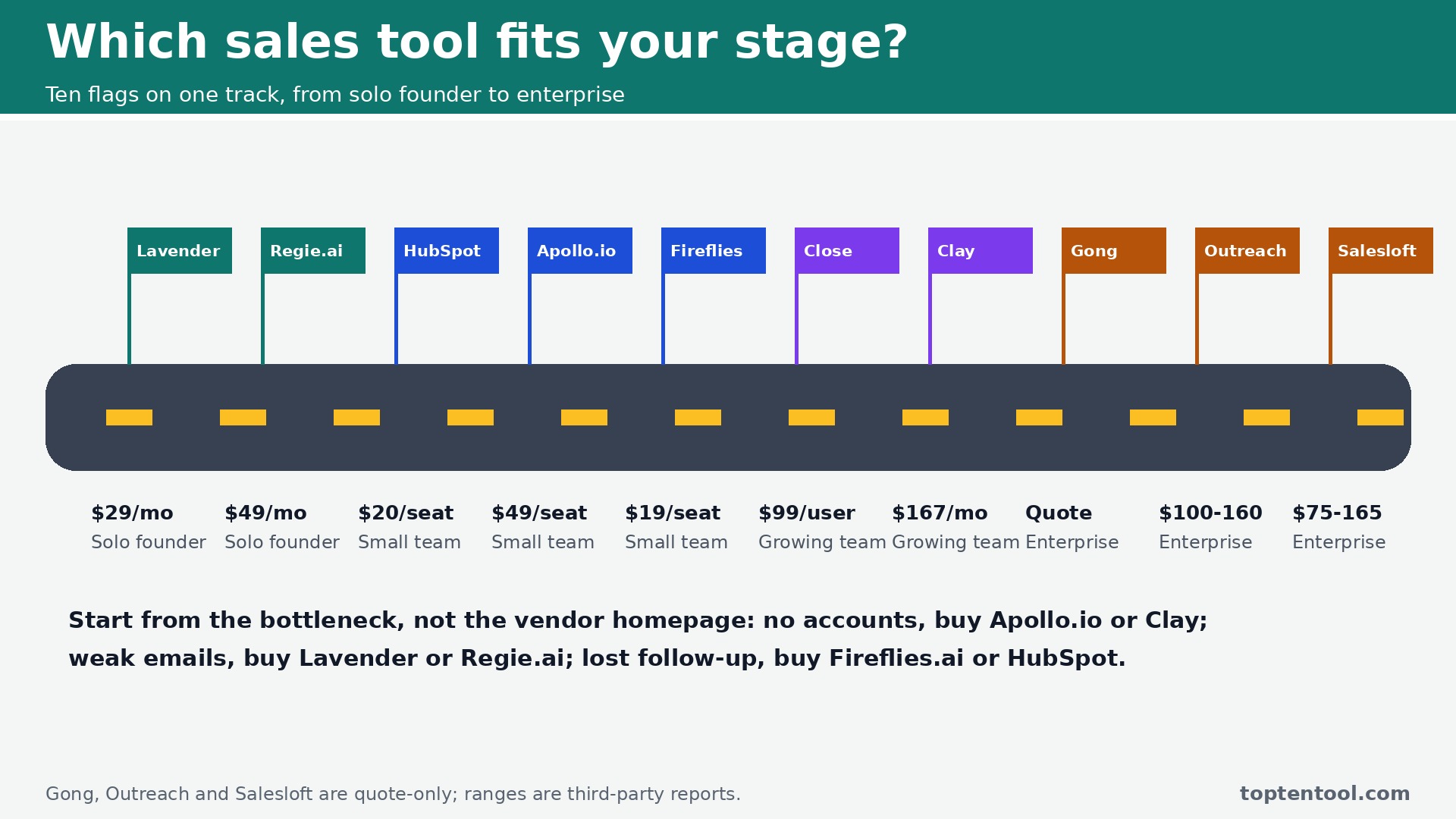
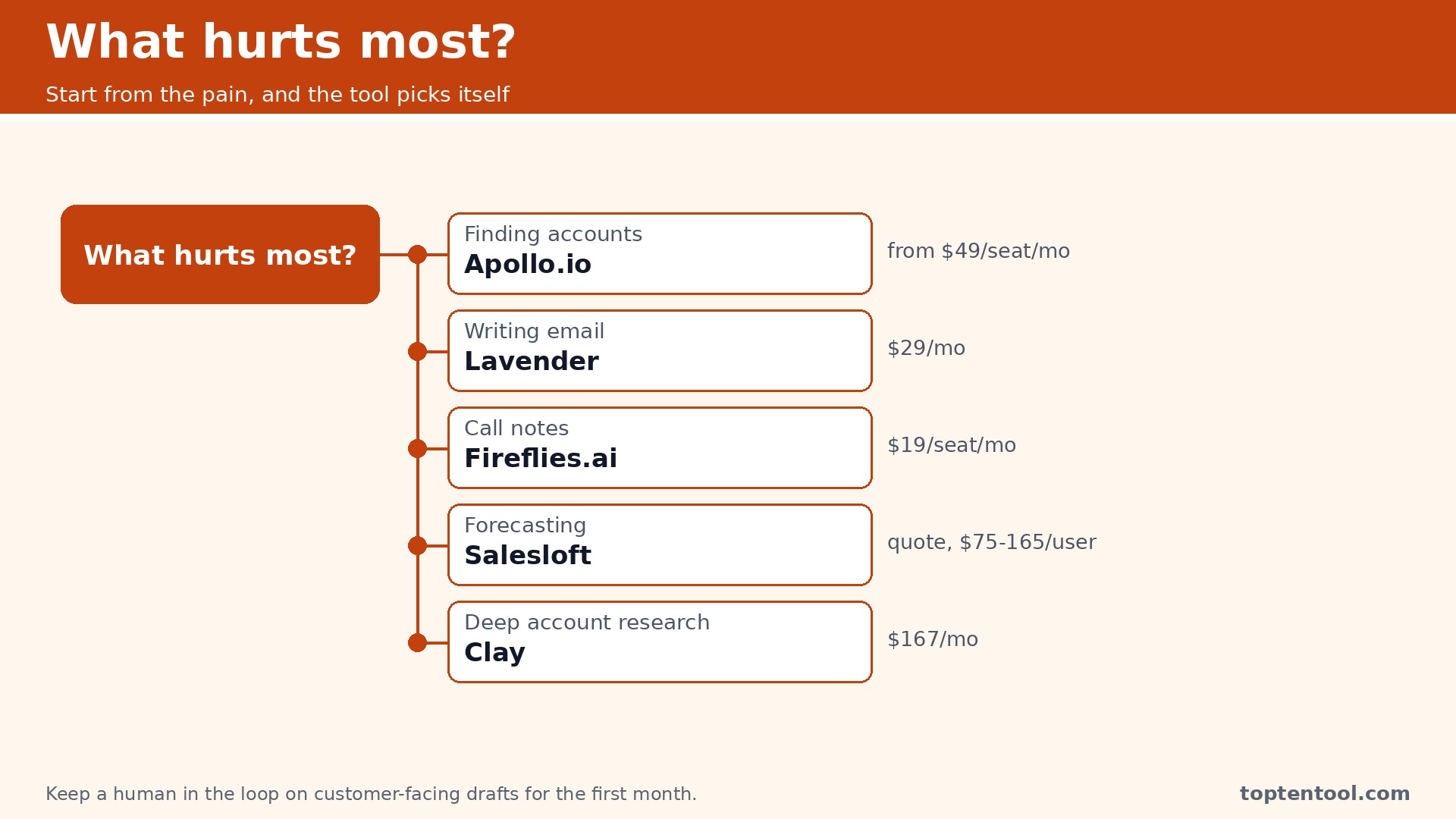
The best AI tools for sales teams are not the ones with the longest feature list. They are the ones that fix the bottleneck your team feels every week. A team that cannot find accounts should buy Apollo.io or Clay. A team that finds accounts but writes weak emails should buy Lavender or Regie.ai. A team that closes calls but loses the follow up should buy Fireflies.ai or HubSpot. A team that cannot forecast should buy Salesloft or Gong. Start from the bottleneck, not from the vendor homepage.
Budget the full stack, not the headline seat price. The table below shows what a five rep team actually pays in year one for the most common combinations, using starting annual prices. Credits, platform fees and add ons are the lines that surprise buyers, so ask for them in writing before you sign.
| Stack for a five rep team | Monthly cost, annual billing | What it covers |
|---|---|---|
| Apollo.io Basic, 5 seats | 245 dollars | Data, sequences, dialer, AI research |
| HubSpot Starter, 5 seats | 100 dollars | CRM, email drafts, call summaries |
| Apollo.io plus Lavender | 274 dollars | Prospecting plus sharper email |
| Fireflies.ai Business, 5 seats | 95 dollars | Call notes and shared meeting memory |
| Gong, 5 seats, reported range | 500 dollars plus, plus platform fee | Coaching and deal risk, priced for scale |
| Clay Launch plus Apollo.io | 412 dollars | Deep research plus outbound in one flow |
Frequently Asked Questions
What is the cheapest good AI sales tool for a small team
HubSpot Sales Hub Starter at 20 dollars a seat a month is the cheapest paid entry with a real free plan behind it, and Apollo.io at 49 dollars a seat a month covers more of the outbound job in one login. Lavender at 29 dollars a month is the cheapest useful add on if you already have a CRM and a sequencer. The cheapest stack that actually works is usually HubSpot for the CRM plus Lavender for email quality, which costs less than 150 dollars a month for a five rep team.
Do AI sales tools replace sales reps
No, and the teams that treat them as replacements get the worst results. AI replaces the research, drafting, logging and scoring work that sits around selling, which is roughly a third of a rep’s week. The conversation, the objection handling and the close still belong to a person. Buy AI to give each rep more selling hours, not to cut heads, and measure the return in meetings booked per rep rather than in seats saved.
Which tool is best for outbound prospecting
Apollo.io is the best single tool for most teams, because it combines the contact database with sequences and a dialer at a published price. Clay is better when your outbound depends on deep account research and personalized first lines. Outreach is better when you run outbound at enterprise scale with hundreds of sequences. Pick Apollo.io if you want one login, Clay if you want research depth, and Outreach if you need enterprise control.
How much should a five rep team budget for AI sales tools
A realistic year one budget for the best AI tools for sales teams is 100 to 300 dollars a month for a small team using self serve tools, and 500 dollars a month or more once you add conversation intelligence like Gong. Credit based tools can push the bill higher in heavy prospecting months, so set a monthly credit cap and review usage in the first 90 days. Quote only tools need a sales call to price, so budget a range and get the platform fee in writing.
Our Verdict
If you buy one tool this quarter, buy Apollo.io. It covers the most of the sales job at a published price a small team can afford, and it is the fastest way to find out whether AI outbound works for your market. The best AI tools for sales teams earn their keep by giving reps selling hours back, and Apollo.io does that from the first week, without an enterprise contract or a migration project.
Whatever you pick, start with the bottleneck, trial with real accounts, and keep a human in the loop on customer facing drafts for the first month. The best AI tools for sales teams on this list all work. The difference is whether the tool matches the job your team actually needs done, and whether you measure the return in meetings and pipeline rather than in features used.