
The verdict first. If your team answers chat all day, buy Intercom with Fin. If you already run Zendesk, stay there and add its AI agents. If you sell on Shopify, buy Gorgias. Every other choice among the best AI tools for customer support is a variation on those three answers, and the rest of this guide explains why, with real prices and the billing traps that catch buyers.
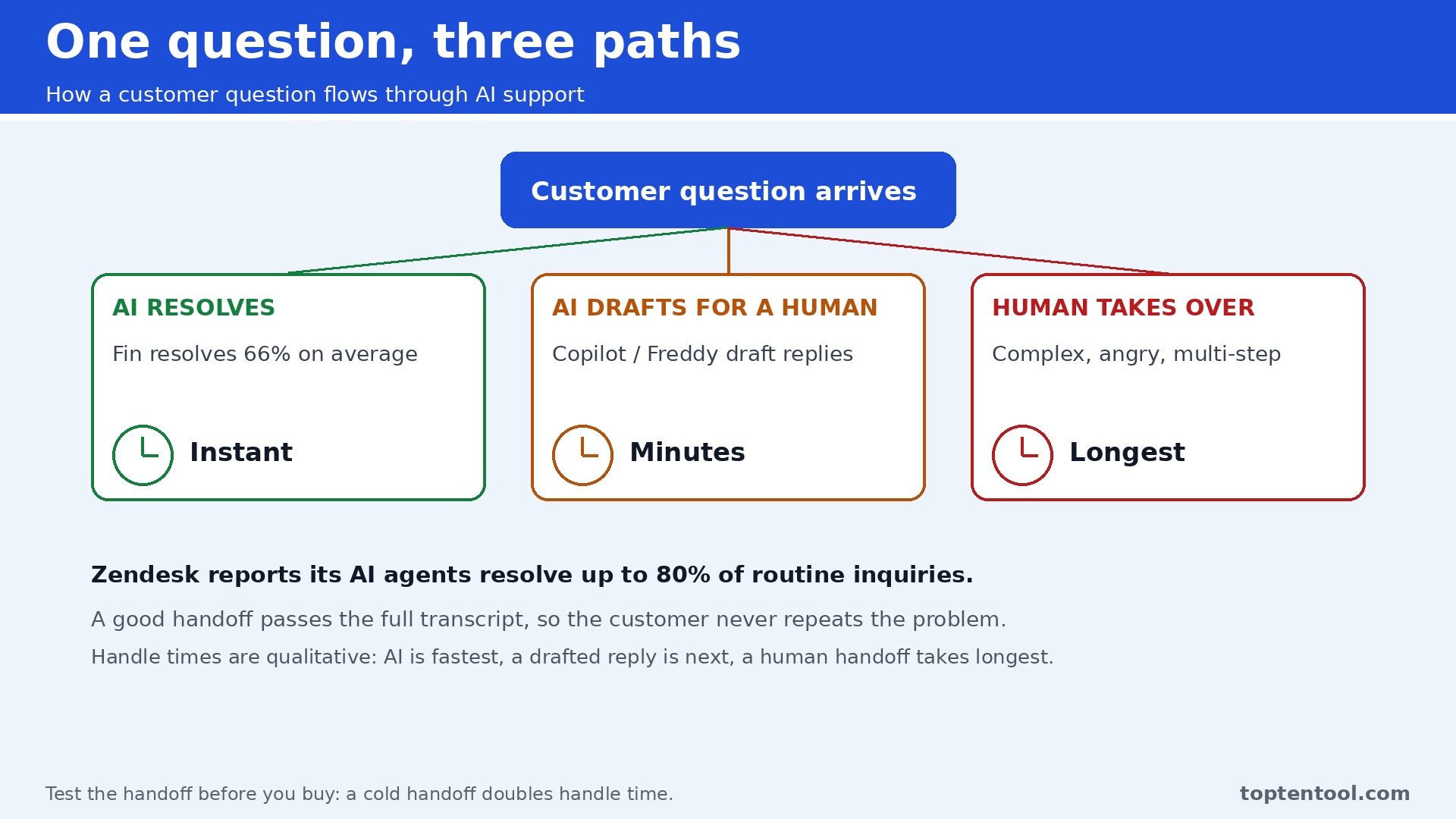
The best AI tools for customer support have changed what a help desk can do. In 2026 the AI agent is no longer a chatbot that hands out help center links. It resolves whole conversations, processes refunds, checks order status and updates the ticket, and it only hands the conversation to a person when the problem needs judgment. Intercom reports that Fin resolves an average of 66 percent of support queries, and Zendesk reports that its AI agents can resolve up to 80 percent of routine inquiries. Those are vendor numbers, and your rate will depend on your help center, but the direction is clear.
A large share of routine support no longer needs a human touch at all.
The Shortlist by Job
| Job | Best tool | Why it wins |
|---|---|---|
| Chat first SaaS support | Intercom Fin | Most mature AI agent on a full help desk |
| Large team with QA needs | Zendesk AI | Deepest ticketing plus QA and workforce tools |
| Shopify stores | Gorgias | AI that cancels and edits orders, not just answers |
| Small chat first team | LiveChat | Cheapest capable starting point at 19 dollars a month |
| Budget help desk with AI | Freshdesk | Freddy AI from 18 dollars an agent a month |
| Simple shared inbox | Help Scout | Clean inbox with AI drafts at a fair price |
| No code AI agent | Ada | Builds an agent without an enterprise project |
| Zoho users on a budget | Zoho Desk | Zia AI from 7 dollars a user a month |
| HubSpot users | HubSpot Service Hub | AI inside the CRM your team already runs |
| Salesforce shops | Salesforce Agentforce | 2 dollars per conversation inside Service Cloud |
| WhatsApp first teams | Tidio | Lyro AI plus WhatsApp at a low entry price |
| Enterprise automation | Forethought | Agentic triage for high volume teams |
What We Checked Before Ranking the Best AI Tools for Customer Support
A tool earned a place among the best AI tools for customer support only if its AI resolves real customer problems in 2026, not if it drafts replies a human still has to send. We judged each one on five things that decide whether a team keeps paying after the trial.
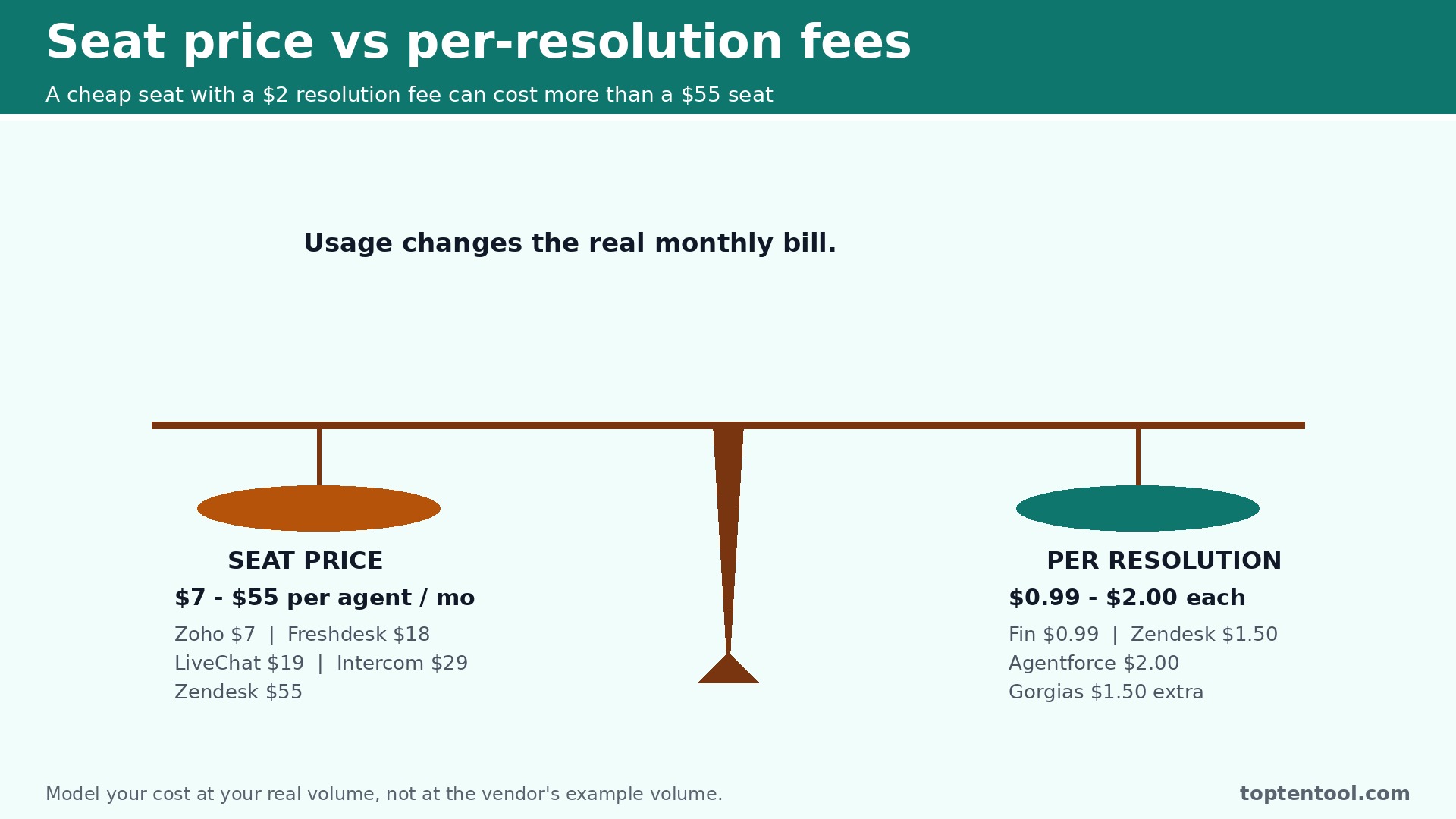
First, the resolution rate the vendor reports and what it actually includes, because a 66 percent rate on simple order questions is worth more than an 80 percent rate on password resets. Second, the true monthly cost, seats plus AI usage, because a 19 dollar seat with a 2 dollar resolution fee can cost more than a 55 dollar seat with cheaper AI. Third, the channels it covers, from chat and email to WhatsApp, voice and social, since customers do not all arrive through one door.
Fourth, how it hands off to a human, because a bad handoff feels worse than no AI at all. Fifth, the setup effort, since an agent that needs six weeks of training data is a different purchase from one that reads your help center in an afternoon.
| Check before you buy | What to ask | Why it matters |
|---|---|---|
| AI billing unit | Per resolution, per session, or per ticket | Decides the real monthly bill |
| Included AI volume | How many resolutions come with the plan | Stops a cheap seat becoming an expensive month |
| Handoff quality | Full transcript and context passed to the agent | A cold handoff doubles handle time |
| Action depth | Refunds, order edits, account changes | Answers alone do not resolve tickets |
| Knowledge source | Help center, docs, past tickets | Weak sources mean wrong answers |
| Trial terms | Days, card required, AI included | Some trials exclude the AI you are testing |
Twelve Tools, Reviewed in Order
1. Intercom Fin
Starting price 29 dollars a seat a month billed annually for Essential, plus 99 cents per Fin resolution. Best for Chat first SaaS support. Watch out The AI fee is charged on top of seats, so high volume months cost more.
Intercom Fin is the AI agent with the longest track record, and it shows in the way it works. Fin answers from your help center, docs and past conversations, takes actions like processing refunds, and works across chat, tickets, email and voice. It resolves an average of 66 percent of support queries, according to Intercom, and the handoff to a human carries the full conversation so the customer never repeats the problem.
The pricing has two layers, and both matter. Essential starts at 29 dollars a seat a month billed annually, Advanced at 85 dollars and Expert at 132 dollars, and Fin costs 99 cents per resolution on every plan. A standalone option costs 99 cents per resolution with a 50 resolution monthly minimum and no seat charges. A three agent team handling 600 conversations a month with 40 percent resolved by AI pays around 966 dollars a month on annual billing, according to third party cost modelling checked in October 2026.
The catch is that the per resolution fee rewards good knowledge and punishes bad knowledge. If your help center is thin or out of date, Fin guesses more and resolves less, and you pay for the attempts. Clean up the top 20 help articles before you switch Fin on, and the resolution rate follows. Fin earns the top spot because it is the most proven agent on a complete help desk.
2. Zendesk AI
Starting price 55 dollars an agent a month billed annually for Suite Team, plus 1 dollar 50 per automated resolution on a committed plan. Best for Large teams that need QA and workforce tools. Watch out The full AI value sits on higher Suite tiers, so the entry price is not the whole story.
Zendesk AI agents resolve issues across messaging, email and voice, with the advantage of living inside the most widely used help desk in the world. The agents are pre trained on billions of customer interactions, according to Zendesk, and they resolve inquiries without custom model training. Copilot drafts replies for human agents, and the QA tools score conversations automatically so a manager can spot coaching needs without reading every ticket.
The pricing also has two layers. Suite seats start at 55 dollars an agent a month annually, with Professional at 115 dollars, and AI resolutions cost 1 dollar 50 committed or 2 dollars pay as you go. The AI add on runs around 50 dollars an agent a month on some plans, and the QA add on is priced separately. A six agent team with 2,000 conversations a month pays around 1,485 dollars on Suite Team in third party modelling, the highest of the mainstream options here.
The catch is cost and complexity. Zendesk is the right pick for a larger team that needs QA, workforce management and omnichannel ticketing in one system, and it is overkill for a team of three that answers chat. If you already run Zendesk, though, adding its AI agents is the lowest friction upgrade on this list.
3. Freshdesk
Starting price 18 dollars an agent a month for Growth, with Freddy AI included. Best for Budget help desk with AI. Watch out Multilingual support and custom reporting need the Pro tier at 59 dollars an agent a month.
Freshdesk pairs a full help desk with Freddy AI, and it is the best value pick for a generalist team. Freddy AI drafts replies, triages tickets, suggests solutions and automates routine work, and the vendor reports that it can handle up to 80 percent of routine tickets. The Omni plans cover chat, email, phone and social in one inbox, and the interface is simpler than Zendesk, so a small team can set it up in days rather than weeks.
The pricing is straightforward for this category. Growth starts at 18 dollars an agent a month, Pro at 59 dollars adds multilingual support and custom reporting, and Freddy sessions are billed in blocks, with 500 sessions included once on some plans and extra sessions at 49 dollars per 100. A free trial runs 14 days. For a team that wants a real help desk plus AI without enterprise pricing, Freshdesk is the cheapest capable option here.
The catch is depth. Freddy AI is strong on routine tickets and weaker on complex multi step problems that need several systems. Teams that need deep QA or workforce management will outgrow it.
4. Gorgias
Starting price 50 dollars a month for Basic, covering 300 tickets. Best for Shopify stores. Watch out The AI agent costs extra per interaction, and voice and SMS pricing is separate.
Gorgias is built for ecommerce, and its AI does something most support AI cannot. It takes actions inside Shopify, cancelling orders, editing addresses, checking delivery status and issuing refunds, instead of only answering questions about them. The vendor reports that its AI agent automates up to 60 percent of repetitive tasks, and the Basic plan includes 30 automated interactions, with Pro including 190.
The pricing is ticket based rather than seat based, which suits a store where many people answer chats at modest volume. Basic costs 50 dollars a month for 300 tickets, and extra automated interactions cost 1 dollar 50 each. There is a 7 day trial. For a Shopify store doing steady volume, the ticket model is often cheaper than paying per seat for every person who occasionally answers a chat.
The catch is that Gorgias is an ecommerce tool first and a general help desk second. A SaaS team with no store will find its Shopify depth wasted. For a store, though, the order actions are the difference between an AI that answers and an AI that resolves, and that is why it ranks this high.
5. Tidio
Starting price Paid plans start in the low tens per month, with Lyro AI billed per conversation. Best for Small teams and WhatsApp first support. Watch out Pricing above 1,000 Lyro conversations a month is not published, so high volume teams must ask.
Tidio is the light weight pick for a small team that answers chats and WhatsApp messages. Lyro, its AI agent, answers from your help center and website content, handles common questions and hands off to a human with context. The interface is simple, the setup takes an afternoon, and many people can answer chats at modest volume without paying per seat for each of them.
The value is the low starting cost and the WhatsApp strength. For a small shop or a startup with a few hundred conversations a month, Tidio covers the job at a fraction of the price of Intercom or Zendesk. Third party cost modelling puts a three agent team handling 600 conversations a month at around 512 dollars, which is near the top of the cheap end of this list only because the comparison includes very cheap options, and Tidio still beats the enterprise tools by a wide margin.
The catch is scale. The free and entry plans suit low volume, and the price for Lyro above 1,000 conversations a month is not published, so a growing team should confirm the cost before committing. Tidio is the right pick for a small team starting out, and the wrong pick for a team already handling thousands of chats a month.
6. Help Scout
Starting price Paid plans start in the low tens per user a month. Best for Simple shared inbox support. Watch out AI features are lighter than the dedicated agent tools, so it suits drafting more than full automation.
Help Scout is the calmest tool on this list, and that is its appeal. It gives a small team a clean shared inbox, collision detection so two agents never answer the same ticket, saved replies, and AI drafts that help an agent write faster. It does not try to replace the agent. It makes the agent faster and keeps the inbox tidy, which is what most small teams actually need.
The pricing sits in the low tens per user a month, with a free trial and no enterprise sales process to survive. The setup is quick, the reporting covers the basics, and the integrations with Shopify, Slack and the usual CRMs cover a small business stack. For a team that answers email and chat and wants a shared inbox that stays organized, Help Scout is the least stressful option here.
The catch is ambition. If you want an AI agent that resolves whole conversations without a human, Help Scout is not that tool. Its AI drafts and summarizes, and a person still sends the reply. Buy it when you want a better inbox, not when you want to automate half your tickets.
7. Ada
Starting price Quote only. Best for No code AI agent for mid market teams. Watch out No published price means the sales process decides the cost, so budget a range.
Ada is the proven no code option for a mid market team that wants an AI agent without an enterprise sales cycle or a long implementation project. It builds an agent from your help center and docs, resolves conversations across chat and messaging, and hands off to a human with full context when the problem needs one. The no code builder means a support lead can change answers and flows without waiting for a developer.
The catch is the quote only pricing. There is no published starting price, so a small team cannot budget it without a sales call. Ada suits a mid market team with real volume and a support lead who will own the agent. A team of three should start with Intercom or Freshdesk and revisit Ada when volume justifies it.
8. Zoho Desk
Starting price 7 dollars a user a month. Best for Zoho users on a budget. Watch out The AI is lighter than the dedicated agent tools, and the best features sit on higher tiers.
Zoho Desk is the budget pick for a team already running Zoho, and its AI assistant Zia drafts replies, suggests knowledge base articles and flags ticket sentiment. At 7 dollars a user a month it is the cheapest seat price on this list, and the multichannel inbox covers email, chat, phone and social without extra tools.
The catch is depth. Zia assists agents rather than resolving whole conversations on its own, so a team that wants full automation should look at Intercom or Zendesk instead.
9. HubSpot Service Hub
Starting price Starter plans start in the low tens per seat a month. Best for HubSpot users who want AI inside the CRM. Watch out The AI agents are billed per outcome on higher tiers, so check the usage terms.
HubSpot Service Hub brings AI into the CRM your team already runs, which is its whole argument. The AI drafts replies from ticket history, summarizes conversations, routes tickets to the right team and suggests knowledge base articles while the agent works. Because the ticket, the contact and the deal live in one system, the AI has better context than a standalone help desk that only sees the ticket.
The pricing follows the HubSpot pattern. Starter plans start in the low tens per seat a month, with a free CRM behind them, and the AI agents on Pro and Enterprise are billed per resolved conversation or per outcome rather than bundled flat. That outcome based pricing can be fair for a team with spiky volume, but it is a second bill to budget.
The catch is that Service Hub is strongest for teams already on HubSpot. A team that runs Salesforce or Zendesk gains nothing by switching. For a HubSpot team, though, the native fit means the AI sees the full customer story, and that context shows up in better replies.
10. Salesforce Agentforce
Starting price 2 dollars per conversation, plus a Salesforce license. Best for Salesforce shops that want agentic AI. Watch out It needs a Salesforce license first, so the real cost is the platform plus the AI.
Agentforce is Salesforce’s agentic AI layer, and it is the natural choice for a team already running Service Cloud. It builds autonomous agents on existing CRM objects, so the agent can read the account, the case history and the order data before it answers. The pricing is 2 dollars per conversation, or 500 dollars per 100,000 Flex Credits under the newer model, which covers employee and voice use cases the conversation model does not.
The strength is depth inside Salesforce. An agent that can see the full customer record resolves more than an agent that only sees the chat window, and the actions it takes write back to the CRM automatically. For an enterprise team with a Salesforce investment, that is a real advantage.
The catch is the entry cost. Agentforce needs a Salesforce license, and the implementation is a project, not an afternoon. A team that is not already on Salesforce should not buy Salesforce to get Agentforce. A team that is should trial it on one queue first and measure the resolution rate before rolling it out.
11. LiveChat
Starting price 19 dollars a month billed annually for Essential. Best for Small chat first teams on a tight budget. Watch out AI resolutions are capped per plan, so check the included volume.
LiveChat, now sold under the Text brand, is the cheapest capable starting point on this list. Essential costs 19 dollars a month billed annually, or 25 dollars month to month, and Growth at 79 dollars a month billed annually includes 200 AI resolutions per account. The AI Copilot helps agents draft replies, and the AI resolution feature answers common questions automatically.
The catch is the caps. AI resolutions are limited per plan, with extra blocks at 49 dollars 50 per 50 resolutions, so a team whose AI volume grows will pay more. The help desk depth is also lighter than Intercom or Zendesk. Buy LiveChat when budget is the deciding factor and chat is the main channel.
12. Forethought
Starting price Quote only. Best for Enterprise automation at high volume. Watch out It is built for scale, so a small team will pay enterprise prices for features it never uses.
Forethought closes the list as the enterprise automation pick. It triages tickets with AI, routes them to the right team, drafts replies and resolves routine work across email and chat, with a focus on high volume operations where small gains per ticket add up to real savings. It integrates with the major help desks rather than replacing them, so a team keeps its existing ticketing system.
The strength is triage at scale. A team handling thousands of tickets a day needs the AI to sort, prioritize and route before a human ever sees the queue, and Forethought is built for that job. The reporting shows where automation helps and where it fails, which is what an operations lead needs to defend the investment.
The catch is that everything about Forethought is enterprise, from the pricing to the implementation. There is no published price and no self serve start. A team with fewer than a thousand tickets a day should pick a cheaper tool and revisit Forethought when volume justifies it.
Every Tool on One Page
| Tool | Starting price | AI billed by | Best for | Free plan |
|---|---|---|---|---|
| Intercom Fin | 29 dollars a seat a month, annual | 99 cents per resolution | Chat first SaaS support | Trial |
| Zendesk AI | 55 dollars an agent a month, annual | 1 dollar 50 per resolution | Large teams with QA needs | Trial |
| Freshdesk | 18 dollars an agent a month | Per Freddy session | Budget help desk with AI | Trial |
| Gorgias | 50 dollars a month, 300 tickets | 1 dollar 50 per extra interaction | Shopify stores | Trial |
| Tidio | Low tens per month | Per Lyro conversation | Small teams, WhatsApp first | Yes |
| Help Scout | Low tens per user a month | Included drafts | Simple shared inbox | Trial |
| Ada | Quote only | Per conversation | No code AI agent | Trial |
| Zoho Desk | 7 dollars a user a month | Included Zia | Zoho users on a budget | Yes |
| HubSpot Service Hub | Low tens per seat a month | Per outcome on higher tiers | HubSpot users | Yes |
| Salesforce Agentforce | 2 dollars per conversation | Per conversation | Salesforce shops | Trial |
| LiveChat | 19 dollars a month, annual | Capped per plan | Small chat first teams | Trial |
| Forethought | Quote only | Per ticket | Enterprise automation | No |
A Cost Check Before You Sign
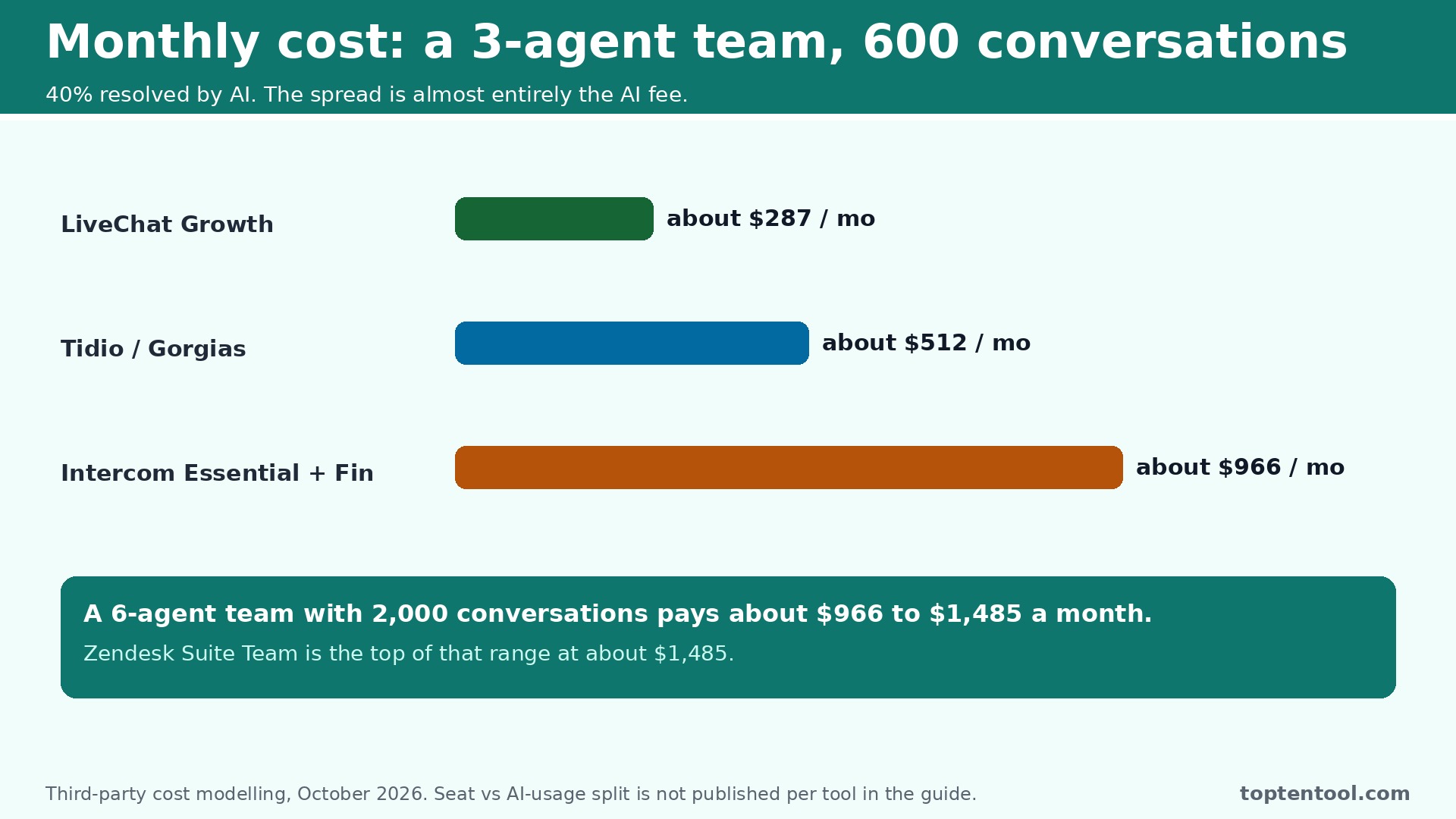
The best AI tools for customer support are the ones whose billing matches your volume pattern, not the ones with the lowest seat price. The table below shows what a three agent team handling 600 conversations a month with 40 percent resolved by AI pays, using third party cost modelling from October 2026. The spread is wide, from under 300 dollars to over 500 dollars, and the difference is almost entirely the AI fee.
| Team and volume | Cheapest option | Mid range option | Most expensive option |
|---|---|---|---|
| 3 agents, 600 conversations a month | LiveChat Growth, around 287 dollars | Tidio or Gorgias, around 512 dollars | Intercom Essential plus Fin, higher once AI volume grows |
| 6 agents, 2,000 conversations a month | Intercom Essential plus Fin, around 966 dollars | Freshdesk Omni, mid range on seat price | Zendesk Suite Team, around 1,485 dollars |
Frequently Asked Questions
Which AI support tool is best for a small team
Among the best AI tools for customer support, LiveChat is the cheapest capable starting point at 19 dollars a month, and Freshdesk at 18 dollars an agent a month is the best value full help desk. If your team answers chat all day and you can afford it, Intercom with Fin is the better long term pick, because the AI resolves more and the handoff is cleaner. Start with LiveChat or Freshdesk, and move to Intercom when volume or complexity justifies the per resolution fee.
How much does AI customer support cost per month
A three agent team handling 600 conversations a month pays roughly 287 to 512 dollars a month across the tools on this list, depending on the seat price and the AI fee. A six agent team with 2,000 conversations pays roughly 966 to 1,485 dollars. The AI fee is the variable that matters most, so model your cost at your real volume, not at the vendor’s example volume.
Can AI really resolve customer tickets without a human
Yes, for routine tickets. Intercom reports Fin resolves an average of 66 percent of queries, and Zendesk reports up to 80 percent on routine inquiries. The rate depends on your help center, because the AI answers from what it can read. Complex problems, angry customers and multi step account changes still need a person, and the best tools hand those over with full context instead of making the customer start again.
What happens when the AI cannot answer
A good AI agent hands the conversation to a human with the full transcript, the articles it already tried and the customer details attached. A bad one makes the customer repeat the problem or loops them back to the start. Test the handoff before you buy, because a cold handoff doubles handle time and damages trust faster than a slow answer.
The Bottom Line
Buy Intercom with Fin if your team answers chat all day and you want the most proven AI agent on a complete help desk. The best AI tools for customer support earn their keep by resolving routine work without a human, and Fin does that at a published price with a handoff you can trust. The 99 cents per resolution is fair when the resolution rate holds, and the Essential plan at 29 dollars a seat a month keeps the entry cost reasonable.
Whatever you pick, clean up the help center first, cap the AI volume for the first month, and read the AI bill separately from the seat bill. The best AI tools for customer support on this list all work. The difference is whether the billing matches your volume, whether the AI can take actions instead of only answering, and whether the handoff to a human feels like a continuation rather than a restart.