

The best AI tools for coaches show their differences fast when you put two coaches side by side. One runs the practice on Paperbell, with booking, contracts, payments and a client portal in a single system, and the business side takes care of itself. The other pieces together Fathom for session notes, Notion for client records, Calendly for booking and Canva for workbooks, and spends Sunday evening stitching the week together. Neither coach is wrong. They have different practices, different client numbers and different tolerance for admin, and the same split runs through all eight tools on this list.
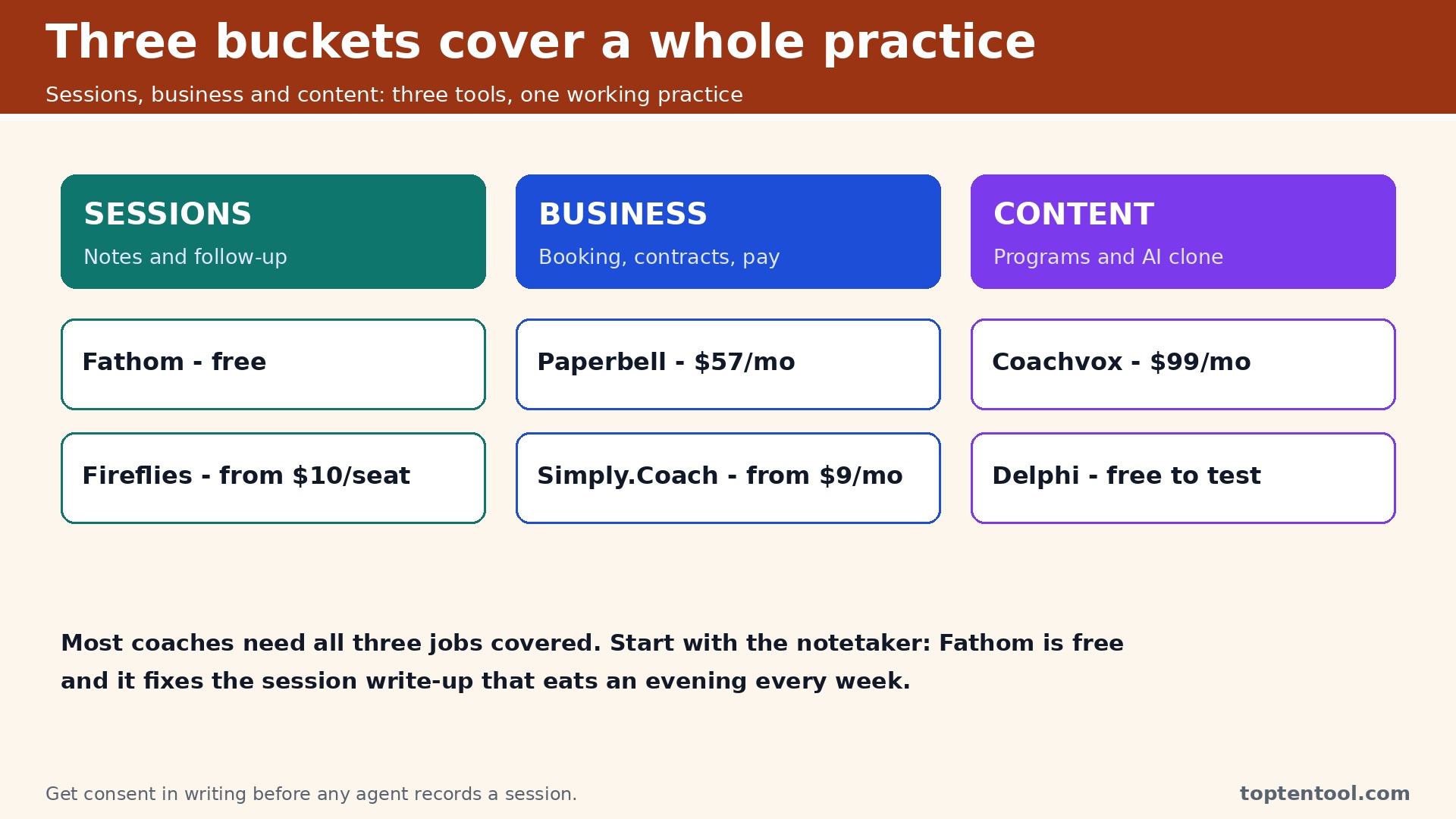
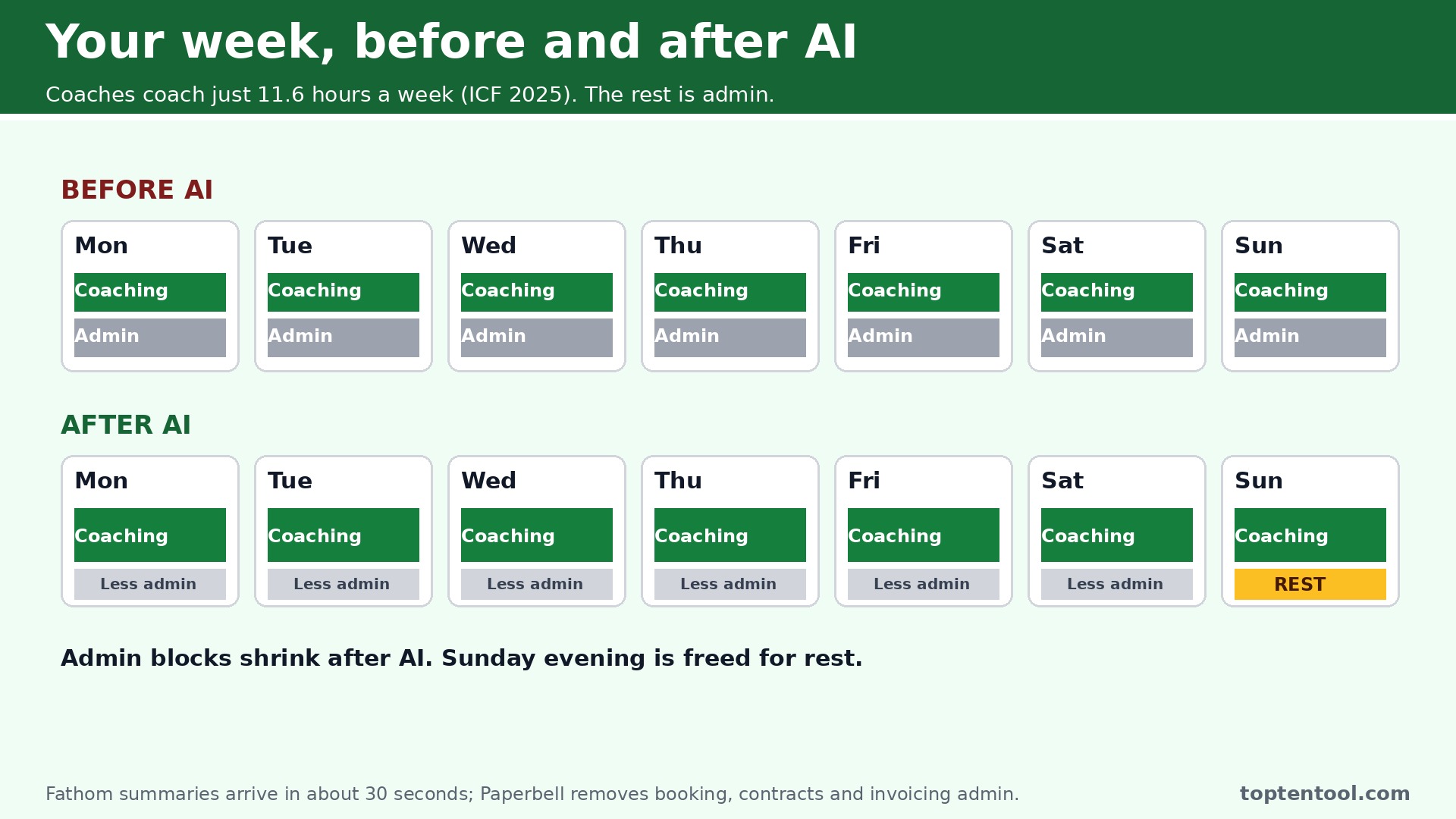
The best AI tools for coaches cover three jobs, and most coaches need all three. Something to prep for and follow up on sessions, something to run the business side with bookings, contracts and payments, and something to turn a single conversation into workbooks, social content and program materials. ChatGPT and Claude cover the first job well. Kajabi and Paperbell cover the second. Fathom, Coachvox and Delphi cover the first and the third in different ways. The 2025 ICF Global Coaching Study found that coaches spend just 11.6 hours a week actually coaching, which tells you where the rest of the week goes.
There is a consent line running through this category that matters more than any feature. Get consent in writing before any agent records a session or reads client notes, because a recording made without clear consent damages trust and creates risk. The practical rule is simple. Tell the client what is recorded, what it is used for, and how it is stored, and keep the notes under your review before they reach the client.
The Shortlist by Coaching Job
The table below matches each common coaching job to the tool that handles it best. The best AI tools for coaches are the ones that match the job that eats your week, so use this table to narrow eight tools to two or three before you read the reviews. Prices are monthly list prices unless noted, and annual billing is usually cheaper than paying month to month.
| Job | Best tool | Why it wins |
|---|---|---|
| Running the whole practice | Paperbell | Booking, contracts, payments and portal in one flat fee |
| Session notes without typing | Fathom | Free unlimited recordings and summaries |
| An AI version of you for leads | Coachvox | Trained on your material, answers leads around the clock |
| A free AI clone to test | Delphi | Free with 1 million training words |
| Practice management on a budget | Simply.Coach | Plans from 9 dollars a month for 3 active clients |
| Programs and client work | CoachAccountable | Programs, groups and payments from 20 dollars a month |
| Courses and programs at scale | Kajabi | Full platform plus five free AI products on every plan |
| Searching past sessions | Fireflies | Transcripts and search across sessions from 10 dollars a seat a month |
How We Ranked the Best AI Tools for Coaches
A tool earned a place among the best AI tools for coaches only if it does a real coaching job in 2026, not if it added a chatbot to a generic product. We judged each one on five things that decide whether a coach keeps paying after the trial.
First, the job it does, from session notes to practice management to content, because a notetaker and a booking system solve different pains. Second, the starting price a solo coach can actually buy, including whether a free plan exists and what it really includes. Third, how it handles client data, from consent to storage, since session recordings are sensitive by nature. Fourth, the quality of the output, from session summaries a client could read to program materials that feel like your work rather than a template. Fifth, the fit for your client number, because a tool priced per client suits a coach with five clients and punishes a coach with fifty.
The other test was whether the tool respects the coach’s voice. A content tool that writes in generic corporate language is worse than no tool at all, because the coach’s voice is the product. The checklist below is the fastest way to compare any two tools on this list before you trial them.
| Check before you buy | What to ask | Why it matters |
|---|---|---|
| Consent flow | Written consent before recording | Recordings without consent damage trust |
| Free plan limits | Recordings, clients, storage | A free plan that caps clients is a trial |
| Client pricing | Per client, per seat, or flat fee | Per client pricing grows with success |
| Note accuracy | Who reviews the summary | A wrong note sent to a client hurts |
| Content voice | Trained on your material or generic | Generic content is not your brand |
| Payment handling | Stripe, PayPal, or built in | Getting paid late kills a practice |
Eight Tools, Reviewed in Order
1. Paperbell
Starting price 57 dollars a month, free for your first client. Best for Running the whole practice. Watch out The flat fee suits a coach with several clients, and a coach with one client pays the same as a coach with twenty.
Paperbell handles the business side of coaching, with booking, contracts, payments and a branded website in one flat fee tool. A client books a session, signs the contract, pays and lands in the client portal without the coach touching a spreadsheet. The free plan covers the first client in full, and the paid plan at 57 dollars a month, or around 47 dollars 50 a month billed annually, covers the rest.
The strength is the single system. A coach who pieces together a booking link, a PDF contract, a payment link and a spreadsheet spends hours a week on admin that Paperbell removes entirely. The branded booking site looks professional, the contracts are built in, and the payments arrive without chasing invoices.
The catch is the flat fee shape. A coach with one paying client pays the same 57 dollars as a coach with twenty, which is fair at scale and heavy at the start. Paperbell still earns the top spot for a coach who wants the business side handled in one place, because the hours it saves are the hours that used to disappear on Sunday evening.
2. Fathom
Starting price Free for individuals, with Premium at 16 dollars a month billed annually. Best for Session notes without typing. Watch out Action items and the meeting assistant start on Premium, so the free plan is summaries only.
Fathom is the notetaker most coaches try first, because the free plan has no catch. It joins Zoom, Google Meet and Microsoft Teams calls, records and transcribes them, and creates a structured summary with action items in about 30 seconds. Unlimited recordings, unlimited transcription and an instant summary after every call, free for individuals, is the best free offer in this category.
The value is presence. A coach who stops scribbling notes mid session can actually listen, and the summary arrives before the coach has left the call. Premium at 16 dollars a month billed annually, or 20 dollars month to month, adds advanced summaries, action items and a conversational meeting assistant that answers questions about past sessions.
The catch is the tier split. The free plan covers summaries, while the action items and the assistant that make Fathom a real workflow need Premium. At 16 dollars a month, Premium is still cheap for the hours it saves. Fathom earns second place because it is free to start and it fixes the most painful admin job first, which is writing up the session.
3. Coachvox
Starting price 99 dollars a month, or 83 dollars billed yearly. Best for An AI version of you for leads. Watch out One plan only, so there is no cheaper tier to start on, and a 14 day trial needs a card.
Coachvox builds an AI version of you for leads and clients, trained on your own material, your frameworks, your content and your voice. A prospect asks a question at midnight and gets an answer in your style, a lead is qualified before the discovery call, and a client gets answers between sessions without waiting for your inbox. The AI is only as good as the content you train it on, so the setup work matters.
The strength is the reuse of your own thinking. A coach who has written frameworks, recorded sessions and built programs can turn that material into an assistant that works around the clock, and the lead qualification saves discovery calls with people who were never a fit. The 14 day trial needs a card, and the single plan at 99 dollars a month, or 83 dollars billed yearly, is the whole offer.
The catch is the price and the training effort. Ninety nine dollars a month is the most expensive single tool on this list for a solo coach, and a thin training set produces generic answers. Coachvox suits a coach with real content and real lead volume. A coach starting out should test Delphi free first and buy Coachvox when the leads justify it.
4. Delphi
Starting price Free with 1 million training words. Best for A free AI clone to test. Watch out The free plan is a test, and the paid tiers are needed for serious volume and customisation.
Delphi is the free clone to test, and it is the best way to find out whether an AI version of you is worth paying for. Upload your content, up to 1 million training words free, and Delphi builds a clone that answers questions, shares your frameworks and talks to leads in your voice. The free plan is genuinely usable, which is rare in this category.
The strength is the low risk test. A coach can build a clone in an afternoon, share it with a few trusted clients, and see whether the answers sound like them before spending anything. The paid tiers add more training words, more conversations and deeper customisation for a coach who wants the clone on their website full time.
The catch is the ceiling. The free plan is a test rather than a business tool, and the clone is only as good as the material it learns from. A coach with little written content will get a thin clone. Delphi earns its place as the free starting point for the AI clone idea, and it pairs well with Paperbell for the business side.
5. Simply.Coach
Starting price 9 dollars a month for up to 3 active clients. Best for Practice management on a budget. Watch out The price rises with client numbers, so a growing practice pays more each tier.
Simply.Coach is the lowest priced practice management tool on this list, with plans from 9 dollars a month for up to 3 active clients, rising to 29, 49 and 69 dollars for more clients and features. It covers scheduling, client management, programs, invoicing and a client portal, with a 14 day free trial and no card needed. The annual plans advertise up to 52 percent off, so confirm whether the price shown is billed monthly or annually before you commit.
The strength is the entry price. A new coach with three clients can run the whole practice for 9 dollars a month, which is less than a single session is worth. The feature set is solid for the price, and the client portal keeps the practice looking professional from the start.
The catch is the per client pricing. The bill grows with success, and a coach with thirty clients pays the top tier. That is fair, but it means the tool is cheapest when the practice is smallest. Simply.Coach suits a new coach who wants a real system at the lowest possible price. A coach with many clients should compare it with Paperbell’s flat fee.
6. CoachAccountable
Starting price 20 dollars a month for 2 clients. Best for Programs and client work. Watch out The price is per active client, so a coach with many clients pays more than the headline rate.
CoachAccountable bills by active clients, from 20 dollars a month for 2 clients, and it runs programs, groups and client work in one system. A coach can deliver multi week programs, assign actions, track progress and take payments through their own Stripe, Square or PayPal account. The program delivery is the core, and it is deeper than the program features in the general practice tools.
The strength is the program focus. A coach whose business is structured programs rather than single sessions gets a system built for that shape, with worksheets, actions and group management that a booking tool does not offer. The payment handling through the coach’s own accounts keeps the money flow simple.
The catch is the per client price. A coach with twenty active clients pays far more than the 20 dollar headline, so the bill scales with the practice. CoachAccountable suits a coach who sells programs and groups. A coach who sells single sessions should look at Paperbell or Simply.Coach first.
7. Kajabi
Starting price Growth plan at 199 dollars a month billed annually. Best for Courses and programs at scale. Watch out The Growth plan rose from 159 to 199 dollars a month in January 2026, and the platform is built for scale, not for a solo coach starting out.
Kajabi is the full platform for a coach who sells courses and programs at scale, covering the website, the course hosting, the email marketing and the payments in one system. In 2026 Kajabi shipped five new AI products free on every plan, including Cofounder, a context aware business assistant, Creator.io, an AI chatbot trained on your own courses, and Expert Agents that sell and teach around the clock in your voice.
The strength is the platform depth. A coach who sells a flagship program to hundreds of clients needs a system that handles the course, the marketing and the sales together, and Kajabi does that better than any other tool on this list. The AI products add extra power without extra cost, which is rare in a category where AI usually means a second bill.
The catch is the price and the scale. Growth at 199 dollars a month billed annually is a serious commitment, and Kajabi is built for a coach with an audience and a program to sell, not for a coach with three clients. A new coach should start with Paperbell or Simply.Coach and move to Kajabi when the audience justifies it.
8. Fireflies
Starting price Free, with Pro at 10 dollars a seat a month billed annually. Best for Searching past sessions. Watch out The free plan limits AI summaries and storage, so heavy users need the paid tier.
Fireflies transcribes coaching calls and makes them searchable, which is its edge over Fathom for a coach who wants to find things later. AskFred, its AI assistant, answers questions about past sessions, pulls out action items and syncs notes to the CRM. A coach who wants to search six months of sessions for every mention of a goal or a commitment will find Fireflies the better tool for that job.
The strength is the search. A session library that can be searched is a knowledge base, and a coach who reviews past sessions before a follow up call walks in prepared. Pro at 10 dollars a seat a month billed annually, or 18 dollars month to month, adds the AI summaries and the storage that a heavy user needs.
The catch is the free plan limit. The free plan caps AI summaries and storage, so a coach who records every session will outgrow it fast. Fireflies suits a coach who values the searchable archive. A coach who only needs the summary after each call should start with Fathom free and add Fireflies when the archive matters.
Every Tool on One Page
The table below puts the whole list on one page. Prices are starting monthly list prices unless noted. Compare the job first, then the price, because the cheapest tool for the wrong job is the most expensive mistake.
| Tool | Starting price | Job it does | Best for | Free plan |
|---|---|---|---|---|
| Paperbell | 57 dollars a month | Practice management | Running the whole practice | First client free |
| Fathom | Free, Premium 16 dollars a month | Session notes | Notes without typing | Yes |
| Coachvox | 99 dollars a month | AI clone for leads | An AI version of you | Trial |
| Delphi | Free, 1 million words | AI clone to test | Testing the clone idea | Yes |
| Simply.Coach | 9 dollars a month | Practice management | Budget practice management | Trial |
| CoachAccountable | 20 dollars a month | Programs and clients | Program delivery | Trial |
| Kajabi | 199 dollars a month, annual | Courses and programs | Scale course sales | No |
| Fireflies | Free, Pro 10 dollars a seat a month | Searchable transcripts | Searching past sessions | Yes |
What a Solo Coach Actually Pays
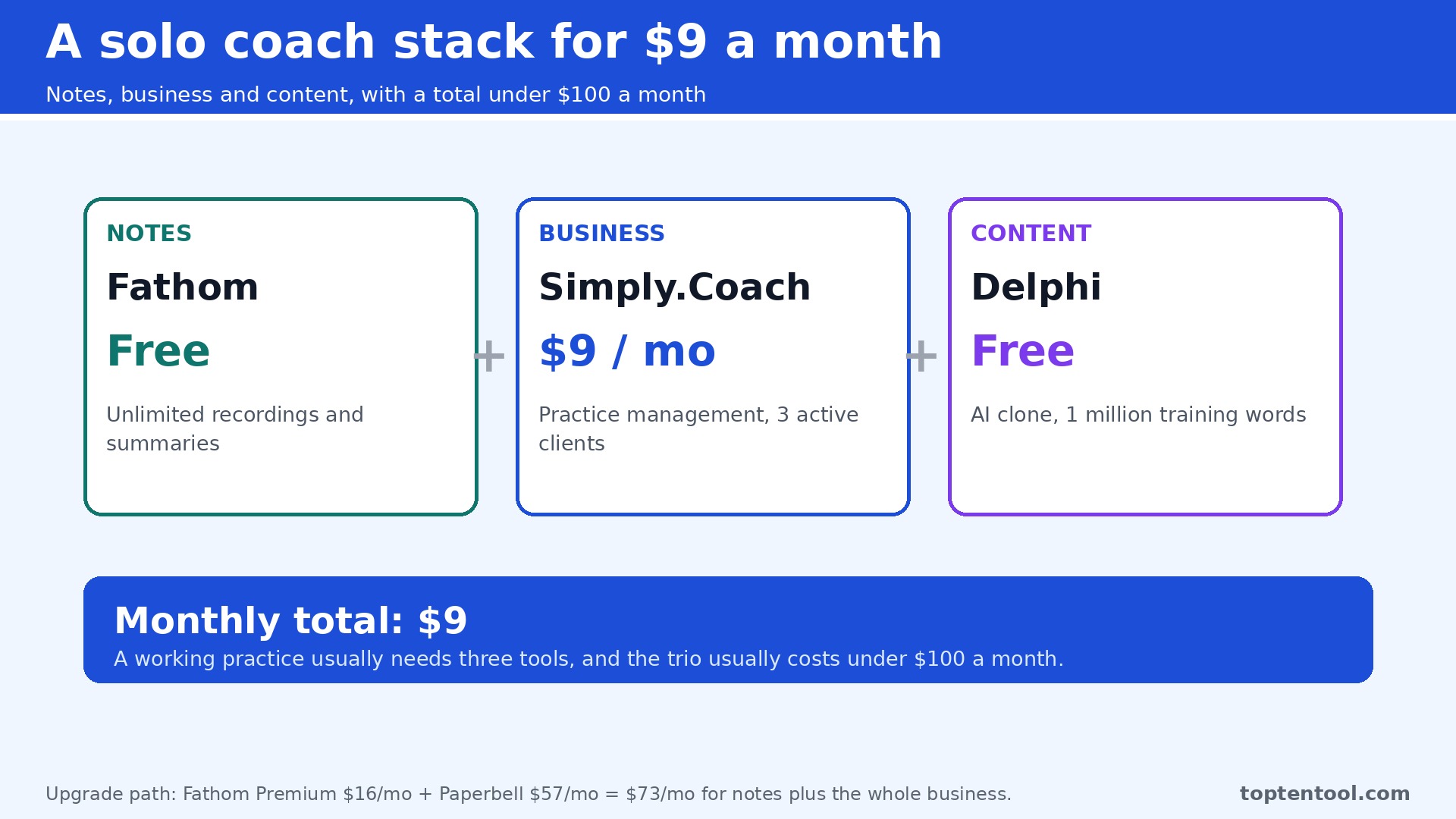
The best AI tools for coaches are the ones that pay for themselves in hours saved or clients gained, and the monthly cost is the right way to judge them. The table below shows what a solo coach pays in a month for the most common combinations, using starting prices. A working practice usually needs three tools, one for notes, one for the business and one for content, and the trio usually costs less than 100 dollars a month.
| Setup for one coach | Monthly cost | What it covers |
|---|---|---|
| Fathom free plus Simply.Coach | 9 dollars | Notes plus practice management |
| Fathom Premium plus Paperbell | 73 dollars | Notes plus the whole business |
| Fireflies Pro plus Simply.Coach | 19 dollars | Searchable notes plus practice |
| Fathom Premium plus Coachvox | 115 dollars | Notes plus an AI clone for leads |
| Paperbell plus Delphi free | 57 dollars | Business plus a free AI clone |
| Kajabi Growth alone | 199 dollars | Courses, marketing and sales |
Three rules keep the spend on the best AI tools for coaches sensible. First, start with a notetaker, because Fathom is free and it fixes the most painful admin job on day one. Second, add the practice tool that fits your client number, Simply.Coach for three clients, Paperbell for a flat fee at scale, and CoachAccountable for programs. Third, get consent in writing before any agent records a session, and keep the notes under your review before they reach the client, because trust is the product and a recording made without clear consent damages it.
How to Trial a Coaching Tool on Real Sessions
Start the trial with real sessions, not with sample data, because a notetaker that handles a tidy demo can still fail on a real coaching conversation. Pick three upcoming sessions with clients who have already agreed to recording, and run the tool on all three. Read every summary before it reaches the client, and mark each line as right, wrong or missing. A summary that invents an action item or drops a commitment the client made is worse than no summary at all, and you will only catch those errors by reading the first few yourself.
Measure the trial in evenings saved, not in features tried. Write down how long the session write up took before the tool, then time the review and edit of the AI summary. A notetaker that writes a good draft in thirty seconds but needs twenty minutes of fixing has saved you nothing. Run the trial for three weeks so you see the tool on good sessions and messy ones, on new clients and long term clients, and on the weeks when you have six sessions back to back and no time to fix sloppy notes.
Test the practice side with a real booking, not a test client. Create a booking link, send it to a friendly client, and follow the full path from booking to contract to payment to reminder. Watch where the client gets stuck, and count how many emails you still have to send by hand. A practice tool that handles the booking but leaves the contract and the payment to you has only moved the admin, not removed it. The full path test takes an hour and tells you more than a month of reading feature lists.
Finally, test the content side on your own material. Give the tool three of your past session notes or program documents, and ask it to draft a workbook page or a follow up email in your voice. Read the draft out loud and ask whether a client would recognize it as yours. A tool that writes in flat corporate language will cost you editing time on every piece, while a tool trained on your material starts close to your voice and needs only a light edit. Keep the tool that sounds like you after one edit, and drop the one that needs a rewrite every time.
One more check protects the practice. Read the tool’s data terms before the trial ends, and confirm where session recordings are stored, how long they are kept, and whether the vendor trains on client material. A free plan that keeps recordings longer than a paid plan, or trains on your sessions, costs more than its price suggests, and the time to find that out is before your clients’ words are in the system.
Frequently Asked Questions
Which AI tool should a coach buy first
Fathom is the best first buy, because the free plan covers unlimited recordings and summaries, and it fixes the session write up that eats an evening every week. Add Simply.Coach at 9 dollars a month when you need practice management, or Paperbell at 57 dollars a month when you want the whole business in one system. Start free, and pay only when the client number justifies it.
Do I need consent to record coaching sessions with AI
Yes, get consent in writing before any agent records a session or reads client notes. Tell the client what is recorded, what it is used for, and how it is stored, and keep the notes under your review before they reach the client. A recording made without clear consent damages trust and creates risk, however good the tool is.
What is the best AI tool for coaching session notes
Fathom is the best pick for most coaches, because the free plan is genuinely free and the summaries arrive in about 30 seconds. Fireflies is the better pick when you want to search past sessions, because its transcripts and AskFred assistant turn the archive into a knowledge base. Both are free to start, so trial them on real sessions and keep the one whose summaries sound like your notes.
How much should a coach budget for AI tools per month
A realistic budget is 10 to 75 dollars a month for a solo coach using a free notetaker plus a practice tool, and 100 to 200 dollars a month once you add an AI clone like Coachvox or a course platform like Kajabi. The cheapest working practice is Fathom free plus Simply.Coach at 9 dollars a month. The most expensive single tool here is Kajabi Growth at 199 dollars a month.
Can AI really coach my clients for me
No, and it should not try. AI can answer questions from your material, qualify leads, draft session plans and turn a conversation into workbooks, but the coaching itself, the listening, the challenge and the judgment, belongs to a person. The tools on this list make a coach faster and more present. They do not replace the coach, and a practice that pretends otherwise will lose the trust that makes coaching work.
Our Verdict
If you buy one tool this quarter, buy Paperbell. It is the only tool on this list that runs the whole business, booking, contracts, payments and a client portal, in one flat fee, and it is the fastest way to get Sunday evening back. The best AI tools for coaches earn their keep by giving coaches more hours with clients and fewer hours on admin, and Paperbell does that from the first week.
The situation changes the pick. A new coach with three clients should buy Simply.Coach at 9 dollars a month. A coach who dreads the session write up should start with Fathom free. A coach with real content and real lead volume should buy Coachvox. A coach who sells programs should buy CoachAccountable. A coach who sells courses at scale should buy Kajabi. A coach who wants to search past sessions should buy Fireflies.
Whatever you pick, start with the notetaker, get consent in writing, and add the practice tool that fits your client number. The best AI tools for coaches on this list all work. The difference is whether the tool matches the shape of your practice, and whether you measure the return in coaching hours gained rather than in features used.