
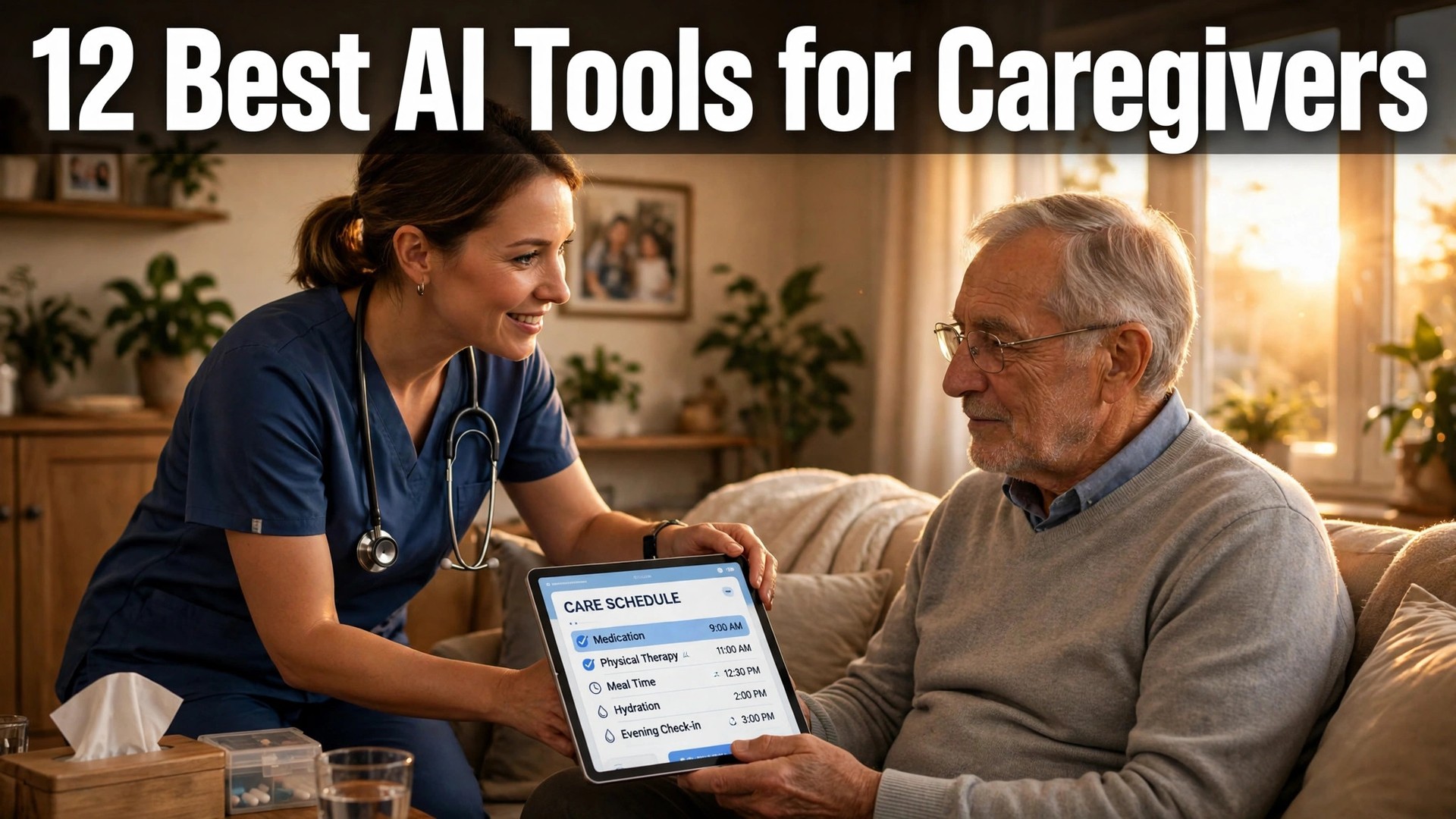
A caregiver who looks after three clients in a day carries a lot in her head: who took which medication, who needs a lift to the clinic, whose daughter called yesterday and what she asked. When that detail lives only in memory, a missed dose or a missed call is a matter of time. The best ai tools for caregivers move that detail out of memory and into a shared record, so the care stays steady even when the caregiver changes.
This guide compares twelve tools on published prices, the care job each one does best and the catch that only shows up after the trial ends. All care work prices below are published starting prices as of late 2026, and annual billing is noted where it changes the number. Where a vendor publishes no price, this guide says so plainly instead of guessing, because most care software is sold on a quote and the number depends on team size.
A care team does not need twelve tools. One scheduling and notes app plus one safety monitor covers most home care work, and a third tool only earns its place when it fixes a specific weekly pain, such as family updates or medication reminders. Each review below names the daily caregiving job its tool does best, so pick two and stop shopping.
The Full Shortlist in One Place
The table below matches each common caregiving task type to the single tool that handles it best. Use it to narrow the best ai tools for caregivers to two or three candidates before you read the full reviews. Monthly list prices apply unless noted, and annual billing usually beats monthly billing for care teams.
| Job | Best tool | Why it wins |
|---|---|---|
| Home care agencies | Birdie | The strength is the single record. A visit note, a medication check… |
| Agencies that need scheduling plus billing | AlayaCare | The strength is depth. An agency can run the rota, the care… |
| Agencies already using WellSky products | WellSky | The strength is the business tools. Payroll, billing and scheduling sit in… |
| Medicare-certified home health agencies | Homecare Homebase | The strength is compliance. A home health agency must document every visit… |
| Growing home care agencies | AxisCare | The strength is growth fit. An agency can start small and add… |
| Training caregivers at scale | CareAcademy | The strength is compliance proof. An agency facing an audit can show… |
| Families arranging care for a parent | Honor | The strength is the managed service. A family does not hire a… |
| Companionship for older adults | Papa | The strength is companionship. Loneliness harms health as surely as a missed… |
| Agencies that need care oversight | Sensi.AI | The strength is the automatic record. A carer who forgets to note… |
| Senior living and home safety monitoring | CarePredict | The strength is the pattern learning. A generic alert fires on any… |
| AI visit notes for carers and clinicians | Freed | The strength is time saved. A clinician who spends an hour a… |
| AI notes for care teams | Heidi Health | The strength is the free start. A team can test the scribe… |

How We Chose the 12 Best AI Tools for Caregivers
A tool earned a place here only if it does a real care job in 2026, not if it added an AI label to an old rota spreadsheet. The best ai tools for caregivers were judged on five things that decide whether a care team keeps paying after the first year.
First, the job it does, because care teams get more from a tool that does one caregiving main task well than from a platform that does five poorly. Second, whether the price is published and how it scales, including per-seat charges that change the real bill as caregivers grow. Third, output quality, because a tool that gets the care work detail wrong costs more in lost trust than the subscription saves.
Fourth came ease of use, since caregivers abandon a care tool option that needs a week of training before its first result. Fifth came the catch, from free plans that limit the core feature to quote-only pricing that hides the real care work cost until the sales call.
| Check before you buy | What to ask | Why it matters |
|---|---|---|
| Care record quality | Whether notes, tasks and visits stay in one clean record | Scattered notes are where care fails first |
| Family updates | Whether relatives can see what happened without phoning | Good updates cut the daily phone calls in half |
| Safety monitoring | Whether it spots falls, inactivity or missed medication | Early alerts matter more than reports after the fact |
| Ease for carers | Whether a carer can use it on a phone between visits | Complex tools get skipped on busy days |
| Total cost | Published price plus per-carer charges | Quote-only tools need a budget call before a trial |
Each Tool, Reviewed
1. Birdie
Starting price Pricing on request. Best for Home care agencies. Watch out Quote-only pricing, so small agencies serving caregivers need a sales call. Birdie is a home care platform that runs scheduling, visit notes, medication records and family updates in one place. It suits agencies that want the whole care record in one app, because the carer logs the visit on a phone and the office sees it at once.
The strength is the single record. A visit note, a medication check and a family update all come from the same entry, so nothing is written twice and nothing is lost between the carer and the office. That single entry is what stops the missed dose and the missed call.
Pick Birdie when the agency needs one platform for the whole care operation. Ask for a quote with your carer count stated, and trial it on five clients before signing.
2. AlayaCare
Starting price Pricing on request. Best for Agencies that need scheduling plus billing. Watch out Enterprise pricing and a long onboarding. AlayaCare is a care platform that covers scheduling, clinical notes, billing and family communication for home care agencies. It suits larger agencies, because its workflows handle complex rotas and funding rules that smaller tools cannot.
The strength is depth. An agency can run the rota, the care plan, the billing and the family portal from one system, without stitching four tools together. That depth matters when the agency grows past fifty carers and spreadsheets stop working.
Pick AlayaCare when the agency is large and the workflows are complex. Expect a proper onboarding and a quote, and bring the real rota to the first demo.
3. WellSky
Starting price Pricing on request. Best for Agencies already using WellSky products. Watch out Quote-only pricing, so caregivers face an enterprise sales process. WellSky, formerly ClearCare, is a home care platform with scheduling, billing, payroll and family updates. It suits agencies that want a proven system with a long history in home care, because the workflows match how agencies actually run.
The strength is the business tools. Payroll, billing and scheduling sit in one place, so the office does not re-enter the same visit three times. That single entry saves hours every week and cuts the errors that come from copying numbers between systems.
Pick WellSky when the agency wants a mature platform with strong business tools. Ask for a quote with your carer and client counts, and check the payroll fit before signing.
4. Homecare Homebase
Starting price Pricing on request. Best for Medicare-certified home health agencies. Watch out Built for home health, not for simple companion care. Homecare Homebase is a platform for home health and hospice agencies, with clinical documentation, scheduling and billing in one system. It suits Medicare-certified agencies, because its workflows follow the compliance and documentation rules those agencies must meet.
The strength is compliance. A home health agency must document every visit to a standard, and this platform is built around that standard rather than adding it later. That fit saves audit time and reduces the risk of a failed review.
Pick Homecare Homebase when the agency is Medicare-certified and needs clinical depth. Expect an enterprise quote and onboarding, and bring the compliance checklist to the first call.
5. AxisCare
Starting price Pricing on request. Best for Growing home care agencies. Watch out Pricing is only available on request, which slows down side-by-side comparison. AxisCare is a home care platform with scheduling, notes, billing and family communication, built for agencies that are growing fast. It suits teams that need a system that scales from ten carers to a hundred without a rebuild.
The strength is growth fit. An agency can start small and add carers, clients and offices without changing systems, because the platform handles multi-location work from the start. That scale matters when the agency wins a new contract and must staff it in weeks.
Pick AxisCare when the agency is growing and needs a platform that scales. Ask for a quote with your growth plan stated, and trial the carer app on real visits.
6. CareAcademy
Starting price Pricing on request. Best for Training caregivers at scale. Watch out It trains carers, it does not run the care rota. CareAcademy is a training platform for caregivers, with online courses that meet state requirements and track completion. It suits agencies that must prove every carer is trained, because the platform records the course, the test and the certificate in one place.
The strength is compliance proof. An agency facing an audit can show exactly who completed which course and when, without digging through paper files. That proof is the difference between a passed audit and a failed one.
Pick CareAcademy when training and compliance proof are the gap. Pair it with a scheduling platform, because it does not run the rota itself.
7. Honor
Starting price Pricing on request. Best for Families arranging care for a parent. Watch out Pricing depends on the care plan, so quotes vary widely. Honor is a home care service that matches families with caregivers and manages the care through its platform. It suits families arranging care for a parent, because Honor handles the hiring, the scheduling and the quality checks.
The strength is the managed service. A family does not hire a carer and hope, because Honor vets, schedules and supervises the care, and the family sees the visits and notes in the app. That management is the value for a family with no time to run a hiring process.
Pick Honor when the family wants care arranged and managed, not just software. Ask for a care plan quote for the specific parent, because the price follows the hours and the needs.
8. Papa
Starting price Pricing on request. Best for Companionship for older adults. Watch out It provides companionship, not medical care. Papa connects older adults with companions, called Papa Pals, who visit, help with errands and provide company. It suits seniors living alone who need social contact and practical help, because the visit is about the person, not just the task.
The strength is companionship. Loneliness harms health as surely as a missed medication, and a regular visit from the same companion improves mood, appetite and activity. That human contact is the outcome, and the app is only the way to arrange it.
Pick Papa when the need is company and practical help, not nursing. Check whether the health plan covers it, because that changes the cost completely.
9. Sensi.AI
Starting price Pricing on request. Best for Agencies that need care oversight. Watch out Quote-only pricing with an enterprise sales process for caregivers. Sensi.AI listens to care visits through audio analysis and flags risks such as a fall, a change in mood or a missed task. It suits agencies that want oversight without a carer writing extra notes, because the system hears what happened and reports it.
The strength is the automatic record. A carer who forgets to note a change still leaves an audio trace, and the system flags the change for the office to review. That safety net catches the problems that paper notes miss, especially on busy days.
Pick Sensi.AI when oversight and risk detection are the gap. Expect a quote and a privacy discussion, because audio analysis needs clear consent rules before it goes live.
10. CarePredict
Starting price Pricing on request. Best for Senior living and home safety monitoring. Watch out Hardware is needed, so the setup is more than software. CarePredict is a safety system for seniors, with a wearable that tracks activity, sleep and location, and an AI that learns the normal pattern for each person. It suits senior living communities and families with a parent living alone, because it flags a change, such as less movement or a missed meal, before it becomes an emergency.
The strength is the pattern learning. A generic alert fires on any fall, but CarePredict also flags the slow changes, such as a person moving less over a week, which often precede a fall or an illness. That early warning is the value, because it buys time to act.
Pick CarePredict when the senior lives alone or in a community and early warning matters. Budget for the wearable hardware as well as the subscription, and trial it for a month to learn the baseline.
11. Freed
Starting price From 99 dollars a month. Best for AI visit notes for carers and clinicians. Watch out Per-user pricing, so a large team pays more for caregivers. Freed is an AI scribe that listens to a visit and writes the note, so the carer or clinician does not type it after. It suits care teams drowning in documentation, because the note is ready in minutes and matches the conversation.
The strength is time saved. A clinician who spends an hour a day on notes gets most of that hour back, and the notes are more complete because they come from the actual conversation rather than from memory at the end of the day. That completeness also helps the next carer who reads the record.
Pick Freed when documentation is the bottleneck and the team is small enough for per-user pricing. Trial it on real visits, and check the note accuracy before rolling it out.
12. Heidi Health
Starting price Free plan, then pricing on request. Best for AI notes for care teams. Watch out Paid pricing is not published. Heidi Health is an AI scribe for care teams, turning a visit conversation into a structured note. It suits teams that want the note-taking done by AI but need a free start, because the free plan covers real use before any payment.
The strength is the free start. A team can test the scribe on real visits without a purchase order, and the note quality shows up in the first week. The structured output fits the care record, so the note is usable without retyping.
Pick Heidi Health when the team wants to trial AI notes without paying first. Ask for the paid quote once the trial proves the notes are accurate, and compare the per-user cost against Freed.
The Comparison Table, Explained
The table below puts the best ai tools for caregivers side by side on price, best job and free plan, so you can compare the published prices against the per-seat tools at a glance.
Read the table by job, not price, for caregivers. A 5-dollar tool that fails the caregiving job itself costs more than a 20-dollar tool that does it well, since rework eats an hour on every job. Check the best-for column first, then the price, and the right care tool option for care teams is usually clear in under a minute.
| Tool | Starting price | Best for | Free plan |
|---|---|---|---|
| Birdie | Pricing on request | Home care agencies | No |
| AlayaCare | Pricing on request | Agencies that need scheduling plus billing | No |
| WellSky | Pricing on request | Agencies already using WellSky products | No |
| Homecare Homebase | Pricing on request | Medicare-certified home health agencies | No |
| AxisCare | Pricing on request | Growing home care agencies | No |
| CareAcademy | Pricing on request | Training caregivers at scale | No |
| Honor | Pricing on request | Families arranging care for a parent | No |
| Papa | Pricing on request | Companionship for older adults | No |
| Sensi.AI | Pricing on request | Agencies that need care oversight | No |
| CarePredict | Pricing on request | Senior living and home safety monitoring | No |
| Freed | From 99 dollars a month | AI visit notes for carers and clinicians | No |
| Heidi Health | Free plan, then pricing on request | AI notes for care teams | Yes |
Best Pick by Job
The table below is the fastest way to use this care work guide. Match the care work job to its named tool and trial that one first, for caregivers. The best ai tools for caregivers are not ranked by price here, they are matched by fit, because the cheapest tool that cannot do your job is the most expensive mistake on this list.
| Job | Best tool | Why it wins |
|---|---|---|
| Home care agencies | Birdie | The strength is the single record. A visit note, a medication check… |
| Agencies that need scheduling plus billing | AlayaCare | The strength is depth. An agency can run the rota, the care… |
| Agencies already using WellSky products | WellSky | The strength is the business tools. Payroll, billing and scheduling sit in… |
| Medicare-certified home health agencies | Homecare Homebase | The strength is compliance. A home health agency must document every visit… |
| Growing home care agencies | AxisCare | The strength is growth fit. An agency can start small and add… |
| Training caregivers at scale | CareAcademy | The strength is compliance proof. An agency facing an audit can show… |
| Families arranging care for a parent | Honor | The strength is the managed service. A family does not hire a… |
| Companionship for older adults | Papa | The strength is companionship. Loneliness harms health as surely as a missed… |
| Agencies that need care oversight | Sensi.AI | The strength is the automatic record. A carer who forgets to note… |
| Senior living and home safety monitoring | CarePredict | The strength is the pattern learning. A generic alert fires on any… |
| AI visit notes for carers and clinicians | Freed | The strength is time saved. A clinician who spends an hour a… |
| AI notes for care teams | Heidi Health | The strength is the free start. A team can test the scribe… |
Putting It Together: A First-Month Care Workflow
A list of tools is only useful when it turns into a decision, so here is a four-week plan for testing the best ai tools for caregivers on real work before you pay for a year. The plan is deliberately slow, because a rushed care trial run tells nothing and a careful one tells everything.
Week one is the client list, not the software. Write down every client, their visit pattern, their medication times and the one relative who wants updates. Check each tool against that list before you trial anything, because a tool that cannot handle your real visit pattern will fail in week two. Import five clients only, and run the real rota through the trial for one week.
Week two is the notes test. Ask every carer to log each visit in the app for three days, then read the notes as a family member would. If the notes are clear, timed and complete, the tool works. If half the visits have no note, the tool is too slow for a carer standing in a hallway, and no feature list fixes that. Ask the carers directly what slowed them down.
Week three is the family test. Turn on family updates for two families and count the phone calls that stop. A good update feed, with visit times, tasks done and a short note, cuts the check-in calls sharply. If families still phone for the same detail, the update is missing something they need, and the tool should show it before the next trial week.
Week four is the decision. Keep the tool only if the notes stayed complete, the families stopped phoning for basics, and the carers did not complain about the extra work. If the tool added admin without removing phone calls, it is the wrong tool for this team. Cancel before the trial converts, and keep the client list for the next tool you test.
What Readers Ask
What is the cheapest good caregiver tool to start with
Freed is the cheapest priced start on this list, from 99 dollars a month for AI visit notes, and Ianacare is free for families coordinating care. Most agency platforms are quote-only, so the cheapest real option depends on team size. Start with the care job that hurts most each week, and add a second tool only when the first cannot cover a job you are paid to do.
Can AI tools replace a human caregiver
No. None of the tools on this list makes that claim. AI handles the record, the reminder and the alert, while the person handles the care itself. The best ai tools for caregivers are the ones that give the carer more time with the client by cutting the paperwork, and a tool that promises to replace the visit is one to avoid.
How do caregiver tools protect privacy
Care tools hold health and personal detail, so they must encrypt data, limit who sees each client record, and log who opened it. In the United States, HIPAA-compliant tools sign a business associate agreement, and in Europe the same detail falls under GDPR. Ask for the compliance statement in writing before any client record goes into a new tool.
Do families get updates from these tools
Most agency tools on this list include a family portal or update feed, and Birdie, AlayaCare and WellSky all show visit times, tasks done and notes to relatives. Family updates are one of the fastest wins in care software, because they cut the daily phone calls that eat a coordinator’s morning. Check the family view during the trial, not after signing.
What is the difference between a care agency platform and a safety monitor
A care agency platform runs the business, with scheduling, notes, billing and family updates. A safety monitor watches the person, with sensors or wearables that flag falls, inactivity or missed medication. Most teams need the platform first and add the monitor for clients who live alone, because the monitor only helps when someone is watching the alerts.
Which tool is best for a family caring for one relative
Ianacare is the strongest choice for a family, because it is free and built for relatives coordinating care around one person. Freed suits a family that wants AI-written visit notes, and Papa adds companionship visits for older adults living alone. Price the combination, not one tool, and confirm the current plan limits before you sign, because family features sit on different tiers across these tools.
What We Would Buy
If you buy one tool this quarter, buy Birdie if you run a home care agency and need the full platform, and buy Freed if the paperwork is the pain and the team is small. Birdie is the best agency pick on this list, with scheduling, notes and family updates in one place. Freed is the best value for notes alone at 99 dollars a month, with AI visit notes that give carers their evenings back.
Whatever you pick, start with the client list, trial on five real clients, and keep a human eye on every AI note before it goes to the family. The tools on this list all work. The difference is whether the tool matches the care setting you actually run and whether you measure the return in hours with clients rather than in features used. The tools that are still in your stack a year from now are the ones the carers kept using on busy days, and that is the test every purchase on this list has to pass.
The best ai tools for caregivers that earn a permanent place are the ones that prove their value in the first month, not the ones with the longest feature list.
That first-month proof is what separates the best ai tools for caregivers worth keeping from the ones that look good in a demo and gather dust after.