A one page website translated badly costs more than the translation itself. A visitor who reads a clumsy sentence does not think the translator was cheap. The visitor thinks the business behind the page is careless, and that impression follows every product on the site. That is why ai translation tool pricing deserves a careful read before anyone signs up, because the cheapest plan is rarely the cheapest translation once accuracy, review, and rework are counted.
Translation tools now split into three different products that happen to share a name. The first is a machine translation engine that turns text from one language into another for a price per million characters. The second is a subscription app for a person or a small team, charged per user per month, with document translation and glossaries included. The third is a localization platform that manages software strings, websites, and reviewers, charged by hosted words or by an annual word allowance. A buyer who compares a per character engine with a per user app is comparing a taxi fare with a car lease, and the numbers will not line up until the job is defined.
The job decides the bill. A freelancer translating documents needs a per user subscription. A developer shipping an app in twelve languages needs a platform that counts hosted words. A website owner translating product pages needs a tool that counts translated words and keeps the pages live. This guide works through ai translation tool pricing for all three jobs, with published prices checked in November 2026, and it says plainly where a price comes from a third party roundup rather than the vendor page.
Prices below are US list prices before tax unless a euro price is stated, in which case the currency is named. Monthly prices are per month, with the annual billing rate beside the monthly rate where the vendor publishes one. Where a vendor hides its price behind a sales call, this guide says so instead of guessing.
At a Glance. ai translation tool pricing in One Table
The table below is the short answer. Prices are in US dollars before tax unless stated. Free means free to translate with limits, and the paid column is what the entry plan costs.
| Tool | Free plan | Entry paid price | What you get | How it charges |
|---|---|---|---|---|
| DeepL | Free web translator | Starter 8.74 dollars per user a month | 1 million characters and 5 documents a month per user | Per user per month |
| Google Cloud Translation | 500,000 characters a month free | 20 dollars per 1 million characters | Neural machine translation, 249 languages | Per million characters |
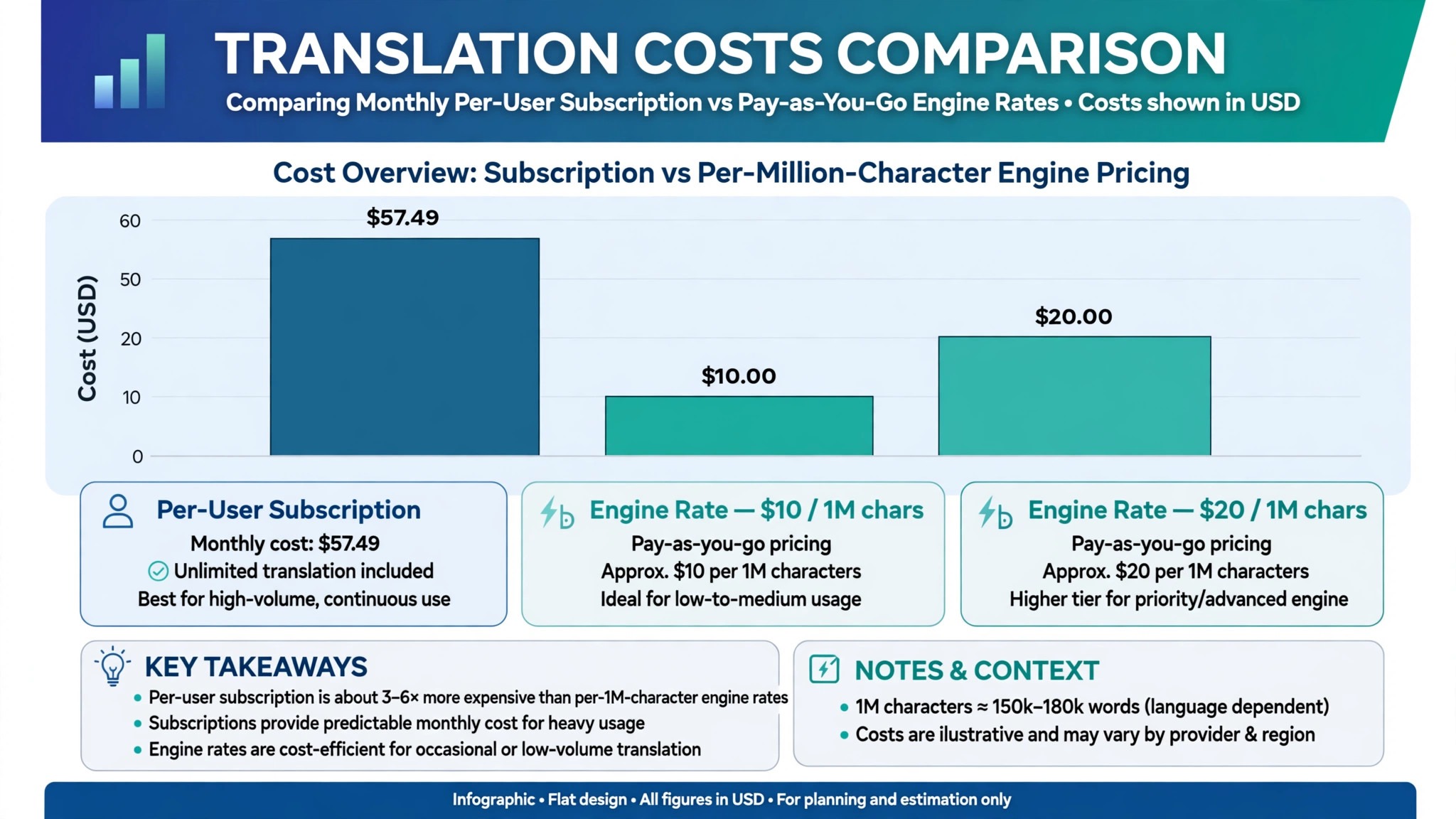
| Microsoft Translator | 2 million characters free in year one | 10 dollars per 1 million characters | Neural translation, custom models | Per million characters |
| Smartcat | 15 day trial | Adapt 1,200 dollars a year | 100,000 Smartwords, unlimited users | Annual word allowance |
| Crowdin | Free plan, 60,000 hosted words | Pro 50 dollars a month | 60,000 hosted words, 2 private projects | Per month, hosted words |
| Lokalise | 14 day trial | Explorer 149 dollars a month billed yearly | 60,000 processed words a year, 5 projects | Per month, processed words |
| Weglot | 14 day trial | Starter 15 euros a month | 10,000 translated words, 1 added language | Per month, translated words |
| Phrase | 14 day trial | Quote only for most teams | Localization platform, integrations | Quote only |
| ChatGPT | Free plan | Plus 20 dollars a month | Translation inside a general AI chat | Per user per month |
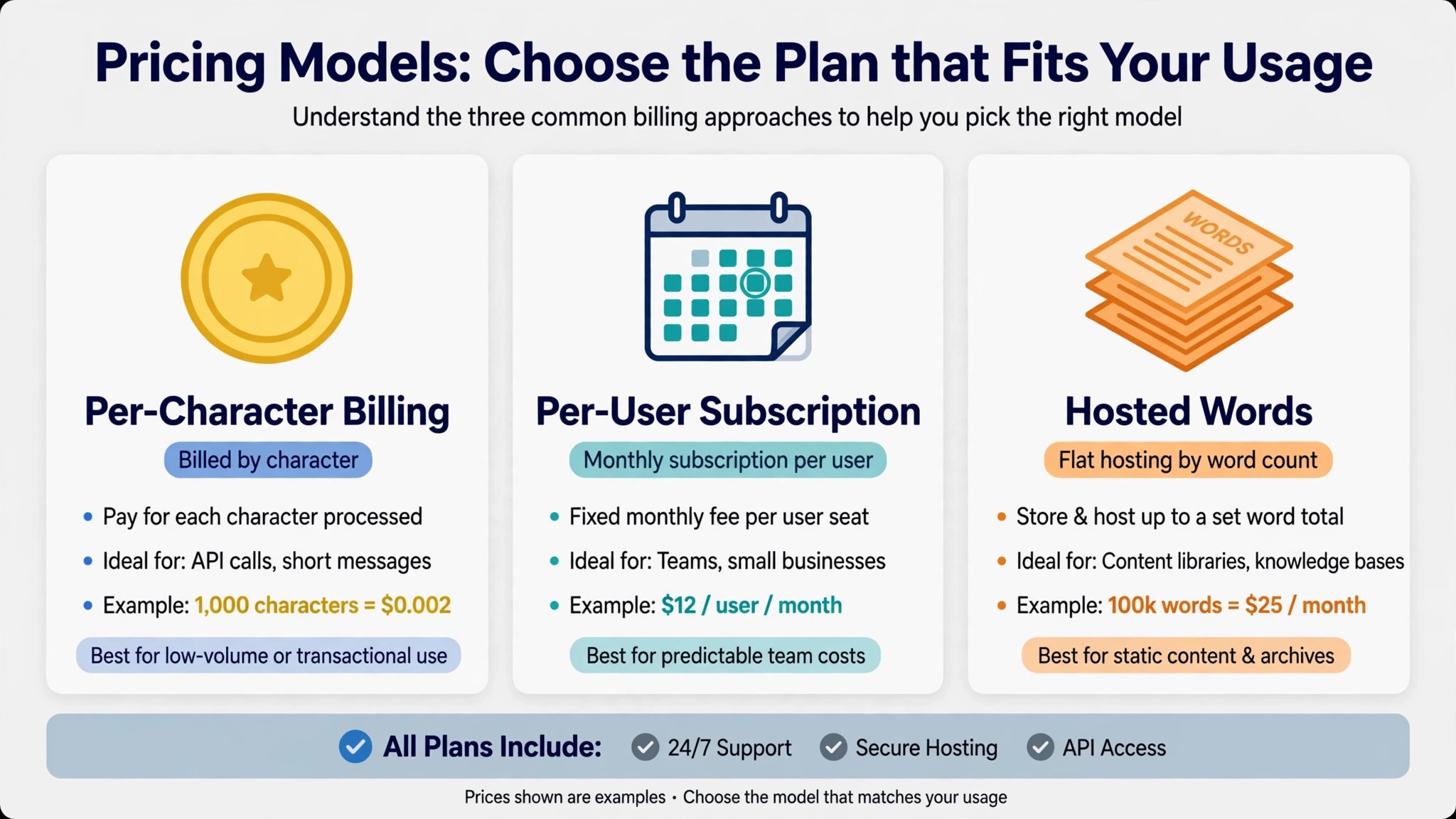
Read the charging column first, because it decides whether the bill grows with people, with words, or with languages. A per user plan stays flat when the word count doubles, and a per word plan stays flat when the team doubles. A business that translates a lot of text with one person should pay per user. A business that translates a little text with ten people should pay per word. That single choice is the heart of ai translation tool pricing, and it matters more than any headline price.
Read the free column second, because free means different things here. Google gives away half a million characters a month, every month, which covers a small website. DeepL gives away a web translator with daily limits and no API. Crowdin gives away a free plan for public projects with 60,000 hosted words. Each free tier solves a different job, and none of them covers a serious commercial workload for long.
DeepL
DeepL is the quality pick in this guide, and its pricing is a per user subscription with a separate API priced by characters. The free web translator handles everyday text with daily limits. Starter costs 8.74 dollars per user a month, and each user gets 1 million characters and 5 documents a month. Advanced costs 28.74 dollars per user a month, with unlimited text translation, 20 documents a month, glossaries, and CAT tool integration. Ultimate costs 57.49 dollars per user a month, with 100 documents a month per user and a higher file size limit.
The API changed in 2026, and buyers should know the new shape before they budget. New API customers no longer get the old Free and Pro plans. The replacement Growth plan costs about 32.50 dollars a month with 1 million characters included and 27.50 dollars per additional million, according to a third party capture of the pricing page dated September 2026. Existing Pro customers keep their old plan. Enterprise is priced by quote.
Worked cost for 1 million characters a month. A single user on Starter pays 8.74 dollars a month and gets exactly that allowance for text and documents. The same volume through the API Growth plan costs about 32.50 dollars a month. The difference buys the API, the glossary handling, and the integration with other tools. A business translating documents by hand should take Starter. A business feeding translation into software should take the API.
DeepL earns its price with fluency, especially for European language pairs. Independent benchmarks consistently rate it the most natural sounding engine for English, German, French, Spanish, Italian, Dutch, and Polish. The weakness is coverage. It supports just over 30 languages for its subscription translator, far fewer than Google at 249, so a business translating into Japanese, Korean, or Arabic should test the pair it needs before it pays. A team working mainly in European languages should test DeepL first.
Google Cloud Translation
Google Cloud Translation is the scale pick in this guide, and its pricing is pay as you go by the character. The web translator and the mobile app are free with no usage limits for a person. The Cloud Translation API costs 20 dollars per 1 million characters for standard neural translation, after a free allowance of 500,000 characters a month, applied as a 10 dollar credit. Document translation starts at 8 cents a page. The newer LLM based translation costs 10 dollars per 1 million input characters plus 10 dollars per 1 million output characters, which works out to about the same 20 dollars per million in practice.
Worked cost for 1 million characters a month. The first 500,000 characters are free, so the bill is 10 dollars for the second half million. At 5 million characters a month the bill is 90 dollars, because 4.5 million characters are charged at 20 dollars per million. At 10 million characters the bill is 190 dollars. There is no subscription, no seat, and no renewal to remember, which makes Google the simplest bill in this guide for uneven volumes.
Google earns its place with coverage and simplicity. It supports 249 languages, more than any rival here, and the free allowance covers a small site or a testing phase without a card. The weakness is that raw machine output still needs a human review for anything a customer will read, and Google sells no review workflow of its own. A business that needs translation plus human review should pair Google with a review tool, and budget the reviewer separately. A business translating at scale into many languages should test Google first.
Microsoft Translator
Microsoft Translator is the value engine pick in this guide, and its pricing undercuts Google by half on the meter. The translator service inside Azure charges 10 dollars per 1 million characters for standard neural translation, with 2 million characters free per month in the first year. After year one the free allowance ends and billing starts from the first character at the full rate, so buyers should budget year two on the paid rate, not the free one.
Worked cost for 1 million characters a month. In year one the bill is zero, because the volume sits inside the free allowance. In year two the same volume costs 10 dollars a month. At 5 million characters a month the bill is 50 dollars, against 90 dollars on Google for the same volume after its free credit. At 10 million characters the bill is 100 dollars, against 190 dollars on Google. The saving is real, and it grows with volume.
Microsoft earns its place with custom models and with the Azure ecosystem. A team already running on Azure can add translation to an existing bill with no new vendor, and custom translation models let a business train the engine on its own terminology. The weakness is that Microsoft is an engine, not a workflow, so glossaries, review, and publishing still need another tool. A business already inside Azure should test Microsoft first. A business outside Azure should weigh the saving against the cost of learning a new platform.
Smartcat
Smartcat is the workflow pick in this guide, and its pricing is an annual word allowance called Smartwords. There is no free plan, only a 15 day trial with 15,000 Smartwords and no card. Adapt starts at 1,200 dollars a year, billed yearly, and includes 100,000 Smartwords, unlimited users, and one workspace. Higher plans rise steeply, with Accelerate reported at 24,000 dollars a year and Anticipate at 60,000 dollars a year, so most small businesses will live on Adapt or not at all.
Worked cost for 100,000 words a year. Adapt at 1,200 dollars a year works out to 1.2 cents per word of allowance, before the cost of any human linguist hired through the marketplace. Translation memory matches and repetitions use no Smartwords, so a business translating similar content repeatedly will stretch the allowance further than the headline suggests. A business translating 100,000 fresh words a year pays 100 dollars a month for the platform, and the linguist fees sit on top.
Smartcat earns its place with the review loop. The platform combines machine translation, an in context editor, a linguist marketplace, and vendor payments in one place, so a translation can move from machine draft to reviewed page without leaving the tool. The weakness is the entry price. A freelancer or a tiny team will find 1,200 dollars a year hard to justify against DeepL Starter at about 105 dollars a year. A team translating a website with regular human review should test Smartcat first.
Crowdin
Crowdin is the developer pick in this guide, and its pricing is by hosted words per month. The free plan covers public projects with 60,000 hosted words and one private project. Pro costs 50 dollars a month billed yearly, or about 59 dollars a month on monthly billing according to third party roundups, and includes 60,000 hosted words, two private projects, two integrations, and unlimited collaborators on private projects. Team and higher tiers rise with word counts and features.
Worked cost for 60,000 hosted words. Pro at 50 dollars a month covers that volume for a year of hosting, with the words counted as source words times target languages, so adding a language multiplies the count. A project with 10,000 source words in six languages uses all 60,000 hosted words. A project with 10,000 source words in two languages uses 20,000, and the same plan leaves room to grow. Buyers should count languages before they count words.
Crowdin earns its place with integrations. It connects to GitHub and more than 700 other tools, so strings can flow from code to translator and back without manual file handling. The weakness is that AI usage is charged on top of the plan, and the plan itself is a hosting fee rather than a translation fee, so the machine translation bill sits separately. A software team shipping frequent releases should test Crowdin first.
Lokalise
Lokalise is the product team pick in this guide, and its pricing is by processed words plus seats. There is no free plan, only a 14 day trial with no card. Explorer costs 149 dollars a month billed yearly, or 169 dollars a month on monthly billing, and includes five advanced seats, five projects, ten target languages, two integrations, and 60,000 processed words a year. Growth costs 379 dollars a month billed yearly. Context aware AI is an add on at the Explorer tier, so buyers should confirm what the AI costs before they compare.
Worked cost for 60,000 processed words a year. Explorer at 149 dollars a month costs 1,788 dollars a year, which works out to about 3 cents per processed word before the AI add on. That is the most expensive per word rate in this guide, and it buys the Figma integration, screenshot context, and reviewer workflow that product teams value. A team translating app strings with designers in the loop will feel that value every week. A team translating documents will not, and should not pay for it.
Lokalise earns its place with design context. Translators see screenshots and Figma frames beside each string, which cuts the back and forth that eats localization time. The weakness is price. At 149 dollars a month it costs more than Crowdin Pro and DeepL Ultimate combined, so the design workflow has to be worth the gap. A product team with designers and reviewers should test Lokalise first.
Weglot
Weglot is the website pick in this guide, and its pricing is by translated words on a live site. There is no free plan, only a 14 day trial. Starter costs 15 euros a month on monthly billing, or 150 euros a year, and includes 10,000 translated words and one added language. Higher tiers rise with word counts and languages, and the count is total translated words across the site, so every new page in every language adds to it.
Worked cost for a 10,000 word site in one extra language. Starter at 15 euros a month covers it, and the translation appears on the live site through a JavaScript snippet or a subdomain, with no code changes. A 10,000 word site in three extra languages uses 30,000 translated words and needs a higher tier. A business should count the words on its site, multiply by languages, and then pick the tier, because the count grows faster than most owners expect.
Weglot earns its place with speed. A website can be translated and live in an afternoon, with automatic detection of new content and a dashboard for human edits. The weakness is that the per word count includes every word on every page, including footers and legal text that rarely needs translating. A small website owner who wants one extra language should test Weglot first.
Phrase
Phrase is the enterprise pick in this guide, and its pricing is quote only for most teams. The platform covers software localization, translation memory, machine translation, and integrations with code repositories and content systems. A 14 day trial is available, but the paid plans are priced by quote, so a buyer cannot budget from the website and must go through a sales call to learn the number.
Worked cost for a small team. There is no published figure to work from, so the honest answer is that Phrase is not priced for a small team that needs a number today. A business that needs a published price should start with Crowdin or Lokalise, where the entry tier is public. A larger team with an existing localization budget should ask Phrase for a quote and compare it against Lokalise Growth at 379 dollars a month, because that is the closest published anchor.
Phrase earns its place with depth. It is built for teams that localize continuously, with workflows, quality checks, and integrations that smaller tools do not offer. The weakness is transparency. Quote only pricing hides the cost until late in the buying process, and a small business can waste weeks learning a number it cannot afford. A team with a real localization budget should test Phrase. A team without one should not start here.
ChatGPT
ChatGPT is the generalist pick in this guide, and its pricing is a flat subscription that includes translation among many other jobs. The free plan covers everyday translation in chat. Plus costs 20 dollars a month, with higher limits, faster responses, and access to newer models. There is no per word charge and no language limit inside the subscription, so the cost stays flat no matter how much text is translated.
Worked cost for 1 million characters a month. Plus at 20 dollars a month covers it, and the same subscription also writes, summarizes, and answers questions, so the translation cost is really a share of a general tool. The catch is workflow. ChatGPT has no glossary, no translation memory, and no review queue, so a business translating the same terms every week will repeat work that DeepL or Smartcat would remember. A business translating varied text once should use ChatGPT. A business translating the same product copy every month should use a tool with memory.
ChatGPT earns its place with flexibility. It handles tone, context, and unusual phrasing better than a plain engine, and it can explain why it chose a word, which helps a reviewer. The weakness is consistency. The same sentence can come back differently on different days, which is fine for a draft and risky for a legal page. A small business that needs quick translations of varied text should test ChatGPT first.
Total Cost of Ownership
The sticker price is not the total cost, and a buyer that budgets on the sticker price will be surprised in month two. The total cost includes the subscription, the per character or per word overage, the human review, and the cost of fixing a translation that a customer laughed at. A 8.74 dollar subscription that needs a reviewer at 30 dollars an hour costs far more than the subscription, and a 10 dollar engine bill that needs no review costs exactly 10 dollars. The review is the line that decides the real bill, and ai translation tool pricing only makes sense once that line is added.
Add the hidden costs to every tool. A per word plan that counts every language multiplies fast, so a 10,000 word site in six languages costs six times the single language price. A per user plan that adds a seat for every reviewer multiplies the other way, so a team of five reviewers on DeepL Ultimate pays 287.45 dollars a month before a single word is translated. A free allowance that ends in year one, like Microsoft at 2 million characters, turns a zero bill into a real one without any warning on the invoice.
The rule is simple. Take the published price, work out the cost at the volume and the language count the business actually has, add the review, and that is the real monthly cost. That figure is the number that decides the value in ai translation tool pricing, not the entry price on the pricing page. Any buyer who skips the review line will misread ai translation tool pricing by a wide margin.
Cheapest by Situation
| Situation | Best value | Why it wins |
|---|---|---|
| One person translating documents | DeepL Starter | 8.74 dollars a month, 1 million characters included |
| High volume engine translation | Microsoft Translator | 10 dollars per 1 million characters, half of Google |
| Widest language coverage | Google Cloud Translation | 249 languages, 500,000 characters free a month |
| Software strings with GitHub | Crowdin Pro | 50 dollars a month, 60,000 hosted words |
| Website in one extra language | Weglot Starter | 15 euros a month, live in an afternoon |
| Website with human review | Smartcat Adapt | 1,200 dollars a year, review and payments in one place |
| Product team with designers | Lokalise Explorer | 149 dollars a month, Figma and screenshot context |
| Varied text, no workflow | ChatGPT Plus | 20 dollars a month, flat, no per word charge |
| Enterprise localization | Phrase | Quote only, depth for continuous localization |
Read the table by situation, not by price alone. The cheapest tool for one person is not the cheapest tool for a software team, because the billing model flips the math. A buyer that chooses the cheapest engine and then discovers it has no review workflow will pay twice, once for the engine and once for the reviewer. That situation test is the core of ai translation tool pricing. A business that buys the tool that fits the job it has will not pay twice.
Frequently Asked Questions
How much does AI translation cost per word?
It depends on the model. Engine pricing runs 10 to 20 dollars per 1 million characters, which works out to roughly a tenth of a cent per word for raw machine output. Subscription pricing runs 8.74 to 57.49 dollars per user a month on DeepL, with a character allowance included. Platform pricing runs about 1.2 cents per word of annual allowance on Smartcat Adapt. Human review on top costs far more than any of those figures, so the machine price is the smallest part of a finished translation.
Is DeepL better than Google Translate?
For European language pairs, independent benchmarks rate DeepL the most natural sounding engine, and its subscription adds glossaries and document translation that Google web translator does not offer. For coverage, Google wins, with 249 languages against just over 30 for DeepL. A business translating mainly between English, German, French, and Spanish should pick DeepL. A business translating into many languages should pick Google.
What is the cheapest AI translation tool?
Google Cloud Translation is cheapest for low volumes, because the first 500,000 characters a month are free. Microsoft Translator is cheapest for high volumes, at 10 dollars per 1 million characters. DeepL Starter is cheapest for a single person translating documents, at 8.74 dollars a month. Crowdin free plan is cheapest for a public software project. The cheapest tool depends on the job, and the free tier that fits the job is the one to use.
Do I need a human to review AI translations?
Yes, for anything a customer will read. Machine translation is accurate for meaning and often wrong on tone, brand terms, and legal phrasing. A reviewer who knows the product should check every customer facing page, and a glossary should lock down brand names and product terms before translation starts. Internal drafts and quick understanding do not need review. Published pages do.
How is translation pricing counted?
Engines count characters, including spaces and punctuation, and Google bills every character it receives. Platforms count hosted words or processed words, with hosted words counted as source words times target languages. Subscriptions count users, with a character or document allowance per user. A buyer who understands those units will read ai translation tool pricing without comparing a per character price against a per word price as if they were the same thing.
Verdict
For most small businesses, the best value is DeepL Starter at 8.74 dollars a month, because it buys the most natural European translation with a generous character allowance and a document limit that covers real work. A business translating documents by hand should pay that price and stop there. For a business translating at volume through software, Microsoft Translator at 10 dollars per 1 million characters is the best engine value, and Google Cloud Translation at 20 dollars per 1 million characters is the best choice when language coverage matters more than the last dollar.
For software teams, Crowdin Pro at 50 dollars a month is the best entry into a real localization workflow. For a website in one extra language, Weglot Starter at 15 euros a month is the fastest way live. The right tool is the one that fits the job, the volume, and the language count at the tier the business will use in six months, not at the entry price, because the entry price buys an allowance that may not cover the real workload. That is the honest read on ai translation tool pricing in 2026.