
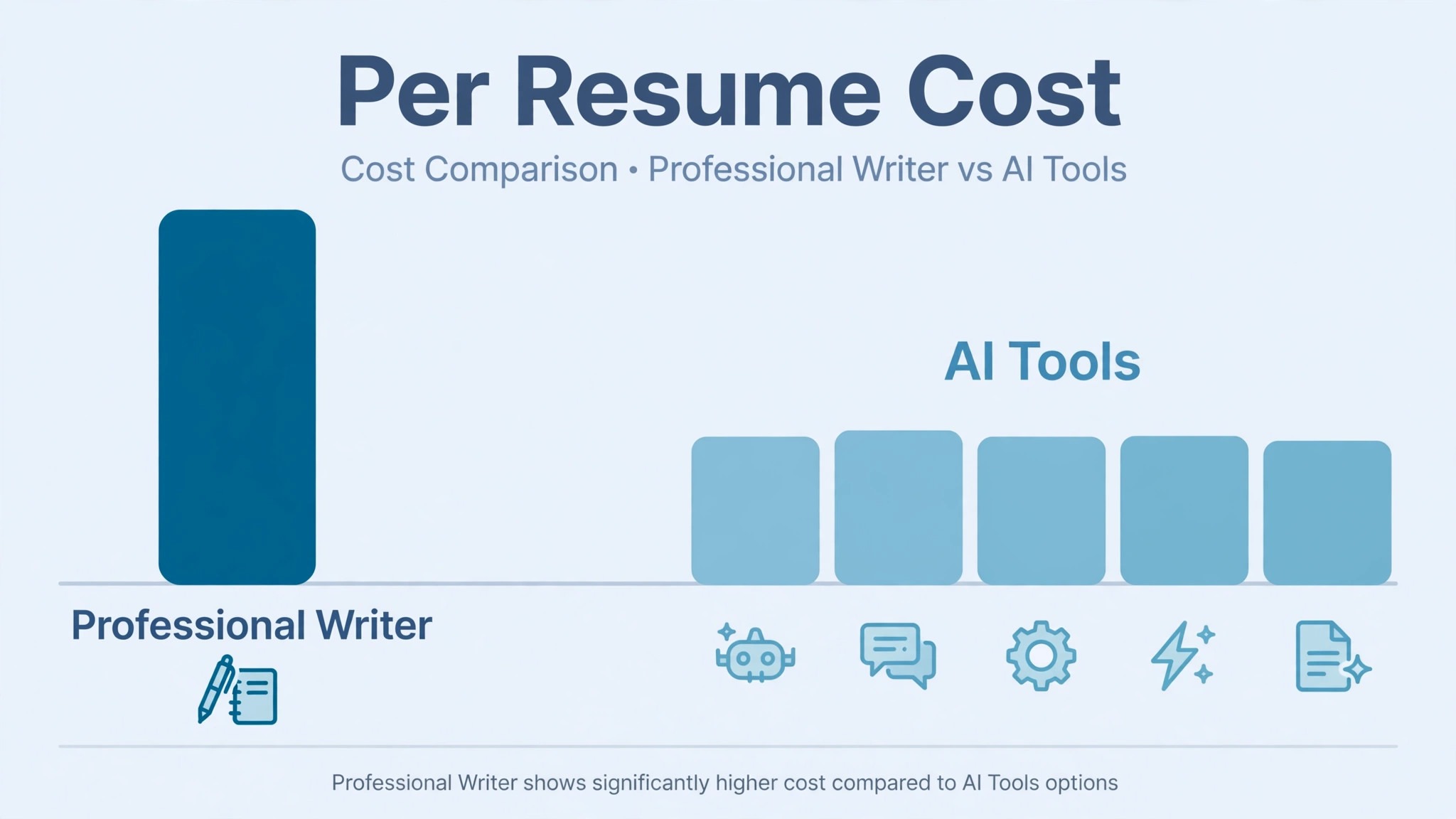
A resume writer charges 100 to 400 dollars for a professional resume, and a career coach charges more. An AI resume builder charges nothing to write the first draft and 29 dollars a month to download it as a PDF, and that gap is the reason most job seekers start with AI. The gap also hides the real question, which is not whether AI is cheaper, because it is, but what the subscription actually buys. That question is the heart of ai resume builder pricing, and it is the number this guide works out for every tool.
A tool that charges 29 dollars a month and a tool that charges 149 dollars once for life are not selling the same thing. The first sells a month of access. The second sells a tool the job seeker keeps through every job search for years. A person who needs one resume for one application pays less with a single month, and a person who changes jobs every two years pays less with the lifetime plan. The billing model decides the bill more than the headline price does.
The third thing to check is the download. Several builders let a job seeker write a full resume for free and then charge at the download button, and some only allow a TXT export on the free plan. A TXT file is not a resume an employer expects, so the free plan is a trial, not a plan. Others let a job seeker download a real PDF for free, and those are the tools worth testing first. Knowing ai resume builder pricing means knowing which free plan hands over a PDF and which one only hands over a text file.
Prices in this guide are US list prices checked in November 2026, before tax. Monthly prices are per month, with the annual or quarterly rate beside the monthly rate where the vendor publishes one. Several vendors bill every four weeks instead of every month, which means 13 payments a year instead of 12, and this guide calls that out wherever it applies. Where prices differ by region, this guide uses the US price.
At a Glance. ai resume builder pricing in One Table
The table below is the short answer. Prices are in US dollars, before tax. Free means the free tier, and the paid column is the entry paid price.
| Tool | Free plan | Entry paid price | What you get | PDF download free |
|---|---|---|---|---|
| Rezi | 1 resume, 3 PDF downloads | Pro 29 dollars a month | Unlimited resumes, ATS score | Yes, 3 downloads |
| Kickresume | 4 templates | Premium 19 dollars a month | AI writer, 40 plus templates | Yes, on free templates |
| Resume.io | TXT export only | 2.95 dollars trial, then 29.95 dollars per 4 weeks | Guided builder, cover letters | No, TXT only |
| Novoresume | 1 page resume | Premium 23.99 dollars one time | One month access, no renewal | Yes, one page |
| Teal | Unlimited resumes, PDF export | Teal plus 29 dollars per 30 days | AI tailoring, job tracker | Yes, unlimited |
| Enhancv | 7 day trial, branded exports | Pro 39 dollars a month | Design led templates, tailoring | No, trial only |
| Zety | TXT export only | 1.95 dollars trial, then 25.95 dollars per 4 weeks | Templates, phrase library | No, TXT only |
| Jobscan | 5 scans a month | 49.95 dollars a month | Match rate, keyword scan | Yes, builder PDF |
Read the PDF column first, because a builder that will not hand over a PDF for free is a builder that charges for the only file that matters. Teal gives unlimited resumes with PDF export on the free plan, which is the most generous free tier in this guide. Rezi gives one resume with three PDF downloads, and Kickresume gives four templates with free downloads. Resume.io and Zety give TXT export only, so their free plans are not free resumes at all. That difference is the first filter in ai resume builder pricing, and it removes two tools from the free list before any money moves.

Read the billing column second, because four week billing is a quiet price rise. Resume.io at 29.95 dollars every four weeks charges 13 times a year, which is about 389 dollars a year, not the 359 dollars a monthly price would suggest. Zety at 25.95 dollars every four weeks charges about 337 dollars a year. A job seeker who compares 29.95 dollars against a 29 dollar monthly plan is comparing different things, and the four week plan costs more. Novoresume avoids the trap entirely by charging once with no renewal, and Rezi avoids it with a 149 dollar lifetime plan.
Rezi
Rezi is the ATS pick in this guide, and its pricing is a monthly plan with a lifetime option beside it. The free tier gives one resume and three PDF downloads, with the Rezi Score and limited keyword targeting, which is enough to test the scoring on a real application. Pro costs 29 dollars a month, and it adds unlimited resumes, cover letters, and full keyword targeting against a job description. The lifetime plan costs 149 dollars once, with no subscription and no renewal, which makes Rezi the cheapest long term option in this guide for a person who job hunts more than once.
Worked cost for 1 resume a month. A three month job search on Pro costs 87 dollars, and a year on Pro costs 348 dollars. The lifetime plan costs 149 dollars once, so it pays for itself in about five months against the monthly plan. A person who needs one resume for one application should use the free tier and pay nothing. A person who expects to search again in two years should buy the lifetime plan and never pay for a resume builder again.
Rezi earns its price with the score. The AI checks the resume against the job description in real time and tells the job seeker exactly what to change to cross its 90 point threshold, and its parse rate in ATS tests is the highest in this guide. A job seeker applying through corporate portals, where a machine reads the resume before a human does, should test Rezi first, because the score is the feature that gets the resume past the machine.
Kickresume
Kickresume is the value pick in this guide, and its pricing is a monthly plan with a strong annual discount. The free tier gives four basic templates with unlimited resumes and downloads, and AI is Premium only. Premium costs 19 dollars a month on monthly billing, or 54 dollars a quarter, or 96 dollars a year on annual billing, which works out to 8 dollars a month. Students get six months free, which is the best student deal in this guide.
Worked cost for 1 resume a month. A three month job search on the monthly plan costs 57 dollars, and a year on the annual plan costs 96 dollars. The annual plan is the real price, because 96 dollars a year beats three months of monthly billing for a search that runs past a season. A person who needs one resume for one application should use the free tier and pay nothing, because the four free templates cover a clean, professional layout. A person who needs the AI writer should pay for the annual plan and keep it for the next search too.
Kickresume earns its price with templates and speed. The library holds more than 40 templates designed by typographers, the AI writes a full first draft from a job title in minutes, and the matching cover letter builder and personal website keep the application consistent. That annual price is the clearest example of ai resume builder pricing rewarding a longer commitment. A job seeker who wants a designed resume fast, without learning a new tool, should test Kickresume first, because the annual price of 96 dollars is the cheapest honest yearly price among the monthly builders in this guide.
Resume.io
Resume.io is the speed pick in this guide, and its pricing is a cheap trial that renews every four weeks. The free tier gives one resume and one cover letter with TXT download only, which is not a file an employer expects. The trial costs 2.95 dollars for 7 days, and it opens PDF downloads, then it converts to 29.95 dollars every four weeks if the job seeker does not cancel. A quarterly plan costs 49.95 dollars and renews every three months, which works out to about 17 dollars a month.
Worked cost for 1 resume a month. The trial plus three months of four week billing costs about 93 dollars, and a year costs about 389 dollars across 13 charges. That is the most expensive way in this guide to buy a resume builder for a year, and the quarterly plan at 49.95 dollars is the only sane way to use the tool, at about 200 dollars a year. A person who needs one resume for one application should pay the 2.95 dollar trial, download the PDF, and cancel on day six, because the trial is the whole value of this tool.
Resume.io earns its place with speed and guidance. The builder walks a first time writer through each section in about 20 minutes, the AI phrases and fine tuning work from a pasted job description, and the free ATS checker runs 16 checks with a score. A job seeker who has never written a resume and needs one today should test Resume.io first, and should set a calendar reminder to cancel the trial before it renews.
Novoresume
Novoresume is the one time purchase pick in this guide, and its pricing is the exception to the subscription rule. The free tier gives a one page resume with predefined layouts and a clean PDF download, which is enough for a short career. Premium is sold as one time purchases with no automatic renewal. One month of access costs 23.99 dollars, a quarter costs 49.99 dollars, and a year costs 189.99 dollars, each paid once. There is no subscription to cancel and no renewal to forget.
Worked cost for 1 resume a month. A three month job search on the quarterly pass costs 49.99 dollars, which is the cheapest three month price in this guide. A year of access costs 189.99 dollars once, which is cheaper than a year of Resume.io at about 389 dollars and cheaper than a year of Rezi Pro at 348 dollars. A person who needs one resume for one application should use the free one page resume and pay nothing. A person who needs a full resume for a three month search should buy the quarterly pass and pay once.
Novoresume earns its place with layout discipline. The builder enforces a strict one page layout with strong spacing and clear hierarchy, and its ATS score and job matcher help a job seeker see how the resume reads to a machine. A job seeker with a short career, or a job seeker who hates subscriptions, should test Novoresume first, because the one time purchase is the only pricing model in this guide that cannot surprise the buyer with a renewal.
Teal
Teal is the free tier pick in this guide, and its pricing is the most generous starting point. The free plan gives unlimited resumes with PDF downloads, ten templates, five AI bullet credits, and a job tracker, which is more than most paid plans in this guide. Teal plus costs 13 dollars for 7 days, or 29 dollars for 30 days, or 79 dollars for 90 days, and it adds unlimited AI tailoring, the match score, and more templates. There is no annual plan, so a heavy user pays about 29 dollars a month indefinitely.
Worked cost for 1 resume a month. A three month job search on the free plan costs nothing, because the free tier covers unlimited resumes and PDF downloads, and the five AI bullet credits cover the first tailored applications. A three month search on Teal plus costs 79 dollars for the 90 day plan, which is the cheapest paid three month price among the subscription tools in this guide after Novoresume. A person who needs one resume a month should start free and only pay for Teal plus when the AI tailoring becomes the bottleneck.
Teal earns its place with the tracker. The job board and application tracker sit beside the builder, so a job seeker manages the whole search in one place, and the match score shows the top five keywords for free. A job seeker applying to many roles at once should test Teal first, because no other tool in this guide pairs a free builder with a free tracker. The weakness is the lack of an annual discount, because a person who pays 29 dollars every 30 days for a year pays 348 dollars, the same as Rezi Pro without the lifetime option.
Enhancv
Enhancv is the design pick in this guide, and its pricing is the premium end of the builder market. The free plan lasts seven days, with Enhancv branding on exports and at most 12 section items, which is a trial rather than a plan. Pro costs 39 dollars a month on monthly billing, or 69 dollars every three months, or 99 dollars every six months, which works out to 23 dollars a month on the quarterly plan and 16.50 dollars a month on the six month plan. The longer plans are the real price, because the monthly rate is the most expensive in this guide after Jobscan.
Worked cost for 1 resume a month. A three month job search on the quarterly plan costs 69 dollars, and a year on the six month plan costs 198 dollars. The monthly plan costs 117 dollars for three months, so a job seeker who pays monthly for a full search wastes 48 dollars against the quarterly plan. A person who needs one resume for one application should use the seven day trial and export within the week, and should accept the branding on the export or pay for one month to remove it.
Enhancv earns its place with visual polish. The templates are the most distinctive in this guide, with strong use of color, icons, and section design, and the one click tailoring rewrites the resume for a job description in seconds. A job seeker in a creative or client facing role, where the resume itself is a design sample, should test Enhancv first, because the visual difference is visible the moment the file opens. A job seeker applying through a strict ATS should test Rezi instead, because a two column design can scramble in extraction.
Zety
Zety is the template pick in this guide, and its pricing follows the same trial pattern as Resume.io. The free tier gives the builder and templates with TXT download only, which is not a usable resume file. The trial costs 1.95 dollars for 14 days, and it converts to 25.95 dollars every four weeks if the job seeker does not cancel. An annual plan costs 71.40 dollars a year, which works out to 5.95 dollars a month, and it is the cheapest annual headline in this guide.
Worked cost for 1 resume a month. The trial plus three months of four week billing costs about 80 dollars, and a year costs about 337 dollars across 13 charges. The annual plan at 71.40 dollars a year is far cheaper, and it is the only sane way to use Zety for a long search. A person who needs one resume for one application should pay the 1.95 dollar trial, download the PDF, and cancel on day thirteen, because the trial is the whole value of this tool for a short search.
Zety earns its place with the phrase library and the resume check. The builder holds a large library of pre written phrases for each role, and the resume check finds more than 30 issues in a draft, from missing keywords to weak verbs. A job seeker who struggles to write bullet points should test Zety first, because the phrases turn a blank page into a draft in minutes. The weakness is the four week billing, which costs more per year than the monthly price suggests, so read the line under the checkout button before paying.
Jobscan
Jobscan is the scanner pick in this guide, and its pricing is the highest in the builder market. The free tier gives five scans a month and a free builder with nine ATS templates and PDF download, which is enough to test the match rate on a real job. The paid plan costs 49.95 dollars a month, or 89.95 dollars a quarter after a seven day free trial, which works out to 29.98 dollars a month on the quarterly plan. The quarterly plan is the real price, because the monthly rate is the most expensive in this guide.
Worked cost for 1 resume a month. A three month job search on the quarterly plan costs 89.95 dollars, and a year on the quarterly plan costs about 360 dollars. The monthly plan costs about 150 dollars for three months, so a job seeker who pays monthly wastes 60 dollars against the quarterly plan. A person who needs one resume for one application should use the five free scans and the free builder and pay nothing, because the free tier covers a single application well.
Jobscan earns its place with the scan itself. The match rate report compares the resume against a job description across more than 30 parameters, and the AI optimize tool suggests the keywords, bullets, and summary changes that lift the score. A job seeker who keeps getting rejected by online portals, without knowing why, should test Jobscan first, because the scan names the problem instead of guessing at it. The weakness is the price, because 49.95 dollars a month buys a scanner, not a builder, and a job seeker who needs both should pair the free Jobscan scans with a cheaper builder.
Total Cost of Ownership
The sticker price is not the total cost, and a buyer that budgets on the sticker price will be surprised in month two. The total cost includes the plan, the trial conversion, the four week billing, and the cost of a resume that never gets read. A 2.95 dollar trial that converts to 29.95 dollars every four weeks costs about 93 dollars for three months, not the 2.95 dollars the trial promised. A 39 dollar monthly plan that drops to 16.50 dollars a month on a six month plan costs 99 dollars for six months, not the 234 dollars the monthly rate suggests. The billing period decides the bill more than the headline price does.
Add the hidden costs to every tool. A resume that fails an ATS parse because of a two column layout costs the job it was written for, which is the most expensive outcome in this guide. A trial that renews because the job seeker forgot to cancel costs 25.95 to 29.95 dollars every four weeks until it is noticed. A subscription that runs for a year at 29 dollars a month costs 348 dollars, while a lifetime plan at 149 dollars once costs less than half of that for the same year and nothing for the next search.
The rule is simple. Take the published price, work out the cost for a three month search and for a year, add the trial conversion, and that is the real cost. That three month figure is the heart of ai resume builder pricing, and it is the number that decides the value.
Cheapest by Situation
| Situation | Best value | Why it wins |
|---|---|---|
| One resume, one application | Teal free | Unlimited resumes, PDF export, free |
| One resume, ATS portals | Rezi free then lifetime | 1 free resume, 149 dollars once for life |
| Three month search, cheapest | Novoresume quarterly | 49.99 dollars once, no renewal |
| Three month search, subscription | Teal plus 90 day | 79 dollars for 90 days |
| One year, cheapest annual | Kickresume annual | 96 dollars a year, AI writer included |
| Design led resume | Enhancv six month | 99 dollars for six months, 16.50 a month |
| Never written a resume | Resume.io trial | 2.95 dollars for 7 days, cancel on day six |
| Rejected by ATS, need a scan | Jobscan free scans | 5 scans a month, free builder PDF |
| Struggle to write bullets | Zety trial | 1.95 dollars for 14 days, phrase library |
Read the table by situation, not by price alone. The cheapest tool for one resume is not the cheapest tool for a three month search, because the billing model flips the math. A buyer that chooses the cheapest tool and then discovers it lacks a PDF download will pay twice, once for the cheap builder and once for the replacement. That situation test is the core of ai resume builder pricing. A job seeker that buys the plan matching the length of the search, with the files that search requires, will not pay twice.
Frequently Asked Questions
Is there a truly free AI resume builder?
Yes, with limits. Teal gives unlimited resumes with PDF export on the free plan, which is the most generous free tier in this guide. Rezi gives one resume with three PDF downloads, and Kickresume gives four templates with free downloads. Novoresume gives a one page resume with a clean PDF download. Resume.io and Zety give TXT export only, so their free plans are not free resumes. Enhancv gives a seven day trial with branded exports. Those four are the only free plans in this guide that hand over a real PDF.
Will an AI resume pass an ATS?
It depends on the template and the keywords. Rezi scores the resume against the job description and checks parsing rules as the job seeker types, which is the strongest ATS support in this guide. Jobscan scans the resume against a job description across more than 30 parameters. Novoresume and Kickresume use ATS safe layouts with a free score or checker. A two column design with graphics can scramble in extraction, so a job seeker applying through a corporate portal should choose a single column template and test the parse before sending.
How much does a resume cost in 2026?
A polished AI resume costs nothing on the best free plans, 2.95 dollars for a trial, 23.99 dollars for a one month pass, 29 dollars a month on a subscription, or 149 dollars once for a lifetime plan, depending on the tool. That range is the short answer to ai resume builder pricing in 2026. A three month job search costs 49.99 dollars on Novoresume quarterly, 79 dollars on Teal plus 90 day, and about 93 dollars on Resume.io after the trial. A professional resume writer charges 100 to 400 dollars for one resume. The AI price buys speed and templates, and the writer price buys judgment and originality.
Do unused AI credits roll over?
No, on most tools in this guide. Teal AI bullet credits, Rezi downloads, and Jobscan scans reset each month, and unused credits are lost. A job seeker that buys a plan for a busy month and then has a quiet month will lose the unused allowance, so the plan should match the average month, not the busiest month. Buy the quarterly pass for a busy search rather than buying a higher plan for a quiet month.
Which AI resume builder is best for a small business hiring manager?
It depends on the job. Teal is best for a job seeker applying to many roles, because the free builder pairs with a free tracker. Rezi is best for corporate portals, because the ATS score is the strongest. Kickresume is best for a designed resume on a budget, because the annual plan costs 96 dollars. Novoresume is best for a job seeker who hates subscriptions, because the quarterly pass costs 49.99 dollars once. A hiring manager reading this guide should note that candidates use all of these, so the resume format matters less than the content inside it.
Verdict
For most job seekers, the best value is Teal free, because unlimited resumes with PDF export cost nothing, and the tracker covers the whole search. A job seeker who needs AI tailoring should pay 79 dollars for the 90 day Teal plus plan and cancel when the search ends. For a job seeker who expects to search again, Rezi lifetime at 149 dollars once is the best pick, because it pays for itself in about five months against the monthly plan and costs nothing for the next search.
For a three month search on a single payment, Novoresume quarterly at 49.99 dollars is the best pick, because there is no renewal to forget. For a designed resume, Kickresume annual at 96 dollars is the best pick, because the AI writer and the templates cover the whole year. The right tool is the one that fits the length of the search, the file need, and the budget at the tier the job seeker will use in three months, not at the entry price, because the entry price buys a trial that may convert before the resume is sent. That is the honest read on ai resume builder pricing in 2026.