Square is the best software for food trucks for most operators in 2026, and the reason is simple. It costs nothing to start, takes cards offline when the signal drops at a festival, and runs on a phone you already own. That verdict holds for a new truck finding its first regular pitch. It changes once volume, staff, or a second truck enters the picture, which is why this guide compares ten platforms instead of crowning one and stopping there.
A food truck is a restaurant with a smaller kitchen, a moving location, and a line that forms and vanishes in minutes. The best software for food trucks has to take orders fast, take cards in dead zones, track a menu that changes by the day, and tell the owner which pitch actually made money. A system built for a sit down restaurant can do most of that, but the details matter. Offline mode, handheld hardware, QR ordering, and location based reporting decide whether a busy lunch service runs smoothly or falls apart at the exact moment the queue is longest.
This guide compares the ten systems food truck owners actually buy in 2026, with pricing checked against vendor pages and independent 2026 comparisons. Card rates are quoted as published, and where a vendor hides its rate behind a sales call, that is stated plainly. The ranking weighs entry cost, card rates, offline reliability, hardware, and how well each system handles the daily reality of a truck.
Best Pick by Job
| Job | Best pick | Why it wins |
|---|---|---|
| New truck, tight budget | Square | Free software, 59 dollar reader, offline card payments |
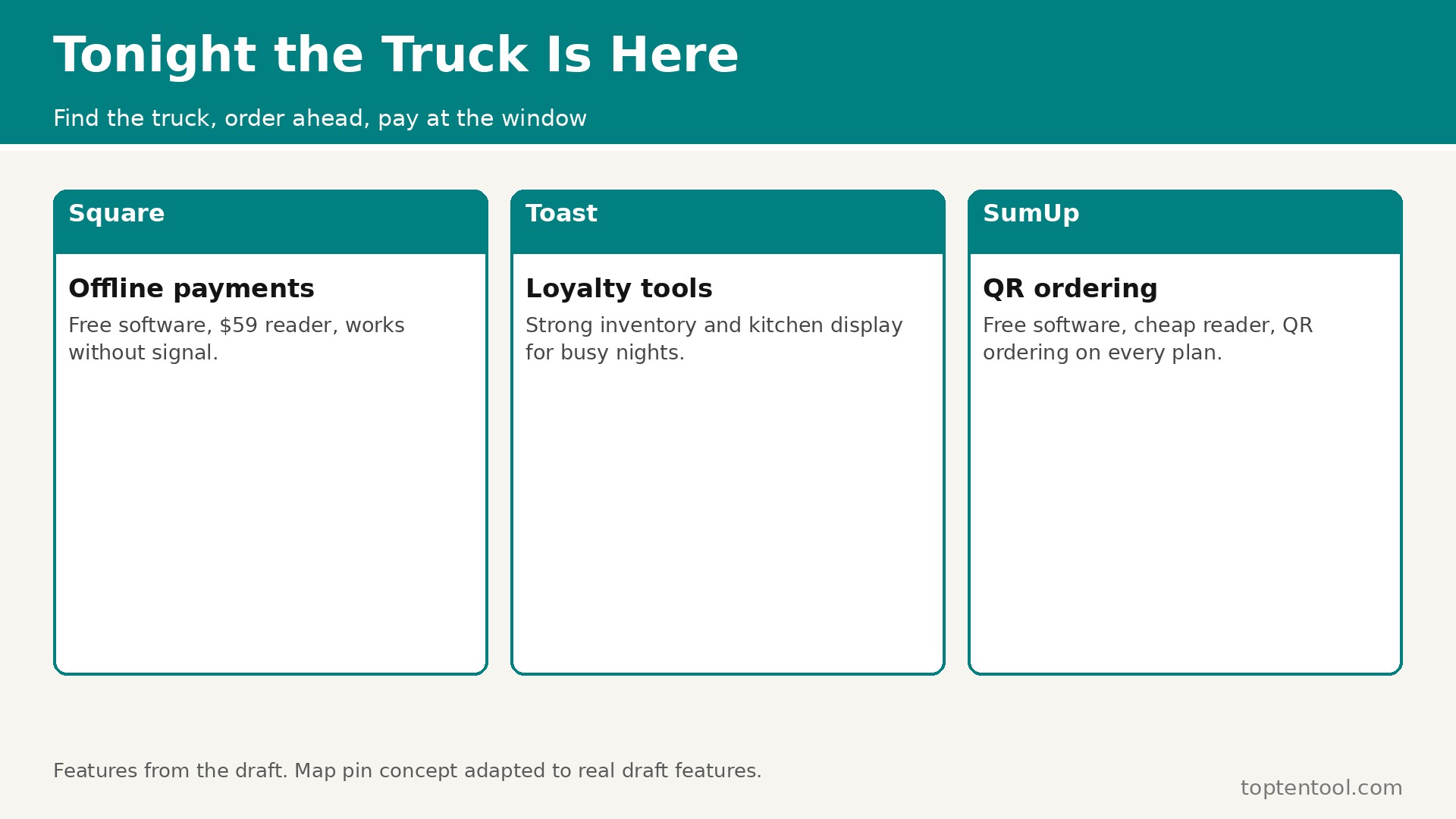
| High volume established truck | Toast | Strong inventory, kitchen display, loyalty tools |
| Premium handheld hardware | Clover | Toughest handhelds, reliable offline queue |
| Lowest published card rate | Avocado | 2.1 percent in person rate with no reseller variance |
| Multi location and delivery | Otter | Bundled hardware, delivery and order aggregation |
| Simple mobile ordering | SumUp | Free software, cheap reader, QR ordering on every plan |
| Growing into a restaurant | Lightspeed | Scales from truck to full restaurant without migrating |
| Full service menu complexity | TouchBistro | Deep menu modifiers and table style service tools |
| Enterprise multi truck fleet | Revel Systems | Central control across trucks, strong reporting |
| Budget all in one | Epos Now | Low entry cost, wide app marketplace |
How the Best Software for Food Trucks Was Compared
Every system was judged on the same six tests. Entry cost counted the software fee, the cheapest workable hardware, and the card rate together, because a free plan with a high card rate can cost more than a paid plan within months. Offline mode was tested on paper against vendor documentation, since a truck that cannot take cards in a dead zone loses sales it can never recover. Order speed covered QR ordering, line busting with a handheld, and kitchen display flow.
Menu control covered daily specials, sold out items, and modifiers. Reporting had to show sales by location and by hour, because a truck lives or dies on knowing which pitch pays. Finally, exit terms mattered. A system with no contract scored higher than one that locks the owner into a two or three year term.
Card rates deserve a note before the list begins. Vendors quote them in different ways, and some publish a rate for one plan while quoting the real rate only on a sales call. Toast, for example, publishes a free Starter Kit but does not publish the processing rate that comes with its paid plans, and Clover prices vary by reseller. Confirm the rate in writing before signing, because the card rate is the largest cost line for most trucks.
What a Food Truck Actually Needs From Software
The first need is speed at the window. A lunch rush gives each customer about ninety seconds from order to payment, and every extra tap costs a sale at the back of the queue. The best truck systems keep the menu to one screen, support modifiers with one touch, and let a second staff member take orders further down the line on a handheld. That line busting feature alone can lift a busy service by a third, because the queue moves while food is still cooking.
The second need is offline card payments. Festivals, markets, and rural pitches all have dead zones, and a truck that stops taking cards when the signal drops loses the customers who do not carry cash. Square, Toast, Clover, and Avocado all queue card payments offline and sync when the signal returns, but the details differ, so ask about the per sale cap and the sync window before buying.
1. Square
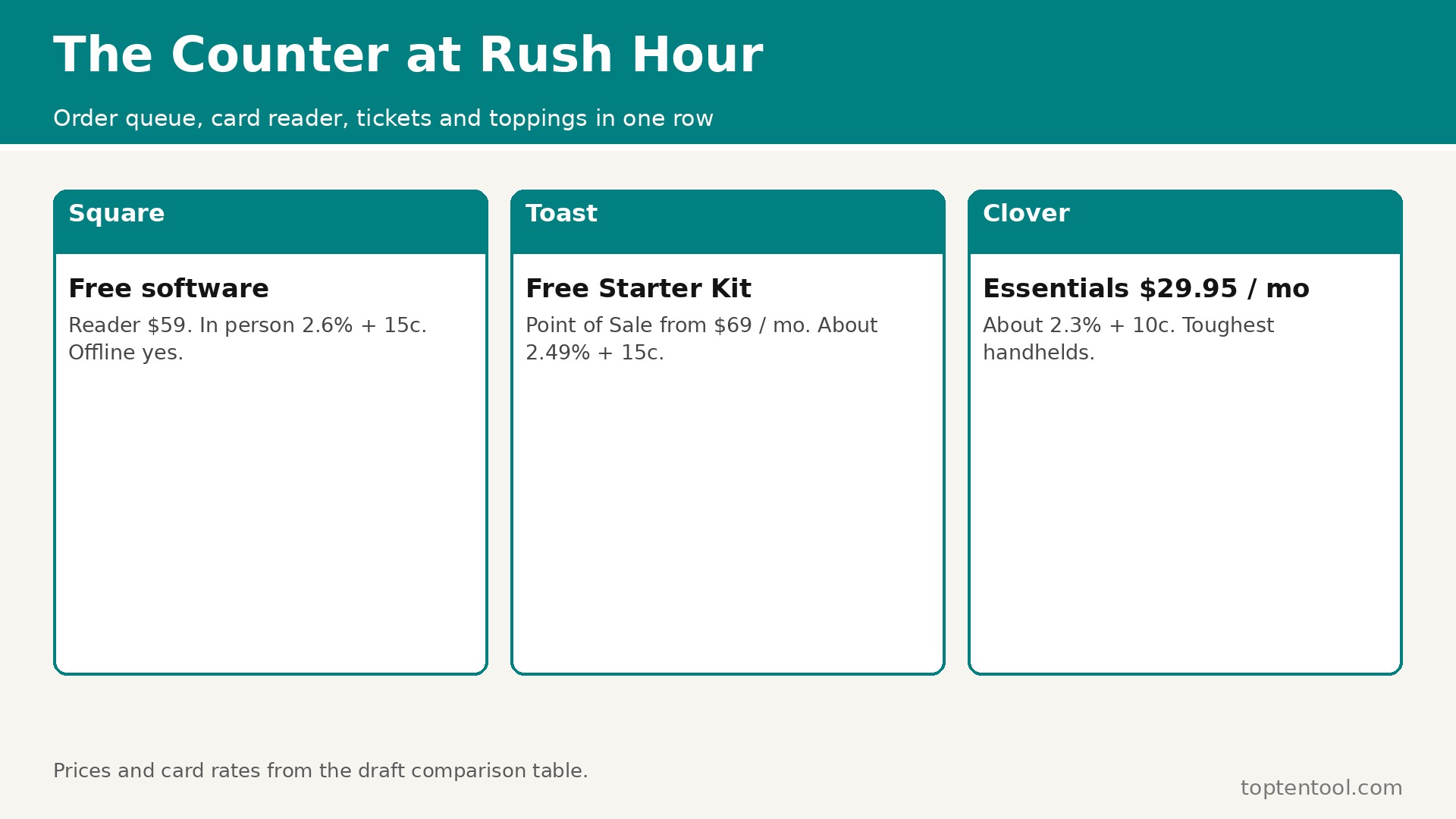
Square is the best software for food trucks for most new operators, and the value case is hard to argue with. The software is free on the Free plan, the contactless and chip reader costs 59 dollars, and in person card payments run at 2.6 percent plus 15 cents. The Plus plan costs 49 dollars a month per location and drops the rate to 2.5 percent, while Premium at 149 dollars a month drops it to 2.4 percent. Online orders run at 3.3 percent plus 30 cents on Free, or 2.9 percent plus 30 cents on the paid plans. All of those figures are published by Square, which is itself a point in its favor.
Beyond price, Square fits a truck because it runs on a phone or tablet, works offline by default with a 24 hour sync window, and includes QR code ordering, a free online store, and compact hardware options. The Terminal costs 299 dollars, the handheld runs 299 to 399 dollars, and a kitchen display app is available for 30 dollars a month per device on Plus. For a solo operator or a two person crew, that is everything needed to trade from day one with no contract and no monthly fee until volume justifies an upgrade.
The drawback is scale. High volume trucks eventually want deeper inventory and ingredient tracking, which is where Toast pulls ahead, and Square support can feel thin at peak times. The free plan also charges the highest card rate of the major systems, so a truck processing more than about 15,000 dollars a month should compare the Plus plan rate against Avocado and Clover before staying put. For a first truck, though, Square is the right start.
2. Toast
Toast is the best choice for an established or high volume truck that also runs a kitchen with real inventory needs. Its Starter Kit costs nothing a month for one location and up to two terminals, with hardware included, while the Point of Sale plan starts from 69 dollars a month. The published in person card rate on the paid plan is around 2.49 percent plus 15 cents, and the Starter Kit rate is higher, at about 3.09 percent plus 15 cents according to 2026 comparisons. Toast does not publish every rate on its own site, so confirm the figure on a quote before committing.
What Toast does better than any rival is restaurant depth. Ingredient level inventory, kitchen display systems, loyalty programs, and marketing add ons are all built in, and the Toast Go handheld is made for line side order taking during a rush. A truck that also runs a brick and mortar kitchen gets one system across both, with shared menus and reporting. That depth is why high volume operators accept the higher entry cost and the longer setup.
The drawback is commitment. Toast plans commonly run on a two year software agreement that renews yearly, and the hardware floor is higher than Square, with terminals running 799 dollars and up before add ons. Smaller trucks can feel trapped by a contract written for a restaurant. If your truck is established, busy, and menu heavy, Toast earns its price. If you are still finding your pitches, start cheaper and switch later.
3. Clover
Clover is the pick for trucks that want the toughest handheld hardware and the most reliable offline behavior. The Flex handheld costs around 749 dollars, or about 40 dollars a month financed, and it survives drops, heat, and rain better than a phone in a case. In person card rates run around 2.3 percent plus 10 cents on the Growth plan, with Essentials at 29.95 dollars a month and Growth at 84.95 to 89.95 dollars a month depending on the seller. Clover is sold through resellers, so the exact rate and hardware price vary, and that variation is the main thing to watch.
Offline mode is automatic on Clover, with payments queuing and reprocessing with no staff toggle, which matters when the person at the window is also cooking. The system covers QR ordering, loyalty, and reporting, and the hardware range covers a compact Go reader through to a full countertop setup. For a truck working festivals and rural pitches where the signal is unreliable, that automatic offline behavior is worth real money.
The drawback is price transparency. Because resellers set terms, two trucks can pay different rates for the same plan, and the headline price rarely matches the final quote. Get three reseller quotes and compare them line by line, including the contract length and any monthly hardware fee. If the quotes come back clean, Clover is a strong premium choice. If they do not, Square or Avocado will serve you better.
4. Avocado
Avocado is the quiet value pick in this guide, and the numbers explain why. The base plan costs nothing a month, the premium plan is 29 dollars a month, and the in person card rate is 2.1 percent plus 10 cents, the lowest transparent rate in this comparison. The reader costs 149 dollars and the Hub runs 399 to 599 dollars. There is no reseller variance, because Avocado sells direct, so the rate you read is the rate you pay.
Offline mode syncs automatically on reconnect, and the system covers the truck basics without a long setup. For a truck processing steady volume, the rate saving against Square Free is about half a percent on every sale, which adds up to hundreds of dollars a month at festival volume. That saving is the whole pitch, and for many owners it is enough.
The drawback is history. Avocado is newer and less proven than Square, Toast, or Clover, with a smaller support network and fewer third party integrations. A truck that needs deep inventory, loyalty, or a large app marketplace will feel the limits. For a straightforward truck that wants the lowest published rate and a simple setup, Avocado deserves a serious look before you default to the biggest name.
5. SpotOn
SpotOn is built for trucks that want strong marketing and loyalty tools without paying Toast prices. Its software starts from nothing a month on the entry tier, with card rates from 2.45 percent plus 15 cents, and it includes online ordering, loyalty, and customer marketing in the package. The pitch is that a truck lives on repeat customers at regular pitches, and SpotOn gives the owner the tools to bring those customers back with offers and reminders.
The system runs on handheld hardware and covers the standard truck workflow, including offline payments and kitchen display options. Reporting shows sales by location and by hour, and the loyalty program is easier to set up than Toast, which suits a small team without a marketing manager. For a truck with regular weekly pitches and a growing list of regulars, that marketing depth pays for itself.
The drawback is that SpotOn pricing is less transparent than Square, with final rates depending on a quote. Hardware costs also vary. Ask for the full written quote, including the card rate, the monthly fee, and any hardware financing, before comparing it against the published rates in this guide. If the quote lands near the published figures, SpotOn is a strong mid priced choice.
6. SumUp
SumUp is the simplest system in this guide, and simplicity is a real feature on a truck with one or two staff. The software costs nothing a month, the card reader is inexpensive, and the in person card rate is 2.6 percent plus 10 cents. QR code ordering and mobile ordering work on every plan, and the app runs on a phone with no extra hardware beyond the reader. Setup takes minutes rather than days, which suits a seasonal truck or a side business that trades at weekends.
The trade is depth. SumUp does not match Square on reporting, Toast on inventory, or Clover on hardware range. Menu control is basic, kitchen display options are limited, and there is no loyalty program to match SpotOn. For a truck with a short menu, a regular pitch, and a small team, those limits rarely matter. For a truck with a long menu and complex modifiers, they will show within a month.
The drawback that matters most is support at scale. SumUp is built for small sellers, and a truck that grows into a fleet will outgrow it. Start here if your menu is short and your budget is tight, and plan to move to Square or Toast when volume or menu complexity forces the change. The low entry cost makes that path cheap.
7. Lightspeed
Lightspeed is the pick for a truck that plans to grow into a restaurant, because it scales from a single truck to a full dining room without a migration. The restaurant platform covers inventory, menu management, reporting, and multi location control, and the truck runs as one location inside the same system. Pricing is quote based, so request a written quote for a single truck and compare it against the published rates for Square and Toast before deciding.
What Lightspeed does well is menu and stock control. Ingredient tracking, recipe costing, and waste reporting help a truck that cooks from scratch and needs to know its true food cost per dish. Reporting is strong, with sales by location, by hour, and by item, and the system handles complex modifiers better than the simpler tools in this guide. A truck with a large menu and tight margins will feel the benefit within weeks.
The drawback is cost and setup. Lightspeed is priced for restaurants, not for a first truck, and the onboarding takes longer than Square or SumUp. It is also overkill for a truck with a five item menu. Choose Lightspeed when the restaurant is already in the plan, not before. Until then, a cheaper system keeps more cash in the business.
8. TouchBistro
TouchBistro is a restaurant point of sale system that suits trucks with full service menus and complex orders. Its strength is menu depth, with modifiers, courses, and split bills handled cleanly, and it runs well on tablets at the window. Pricing is quote based, and the system is sold as a restaurant platform rather than a truck specialist, so ask for a truck specific quote and confirm offline behavior in writing.
The system covers tableside ordering, kitchen display, and reporting, and it handles a long menu with daily specials better than most truck tools. Staff management, including roles and permissions, is solid, which helps a truck with a rotating crew. For a truck that serves a full menu at festivals and private events, TouchBistro gives the kitchen the structure it needs.
The drawback is that it is not built for a truck first. Location reporting and mobile ordering need checking against the simpler tools, and the quote based pricing makes comparison harder. If your menu is genuinely complex and your team is experienced, TouchBistro is worth a demo. If your menu fits on one board, a simpler system will serve you faster and cheaper.
9. Revel Systems
Revel Systems is the enterprise choice for a multi truck fleet, and it is the only tool in this guide built from the ground up for central control across many locations. Menus, prices, and promotions are managed centrally and pushed to every truck, reporting rolls up across the fleet, and head office can see each truck in real time. Pricing is quote based and sits at the enterprise end of the market.
For a single truck, Revel is too much system at too high a price. For a fleet of five or ten trucks, it is the tool that keeps the brand consistent, stops each truck running its own menu, and gives the owner the numbers to decide which trucks to keep and which to sell. Inventory, labor, and customer data all sit in one place, which is exactly what a growing fleet needs and exactly what a patchwork of single truck systems cannot provide.
The drawback is cost and complexity. Implementation takes weeks, training takes longer, and the quote will reflect enterprise pricing. Only shortlist Revel when you already run more than one truck and the admin burden is the bottleneck. Before that point, Square or Toast will do the job for far less money.
10. Epos Now
Epos Now closes the list as the budget all in one option for a truck that wants a full point of sale system without a big monthly fee. Entry costs are low, the app marketplace covers loyalty, accounting, and online ordering, and the system runs on tablets and handhelds. Pricing is quote based for the full package, but the entry tier is positioned well below Toast and Lightspeed, which makes it a real option for a cost conscious operator.
The system covers the truck basics, including offline payments, menu control, and reporting by location, and the marketplace lets the owner add features as needed rather than paying for a large bundle upfront. That modular approach suits a truck that wants to start lean and add tools as volume grows. Support is available by phone and chat, which matters when a problem hits during service.
The drawback is polish. Epos Now does not match Square on ease of use or Toast on restaurant depth, and some marketplace apps cost extra. Check which features are included in the quoted price and which are paid add ons, because the add ons can lift the real monthly cost above the headline figure. For a budget truck that wants a proper till system rather than a phone app, it is a fair choice.
Side by Side Comparison of the Best Software for Food Trucks
| Tool | Software cost | In person card rate | Offline mode | Best for |
|---|---|---|---|---|
| Square | Free, Plus 49 dollars a month | 2.6 percent plus 15 cents | Yes | New trucks |
| Toast | Free Starter Kit, Point of Sale from 69 dollars | About 2.49 percent plus 15 cents | Yes | High volume trucks |
| Clover | Essentials 29.95 dollars a month | About 2.3 percent plus 10 cents | Yes | Premium hardware |
| Avocado | Free, Premium 29 dollars a month | 2.1 percent plus 10 cents | Yes | Lowest card rate |
| SpotOn | From nothing a month | From 2.45 percent plus 15 cents | Yes | Loyalty and marketing |
| SumUp | Free | 2.6 percent plus 10 cents | Yes | Simple setups |
| Lightspeed | Quote only | Quote only | Yes | Growing into a restaurant |
| TouchBistro | Quote only | Quote only | Check before buying | Complex menus |
| Revel Systems | Quote only | Quote only | Yes | Multi truck fleets |
| Epos Now | Low entry, quote based | Quote only | Yes | Budget all in one |
Card rates change often. Confirm the current rate in writing before signing any contract.
Fee Breakdown Before You Choose
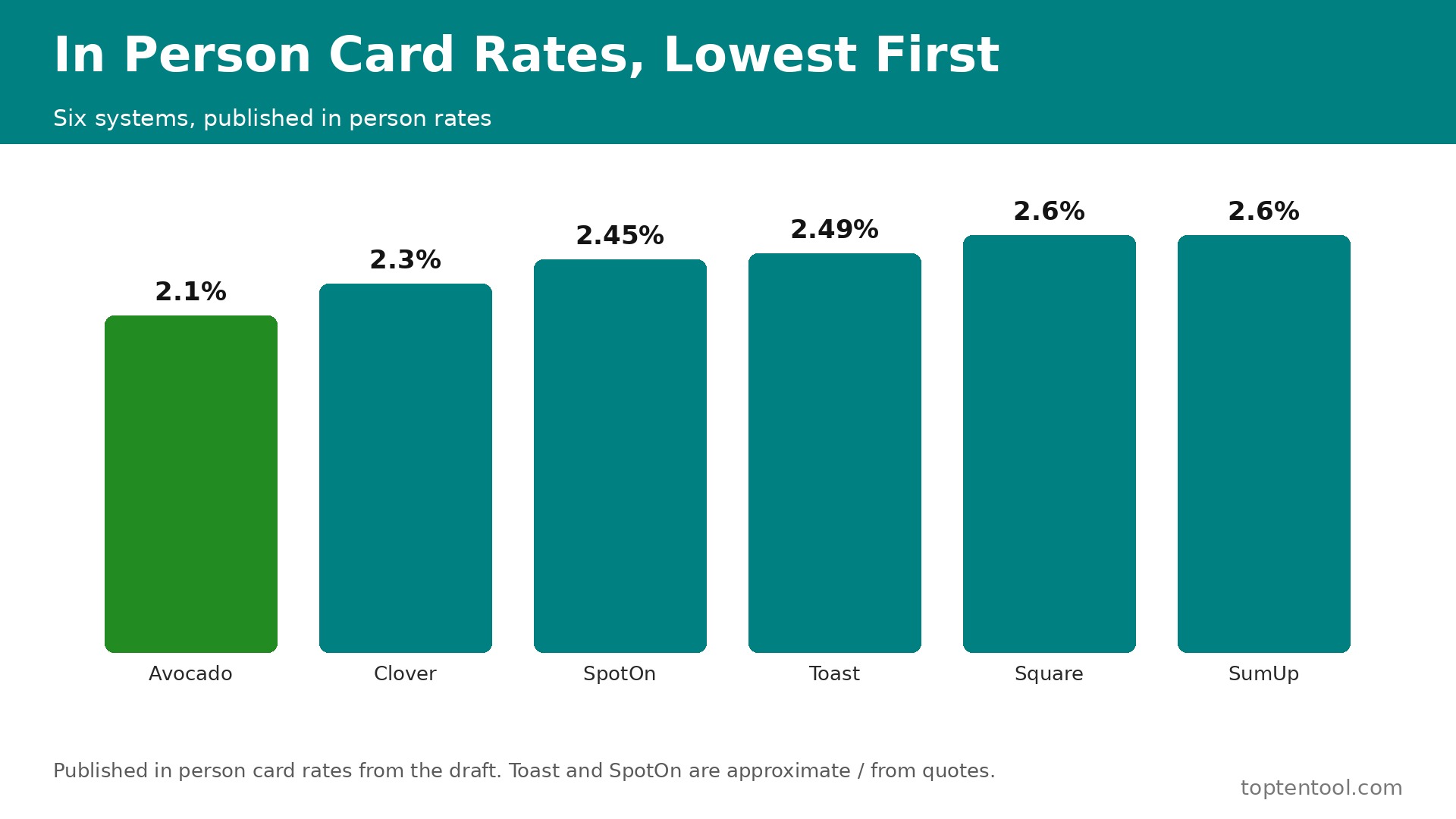
The monthly fee is the smallest line for most trucks. The card rate is the largest, and a small difference in the rate beats a large difference in the monthly fee once volume rises. A truck processing 20,000 dollars a month in cards pays 520 dollars at 2.6 percent and 420 dollars at 2.1 percent, a saving of 100 dollars a month or 1,200 dollars a year, before the per transaction cents. That saving alone can pay for a paid plan, a handheld, or a month of marketing.
Run this check with your own numbers. Take last month card volume, multiply it by each system rate, add the monthly software fee and any hardware financing, and compare the totals. A free plan at 2.6 percent costs more than a 49 dollar plan at 2.5 percent once card volume passes about 10,000 dollars a month, and the crossover arrives sooner at festival volume. Also add the online order rate, which is higher than the in person rate on every system, and check whether tips, refunds, and chargebacks carry extra fees.
How to Choose in One Afternoon
Start with volume, not features. A new truck should trial Square and SumUp for one week each, using real service, and keep the one that feels faster at the window. A busy truck processing more than 15,000 dollars a month should compare Avocado, Square Plus, and Toast on total monthly cost, using the fee check above. A fleet should demo Revel and Lightspeed with head office staff in the room, because the decision is about control, not about the window.
Next, test offline mode for real. Take each trial system to a weak signal area, switch the phone to airplane mode, take three card payments, and confirm they sync when the signal returns. A system that fails that test is not fit for a truck, whatever its feature list says. Then test the kitchen flow during a rush, with one person on the window and one on the grill, and watch whether tickets print clearly and sold out items disappear from the menu instantly.
Frequently Asked Questions
What is the best software for food trucks for a new truck?
For most new trucks, Square is the best software for food trucks to start with, because the software is free, the reader costs 59 dollars, and offline payments work from day one. SumUp is the closest alternative for a very short menu. Move to Toast or Avocado once volume or menu complexity makes the card rate or inventory tools matter more than the free start.
How much does food truck software cost per month?
Software costs range from nothing a month on Square Free, SumUp, and Avocado base plans to 49 dollars for Square Plus and from 69 dollars for Toast Point of Sale. The bigger cost is the card rate, which runs from 2.1 percent to about 2.6 percent in person, plus 10 to 15 cents per sale. A busy truck usually pays more in card fees than in software fees.
Does food truck software work offline?
Yes, the leading systems queue card payments offline and sync when the signal returns. Square requires a sync within 24 hours and caps offline sales. Clover queues automatically with no staff toggle. Always test offline mode in a real dead zone before a festival, and confirm the per sale cap and the sync window in writing.
Do I need a kitchen display system on a food truck?
A kitchen display helps once the truck serves more than about 30 orders an hour or runs a menu with many modifiers. Below that volume, printed tickets or a tablet at the grill work fine. Square charges 30 dollars a month per device for its kitchen display app on Plus, and Toast includes a kitchen display in its restaurant plans. Add it when ticket errors, not ambition, force the change.
Can I switch food truck software later without losing data?
Yes, but plan the switch in a quiet week. Export sales history, customer lists, and menu data before cancelling, and run the new system alongside the old one for a few days. Systems with no contract, like Square and SumUp, are the easiest to leave. Systems with a two year agreement or financed hardware can carry exit fees, so check the contract before signing.
Verdict
Square is the best software for food trucks for most operators, because it removes every barrier to starting and charges nothing until volume justifies an upgrade. Toast is the right step up for a high volume truck that needs inventory and kitchen depth, and Avocado is the smart money pick for a truck that processes steady volume and wants the lowest published card rate. Clover suits trucks that work in dead zones and need the toughest hardware, while SpotOn suits trucks that live on regulars and loyalty.
Pick by volume and by pitch, not by brand. A new truck needs a free start and offline payments. A busy truck needs a low card rate and a kitchen that keeps up. A fleet needs central control. Test the top two on your shortlist during a real service, run the fee check with your own card volume, and choose the system that is fastest at the window on your busiest day. That is the test that decides whether the software earns its place on the truck.