

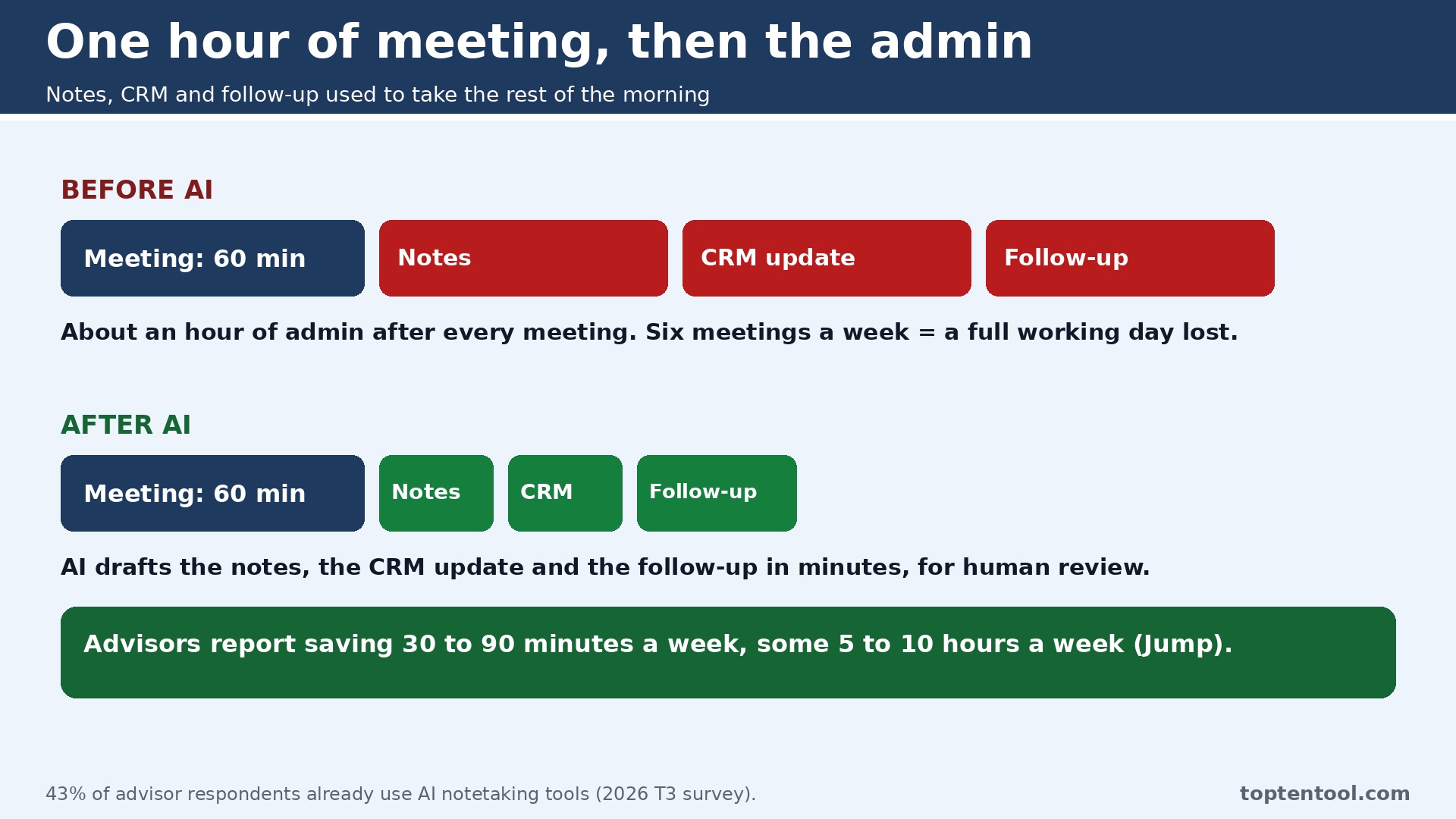
The best AI tools for financial advisors exist to fix one costly habit. A client meeting ends at 11 in the morning, and the advisor spends the next hour writing notes, updating the CRM, drafting the follow up email and filing the meeting record for compliance. Multiply that by six meetings a week and the advisor loses a full working day to work that happens after the conversation, not during it. That is the problem every advisor faces in 2026, and it is not a knowledge problem. It is an admin problem, and it is exactly the problem AI now solves.
The best AI tools for financial advisors attack that admin from four directions. Meeting notetakers capture the conversation and write the notes, the follow up and the CRM update. Tax and estate tools read a return or a trust document and build a client ready report in minutes. Risk tools turn a tolerance conversation into a proposal. CRM and marketing tools keep the client relationship warm between meetings. The 2026 T3 survey found that 43 percent of advisor respondents already use AI notetaking tools, up from a single tracked solution the year before, which tells you where the profession is moving.
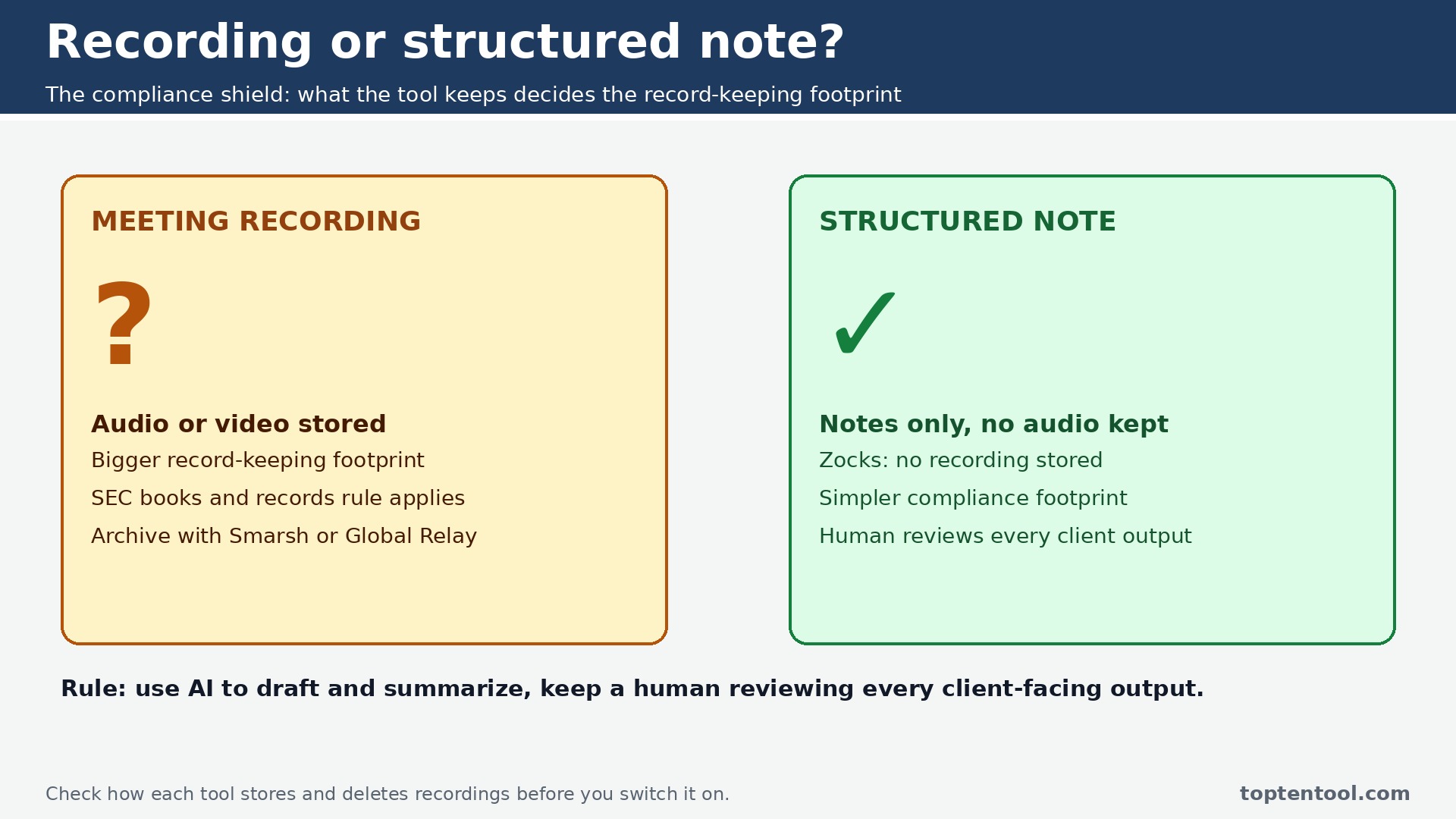
There is a compliance line running through this category that matters more than any feature. Tools that record and store audio or video create a different record keeping footprint from transcript only tools, and the SEC books and records rule applies to the notes, the emails and the CRM updates the AI produces. The practical rule is simple. Use AI to draft and summarize, keep a human reviewing every client facing output, and check how each tool stores and deletes recordings before you switch it on.
The Shortlist by Advisor Job
The table below matches each common advisor job to the tool that handles it best. The best AI tools for financial advisors are the ones that match the job that eats your week, so use this table to narrow twelve tools to two or three before you read the reviews. Prices are monthly list prices unless noted, and annual billing is usually cheaper than paying month to month.
| Job | Best tool | Why it wins |
|---|---|---|
| Meeting notes and CRM updates | Jump | Deepest CRM write back, Meet from 100 dollars an advisor a month |
| Notes without storing audio | Zocks | Structured notes only, no recording kept |
| Tax planning from returns | Holistiplan | Reads a return in about a minute, from 749 dollars a year |
| Risk tolerance and proposals | Nitrogen | Risk Number plus AI proposals, 199 to 450 dollars a month |
| Goals based planning | RightCapital | Planning plus Iris AI agent that reads client data |
| CRM with AI built in | Wealthbox | AI contact intelligence from around 45 dollars a user a month |
| Tax, estate and insurance review | FP Alpha | Reads all three document types, 1,995 dollars a year |
| Retirement and goals planning | MoneyGuidePro | 2,000 dollars an advisor a year |
| Enterprise platform intelligence | Orion Denali AI | AI layer across the full Orion platform |
| Advisor CRM and reporting | Redtail | Long standing advisor CRM inside Orion |
| Marketing and client outreach | Snappy Kraken | AI marketing automation for advisors |
| Meeting notes plus prospect content | Zeplyn | Notes plus engagement and social content |
How We Ranked the Best AI Tools for Financial Advisors
A tool earned a place here only if it does a real advisor job in 2026, not if it added a notetaker to a generic product. We judged each one on five things that decide whether an advisor keeps paying after the trial.
First, the job it does, from meeting notes to tax planning to risk proposals, because a notetaker and a tax tool solve different pains. Second, the CRM integration depth, since a notetaker that writes back to Wealthbox, Redtail and Salesforce saves more time than one that exports a text file. Third, the starting price an independent advisor can actually buy, including whether a free trial exists. Fourth, the compliance posture, including how recordings are stored and deleted, and whether the tool supports archiving with Smarsh or Global Relay. Fifth, the quality of the output, from notes a client could read to proposals a compliance officer will approve.
The other test was whether the tool was built for advisors or adapted from a generic product. A generic notetaker can transcribe a meeting, but it will not know what a suitability note needs, what a CRM field expects, or what a compliance archive requires. The checklist below is the fastest way to compare any two tools on this list before you trial them.
| Check before you buy | What to ask | Why it matters |
|---|---|---|
| CRM write back | Which CRMs, and which fields | A text export means manual entry |
| Recording storage | Audio kept, or notes only | Storage changes the compliance footprint |
| Archive support | Smarsh, Global Relay integration | Records must be archivable |
| Review step | Human approval before client send | AI drafts need a human check |
| Plan transparency | Which tiers have a public price | Several tools hide the full price |
| Trial terms | Days, card required, data use | Test with a real meeting, not a demo |
Twelve Tools, Reviewed in Order
1. Jump
Starting price 100 dollars an advisor a month for Meet. Best for Meeting notes and CRM updates. Watch out Only the entry Meet tier has a public price, so the full platform cost needs a quote.
Jump is the strongest pick for meeting automation, and advisors report saving 30 to 90 minutes a week, with some vendor materials putting the saving at 5 to 10 hours a week on meeting documentation and follow up. It turns client meetings, emails and documents into structured notes, follow up tasks and CRM updates, with native sync to Redtail, Wealthbox and Salesforce. The pre meeting prep and the follow up drafts mean the advisor walks into the meeting prepared and leaves it with the admin already drafted.
The strength is the CRM write back. Jump has the deepest write back on this list, covering Wealthbox, Redtail, Salesforce Financial Services Cloud and Practifi, plus archive integrations with Smarsh and Global Relay. A meeting note that lands in the right CRM fields, with the follow up tasks attached, is worth more than a transcript in a separate app.
The catch is price transparency. Only the Meet tier at 100 dollars an advisor a month has a public price, and the Grow and Operate tiers that add growth analytics and operations features are quote only. Jump still earns the top spot, because the meeting to CRM workflow is the job most advisors need done first.
2. Zocks
Starting price Around 149 dollars a user a month. Best for Notes without storing audio. Watch out The price is at the top of the notetaker range, so the privacy benefit has to justify it.
Zocks is the compliance first notetaker, and its pitch is simple. It captures meeting notes, drafts client emails, fills intake forms and updates client profiles, then syncs the data into your CRM and planning stack, without storing audio or video. Only structured notes are kept, which simplifies the record keeping footprint in a way that recording tools cannot match.
The strength is the privacy design. A firm that worries about what a recording tool stores, and for how long, can use Zocks and keep the conversation out of long term storage entirely. The CRM sync covers the same major platforms as Jump
The catch is the price. At around 149 dollars a user a month, Zocks costs more than Jump Meet, and the buyer is paying for the privacy design rather than for extra features. For a compliance first RIA, that is a fair trade. For a solo advisor who is comfortable with recordings, Jump is cheaper.
3. Holistiplan
Starting price 749 dollars a year for Basic. Best for Tax planning from returns. Watch out The price nearly doubled for some users in a recent restructuring, and the top tier runs to 11,049 dollars a year.
Holistiplan is the undisputed leader in tax planning, with more than 30,000 subscribers and a reported 38.92 percent market share. It reads a tax return and builds a client ready report in about a minute, covering Roth conversions, tax bracket planning, capital gains and Social Security timing. A task that took an advisor an afternoon now takes a coffee break.
The strength is speed plus depth. The report is not a summary, it is a planning document with specific recommendations the advisor can discuss with the client, and the household based pricing scales with the practice. Basic starts at 749 dollars a year, with higher tiers for larger practices.
The catch is the price history. The recent restructuring nearly doubled costs for some users, which is the main complaint in user reviews, and the top tier at 11,049 dollars a year is an enterprise price. For a tax focused practice, Holistiplan still pays for itself in the first month. For a practice that does tax planning rarely, a broader planning tool may be better value.
4. Nitrogen
Starting price 199 to 450 dollars a month. Best for Risk tolerance and proposals. Watch out The full price is not published, so the range is a guide rather than a quote.
Nitrogen, formerly Riskalyze, is the risk first platform, built around the Risk Number methodology that has become the standard in risk tolerance assessment. It turns a risk conversation into a proposal, runs stress tests on a portfolio, and now adds Nucleus agentic AI into client meetings and tax planning. The client portal keeps the risk conversation visible between meetings.
The catch is price transparency. The full pricing is not published, so a buyer needs a sales conversation to get the real number for their firm size. Nitrogen still earns its place, because no other tool on this list does risk profiling and proposals at this depth.
5. RightCapital
Starting price Priced per advisor, by quote on the vendor site. Best for Goals based planning. Watch out The price is not published, so budget a range and get the quote in writing.
RightCapital is the goals based planning platform, and in 2026 it shipped Iris, the first planning focused AI agent that reads client data directly inside the planning software, plus Smart Import, which pulls figures from meeting transcripts, statements and emails straight into a client plan. A plan that used to need manual data entry now fills itself from the documents the advisor already has.
The strength is the data flow. Smart Import removes the most tedious part of planning, which is typing numbers from statements into the software, and Iris answers planning questions from the live client data. The retirement, tax and estate modules cover the full planning job, and the client portal makes the plan visible to the client.
The catch is the quote only pricing. There is no published starting price, so a small practice cannot budget it from the website. RightCapital suits a planning focused practice that will use the full platform. A practice that only needs meeting notes should buy Jump and revisit RightCapital when planning volume justifies it.
6. Wealthbox
Starting price From around 45 dollars a user a month for the CRM tier. Best for CRM with AI built in. Watch out AI features sit on higher tiers, so the entry price is not the AI price.
Wealthbox is the easy CRM for advisors, and its AI has grown past a notetaker add on into Agents, Playbooks and an AI Assistant that flag overdue tasks and draft client communications for advisor review. The CRM is built for the advisor client relationship, with contact intelligence, workflow automation and activity tracking that fits a small practice without a dedicated administrator.
The strength is the native fit. A firm already on Wealthbox gets AI without adding a second vendor, and the AI sees the full client record, so its drafts and flags are grounded in real data. The early access Agents and Playbooks point toward autonomous background workflows, which is where the category is heading.
The catch is the tier split. The CRM starts around 45 dollars a user a month, and the AI features sit on higher tiers, so the price for the AI version is higher than the headline rate. Wealthbox still earns its place for firms that want a CRM and AI in one system, without the complexity of Salesforce.
7. FP Alpha
Starting price 1,995 dollars a year for the all in one platform. Best for Tax, estate and insurance review. Watch out The annual price is high for a solo advisor who only needs one of the three reviews.
FP Alpha goes wider than Holistiplan, reading tax, estate and insurance documents and building a client ready review across all three. A trust document, an insurance policy and a tax return become one planning picture, with gaps and opportunities flagged for the advisor to discuss. The all in one platform at 1,995 dollars a year covers the full review.
The strength is the breadth. An advisor who reviews estate documents by hand knows how slow that work is, and FP Alpha turns it into a structured review in minutes. The tax module competes with Holistiplan, and the estate and insurance modules have no direct rival on this list.
The catch is the price for a narrow need. A practice that only needs tax planning should buy Holistiplan at 749 dollars a year. A practice that reviews tax, estate and insurance regularly will find FP Alpha the better value, because three separate tools would cost more than the one platform.
8. MoneyGuidePro
Starting price 2,000 dollars an advisor a year, or 175 dollars a month. Best for Retirement and goals planning. Watch out The price is annual and per advisor, so a team of five pays 10,000 dollars a year.
MoneyGuidePro is the goals based retirement planning standard, and its three advisor tiers all run on annual pricing. The core plan costs 2,000 dollars an advisor a year, or 175 dollars a month, and it covers retirement projections, goal tracking and what if scenarios that clients can understand. The visual plan makes a retirement conversation concrete, which is why advisors keep using it year after year.
The strength is the client conversation. A retirement plan that a client can see, with trade offs shown clearly, is easier to agree on than a spreadsheet, and the goals based approach fits the way clients actually think about money. The integration with the major CRMs and custodians keeps the data fresh.
The catch is the per advisor price. A solo advisor pays 2,000 dollars a year, and a team of five pays 10,000 dollars, which is a serious line for a planning tool. MoneyGuidePro suits a practice where retirement planning is the core service. A practice that plans rarely should look at RightCapital or the planning inside its CRM first.
9. Orion Denali AI
Starting price Custom, by quote. Best for Enterprise platform intelligence. Watch out Broad availability and public pricing were still pending in mid 2026, so access depends on the Orion relationship.
Orion Denali AI is the intelligence layer across the full Orion platform, covering portfolio management, financial planning, CRM, reporting and compliance in one ecosystem. It is not a standalone product. It operates across the platform at once, pulling from portfolio data, financial plans, CRM records and reporting simultaneously, which is a different kind of AI from a notetaker that only sees the meeting.
The catch is access and price. Denali AI is custom priced, broad availability was still pending in mid 2026, and it only makes sense for a firm already running Orion. A firm that is not on Orion should not buy Orion to get Denali. A firm that is should ask its Orion contact for the enterprise terms.
10. Redtail
Starting price Priced per user, by quote. Best for Advisor CRM and reporting. Watch out The CRM is long standing and practical, and the AI is lighter than the newer platforms.
Redtail is the long standing advisor CRM inside the Orion ecosystem, and it is the system many independent advisors have run for years. It covers contacts, workflows, reporting and compliance, with integrations across the advisor technology stack. The AI features help with drafting and workflow, but the core value is the CRM itself, which is built for the way advisory firms actually work.
The strength is familiarity and depth. A firm that has run on Redtail for years has its client history, its workflows and its compliance records in one place, and the reporting covers the operational view a practice owner needs. The integration with Orion portfolio data keeps the client picture complete.
The catch is the AI depth. Redtail is a CRM with AI added, not an AI native platform, and a firm that wants the deepest AI should look at Jump for meetings or Wealthbox for CRM plus AI. Redtail suits a firm that values a proven CRM and an Orion ecosystem over the newest AI features.
11. Snappy Kraken
Starting price Priced by quote. Best for Marketing and client outreach. Watch out The price is not published, so a small practice needs a sales conversation to budget it.
Snappy Kraken is the AI marketing automation pick for advisors, covering email campaigns, social content, client outreach and lead nurturing in one system. The AI drafts marketing content, personalizes outreach and tracks which clients engage, so a practice can stay in touch between meetings without a marketing hire. The content is built for financial advisors specifically, not for generic small business marketing.
The strength is the advisor focus. Generic marketing tools do not know what a compliance reviewed advisor email needs, and Snappy Kraken builds the compliance step into the workflow. A practice that wants to grow through consistent outreach gets a system rather than a set of disconnected tools.
The catch is the quote only pricing. There is no published starting price, so a small practice cannot budget it without a sales call. Snappy Kraken suits a practice that is actively growing and needs marketing automation. A practice that only needs occasional emails should use the marketing inside its CRM first.
12. Zeplyn
Starting price Priced by quote. Best for Meeting notes plus prospect content. Watch out The price is not published, and the platform is newer than the established notetakers.
Zeplyn closes the list as the meeting notes tool that also handles prospect engagement and social content. It captures meeting notes, drafts follow ups and turns the conversation into content for prospects and social channels, so the advisor gets two jobs from one tool. The workflow suits an advisor who publishes content and wants the meeting to feed it.
The catch is the newer platform and the quote only pricing. There is no published price, and the track record is shorter than Jump or Zocks. Zeplyn suits an advisor who publishes content regularly and wants the meeting to feed it. An advisor who only needs notes should buy Jump or Zocks first.
Every Tool on One Page
The table below puts the whole list on one page. Prices are starting monthly or annual list prices unless noted, and quote only means the vendor does not publish a price. Compare the job first, then the price.
| Tool | Starting price | Job it does | Best for | Free plan |
|---|---|---|---|---|
| Jump | 100 dollars an advisor a month | Meeting notes and CRM | Meeting automation | Trial |
| Zocks | Around 149 dollars a user a month | Notes without audio storage | Compliance first firms | Trial |
| Holistiplan | 749 dollars a year | Tax planning | Tax focused practices | No |
| Nitrogen | 199 to 450 dollars a month | Risk and proposals | Risk first workflows | No |
| RightCapital | Quote | Goals based planning | Planning focused practices | No |
| Wealthbox | From around 45 dollars a user a month | CRM with AI | Firms already on Wealthbox | No |
| FP Alpha | 1,995 dollars a year | Tax, estate, insurance | Full document review | No |
| MoneyGuidePro | 2,000 dollars an advisor a year | Retirement planning | Goals based retirement | No |
| Orion Denali AI | Custom | Platform intelligence | Enterprise RIAs on Orion | No |
| Redtail | Quote | Advisor CRM | Long standing CRM users | No |
| Snappy Kraken | Quote | Marketing automation | Growing practices | No |
| Zeplyn | Quote | Notes plus content | Advisors who publish content | No |
What a Solo Advisor Actually Pays
The best AI tools for financial advisors are the ones that give a solo advisor hours back without an enterprise bill, and the monthly cost is the right way to judge them. The table below shows what a solo advisor pays in a month for the most common combinations, using starting prices. The meeting notetaker is the cheapest place to start, and the planning tools are the biggest single line.
| Setup for one advisor | Monthly cost | What it covers |
|---|---|---|
| Jump Meet alone | 100 dollars | Meeting notes, follow up, CRM updates |
| Zocks alone | Around 149 dollars | Notes without audio storage |
| Jump Meet plus Holistiplan Basic | Around 162 dollars | Meetings plus tax planning |
| Nitrogen Risk Center alone | 199 dollars | Risk profiling and proposals |
| MoneyGuidePro alone | 175 dollars | Retirement and goals planning |
| Jump Meet plus FP Alpha | Around 266 dollars | Meetings plus full document review |
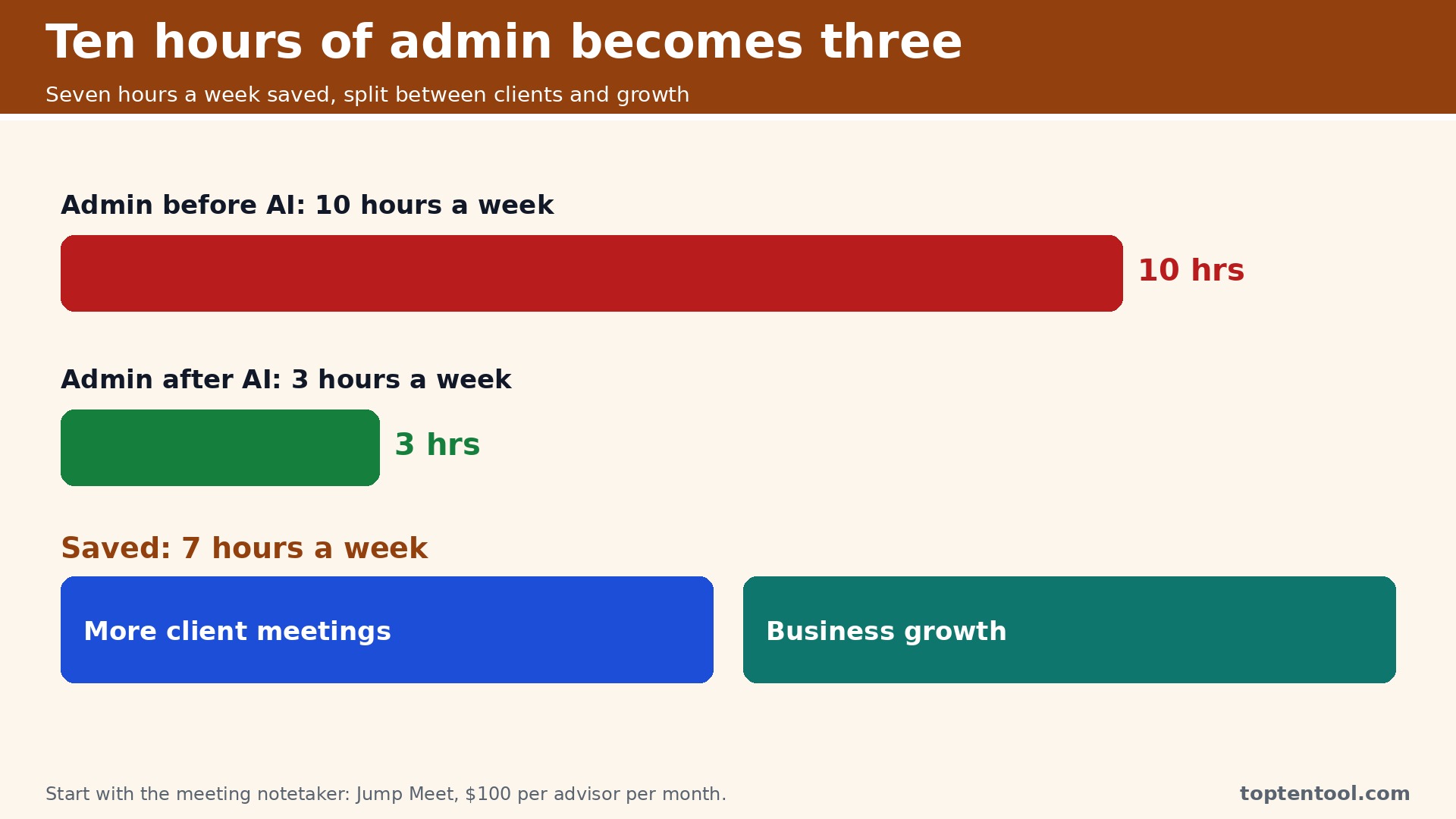
Three rules keep the spend on the best AI tools for financial advisors sensible. First, start with the meeting notetaker, because it saves hours every week from day one and the trial is free. Second, add one planning tool for the job you do most, tax or retirement, and measure the hours it saves for a month before you add a second. Third, check the recording and storage terms before you buy, because a tool that keeps audio creates a different compliance footprint from one that keeps notes only, and the archive integration matters when the regulator asks.
Frequently Asked Questions
Which AI tool should a financial advisor buy first
Among the best AI tools for financial advisors, Jump is the best first buy, because meeting notes and CRM updates eat the most hours every week and Meet costs 100 dollars an advisor a month. Add Holistiplan when tax planning becomes a regular job, and add Nitrogen when risk proposals matter.
Is it safe to record client meetings with AI
It is safe when the client consents, the recording terms are clear, and a human reviews every client facing output. Tools that store audio create a different record keeping footprint from tools that keep notes only, so Zocks suits a firm that wants no recording stored at all. Check the archive integration with Smarsh or Global Relay, and keep the notes under human review before they reach a client.
How much do AI tools cost a financial advisor per month
A solo advisor pays around 100 to 150 dollars a month for a meeting notetaker, and 160 to 270 dollars a month for a notetaker plus one planning tool. The planning tools are the bigger line, with Holistiplan Basic at 749 dollars a year and MoneyGuidePro at 2,000 dollars an advisor a year. Enterprise tools like Orion Denali AI and HireVue price by quote, so budget them separately.
Can AI write client emails and proposals
Yes, and the tools on this list draft them well, but a human must review every client facing output before it is sent. Jump drafts follow up emails from the meeting, Nitrogen drafts proposals from the risk conversation, and Wealthbox drafts client communications for advisor review. The AI drafts, the advisor decides, and the compliance archive keeps the record.
Our Verdict
If you buy one tool this quarter, buy Jump. It is the strongest meeting automation pick on this list, it costs 100 dollars an advisor a month for Meet, and the CRM write back means the admin actually disappears rather than moving to a different app. The best AI tools for financial advisors earn their keep by giving advisors their afternoons back, and Jump does that from the first week.
Whatever you pick, start with the meeting notetaker, keep a human reviewing every client facing output, and check the recording terms before you buy. The best AI tools for financial advisors on this list all work. The difference is whether the tool matches the job that eats your week, and whether you measure the return in hours given back to clients rather than in features used.