

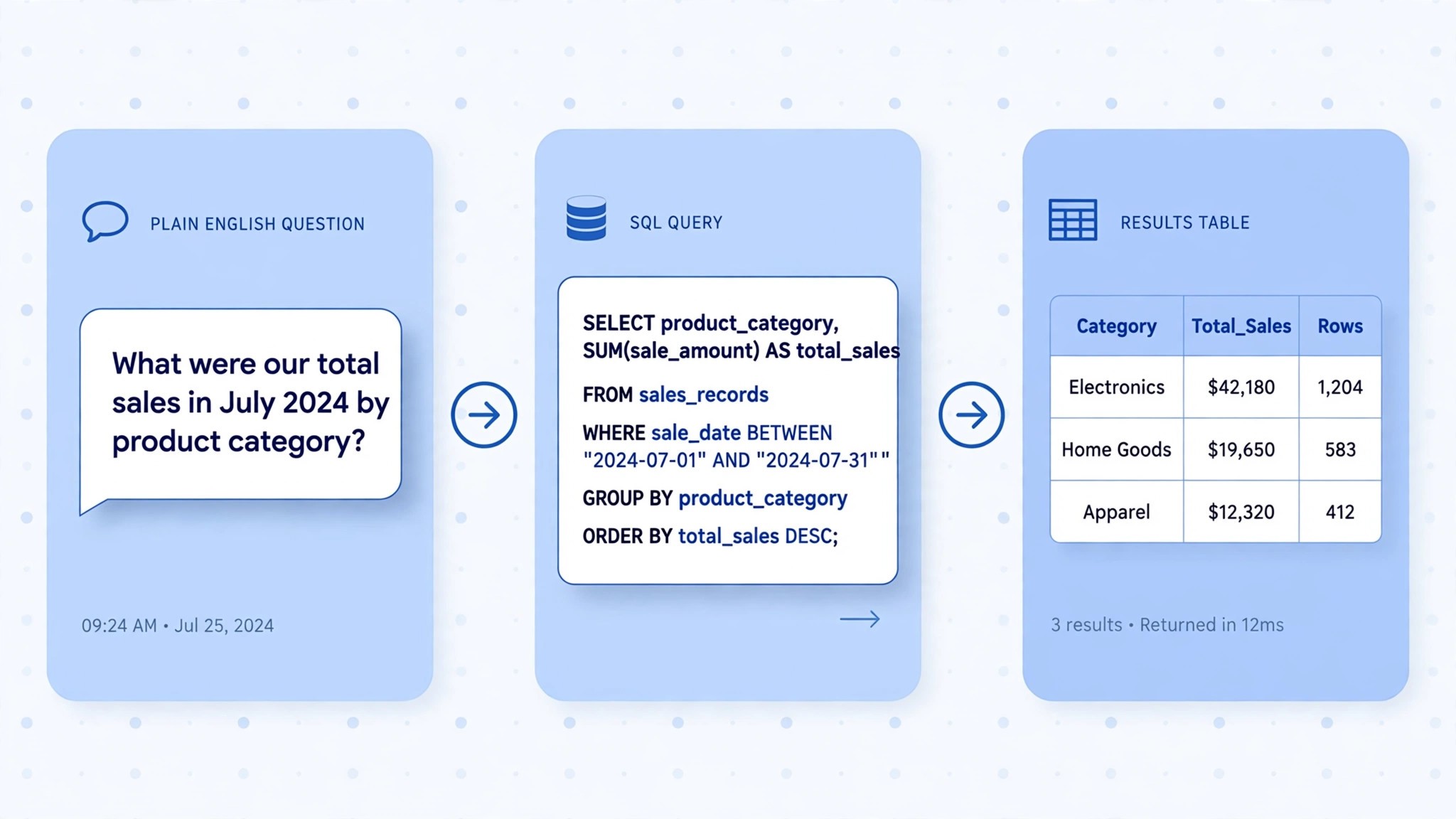
A business question that waits three days for an analyst is a question that never gets asked, and the queue for the data team is the bottleneck in most companies. The top 10 ai tools for sql queries exist because a plain-English question can now become working SQL in seconds, with an explanation of what the query does. This guide compares ten tools on published prices, the SQL job each one does best and the catch that only shows up after the trial ends.
The tools here split into three groups. Text-to-SQL generators such as Vanna, AI2SQL and Text2SQL.ai turn a question into a query to paste elsewhere. AI SQL clients such as Chat2DB and WrenAI work against a live database. General models such as ChatGPT and Claude write SQL well, but with no live connection by default. The right group depends on whether the user is a developer, an analyst or a manager who never wants to see SQL at all.
Every price below is the published starting price as of late 2026. The cheapest tools here cost five dollars a month, and the open-source options cost nothing to self-host, so price is rarely the reason to pick wrong. Use the shortlist first, then read the reviews that match the query jobs teams do most.
First, the Shortlist
The table below matches each common query task type to the single tool that handles it best. Use it to narrow the list to two or three top query candidates before reading the full reviews. Prices are monthly list prices unless noted, and annual billing usually beats monthly billing for data teams.
| Job | Best tool | Why it wins |
|---|---|---|
| Engineering teams that want text-to-SQL trained on their own schema | Vanna AI | Open source free; Vanna Cloud Explorer from 50 dollars a month |
| Analysts who want complex SQL syntax handled well | AI2SQL | Starter from 9 dollars a month; Pro from 24 dollars a month |
| Generating SQL to paste elsewhere, without sharing database credentials | Text2SQL.ai | Free to try; Pro from 29 dollars a month |
| Individuals who want the cheapest capable SQL generator | SQLAI.ai | Hobby from 5 dollars a month; Pro from 24 dollars a month |
| Developers who want an AI SQL client that covers thirty-plus databases | Chat2DB | Free community plan; Professional from 19 |
| Teams that want a semantic layer to fix schema confusion at the root | WrenAI | Free and open source; self-hosted |
| Business users who want to ask questions and get charts, not just SQL | AskYourDatabase | From 49 dollars per seat a month |
| Analysts who work across spreadsheets and databases in one place | Julius AI | From 20 dollars a month |
| Anyone who wants a general AI that also writes SQL well | ChatGPT | Plus from 20 dollars a month |
| Teams that want careful, well-explained SQL with strong reasoning | Claude | Pro from 20 dollars a month |
How We Picked the Winners
Only tools doing a real query job well in 2026 made this list for sql queries, not products with a fresh AI label on old software. The top 10 ai tools for sql queries were judged on five things that decide whether a buyer keeps paying after the first year.
The job came first, since a tool that does one query routine task well beats a platform that does five poorly for data teams. Published pricing and scaling came second, with per-seat charges that change the real bill for data teams as the team grows. Output quality came third, because a wrong query output error costs more than the subscription saves.
Fourth, how it fits the workflow it claims to serve for data teams, from integrations to the way core query data gets in and out. Fifth, the catch, from free plans that cap the useful query toolkit today to quote-only pricing that hides the real cost until the call.
| Check before you buy | What to ask | Why it matters |
|---|---|---|
| Published price | Is there a number on the pricing page | A quote-only tool hides the real cost |
| Free plan limits | What is capped or watermarked | A capped free plan cannot be tested properly |
| Data quality | Where does the AI get its facts | A wrong answer costs more than the subscription |
| Integrations | Does it connect to your current stack | A tool that sits alone gets abandoned |
| Contract terms | Monthly or annual, and what year two costs | Annual billing locks the price but not the need |
| Support and setup | How long to go live, and who helps | A tool that takes months to set up delays the return |
The Detailed Reviews

1. Vanna AI
Starting price Open source free; Vanna Cloud Explorer from 50 dollars a month. Best for Engineering teams that want text-to-SQL trained on their own schema.
Vanna is a Python framework that trains a retrieval layer on a database schema, documentation and past question-and-answer pairs, then generates SQL from new questions. Vanna 2.0 adds user identity, row-level security and audit logging, which is what turns a demo into something a team can run in production.
The catch is that it is a framework, not a polished app, so a team needs an engineer to build the interface around it.
Does text-to-SQL trained on your own schema beat a general chatbot at writing queries? With Vanna AI, the answer depends on the schema: a clean one trains well, a messy one does not. It is a framework, not a polished app, so expect setup work before the first good query. Ask for the renewal price in writing before the trial runs out, then trial it on live queries for a week.
2. AI2SQL
Starting price Starter from 9 dollars a month; Pro from 24 dollars a month. Best for Analysts who want complex SQL syntax handled well.
AI2SQL generates SQL from plain English across more than ten dialects, including MySQL, PostgreSQL, SQL Server, BigQuery and Snowflake. It handles joins, nested queries, aggregations and window functions better than most single-prompt tools, and it plugs into Slack, VS Code and Chrome.
The catch is that it has no permanent free tier, only a trial, and it struggles on multi-step analytical queries without a semantic layer.
At 9 dollars a month, AI2SQL only pays when the team leans on it for complex SQL syntax, and for that job it is one of the cheapest options here. The catch is the trial: there is no permanent free tier, only a trial, so the clock starts the day you sign up. Get that tier priced before the trial ends, then run it on queries for a week.
3. Text2SQL.ai
Starting price Free to try; Pro from 29 dollars a month. Best for Generating SQL to paste elsewhere, without sharing database credentials.
Text2SQL.ai turns a question and a pasted schema into SQL, with a plain-language explanation of what the query does, and it never touches a live database. That separation is the point for teams that cannot share credentials, and it also stretches into Excel formulas and regex.
The catch is that there is no live connection, so the user runs and checks the query themselves, and the paid plans are priced by volume.
Rule Text2SQL.ai out if the team needs a connection to the database, because there is none, and the SQL it generates is pasted elsewhere. For anyone who wants to generate SQL without sharing database credentials, that gap is the point: nothing connects, so nothing leaks. The free tier makes the trial cheap, but get the renewal price in writing first, then test it on queries for a week.
4. SQLAI.ai
Starting price Hobby from 5 dollars a month; Pro from 24 dollars a month. Best for Individuals who want the cheapest capable SQL generator.
SQLAI.ai keeps the loop simple: type a plain-English request, get ready-to-use SQL, and move on, with a free tier to test it first. Its low price makes it the easiest tool on this list to try, and the higher tiers add more queries and features without a big jump.
The catch is the narrow scope: it generates SQL well, but it does not offer the dashboards, alerts or semantic layer of the bigger platforms.
SQLAI.ai is a straight yes when the job is the cheapest capable SQL generator, and a straight no when the job needs anything more, because cheap is the whole pitch. At 5 dollars a month it is pocket change, but the value still shows up in hours saved, not in the price tag. Spend a week with it on live queries and keep a human eye on every output before it reaches a client.
5. Chat2DB
Starting price Free community plan; Professional from 19.80 dollars a month billed annually. Best for Developers who want an AI SQL client that covers thirty-plus databases.
Chat2DB is an open-source SQL client with AI built in, supporting more than thirty databases and ten-plus language models, including GPT-4o and Claude. It writes, explains and optimises queries inside the client, so a developer never leaves the tool they already use to browse tables.
The catch is that the AI features sit on the paid plan, and the interface carries more options than a non-technical user will want.
Three checks before Chat2DB earns a place on the shortlist. First, does the team work across many databases? The AI SQL client covers thirty-plus, and that breadth is the draw. Second, the AI features sit on the paid plan, so the free starting tier is a trial of the idea. Third, ask for that tier’s price before the trial ends, then try it on live queries for a week.
6. WrenAI
Starting price Free and open source; self-hosted. Best for Teams that want a semantic layer to fix schema confusion at the root.
WrenAI adds a semantic layer over the database, so the AI understands what a column means in business terms instead of guessing from a name. That layer is what makes its answers more reliable on complex questions, and self-hosting keeps the data inside the team infrastructure.
The catch is that self-hosting needs someone to run it, and the setup is heavier than a cloud tool that works out of the box.
The test for WrenAI is simple: if the team has someone to run a self-hosted tool, the semantic layer fixes schema confusion at the root, which is a deeper fix than any query generator offers; without that person, it will stall. Check the renewal terms in writing before the trial clock runs out, then use it on live queries for a week and compare every output with your records.
7. AskYourDatabase
Starting price From 49 dollars per seat a month. Best for Business users who want to ask questions and get charts, not just SQL.
AskYourDatabase connects to a live database and answers plain-English questions with results and charts, so a manager can ask a question without learning SQL. Its chat interface suits a team that asks the same questions every week, because the answers stay in the conversation history.
The catch is the per-seat price, which adds up across a team, and the accuracy depends on how well the schema is documented.
At 49 dollars per seat a month, AskYourDatabase earns its keep only when the team actually asks questions and gets charts, not just SQL, and the per-seat price adds up across a team, so multiply before you commit. Accuracy depends on the schema, so a messy schema will produce confident-looking charts that are wrong. Ask what that tier costs before the trial ends, then let it run on live questions for a week.
8. Julius AI
Starting price From 20 dollars a month. Best for Analysts who work across spreadsheets and databases in one place.
Julius AI answers questions about data from spreadsheets and database connectors, with charts and summaries that a non-technical user can read. It suits a team that does not have a data team, because the AI does the joining, aggregating and charting that used to need an analyst.
The catch is that it is a general data analyst, not a SQL specialist, so a developer who wants precise dialect control will prefer a dedicated tool.
Set against the SQL specialists, Julius AI trades depth for range: it is a general data analyst, not a SQL specialist, and that is the right trade for an analyst who works across spreadsheets and databases. For a team that needs pure SQL depth, it is the wrong buy. Confirm the tier before the trial runs out, then work with it on live analysis for a week.
9. ChatGPT
Starting price The Plus plan costs 20 dollars a month to start. Best for Anyone who wants a general AI that also writes SQL well.
ChatGPT writes, explains and debugs SQL across every major dialect, and it can reason through a schema pasted into the chat. Its strength is flexibility: the same subscription that writes a query can also draft the report that explains what the query found.
The catch is that it has no live database connection by default, so the user pastes the schema and runs the query themselves, and the SQL must be checked before it runs on production data.
ChatGPT fits when the job is a general AI that also writes SQL well, and at 20 dollars a month it is the cheapest generalist here, though it has no live database connection and every query has to be pasted in by hand. Get the renewal price in writing, then run it on real work for a week and judge whether the SQL it writes matches your schema.
10. Claude
Starting price The Pro plan is priced from 20 dollars a month. Best for Teams that want careful, well-explained SQL with strong reasoning.
Claude writes SQL with clear explanations of each step, and it is strong at spotting a flawed join or a filter that will return the wrong rows. Its long context window suits a large schema pasted in full, and the explanations help a junior analyst learn while they work.
The catch is the same as ChatGPT: no live connection by default, and the generated SQL still needs a human check before it touches real data.
Claude is a strong fit when the job that eats the week is careful, well-explained SQL with strong reasoning, and a weak one when it is not. Test Claude on live files for a full working week, and keep a human eye on every output before it reaches a client. At 20 dollars a month, Claude’s value shows up in hours saved, so count those hours before counting features.
The Full Comparison
The table below puts the top 10 ai tools for sql queries side by side on price, best job and free plan, so you can compare the published prices against the quote-only tools at a glance. The cheapest way to read it is by query job type, not by price, because a tool that costs little and cannot do the job is more expensive than a tool that costs more and does it well.
| Tool | Starting price | Best for | Free plan |
|---|---|---|---|
| Vanna AI | Open source free; Vanna Cloud Explorer from 50 dollars a month | Engineering teams that want text-to-SQL trained on their own schema | Trial only |
| AI2SQL | Starter from 9 dollars a month; Pro from 24 dollars a month | Analysts who want complex SQL syntax handled well | Trial only |
| Text2SQL.ai | Free to try; Pro from 29 dollars a month | Generating SQL to paste elsewhere, without sharing database credentials | Yes |
| SQLAI.ai | Hobby from 5 dollars a month; Pro from 24 dollars a month | Individuals who want the cheapest capable SQL generator | Trial only |
| Chat2DB | Free community plan; Professional from 19 | Developers who want an AI SQL client that covers thirty-plus databases | Yes |
| WrenAI | Free and open source; self-hosted | Teams that want a semantic layer to fix schema confusion at the root | Yes |
| AskYourDatabase | From 49 dollars per seat a month | Business users who want to ask questions and get charts, not just SQL | Trial only |
| Julius AI | From 20 dollars a month | Analysts who work across spreadsheets and databases in one place | Trial only |
| ChatGPT | Plus from 20 dollars a month | Anyone who wants a general AI that also writes SQL well | Trial only |
| Claude | Pro from 20 dollars a month | Teams that want careful, well-explained SQL with strong reasoning | Trial only |
Best Pick by Job: the top 10 ai tools for sql queries by role
The top 10 ai tools for sql queries are not the ones with the longest feature list. Those tools fix the slowest part of the week, and for sql queries that part depends on the query work role. The table below names one pick per role, so a buyer can skip the full reviews and start with the query work tool that fits the job.
| Role | Best pick | Why |
|---|---|---|
| Solo practitioner | Vanna AI | Engineering teams that want text-to-SQL trained on their own schema |
| Small team | AI2SQL | Analysts who want complex SQL syntax handled well |
| Growing business | Text2SQL.ai | Generating SQL to paste elsewhere, without sharing database credentials |
| Enterprise buyer | SQLAI.ai | Individuals who want the cheapest capable SQL generator |
| Budget buyer | Chat2DB | Developers who want an AI SQL client that covers thirty-plus databases |
How to Decide This Week
Begin with the slowest query pain point, not the vendor homepage. The top 10 ai tools for sql queries earn their keep by giving back the hours a manual process used to eat, and the right one is the tool that fixes the bottleneck you actually feel, not the one with the longest feature list. Trial it on real query work, with real data, before committing to annual billing.
Price the whole query work bill, not the headline. Per-seat charges, add-ons and setup fees are the lines that surprise data teams, so get them in writing before signing, and annual billing usually saves about twenty percent. Ten dollars a seat looks cheap until sql queries multiply it by fifty seats.
Run the trial in five steps for data teams. First, pick the two tools from the shortlist that match the core query task. Second, load real data from the team’s own query work, not a vendor demo. Third, do the core query routine task three times and time it. Fourth, check the query work output against a reference the team trusts. Fifth, price the full year, including seats and add-ons, before sql queries sign.

The Fine Print in 2026
The query work prices in this guide shifted several times during 2026, so a January homepage number often differed by November. Treat each price as a starting point for data teams, confirm it on the vendor page, and get the renewal price in writing before an annual contract. The cheapest homepage plan is rarely the one a working data teams keeps.
Watch accuracy second. AI summaries, scores and predictions for data teams are drafts, not verdicts, and tools grounded in the team’s own query case files beat tools guessing from general knowledge. Test outputs on real query files today with a human check before anything reaches a client, and count the cost of one wrong answer against a month of subscription.
Whether the tool connects decides whether data teams still use it in a month. Products wired into the CRM, the practice system or the team’s database get adopted, since the core query figures already lives there. Products needing weekly manual exports get abandoned by data teams, however smart the demo looks. Check the vendor integration list and trial the one query work connection that matters most.
Data handling matters more in 2026 than it did two years ago for data teams. Ask where the live query data is stored, whether it is used to train models, and what happens to it when the subscription ends. The answer should be in the vendor terms for data teams, not in a sales email. For health, legal and financial query work, a signed data agreement and a clear retention policy are not optional extras.
Run the trial like a test, not a tour, for data teams. Take two tools from the shortlist, load real query records now, repeat the core job three times and measure the hours saved. No real query work saving in two weeks means no saving in a year for data teams. That discipline is what keeps a query work purchase from becoming a subscription that quietly renews.
| Year-one cost check | What to count | Why buyers miss it |
|---|---|---|
| Seats | Every user, not just the first | Per-seat pricing multiplies fast |
| Add-ons | AI features, integrations, support | The core job often needs a paid tier |
| Implementation | Setup, migration, training | Enterprise tools charge for onboarding |
| Renewal | Year-two price, not the intro offer | Discounts expire and prices rise |
FAQ
What is the cheapest good query work option to start with
The cheapest credible start depends on the core query task, and the free plans here are the right first step. Trial the tool that matches the main query daily task on real work for two weeks, and only pay when the free plan hits a limit you actually feel. The top 10 ai tools for sql queries that cost the least are not always the cheapest in year one, because per-seat charges and add-ons change the real bill.
Will the AI output be accurate enough for sql queries to trust
It will be accurate enough to draft for data teams, not accurate enough to publish unchecked. Every tool on this list can produce a wrong answer, a wrong number or a fabricated citation, so a human must check the query work output against a trusted source before it goes to a client. The tools that ground their answers in the team’s own query numbers here are safer than the ones that guess from general knowledge.
Do sql queries need one query software tool or a stack of two
One general tool plus one specialist covers most everyday query buyers. The general tool does the everyday query standard job, and the specialist fixes the single weekly pain it cannot handle, from bulk review to deep research. Buying three at once is the classic mistake for sql queries, since the second and third subscriptions sit idle while the first does the work.
How much should small data teams budget in year one
A realistic year-one budget is the monthly price times twelve, plus twenty percent for seats, add-ons and implementation for data teams. A solo buyer can run most of these query work tools for under fifty dollars a month. A team of ten should budget for the per-seat price on every seat for data teams, not just the first, and should ask the vendor for the year-two price in writing.
Can data teams switch query work tools later without losing work
Yes, with exports done as data teams go. Hold source data in the team’s own system, export clean query summaries and plans often, and skip any tool that charges to release history. Tools on this list that connect to a CRM, EHR or database ease switching, since the data of record stays in a system sql queries already own.
What should data teams check on the free query trial run
Three checks decide the trial for sql queries: accuracy on real query records now, fit with the workflow the team already uses, and a price at the team’s size that can be defended. Demo-only trials tell nothing, so load real query work, bring in the daily users, and measure the time saved in week one.
Where We Land
If you buy one tool this quarter, buy Vanna AI if it matches the job you do most each week, and buy AI2SQL if your work leans the other way. The top 10 ai tools for sql queries earn their keep by giving you back the hours a manual process used to eat, and both of these do that from the first week. Begin with the slowest query pain point, trial on real work, and check every AI output by eye before a client sees it, for sql queries.
Judge any pick by hours saved and faster query work decisions, not by feature count, for sql queries. Every tool here works. What differs is the match to the team’s real query work, and whether the tool is still in use a year from now. That is the test each purchase must pass, and the test this guide helps data teams run.