
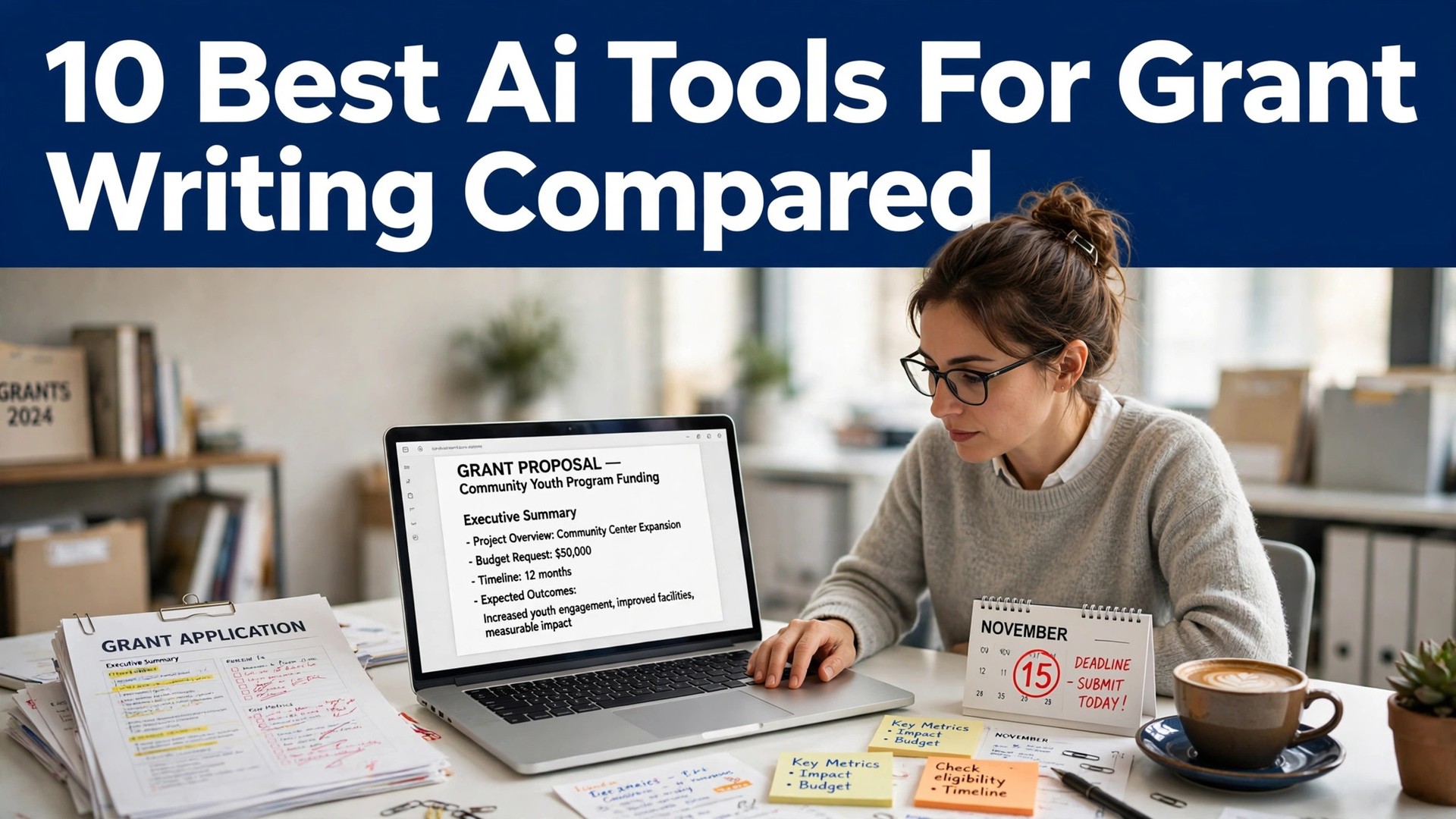
An AI-assisted grant application can be prepared in three to five days, against thirty to fifty days for a fully manual one, according to a 2025 study. The top 10 ai tools for grant writing below are the ones that actually deliver that saving, with real prices checked in late 2026 and the funder AI rules stated plainly, because some funders restrict AI text in parts of the proposal.
Grant writing has two separate jobs, and buyers confuse them: finding the right funder, and writing a proposal that funder will fund. A database does the first, a drafting tool does the second, and only a few tools do both well. This guide shows which job each tool does, so a nonprofit can buy the piece it actually needs first.
This guide compares ten tools on published prices, the grant job each one does best and the catch that only shows up after the trial ends. All prices below are published starting prices as of late 2026 for grant writing, or marked pricing on request where a vendor publishes no proposal writing rate. Use the shortlist first, then read the reviews that match the proposal writing jobs grant writing do most.
The Shortlist at a Glance
Use it to narrow the top 10 ai tools for grant writing to two or three candidates before you read the full reviews. Prices are monthly list prices unless noted, and annual billing usually beats monthly billing for fundraising teams.
| Job | Best tool | Why it wins |
|---|---|---|
| AI drafting from your own content library | Grantable | Drafts that sound like your organisation |
| Funder matching and proposal drafts | Granted AI | Find the grant, then draft the proposal |
| The deepest funder database | Instrumentl | Discovery first, drafting second |
| Cheap discovery with AI search | GrantWatch | The cheapest way into grant discovery |
| Fast drafts with brand-voice training | Grantboost | A fast first draft, in your voice |
| A general assistant for the whole proposal | ChatGPT | The draft that beats the blank page |
| Long, careful proposal writing | Claude | The careful editor for a long narrative |
| A large database, lightly AI-assisted | GrantStation | Discovery with a long track record |
| The reference database for funders | Candid Foundation Directory | Research that funders themselves trust |
| A grant platform for UK and EU teams | FundRobin | Grants with UK and EU compliance built in |
How We Chose the Top 10 AI Tools for Grant Writing
Only tools doing a real proposal writing job in 2026 made this list for grant writing, not products with a fresh AI label on old software. The top 10 ai tools for grant writing were judged on five things that decide whether a team keeps paying after the first year.
First, the job itself, since fundraising teams get more from a tool that handles one proposal writing task well than from a platform that handles five badly. Second, whether the price is published and how it grows, because per-seat charges change what grant writing really pay as the team grows. Third, output quality, since a proposal writing mistake costs more in rework than the subscription saves.
Fourth came system fit, since grant writing lose the time saved when a tool cannot connect to the records they already keep for proposal writing. Fifth came the catch, from free tiers that cap the useful proposal writing features to enterprise pricing that hides behind a sales conversation.
| Check before you buy | What to ask | Why it matters |
|---|---|---|
| Published price | Is the rate on the pricing page | A hidden price is a hidden bill |
| Free plan limits | Usage caps, watermarks or seats | A capped free plan cannot run the real job |
| Integration | Does it connect to your core system | Double entry eats the time it saves |
| Compliance | BAA, retention and consent | A fast output that breaks the rules is a risk |
| Trial access | Can you test it on real work | A demo is not a trial |
| Contract terms | Monthly or annual, and what year two costs | Annual billing locks the price but not the need |
The Reviews in Full
1. Grantable
Starting price Free plan, then Starter from 50 dollars a month. Best for Nonprofits that want the full grant workflow. Watch out Free plan caps messages at 5 a day.
Grantable is an AI-native grant workspace, with funder discovery from IRS 990 data, AI proposal drafting from your own content library, RFP requirements turned into checklists, and deadline tracking in one place. The Starter plan from 50 dollars a month covers the whole team with no per-seat fees, and the free plan is enough to test the drafting on a real proposal.
The free plan caps chat messages at five a day, so a working grant writer will need Starter quickly. The Pro plan at 150 dollars a month adds more messages and capacity. For a nonprofit that writes grants every month, Grantable is the most complete tool on this list, because it covers discovery, drafting and tracking without a second login.
That is the test to apply to the top 10 ai tools for grant writing as a group: the tool that saves an hour a week on real work pays for itself, and the tool that needs constant correction does not, however cheap the headline looks.
2. Granted AI
Starting price Free plan, then Basic from 29 dollars a month. Best for Grant discovery plus drafting. Watch out Basic caps drafts at 3 a month.
Granted AI combines a searchable grant database with AI proposal drafting, matching a nonprofit to federal, state, foundation and corporate grants and then drafting the proposal from the RFP. The Basic plan from 29 dollars a month, or 18 dollars billed annually, covers three drafts a month, and Professional at 89 dollars a month adds unlimited drafts.
The Basic cap of three drafts a month is tight for a team that applies often, so the Professional tier is the realistic pick for a working writer. Granted AI also offers a refund if a team submits three proposals in a year and none is funded, on its stated terms. For a small nonprofit that needs both discovery and drafting, it is the best value here.
3. Instrumentl
Starting price From 299 dollars a month billed annually. Best for Discovery-heavy teams with budget. Watch out AI drafting needs the 499 dollar tier.
Instrumentl is the deepest grant-discovery platform on this list, with hundreds of thousands of funder profiles and tens of thousands of active RFPs, plus pipeline tracking and, on the higher tiers, AI drafting help. The Discover tier from 299 dollars a month billed annually covers up to three users, and the Pre-Award tier at 499 dollars adds the AI drafting.
The price puts Instrumentl out of reach for many small nonprofits, and the entry tier does not include the AI writing, so a buyer should price the tier that actually drafts. For a team that lives on discovery and tracks dozens of applications, Instrumentl is the best database here. For a team that mainly needs drafting, Grantable is cheaper.
4. GrantWatch
Starting price From 49 dollars a month. Best for Cost-sensitive teams that apply occasionally. Watch out Token-metered AI, watch the usage.
GrantWatch lists thousands of human-verified grants, with AI search and writing features on a token-metered model. The price from 49 dollars a month, or 249 dollars a year, makes it the cheapest discovery tool on this list, and the weekly option at 22 dollars a week suits a team that applies in bursts.
The token model means the AI usage has a meter, so a heavy drafting week can cost more than the headline price. For a small nonprofit that applies a few times a year, GrantWatch is the right shape. For a team that drafts every week, a flat-rate tool like Grantable is easier to budget.
5. Grantboost
Starting price From 32 dollars a month. Best for Quick proposal generation. Watch out Smaller feature set than Grantable.
Grantboost generates grant proposals quickly, with brand-voice training on the Growth plan and up, so the draft reads like the organisation, not like a template. The starting price from 32 dollars a month covers a workspace, and the tool is built for speed: a first draft in minutes, not days, with funder data alongside.
The feature set is smaller than Grantable, with less tracking and less pipeline work, so a team that needs the full workflow will outgrow it. For a consultant or a small nonprofit that needs a fast, clean first draft and nothing else, Grantboost is the cheapest specialist here. Trial it on a real RFP, because the draft quality is the test.
6. ChatGPT
Starting price A free plan is available, and Plus begins at 20 dollars a month. Best for Drafting, budgets and general grant work. Watch out No funder data and no compliance checks.
ChatGPT Plus, from 20 dollars a month, drafts proposal sections, builds budget narratives, summarises a long RFP and turns rough notes into clean copy. A grant writer who uses it for first drafts and for the admin around a proposal will save days on each application, and the tool is already familiar to most teams.
ChatGPT has no funder database, no RFP checklist and no compliance checking, so a writer still needs to verify every funder rule by hand. It also needs careful prompting to match a funder voice. Used as a drafting assistant beside a discovery tool, it is the most useful twenty dollars on this list. Used alone, it leaves the hardest parts undone.
7. Claude
Starting price Free plan, then Pro from 20 dollars a month. Best for Long-form narratives and careful editing. Watch out No funder data, needs a human check.
Claude Pro, from 20 dollars a month, is strong on long-form writing, holding a whole proposal in context and keeping the voice consistent across sections. A grant writer working on a long narrative, a logic model or a detailed budget justification will find Claude the most careful of the general tools, with edits that respect the original meaning.
Like ChatGPT, Claude has no funder database and no compliance checks, so the writer must verify every funder rule. The value is the writing quality on long documents, where other tools lose the thread. For a nonprofit that writes long federal proposals, Claude beside Grantable is a strong pairing. For short proposals, ChatGPT does the same job.
8. GrantStation
Starting price Pricing on request. Best for Teams that want a large grant database. Watch out No AI drafting built in.
GrantStation is a long-running grant database, with a large listing of federal, state and foundation opportunities and tools for tracking deadlines and funders. It is a discovery tool first, with limited AI drafting, so a team buys it for the breadth of the database and the reliability of the listings.
The price is quoted, and the AI features are lighter than Grantable or Granted AI, so a team that wants drafting should pair it with a writing tool. For a team that already has a writer and needs the widest possible funder list, GrantStation is a solid database. For a team that needs the draft as well, a combined tool is cheaper.
9. Candid Foundation Directory
Starting price Pricing on request. Best for Research-heavy teams and large nonprofits. Watch out Enterprise pricing, no public rate.
Candid Foundation Directory is the reference database for foundation funding, with detailed funder profiles, giving history and grant records that a serious researcher trusts. A large nonprofit or a consultant who needs to verify a funder before approaching will find it the deepest source on this list.
The price is quoted and sits at the enterprise end, so a small nonprofit should look at Instrumentl or GrantWatch first. Candid is a research tool, not a drafting tool, and it pairs with Grantable or Claude for the writing. Buy it when the research matters more than the draft, which is true for a large or complex application.
10. FundRobin
Starting price From 49 pounds a month. Best for UK and EU nonprofits. Watch out UK-first, smaller US coverage.
FundRobin is a grant platform built first for UK and EU nonprofits, with funder data, compliance checks and drafting that respect UK and EU rules. The starting price from 49 pounds a month covers a workspace, and the tool is the best pick on this list for a team that applies mainly to UK or EU funders.
The US coverage is smaller than the US-first tools, so an American nonprofit should buy Grantable or Instrumentl instead. For a UK charity, the compliance fit and the local funder data are worth the price. Trial it on a real UK application, because the funder match is the test that matters.
The Tools Compared
The table below puts the top 10 ai tools for grant writing side by side on price, best job and free plan, so you can compare the published prices against the quote-only tools at a glance.
Read the table by proposal writing job, not by price, because a cheap tool that cannot do the job costs fundraising teams more than a dearer one that finishes it in one pass. Reworking the output eats roughly an hour per job. Scan the best-for column first, then the price, and the right proposal writing pick for grant writing is usually clear in under a minute.
| Tool | Starting price | Best for | Free plan |
|---|---|---|---|
| Grantable | Free plan, then Starter from 50 dollars a month | Nonprofits that want the full grant workflow | Yes |
| Granted AI | Free plan, then Basic from 29 dollars a month | Grant discovery plus drafting | Yes |
| Instrumentl | From 299 dollars a month billed annually | Discovery-heavy teams with budget | Trial |
| GrantWatch | From 49 dollars a month | Cost-sensitive teams that apply occasionally | No |
| Grantboost | From 32 dollars a month | Quick proposal generation | Trial |
| ChatGPT | Free plan, then Plus from 20 dollars a month | Drafting, budgets and general grant work | Yes |
| Claude | Free plan, then Pro from 20 dollars a month | Long-form narratives and careful editing | Yes |
| GrantStation | Pricing on request | Teams that want a large grant database | Trial |
| Candid Foundation Directory | Pricing on request | Research-heavy teams and large nonprofits | No |
| FundRobin | From 49 pounds a month | UK and EU nonprofits | Trial |
Choosing for the Job You Do Most
Buy for the slowest hour of the proposal writing week, not for the shiniest homepage. When one proposal writing task eats the week, the tool built for that task is the first purchase. When admin tasks eat the week, the automation is the purchase to make first. Fix the slowest proposal writing job first and the rest of the list can wait.
Work out what the full bill will be, rather than trusting the headline price. The table below shows what a solo buyer and a small team actually pay in year one for the usual proposal writing combinations, using published starting prices. Per-seat charges surprise fundraising teams most, so ask for them in writing before signing, and annual billing usually saves about twenty percent against monthly billing.
| Stack | Monthly cost | What it covers |
|---|---|---|
| Grantable plus Granted AI | Check the pricing page | Core tool plus a second specialist |
| Granted AI alone | Lowest starting price | One tool for the main job |
| Grantable plus Instrumentl | Mid-range | Core tool plus a workflow specialist |
| Instrumentl plus Granted AI | Mid-range | Specialist pair for a busy week |
Check the exit before the price. grant writing can leave a tool that exports their proposal writing work cleanly in an afternoon, while a tool that locks it in costs months to quit. Read the export formats, data ownership and contract length on the pricing page first, because those lines decide what happens when fundraising teams outgrow the tool.
Best Pick by Job
Pick from the table below by the job grant writing do most each week. The top 10 ai tools for grant writing are not ranked by features alone; they are ranked by which job each one actually finishes, so the pick that matches your week is the pick that will still be in your stack a year from now.
| Your job | Best pick | Why it wins |
|---|---|---|
| AI drafting from your own content library | Grantable | Drafts that sound like your organisation |
| Funder matching and proposal drafts | Granted AI | Find the grant, then draft the proposal |
| The deepest funder database | Instrumentl | Discovery first, drafting second |
| Cheap discovery with AI search | GrantWatch | The cheapest way into grant discovery |
| Fast drafts with brand-voice training | Grantboost | A fast first draft, in your voice |
| A general assistant for the whole proposal | ChatGPT | The draft that beats the blank page |
| Long, careful proposal writing | Claude | The careful editor for a long narrative |
| A large database, lightly AI-assisted | GrantStation | Discovery with a long track record |
| The reference database for funders | Candid Foundation Directory | Research that funders themselves trust |
| A grant platform for UK and EU teams | FundRobin | Grants with UK and EU compliance built in |
Testing Before You Pay
A trial tells fundraising teams more in five working days than a month of reading reviews, but only when the trial runs on real proposal writing work. Pick the two tools that look closest after the shortlist, run them side by side on the same proposal writing jobs, and score them on time saved, edits needed and how the output reads to a colleague. Never trial on a demo file, because a demo hides the rough edges real proposal writing work exposes.
| Day | What to test | What good looks like |
|---|---|---|
| Day 1 | Setup and first real job | Working in under an hour, no IT ticket |
| Day 2 | The hardest job you do | Output needs light edits, not a rewrite |
| Day 3 | Integration with your core system | Data flows without double entry |
| Day 4 | A colleague tries it cold | They finish a job without asking for help |
| Day 5 | Count the time and the cost | Hours saved beat the monthly price |
Keep a simple log through the trial week, noting the proposal writing job, the minutes it took, the edits made and whether the output could go out unchecked. At the end of the week the log is the decision for fundraising teams. The tool with the best log wins, even when it was not the expected favourite, because the log measures the team’s own proposal writing work, not the vendor demo.
What Not to Do When You Buy
The first mistake is buying the cheapest proposal writing plan and then finding the needed feature two tiers higher. Read the pricing page tier by tier before fundraising teams pay, and price the tier that does the job, not the one that looks cheap. The second mistake is buying for the whole team before one person has used the tool for a week, because a tool one person loves and five ignore is a cost for fundraising teams, not a system.
The third mistake is skipping the data and compliance check for fundraising teams. Ask for the data agreement, read the retention policy and check the consent wording before the first real proposal writing record goes through the tool, because fixing compliance after the fact costs far more than checking it first. The fourth mistake is judging the tool on its best day, so trial it on the hardest proposal writing job and let the hard job decide.
Frequently Asked Questions
What is the cheapest good proposal writing tool to start with
Grantable is the cheapest credible start on this list at free plan, then starter from 50 dollars a month, and Granted AI at free plan, then basic from 29 dollars a month is close behind. The top 10 ai tools for grant writing include free tiers and free plans, so start with the job you do most each week, trial the free tier on real work, and add a specialist only when the general tool cannot do a job you are paid to do. That is the cheapest way to build a proposal writing stack without paying for features never opened.
Will AI output for grant writing look the same as every other team’s
It will when fundraising teams publish the template unchanged. AI tools draft a usable first version, but the facts, the wording and the judgement still come from the professional doing the proposal writing work. An output that goes out unedited reads generic, and clients notice generic proposal writing fast. Use the AI to beat the blank page, then change the details, the wording and the checks, so the result sounds like fundraising teams and not the tool.
Which tool suits small fundraising teams best
Granted AI is the best pick for a small team, because it starts at free plan, then basic from 29 dollars a month and needs almost no setup, while Grantable at free plan, then starter from 50 dollars a month is the strongest all-round choice once the team grows. The top 10 ai tools for grant writing were ranked by the job each one finishes, not by the size of the feature list, so a small team should buy the tool that fixes its slowest weekly job first and add a second tool only when a specific limit starts costing time.
How much should small fundraising teams budget in year one
A realistic year one budget is 20 to 50 dollars a month for one general tool such as Granted AI, and 100 to 200 dollars a month once you add a specialist such as Instrumentl. Any fundraising teams paying per seat should multiply the headline price by the headcount before budgeting, because per-seat charges are the lines that surprise buyers. Budget for the proposal writing stack, not for one tool, and trial each one on real work before you commit to annual billing.
Do grant writing need a separate tool for this proposal writing job
Usually not. One general tool covers most proposal writing for months, and a specialist earns its place only when one proposal writing job repeats weekly and the general tool handles it badly. Measure the week before buying. A job that takes hours and drops to minutes with a specialist is worth paying for, while a job that already takes minutes makes the specialist a cost for fundraising teams.
Can fundraising teams trial these proposal writing tools before paying
Most of the tools on this list offer a free plan or a free trial, and Grantable and Granted AI both let you test on real work before paying. Use the trial on the job grant writing do most, not on a demo, and count the time saved and the edits each output needs. A trial that covers a real week of proposal writing tells you more than a sales call, and a tool that will not trial is a tool to be careful about.
Our Recommendation
If you buy one tool this quarter, buy Grantable if you want discovery, drafting and tracking in one workspace, and Granted AI if you want the cheapest specialist that does both. Grantable Starter runs 50 dollars a month, and Granted AI Basic runs 29 dollars a month. The top 10 ai tools for grant writing earn their keep when a proposal goes out days sooner, and both of these do that from the first application.
Whatever you pick, check the funder AI policy before you submit, verify every funder rule by hand, and keep a human editor on every proposal. The tools on this list all work. The difference is whether the tool matches the grants you actually apply for, and whether you measure the return in proposals submitted on time rather than in features used.