Every team that compares Zoom and Google Meet faces the same trade, and learning how to switch from Zoom to Google Meet starts with naming it plainly.
Zoom gives you 30 hour paid meetings, 300 person rooms on the Business plan, and local recording on the free plan. Google Meet gives you 60 minute free group calls, one on ones with no time limit, and a paid plan that starts at half the price of Zoom Pro, with Gmail, Drive, and Calendar included. The right choice depends on whether the team lives in Google Workspace already, how large its meetings run, and whether it needs webinars or just daily calls. This guide covers the full switch, with the real prices, the real limits, and the steps that keep meetings and recordings safe.
The switch is common for a simple reason. Google Meet comes inside Google Workspace, so a team that already pays for Gmail and Drive gets meetings for little extra cost. Zoom is a separate product with a separate bill, and its cheapest paid plan costs 14.16 dollars per user per month on annual billing, against 7 dollars for Workspace Business Starter. For a ten person team, that gap is about 70 dollars a month, or 850 dollars a year, before any other Workspace value is counted. A team that already uses Google tools is paying for Meet whether it uses it or not, which makes Zoom a duplicate cost.
This guide walks through how to switch from Zoom to Google Meet in seven steps, with a checklist, a cost comparison, and a clear account of what transfers, what does not, and what to test before cancelling Zoom. Follow the steps in order, run both tools side by side for two weeks, and the move will be boring in the best way. Skip the steps, cancel early, and recurring meetings, recordings, and calendar links can break without warning.
Why Teams Switch from Zoom to Google Meet
Price is the reason most teams switch, and the gap is wide. Zoom Workplace Pro costs 14.16 dollars per user per month on annual billing, or 16.99 dollars monthly, for 100 participants and 10 gigabytes of cloud recording per user. Zoom Business costs 18.33 dollars per user per month on annual billing, or 21.99 dollars monthly, for 300 participants. Google Workspace Business Starter costs 7 dollars per user per month on an annual plan, or 8.40 dollars on a flexible plan, for 100 participants plus business Gmail, Drive, Docs, and Calendar.
Business Standard costs 14 dollars a month for 150 participants with Meet recording, breakout rooms, and polls, and Business Plus costs 22 dollars for 500 participants with attendance tracking.
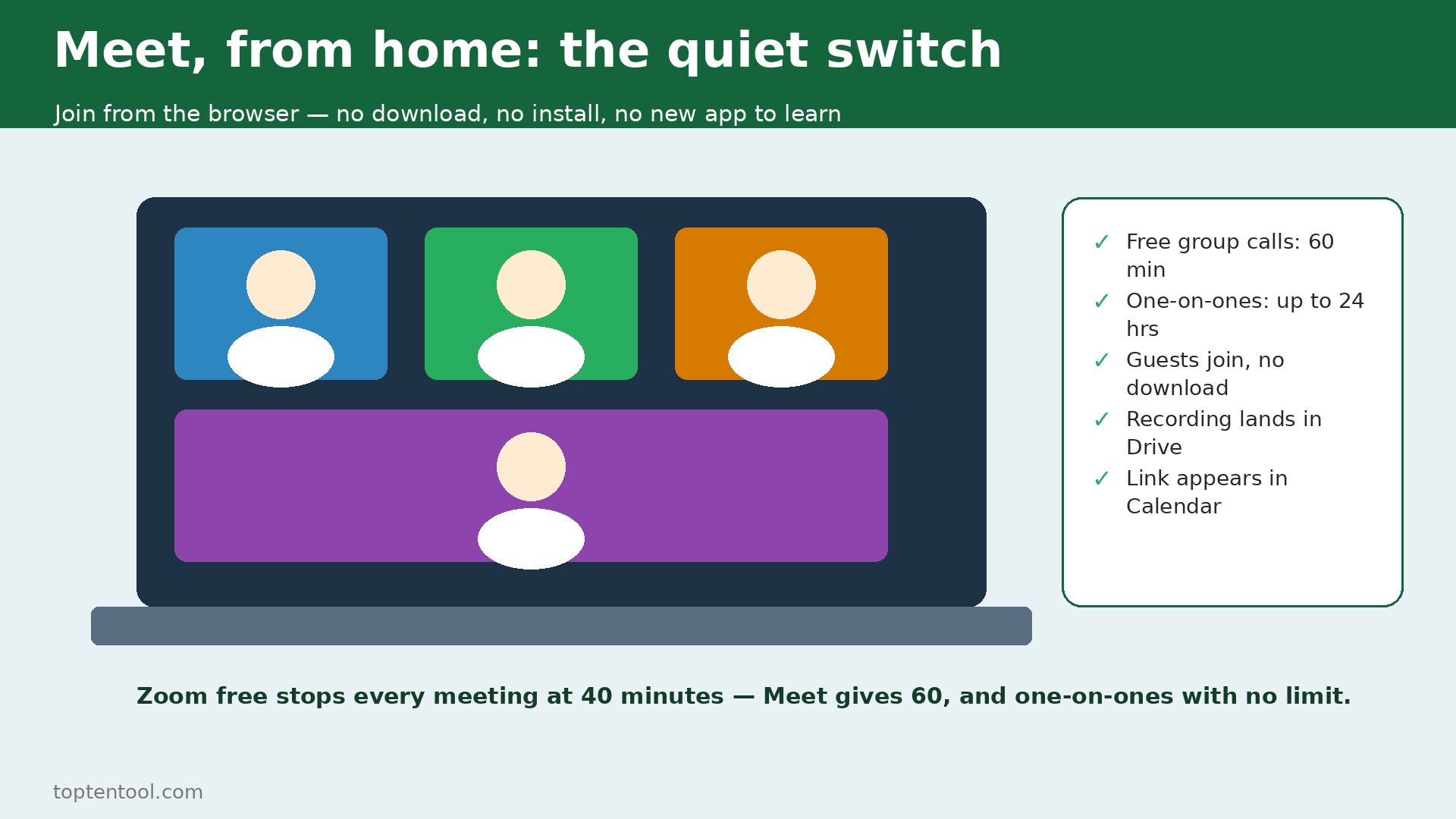
The free plan gap is just as wide. Google Meet allows group calls of up to 60 minutes with 100 participants, and one on one calls can run up to 24 hours. Zoom Basic limits every meeting to 40 minutes, including one on ones, with 100 participants. A team that runs daily standups or client calls on a free plan will hit the Zoom 40 minute wall constantly, while Meet gives an extra twenty minutes on group calls and no limit on one on ones. That difference alone pushes many small teams to Meet before they ever pay for a plan.
Simplicity is the second reason. Meet lives inside Gmail and Google Calendar, so a meeting link appears in the calendar invite automatically, guests join from the browser with no download, and the recording lands in Drive. Zoom needs a separate app, a separate link, and a separate recording store. A team that already works in Google tools finds Meet invisible in the best way, because there is nothing new to install and nothing new to learn. The meeting just appears where the team already works.
The third reason is the bundle. Workspace Starter at 7 dollars includes business email, 30 gigabytes of Drive storage per user, and the full Docs suite alongside Meet. Zoom Pro at 14.16 dollars includes meetings and AI summaries, but no email, no Drive, and no documents. A team that pays for both Google Workspace and Zoom is paying twice for overlapping tools, and dropping Zoom removes the duplicate bill without losing email or files. That bundle logic is the strongest argument for the switch, and it holds for almost every team that already uses Gmail.
Zoom vs Google Meet Side by Side
| Feature | Zoom | Google Meet |
|---|---|---|
| Free group meeting length | 40 minutes | 60 minutes |
| Free one on one length | 40 minutes | Up to 24 hours |
| Free participants | 100 | 100 |
| Cheapest paid plan | Pro 14.16 dollars a month annual | Workspace Starter 7 dollars a month annual |
| Mid paid plan | Business 18.33 dollars a month annual | Standard 14 dollars a month annual |
| Paid participants | 100 Pro, 300 Business, 1,000 Enterprise | 100 Starter, 150 Standard, 500 Plus |
| Paid meeting length | Up to 30 hours | Up to 24 hours |
| Cloud recording | 10 GB per user on Pro and Business | From Standard, stored in Drive |
| Free recording | Local recording to computer | No recording on free plan |
| AI summaries | Included on paid plans | Gemini in Meet from Standard |
| Webinars | Strong, large meeting add on to 5,000 | Limited, Enterprise focus |
Zoom allows bigger meetings for less money at the mid tier, since Business takes 300 participants while Google needs Business Plus to pass 150. Meet is cheaper at the entry tier and more generous on the free plan. Check the participant count the team actually needs before deciding, because that number can reverse the recommendation.
Before You Switch. The Honest Comparison
A switch guide that only lists the savings is not honest, so this section states the trade plainly. Zoom is a meeting specialist, Meet is a bundle inside Workspace, and the difference shows in the weekly work. A team that runs webinars every week, hosts all hands meetings with hundreds of people, and relies on tight host controls will feel the loss of Zoom tools on Meet from the first day.
A team that runs daily standups, client calls, and one on ones will not miss them at all, because it never used them in the first place. The question is not which tool is better. The question is which meetings the team actually runs, and learning how to switch from Zoom to Google Meet starts with answering that question honestly.
The participant count is the number that decides the switch more than price. Zoom Business covers 300 participants at 18.33 dollars a month, while Google needs Business Plus at 22 dollars to pass 150 participants, and Enterprise Plus to reach 1,000. A team whose largest regular meeting has 200 people will pay more on Meet or need a higher tier, and the saving disappears. A team whose largest meeting has 40 people will never notice the limit, and the saving is real every month. Count the participants in the largest regular meeting before deciding, and the answer will be clear.
The free plan also changes the risk. Meet allows group calls of 60 minutes and one on ones with no time limit, while Zoom Basic stops every meeting at 40 minutes. A team that runs on a free plan will feel that difference daily, and the switch costs nothing to test. Run Meet for two weeks with real calls, and the team will know whether the simpler tool fits before any money moves. That test is the cheapest way to learn how to switch from Zoom to Google Meet without committing to the move, and it works because the free plan is genuinely usable rather than a trial in disguise.
What You Lose and What You Gain
The switch trades meeting depth for simplicity and price, and the team should name that trade before starting. What you gain is a lower bill, a more generous free plan, one on ones with no time limit, meetings inside Gmail and Calendar, recordings in Drive, and a bundle that includes email and files. The join experience is simpler, because guests can join from a browser with no download, and the calendar integration is automatic for a team that already uses Google Calendar.
What you lose is real, and it matters for some teams. Zoom offers larger meetings at the mid tier, with 300 participants on Business against 150 on Workspace Standard, and paid meetings run up to 30 hours against 24 hours on Meet. Zoom offers local recording on the free plan, while free Meet cannot record at all, and native Meet recording starts on Business Standard. Zoom has stronger webinar tools, tighter host controls, and a large meeting add on that reaches 5,000 participants. A team that runs webinars, large all hands, or training sessions will miss those tools on Meet.
AI also differs. Zoom includes core AI summaries, questions, and notes on paid plans, and gives free users three of each per month. Gemini in Meet needs Business Standard or higher, so a team on Starter gets no AI in meetings. That gap matters less for a team that takes its own notes, and more for a team that relies on automatic summaries for every call. Name the loss before the move, and the team can plan around it instead of discovering it in week two.
How to Switch from Zoom to Google Meet in 7 Steps
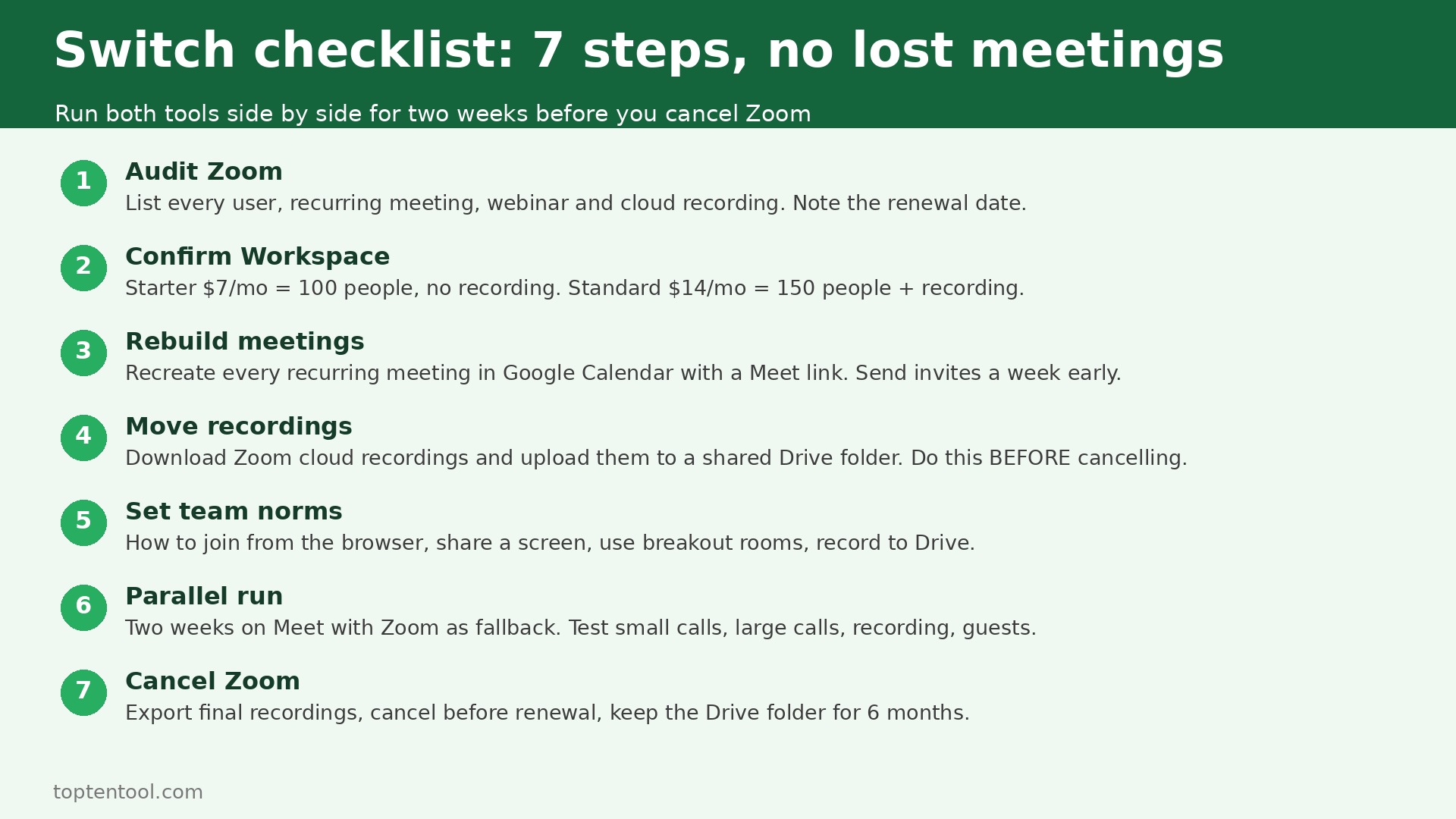
Step 1. Audit the Zoom account before touching anything
Open Zoom and list every user, every recurring meeting, every scheduled webinar, every cloud recording, and every integration. Export the meeting list and the recording list, and note the renewal date and the contract terms. Download the cloud recordings that matter, because they do not move to Google Drive automatically. This audit takes an hour and prevents the most common switch failure, which is discovering a recurring client meeting only after its Zoom link stopped working.
Step 2. Set up Google Workspace and confirm the Meet plan
Confirm the team already has Google Workspace, and check which edition it runs. Business Starter at 7 dollars a month covers 100 participants but no recording. Business Standard at 14 dollars covers 150 participants with recording, breakout rooms, and polls. If the team needs recording, upgrade to Standard before the switch, because Starter cannot record. Test a Meet call from Gmail and from Calendar, and confirm the link appears automatically in new invites.
Step 3. Recreate the recurring meetings in Google Calendar
Rebuild every recurring Zoom meeting as a Google Calendar event with a Meet link. Do this for the next month of meetings, and include the agenda, the guest list, and any attached docs. Send the new invites early, and tell guests the link has changed. Keep the old Zoom meetings running for the current week so nobody joins a dead link, and cancel the Zoom occurrences only after the new Meet invites are accepted.
Step 4. Move the recordings and the meeting history
Download the Zoom cloud recordings that the team needs to keep, and upload them to a shared Drive folder with clear names and dates. Local recordings already sit on individual computers, so ask each person to move theirs to Drive as well. Export any meeting reports the team relies on, and save them alongside the recordings. Recordings do not transfer automatically, so this manual move is the only way to keep the history.
Step 5. Move the team and set the meeting norms
Invite the team to the new workflow, and set the norms for Meet. That includes how to join from the browser, how to share a screen, how to use breakout rooms on Standard, and how to record to Drive. Run a practice meeting with the whole team, and test the features the team actually uses, including captions, hand raising, and recording. A teammate who cannot find the record button or the breakout rooms will fall back to Zoom, and the switch will stall.
Step 6. Run both tools side by side for two weeks
Use Meet for all new meetings for two weeks while Zoom stays available for any meeting that was already booked. Watch for problems daily, including guests who cannot join, recordings that do not appear in Drive, and meetings that run over the participant limit. Compare the experience with the Zoom export from step 1, and fix the gaps while Zoom is still available as a fallback. Two quiet weeks of parallel running cost nothing and catch every problem early.
Step 7. Cancel Zoom and confirm the data is safe
Once two weeks of Meet calls look clean, export any final recordings and reports from Zoom, then cancel the subscription before the renewal date. Confirm the cancellation email arrives, and check that no auto renewal is set. Keep the Drive folder with the old recordings for at least six months, because Zoom deletes cloud recordings after the account closes. The switch is done when Meet has run cleanly for two weeks and Zoom is cancelled without a surprise charge.
Pre Switch Checklist
Use this checklist before starting step 1, and do not skip a line.
– List every Zoom user, recurring meeting, webinar, and cloud recording. – Download the cloud recordings that matter and upload them to Drive. – Note the Zoom renewal date and any contract term. – Confirm the Google Workspace edition and whether it records. – Upgrade to Business Standard if the team needs recording. – Rebuild recurring meetings in Google Calendar with Meet links. – Tell guests the link has changed before the first Meet call. – Test breakout rooms, captions, and recording in a practice meeting. – Set a switch date in a quiet week, not during a launch. – Tell the team the switch date and the new workflow before step 1.
Data Migration. What Transfers and What Does Not
Meetings do not transfer automatically. There is no import tool that moves a Zoom meeting list into Google Calendar, so the team rebuilds each recurring meeting manually from the audit in step 1. That work takes an afternoon for a normal meeting load, and it is the largest single task in the switch. Plan for it, and send the new invites early so guests have time to accept. One off meetings need no migration, because they are booked fresh in Calendar with a Meet link.
Recordings do not transfer automatically either. Zoom cloud recordings must be downloaded and uploaded to Drive by hand, and local recordings must be moved from individual computers. The recording list export from step 1 is the map for that work, and the Drive folder is the new home. A team that cancels Zoom before downloading loses the cloud recordings permanently, so finish the download before step 7. Meeting reports, attendance data, and past analytics also need a manual export, because Meet starts its history from the day the team switches.
What does transfer is the team itself and its calendar. The people, their email addresses, and their Google Calendar events stay the same, and the new Meet links attach to the same calendar the team already uses. Contacts, chat history in Gmail, and files in Drive are untouched by the switch. The only things lost are the Zoom specific records, which are the meeting links, the cloud recordings, and the Zoom analytics. Export them all before cancelling, and the switch loses nothing that matters.
Calendar attachments also need a check. Meeting notes, agendas, and files attached to Zoom invites do not move with the meeting, so reattach them to the new Calendar events while rebuilding the schedule. A guest who joins the new Meet link without the agenda will ask for it in the call, which wastes the first five minutes.
Cost Comparison. What the Switch Actually Saves
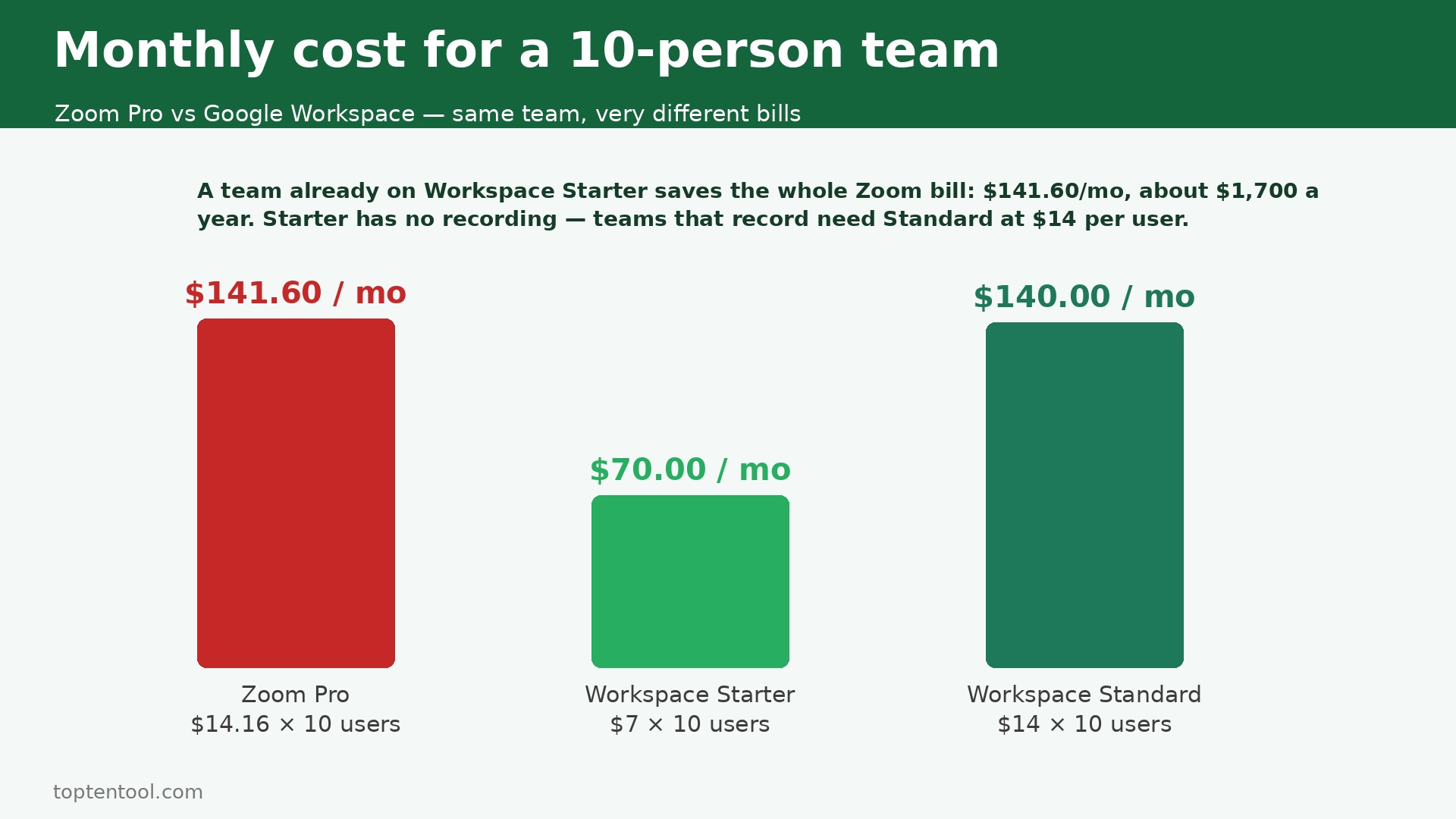
The saving depends on team size and on whether the team already pays for Google Workspace. A ten person team that already runs Workspace Starter pays 70 dollars a month for email, Drive, and Meet together, and dropping Zoom Pro saves 141.60 dollars a month, or about 1,700 dollars a year. The same team on Workspace Standard pays 140 dollars a month for the bundle with recording, against 141.60 dollars for Zoom Pro alone, so the saving is the whole Zoom bill plus the email and Drive that come with Workspace.
A ten person team that does not yet use Workspace needs a fuller comparison. Workspace Standard at 14 dollars a month costs about the same as Zoom Pro at 14.16 dollars, so the saving is small on meetings alone, but the team gains business email, Drive, and Docs for the same money. Workspace Starter at 7 dollars is half the price of Zoom Pro, but it cannot record, so a team that needs recording must pay Standard. Run the comparison on the bundle, not on meetings alone, because the bundle is where Meet wins.
The saving shrinks when the team needs large meetings. Zoom Business at 18.33 dollars a month covers 300 participants, while Google needs Business Plus at 22 dollars for 500 participants, and a team that regularly hosts 200 to 300 people will pay more on Meet or need an Enterprise plan. Webinars are the other gap, because Zoom webinar tools are stronger and Meet webinar capacity is limited. A team that runs weekly webinars should price the webinar add on before switching, because it can erase the saving. Count the participants, count the webinars, and run the two totals before deciding.
What to Test in the First Two Weeks on Meet
The parallel run only helps if the team tests the calls it actually runs, so set the tests before the first Meet call goes out. Run a one on one, a small team call, and the largest regular meeting the team holds, and confirm the join, the captions, the screen share, and the recording all work on the plan the team bought.
Then compare the Meet experience against the Zoom export from step 1, checking audio quality, video quality, and how guests join. That test list is the part of how to switch from Zoom to Google Meet that most teams skip, and it is the part that catches the problems while Zoom is still available as a fallback.
Test the recording flow next, because it is the workflow that breaks quietly. Record a practice call, confirm the file appears in Drive, and check that the whole team can open it. Also test a call with an external guest, since guests join Meet from the browser with no download, and confirm the guest link works from outside the company. A test that covers small calls, large calls, recording, and guests in the first week leaves the second week for fixing what failed, which is exactly how a quiet switch is supposed to work.
Common Switch Mistakes and How to Avoid Them
The first mistake is cancelling Zoom before the recordings are downloaded. Cloud recordings vanish when the account closes, and a team that cancels on day one loses months of client calls and training sessions in one move. Download first, upload to Drive, confirm the files play, and only then cancel. The second mistake is rebuilding the meetings late. Guests who receive a new Meet link the morning of the call will join the old Zoom link instead, and the meeting starts with half the room in the wrong tool. Send the new invites a week early, and cancel the old Zoom occurrences only after the new invites are accepted.
The third mistake is assuming Starter records. Business Starter at 7 dollars a month does not include Meet recording, and a team that switches to Starter and then tries to record a client call will find no record button. Upgrade to Standard before the switch if recording matters, and test it in a practice meeting. The fourth mistake is skipping the practice meeting. A team that goes live on Meet without testing breakout rooms, captions, and screen sharing will discover the gaps during a real call. One practice meeting with the whole team catches every problem early.
The fifth mistake is forgetting the guests. External clients and partners may have Zoom installed and Meet blocked, or the reverse, and a team that switches without telling guests will lose people at the door. Tell guests the link has changed, include a short note that Meet joins from the browser with no download, and keep a Zoom fallback for the first two weeks for any guest who cannot join Meet. The fallback costs nothing and saves the meeting.
The sixth mistake is forgetting the integrations. Zoom connects to tools the team may rely on, including scheduling apps, CRM tools, and webinar platforms, and those connections do not follow the team to Meet automatically. List every Zoom integration before the switch, and confirm the same tool connects to Google Workspace or Meet, or plan a replacement. A team that treats how to switch from Zoom to Google Meet as a meetings only job will discover the missing integration during a client call, and that is the worst moment to find it.
Frequently Asked Questions
How long does it take to switch from Zoom to Google Meet?
Most small teams finish the switch in one to two weeks. The audit and the meeting rebuild take an afternoon each, the recording move takes a few hours, and the two week parallel run catches the problems while Zoom is still available. A team with many recurring meetings or a large recording library should budget three weeks. Do not promise a one day switch, because the manual rebuild and the recording move are what make the migration safe.
Will I lose my Zoom recordings when I switch to Google Meet?
Cloud recordings do not transfer automatically, so download them from Zoom and upload them to a shared Drive folder before cancelling. Local recordings already sit on individual computers, so ask each person to move theirs to Drive as well. A team that cancels Zoom before downloading loses the cloud recordings permanently, so finish the download before step 7.
Is Google Meet really cheaper than Zoom?
For most small teams, yes. Workspace Starter costs 7 dollars per user per month against 14.16 dollars for Zoom Pro, and the bundle includes business email, Drive, and Docs. A team that already pays for Workspace saves the whole Zoom bill. The saving shrinks for teams that need large meetings or webinars, because Zoom Business covers 300 participants at 18.33 dollars while Google needs Plus at 22 dollars to pass 150. Count the participants before deciding.
Does Google Meet work without a download?
Yes. Guests can join a Meet call from the browser with no download, which is simpler than Zoom for external guests. The team joins from Gmail or Google Calendar, and the link appears automatically in the invite. That browser join is one of the strongest reasons teams switch, because it removes the install step that loses guests.
Can I keep my Zoom meeting links after switching to Google Meet?
No, Zoom meeting links stop working when the account is cancelled, and Meet uses its own links. Rebuild every recurring meeting in Google Calendar with a Meet link, send the new invites a week early, and cancel the old Zoom occurrences only after the new invites are accepted. One off meetings need no migration, because they are booked fresh with a Meet link.
Verdict. Who Should Switch and Who Should Stay
Switch to Meet if the team already lives in Google Workspace, runs mostly small to medium meetings, and wants a lower bill with a simpler join experience. A team of up to ten people with meetings under 150 participants will save money, get a more generous free plan, and lose nothing it actually uses. The bundle alone justifies the switch for most Google teams, because Workspace includes email and Drive for less than Zoom charges for meetings alone. For those teams, learning how to switch from Zoom to Google Meet is worth an afternoon, and the saving repeats every month.
Stay on Zoom if the team runs webinars, hosts meetings over 150 participants regularly, needs local recording on a free plan, or relies on tight host controls and large meeting tools. Zoom Business covers 300 participants at 18.33 dollars a month, paid meetings run up to 30 hours, and the webinar tools are stronger than Meet. A training company, a webinar heavy marketer, or a large all hands team will miss those tools daily on Meet. Stay also if the team is mid launch or mid training program. A switch during a busy period costs more in chaos than it saves in subscription fees.
The decision rule is simple. Count the participants in the largest regular meeting, check whether the team needs recording and webinars, and run the bundle comparison for the team size. If Meet covers the weekly meetings and costs less, switch in a quiet week and follow the seven steps. If Zoom covers a weekly meeting that Meet cannot, stay and use Meet for the small internal calls instead. The right tool is the one that matches the meetings the team actually runs, not the one with the lower headline price.