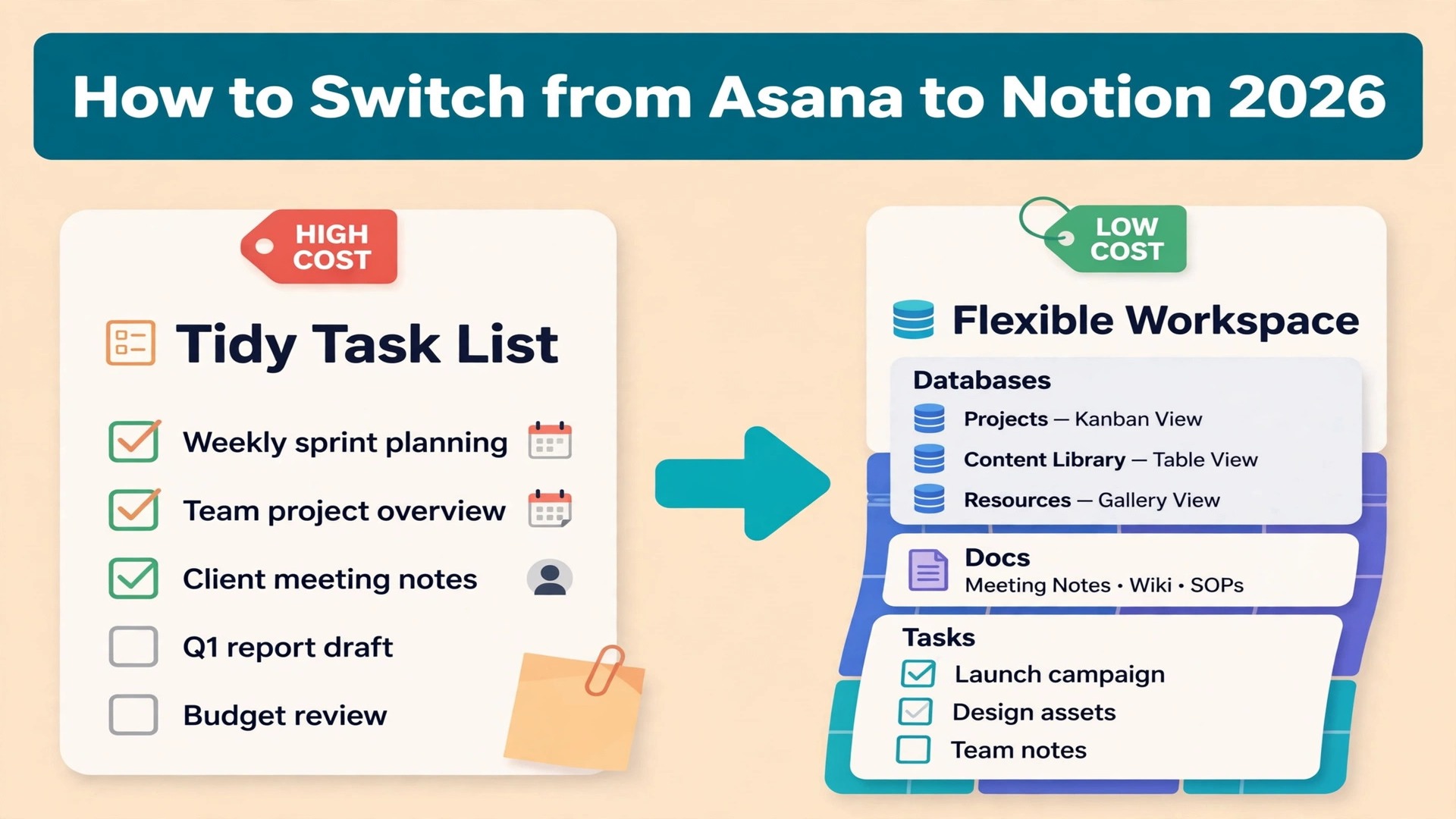
In most teams the work lives in three places at once. Tasks sit in Asana, meeting notes sit in a docs tool, and the processes everyone needs sit in a wiki nobody can find. The three bills add up, and so does the jumping between them, which is why teams start asking how to switch from Asana to Notion. Notion puts tasks, docs and wikis in one workspace, and the mid tier costs less per seat than Asana Advanced.
Asana does one thing and does it well. It is a tidy project tool with a calm interface, and its price climbs steeply per user as the team grows. Notion is a looser workspace that holds docs, wikis and databases beside the tasks, under the same login and at a lower mid tier seat price. The arithmetic shows the difference plainly. Ten people on Asana Advanced cost about 250 dollars a month, ten on Notion Business cost about 200 dollars a month with docs and databases Asana never offered, and ten on Notion Plus cost about 100 dollars a month for the task and docs workflow most small teams actually use.
No tool wins this comparison outright. The right choice comes down to the price the team pays and the shape of work it does every day. Asana bills per user and keeps portfolios, workload and native time tracking behind the Advanced plan. Notion also bills per member, at 10 dollars a member a month for Plus and 20 dollars for Business, and every paid plan includes docs, databases and wikis. A team that spends half its day in docs will feel the saving, because the second subscription disappears. A team that adores the calm Asana interface and steers by its portfolio and workload views may find Notion loose and fiddly instead, and this guide states that trade off plainly.
Below are the seven steps for how to switch from Asana to Notion, with a checklist, a cost comparison, and an honest account of what transfers, what stays behind, and what to test before Asana is cancelled. Work through them in order, keep both tools running side by side for two weeks, and the switch stays uneventful, which is the best outcome a migration can have. Rush it, cancel early, and the portfolios, automations and recurring tasks can disappear before anyone notices they are gone.
The Price Gap That Starts the Conversation
Look at Asana first. Personal costs nothing for up to two users and includes unlimited tasks and projects. Starter is 10.99 dollars per user per month on annual billing, or 13.49 dollars when paid monthly, and brings timeline and Gantt views, dashboards, forms, custom fields and unlimited automations. Advanced is 24.99 dollars per user per month on annual billing, or 30.49 dollars monthly, and adds portfolios, goals, workload, approvals, proofing and native time tracking. Enterprise has no published price and is priced by quote.
Notion answers with a lower ladder. Free costs nothing for individuals and includes unlimited blocks, Notion Calendar and 10 guests, plus a limited AI trial. Plus is 10 dollars per member per month on annual billing, and adds custom forms, chart views, 5 GB uploads and more guests. Business is 20 dollars per member per month on annual billing, and adds Notion Agent, AI meeting notes, SAML SSO, private teamspaces and granular database permissions. Enterprise is priced by quote, and the AI bundle, the Agent, AI meeting notes and enterprise search, is a limited trial on Free and Plus and included on Business and Enterprise.
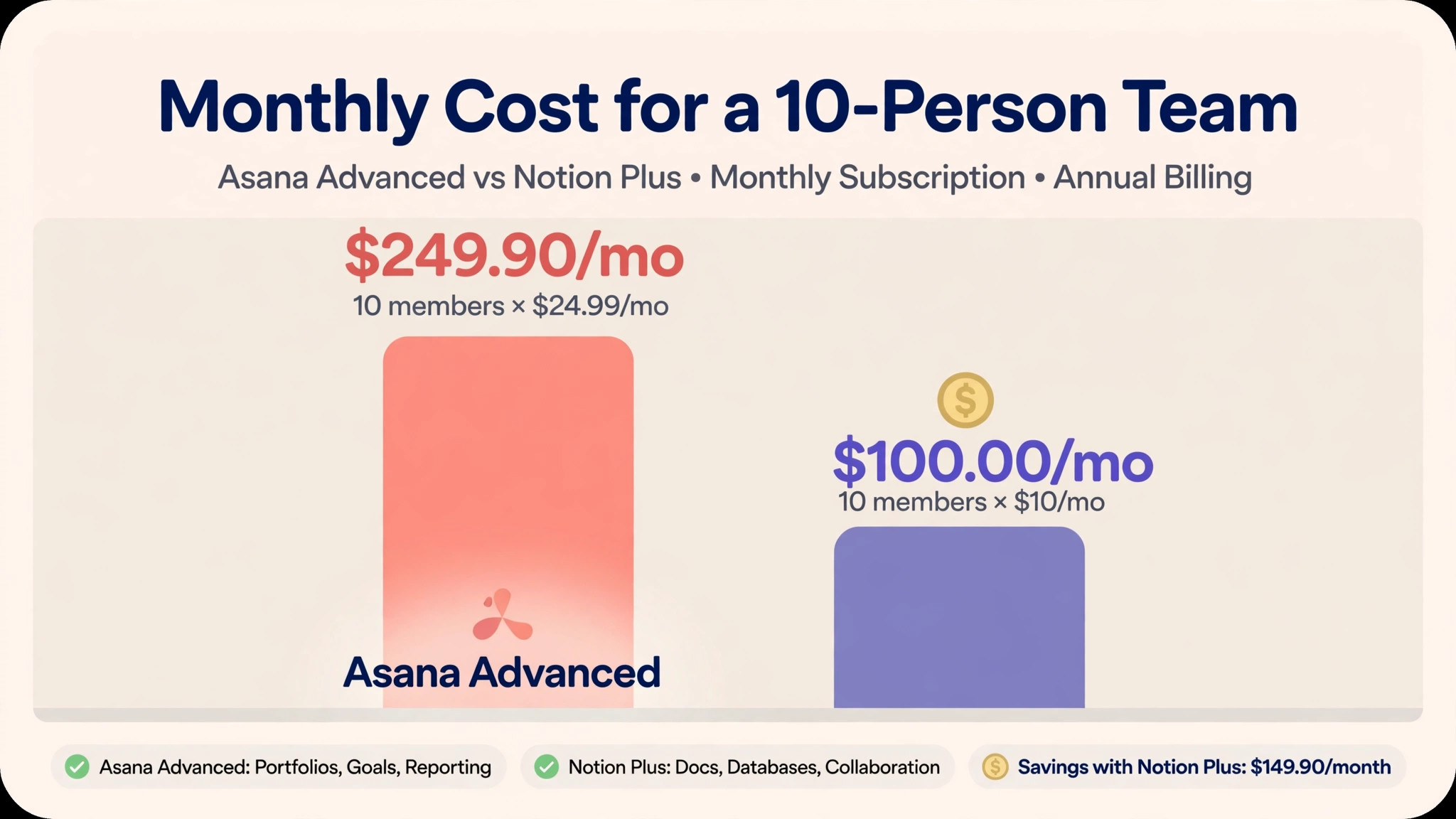
At ten seats the numbers pull further apart. Asana Advanced runs about 250 dollars a month on annual billing, Notion Business runs about 200 dollars, which saves about 50 dollars a month or about 600 dollars a year, and Notion Plus runs about 100 dollars, which saves about 150 dollars a month or about 1,800 dollars a year when Plus covers the workflow.
Start with the bill for a real team, because the plan lists hide the gap. Five people on Asana Starter pay about 55 dollars a month on annual billing, while five on Notion Plus pay about 50 dollars, a saving of about 5 dollars a month. The gap widens as the team grows, because every Asana seat costs more than every Notion Plus seat. The free tiers point the same way. Asana Personal stops at two users, so it suits one person and a colleague, not a team. Notion Free sets no seat limit for individuals, so a whole small team can try the workspace before paying anything.
Asana vs Notion at a Glance
| Feature | Asana | Notion |
|---|---|---|
| Pricing model | Per user seat | Per member, lower mid tier |
| Free plan | Up to 2 users | Free for individuals, 10 guests |
| Entry paid plan | Starter 10.99 dollars a user a month annual | Plus 10 dollars a member a month annual |
| Mid plan | Advanced 24.99 dollars a user a month annual | Business 20 dollars a member a month annual |
| Time tracking | Advanced only | Not native, use an integration |
| Goals and portfolios | Advanced only | Databases and linked views, rebuilt by hand |
| Docs and wikis | Basic docs | Built in docs, wikis and databases |
| AI | AI Studio credits on Starter | Limited trial on Plus, included on Business |
| Automations | Unlimited rules on Starter | Native automations, more limited |
| Guest access | Unlimited free guests on Starter | Free guests, 10 on free plan |
Notion bundles docs and databases into each tier, and that bundling is the point of the switch. Docs, wikis, databases and tasks all live in the same workspace, so a team stops paying for a separate docs tool and a separate wiki. Asana stays cleaner and calmer, with fewer menus and a gentler learning curve, and that calm is worth real money to a team that values structure over flexibility. Check which side of that trade your team sits on before you move.
The Trade-Offs Nobody Mentions First
A switch guide that only lists the savings is not honest, so this section states the trade plainly. Asana is a focused project tool. Notion is a flexible workspace that can become anything, and the difference shows in the daily work. A team that opens Asana, checks its tasks and closes it will find Notion open ended, with more ways to structure the same work and more decisions to make. The first week in Notion feels slower, even when the bill is lower, and a team that hates setup will feel that friction daily.
A team that already pays for a docs tool and a wiki will not miss the simplicity, because Notion replaces two subscriptions at once. The question is not which tool is better. The question is whether the team wants one flexible workspace or one calm project list, and learning how to switch from Asana to Notion starts with answering that question honestly.
The portfolio gap deserves a second look, because it decides the saving for teams that report upward. Asana Advanced includes portfolios and workload views that roll up many projects into one report. Notion has no portfolios, so a team must rebuild that roll up with linked databases, which takes days of work and a clear taxonomy. Count the portfolio reports before deciding, and the math will make the choice. A team with many portfolio reports can find the rebuild costs more than the subscription saves.
The AI pricing also changes the bill. Asana includes AI Studio credits on Starter, 50,000 a month per billing account, rising to 75,000 on Advanced. Notion AI is a limited trial on Free and Plus, and included on Business at 20 dollars a member a month, so a ten person team that wants AI everywhere must pay for Business. A team that does not need AI saves the full amount on Plus. A team that does should price Business into the comparison before moving.
How to Switch from Asana to Notion in 7 Steps
Step 1. Audit the Asana workspace before touching anything
Open Asana and list every team, every project, every task count, every custom field, every automation rule, every dashboard and every guest. Export each project as a CSV, and note the renewal date and the contract terms, because cancelling mid contract can carry a fee. Pay special attention to recurring tasks, private tasks, freestanding tasks that sit outside any project, and tasks shared between projects, because the importer does not move those cleanly. This audit takes an hour and prevents the most common switch failure, which is discovering a workflow only after it was deleted.
Step 2. Set up Notion and map the structure
Create the Notion workspace, choose the plan that matches the team size, and decide the structure before importing anything. Asana teams become Notion teamspaces, Asana projects become Notion projects, and Asana tasks become Notion tasks, in Projects and Tasks databases that are related to each other. Decide which projects go into which teamspace, because multiple projects imported into one teamspace go into the same Projects and Tasks databases. Do not import yet. A clean structure decided on paper saves a week of reorganizing later.
Step 3. Run the Asana importer on one project first
Open Notion settings, choose Import, pick Asana, and authorize the connection. Import a single small project first, not the whole workspace. The importer brings across teams, projects and tasks, with the databases pre populated with several views. Check the imported project carefully, count the tasks against the Asana original, open a few tasks to confirm dates and assignees survived, and fix the mapping before the big import. A pilot import that takes an afternoon prevents a workspace wide mess.
Step 4. Import the rest and rebuild what does not transfer
Once the pilot looks clean, import the remaining projects in batches, checking each one as it lands. Then rebuild what the importer leaves behind. Automations, dashboards, views and portfolios do not transfer and must be rebuilt in Notion.
Recurring tasks need to be set up again by hand. Nested subtasks, private tasks and tasks shared between projects need manual attention. The import has a size limit of about 14,000 tasks, with no limit on projects, and each workspace can import about 100 to 120 file attachments per day, so a large workspace may need several days. This is the largest single task in the switch, so budget a full afternoon for a normal workspace and do not promise a one hour migration.
Step 5. Move the team and set permissions
Invite the team to Notion and set access levels. Remember that guests are free on Notion, so decide who needs a full member seat and who can be a guest. Assign each person to the teamspaces they manage, and run a short training session on the views the team will actually use, because Notion has more ways to view the same data than Asana and a new user can drown in options. A teammate who cannot find their tasks will fall back to Asana, and the switch will stall.
Step 6. Run both tools side by side for two weeks
Work from Notion for two weeks while Asana stays open and the old projects finish. Watch the task counts daily, check that due dates and assignees match, and confirm the automations you rebuilt actually fire. Compare a Notion database view with the Asana export from step 1 to spot any gap in reporting. Fix the problems while Asana is still available as a fallback, not after it is cancelled. Two quiet weeks of parallel running cost nothing and catch every problem early.
Step 7. Cancel Asana and confirm the data is safe
Once two weeks of Notion work look clean, export the final project data and any remaining reports from Asana, then cancel the subscription before the renewal date. Confirm the cancellation email arrives, and check that no auto renewal is set. Keep the Asana export files for six months, because the importer does not move everything and the old exports are the only record of recurring tasks, private tasks and automations. The switch is done when Notion has run cleanly for two weeks and Asana is cancelled without a surprise charge.
What Comes Across and What Stays Behind
The Notion Asana importer moves the core work well. Asana projects land as Notion projects, Asana tasks land as Notion tasks, Asana teams land as Notion teamspaces, and Asana organizations or workspaces land as Notion workspaces. The Projects and Tasks databases are related to each other, in line with the Projects and Tasks template, and the importer pre populates several views. For a normal project, that covers most of what a team needs to keep working on day one.
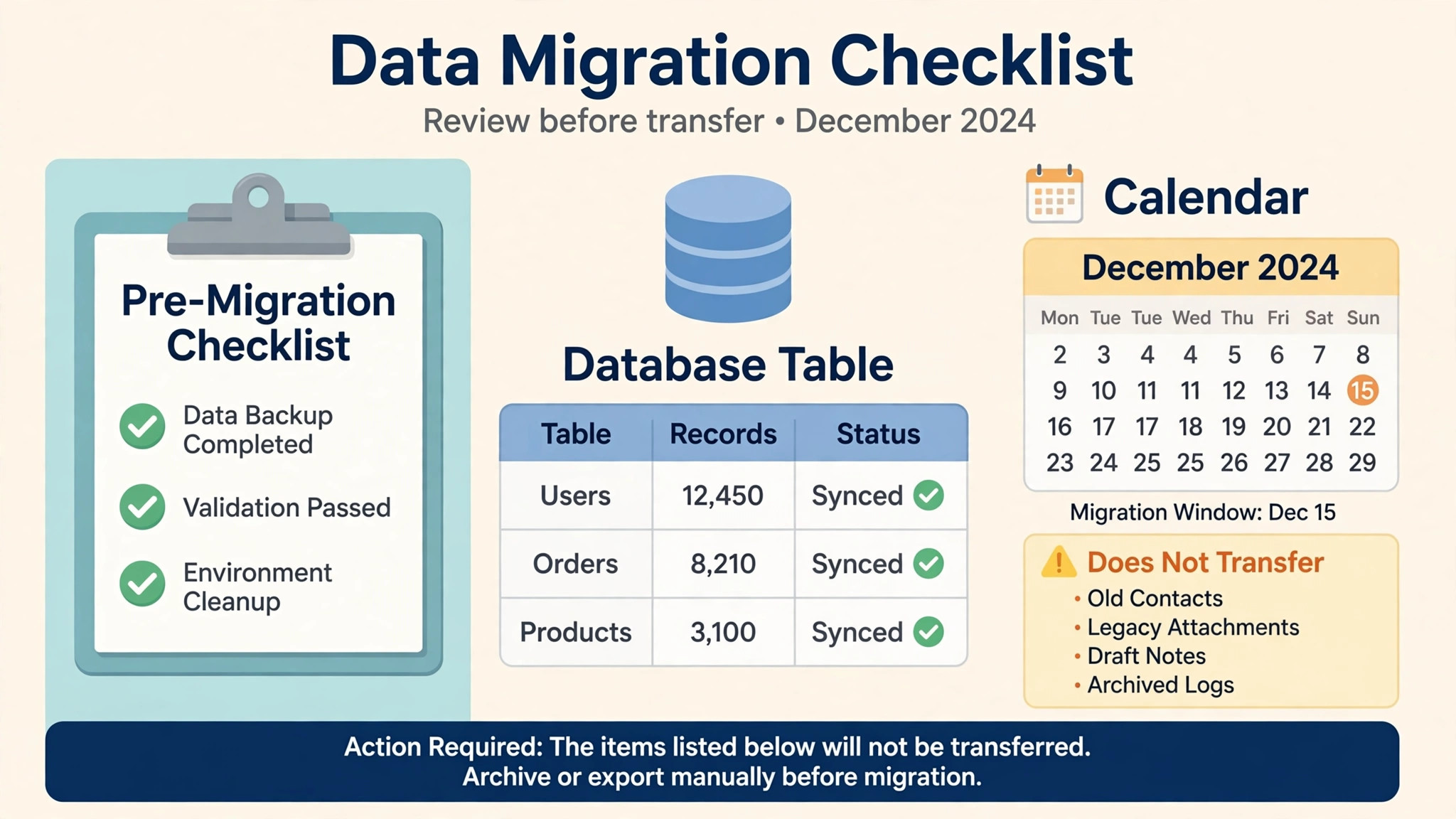
What does not transfer is specific, and the team should name it before starting. Portfolios do not transfer, so rebuild the roll up with linked databases. Automations, dashboards and views do not transfer from any source. Asana rules must be rebuilt as Notion automations, and the native automation limits are tighter than Asana Starter. Recurring tasks do not transfer, so note each one and set up the recurrence again in Notion. Private tasks, freestanding tasks and tasks shared between projects need manual attention, and projects must belong to a team in Asana to appear in the importer at all.
The import is a one time event, not a sync. Future changes in Asana will not reflect in Notion, and you can only import one Asana workspace into Notion at a time. Import times range from a few minutes to several hours depending on size, and Notion sends an email when the import is complete. That is the full picture of how to switch from Asana to Notion without losing the work that matters.
The Go-Live Checklist
Work through this list before step 1, and treat every line as required.
- Write down every Asana team, project, task total and custom field before anything moves. – Save a CSV export of each project and keep the files somewhere safe. – Check the Asana renewal date and read the contract terms for cancellation fees. – Mark the recurring tasks, private tasks, freestanding tasks and tasks shared across projects. – Pick the Notion plan from the team size and the AI the team needs. – Agree which Notion teamspace each Asana team will become.
- Write down the automations, dashboards and portfolios the team really uses. – Work out the replacement for every Asana feature Notion does not have. – Count all the tasks first, because the import stops at about 14,000 tasks. – Fix the switch date for a quiet week, never during a launch. – Tell everyone the switch date and how the new workflow runs, before step 1 starts.
What the Switch Saves in Real Money
The saving depends on team size and plan, because the two tools charge different rates for similar work. A five person team on Asana Starter pays about 55 dollars a month on annual billing. The same team on Notion Plus pays about 50 dollars a month, a saving of about 5 dollars a month or 60 dollars a year. The same team on Asana Advanced pays about 125 dollars a month against about 50 dollars on Notion Plus, a saving of about 75 dollars a month or 900 dollars a year.
A ten person team on Asana Advanced pays about 250 dollars a month on annual billing. The same team on Notion Business pays about 200 dollars a month, a saving of about 50 dollars a month or about 600 dollars a year. The same team on Notion Plus pays about 100 dollars a month, a saving of about 150 dollars a month or about 1,800 dollars a year. Those figures use annual billing on both tools, and monthly billing widens the gap further, since Asana Starter costs 13.49 dollars a month on monthly billing.
The saving shrinks when the team adds AI or needs portfolios. Notion Business at 20 dollars a member a month adds 100 dollars a month for a ten person team against Plus, which eats part of the saving against Asana Advanced. A team that rebuilds portfolios with linked databases will spend days on the rebuild, which is a one off cost, not a monthly one. Count the AI users and the portfolio reports, run the two totals, and the answer will be clear. For most teams without heavy portfolio reporting, Notion saves hundreds of dollars a year.
Run the same math for your own team before you commit to how to switch from Asana to Notion, because the totals decide the plan.
Your First Two Weeks in Notion
The parallel run only helps if the team tests the right things, so set the tests before the first Notion task is assigned. Create tasks across every teamspace the team uses, including one with subtasks, one with a custom field, and one with an attachment, and confirm each one shows the right assignee and the right due date. Then compare the Notion task counts against the Asana export from step 1, checking totals by project and by assignee. That test plan is the part of the switch that most teams skip, and it is the part that catches the problems while Asana is still available as a fallback.
Test the automations and the views next, because those are the workflows that break quietly. Trigger one rebuilt automation and confirm it fires, open the board, table and calendar views for the same project, and have a second teammate confirm they see the same tasks. Also test a task that needs a recurring setup, since recurrence must be rebuilt by hand and trips up teams that rely on it. A test that covers tasks, automations, views and recurrence in the first week leaves the second week for fixing what failed, which is exactly how a quiet switch is supposed to work.
Five Mistakes That Stall the Move
The first mistake is cancelling Asana before the Notion import is checked. A team that cancels on day one loses the recurring tasks, the private tasks and the automation history in one move, and the rebuild takes days instead of hours. Keep Asana until step 7, and the switch stays boring. The second mistake is importing the whole workspace at once without a pilot. A mapping error on teamspaces repeats across every project, and fixing it after the fact costs more than the pilot ever did.
The third mistake is forgetting the attachment limit. Each workspace can import about 100 to 120 file attachments per day, so a large workspace with hundreds of attachments will take several days, not one afternoon. Plan the import in batches and check the count daily. The fourth mistake is skipping the two week parallel run. A team that switches overnight discovers the portfolio gaps during a live sprint, when fixing them costs the most. Two quiet weeks of parallel running cost nothing and catch every problem early.
The fifth mistake is underestimating the manual rebuild. Recurring tasks, portfolios, dashboards and views do not transfer, and a team that budgets an hour for the rebuild will run out of time. Budget an afternoon, rebuild the top automations first, and leave the long tail of old views behind. The switch is a good time to clean the workspace, not a reason to move every old report into the new tool.
Life After the Switch
The first month after the move is when the saving becomes real, and it is also when the new habits form. Set a weekly review in Notion, one hour where the team checks overdue tasks, clears the inbox and updates the databases, because a workspace with more views needs a steadier rhythm than Asana did. Tune the rebuilt automations after two weeks, not on day one, because the first fortnight shows which rules fire too often and which never fire at all. The work of learning how to switch from Asana to Notion does not end on cancel day. It ends when the team stops opening the old tool out of habit, and that usually takes a full month.
Revisit the plan choice after 90 days. A team that started on Plus may find it needs Business for the AI features or the granular permissions, and a team that started on Business may find it can drop to Plus if it never uses the Agent. Count the seats again too, because Notion bills per member, and a contractor who finished their project should come off the plan. The switch saves money once. The habits save it every month after.
Frequently Asked Questions
How long does it take to switch from Asana to Notion?
Most small teams finish the switch in one to two weeks. The setup takes an afternoon, the pilot import and the manual rebuild take another afternoon, and the two week parallel run catches the problems while Asana is still available. A team with many projects, heavy automation or more than 14,000 tasks should budget three weeks. Do not promise a one day switch, because the manual rebuild and the parallel run are what make the move safe.
Will I lose my tasks when I switch from Asana to Notion?
Tasks, projects and teams transfer through the native Asana importer, so export each project first and run a pilot import on one project to confirm the mapping. Recurring tasks, portfolios, automations and private tasks do not transfer cleanly, so flag them in the audit and rebuild them by hand. Keep Asana running until the Notion import is checked, and no task will be lost.
Is Notion really cheaper than Asana?
For most teams, yes, by a wide margin at the mid tier. Notion Plus costs 10 dollars per member a month on annual billing against 24.99 dollars for Asana Advanced, so a ten person team saves about 150 dollars a month. The only common case where the saving shrinks is a team that needs Notion Business at 20 dollars a member a month for AI, or a team that spends days rebuilding portfolios. Count the AI users and the portfolio reports before deciding.
Does Notion have the same views as Asana?
Notion has more ways to view the same data than Asana, including board, table, calendar, timeline and gallery views, but views do not transfer, so the team rebuilds its preferred views by hand. Asana projects map to Notion projects and tasks map to Notion tasks during import, so the structure survives even though the saved views do not. Pick the two or three views the team actually uses and rebuild those first.
Can I keep my Asana automations when I switch?
No, automations do not transfer from any source. Asana rules must be rebuilt as Notion automations, and Notion native automations are more limited than Asana Starter. List the automations the team actually uses, rebuild the top ones first, and check the limits before choosing a plan. A team with heavy automation should test the rebuild before committing.
The Call
Switch to Notion if the team is paying for Asana Advanced and only using task lists, timelines and docs, if the team wants docs, wikis and databases in the same login, or if the bill is the problem. A team of five to twenty people will save hundreds to more than a thousand dollars a year, get docs and databases that Asana never offered, and lose nothing it actually uses, as long as the audit flags the recurring tasks and the portfolios first. For those teams, learning how to switch from Asana to Notion is worth an afternoon, and the saving repeats every month.
Stay on Asana if the team loves the calm interface and runs on portfolios and workload views, if outside guests are a large part of the workspace and Asana free guests matter, or if the team is mid sprint and cannot afford a week of parallel running. A team that values structure over flexibility will feel Notion as noise, and a team with many portfolio reports can find the rebuild costs more than the subscription saves. Stay also if the contract renewal is close and the team is mid launch. A switch during a launch costs more in chaos than it saves in subscription fees.
The decision rule is simple. Count the people, count the portfolios, list the features the team actually opens every week, and run the two totals with AI included. If Notion covers the weekly workflow and costs less, switch in a quiet week and follow the seven steps. If Asana covers a weekly workflow that Notion cannot match, stay and renegotiate the Asana plan instead. The right tool is the one that matches the work, not the one with the lower headline price.