

A pottery studio runs on a kiln schedule, and the kiln does not wait for the admin to catch up. A wheel class fills, a glazing session needs a kiln slot, a member forgets to pay for clay, and the owner spends Sunday night reconciling three spreadsheets that never agree. The right software ties the class, the kiln and the payment together, so the studio fires on time and the teacher stays at the wheel. The best software for pottery studios does exactly that, and it is built for the way a small studio actually sells, which is courses, memberships and open studio time, not single appointments.
This guide compares five tools on published prices, the studio job each one does best and the catch that only shows up after the trial ends. Prices below are published starting prices as of late 2026, with annual billing noted where it changes the number. Start with the shortlist, then read the reviews that match the classes you actually teach.
The Quick Shortlist
The table below matches each common pottery studio job to the single tool that handles it best. Use it to narrow the best software for pottery studios to two or three candidates before you read the full reviews. Prices are monthly list prices unless noted, and annual billing is usually cheaper than paying month to month.
| Job | Best tool | Why it wins |
|---|---|---|
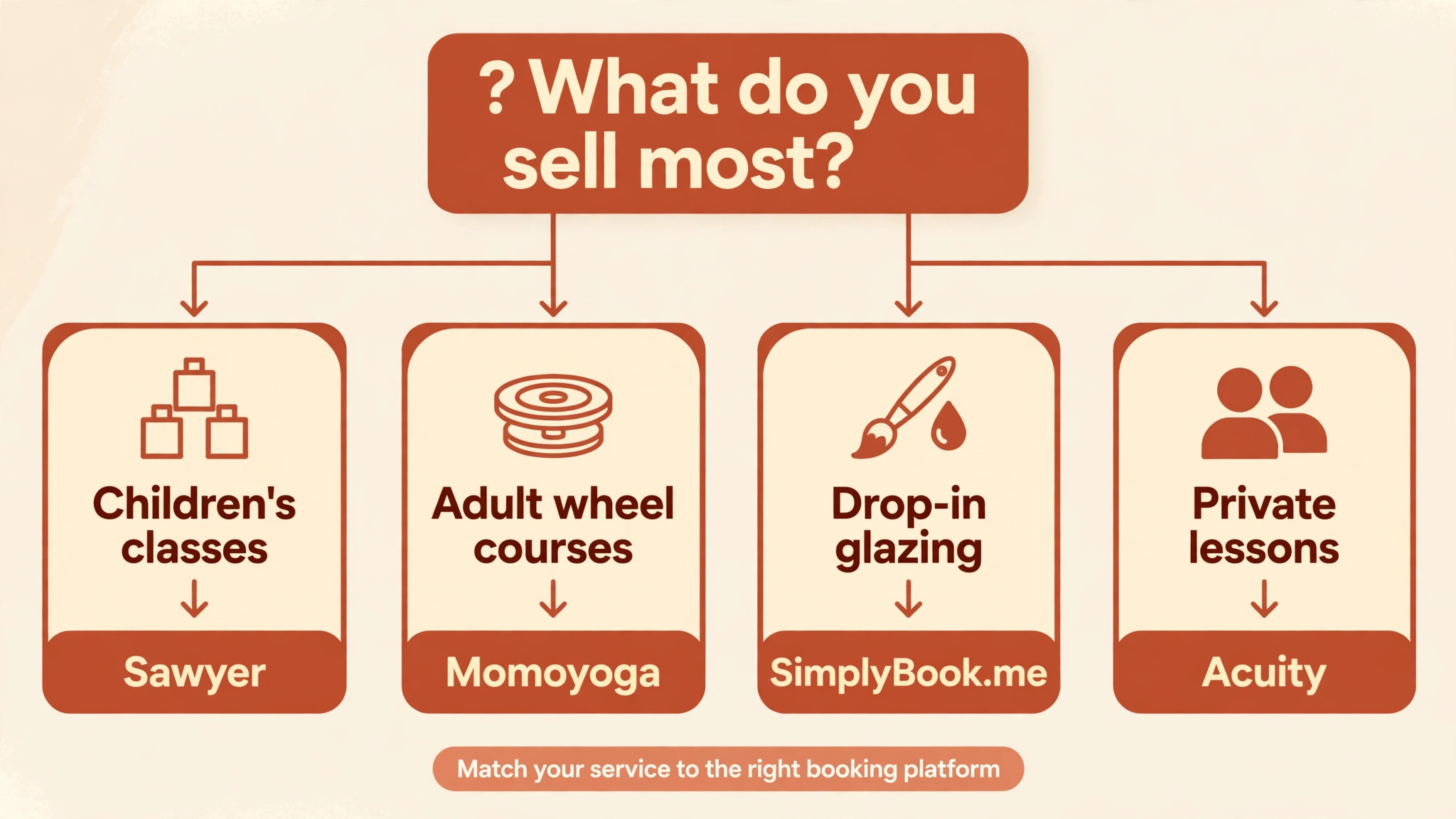
| Children’s group classes, camps and workshops | Sawyer | Sawyer is a registration and business management platform for children’s activity providers, and it connects published activities, family bookings, class rosters and payments in one place |
| Small studios that want affordable class booking | Momoyoga | Momoyoga lets students book and pay for classes online, through a free app or a schedule embedded on the studio website, with automatic messages and invoices included |
| Small studios that want the lowest paid price | SimplyBook.me | SimplyBook |
| Studios mixing one to one lessons with group classes | Acuity Scheduling | Acuity is a clean scheduling tool that handles one to one lessons, private tuition and group sessions from a simple booking page, with payments and reminders built in |
| Multi location studios and growing brands | Mindbody | Mindbody is the incumbent in the studio category, and it handles scheduling, memberships, retail sales, staff management and marketing automation in one deep platform |
How We Judged the Shortlist
A tool earned a place here only if it does a real studio job in 2026, not if it added a booking button to an old calendar. The best software for pottery studios was judged on the five checks in the table below, because those are the checks that decide whether an owner keeps paying after the first year. A booking tool that cannot sell a six week wheel course, or a payment tool that takes a cut of every student, fails no matter how polished the demo looks.
No tool on this list books a kiln firing by itself, so the review notes where each one helps with kiln time and where a simple shared calendar still does the job.
The second check is whether the price is published and how it scales, including per seat and per booking charges that change the real bill as the business grows. The third is output quality in daily use, because a tool that needs a workaround for every second booking costs more time than the old spreadsheet. The fourth is fit with the systems already in place, from the POS to the payment provider, because a tool that cannot talk to them creates double entry.
| Check before you buy | What to ask | Why it matters |
|---|---|---|
| Class booking | Recurring courses, terms and drop ins | A studio lives on recurring courses, not one off appointments |
| Kiln and studio time | Kiln slots, open studio hours and firing queues | A pottery studio sells kiln time as well as class time |
| Published price | Starting price and what scales it | Per student and marketplace fees change the real bill fast |
| Memberships and passes | Class packs, memberships and clay deposits | A studio sells passes, not single tickets |
| The catch | Caps, fees and contract terms | A free plan with a booking fee can cost more than a paid plan |
The 5 Tools, Reviewed One by One
Each review below gives the published starting price, the pottery studio job the tool does best and the catch that only shows up after the trial ends. Read the reviews for the best software for pottery studios that match the work you do most, and skip the rest until you have a shortlist of two or three.
1. Sawyer
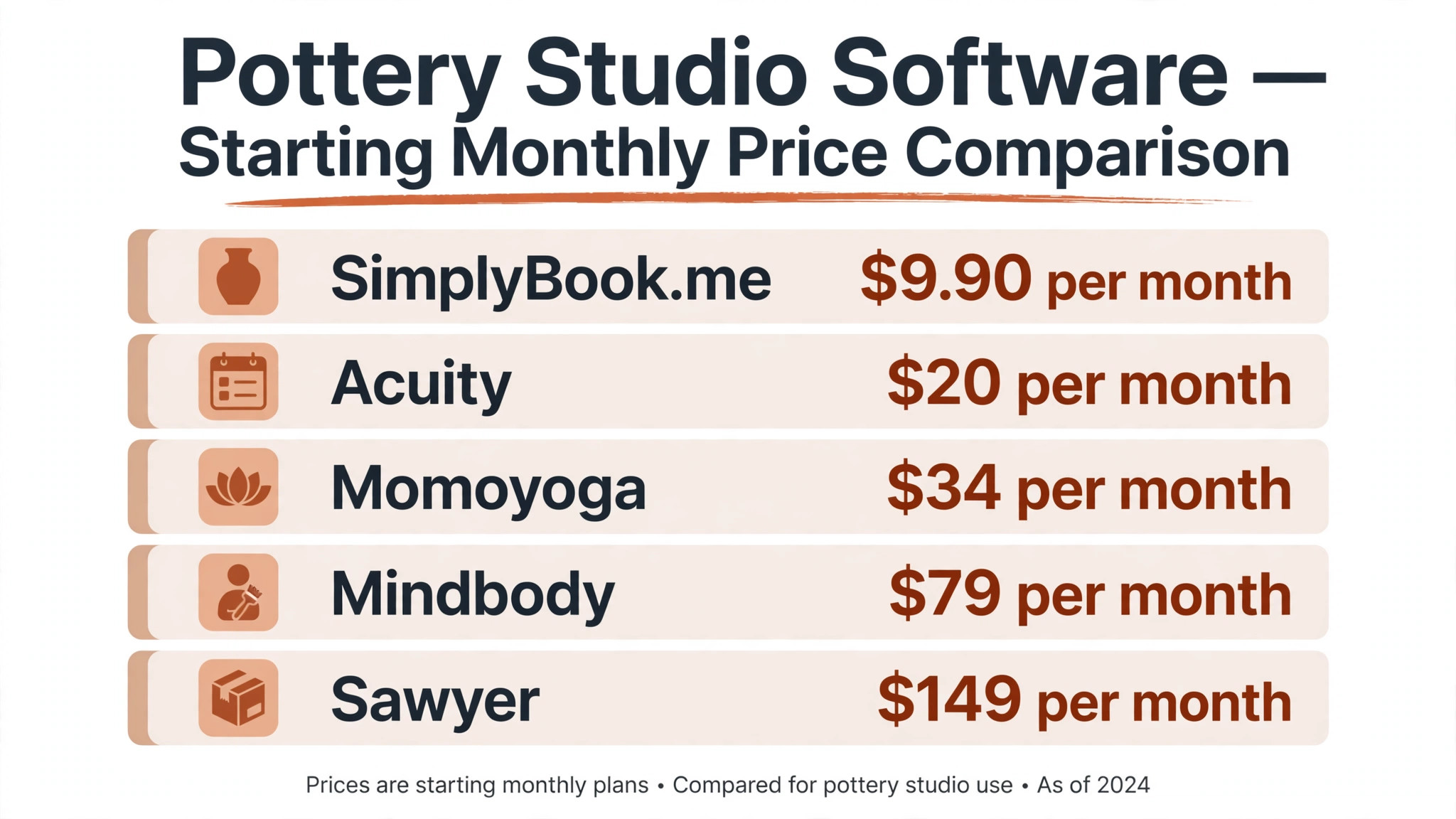
Starting price From 149 dollars a month plus a marketplace fee on bookings found through its marketplace. Best for Children’s group classes, camps and workshops. Watch out The marketplace fee on some bookings plus the monthly price adds up fast.
Sawyer is the pick for children’s group classes, camps and workshops, and it earns that place on the strength of what it does every day rather than on the promise in the demo. Sawyer is a registration and business management platform for children’s activity providers, and it connects published activities, family bookings, class rosters and payments in one place. Families book from the studio website, manage their own children’s schedules and pay online, which cuts the email back and forth that eats a small studio’s week.
The catch is the marketplace fee, which runs to 30 percent on purchases made through the Sawyer marketplace, so steer families to book on your own site and check the fee before you list a camp there.
For a pottery studio, Sawyer earns its place when children’s classes and holiday camps drive the bookings, because the family roster and the camp enrolment tools are built for exactly that trade.
The enrolment model suits a studio offering children’s classes alongside adult teaching, particularly when families book from the website and the studio needs one roster for the whole term.
The price is the watch item. At 149 dollars a month plus the marketplace fee, a studio with a quiet children’s term pays for a platform built for busy family providers, so check the fee table before you sign.
2. Momoyoga
Starting price Free plan; Standard from 34 dollars a month, Plus from 69 dollars a month. Best for Small studios that want affordable class booking. Watch out Payment handling can feel clumsy, and some features sit on higher tiers.
Momoyoga is the pick for small studios that want affordable class booking, and it earns that place on the strength of what it does every day rather than on the promise in the demo. Momoyoga lets students book and pay for classes online, through a free app or a schedule embedded on the studio website, with automatic messages and invoices included. The free plan covers unlimited online and recorded classes, so a solo teacher can start without a monthly bill and move to Standard only when the studio grows.
Reviewers say taking payment in the studio can feel clumsy, and some functions need the higher priced plans, so test the payment flow your students will actually use before you commit.
For a pottery studio, Momoyoga fits the adult course trade well, because recurring classes, class packs and memberships are the core of the product, and the schedule is easy for students to read.
The studio can publish a six week wheel course, sell the places online and send automatic reminders, which is most of what a small pottery studio needs from software.
The watch item is kiln time. Momoyoga has no kiln specific tools, so firing slots need to be booked as resources or managed on a shared calendar beside the class diary.
3. SimplyBook.me
Starting price Free plan for under 50 bookings a month; Basic from 9.90 dollars a month, Standard from 29.90 dollars a month, Premium from 59.90 dollars a month. Best for Small studios that want the lowest paid price. Watch out Custom features are limited on the cheaper plans.
SimplyBook.me is the pick for small studios that want the lowest paid price, and it earns that place on the strength of what it does every day rather than on the promise in the demo. SimplyBook.me is an online booking system that works for most service businesses, and for a pottery studio it handles class schedules, bookings and reminders without a long setup. The free plan covers a studio under 50 bookings a month with one custom feature, which is enough to test whether online booking actually suits your students.
Basic covers 100 bookings with three custom features, so a growing studio moves up a tier sooner than the headline price suggests, and the features that matter most may sit on Premium.
For a pottery studio, SimplyBook.me suits drop in glazing sessions and taster classes, because the booking flow is simple and students can grab a place in a minute.
The custom features let a studio add questions about experience level or clay choice, which helps the teacher plan a session before the students arrive.
The watch item is course depth. There is no real term enrolment or family roster, so a studio selling six week courses will outgrow the tool as the diary fills.
4. Acuity Scheduling
Starting price From 20 dollars a month for one calendar. Best for Studios mixing one to one lessons with group classes. Watch out One calendar on the entry plan, and no real course enrolment tools.
Acuity Scheduling is the pick for studios mixing one to one lessons with group classes, and it earns that place on the strength of what it does every day rather than on the promise in the demo. Acuity is a clean scheduling tool that handles one to one lessons, private tuition and group sessions from a simple booking page, with payments and reminders built in. Students book, pay and get reminded without the owner sending a single email, which is most of what a small studio needs from software.
It is a scheduling tool, not a studio platform. There is no real course enrolment, no family roster and no kiln or materials tracking, so a studio that sells six week courses will outgrow it.
For a pottery studio, Acuity fits private tuition and one to one wheel lessons, because the booking page is simple and the payment flow is clean.
A teacher can offer open studio hours as bookable slots, which lets members reserve bench time without a phone call, and that is a real saving for a busy studio.
The watch item is scale. One calendar on the entry plan means a studio with two teachers and a kiln schedule will need a higher tier or a second tool sooner than expected.
5. Mindbody
Starting price From 79 dollars a month per location; higher tiers are quote only. Best for Multi location studios and growing brands. Watch out The marketplace takes up to 20 percent of a new client’s first purchase, capped at 30 dollars.
Mindbody is the pick for multi location studios and growing brands, and it earns that place on the strength of what it does every day rather than on the promise in the demo. Mindbody is the incumbent in the studio category, and it handles scheduling, memberships, retail sales, staff management and marketing automation in one deep platform. Listing on the Mindbody app puts the studio in front of millions of people looking for classes, which is a real source of new students for a studio in a busy area.
Only the Starter plan has a published price, the higher tiers need a sales quote, and new clients booked through the app trigger a fee of up to 20 percent on their first purchase, capped at 30 dollars.
For a pottery studio, Mindbody earns its place when the studio grows past one room, because multi location reporting, staff management and retail sales for clay and tools sit in one system.
The membership tools handle open studio passes and class packs, which are the two products a growing pottery studio sells most, and the marketing automation chases lapsed students.
The watch item is the contract. Longer terms are now common, and the marketplace fee means a studio should steer new students to its own site wherever it can.
Side by Side Comparison
The table below puts the best software for pottery studios side by side on the numbers that decide the purchase. Prices are starting monthly prices as published in late 2026, and quote only tools are marked so you can see where the price is a negotiation rather than a number.
| Tool | Starting price | Best for |
|---|---|---|
| Sawyer | From 149 dollars a month plus a marketplace fee on bookings found through its marketplace. | Children’s group classes, camps and workshops |
| Momoyoga | Free plan; Standard from 34 dollars a month, Plus from 69 dollars a month. | Small studios that want affordable class booking |
| SimplyBook.me | Free plan for under 50 bookings a month; Basic from 9.90 dollars a month, Standard from 29.90 dollars a month, Premium from 59.90 dollars a month. | Small studios that want the lowest paid price |
| Acuity Scheduling | From 20 dollars a month for one calendar. | Studios mixing one to one lessons with group classes |
| Mindbody | From 79 dollars a month per location; higher tiers are quote only. | Multi location studios and growing brands |
What It Costs in Year One
A realistic year one budget for a small studio runs from about 10 dollars a month for a lean booking tool to about 150 dollars a month once memberships, marketing and a marketplace listing are all covered. The table below prices three honest stacks, so you can see what the monthly total looks like before you sign anything. The best software for pottery studios on this list cover the whole range, from free plans that cost nothing until the bookings arrive to platforms that charge hundreds a month before the first guest walks in, so the stack matters more than any single price.
| Stack | What you get | Monthly cost | Covers |
|---|---|---|---|
| Lean, one teacher | SimplyBook.me Basic plus Square | 9.90 dollars a month | Classes, bookings and card payments |
| Growing studio | Momoyoga Standard plus Acuity | 54 dollars a month | Courses, private lessons and reminders |
| Children’s classes plus camps | Sawyer plus Mindbody Starter | 228 dollars a month | Family booking, camps and marketplace reach |
The honest way to compare is to price the stack at your real volume for a full year, including the transaction fees, the add ons and the renewal price, and then divide by twelve. A cheap month one that doubles in month thirteen is not a cheap tool, and a dear month one that stays flat for three years is often the better buy.
What to Check Before You Sign
Ask what happens at the cap. Every tool on this list has a limit somewhere, whether it is a booking count, a user count, a court count or a transaction fee, and the limit that matters is the one you will hit first. A free plan that caps at fifty bookings a month is a trial, not a system, and a paid plan that charges per location doubles the bill when you open a second site. Get the cap in writing before you sign, and ask what the upgrade costs.
Read the contract and the data export terms before you sign. A platform that holds your customer list, your booking history and your payment records hostage is a platform you cannot leave, and the cost of leaving is the real price of the software. Ask how to export every record, how long the contract runs, and what happens to the data on the day you cancel. A vendor that answers clearly is a vendor worth trusting.
Trial the tool on a real busy day, not on a quiet afternoon. A demo on a Tuesday tells you nothing about a Saturday, and the tool that looks fast with ten bookings may crawl with two hundred. Run a full day on the trial, move a booking, cancel a booking, take a payment and chase a late payer, then ask the team what broke. The answer is worth more than any sales call.
Ask what year two costs, not just month one. Introductory prices, founding member rates and first year discounts all end, and the renewal price is the price you will actually pay for most of the life of the software. A tool that costs 75 dollars a month in year one and 179 dollars a month in year two is a different purchase, and the renewal should be in the budget before the trial starts.
Ask who trains the team and how long it takes. A platform that needs a week of training for every new hire costs more than the subscription, because the training hours come out of the working week. A tool that a new starter can learn in an afternoon is worth more than a tool with a thicker manual, and the vendor should be able to show you the training, not just describe it.
Ask how support works when it matters. A support line that answers in ten minutes on a Tuesday and in ten hours on a Saturday is no support at all for a business that earns on weekends. Test the support channel during the trial, at the busiest time of the week, and judge the vendor by the answer you get, not by the promise on the pricing page.
Ask what the tool does with your customer data. A platform that sells or shares guest data, or that trains its models on your bookings, is a risk to the business and to the guests who trusted you with their details. Read the privacy terms, ask the question directly, and pick the vendor whose answer is short and clear rather than long and vague.
How to Pick the Right Tool from the best software for pottery studios
Start with the classes you sell most. If the diary is mostly recurring six week wheel courses, pick a tool built for terms and enrolment first and treat one off bookings as second choice, because a course tool handles drop ins badly and an appointment tool handles courses worse. If the studio is mostly drop in glazing sessions, a simple booking tool beats a full studio platform you will never fill.
Price the stack at your real student count, not the demo count. A marketplace fee of 30 percent on bookings found through the platform changes the maths completely, and a per student fee that looks small at twenty students doubles the bill at forty. Ask each vendor for the bill at your class size, your busiest term and your quietest month, and compare those three numbers before you sign. That is the test every best software for pottery studios on this list has to pass, and the tool that passes it at your volume is the one to buy.
Trial each finalist on a real term, not a quiet week. Publish a course, sell a class pack, book a kiln slot, move a student to another session and chase a late payment, then check what the teacher sees. The tool that survives a full term without a phone call to support is the one to buy.
How the Kiln Fits In
A pottery studio has one scheduling problem no other studio has, and it is the kiln. A wheel class fills, the pieces dry, the bisque firing needs a slot, and the glaze firing needs another, and the kiln does not care that the booking software has no field for it. The studios that run smoothly treat kiln time as a bookable resource inside the same system as the class, with a firing queue the members can see and a waiting list for the next firing.
The practical answer is to book the kiln as a resource, not as a class. Most of the tools on this list let a studio create bookable resources, and a kiln slot with a capacity, a price and a firing date behaves like a class for booking purposes. The teacher sets the firing dates at the start of the term, members reserve a shelf, and the queue is visible to everyone, which ends the Monday morning argument about whose pots went in first.
The second practical answer is to charge for firing by the piece or by the shelf, and to take the payment at booking time. A studio that fires for free absorbs the electricity, the kiln wear and the failed firings, and that cost hides in the class price. A studio that charges a small firing fee, collected when the member books the slot, covers the cost and teaches members to bring only the pieces they actually want fired.
Frequently Asked Questions
What is the cheapest pottery studio software to start with
SimplyBook.me is the cheapest credible start, with a free plan for under 50 bookings a month and a Basic plan from 9.90 dollars a month. Momoyoga has a free plan and a Standard plan from 34 dollars a month, which suits a studio that wants class booking with payments. Start there, and add a bigger platform only when courses, camps or multiple teachers make the small tool strain.
Which software is best for a pottery studio that sells courses
Sawyer is the strongest pick for children’s group classes and holiday camps, because families book, pay and manage rosters from one place. For adult wheel courses, Momoyoga and Mindbody handle recurring classes and memberships well. Pick Sawyer for family enrolment, and Momoyoga or Mindbody for adult term courses.
Can any of these tools book kiln time
None of the five books a kiln firing as a native feature, and that is the honest answer. The best software for pottery studios handles the class and the payment, and most studios run kiln slots as bookable resources inside the same calendar, or on a shared calendar beside it. Ask each vendor how resources are booked before you assume the kiln is covered.
How much should a small pottery studio budget for software
A realistic year one budget is 10 to 35 dollars a month for a booking tool, 45 to 110 dollars a month once memberships and marketing join the stack, and 150 to 230 dollars a month with a children’s enrolment platform added. Budget for the stack at your student count, not for one tool, and trial each one on a real term before you commit to annual billing.
Our Verdict
If you buy one tool this quarter, buy Momoyoga if you run a small adult studio and SimplyBook.me if you want the lowest possible bill. Momoyoga is the best fit for a pottery studio at 34 dollars a month for Standard, with class booking, payments and student records that match the way a studio sells. SimplyBook.me is the best value at 9.90 dollars a month for Basic, with booking, payments and reminders that cover most of what a small studio needs.
Across the whole list, the best software for pottery studios that win are the ones that match the pottery studio you actually run, and both of these do that from the first month.
Whatever you pick, start with the courses that fill your kiln, trial it on a real term, and keep a paper backup of the roster for the first month. The tools on this list all work. The difference is whether the tool sells courses the way your students actually buy them, and whether you measure the return in hours saved and students kept rather than in features used.