
A market that reconciles tokens by hand at the end of a day and a market whose software reconciles them automatically are running two different businesses, even when they sell the same vegetables on the same street. One ends the day counting, arguing over the cash box, and hoping the report adds up. The other ends the day with vendors paid, stalls full for next week, and a report ready. The best software for farmers markets is the system that moves a market from the first kind to the second, handling vendor signups, stall maps, payments and market days without the manager juggling spreadsheets, and the fifteen tools below are judged on that move.
This guide compares fifteen tools on published prices where they exist, the market job each one does best and the catch that only shows up after the demo ends. Most vendors in this category are small and niche, so where a price is reported by a third party rather than published by the vendor, this guide says so. Start with the shortlist, then read the reviews that match the size of your market.
The Quick Shortlist
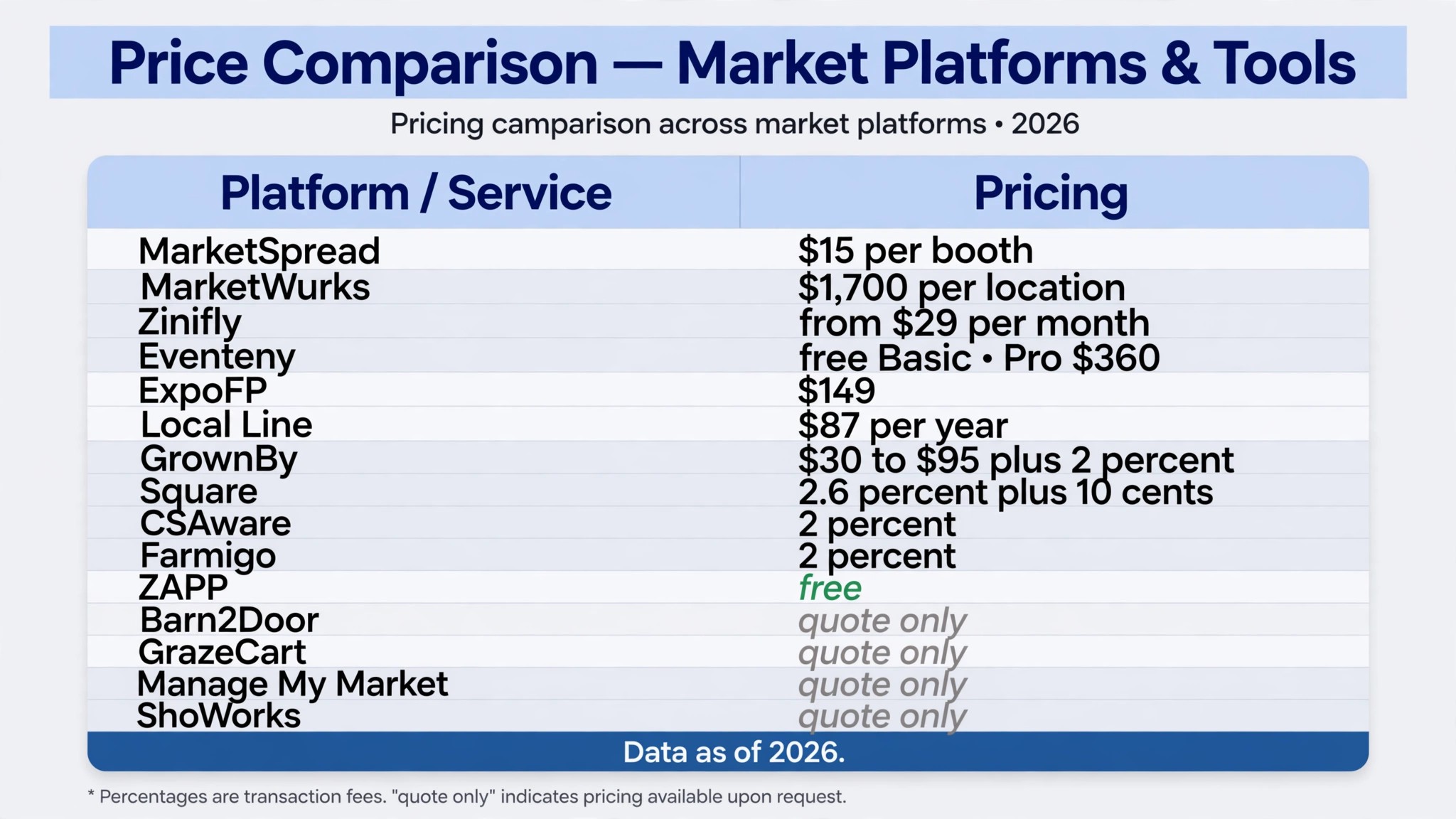
The table below matches each common market job to the single tool that handles it best. Use it to narrow the best software for farmers markets to two or three candidates before you read the full reviews. Prices are monthly list prices unless noted, and payment processing is usually charged separately.
| Job | Best tool | Why it wins |
|---|---|---|
| Token tracking for SNAP and WIC | MarketSpread | 15 dollars per booth, token reconciliation included |
| Shared vendor profiles across markets | Manage My Market | Quote based, used in 30 plus states and Canada |
| Large markets with 35 plus vendors | MarketWurks | 1,700 dollars per location, unlimited vendors |
| Flat subscription for a small market | Zinifly | 29, 79 or 199 dollars a month |
| Festivals plus markets in one suite | Eventeny | Free Basic, Pro at 360 dollars a month |
| Interactive stall map for visitors | ExpoFP | DIY at 149 dollars a month |
| Farm sales across many channels | Local Line | From 87 dollars a month billed annually |
| Direct farm sales under your brand | Barn2Door | Quote based, built for farm e-commerce |
| Meat and perishable direct sales | GrazeCart | Quote based, weight based selling |
| CSA boxes that build themselves | CSAware | 2 percent of delivery revenue, 100 dollars a month minimum |
| CSA signup and delivery logistics | Farmigo | 2 percent of deliveries, 150 dollars a month minimum |
| Co-op farms with SNAP built in | GrownBy | Tiered 30 to 95 dollars a month plus 2 percent |
| Taking card payments at the stall | Square | Free to start, 2.6 percent plus 10 cents per payment |
| Juried art fair applications | ZAPP | Free for artists, fees on the fair side |
| County fairs with entries and livestock | ShoWorks | Quote based, built for traditional fairs |
How We Judged the Best Software for Farmers Markets
A tool earned a place here only if it does a real market job in 2026, not if it added a market label to a general event system. The best software for farmers markets were judged on five things that decide whether a manager keeps paying after the first year.
First, the market job it does, from vendor applications to stall maps to payments, because a tool that does one job well beats a platform that does five jobs poorly. Second, whether the price is published and how it scales, including per booth and per vendor charges that change the real bill as the market grows.
Third, token tracking, because a market that takes SNAP, WIC and Double Up Food Bucks needs software that reconciles tokens at the end of the day, and most tools do not do it at all. Fourth, the vendor experience, because a vendor who finds the application confusing will not apply again next season. Fifth, the catch, from per booth fees that grow with a large market to quote only pricing that hides the cost until the demo.
| Check before you buy | What to ask | Why it matters |
|---|---|---|
| Token tracking | SNAP, WIC and Double Up reconciliation | Token errors cost a market its funding |
| Pricing model | Per booth, per vendor, or flat monthly | A per booth fee is cheap at 12 stalls, dear at 90 |
| Stall maps | Interactive map with live availability | A live map stops double bookings |
| Payments | Card rates and who pays the fee | Processing fees eat margin on every stall fee |
| Vendor applications | Online forms, documents and approvals | Lost applications mean empty stalls |
| Contract terms | Monthly or annual, and what year two costs | Annual billing locks the price but not the need |
The 15 Tools, Reviewed One by One
1. MarketSpread
Starting price 15 dollars per booth, or 30 dollars per booth for a year round series. Best for Token tracking for SNAP and WIC. Watch out The per booth fee grows with a large market, so model the full season.
MarketSpread is built by people who clearly understand farmers markets, and its standout is token tracking for SNAP, WIC and Double Up Food Bucks, with end of market reconciliation. For a market that takes food assistance tokens, that reconciliation is the feature that decides the purchase, because no other tool at this price does it as well.
The strength is the pricing model. For a small seasonal market, that is the cheapest honest way to get real market software, and the Farmers Market Coalition partnership links it to its Farmers Market Metrics reporting platform, which matters for grant reporting.
The catch is scale. For token tracking at a fair price, MarketSpread earns the top spot, and it is the best pick for a market that reports to grant funders.
2. Manage My Market
Starting price Quote based, not published. Best for Shared vendor profiles across markets. Watch out Quote only pricing means the bill depends on the market, so get it in writing.
Manage My Market has been serving markets across more than 30 states and Canada for years, and its best idea is the shared vendor profile. It covers vendor applications and approvals, license tracking, invoices, PayPal, Square and Stripe payments, vendor emails and interactive market maps.
The strength is the network effect. For a market manager who chases missing documents every season, that shared profile is the selling point.
The catch is price transparency. For a market that values vendor convenience and a proven track record, Manage My Market earns its place, and a buyer should compare its quote against MarketSpread’s per booth price before signing.
3. MarketWurks
Starting price 1,700 dollars per location per subscription, unlimited vendors. Best for Large markets with 35 plus vendors. Watch out The price suits large markets, so a small market will find it dear.
MarketWurks is built for markets with roughly 35 to 40 or more vendors, and it charges 1,700 dollars per location per subscription with unlimited vendors included. For a large market, that flat per location price with unlimited vendors is the selling point, because per booth fees would cost more at that size.
The strength is the scale. That matters when a market grows from 40 vendors to 80 and the software cost stays flat.
The catch is the entry price. For a large market, MarketWurks earns its place, and it is the best pick when the vendor count makes per booth pricing more expensive than a flat fee.
4. Zinifly
Starting price 29, 79 or 199 dollars a month. Best for Flat subscription for a small market. Watch out It does not track market tokens, so check that gap before choosing.
Zinifly publishes a flat subscription of 29, 79 or 199 dollars a month depending on plan, which makes it easy to budget for a small market. For a small market that wants a predictable monthly bill, that flat price is the selling point.
The strength is simplicity and price transparency. That is a better experience than the quote based vendors on this list, and it suits a market run by volunteers who need software that just works.
The catch is token tracking. For a small market that does not need token tracking, Zinifly earns its place, and it is the best flat price pick on this list.
5. Eventeny
Starting price Free Basic, Pro at 360 dollars a month, or 240 dollars billed annually. Best for Festivals plus markets in one suite. Watch out Platform transaction fees of 3 to 5 percent add up on high volume events.
Eventeny is an all in one platform built for festivals, fairs, markets, community events and fan conventions, reporting more than 32,500 events hosted. For a market that is part of a larger festival, or a manager who also runs fairs, that breadth is the selling point.
The strength is the suite. Pro at 360 dollars a month monthly, or 240 dollars billed annually, adds the mapping module and deeper features.
The catch is the transaction fees. For a festival sized market, Eventeny earns its place, and it is the best pick when one tool must run the whole event.
6. ExpoFP
Starting price DIY at 149 dollars a month, 7 day trial. Best for Interactive stall map for visitors. Watch out It does not run vendor applications or jurying, so pair it with another tool.
ExpoFP is an interactive floor plan platform used by trade shows, expos, fairs, festivals and venues, with more than 10,000 floor plans created. For a market whose shoppers cannot find the stall they came for, that live map is the selling point.
The strength is the visitor experience. The DIY plan at 149 dollars a month includes booth reservation and sponsorship, with a 7 day trial and no credit card required.
The catch is scope. For an interactive stall map, ExpoFP earns its place, and it pairs well with any application tool on this list.
7. Local Line
Starting price From 87 dollars a month billed annually, or 109 dollars month to month. Best for Farm sales across many channels. Watch out It does not do production records, so it is a sales tool, not a farm management tool.
Local Line is a sales platform for farms, CSAs and food hubs, built around one master inventory feeding multiple price lists. For a farm that sells at the market, online and wholesale from one supply, that shared inventory is the selling point.
The strength is the multi channel model. There is no setup fee, no commission and no transaction fee beyond standard card and ACH processing, with free migration.
The catch is scope. For a farm selling across many channels, Local Line earns its place, and it is the best pick for a market vendor who also sells online and wholesale.
8. Barn2Door
Starting price Quote based. Best for Direct farm sales under your brand. Watch out Quote only pricing means the bill depends on the farm, so get it in writing.
Barn2Door is an e-commerce solution for farmers and ranchers selling direct to consumers under their own brand. For a market vendor who wants to sell online between market days, that brand ownership is the selling point.
The strength is the brand. That matters for a farm whose market day is the best marketing it has, because the online store captures the sale after the market ends.
The catch is price transparency. For a farm that wants direct sales under its own brand, Barn2Door earns its place, and a buyer should compare its quote against Local Line’s published price before signing.
9. GrazeCart
Starting price Quote based. Best for Meat and perishable direct sales. Watch out Quote only pricing means the bill depends on the farm, so get it in writing.
GrazeCart is built for meat producers, butcher shops and perishable direct sales, with weight based selling and shipping that generic farm tools handle badly. For a farm that sells meat at the market and online, that weight based model is the selling point.
The strength is the perishable workflow. That accuracy matters when a mistake means a lost customer and a wasted cut.
The catch is price transparency. For a meat focused farm, GrazeCart earns its place as the best specialist on this list, and it is the wrong pick for a vegetable farm that needs a simpler store.
10. CSAware
Starting price 2 percent of delivery revenue, 100 dollars a month minimum. Best for CSA boxes that build themselves. Watch out The cost scales with revenue, so a growing CSA pays more every month.
CSAware, backed by LocalHarvest since 1999, is built for CSAs and food hubs managing subscriptions, payments, packing and delivery logistics. For a CSA that packs dozens of different boxes every week, that automation is the selling point.
The strength is the box building. Real human support is included, which matters for a small farm team.
The catch is the pricing model. For a CSA that wants automated box building, CSAware earns its place, and a buyer should model the cost at full season revenue before committing.
11. Farmigo
Starting price 2 percent of deliveries, 150 dollars a month minimum. Best for CSA signup and delivery logistics. Watch out The cost scales with deliveries, and support should be confirmed after the GrubMarket acquisition.
Farmigo is built around member signup conversion and complex multi site delivery logistics, with a signup wizard, multiple payment plans and drop site coordination across many small pickup points. For a CSA with many drop sites and a complex delivery map, that logistics strength is the selling point.
The strength is conversion. That matters for a CSA whose growth depends on signing members faster than it loses them.
The catch is the pricing model and the ownership change. For a CSA that prioritises signup and delivery logistics, Farmigo earns its place.
12. GrownBy
Starting price Tiered 30 to 95 dollars a month, plus a 2 percent co-op fee on transactions. Best for Co-op farms with SNAP built in. Watch out The co-op fee stacks on top of the plan fee, so model the full cost.
GrownBy is the cooperative minded farm platform, and it was the first farm platform with USDA SNAP Online approval, with free SNAP and EBT processing built in natively. For a farm that sells to SNAP customers online, that native support is the selling point.
The strength is the SNAP handling. A farm can take SNAP payments online without a workaround, which opens a customer base that most farm platforms cannot serve, and the cooperative model means the platform is owned by the farms that use it rather than by outside investors.
The catch is the fee stack. For a cooperative minded farm that needs SNAP online, GrownBy earns its place, and it is the best pick for a farm whose customers pay with benefits.
13. Square
Starting price Free to start, 2.6 percent plus 10 cents per payment. Best for Taking card payments at the stall. Watch out It is a payment tool, not a market management system, so pair it with another tool.
Square is the payment pick, and it belongs on this list because every market vendor needs to take card payments at the stall. For a vendor who has only ever taken cash, that reader is the difference between a sale and a lost customer who has no cash in their pocket.
The strength is simplicity. Square also integrates with Manage My Market, so a market that uses both gets payments tied to vendor accounts automatically.
The catch is scope. For taking card payments at the stall, Square earns its place as the cheapest way to start, and it pairs with any market tool on this list.
14. ZAPP
Starting price Free for artists, fees on the fair side. Best for Juried art fair applications. Watch out It is built for juried art fairs, so a produce market will find it the wrong shape.
ZAPP, short for ZAPPlication, is the application and jurying system that many juried art fairs already use, and it earns its place for markets that jury their vendors. For a market that juries its craft vendors, that jury workflow is the selling point.
The strength is the standard. The jury scoring is built for the way art fairs actually judge work, rather than for a generic application form.
The catch is fit. For a market with a juried craft section, ZAPP earns its place, and it pairs well with MarketSpread or Manage My Market for the rest of the operation.
15. ShoWorks
Starting price Quote based. Best for County fairs with entries and livestock. Watch out Quote only pricing means the bill depends on the fair, so get it in writing.
ShoWorks closes the list as the fair entry specialist, built for county and state fairs with competitive exhibits and livestock. For a county fair that runs alongside a farmers market, that entry system is the selling point.
The strength is the fair workflow. That matters when a fair has hundreds of entries across dozens of classes and a paper system would collapse under the volume.
The catch is price transparency and fit. For a county or state fair, ShoWorks earns its place as the best specialist on this list, and it is the right pick when entries and livestock are part of the event.
Side by Side Comparison
The table below puts the best software for farmers markets side by side on price, best job and free plan, so you can compare the published prices against the quote only tools at a glance.
| Tool | Starting price | Best for | Free plan |
|---|---|---|---|
| MarketSpread | 15 dollars per booth | Token tracking for SNAP and WIC | Trial only |
| Manage My Market | Quote only | Shared vendor profiles across markets | Trial only |
| MarketWurks | 1,700 dollars per location | Large markets with 35 plus vendors | Trial only |
| Zinifly | 29 dollars a month | Flat subscription for a small market | Trial only |
| Eventeny | Free Basic | Festivals plus markets in one suite | Yes |
| ExpoFP | 149 dollars a month | Interactive stall map for visitors | Trial only |
| Local Line | From 87 dollars a month | Farm sales across many channels | Trial only |
| Barn2Door | Quote only | Direct farm sales under your brand | Trial only |
| GrazeCart | Quote only | Meat and perishable direct sales | Trial only |
| CSAware | 2 percent, 100 dollars a month minimum | CSA boxes that build themselves | Trial only |
| Farmigo | 2 percent, 150 dollars a month minimum | CSA signup and delivery logistics | Trial only |
| GrownBy | 30 to 95 dollars a month | Co-op farms with SNAP built in | Trial only |
| Square | Free to start | Taking card payments at the stall | Yes |
| ZAPP | Free for artists | Juried art fair applications | Yes |
| ShoWorks | Quote only | County fairs with entries and livestock | Trial only |
How to Pick the Right Tool for Your Market
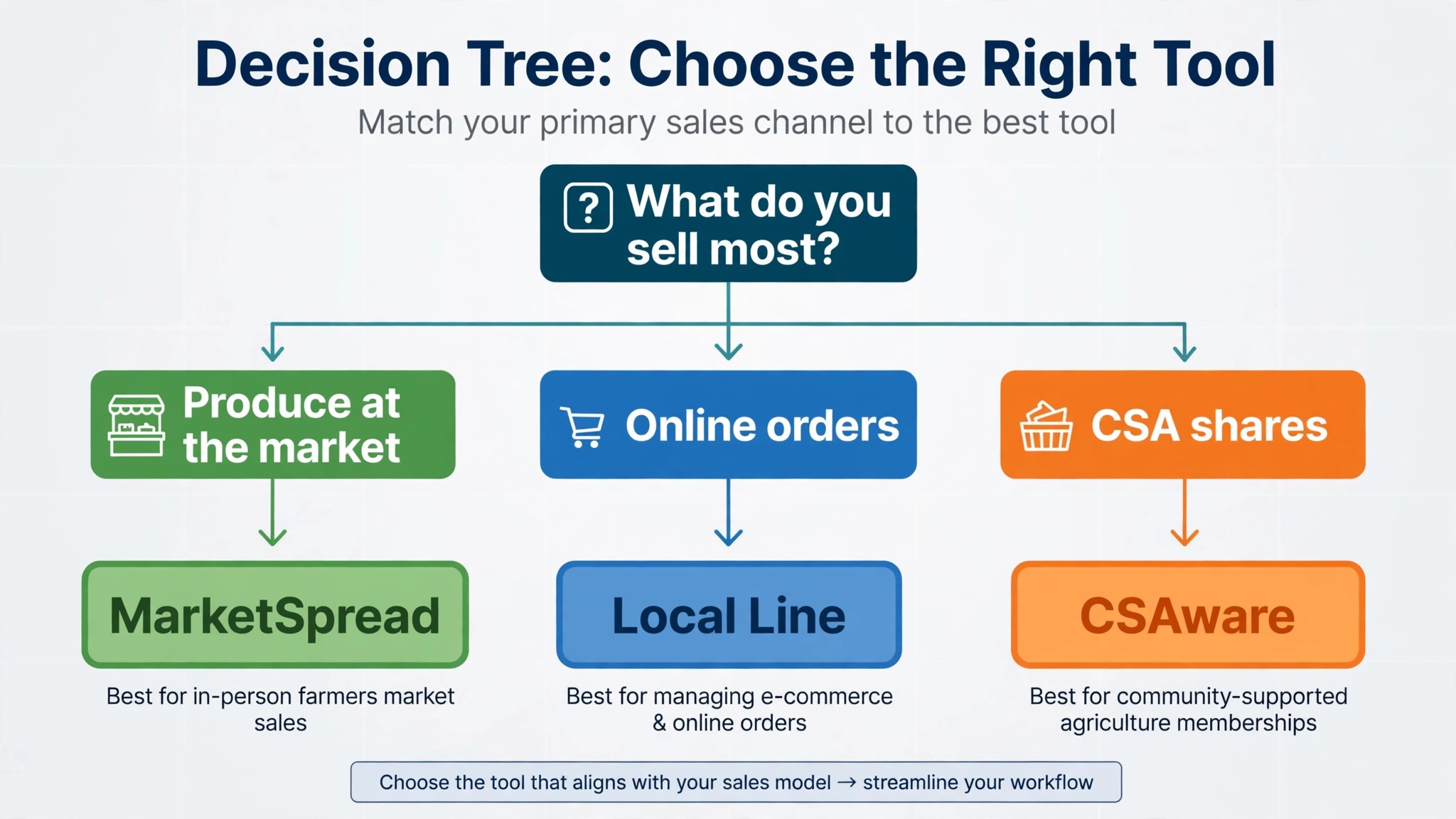
The best software for farmers markets is not the one with the longest feature list. It is the one that fixes the bottleneck in your market. A market losing vendors to confusing applications should buy Manage My Market or Zinifly. A market that takes food assistance tokens should buy MarketSpread. A large market should buy MarketWurks. A market whose shoppers cannot find stalls should buy ExpoFP. Start from the bottleneck, not from the vendor homepage.
Budget the full bill, not the headline price. The table below shows what a small market actually pays in a season for the most common combinations, using published or reported prices. Per booth fees, transaction fees and payment processing are the lines that surprise buyers, so ask for them in writing before you sign, and model the cost at your real stall count rather than at an average market.
| Market size | Best value pick | Season cost |
|---|---|---|
| 12 stalls, seasonal | MarketSpread | About 180 dollars per season |
| 12 stalls, year round | MarketSpread | About 360 dollars per year |
| 20 stalls, small market | Zinifly | 29 dollars a month |
| 40 vendors, large market | MarketWurks | 1,700 dollars per location |
| 90 stalls, year round | Zinifly or flat plan | Flat beats per booth at this size |
| Festival plus market | Eventeny | Free Basic, then Pro |
Frequently Asked Questions
What is the cheapest good software for farmers markets to start with
MarketSpread is the cheapest credible start for a small seasonal market, at 15 dollars per booth, so a 12 stall market pays about 180 dollars per season. Zinifly from 29 dollars a month is the cheapest flat subscription, and Eventeny has a free Basic plan for a market that wants to test a full suite before paying. Start with the market job that costs you the most time each week, and add a second tool only when the first one cannot do a job you are paid to do. That is the cheapest way to choose from the best software for farmers markets without paying for features your market never uses.
Do I need token tracking, or can I count tokens by hand
You need it if your market takes SNAP, WIC or Double Up Food Bucks, and any vendor that treats it as optional should be treated with caution. The best software for farmers markets includes token tracking, because a market that counts tokens by hand will make errors at the end of a busy day, and those errors cost the market its funding and its vendors their pay. MarketSpread is the strongest pick for token reconciliation, and it links to Farmers Market Metrics reporting for grant funders. If your market does not take food assistance tokens, Zinifly is a fair choice without that feature.
Which tool is best for a small market run by volunteers
Zinifly and MarketSpread are the strongest picks for a volunteer run market, because Zinifly publishes a flat price from 29 dollars a month and MarketSpread charges a simple per booth fee with no monthly bill. Manage My Market is the best pick when the market wants shared vendor profiles and a proven track record across many states. Price the full season, not one month, and trial the vendor application flow with a real vendor before you commit.
How much should a small market budget for market software
A realistic year one budget is 180 to 400 dollars a season for a small market on MarketSpread, or 350 to 2,400 dollars a year for a flat subscription such as Zinifly. A large market on MarketWurks pays 1,700 dollars per location per subscription, and a festival on Eventeny Pro pays 240 to 360 dollars a month plus transaction fees. Budget for the season, not for one month, and check the payment processing rate before you compare, because card fees apply on every stall payment.
Our Verdict
If you buy one tool this quarter, buy MarketSpread if your market takes food assistance tokens and Zinifly if it does not. MarketSpread is the best value on this list for a token taking market, with a per booth price of 15 dollars and reconciliation that protects the market’s funding. Zinifly is the best flat price pick for a small market that wants a predictable monthly bill, from 29 dollars a month with no per booth maths. The best software for farmers markets earns its keep by filling stalls and paying vendors on time without eating the manager’s week, and both of these do that from the first market day.
Whatever you pick, start with the bottleneck, trial with real vendors, and check the token tracking before you sign. The tools on this list all work. The difference is whether the tool matches the market you actually run, and whether you measure the return in stalls filled and vendors paid rather than in features used.