
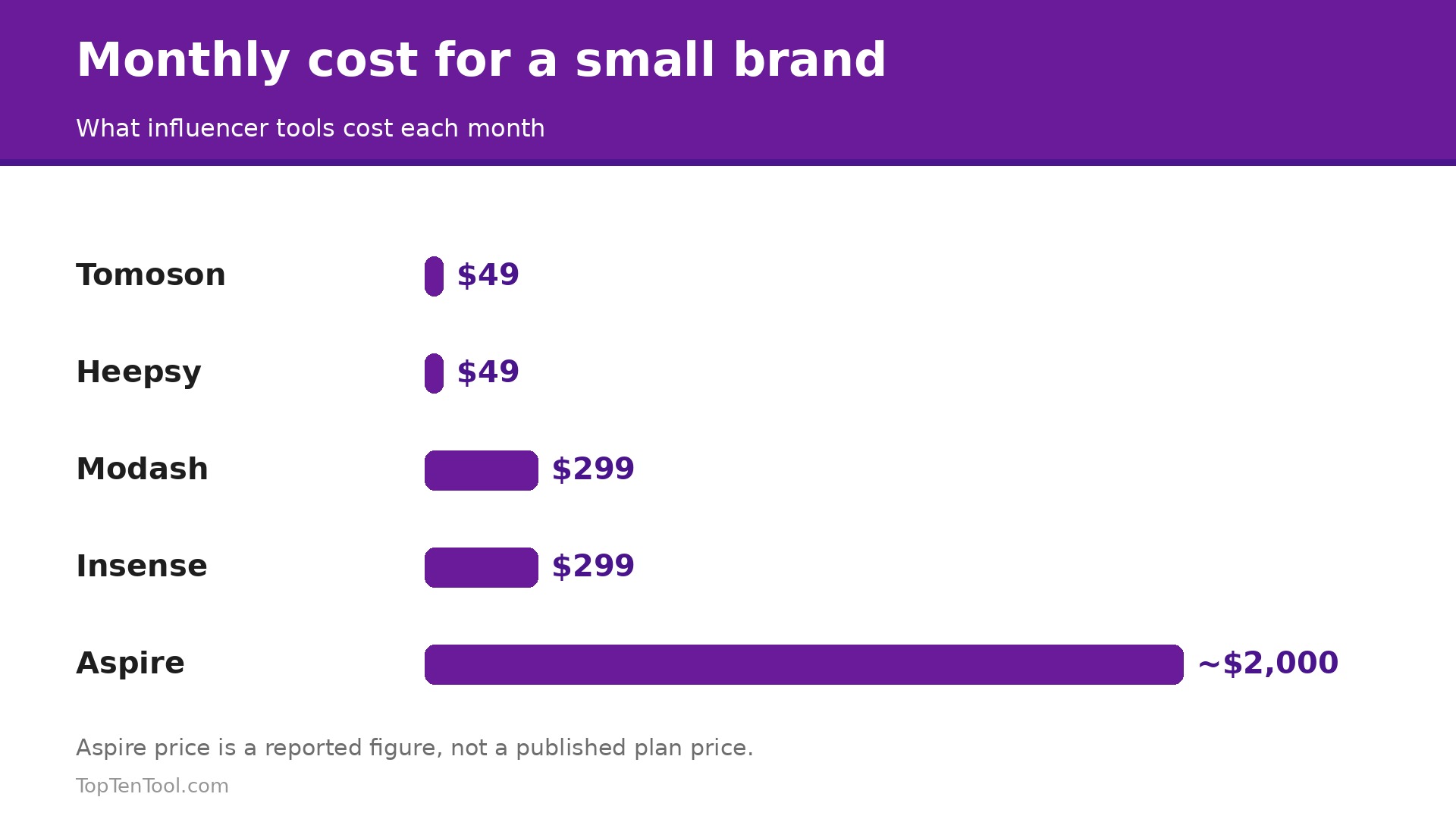
A small brand cannot outspend a big brand on ads, but it can outsmart one with creators, because a trusted recommendation from a small creator often sells more than a polished ad from a famous one. The best influencer marketing tools for small brands help you find those creators, check that their audience is real, run the campaign, and track the sales it brings. Our research compared vendor pricing and reported figures in November 2026, and the price gap is the widest on this list, from free tools to platforms that cost $2,000 a month.
Small brands face a different problem from big ones. You may run one campaign with ten micro creators and a few hundred dollars of product, so the tool has to be affordable, transparent about price, and simple enough to run without an agency. A platform that hides its price behind a sales call and locks you into a 12 month contract is the wrong tool for a first campaign.
This guide compares twelve tools on real prices, creator discovery, fraud checks and tracking, and it ends with a pick for each common situation. Start with the comparison table, then read the reviews that match your budget.
The Field in Brief
The table below shows the starting price of each tool, who it suits best, and the one thing to watch. Quote only tools have no published price, and reported figures are marked as reported. Small brands should start with the transparent, self serve tools at the top of the price range. Use the table to shortlist the best influencer marketing tools for small brands options that fit your budget before reading the full reviews.
| Tool | Starting price | Best for | Watch out |
|---|---|---|---|
| Tomoson | $49 a month | Small brands that want transparent pricing | Smaller creator database than the big platforms |
| Heepsy | $49 a month | Finding micro creators by niche | Campaign management is lighter than full suites |
| Modash | $299 a month | Creator discovery with strong fraud checks | No free plan, and $299 is a real commitment |
| Collabstr | Free to join, pay per campaign | Hiring creators for one off jobs | Less suited to long term ambassador programs |
| Shopify Collabs | Free | Shopify stores starting creator programs | Only useful if you run a Shopify store |
| Upfluence | Quote only, reported from about $478 a month | Ecommerce discovery and affiliate tracking | 12 month contract and no published price |
| Aspire | Quote only, reported near $2,000 a month | Ambassador and UGC programs at scale | Enterprise pricing with no self serve trial |
| GRIN | Quote only, free tier available | DTC brands doing 50 plus creator partnerships | Pricing is custom and the platform is built for scale |
| Insense | $299 a month | UGC content for ads | Discovery is weaker than Modash or Upfluence |
| Influencity | $398 a month | Discovery plus campaign management | Higher entry price than Tomoson or Heepsy |
| CreatorIQ | Quote only | Enterprise brands with big creator programs | No published price and no self serve option |
| Traackr | Quote only | Influencer analytics and benchmarking | No published price, built for larger teams |
How We Compared These Influencer Tools
We judged each tool on five things that decide whether a small brand gets value from it. First, transparent pricing, because a small brand cannot plan a campaign around a price it has not seen. Second, creator discovery, including database size, filters and audience checks that catch fake followers. Third, campaign management, from outreach and gifting to contracts and content approval. Fourth, tracking, including discount codes, affiliate links and sales attribution, because a campaign that cannot prove sales will not get a second budget. Fifth, the contract, since a 12 month commitment is a serious risk for a first campaign. We marked quote only tools clearly and gave extra credit to tools with month to month billing.
The best influencer marketing tools for small brands are the ones a small brand can start this month without a sales call.
The 12 Best Influencer Marketing Tools Reviewed
1. Tomoson
Starting price $49 a month. Best for Small brands that want transparent pricing. Watch out Smaller creator database than the big platforms.
Tomoson is one of the few platforms that publishes its prices, with five tiers from $49 to $599 a month, all sharing the same features, so you pay for volume rather than unlocked tools. A 21 day free trial is included. The platform covers discovery, outreach, campaign management and tracking, and it suits a small brand that wants to run a real campaign without a sales call.
The creator database is smaller than Upfluence or CreatorIQ, and the analytics are lighter than the enterprise tools. It is still the best transparent starting point for a small brand, because the price is known before you sign up.
In practice, Tomoson earns its place when small brands that want transparent pricing. The main risk is smaller creator database than the big platforms, so test that specific limit during your trial before you commit.
Pick it when you want to start this month with a known price. Skip it when you need the largest creator database available.
2. Heepsy
Starting price $49 a month. Best for Finding micro creators by niche. Watch out Campaign management is lighter than full suites.
Heepsy is a discovery first tool that helps small brands find micro and nano creators by niche, location and audience quality. Plans start at $49 a month, and the audience reports flag fake followers and engagement problems before you pay a creator. It suits a brand that does its own outreach and just needs to find the right people.
Heepsy is weaker on campaign management, payments and content approval than a full suite such as Aspire or GRIN. It is a finder, not a full platform, so pair it with your own outreach process.
In practice, Heepsy earns its place when finding micro creators by niche. The main risk is campaign management is lighter than full suites, so test that specific limit during your trial before you commit.
Pick it when finding the right micro creators is your main job. Skip it when you need full campaign management and payments.
3. Modash
Starting price $299 a month. Best for Creator discovery with strong fraud checks. Watch out No free plan, and $299 is a real commitment.
Modash publishes its prices, with plans at $299 and $599 a month, and it is known for strong fraud detection and audience verification. The database is large, the filters are precise, and the reporting shows whether a creator audience matches your buyers. It suits a brand that has run a first campaign and is ready to invest in better discovery.
At $299 a month, Modash is a serious commitment for a small brand, and there is no free plan. Campaign management is lighter than a full suite. It earns its price when fraud checks and audience quality decide the campaign.
In practice, Modash earns its place when creator discovery with strong fraud checks. The main risk is no free plan, and $299 is a real commitment, so test that specific limit during your trial before you commit.
Pick it when audience quality and fraud checks matter most. Skip it when you are running your very first campaign on a tiny budget.
4. Collabstr
Starting price Free to join, pay per campaign. Best for Hiring creators for one off jobs. Watch out Less suited to long term ambassador programs.
Collabstr is a marketplace where brands hire creators for one off jobs, from a single Instagram post to a full UGC package, with prices set by the creator. Joining is free, and you pay per campaign rather than a monthly subscription, which suits a small brand testing influencer marketing for the first time. The platform handles messaging, payment and delivery in one place.
Collabstr is weaker for long term ambassador programs and ongoing relationships, which need a full platform such as Aspire or GRIN. It is a hiring marketplace, not a relationship tool. Use it to test creators before committing to a program.
In practice, Collabstr earns its place when hiring creators for one off jobs. The main risk is less suited to long term ambassador programs, so test that specific limit during your trial before you commit.
Pick it when you want to hire creators for one off jobs without a subscription. Skip it when you need a long term ambassador program.
5. Shopify Collabs
Starting price Free. Best for Shopify stores starting creator programs. Watch out Only useful if you run a Shopify store.
Shopify Collabs is free for Shopify stores, and it lets a brand recruit creators, offer discount codes and track affiliate sales from inside Shopify. Creators apply to work with the brand, and the store owner manages gifting and payments without a separate subscription. It is the obvious first step for any Shopify store that wants to try creator marketing.
Shopify Collabs only works for Shopify stores, and it is lighter on discovery and fraud checks than a dedicated platform. It is a starting point, not a full suite. Use it to prove the channel, then upgrade if you need deeper discovery.
In practice, Shopify Collabs earns its place when shopify stores starting creator programs. The main risk is only useful if you run a Shopify store, so test that specific limit during your trial before you commit.
Pick it when you run a Shopify store and want to start free. Skip it when you do not use Shopify.
6. Upfluence
Starting price Quote only, reported from about $478 a month. Best for Ecommerce discovery and affiliate tracking. Watch out 12 month contract and no published price.
Upfluence is a mature all in one platform covering discovery, outreach, affiliate tracking, gifting and payments, with a creator database of 12 million or more. Its Live Capture tool finds influencers among your own customers, and the Shopify, WooCommerce and Amazon integrations are deep. Reported entry is from about $478 a month for a single module, with a realistic all in cost nearer $1,000 a month.
Upfluence publishes no price, requires a demo, and locks customers into a 12 month contract, which is a serious commitment for a small brand. The module system takes time to learn. It suits an established ecommerce brand, not a first campaign.
In practice, Upfluence earns its place when ecommerce discovery and affiliate tracking. The main risk is 12 month contract and no published price, so test that specific limit during your trial before you commit.
Pick it when you are an established ecommerce brand ready to invest. Skip it when you want a transparent price and a short commitment.
7. Aspire
Starting price Quote only, reported near $2,000 a month. Best for Ambassador and UGC programs at scale. Watch out Enterprise pricing with no self serve trial.
Aspire, formerly AspireIQ, is a full suite creator platform with a marketplace of more than a million creators, strong Shopify integration, and tools for product seeding, ambassador, referral, UGC and affiliate campaigns. Creators apply to your campaigns, which suits brands that want inbound interest rather than only outbound search. Reported entry is near $2,000 a month.
Aspire publishes no price, requires a demo, and runs on custom annual contracts, which puts it out of reach for most small brands. It is an enterprise tool for brands running big, managed creator programs. Small brands should start elsewhere and consider Aspire only when volume justifies it.
In practice, Aspire earns its place when ambassador and UGC programs at scale. The main risk is enterprise pricing with no self serve trial, so test that specific limit during your trial before you commit.
Pick it when you run large ambassador and UGC programs. Skip it when you are a small brand on a first campaign.
8. GRIN
Starting price Quote only, free tier available. Best for DTC brands doing 50 plus creator partnerships. Watch out Pricing is custom and the platform is built for scale.
GRIN is built for direct to consumer brands running 50 or more creator partnerships, with product gifting, campaign management and sales tracking in one place. It now offers a free tier and published self serve tiers up to $1,500 a month, which is more transparent than it used to be. The Shopify and WooCommerce integrations are deep, and the platform handles the operational load of many creators at once.
GRIN is built for scale, so a brand with five creators will pay for capacity it does not use. Pricing above the self serve tiers is custom. It fits a growing DTC brand, not a first test.
In practice, GRIN earns its place when dTC brands doing 50 plus creator partnerships. The main risk is pricing is custom and the platform is built for scale, so test that specific limit during your trial before you commit.
Pick it when you run dozens of creator partnerships and need gifting at scale. Skip it when you have five creators and a small budget.
9. Insense
Starting price $299 a month. Best for UGC content for ads. Watch out Discovery is weaker than Modash or Upfluence.
Insense is a UGC platform that connects brands with creators who make ad ready content, from unboxing videos to testimonial clips. Plans start at $299 a month, and the platform handles briefs, content approval and payments. It suits a brand that needs a steady supply of creator content for paid ads, not just organic posts.
Insense is weaker on discovery and long term relationship management than a full suite, and $299 a month is a real commitment. It earns its price when UGC for ads is the main output.
In practice, Insense earns its place when uGC content for ads. The main risk is discovery is weaker than Modash or Upfluence, so test that specific limit during your trial before you commit.
Pick it when you need creator content for paid ads. Skip it when you need discovery and ambassador management.
10. Influencity
Starting price $398 a month. Best for Discovery plus campaign management. Watch out Higher entry price than Tomoson or Heepsy.
Influencity is a full platform covering discovery, campaign management, reporting and payments, with a large creator database and strong audience analytics. Plans start at $398 a month, which sits between the budget tools and the enterprise suites. It suits a mid sized brand that wants one platform for the whole workflow and is ready to pay for it.
The entry price is higher than Tomoson or Heepsy, and there is no free plan for a small brand to test with. It fits a brand that has proven influencer marketing works and is ready to scale.
In practice, Influencity earns its place when discovery plus campaign management. The main risk is higher entry price than Tomoson or Heepsy, so test that specific limit during your trial before you commit.
Pick it when you have proven the channel and want one full platform. Skip it when you are testing influencer marketing for the first time.
11. CreatorIQ
Starting price Quote only. Best for Enterprise brands with big creator programs. Watch out No published price and no self serve option.
CreatorIQ is an enterprise platform for large brands running big creator programs, with discovery, campaign management, payments and deep reporting. It is used by major brands and agencies, and its data and workflow tools are among the strongest in the category. Pricing is quote only, with custom annual contracts.
CreatorIQ is not a small brand tool. There is no published price, no free plan and no self serve option, and the platform assumes a large team and budget. Small brands should not start here.
In practice, CreatorIQ earns its place when enterprise brands with big creator programs. The main risk is no published price and no self serve option, so test that specific limit during your trial before you commit.
Pick it when you are a large brand with a dedicated creator team. Skip it when you are a small brand with a first campaign budget.
12. Traackr
Starting price Quote only. Best for Influencer analytics and benchmarking. Watch out No published price, built for larger teams.
Traackr is an analytics led platform that helps brands find creators, benchmark performance and measure the impact of creator programs over time. It is strong on data and reporting, and it suits teams that need to prove ROI to leadership. Pricing is quote only, with custom contracts.
Traackr publishes no price and is built for larger teams, so a small brand cannot plan around it. It is a measurement tool for established programs, not a starting point for a first campaign.
In practice, Traackr earns its place when influencer analytics and benchmarking. The main risk is no published price, built for larger teams, so test that specific limit during your trial before you commit.
Pick it when you run an established program and need deep measurement. Skip it when you need a transparent price to start this month.
The Fit Check
The right pick depends on your budget, your store platform, and whether this is your first campaign or your fiftieth. Use this table as a shortcut, then read the full review of the tool it points to. Every pick below was judged against the best influencer marketing tools for small brands criteria set out in this guide.
| Job to be done | Best pick | Why it wins |
|---|---|---|
| First campaign, tiny budget | Tomoson | $49 a month, transparent pricing |
| Finding micro creators | Heepsy | $49 a month, strong audience checks |
| One off creator jobs | Collabstr | Free to join, pay per campaign |
| Shopify store, start free | Shopify Collabs | Free for Shopify stores |
| Fraud checks matter most | Modash | $299 a month, best verification |
| UGC content for ads | Insense | $299 a month, ad ready content |
| Established ecommerce brand | Upfluence | Reported from $478, deep integrations |
| Large ambassador program | Aspire | Reported near $2,000, marketplace included |
How to Choose the Best Influencer Marketing Tools for Small Brands
Start with your budget and your contract tolerance, because those two things rule out most of the list. If you have $50 a month and no appetite for a 12 month contract, your shortlist is Tomoson, Heepsy, Collabstr and Shopify Collabs. If you have $300 a month and have already proven the channel, Modash, Insense and Influencity enter the picture. If you have $1,000 or more and a team to run it, Upfluence, Aspire and GRIN become realistic. Never sign a 12 month contract for a first campaign, because you do not yet know which creators convert for your brand.
The best influencer marketing tools for small brands are the ones you can start this month and leave next month if they do not work.
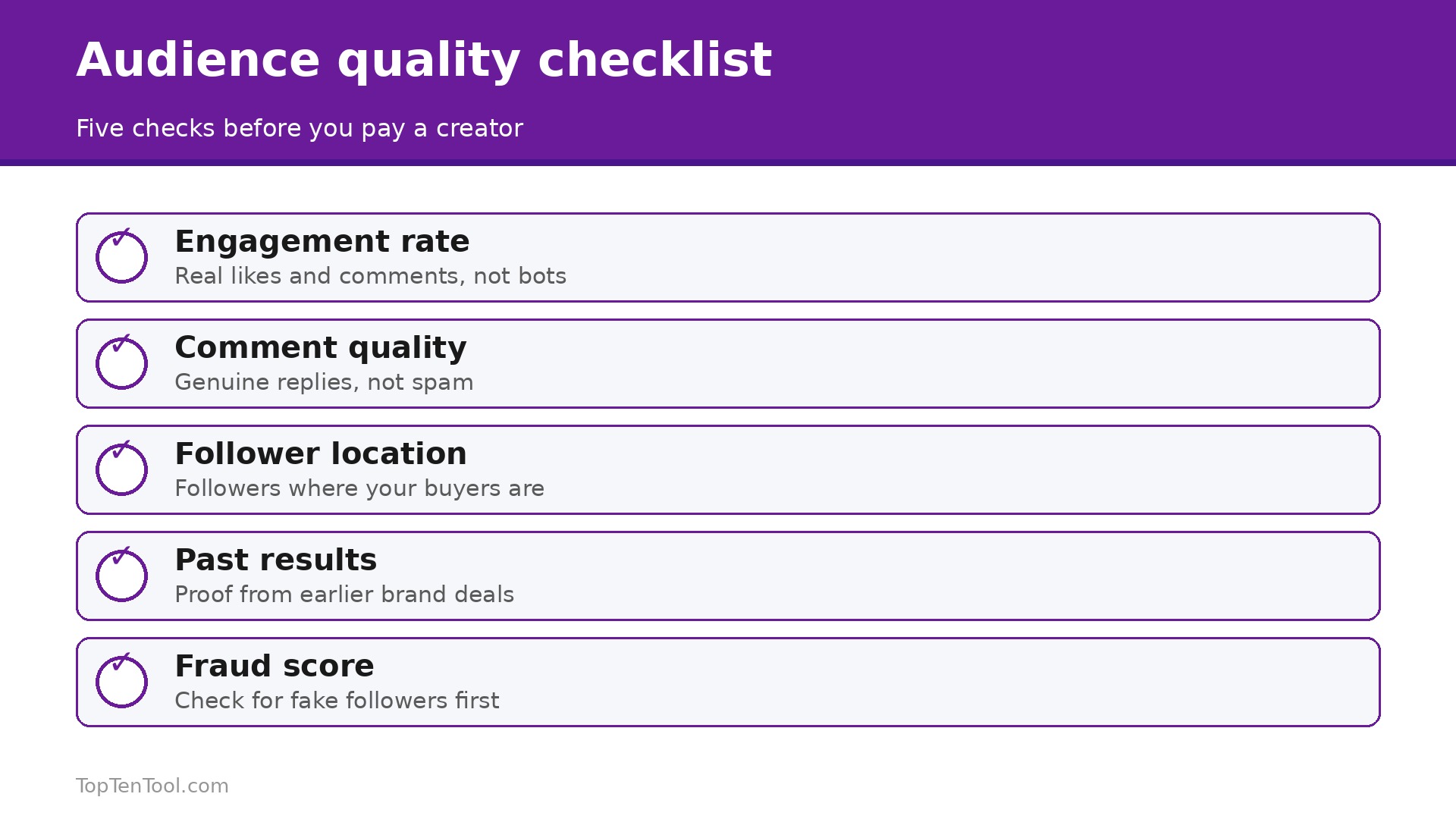
Next, check audience quality before you check follower count. A creator with 10,000 real followers who match your buyers beats a creator with 100,000 bought followers every time. Use the fraud checks in Heepsy or Modash, look at comments for real conversation, and ask for past campaign results before you pay.
Then decide how you will track sales. Discount codes and affiliate links are the minimum, and the tool should report revenue per creator, not just likes. Finally, start with five to ten micro creators rather than one big name, because micro creators cost less, convert better, and give you five chances to learn what works instead of one. Keep this checklist beside you while you compare best influencer marketing tools for small brands options, and the right choice will be obvious by the end.
What a First Influencer Campaign Really Costs
A first campaign does not need a big platform budget. Ten micro creators at $50 to $100 each in product or fee costs $500 to $1,000, plus a $49 tool such as Tomoson or Heepsy, which brings the total to roughly $550 to $1,050 for the first month. Compare that with a single mid tier creator at $500 to $2,000, or an enterprise platform at $2,000 a month before any creator is paid. The micro creator route also gives you ten pieces of content to reuse in ads, ten chances to find a creator who converts, and ten real relationships to build on.
Budget for product, shipping and the tool, and keep a small reserve for the creators who perform best, so you can pay them for a second post while the data is fresh.
Five Mistakes That Waste an Influencer Budget
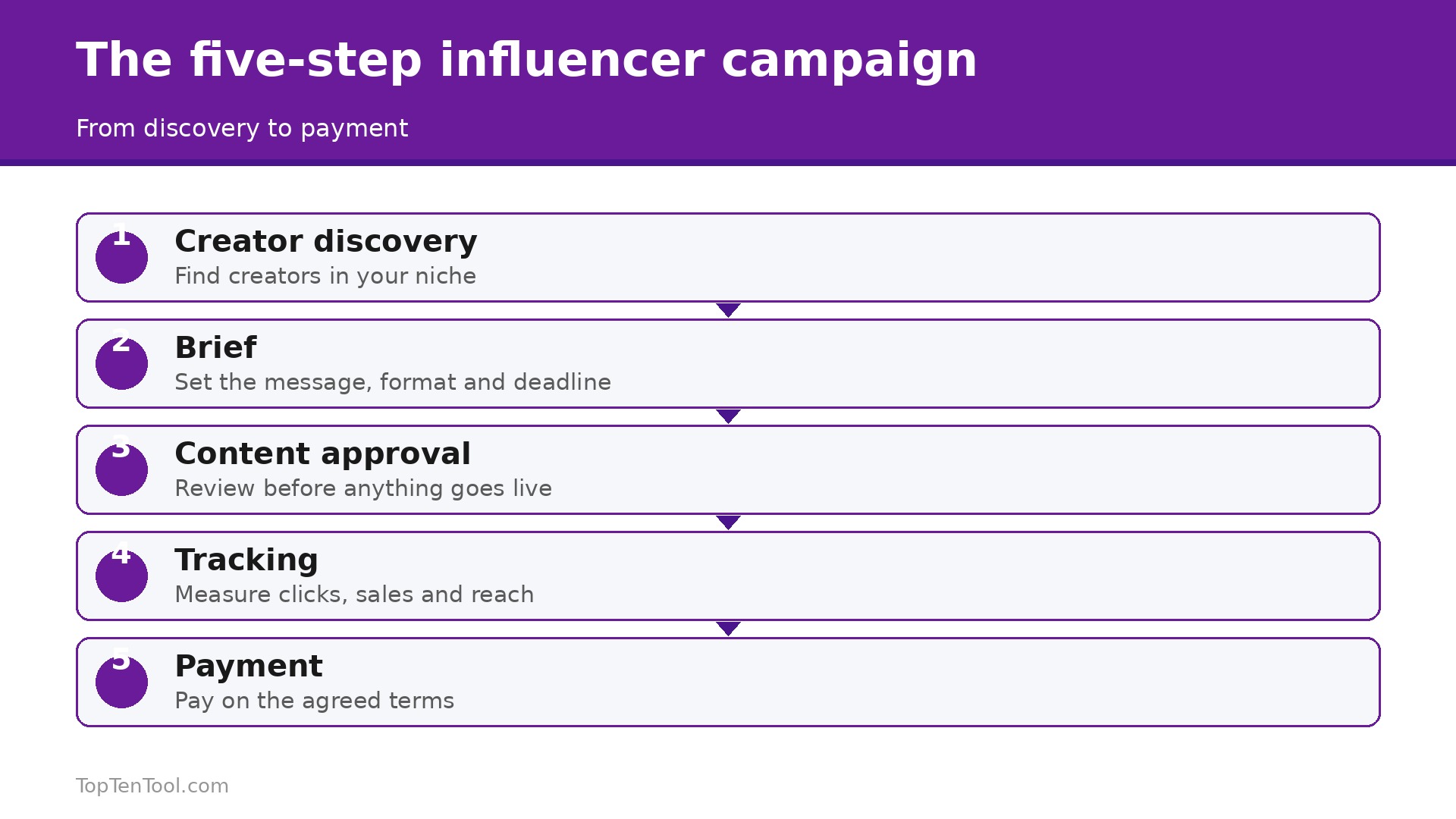
The most common mistake is choosing creators by follower count, which rewards bought audiences and ignores whether the followers match your buyers. The second is giving no brief, which produces content that looks nothing like your brand. Write a one page brief with the message, the call to action and the deadline. The third is skipping discount codes, which makes it impossible to know which creator sold anything. The fourth is paying for one post and disappearing, when the second and third posts from the same creator usually convert better. The fifth is signing a 12 month platform contract before you have run a single campaign, which locks you into a tool you may not need.
Fix these five and a $49 tool will outperform a $2,000 platform.
How to Brief a Creator So the Content Works
A creator brief should fit on one page and answer five questions. What is the one message, what should the viewer do next, what must never be said, when is it due, and what does good look like. Start with the message in a single sentence, because a brief with three messages produces content with none. Then give the call to action in plain words, whether that is a discount code, a link or a comment prompt, and make sure the creator says it the way they would naturally say it, not the way your marketing team wrote it.
Next, show two examples of content you liked, from any brand, and say what you liked about each one. Creators work better from examples than from adjectives, because the word authentic means something different to everyone. Give the creator freedom on the format, the hook and the jokes, because their audience trusts their voice, not yours. The brief should control the message and the deadline, and leave the rest to the creator.
Then set the practical details. The due date, the number of revisions, the usage rights, and how and when they get paid. Put all of it in writing before the creator starts, because a dispute about usage rights after the content is live is far more expensive than a clear line in the brief. Finally, reply fast when the creator sends a draft, because a creator who waits three days for approval will not prioritise your next campaign. A one page brief, two examples, clear payment terms and a fast reply will get you better content than a ten page brand guideline ever will.
The Final Word
For most small brands, the smart start is Tomoson at $49 a month or Heepsy at $49, because both are transparent, affordable and built for a first campaign. Shopify stores should start free with Shopify Collabs, and brands that want one off jobs should try Collabstr. Modash at $299 is the pick when fraud checks and audience quality decide the campaign, and Upfluence or Aspire only make sense once the channel is proven and the budget is real. The best influencer marketing tools for small brands are the ones you can start this month without a sales call, so choose the transparent tool, run a small test with micro creators, and scale only what the sales data proves.
That is the best influencer marketing tools for small brands shortlist we would hand to a friend starting today.
Frequently Asked Questions
How much does influencer marketing software cost for a small brand?
Self serve tools start at $49 a month, with Tomoson and Heepsy both at $49. Shopify Collabs is free for Shopify stores, and Collabstr is free to join with pay per campaign pricing. Mid tier tools such as Modash and Insense start at $299, while enterprise platforms such as Aspire are reported near $2,000 a month with custom contracts.
What is the best influencer marketing tool for a small brand?
Tomoson is the best starting point for most small brands, because it publishes prices from $49 a month and covers discovery through tracking. Heepsy is the best pick when finding micro creators is the main job, and Shopify Collabs is best for Shopify stores. Start with one of these before considering an enterprise platform.
Do I need to pay creators, or is free product enough?
Free product is enough for nano creators with a few thousand followers, especially when the product is desirable. Micro creators with 10,000 to 100,000 followers usually expect a fee of $50 to $500 per post, plus product. Pay for the creators who convert, and use product only for the first test with new creators.
How do I check if an influencer has fake followers?
Look at the engagement rate, read the comments for real conversation, and use a tool with fraud checks such as Heepsy or Modash. A healthy account has comments that mention the content, not just emojis, and an audience that matches the creator niche and location. Ask for past campaign results before you pay.
Should a small brand use micro or macro influencers?
Micro influencers almost always win for a small brand. They cost less, their audiences trust them more, and their engagement rates are higher. A campaign with ten micro creators also gives you ten chances to learn what works, while one macro creator gives you one chance at ten times the price.
How do I track sales from influencer marketing?
Give each creator a unique discount code and affiliate link, and use a tool that reports revenue per creator. Track clicks, code uses and sales in the first 30 days, and compare the cost per sale with your other channels. A campaign that cannot prove sales will not get a second budget, so set up tracking before the first post goes live.