
A season is decided in the weeks nobody watches. A field that needed water on Tuesday gets it on Friday, a pest that was a dozen plants on Monday is a whole row by Sunday, and a crop that looked fine from the road turns out to be two different crops once the harvester measures the yield. The best ai tools for farmers exist because a farm is too big to walk every day and too thin on margin to guess. Satellite imagery, soil sensors, herd records and market prices now sit in software that flags the problem while there is still time to fix it.
This guide compares five tools on published prices, the farm job each one does best and the catch that only shows up after the first season. Prices in this category move often and many are quoted per acre, so every figure below is the published starting price as of late 2026, with the per acre math shown so you can price your own land. Start with the shortlist, then read the reviews that match the problem your farm feels most.
The pattern across all five is simple. The tools that win are the ones that turn a field into a number you can act on, whether that number is a moisture reading, a scouting alert or a seed prescription. Everything else is a bonus, and a farmer who buys the bonus first usually keeps the leak.
The Quick Shortlist
The table below matches each common farm job to the single tool that handles it best. Use it to narrow the best ai tools for farmers to two or three candidates before you read the full reviews. Prices are list prices unless noted, and per acre pricing means the bill scales with your land.
| Job | Best tool | Why it wins |
|---|---|---|
| Crop monitoring and seed prescriptions | Climate FieldView | Free tier, Plus at 4 dollars an acre a year |
| AI crop scouting from the air | Taranis | Sub millimetre aerial imaging and early threat detection |
| Irrigation and soil sensing | CropX | Soil sensors that cut water use by up to a fifth |
| Livestock and grazing records | AgriWebb | Herd tracking with unlimited users |
| Small farm crops, livestock and money in one app | Farmbrite | 29 dollars a month for the whole farm |
How We Judged the best ai tools for farmers
A tool earned a place here only if it does a real farm job in 2026, not if it added an AI label to an old record book. The best ai tools for farmers were judged on five things that decide whether a farmer keeps paying after the first season.
First, the sensing job it does, from satellite imagery to a soil probe in the ground, because a recommendation is only as good as the data behind it. Second, whether the price is published and how it scales, including per acre and per sensor charges that change the real bill as the farm grows.
Third, the decision it produces, because a map that shows a problem without saying what to do about it is a picture, not a tool. A seed prescription, an irrigation schedule or a scouting alert is the deliverable. Fourth, record keeping, because a farm that cannot show its inputs, its yields and its costs per field cannot price its crop or prove its margin. Fifth, the catch, from sensors that need replacing to platforms that only work inside one equipment brand.
| Check before you buy | What to ask | Why it matters |
|---|---|---|
| Price model | Per acre, per sensor, per head, or flat monthly | Per acre bills multiply across a big farm |
| Equipment lock in | Does it work with your tractors and implements | A tool that needs new hardware costs far more |
| Imagery frequency | How often does the field image refresh | A stale image misses a fast moving pest |
| Offline use | Does the app work without signal in the field | Many fields have no coverage at all |
| Data ownership | Can you export your field data and leave | Your yield history is your asset |
| Trial on real fields | Can you test it on your own land before you pay | A trial on demo fields proves nothing |
The 5 Tools, Reviewed One by One
Read the reviews that match the problem your farm feels most, then check the price at your real acreage before you trial anything. Each review names the starting price, the job the tool does best and the catch to ask about.
1. Climate FieldView
Starting price Free for FieldView Drive, then 4 dollars an acre a year for Plus. Best for Crop monitoring and seed prescriptions. Watch out Pro adds another 10 dollars an acre a year, so a big farm pays real money at the top tier.
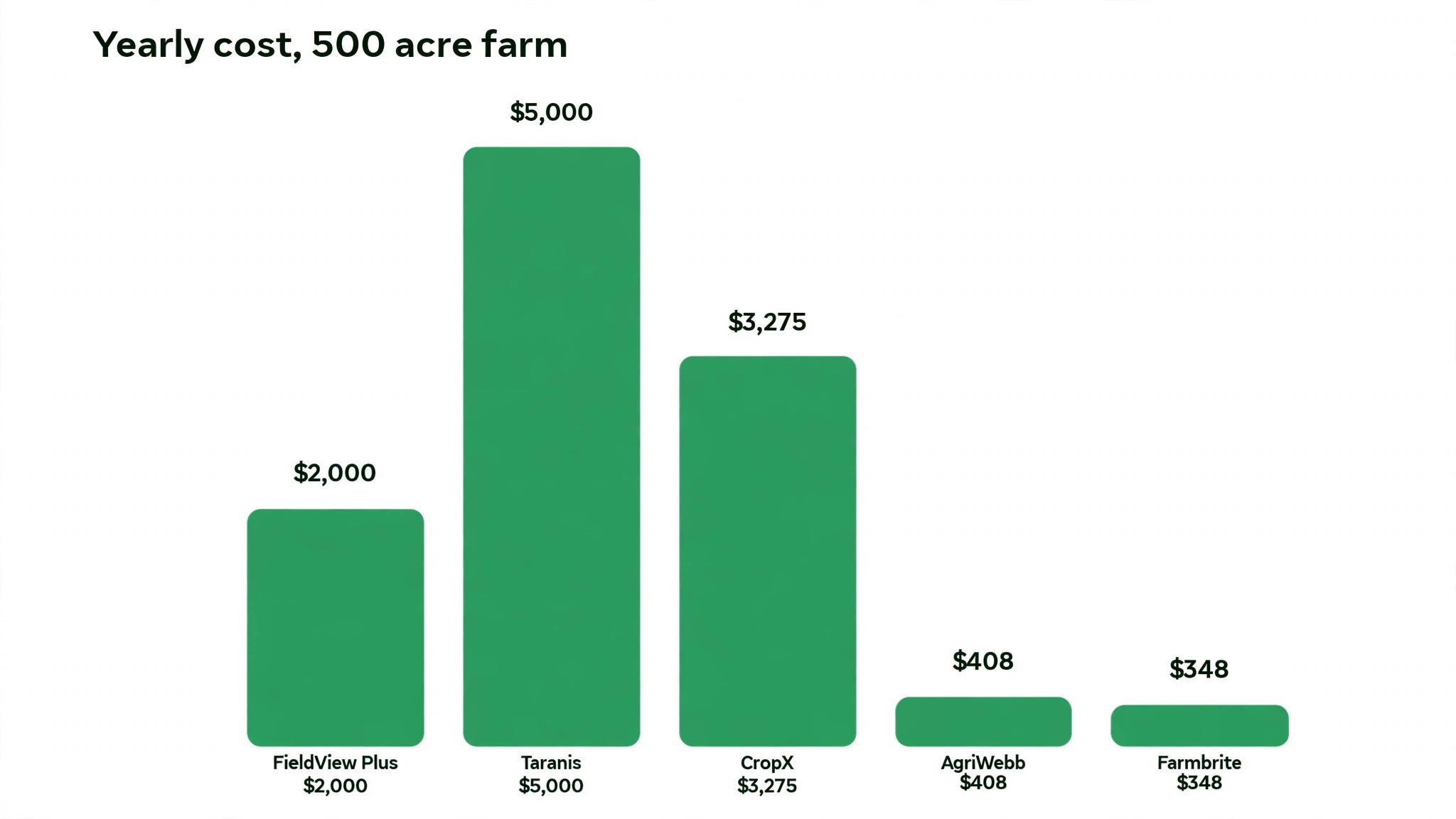
Climate FieldView is the best overall farm platform for most row crop growers, and the free tier is the reason to start here. FieldView Drive is free and covers data collection, storage, basic field mapping and equipment connectivity. Plus at 4 dollars an acre a year adds field health imagery, scouting reports, data analysis and zone management scripting, including seed and nitrogen prescriptions built from your own field data. For a 500 acre farm, Plus costs about 2,000 dollars a year, which is the cheapest credible entry into precision agriculture on this list.
The strength is the prescription. FieldView turns years of yield data, soil maps and imagery into a seed and nitrogen script that varies by zone inside a single field, so the good ground gets more seed and the poor ground gets less. That is the job that pays the subscription back, because seed and nitrogen are two of the largest input bills on any row crop farm. The platform also works with mixed equipment, which matters on a farm running John Deere and Case side by side.
The catch is the top tier. Pro adds 10 dollars an acre a year on top of Plus, so a 1,200 acre operation pays about 12,000 dollars a year for the full decision support package. That is fair for a large operation and far too much for a small one, so price the tier you actually need rather than the one with the longest feature list. For most growers, Plus is the sweet spot, and FieldView earns the top spot because it starts free and scales with the farm.
The second strength worth naming is the imagery cadence. Field health imagery refreshes often enough to catch a stress pattern while it is still a patch rather than a field, and the scouting reports point the walk to the exact spot instead of sending a person across a thousand acres. A farmer who has ever scouted a field by driving its edges will feel the difference on the first week.
2. Taranis
Starting price About 10 to 15 dollars an acre, quoted per farm. Best for AI crop scouting from the air. Watch out It is the most expensive tool on this list and it is built for large operations.
Taranis is the most impressive pure AI tool on this list, and also the most expensive. It flies sub millimetre aerial imaging over a field and uses AI to detect threats early, from emerging weeds and insect damage to nutrient deficiency and disease, at a resolution that satellite imagery cannot match. For a large operation where a missed week of scouting can cost a whole field, that early detection is the whole value.
The strength is the detection itself. Taranis does not show a green map and leave the farmer to interpret it. It names the threat, counts it, maps it and ranks it by severity, so the sprayer goes to the exact acres that need it and skips the ones that do not. That precision is what turns imagery into a spray decision, and it is the reason large growers pay a premium for it.
The catch is the price and the scale. At about 10 to 15 dollars an acre and up, with rates varying by retailer, a 1,000 acre farm pays 10,000 to 15,000 dollars a year before any other tool. Taranis is precision agriculture for operations measured in thousands of acres, not dozens, and a small farm will get better value from FieldView Plus plus a drone of its own. For a large row crop operation, Taranis earns its place, and it is the best scouting tool here by a clear margin.
The honest way to judge it is by the spray bill. If early detection lets a farm spray half the acres it would have sprayed blind, the saving pays for the subscription. If the farm already scouts well by hand, the return is thinner. Trial it on your worst field first, where the detection has the most to prove, and measure the spray saving before you commit to the whole farm.
3. CropX
Starting price About 600 to 1,200 dollars per sensor, plus 275 dollars a year. Best for Irrigation and soil sensing. Watch out The hardware bill comes before the subscription, and sensors need replacing.
CropX is the irrigation pick, and it does one job that no satellite tool can do. Its soil sensors sit in the ground and read moisture, temperature and electrical conductivity every hour, then turn those readings into an irrigation schedule for each field. Published reports put the water saving at up to 20 percent, which is the number that matters in a dry season when water is the limiting input.
The strength is the root zone reading. A satellite can show that a field looks stressed, but it cannot say whether the water is at the roots or sitting below them. A CropX probe can, and the irrigation advice follows from that reading rather than from a weather forecast alone. For a vegetable grower or an irrigated row crop farm, that difference is the difference between watering on schedule and watering on need.
The catch is the hardware model. Sensors cost about 600 to 1,200 dollars each, plus 275 dollars a year, and a farm with ten fields needs ten sensors or more. The bill arrives before the first saving does, and sensors are field equipment that can be damaged by tillage or harvest. For an irrigated farm where water is expensive or limited, CropX earns its place, and it is the best tool on this list for turning irrigation from a habit into a measurement.
The other honest point is the payback. Water savings are real, but they show up over a season, not a week, so a farmer should budget for a full growing season before judging the return. Pair the sensors with FieldView for the imagery, and the two together cover both what the field looks like and what the soil is doing underneath it.
4. AgriWebb
Starting price From about 34 dollars a month. Best for Livestock and grazing records. Watch out US add ons run from 100 to 150 dollars a year on top of the base fee.
AgriWebb is the livestock pick, built for ranches that need to know where every animal is, what it weighs and which paddock it grazed last. It tracks individual animals, builds grazing plans, records treatments and movements, and keeps the whole herd history in one place with unlimited users, so the whole crew works from the same record.
The strength is the grazing plan. AgriWebb turns paddock rotations into a schedule the crew can follow, with rest periods and stocking rates built in, so the grass recovers and the cattle keep gaining. For a 320 head cow calf operation, that planning is the difference between a pasture that lasts the season and one that is eaten bare by July. The platform also handles the compliance record, which matters more every year as buyers ask for proof of how animals were raised.
The catch is the pricing shape. The base fee scales with the number of animals, and US add ons run from 100 to 150 dollars a year, so a growing herd costs more every year even if nothing else changes. The tool is also livestock first, so a mixed farm still needs a crop tool alongside it. For a ranch that lives on grazing records, AgriWebb earns its place, and it is the best livestock tool here.
The practical point is the crew. Unlimited users means the stockman, the owner and the bookkeeper all see the same herd record, and a treatment recorded in the field shows up in the office the same day. That shared record is what stops the double dosing, the lost tag and the paddock that got grazed twice.
5. Farmbrite
Starting price 29 dollars a month. Best for Small farm crops, livestock and money in one app. Watch out It is a generalist, so it does none of the specialist jobs as deeply as the tools above.
Farmbrite is the value pick for small and diversified farms, and it is the only tool on this list that tries to cover the whole farm in one app. Crops, livestock and finances sit together, so a 45 acre vegetable and livestock operation can track plantings, harvests, animal records, expenses and sales without buying three separate subscriptions.
The strength is the price against the coverage. At 29 dollars a month with a 14 day trial, Farmbrite costs less in a year than one CropX sensor, and it covers the record keeping that a small farm actually needs. A diversified grower selling at a farmers market can track which crop made money, which bed lost money and which customer bought what, all from a phone in the field.
The catch is depth. Farmbrite does not fly aerial scouting like Taranis, it does not sense soil moisture like CropX, and it does not write seed prescriptions like FieldView. A farm that grows into precision agriculture will outgrow it. For a small farm that needs one affordable system to replace the notebook and the spreadsheet, Farmbrite earns its place, and it is the easiest tool on this list to start using today.
The honest use case is the small operator. A market gardener, a small mixed farm or a new farmer with forty acres and a tight budget will get real value from Farmbrite for 29 dollars a month. A thousand acre row crop farm will not. Buy it for what it is, a clean whole farm record at a small farm price, and add a specialist when one job outgrows it.
Side by Side Comparison
The table below puts the best ai tools for farmers side by side on price, best job and free plan, so you can compare the published prices against the per acre tools at a glance.
| Tool | Starting price | Best for | Free plan |
|---|---|---|---|
| Climate FieldView | 4 dollars an acre a year | Crop monitoring and prescriptions | Yes, Drive free |
| Taranis | About 10 to 15 dollars an acre | AI crop scouting from the air | No |
| CropX | About 600 dollars per sensor | Irrigation and soil sensing | No |
| AgriWebb | From about 34 dollars a month | Livestock and grazing records | Trial only |
| Farmbrite | 29 dollars a month | Small farm whole farm records | Trial only |
What a Farm Actually Pays in Year One
A 100 acre farm and a 1,000 acre farm pay very different bills for the same list, because per acre pricing multiplies with land. The table below shows what a small farm and a large farm actually pay in year one for the most common combinations, using published starting prices. Per acre and per sensor charges are the lines that surprise buyers, so price the stack at your real acreage before you trial anything.
| Stack | 100 acres | 1,000 acres |
|---|---|---|
| Farmbrite alone | 348 dollars a year | 348 dollars a year |
| FieldView Plus | 400 dollars a year | 4,000 dollars a year |
| FieldView Plus plus CropX, 5 sensors | About 3,900 dollars a year | About 7,500 dollars a year |
| Taranis alone | About 1,000 to 1,500 dollars a year | About 10,000 to 15,000 dollars a year |
| AgriWebb plus Farmbrite | About 750 dollars a year | About 750 dollars a year |
How to Pick the Right Tool for Your Farm
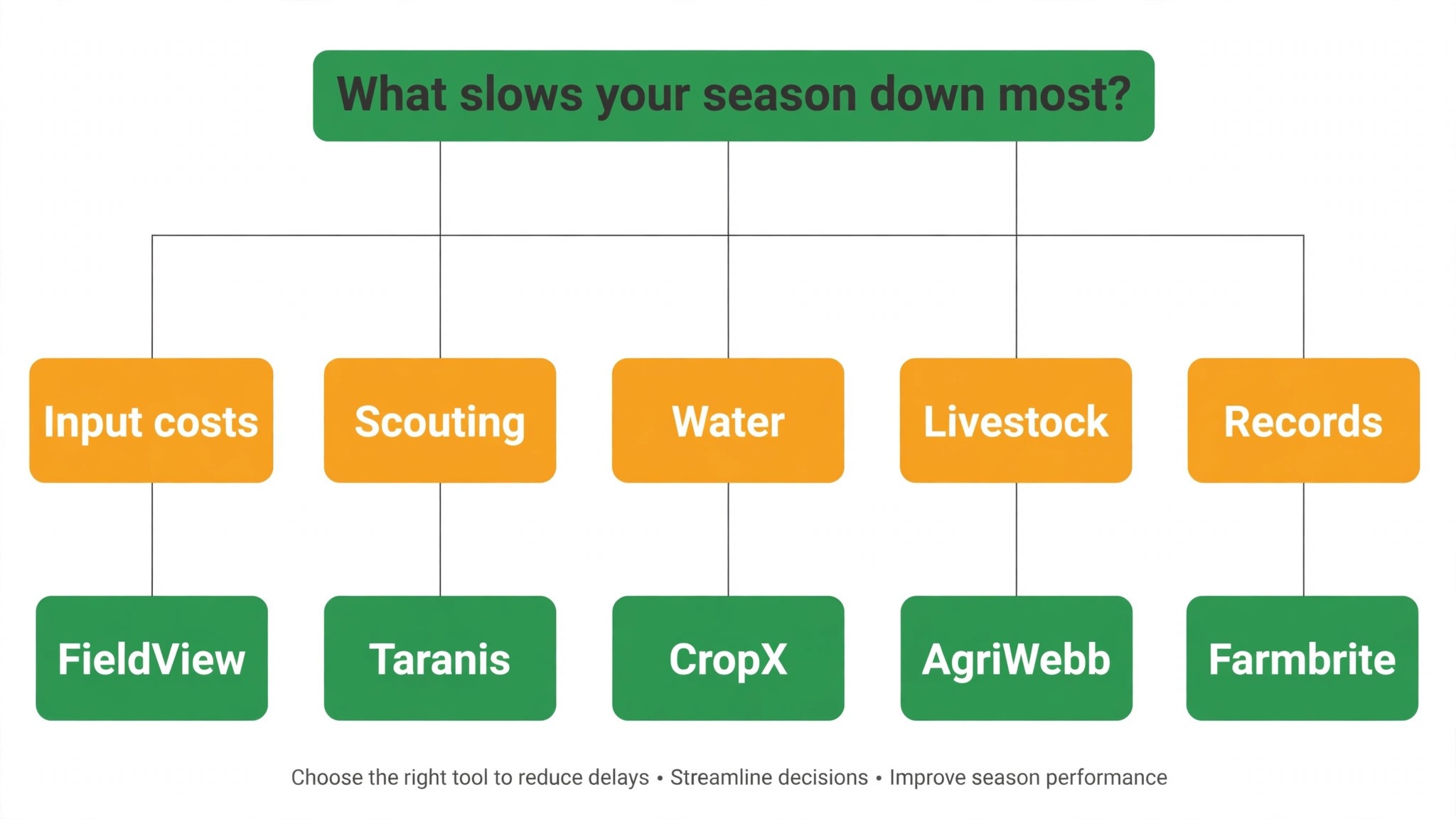
The best ai tools for farmers are not the ones with the longest feature list. They are the ones that fix the slowest part of your season. A row crop grower drowning in input costs should buy FieldView Plus. A large operation that cannot scout fast enough should buy Taranis. An irrigated farm wasting water should buy CropX. A ranch losing track of its herd should buy AgriWebb. A small diversified farm should buy Farmbrite. Start from the slow part, not from the vendor homepage.
Budget the full bill, not the headline price. A 4 dollar an acre tool costs 4,000 dollars a year on a thousand acres, and a sensor that costs 600 dollars needs ten friends before it covers the farm. Price the stack at your real acreage, trial each tool on your own fields, and keep a human walk through the field as a check on every AI alert for the first season. The tools on this list all work. The difference is whether the tool matches the farm you actually run.
Mistakes to Avoid When Buying Farm AI
The first mistake is buying imagery and expecting a decision. A satellite map that shows a stressed field without saying what to do about it is a picture, not a tool. Buy the tool that writes the prescription, the irrigation schedule or the scouting alert, not the one with the prettiest map.
The second mistake is ignoring the equipment lock in. A platform that only works with one brand of tractor or one brand of sensor will cost far more than its subscription once the hardware bill arrives. Check compatibility with the equipment already in the shed before you sign anything.
The third mistake is trusting an AI alert without walking the field. Sensors fail, imagery misreads a shadow as a disease, and a model trained on corn will misjudge a vegetable crop. Walk the flagged spot, look at the plants, and treat the alert as a pointer rather than a verdict for the first season.
The fourth mistake is paying per acre prices for acres that do not need them. A farm with 200 acres of pasture and 50 acres of crop does not need scouting imagery on the pasture. Buy the precision tool for the acres where precision pays, and keep the flat priced record tool for the rest.
Getting Started in One Season
A farmer does not need to buy the whole stack in one season, and the farms that get the best return are the ones that start with a single job and prove it before adding the next tool. The first season should have one goal, one tool and one measurement, because a farm that tries five tools at once cannot tell which one earned its keep.
Start with the free tier. Climate FieldView Drive costs nothing and covers data collection, storage and basic field mapping, which is enough to learn whether the farm’s data is clean enough to use. A farmer who spends a season collecting good yield data and field boundaries will get far more from a paid prescription tool in year two than a farmer who buys the prescription tool first and feeds it messy data.
The second step is the measurement. Pick one field, run the tool on it, and compare the result with a field managed the old way. A seed prescription that saves money on one field will save money on ten, and an irrigation sensor that cuts water on one field will cut it on the rest. The comparison is the proof, and it is also the argument that convinces a partner or a lender that the next purchase is worth it.
The third step is the record. Whatever tool you buy, export the data every month and keep a copy outside the platform. Your yield history is your asset, and a tool that locks it away is a liability. A farmer who owns the record can switch tools, compare seasons and prove the margin to a buyer, while a farmer who rents the record cannot do any of those things.
Frequently Asked Questions
What is the cheapest good AI tool for farmers to start with
Farmbrite is the cheapest credible start for a small farm, at 29 dollars a month with a 14 day trial. Climate FieldView Drive is free and Plus costs 4 dollars an acre a year, which is about 400 dollars a year on a 100 acre farm. Start with the farm job you do most each season, and add a specialist only when the general tool cannot do a job you are paid to do. That is the cheapest way to build a stack from the best ai tools for farmers without paying for features you never open.
Will AI scouting really find problems earlier than walking the field
It will for large fields, because a person cannot walk a thousand acres every day and a satellite or a drone can image all of it at once. Taranis detects threats at sub millimetre resolution and ranks them by severity, so the scout walks to the exact spot instead of the whole field. On a small farm you can walk every row, and the return is thinner. Use AI scouting where the farm is too big to walk, and keep walking the flagged spots to confirm what the imagery says.
Which tool is best for a farm that grows crops and keeps livestock
Farmbrite is the strongest single choice for a mixed farm, because it tracks crops, livestock and finances in one app for 29 dollars a month. AgriWebb is the better livestock specialist and FieldView is the better crop specialist, and a mixed farm that can afford two tools should pair them. Price the combination at your real acreage and head count, because per acre billing multiplies fast, and confirm the current plan limits before you sign, because both FieldView and AgriWebb have changed tiers in the past year.
How much should a small farmer budget for AI tools
A realistic year one budget is 29 to 40 dollars a month for one whole farm tool such as Farmbrite or AgriWebb, and 400 to 800 dollars a year once you add FieldView Plus on a 100 acre farm. A 1,000 acre row crop farm on FieldView Pro pays about 12,000 dollars a year, while the same farm on Taranis pays 10,000 to 15,000 dollars a year. Budget for the stack, not for one tool, and trial each one on real fields before you commit to annual billing.
Our Verdict
If you buy one tool this season, buy Climate FieldView if crops are the business and Farmbrite if the farm is small and mixed. FieldView is the best overall platform here, with a free tier and Plus at 4 dollars an acre a year, and its seed and nitrogen prescriptions are the feature that pays the subscription back. Farmbrite is the best value whole farm record at 29 dollars a month, with crops, livestock and money in one app. The best ai tools for farmers earn their keep by giving you back the hours that walking, guessing and re-entering records used to eat, and both of these do that from the first season.
Whatever you pick, start with the slowest part of your season, trial on your own fields and your own herd, and keep a human walk through the field as a check on every AI alert for the first season. The tools on this list all work. The difference is whether the tool matches the farm you actually run, and whether you measure the return in yield saved and inputs not wasted rather than in features used.