
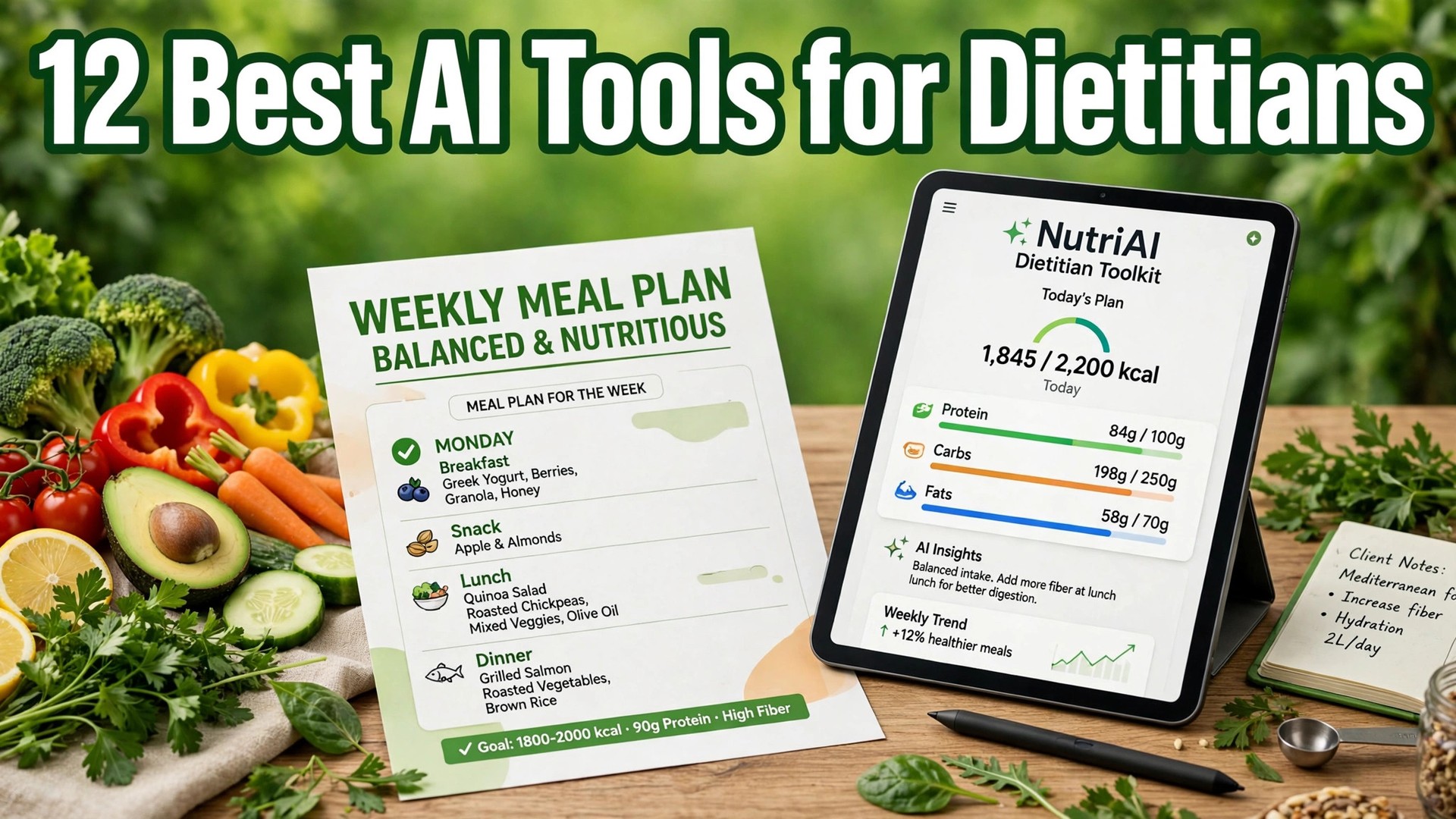
A dietitian who spends an hour building one meal plan cannot take on more clients, and that hour is the bottleneck in most nutrition practices. The best ai tools for dietitians exist because meal planning, nutrient analysis, client tracking and practice admin can now share one system, and the AI draft of a plan is good enough to edit rather than build from scratch. This guide compares twelve tools on published prices, the dietitian job each one does best and the catch that only shows up after the trial ends.
The tools here split into three groups. Practice platforms such as Practice Better and Healthie run the whole business, from scheduling to insurance billing. Nutrition-first tools such as Nutrium and Foodzilla centre on the meal plan itself. Tracking tools such as Keenoa and Cronometer watch what a client actually eats between visits. Most dietitians need one from the first group and one from the second or third.
Prices below are published starting prices as of late 2026 for dietitians, or a note that the nutrition plan price comes only on request. A tool that cannot publish a price is not disqualified, but it should be judged on the quote it gives, not on the headline on its homepage. Start with the shortlist, then read the reviews that match the nutrition work you do most.
Every Tool at a Glance
Each common nutrition task type below has one tool matched to it. Narrow the list to two or three top nutrition candidates from that table before the full reviews. Monthly list prices apply unless noted, and nutrition teams usually pay less on annual billing than month to month.
| Job | Best tool | Why it wins |
|---|---|---|
| Dietitians who want scheduling, charting, payments and programs in one place | Practice Better | Starter from 25 dollars a month billed annually, or 35 dollars month to month |
| Dietitians who bill insurance and need a proper EHR behind the meal plan | Healthie | Core from 19 |
| Dietitians whose work centres on meal plans and nutrient analysis | Nutrium | From 15 dollars a month billed annually for up to ten clients a month |
| Nutritionists who want meal planning plus the admin of running a practice | NutriAdmin | From 29 dollars a month |
| Dietitians who want AI meal planning with a white-label client app | Foodzilla | Professional from 45 dollars a month billed annually |
| Dietitians who prescribe food like a clinician and need precision plans | EatLove | Pricing on request |
| Dietitians who sell meal plans as a product, not just a service | That Clean Life | Pricing on request |
| Dietitians who track client food intake with photos instead of typed diaries | Keenoa | Pricing on request |
| Dietitians who need precise nutrient data down to the micronutrient | Cronometer Pro | Pricing on request for the professional plan; the consumer Gold plan is 8 |
| Dietitians whose clients already log food in MyFitnessPal | MyFitnessPal Premium | Premium from 19 |
| Dietitians who want a desktop-grade nutrition analysis tool with a long track record | DietMaster Pro | Pricing on request |
| UK and European dietitians who want AI meal planning tied to biomarkers | CalorieScience | Free trial; paid plans on request |
How This List Was Built
A tool earned a place here only when it does a real nutrition job well in 2026, not when it added an AI label to an old product. The best ai tools for dietitians were judged on five things that decide whether a buyer keeps paying after the first year.
First, the job it does, because nutrition teams get more from a tool that does one nutrition daily task well than from a platform that does five poorly. Second, whether the price is published and how it scales, including per-seat charges that change the real bill as dietitians grow. Third, output quality, because a wrong answer costs nutrition teams more than the subscription saves.
Fourth came workflow fit, since dietitians need the tool to sit inside their nutrition work process, integrations included, not beside it. Fifth came the catch, from free plans that cap the nutrition feature set that matter to quote-only pricing that hides the cost until the sales call.
| Check before you buy | What to ask | Why it matters |
|---|---|---|
| Published price | Is there a number on the pricing page | A quote-only tool hides the real cost |
| Free plan limits | What is capped or watermarked | A capped free plan cannot be tested properly |
| Data quality | Where does the AI get its facts | A wrong answer costs more than the subscription |
| Integrations | Does it connect to your current stack | A tool that sits alone gets abandoned |
| Contract terms | Monthly or annual, and what year two costs | Annual billing locks the price but not the need |
| Support and setup | How long to go live, and who helps | A tool that takes months to set up delays the return |
The Reviews in Full

1. Practice Better
Starting price Starter costs 25 dollars a month on annual billing, or 35 dollars a month paid month to month. Best for Dietitians who want scheduling, charting, payments and programs in one place.
Practice Better covers intake, scheduling, telehealth, charting, secure messaging and payments, so a private practice can stop stitching five tools together. Its programs and group features let a dietitian sell a course or a group plan instead of only one-to-one sessions, and the client portal keeps forms and notes in one place.
The catch is the client caps on the cheaper plans, and AI charting and some integrations are paid add-ons, so the real monthly bill can pass the headline price.
Three things to settle before Practice Better goes on the shortlist. First, does the week run through scheduling, charting, payments and programs? That four-in-one mix is the draw. Second, the client caps on the cheaper plans bite first, so count active clients before you commit. Third, get the tier and renewal price in writing before the trial ends, then give it a week on real client work.
2. Healthie
Starting price Core begins at 19.99 dollars a month, while Essentials starts at 49.99 dollars a month. Best for Dietitians who bill insurance and need a proper EHR behind the meal plan.
Healthie pairs charting, telehealth, scheduling and payments with insurance billing support, which is the part most nutrition tools skip. Its client app, group programs and API suit clinics that run at volume, and the platform is built for HIPAA-compliant practice from the ground up.
The catch is that the cheaper plan caps active clients at ten, and the insurance add-on carries its own monthly fee, so a growing practice should price the tier it will need in six months.
At 19.99 dollars a month, Healthie is priced for a dietitian who bills insurance. The cheaper plan caps active clients at ten, and the insurance add-on carries its own fee, so the real monthly number is higher than the headline. Ask for the full bill, add-on included, before the trial, then put it on live billing for a week.
3. Nutrium
Starting price From 15 dollars a month billed annually for up to ten clients a month. Best for Dietitians whose work centres on meal plans and nutrient analysis.
Nutrium is built around the nutrition job itself: dietary assessment, nutrient analysis, personalised meal plans, a recipe library and a client app with a food diary. Video consultations come with AI-generated appointment summaries, and clients log meals and measurements between sessions, which keeps follow-ups grounded in real data.
The catch is that insurance billing is not its strength, and invoicing is basic, so a US practice that bills insurers will still need a second system.
Does the week revolve around meal plans and nutrient analysis? Nutrium is a strong fit when the answer is yes, and a weak one when it is not. At 15 dollars a month it is cheap enough to try, but cheap only helps if the hours saved are real. Trial it on live client files for a week and judge it on the hours it saves.
4. NutriAdmin
Starting price From 29 dollars a month. Best for Nutritionists who want meal planning plus the admin of running a practice.
NutriAdmin combines a meal plan generator, questionnaires and a recipe database with client management, so the admin and the nutrition work share one login. Its AI meal planning drafts plans from a client profile, which cuts the hour a dietitian used to spend building a week of meals by hand.
The catch is a smaller community and fewer integrations than the bigger platforms, and the interface feels more functional than polished.
Set against the bigger platforms, NutriAdmin trades community and integrations for focus: it does meal planning plus the admin, and little else. For a dietitian whose daily job is exactly that pair, the smaller community matters less than the cleaner workflow. The trade only works if the integrations you need are the ones it has, so list them before the trial, then spend a week with it on real files.
5. Foodzilla
Starting price Professional from 45 dollars a month billed annually. Best for Dietitians who want AI meal planning with a white-label client app.
Foodzilla generates meal plans from clinical-grade food databases, and the white-label app means clients see the practice brand, not a third-party logo. Its food AI scan and nutrient tracking suit practitioners who check a client plan against real intake rather than a template.
The catch is the price for a solo dietitian, and it is newer than Nutrium or Practice Better, so the template library is still growing.
Skip Foodzilla if you practise solo and the 45-dollar fee has to come out of one diary; the price is built for a practice, not a single dietitian. For a team that wants AI meal planning behind its own white-label client app, it is one of the few that delivers. It is newer than Nutrium, so ask about the roadmap and the renewal price before the trial ends.
6. EatLove
Starting price Pricing on request. Best for Dietitians who prescribe food like a clinician and need precision plans.
EatLove builds prescription-grade meal plans from a client medical profile, allergies and preferences, which suits dietitians working with diabetes, kidney disease or food allergies. The plans adjust portions and nutrients automatically, so a change in a lab result does not mean rebuilding the whole week by hand.
The catch is that pricing is quote-based and it is built for clinical work, so a general wellness practice will pay for depth it never uses.
With EatLove, the renewal price matters more than the trial, because pricing is quote-based and there is no public number to anchor on. It is built for clinical work, for dietitians who prescribe food like a clinician and need precision plans, which makes it the wrong tool for general wellness. Get the quote and renewal terms in writing, then try it on real clinical cases for a week.
7. That Clean Life
Starting price Pricing on request. Best for Dietitians who sell meal plans as a product, not just a service.
That Clean Life is a meal planning platform with a large recipe library, branded plans and a client-facing app, built for dietitians who package plans for many clients at once. Its drag-and-drop planner and shopping lists make a week of meals fast to build, and the branding keeps the plan looking like the practice made it.
The catch is that it is a planning tool first, so scheduling, charting and billing live elsewhere, and pricing is only available on request.
That Clean Life earns its place when meal plans are a product you sell, not just a service, and it is the wrong buy when planning is only part of the week. It is a planning tool first, so do not expect it to run the practice. Pricing is quote-based, so get the full figure and renewal terms in writing before the trial. Let the dietitians who use it daily decide after a week on real files.
8. Keenoa
Starting price Pricing on request. Best for Dietitians who track client food intake with photos instead of typed diaries.
Keenoa lets clients photograph meals, and its AI estimates portions and nutrients from the photo, which removes the typing that kills most food diaries. The dietitian sees intake in real time and can message the client inside the app, which turns a monthly check-in into ongoing coaching.
The catch is that photo-based estimates are approximate by nature, and the tool covers tracking, not the full practice, so it pairs with a second system.
Keenoa fits when clients will photograph their food but will not type a diary, though the estimates are approximate by nature and no photo log replaces a weighed record. Pricing is quote-based, so get the renewal price in writing before the trial, then use it on real client intake for a week and judge whether the photos change what you know about each client.
9. Cronometer Pro
Starting price Pricing on request for the professional plan; the consumer Gold plan is 8.99 dollars a month. Best for Dietitians who need precise nutrient data down to the micronutrient.
Cronometer is known for the depth of its food database, with detailed micronutrient breakdowns that most meal planning tools do not attempt. The Pro version adds client management and monitoring, so a dietitian can watch a client intake against targets without asking for a diary export.
The catch is that it is a tracking tool rather than a practice platform, and the professional pricing is only available on request.
The catch with Cronometer Pro is scope: it is a tracking tool, not a platform, so do not expect it to run a practice. For a buyer whose daily job is precise nutrient data down to the micronutrient, that narrowness is the point. Ask for the renewal price in writing before the trial, then let it run on live client data for a week.
10. MyFitnessPal Premium
Starting price Premium from 19.99 dollars a month. Best for Dietitians whose clients already log food in MyFitnessPal.
MyFitnessPal has the largest food database most clients already know, and Premium adds barcode scanning, macro targets by meal and an ad-free experience. A dietitian can review a client food diary in an app the client actually opens, which beats a perfect tool nobody uses.
The catch is that it is a consumer app, not a clinical tool, so there is no charting, no HIPAA workflow and no way to manage a caseload inside it.
At 19.99 dollars a month, MyFitnessPal Premium earns its keep only when your clients already log food in MyFitnessPal, because without those logs the tool has nothing to build on. It is a consumer app, not a clinical tool, so do not expect clinical depth. Get the renewal price in writing, then work with it on live client work for a week and see whether the shared logs actually save time.
11. DietMaster Pro
Starting price Pricing on request. Best for Dietitians who want a desktop-grade nutrition analysis tool with a long track record.
DietMaster Pro has served dietitians for years with detailed nutrient analysis, meal planning and client records in a single desktop and cloud package. Its food database and reporting suit practices that need printed plans and formal analysis rather than an app-first experience.
The catch is that pricing is only available on request, and the interface shows its age beside newer cloud platforms.
A week on your own client files will tell you more about DietMaster Pro than any sales call, because its value shows in the analysis, not the pitch. Pricing is only available on request, so ask for the full figure and renewal terms before the trial ends. If the analysis matches your own records, keep it; if not, the request-only price was never worth chasing.
12. CalorieScience
Starting price Free trial; paid plans on request. Best for UK and European dietitians who want AI meal planning tied to biomarkers.
CalorieScience builds AI meal plans from a client profile and biomarker data, which suits practitioners who adjust nutrition against lab results rather than generic targets. It covers solo, professional and clinic tiers, with plans that scale from one practitioner to a team.
The catch is that pricing is not published, and the biomarker angle is only useful when the practice actually collects that data.
The decision rule for CalorieScience is: if the practice collects biomarker data and adjusts nutrition against lab results, it deserves a trial; if it does not collect that data, the biomarker angle is useless. Pricing is not published, so ask for the full bill and the renewal terms in writing before the trial. Try it on live client files for a week and see whether the plans match your own records.
Compare Them All at Once
The table below puts the best ai tools for dietitians side by side on price, best job and free plan, so you can compare the published prices against the quote-only tools at a glance. Read it by job, not price, since a cheap nutrition tool option that fails costs dietitians more than a dearer one that works.
| Tool | Starting price | Best for | Free plan |
|---|---|---|---|
| Practice Better | Starter from 25 dollars a month billed annually, or 35 dollars month to month | Dietitians who want scheduling, charting, payments and programs in one place | Trial only |
| Healthie | Core from 19 | Dietitians who bill insurance and need a proper EHR behind the meal plan | Trial only |
| Nutrium | From 15 dollars a month billed annually for up to ten clients a month | Dietitians whose work centres on meal plans and nutrient analysis | Trial only |
| NutriAdmin | From 29 dollars a month | Nutritionists who want meal planning plus the admin of running a practice | Trial only |
| Foodzilla | Professional from 45 dollars a month billed annually | Dietitians who want AI meal planning with a white-label client app | Trial only |
| EatLove | Pricing on request | Dietitians who prescribe food like a clinician and need precision plans | Trial only |
| That Clean Life | Pricing on request | Dietitians who sell meal plans as a product, not just a service | Trial only |
| Keenoa | Pricing on request | Dietitians who track client food intake with photos instead of typed diaries | Trial only |
| Cronometer Pro | Pricing on request for the professional plan; the consumer Gold plan is 8 | Dietitians who need precise nutrient data down to the micronutrient | Trial only |
| MyFitnessPal Premium | Premium from 19 | Dietitians whose clients already log food in MyFitnessPal | Trial only |
| DietMaster Pro | Pricing on request | Dietitians who want a desktop-grade nutrition analysis tool with a long track record | Trial only |
| CalorieScience | Free trial; paid plans on request | UK and European dietitians who want AI meal planning tied to biomarkers | Yes |
Best Pick by Job: the best ai tools for dietitians by role
The best ai tools for dietitians are not the ones with the longest feature list. They are the ones that fix the slowest part of the nutrition work week, and the slowest part depends on the role. The table below names one pick per nutrition work role, so a buyer can skip the full reviews and start with the tool that fits the job.
| Role | Best pick | Why |
|---|---|---|
| Solo practitioner | Practice Better | Dietitians who want scheduling, charting, payments and programs in one place |
| Small team | Healthie | Dietitians who bill insurance and need a proper EHR behind the meal plan |
| Growing business | Nutrium | Dietitians whose work centres on meal plans and nutrient analysis |
| Enterprise buyer | NutriAdmin | Nutritionists who want meal planning plus the admin of running a practice |
| Budget buyer | Foodzilla | Dietitians who want AI meal planning with a white-label client app |
How to Pick the Right One
Start from the slow nutrition work part, not from the vendor homepage. The best ai tools for dietitians earn their keep by giving back the hours a manual process used to eat, and the right one is the tool that fixes the bottleneck you actually feel, not the one with the longest feature list. Test it on real work and real nutrition details here before committing to annual billing.
Budget the full bill for nutrition teams, not the headline price. Per-seat charges, add-ons and implementation fees surprise buyers, so nutrition teams should ask for them in writing before signing, and annual billing usually saves about twenty percent against monthly billing. A tool that looks cheap at ten dollars a seat costs nutrition teams far more at fifty seats.
Trial nutrition work in five steps. First, take the two shortlist tools that fit the daily nutrition job best. Second, load the team’s real nutrition numbers here instead of vendor demo files. Third, run the core nutrition job itself three times and time each run. Fourth, verify every output against a source you trust. Fifth, price the full nutrition work year with seats and add-ons before signing.

Before You Sign: What Changed in 2026
The nutrition work prices in this guide shifted several times during 2026, so a January homepage number often differed by November. Treat each price as a starting point for nutrition teams, confirm it on the vendor page, and get the renewal price in writing before an annual contract. The cheapest homepage plan is rarely the one a working nutrition teams keeps.
Watch accuracy second. AI summaries, scores and predictions for nutrition teams are drafts, not verdicts, and tools grounded in the team’s own nutrition figures today beat tools guessing from general knowledge. Test outputs on real nutrition case files with a human check before anything reaches a client, and count the cost of one wrong answer against a month of subscription.
Integrations decide whether a nutrition tool option survives the first month for nutrition teams. A product that connects to the CRM, the practice system or the database nutrition teams already use gets adopted, because the data is already there. A product that needs manual exports every week gets abandoned by nutrition teams, however good its AI looks in a demo. Check the integration list on the vendor site, and test the one nutrition work integration that matters most.
How vendors handle data matters more for nutrition teams in 2026 than it did two years ago. Ask where live nutrition data lives, whether it trains models, and what happens when the subscription ends. The vendor terms should answer that for nutrition teams, not a sales email. For health, legal and financial work, a signed data agreement and a clear retention policy are not optional for dietitians.
The trial is the last check for nutrition teams, and it should run like a test, not a tour. Pick the two tools from the shortlist, load real nutrition figures today, do the core job three times, and measure the time saved. When the tool cannot show a real saving in two weeks, it will not show one in a year for dietitians. That discipline separates a good nutrition work purchase from a subscription that quietly renews.
| Year-one cost check | What to count | Why buyers miss it |
|---|---|---|
| Seats | Every user, not just the first | Per-seat pricing multiplies fast |
| Add-ons | AI features, integrations, support | The core job often needs a paid tier |
| Implementation | Setup, migration, training | Enterprise tools charge for onboarding |
| Renewal | Year-two price, not the intro offer | Discounts expire and prices rise |
Questions Buyers Ask Most
Where should nutrition teams start on a tight budget
The cheapest credible start depends on the everyday nutrition tasks, but the free plans on this list are the right first step. Give the matching nutrition software tool two weeks on real work, and pay only when the free plan hits a limit dietitians truly feel. The best ai tools for dietitians that cost the least are not always the cheapest in year one, because per-seat charges and add-ons change the real bill.
How accurate is the AI output for dietitians
Accurate enough to draft, not to publish unchecked, for dietitians. Any tool here can return a wrong nutrition reply today, a wrong number or a made-up citation, so a human checks the output against a trusted source before a client sees it, and that check is the whole point of the trial. Tools grounded in the team’s own nutrition records now are safer than tools guessing from general knowledge.
One nutrition software tool or a stack of two, which suits dietitians
Most buyers need one general tool plus one specialist for nutrition work. The general tool covers the everyday nutrition standard job, and the specialist fixes the one weekly pain the general tool cannot handle, such as bulk review or deep research. Buying three tools at once is the most common mistake on this list for nutrition teams, because the second and third subscriptions sit unused while the first does the work.
How much will a small team spend on nutrition work tools in year one
Multiply the monthly nutrition tier price by twelve and add twenty percent for seats, add-ons and setup, and that is the realistic year-one budget for dietitians. A solo buyer usually stays under fifty dollars a month. A team of ten must budget per seat for every seat for nutrition teams, not just the first, and ask the vendor for the year-two price in writing.
Is it easy to switch nutrition work tools later without losing anything
Yes, if dietitians export as they go. Keep the source data in the team’s own system, export summaries and plans regularly, and avoid a right nutrition tool that locks history behind an export fee. The tools on this list that connect to a CRM, EHR or database make switching easier for nutrition teams, because the data of record stays in the system the team already owns.
The Verdict, in Brief
If you buy one tool this quarter, buy Practice Better if it matches the job you do most each week, and buy Healthie if your work leans the other way. The best ai tools for dietitians earn their keep by giving you back the hours a manual process used to eat, and both of these do that from the first week. Start with the slowest part of the nutrition working week, trial with real work, and keep a human eye on every AI output before it reaches a client.
Judge any pick by hours saved and faster nutrition work decisions, not by feature count, for dietitians. Every tool here works. What differs is the match to the team’s real nutrition work, and whether the tool is still in use a year from now. That is the test each purchase must pass, and the test this guide helps nutrition teams run.