
An hour saved every week is worth more than a ten-dollar price gap, and most sales operations teams underestimate how much time the CRM database eats. The top 10 ai tools for crm cleanup in this guide were measured on time saved first and price second, because a tool that gives back an hour a week pays for itself in the first month.
Every price below is the published starting price as of late 2026, with annual billing noted where it changes the CRM cleanup number. Use the shortlist first, then read the reviews that match the CRM cleanup jobs crm cleanup do most. No team needs to buy all 10 of these tools. A general tool plus a specialist covers most CRM cleanup work, and a third tool earns its place only by fixing one specific weekly pain.
Each review below names the CRM cleanup job its tool does best, so pick two and stop shopping. The top 10 ai tools for crm cleanup are not ranked by price alone, because the cheapest tool that cannot do your job is the most expensive mistake on this list.
The Shortlist, Side by Side
The table below matches each common CRM database to the single tool that handles it best. Use it to narrow the top 10 ai tools for crm cleanup to two or three candidates before you read the full reviews. Prices are monthly list prices unless noted, and annual billing usually beats monthly billing for sales ops teams.
| Job | Best tool | Why it wins |
|---|---|---|
| Mid-market teams that need bulk dedupe plus standardisation. | Insycle | Starter at 100 dollars a month billed annually, at the 100,000-record setting. |
| Small teams that want simple, cheap deduplication. | Dedupely | Starter at 32 dollars a month billed annually, for up to 30,000 records. |
| Salesforce teams that need dedupe plus data quality at scale. | Cloudingo | Standard at 2,500 dollars a year, Professional at 6,000 dollars a year, Enterprise at 10,000 dollars a year. |
| HubSpot and Salesforce teams that want validation plus approved merges. | Cleanlist AI | Starter at 49 dollars a seat a month. |
| HubSpot teams that want built-in dedupe without a new vendor. | HubSpot duplicate manager | Included with HubSpot Professional and Enterprise plans. |
| Data teams that clean a file before import. | OpenRefine | Free, open source. |
| Teams that need email validation before a send. | ZeroBounce | Pay as you go from 39 dollars for 2,000 addresses. |
| Small teams that validate lists occasionally. | NeverBounce | Pay as you go from 8 dollars for 1,000 credits. |
| Salesforce admins who need dedupe, import and data quality in one suite. | Validity DemandTools | Pricing on request. |
| Enterprise teams that need dedupe, routing and enrichment together. | RingLead | Pricing on request. |
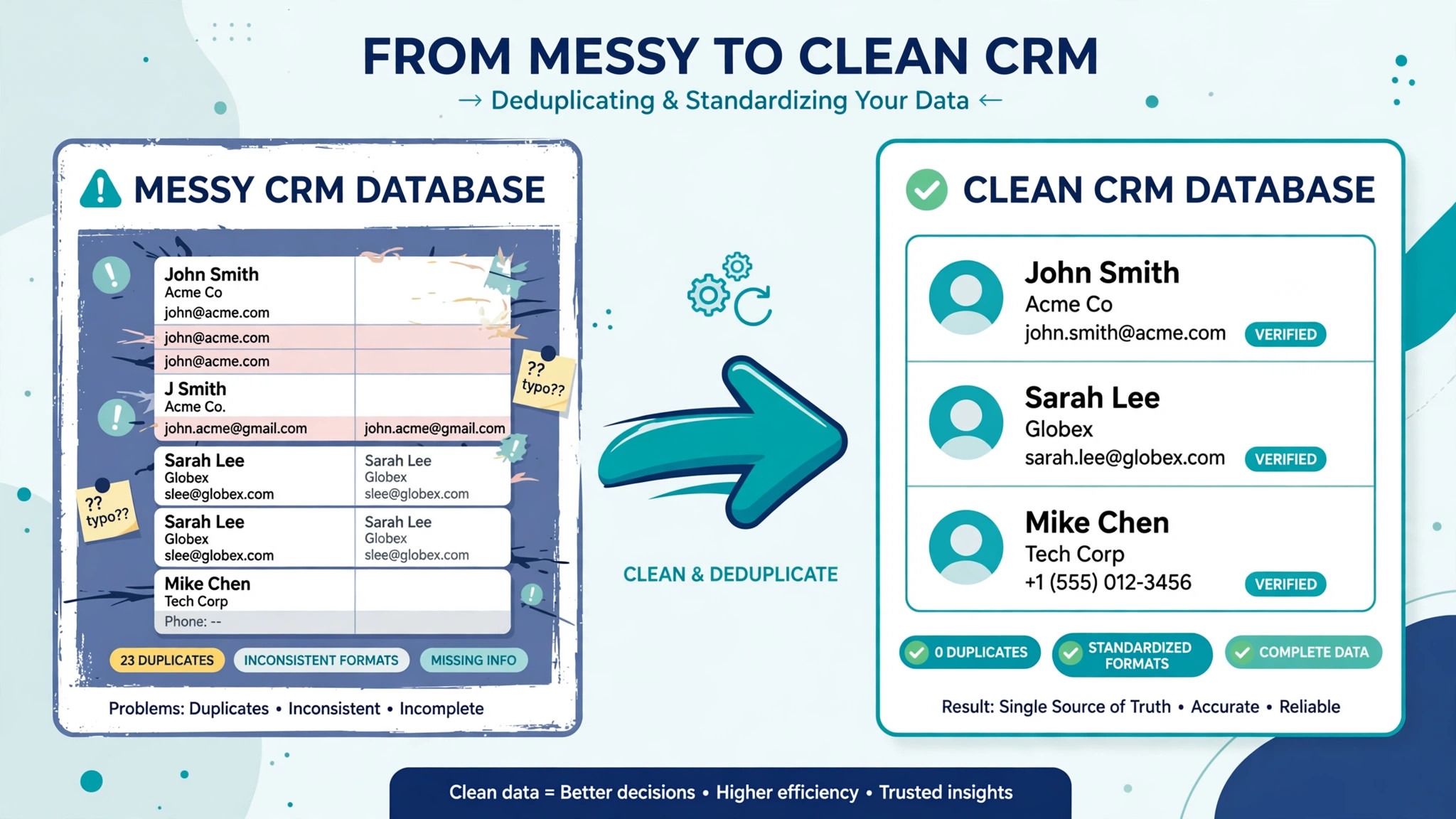
How We Chose the Top 10 AI Tools for CRM Cleanup
A tool earned a place here only if it does a real CRM database in 2026, not if it added an AI label to an old product. The top 10 ai tools for crm cleanup were judged on five things that decide whether a team keeps paying after the first year.
First, the job, because sales ops teams get more from a tool that does one CRM cleanup format well than from a platform that does five poorly. Second, published pricing and scaling, including per-seat charges that change the real bill as crm cleanup grow. Third, output quality, because errors cost sales ops teams more in lost trust than the subscription saves.
Fourth came workflow fit, since crm cleanup need the tool inside their existing CRM cleanup process, not a rebuild of it. Fifth came the catch, from free plans that watermark exports to template libraries that repeat the same ten CRM cleanup designs. Those five checks become the questions in the table below, for sales ops teams to ask before buying.
| Check before you buy | What to ask | Why it matters |
|---|---|---|
| Real job fit | Does it do my weekly job well | A poor fit wastes the subscription |
| Published price | What does year two cost | Hidden rises break the budget |
| Output quality | Is the result good enough to ship | Errors cost trust with clients |
| Workflow fit | Does it connect to my other tools | A disconnected tool adds manual work |
| Free plan limits | What is locked behind the paywall | A locked export cannot be used |
| Contract terms | Monthly or annual, and what changes | Annual billing locks the price, not the need |
The 10 Tools, Up Close
1. Insycle
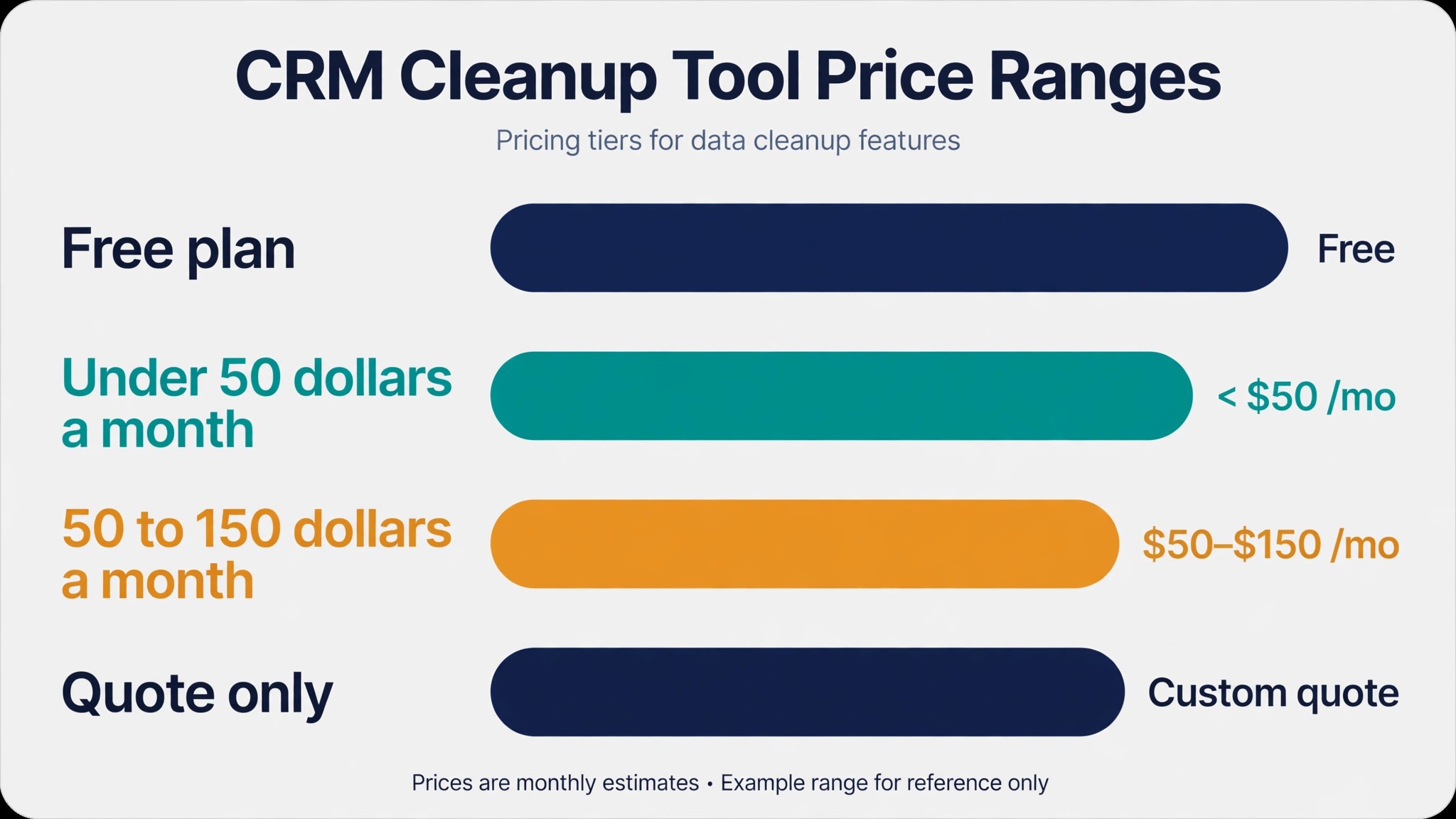
Starting price Starter at 100 dollars a month billed annually, at the 100,000-record setting. Best for Mid-market teams that need bulk dedupe plus standardisation. Watch out Pricing is by record count, so a large database costs more than the headline figure.
Insycle prices by records, not seats, so the whole team can work without counting licences. Its modules cover merging duplicates with exact, similar and fuzzy matching, standardising fields, mass updates and scheduled automation. It connects to HubSpot, Salesforce and six more systems, and it can trigger cleansing inside HubSpot workflows as records arrive.
The strength is depth at a flat team price. Starter at 100 dollars a month billed annually buys one module with unlimited users and unlimited operations, which undercuts per-seat rivals for a team. The catch is the record-count pricing, which rises with database size. For serious CRM cleanup, Insycle earns its place.
2. Dedupely
Starting price Starter at 32 dollars a month billed annually, for up to 30,000 records. Best for Small teams that want simple, cheap deduplication. Watch out It merges duplicates; it does not validate emails or enrich records.
Dedupely merges duplicates in HubSpot, Salesforce, Pipedrive and other CRMs, with AI deduplication included in full on yearly plans. Pricing is based on the number of synced records, not the number of duplicates merged, so the bill is predictable. Setup takes minutes, and the preview shows exactly what will merge before anything changes.
The strength is value. Starter at 32 dollars a month billed annually is the cheapest paid cleanup tool here, and it does the core job well. The catch is scope: Dedupely merges, it does not clean emails or fill in missing fields. For teams whose main pain is duplicates, Dedupely earns its place.
3. Cloudingo
Starting price Standard at 2,500 dollars a year, Professional at 6,000 dollars a year, Enterprise at 10,000 dollars a year. Best for Salesforce teams that need dedupe plus data quality at scale. Watch out Salesforce only, and the entry price is high for a small org.
Cloudingo is built for Salesforce, with deduplication, data cleansing, standardisation and migration tools in one package. Each plan includes 300,000 records, with 100 dollars added for every 100,000 above that. It handles mass merges, field updates and scheduled jobs, and it keeps a full audit trail of what changed.
The strength is Salesforce depth. A Salesforce admin gets dedupe, cleansing and migration without leaving the platform. The catch is the price and the focus: 2,500 dollars a year is a lot for a small org, and other CRMs get nothing. For Salesforce teams at scale, Cloudingo earns its place.
4. Cleanlist AI
Starting price Starter at 49 dollars a seat a month. Best for HubSpot and Salesforce teams that want validation plus approved merges. Watch out Per-seat pricing adds up on a large team.
Cleanlist AI validates, refills and merges CRM duplicates in HubSpot or Salesforce, with a human approval step before any merge runs. It checks email deliverability, fills in missing company data and flags records that look like junk. The 14-day Pro trial gives 50 credits a month after it ends, so a team can test on real data.
The strength is the approval gate. Merges only happen after a person signs off, which stops an automated job from deleting the wrong record. The catch is per-seat pricing at 49 dollars a month, which climbs with team size. For teams that want validation with control, Cleanlist AI earns its place.
5. HubSpot duplicate manager
Starting price Included with HubSpot Professional and Enterprise plans. Best for HubSpot teams that want built-in dedupe without a new vendor. Watch out Bulk work needs Data Hub, and the free CRM gets nothing.
HubSpot’s own duplicate manager compares contacts on name, email, phone, ZIP code and company, and companies on domain and name. Professional and Enterprise plans can manage individual duplicates and show up to 10,000 duplicate pairs, while Data Hub handles bulk work up to 30,000 pairs on Professional and 100,000 on Enterprise. Custom duplicate rules are Data Hub only.
The strength is that it is already there. A HubSpot team pays nothing extra for the basic tool, and the data never leaves the CRM. The catch is the tier wall: the free CRM gets no dedupe, and bulk merging needs the Data Hub add-on. For HubSpot teams, the built-in manager earns its place.
6. OpenRefine
Starting price Free, open source. Best for Data teams that clean a file before import. Watch out It works on files, not live in the CRM, and it needs technical skill.
OpenRefine is a free, open-source tool for cleaning messy data in a spreadsheet or a CSV before it reaches the CRM. It clusters similar values, splits and merges columns, and reconciles names against reference data. A data analyst can fix a 50,000-row import file in an afternoon, with every change recorded and reversible.
The strength is the price and the power. It costs nothing and handles jobs that paid tools charge hundreds for, as long as the work happens in a file. The catch is that it does not live in the CRM, so it cannot stop bad data at the door. For pre-import cleanup, OpenRefine earns its place.
7. ZeroBounce
Starting price Pay as you go from 39 dollars for 2,000 addresses. Best for Teams that need email validation before a send. Watch out It validates emails; it does not dedupe or standardise other fields.
ZeroBounce validates email lists, catching invalid, disposable and catch-all addresses before a campaign goes out. It also scores contacts for activity and flags abuse-prone addresses. Pay-as-you-go pricing starts at 39 dollars for 2,000 addresses, so a team can validate a list once without a subscription.
The strength is send protection. A validated list protects the sender reputation that a dirty list destroys, and the pay-as-you-go model suits occasional use. The catch is scope: ZeroBounce checks emails, not duplicates or company fields. For list validation, ZeroBounce earns its place.
8. NeverBounce
Starting price Pay as you go from 8 dollars for 1,000 credits. Best for Small teams that validate lists occasionally. Watch out Credit pricing makes large lists expensive, and it is email-only.
NeverBounce offers email verification with a simple pay-as-you-go menu, starting at 8 dollars for 1,000 credits. It checks deliverability in real time and integrates with the major email platforms, so a list can be cleaned inside the sending tool. The free tier is small, but the entry price is the lowest on this list.
The strength is the low entry cost. A small team can validate a thousand addresses for eight dollars and see the result before committing. The catch is that large lists get pricey on credits, and the tool does one job only. For occasional validation, NeverBounce earns its place.
9. Validity DemandTools
Starting price Pricing on request. Best for Salesforce admins who need dedupe, import and data quality in one suite. Watch out Quote-only pricing and a Salesforce-only focus.
Validity DemandTools is the long-standing Salesforce data quality suite, covering deduplication, mass import, data standardisation and scheduled jobs. Admins use it to merge duplicates in bulk, fix field formats across thousands of records and keep data clean on a schedule. It has served Salesforce teams for years, and its audit trail satisfies compliance reviews.
The strength is maturity. DemandTools has handled Salesforce data quality longer than most rivals, and its bulk tools are proven at scale. The catch is access: pricing on request, and the tool serves Salesforce only. For Salesforce admins, DemandTools earns its place.
10. RingLead
Starting price Pricing on request. Best for Enterprise teams that need dedupe, routing and enrichment together. Watch out Pricing is enterprise-level and the buying process runs through sales.
RingLead combines duplicate prevention, data cleansing, lead routing and enrichment in one platform. It stops duplicates at the point of entry, routes clean leads to the right rep and enriches records as they arrive. The platform is built for enterprise teams running Salesforce or HubSpot at volume, with rules that run in real time.
The strength is prevention. Most tools clean the mess after it happens, while RingLead stops bad records from entering in the first place. The catch is the enterprise model: pricing on request and a sales process to match. For enterprise data quality, RingLead earns its place.
The Top 10 AI Tools for CRM Cleanup Side by Side
The table below puts the top 10 ai tools for crm cleanup side by side on price, best job and free plan, so you can compare the published prices at a glance. Check the best-for column before the price, since a five-dollar tool that fails the CRM cleanup job costs crm cleanup more than a dearer tool that does it well.
| Tool | Starting price | Best for | Free plan |
|---|---|---|---|
| Insycle | Starter at 100 dollars a month billed annually, at the 100,000-record setting. | Mid-market teams that need bulk dedupe plus standardisation. | No |
| Dedupely | Starter at 32 dollars a month billed annually, for up to 30,000 records. | Small teams that want simple, cheap deduplication. | No |
| Cloudingo | Standard at 2,500 dollars a year, Professional at 6,000 dollars a year, Enterprise at 10,000 dollars a year. | Salesforce teams that need dedupe plus data quality at scale. | No |
| Cleanlist AI | Starter at 49 dollars a seat a month. | HubSpot and Salesforce teams that want validation plus approved merges. | No |
| HubSpot duplicate manager | Included with HubSpot Professional and Enterprise plans. | HubSpot teams that want built-in dedupe without a new vendor. | No |
| OpenRefine | Free, open source. | Data teams that clean a file before import. | Yes |
| ZeroBounce | Pay as you go from 39 dollars for 2,000 addresses. | Teams that need email validation before a send. | No |
| NeverBounce | Pay as you go from 8 dollars for 1,000 credits. | Small teams that validate lists occasionally. | No |
| Validity DemandTools | Pricing on request. | Salesforce admins who need dedupe, import and data quality in one suite. | No |
| RingLead | Pricing on request. | Enterprise teams that need dedupe, routing and enrichment together. | No |
Best Pick by Job
The top 10 ai tools for crm cleanup are not the ones with the longest feature list. They are the ones that fix the slowest part of the CRM cleanup week. Begin with the slowest CRM cleanup job, not the vendor homepage, and price the full bill, not the headline.
Check the export second, for crm cleanup. A flawless editor result that exports with a watermark is unusable, and a single-format export covers one CRM cleanup channel only. Read the export formats on the pricing page before paying, since the format decides where each CRM cleanup result can travel.
| Stack for one person | Monthly cost | What it covers |
|---|---|---|
| Insycle plus Dedupely | See prices above | General tool plus specialist |
| Insycle alone | See price above | The strongest single pick |
| Dedupely plus a free plan | Low cost | Budget start with room to grow |
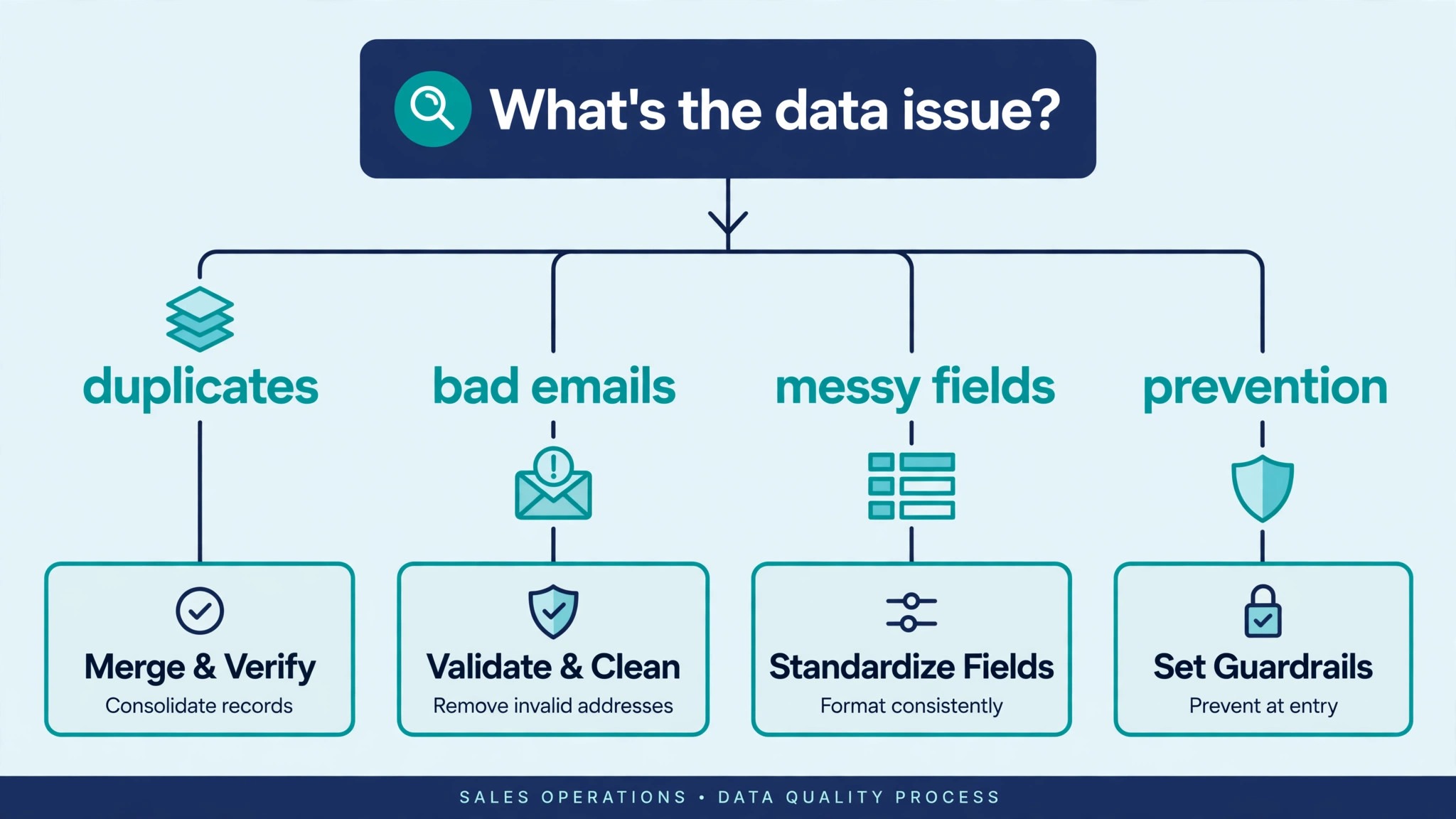
Trialling Over Two Weeks
Score the trial against the checklist below, for crm cleanup. Five of six checks passed means the CRM cleanup tool is worth paying for, while failing the first two ends the trial in week one.
| Trial check | Pass means | Fail means |
|---|---|---|
| Real work test | It handles your actual weekly job | It only works on sample data |
| Export test | The result exports cleanly | Watermarks or locked formats |
| Speed test | The job finishes faster than before | It adds steps instead of removing them |
| Team test | A colleague learns it in a day | Only the buyer can use it |
| Price test | Year-two cost is clear in writing | The renewal price is a surprise |
| Support test | Help answers within a day | No answer before the trial ends |
Run the trial on a real CRM database, not on sample data, because sample data hides the problems that real data exposes. Check the export before paying, because a tool that cannot export CRM cleanup work cleanly owns the work. Get the per-seat price in writing, with year two included, since the headline price rarely covers the full CRM cleanup bill. Time the slowest part of the CRM cleanup week before the trial and after it, because the difference is the only return that matters.
Let the daily user test the CRM cleanup tool, not just the person signing the contract, for sales ops teams. Agree the data rules before importing for sales ops teams, since a cleanup done twice costs more than one done once. One general tool plus one specialist is enough, because five CRM cleanup tools become a second job. Read the cancellation terms first, so a bad fit ends with a click, not a negotiation, for crm cleanup.
Run the trial on a real CRM database, not on sample data, because sample data hides the problems that real data exposes. Check the export before paying, because a tool that cannot export CRM cleanup work cleanly owns the work. Ask for the per-seat price in writing, including what year two costs, because the headline price is rarely the full CRM cleanup bill. Clock the slowest CRM cleanup job before and after the trial, since the gap is the only return that matters for crm cleanup.
Let the daily user test the CRM cleanup tool, not just the person signing the contract, for sales ops teams. Agree the data rules before importing for sales ops teams, since a cleanup done twice costs more than one done once. One general tool plus one specialist is enough, because five CRM cleanup tools become a second job. Read the cancellation terms first, so a bad fit ends with a click, not a negotiation, for crm cleanup.
Run the trial on a real CRM database, not on sample data, because sample data hides the problems that real data exposes. Check the export before paying, because a tool that cannot export CRM cleanup work cleanly owns the work. Get the per-seat price in writing, with year two included, since the headline price rarely covers the full CRM cleanup bill. Time the slowest part of the CRM cleanup week before the trial and after it, because the difference is the only return that matters.
Let the daily user test the CRM cleanup tool, not just the person signing the contract, for sales ops teams. Agree the data rules before importing for sales ops teams, since a cleanup done twice costs more than one done once. One general tool plus one specialist is enough, because five CRM cleanup tools become a second job. Read the cancellation terms first, so a bad fit ends with a click, not a negotiation, for crm cleanup.
Run the trial on a real CRM database, not on sample data, because sample data hides the problems that real data exposes. Test the export first, since a CRM cleanup tool that cannot hand back clean work owns it for crm cleanup. Ask for the per-seat price in writing, including what year two costs, because the headline price is rarely the full CRM cleanup bill. Clock the slowest CRM cleanup job before and after the trial, since the gap is the only return that matters for crm cleanup.
Let the daily user test the CRM cleanup tool, not just the person signing the contract, for sales ops teams. Agree the data rules before importing for sales ops teams, since a cleanup done twice costs more than one done once. One general tool plus one specialist is enough, because five CRM cleanup tools become a second job. Read the cancellation terms first, so a bad fit ends with a click, not a negotiation, for crm cleanup.
Run the trial on a real CRM database, not on sample data, because sample data hides the problems that real data exposes. Check the export before paying, because a tool that cannot export CRM cleanup work cleanly owns the work. Get the per-seat price in writing, with year two included, since the headline price rarely covers the full CRM cleanup bill. Time the slowest part of the CRM cleanup week before the trial and after it, because the difference is the only return that matters.
Test the tool with the crm cleanup who will use it daily, not only with the person who signs the contract. Confirm the CRM cleanup data rules before you import anything, because a cleanup done twice costs more than a cleanup done once. Keep one general tool and one specialist, because a stack of five tools is a second job to maintain.
Frequently Asked Questions
What is the cheapest solid start for crm cleanup
Dedupely is the cheapest credible start, at 32 dollars a month billed annually, and it covers the core job without a long setup. When a free plan exists, crm cleanup should test it first, since the trial shows whether the CRM cleanup workflow fits before money moves. Start with the CRM cleanup job done most each week, and add a specialist only when the general tool cannot do a job you are paid to do. That is the cheapest way to build a CRM cleanup stack without paying for features never opened.
Which free CRM cleanup plan is actually usable
Several tools here offer a free plan or tier that is genuinely usable for CRM cleanup, not just a demo. Limits on volume, exports or seats are the usual catch, so a free plan suiting one person may fail sales ops teams. When you compare the top 10 ai tools for crm cleanup, check what the free tier actually includes, because a free plan that covers your weekly volume is worth more than a cheap paid plan that does not.
Which tool should a small team of crm cleanup start with
Insycle is the strongest pick for most small teams, because it covers the core job well and the price scales fairly as the team grows. Buy one general tool first, and add a specialist only when a weekly CRM cleanup pain appears that the general tool cannot handle, for crm cleanup. That keeps the CRM cleanup stack to two tools and the bill easy to defend.
What is the setup time for these CRM cleanup tools
Most tools on this list take about a day to set up properly, including importing existing data and connecting the tools you already use. The slow part is the habit change: getting sales ops teams to use the new workflow every day instead of falling back to the old spreadsheet for CRM cleanup. Plan a trial on real CRM cleanup, not on sample data, because a trial on real work shows the true setup cost.
What should crm cleanup avoid when buying these tools
The biggest mistake is buying for the feature list instead of the slowest hour of the week, and the second is ignoring an automated merge that deletes the wrong record. Fifty features mean nothing for crm cleanup when the slow part of the CRM cleanup week stays slow, and five features that fix it win. Before paying, name the one CRM cleanup job that costs the most time, then buy the tool that does that job best.
Can I move to another CRM cleanup tool later and keep my work
Yes, in most cases, because the tools on this list export data in standard formats, and the top 10 ai tools for crm cleanup all support common export options. Templates, automations and saved settings rarely move cleanly, so the CRM cleanup workflow is the harder part, and a few days of rebuilding is normal. Export the CRM cleanup data before the trial ends, and keep a copy outside the tool, so a switch is a choice rather than a rescue.
Our Recommendation
If you buy one tool this quarter, buy Insycle. It is the strongest all-round pick on this list, with the best balance of price, quality and workflow fit for most sales operations teams. The top 10 ai tools for crm cleanup all work, and the difference is whether the tool matches the CRM database you actually do, and whether you measure the return in hours saved rather than in features used.
Start with the slowest CRM cleanup job of the week, trial on real work, and check every result by eye before it ships, for sales ops teams. These tools earn their place by returning the hours manual CRM cleanup work used to eat, and that return is the test each purchase must pass.