
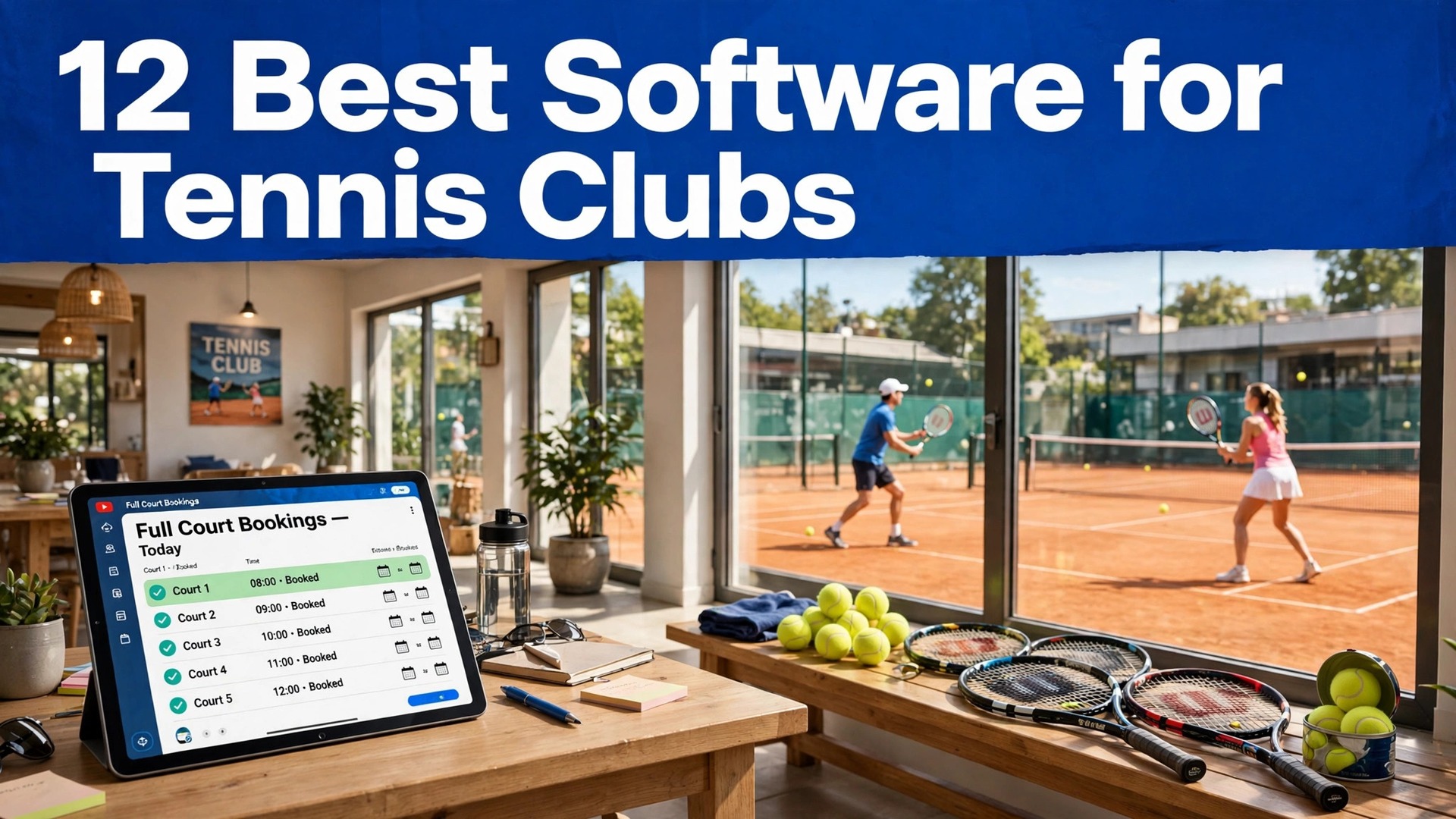
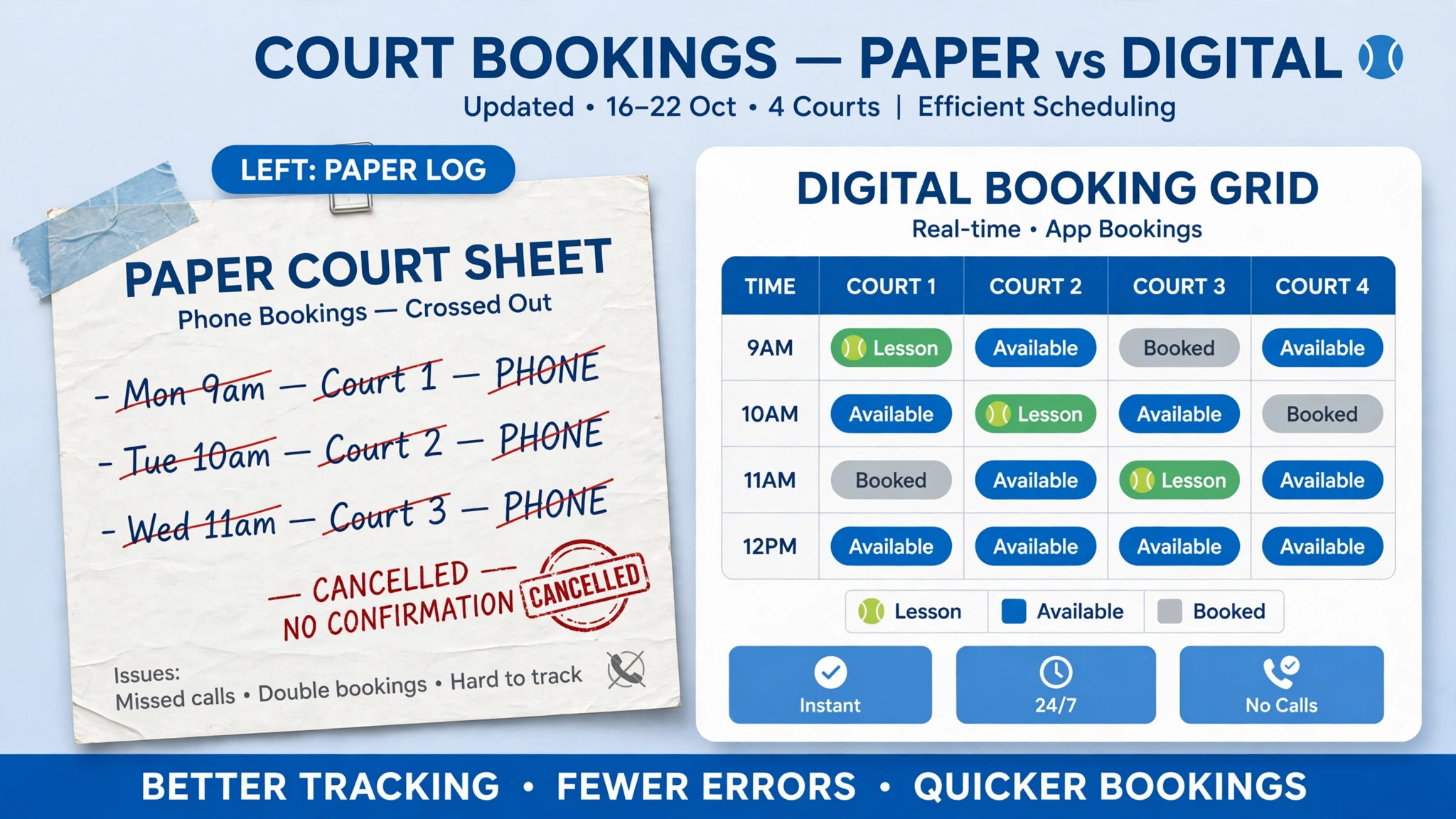
A tennis club runs on a booking sheet, and the booking sheet is where members fall out with each other. Court three is double booked, a lesson overruns, a league match has no court at all, and the coach spends the morning on the phone instead of on the court. The software that runs the club decides whether members book in thirty seconds or give up and play somewhere else. The best software for tennis clubs handles court bookings, memberships, lessons and leagues in one place, so the courts stay full and the committee stays out of the arguments.
This guide compares twelve tools on published prices, the club job each one does best and the catch that only shows up after the trial ends. Prices below are published starting prices as of late 2026, with annual billing noted where it changes the number. Start with the shortlist, then read the reviews that match the tennis you actually run.
The Quick Shortlist
The table below matches each common tennis club job to the single tool that handles it best. Use it to narrow the best software for tennis clubs to two or three candidates before you read the full reviews. Prices are monthly list prices unless noted, and annual billing is usually cheaper than paying month to month.
| Job | Best tool | Why it wins |
|---|---|---|
| Tennis and pickleball clubs that want one system | CourtReserve | CourtReserve is a dedicated club management platform for tennis, pickleball and padel facilities, and it handles rule based court scheduling, including booking windows, double booking prevention and multi court block scheduling for tournaments |
| Clubs that want marketplace exposure and player matchmaking | Playtomic | Playtomic is the largest racket sports player community in the world, and it handles court bookings, player matchmaking, leagues and tournaments with real time analytics |
| Racquet clubs that want a branded player experience | Playbypoint | Playbypoint is club management software for tennis, padel, pickleball and squash facilities, with smart court scheduling at its core and a branded mobile app for members |
| Clubs that want players to find games and partners | MATCHi | MATCHi is a booking and matchmaking platform for racket sports, and it helps players find courts, partners and games without the club doing the matchmaking by hand |
| Clubs in the LTA network that want a simple booking flow | ClubSpark | ClubSpark is a booking platform for tennis clubs, and it handles court booking, memberships and coaching sessions from a clean member portal |
| Clubs that want booking rules and dynamic pricing | Skedda | Skedda is a space scheduling platform with a booking rules engine, dynamic pricing, space sharing and Stripe payments, and it handles court bookings with the rules a club actually needs |
| Clubs that want lessons and coaching in one place | Upper Hand | Upper Hand is a sports business platform that handles lesson booking, coach schedules, payments and client management for clubs that earn from coaching |
| Padel, pickleball and tennis clubs that want their own app | Book & Go | Book and Go gives a club its own native iOS and Android app on every plan, with no co branding, no court limits and no setup fee |
| Small clubs that want no booking fees and unlimited staff | GotYourTeam | GotYourTeam charges 0 percent booking fees with direct Stripe payouts, and every plan includes unlimited staff seats, which is rare at this price |
| Clubs that run leagues and programmes at scale | LeagueApps | LeagueApps is a sports management platform for clubs that run leagues, programmes and tournaments, with registration, scheduling and payments in one system |
| Multi location clubs and growing brands | Mindbody | Mindbody is the incumbent in the studio category, and it handles scheduling, memberships, retail sales, staff management and marketing automation in one deep platform |
| Small racquet, bowling and sports clubs | Hello Club | Hello Club is a club management platform for racquet, bowling and sports clubs, with booking, memberships and payments at a price a small club can afford |
How We Judged the Shortlist
A tool earned a place here only if it does a real club job in 2026, not if it added a booking button to an old spreadsheet. The best software for tennis clubs was judged on the five checks in the table below, because those are the checks that decide whether a club keeps paying after the first year. A booking tool that cannot run a league, or a league tool that cannot take a payment, fails no matter how polished the demo looks.
The second check is whether the price is published and how it scales, including per seat and per booking charges that change the real bill as the business grows. The third is output quality in daily use, because a tool that needs a workaround for every second booking costs more time than the old spreadsheet. The fourth is fit with the systems already in place, from the POS to the payment provider, because a tool that cannot talk to them creates double entry.
| Check before you buy | What to ask | Why it matters |
|---|---|---|
| Court booking | Real time booking, rules and double booking prevention | A club lives on courts that are booked fairly, not just quickly |
| Memberships and leagues | Memberships, ladders, leagues and tournaments | A club sells membership and competition, not just court time |
| Published price | Starting price and what scales it | Per court and per booking fees change the real bill fast |
| Lessons and coaching | Lesson booking, coach schedules and payments | A club earns from coaching as well as from courts |
| The catch | Caps, fees and contract terms | A quote only platform hides the price until the demo |
The 12 Tools, Reviewed One by One
Each review below gives the published starting price, the tennis club job the tool does best and the catch that only shows up after the trial ends. Read the reviews for the best software for tennis clubs that match the work you do most, and skip the rest until you have a shortlist of two or three.
1. CourtReserve
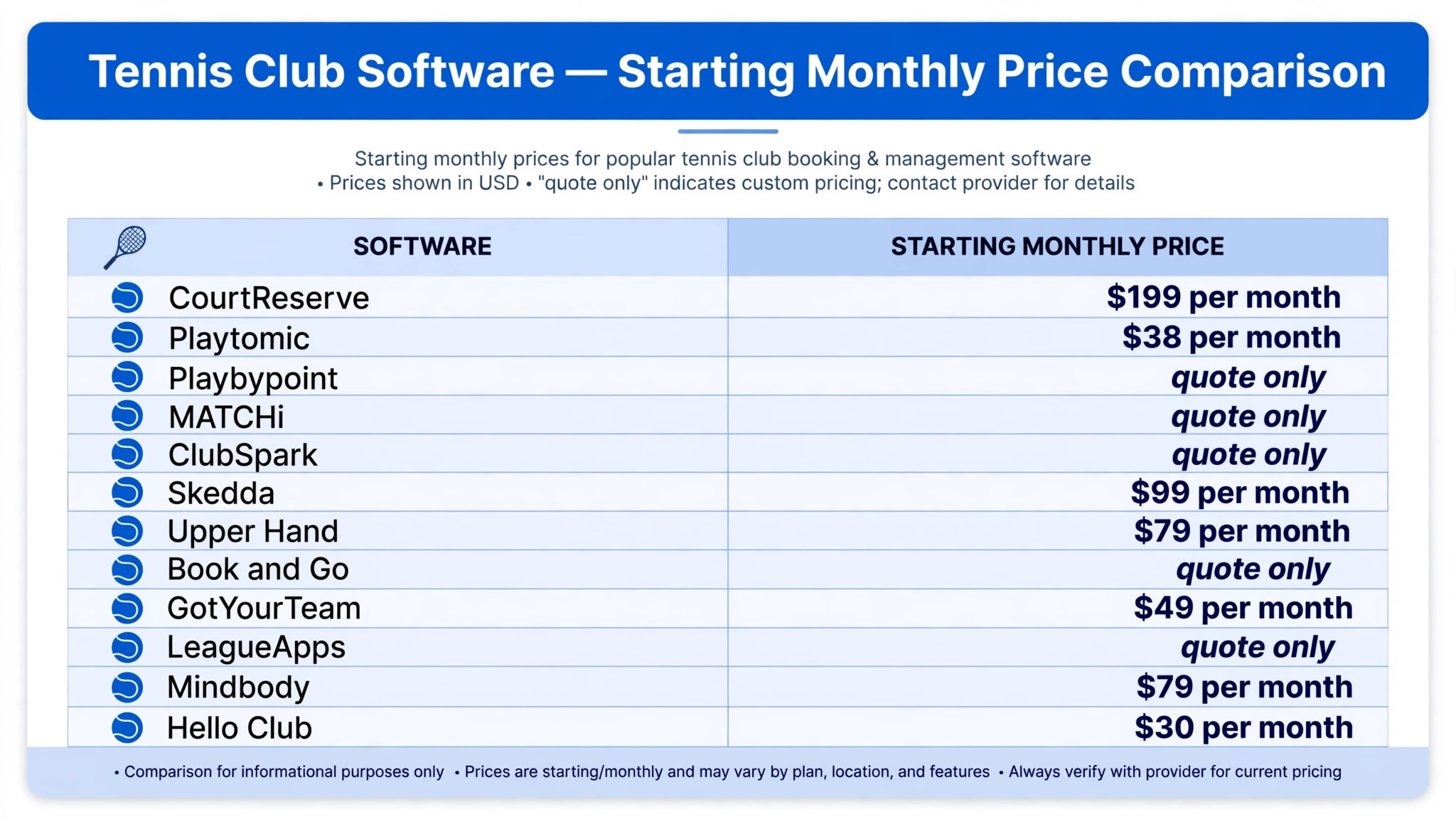
Starting price Launch from 199 dollars a month, or 159 dollars a month billed annually, for up to 8 courts; Advance from 369 dollars a month; Momentum from 549 dollars a month. Best for Tennis and pickleball clubs that want one system. Watch out The branded app sits on Momentum at 549 dollars a month plus a 499 dollar setup fee.
CourtReserve is the pick for tennis and pickleball clubs that want one system, and it earns that place on the strength of what it does every day rather than on the promise in the demo. CourtReserve is a dedicated club management platform for tennis, pickleball and padel facilities, and it handles rule based court scheduling, including booking windows, double booking prevention and multi court block scheduling for tournaments. Every plan includes unlimited players and members, unlimited staff, instructors and pros, unlimited reservations and lessons, and unlimited events, which is the depth a real club needs.
The catch is the app. The branded mobile app is locked behind Momentum at 549 dollars a month plus a 499 dollar setup fee and a 12 month contract, so a small club should budget for that before it promises members an app.
2. Playtomic
Starting price Manager from 38 dollars a month to 276 dollars a month, depending on venue size; booking commission from 4 percent to 20 percent. Best for Clubs that want marketplace exposure and player matchmaking. Watch out The booking commission can reach 20 percent, which is the highest on this list.
Playtomic is the pick for clubs that want marketplace exposure and player matchmaking, and it earns that place on the strength of what it does every day rather than on the promise in the demo. Playtomic is the largest racket sports player community in the world, and it handles court bookings, player matchmaking, leagues and tournaments with real time analytics. The marketplace brings players who would never have found the club website, which fills empty courts on quiet weekdays.
The catch is the commission. Playtomic takes 4 to 20 percent of bookings, so a club that fills its own courts pays a heavy fee for discovery it may not need, and the manager subscription sits on top.
3. Playbypoint
Starting price Pricing on request; sold through a demo. Best for Racquet clubs that want a branded player experience. Watch out No published price, so the quote decides everything.
Playbypoint is the pick for racquet clubs that want a branded player experience, and it earns that place on the strength of what it does every day rather than on the promise in the demo. Playbypoint is club management software for tennis, padel, pickleball and squash facilities, with smart court scheduling at its core and a branded mobile app for members. The app includes an in app pro shop, DUPR integration and app controlled gate access, which gives members a club in their pocket instead of a phone number to call.
Playbypoint does not publish prices, so a small club cannot budget for it without a demo and a quote, and some users report court specific booking limits that should be tested first.
4. MATCHi
Starting price Pricing on request; sold through a demo. Best for Clubs that want players to find games and partners. Watch out No published price, and the marketplace model suits some clubs badly.
MATCHi is the pick for clubs that want players to find games and partners, and it earns that place on the strength of what it does every day rather than on the promise in the demo. MATCHi is a booking and matchmaking platform for racket sports, and it helps players find courts, partners and games without the club doing the matchmaking by hand. The player app keeps members playing more often, which is the metric that decides whether a member renews.
MATCHi does not publish prices, so a small club cannot compare the cost without a sales conversation, and the marketplace model fits a club with spare court time better than one that is already full.
5. ClubSpark
Starting price Pricing on request; sold through a demo. Best for Clubs in the LTA network that want a simple booking flow. Watch out The feature set is simpler than a full club platform.
ClubSpark is the pick for clubs in the lta network that want a simple booking flow, and it earns that place on the strength of what it does every day rather than on the promise in the demo. ClubSpark is a booking platform for tennis clubs, and it handles court booking, memberships and coaching sessions from a clean member portal. The system is widely used by clubs in the LTA network, which means members already know how it works before they join a new club.
It is simpler than CourtReserve or Playbypoint, with less league depth and fewer integrations, so a club that runs serious competition will outgrow it.
6. Skedda
Starting price From 99 dollars a month on annual billing; AllBooked by Skedda starts at 99 dollars a month for Core, 149 dollars for Business and 199 dollars for Advanced. Best for Clubs that want booking rules and dynamic pricing. Watch out A booking engine, not a full club platform.
Skedda is the pick for clubs that want booking rules and dynamic pricing, and it earns that place on the strength of what it does every day rather than on the promise in the demo. Skedda is a space scheduling platform with a booking rules engine, dynamic pricing, space sharing and Stripe payments, and it handles court bookings with the rules a club actually needs. Dynamic pricing lets a club charge more for a Saturday morning peak slot and less for a Tuesday afternoon, which fills the quiet hours.
It is a booking engine, not a club platform. There is no real league, ladder or membership depth, so a club that runs competition will need a second tool.
7. Upper Hand
Starting price From 79 dollars a month. Best for Clubs that want lessons and coaching in one place. Watch out The price is per facility, and the feature set is coaching first.
Upper Hand is the pick for clubs that want lessons and coaching in one place, and it earns that place on the strength of what it does every day rather than on the promise in the demo. Upper Hand is a sports business platform that handles lesson booking, coach schedules, payments and client management for clubs that earn from coaching. Coaches see their diary, their students and their payments in one place, which cuts the admin that eats a coaching programme’s week.
The catch is the focus. Upper Hand is coaching first and club second, so a club that needs deep league and membership tools should check that gap before it signs.
8. Book & Go
Starting price Pricing on request; sold through a demo. Best for Padel, pickleball and tennis clubs that want their own app. Watch out Quote only, so the price is a negotiation.
Book & Go is the pick for padel, pickleball and tennis clubs that want their own app, and it earns that place on the strength of what it does every day rather than on the promise in the demo. Book and Go gives a club its own native iOS and Android app on every plan, with no co branding, no court limits and no setup fee. Members book courts, classes, lessons and events with real time availability, and the club keeps its own brand instead of sharing an app with other clubs.
The catch is the sales process. With no published price, a small club cannot compare the cost without a demo, and the platform is padel first, so a tennis only club should test the tennis features.
9. GotYourTeam
Starting price Club from 49 dollars a month; Facility from 199 dollars a month; Coach from 29 dollars a month. Best for Small clubs that want no booking fees and unlimited staff. Watch out Two courts on the base plan, with 25 dollars a month per extra court.
GotYourTeam is the pick for small clubs that want no booking fees and unlimited staff, and it earns that place on the strength of what it does every day rather than on the promise in the demo. GotYourTeam charges 0 percent booking fees with direct Stripe payouts, and every plan includes unlimited staff seats, which is rare at this price. The Facility plan at 199 dollars a month covers a full club, and the Club plan at 49 dollars a month suits a small club with two courts.
The catch is the court cap. The base plan covers two courts, and each extra court costs 25 dollars a month, so a club with eight courts pays 199 dollars a month anyway.
10. LeagueApps
Starting price Pricing on request; a percentage cut of all registration revenue. Best for Clubs that run leagues and programmes at scale. Watch out The percentage model means the bill grows with every registration.
LeagueApps is the pick for clubs that run leagues and programmes at scale, and it earns that place on the strength of what it does every day rather than on the promise in the demo. LeagueApps is a sports management platform for clubs that run leagues, programmes and tournaments, with registration, scheduling and payments in one system. Unlimited staff seats and programme volume tools suit a club with many leagues running at once.
The catch is the model. LeagueApps takes a percentage of all registration revenue, so a successful season costs more than a quiet one, and the club should model the fee at its real registration volume.
11. Mindbody
Starting price From 79 dollars a month per location; higher tiers are quote only. Best for Multi location clubs and growing brands. Watch out The marketplace takes up to 20 percent of a new client’s first purchase, capped at 30 dollars.
Mindbody is the pick for multi location clubs and growing brands, and it earns that place on the strength of what it does every day rather than on the promise in the demo. Mindbody is the incumbent in the studio category, and it handles scheduling, memberships, retail sales, staff management and marketing automation in one deep platform. Listing on the Mindbody app puts the club in front of millions of people looking for classes, which is a real source of new members for a club in a busy area.
Only the Starter plan has a published price, the higher tiers need a sales quote, and new clients booked through the app trigger a fee of up to 20 percent on their first purchase, capped at 30 dollars.
12. Hello Club
Starting price From about 30 dollars a month to 60 dollars a month or more, with a free tier. Best for Small racquet, bowling and sports clubs. Watch out No AI features in production, and the feature set is simpler than a full platform.
Hello Club is the pick for small racquet, bowling and sports clubs, and it earns that place on the strength of what it does every day rather than on the promise in the demo. Hello Club is a club management platform for racquet, bowling and sports clubs, with booking, memberships and payments at a price a small club can afford. The free tier lets a small club start without a monthly bill, and the paid tiers stay in the 30 to 60 dollar range, which is the lowest full platform price on this list.
The catch is depth. There are no AI features in production and the feature set is simpler than CourtReserve, so a club that runs serious leagues will outgrow it.
Side by Side Comparison
The table below puts the best software for tennis clubs side by side on the numbers that decide the purchase. Prices are starting monthly prices as published in late 2026, and quote only tools are marked so you can see where the price is a negotiation rather than a number.
| Tool | Starting price | Best for |
|---|---|---|
| CourtReserve | Launch from 199 dollars a month, or 159 dollars a month billed annually, for up to 8 courts; Advance from 369 dollars a month; Momentum from 549 dollars a month. | Tennis and pickleball clubs that want one system |
| Playtomic | Manager from 38 dollars a month to 276 dollars a month, depending on venue size; booking commission from 4 percent to 20 percent. | Clubs that want marketplace exposure and player matchmaking |
| Playbypoint | Pricing on request; sold through a demo. | Racquet clubs that want a branded player experience |
| MATCHi | Pricing on request; sold through a demo. | Clubs that want players to find games and partners |
| ClubSpark | Pricing on request; sold through a demo. | Clubs in the LTA network that want a simple booking flow |
| Skedda | From 99 dollars a month on annual billing; AllBooked by Skedda starts at 99 dollars a month for Core, 149 dollars for Business and 199 dollars for Advanced. | Clubs that want booking rules and dynamic pricing |
| Upper Hand | From 79 dollars a month. | Clubs that want lessons and coaching in one place |
| Book & Go | Pricing on request; sold through a demo. | Padel, pickleball and tennis clubs that want their own app |
| GotYourTeam | Club from 49 dollars a month; Facility from 199 dollars a month; Coach from 29 dollars a month. | Small clubs that want no booking fees and unlimited staff |
| LeagueApps | Pricing on request; a percentage cut of all registration revenue. | Clubs that run leagues and programmes at scale |
| Mindbody | From 79 dollars a month per location; higher tiers are quote only. | Multi location clubs and growing brands |
| Hello Club | From about 30 dollars a month to 60 dollars a month or more, with a free tier. | Small racquet, bowling and sports clubs |
What It Costs in Year One
A realistic year one budget for a small club runs from about 30 dollars a month for a simple booking tool to about 550 dollars a month once a full club platform, a branded app and leagues are all covered. The table below prices three honest stacks, so you can see what the monthly total looks like before you sign anything. The best software for tennis clubs on this list cover the whole range, from free plans that cost nothing until the bookings arrive to platforms that charge hundreds a month before the first guest walks in, so the stack matters more than any single price.
| Stack | What you get | Monthly cost | Covers |
|---|---|---|---|
| Lean, small club | Hello Club plus Skedda | 129 dollars a month | Court booking and member management |
| Growing club | CourtReserve Launch plus Playtomic | 197 dollars a month | Courts, lessons, leagues and marketplace |
| Large club with app | CourtReserve Momentum plus Playbypoint | 549 dollars a month plus quote | Branded app, leagues and multi site control |
What to Check Before You Sign
Ask what happens at the cap. Every tool on this list has a limit somewhere, whether it is a booking count, a user count, a court count or a transaction fee, and the limit that matters is the one you will hit first. A free plan that caps at fifty bookings a month is a trial, not a system, and a paid plan that charges per location doubles the bill when you open a second site. Get the cap in writing before you sign, and ask what the upgrade costs.
Read the contract and the data export terms before you sign. A platform that holds your customer list, your booking history and your payment records hostage is a platform you cannot leave, and the cost of leaving is the real price of the software. Ask how to export every record, how long the contract runs, and what happens to the data on the day you cancel. A vendor that answers clearly is a vendor worth trusting.
How to Pick the Right Tool from the best software for tennis clubs
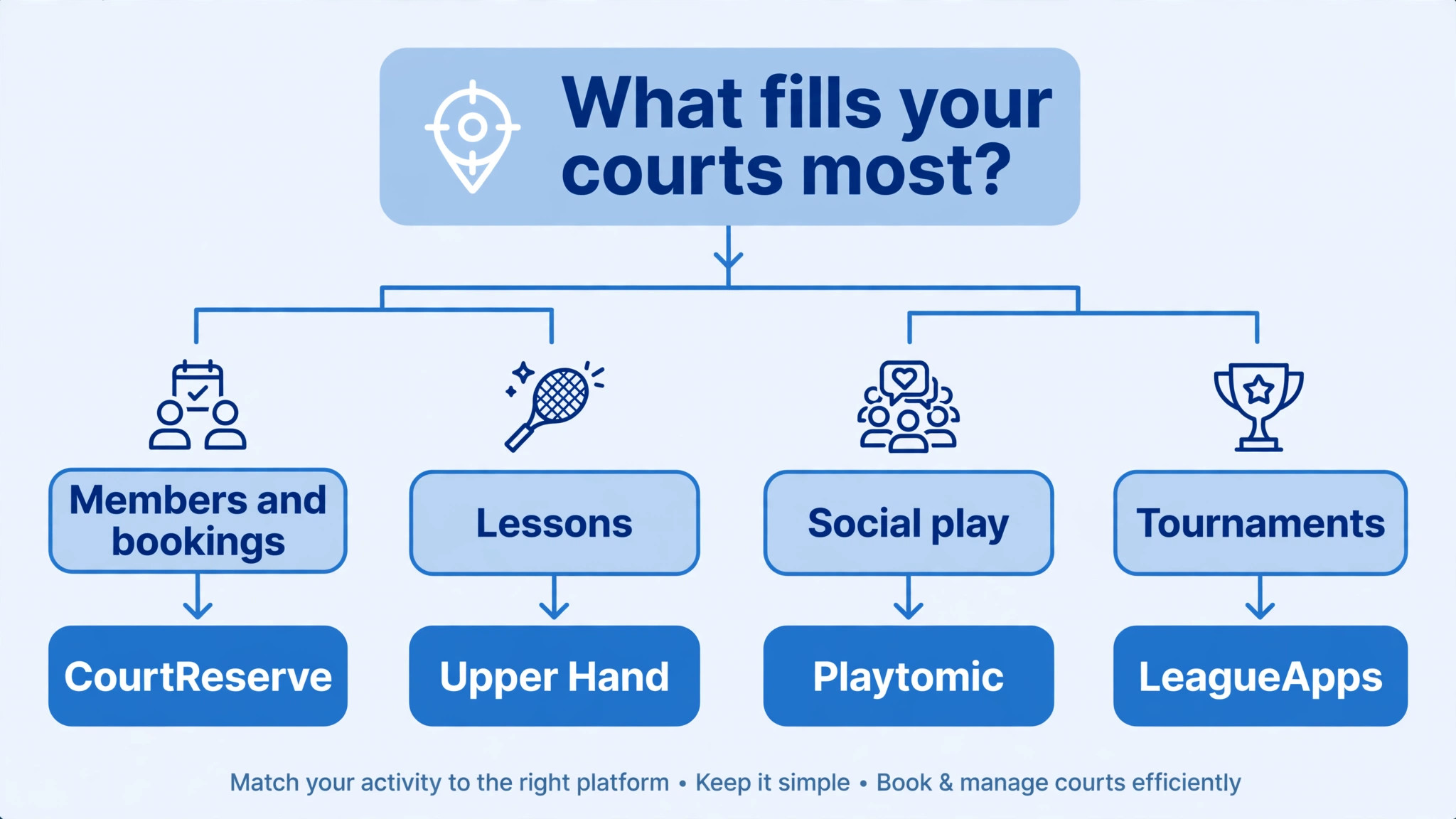
Start with the tennis you run most. If the club is mostly member court booking with a few lessons, pick a court booking specialist first and treat league depth as second choice, because a booking tool handles a ladder badly and a league tool handles a booking worse. If the club runs leagues, ladders and tournaments every week, a full club platform beats a booking tool you will outgrow in a season.
Price the stack at your real court count, not the demo count. CourtReserve prices by court count, so an eight court club pays 199 dollars a month and a 32 court club pays 549 dollars a month, and a marketplace commission of 4 to 20 percent changes the maths completely. Ask each vendor for the bill at your court count, your busiest month and your quietest month, and compare those three numbers before you sign. That is the test every best software for tennis clubs on this list has to pass, and the tool that passes it at your volume is the one to buy.
Trial each finalist on a real league night, not a quiet Tuesday. Book a court, move a lesson, run a ladder match and take a payment, then check what the coach sees. The tool that survives a full league night without a phone call to support is the one to buy.
Frequently Asked Questions
What is the cheapest tennis club software to start with
Hello Club is the cheapest credible start at about 30 to 60 dollars a month, with a free tier for small clubs. GotYourTeam Club costs 49 dollars a month with unlimited staff seats and no booking fees. Start there, and add a full club platform only when leagues, lessons and multiple courts make the small tool strain.
Which software is best for court booking at a tennis club
CourtReserve is the strongest pick for tennis and pickleball clubs, because it handles rule based court scheduling, double booking prevention and multi court block booking for tournaments from 199 dollars a month. Skedda is the pick for a club that only needs booking rules and dynamic pricing. Pick CourtReserve for a full club, and Skedda for booking alone.
Do I need a full club platform or just a booking tool
A booking tool is enough while the club runs court bookings and a few lessons. The best software for tennis clubs earns its price when memberships, leagues, ladders and tournaments need one system, because then the competition tools matter. Until then, a booking tool plus a card reader keeps more money in the club.
How much should a small tennis club budget for software
A realistic year one budget is 30 to 100 dollars a month for a booking tool, 160 to 370 dollars a month once a full club platform joins the stack, and 500 to 550 dollars a month with a branded app added. Budget for the stack at your court count, not for one tool, and trial each one on a real league night before you commit to annual billing.
Our Verdict
If you buy one tool this quarter, buy CourtReserve if you run a real tennis club and Hello Club if you run a small club on a tight budget. CourtReserve is the strongest club platform on this list, with court booking, lessons, memberships and leagues from 199 dollars a month, and it powers more than 2,300 racquet facilities. Hello Club is the best value at about 30 to 60 dollars a month, with booking and member tools that cover most of what a small club needs.
Across the whole list, the best software for tennis clubs that win are the ones that match the tennis club you actually run, and both of these do that from the first month.
Whatever you pick, start with the courts that fill your diary, trial it on a real league night, and keep a paper booking sheet for the first month. The tools on this list all work. The difference is whether the tool runs a club or only takes bookings, and whether you measure the return in courts filled and members kept rather than in features used.