
A flower shop lives on two clocks that never agree. The flowers last a week, the wedding season lasts a month, and the orders arrive at the worst possible moment, usually while the florist is elbow deep in a funeral arrangement with a phone ringing. The best ai tools for florists exist because the shop runs on orders, deliveries, recipes and promos all at once, and a missed delivery or a wrong stem count costs more than the order. Ordering, design, delivery routing and marketing have all moved into software that keeps the shop ahead of the season instead of behind it.
This guide compares twelve tools on published prices, the flower job each one does best and the catch that only shows up after the trial ends. Prices in this category move often and several vendors quote rather than publish, so where a price is not published this guide says so instead of guessing. Start with the shortlist, then read the reviews that match the problem your shop feels most.
The pattern across all twelve is simple. The tools that win are the ones that tie an order to a recipe, a recipe to a stem count, and a delivery to a route, so the shop knows what it costs before the bouquet leaves the counter. Everything else is a bonus, and a florist who buys the bonus first usually keeps the leak.
The Quick Shortlist
The table below matches each common flower shop job to the single tool that handles it best. Use it to narrow the best ai tools for florists to two or three candidates before you read the full reviews. Prices are monthly list prices unless noted, and annual billing is usually cheaper than paying month to month.
| Job | Best tool | Why it wins |
|---|---|---|
| All in one shop, website and weddings | Floranext | POS, website, delivery and weddings together |
| Retail shop POS and delivery depth | FloristWare | Deep florist workflow from 149 dollars a month |
| Wedding and event floral design | Details Flowers | Proposals, recipes and stem counts from 25 dollars |
| Online marketplace and local orders | BloomNation | Marketplace plus website and order management |
| Full event operations and design | Curate | Proposals, design and production in one place |
| Website and POS with an AI assistant | Lovingly | Modern storefront with AI help, pricing on request |
| Online store for a growing shop | Shopify | Basic from 29 dollars a month billed annually |
| Bookings for workshops and consultations | Fresha | Booking and payments from 19.95 dollars a month |
| Free bookings and payments to start | Square Appointments | Free plan with card payments built in |
| Bouquet ideas, copy and seasonal promos | ChatGPT | Fastest all round drafting and ideas |
| Social posts, signs and price cards | Canva | Templates plus AI design, 10 dollars a month |
| Books, invoices and supplier costs | QuickBooks Online | Simple Start from 38 dollars a month |
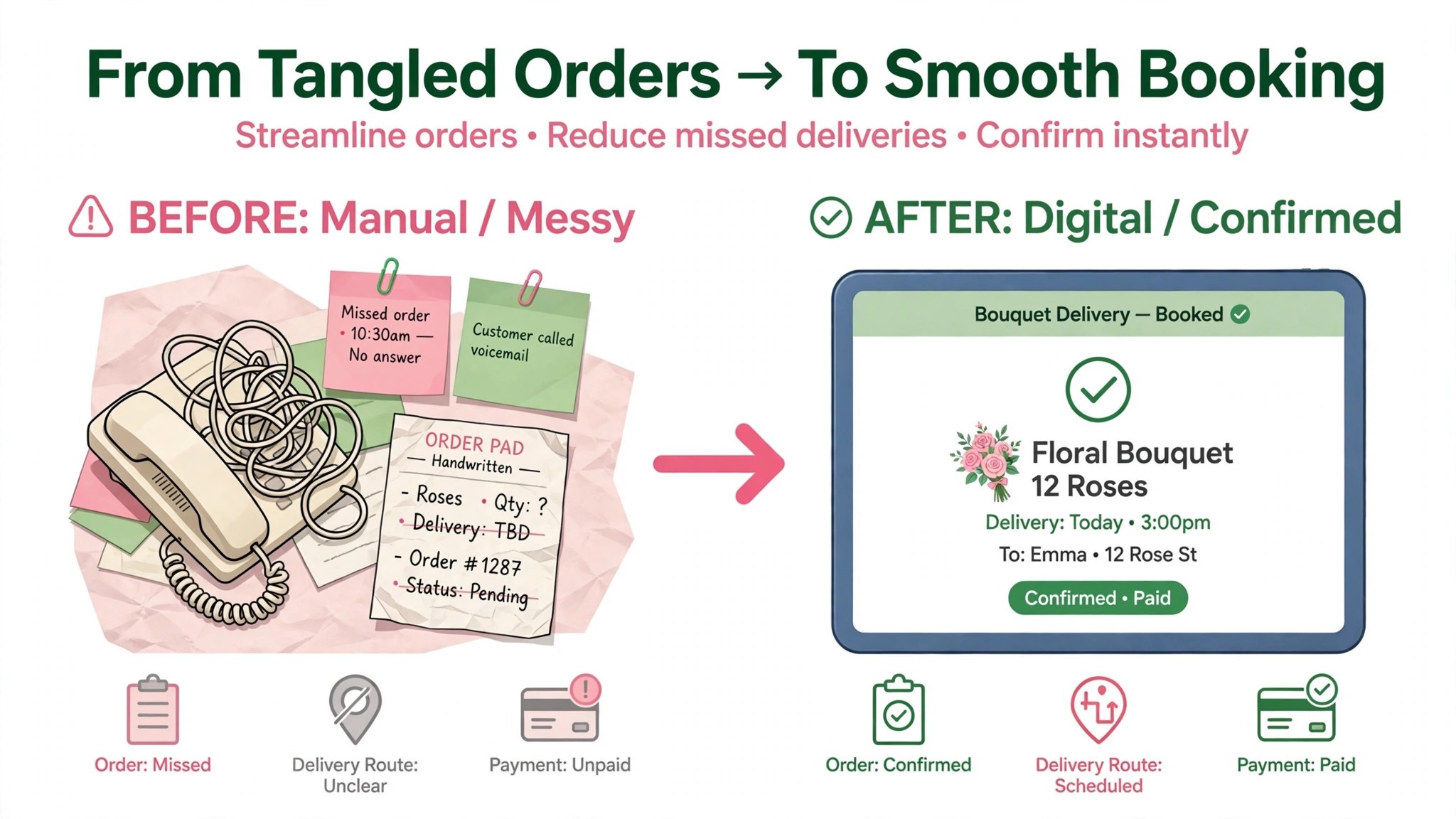
How We Judged the best ai tools for florists
A tool earned a place here only if it does a real flower shop job in 2026, not if it added an AI label to an old till. The best ai tools for florists were judged on five things that decide whether a florist keeps paying after the first season.
First, the order job it does, from taking the order to printing the card message to routing the driver, because a tool that takes orders but cannot deliver them is half a system. Second, whether the price is published and how it scales, including per station charges and marketplace commissions that change the real bill as the shop grows.
Third, recipe costing, because a bouquet that looks beautiful and loses money is a hobby, and the tool should count stems and price them before the arrangement is built. Fourth, seasonal marketing, because a flower shop lives on Mother’s Day, Valentine’s Day and wedding season, and the tool should help the shop sell before the rush rather than during it. Fifth, the catch, from quote only pricing that hides the real bill to marketplace fees that take a cut of every new customer.
| Check before you buy | What to ask | Why it matters |
|---|---|---|
| Recipe and stem counts | Does it cost a bouquet by stem | Stem counts are where flower margin leaks |
| Delivery routing | Does it plan driver routes and track them | Delivery is the most expensive hour of the day |
| Marketplace fees | Commission per order or per new customer | A 20 percent fee eats the margin on a bouquet |
| Wedding tools | Proposals, deposits and production lists | Weddings are the biggest tickets a shop sells |
| Price transparency | Published price, or a quote after a sales call | Hidden prices hide the real first year bill |
| Trial on real orders | Can you test it on your own shop before you pay | A trial on demo data proves nothing |
The 12 Tools, Reviewed One by One
Read the reviews that match the problem your shop feels most, then check the price at your real order volume before you trial anything. Each review names the starting price, the job the tool does best and the catch to ask about.
1. Floranext
Starting price Pricing on request, with free trials. Best for All in one shop, website and weddings. Watch out No published price, so get the quote in writing before you commit.
Floranext is the best overall florist software for shops that want POS, a website, delivery and wedding workflows together. It is built by florists for florists, and it covers the whole shop in one system, from taking an order at the counter to printing the delivery ticket to building a wedding proposal with cost and profit tracking.
The strength is the bundle. A shop can run its website, its point of sale and its wedding manager from one place, with no commission per order, so the margin stays in the shop. The modular approach means a small shop can start with one piece and add the rest as it grows, and the free trial lets a florist test the real workflow before paying.
The catch is the quote. Floranext does not publish prices on its site, and the all in one package is priced after a sales conversation, so a buyer should get the full quote in writing, including support fees, before comparing it with FloristWare. For a shop that wants everything in one florist built system, Floranext earns the top spot.
2. FloristWare
Starting price From 149 dollars a month for one station. Best for Retail shop POS and delivery depth. Watch out Extra stations cost 49 dollars a month each, so a multi till shop pays more.
FloristWare is the retail operations pick for established shops that prioritise order flow, delivery, payments and reporting depth. It is a powerful point of sale system built for retail florists, with delivery management and route optimisation that lets a shop make more deliveries with fewer drivers and less fuel.
The strength is the depth. Every plan includes delivery management, house accounts and ticket printing, and the reporting shows which products, which customers and which delivery zones actually make money. The Basic plan at 149 dollars a month, or 1,499 dollars a year, is the published starting point, with Advanced at 199 dollars a month adding text messaging.
The catch is the price against the competition. At 149 dollars a month for one station, FloristWare costs more than a general POS, and a shop with three tills pays for three stations. For a busy retail shop that needs deep florist workflow, FloristWare earns its place, and it is the best tool here for delivery heavy operations.
3. Details Flowers
Starting price From 25 dollars a month, scaling with event volume. Best for Wedding and event floral design. Watch out The price scales with events, so a busy wedding season costs more.
Details Flowers is the wedding pick, built for floral designers who sell weddings and events rather than daily bouquets. It builds proposals with recipes, stem counts and production planning, so a designer can price a wedding accurately, order the right stems and hand the crew a production list that matches the proposal.
The strength is the recipe. A wedding proposal in Details Flowers carries the stem count for every arrangement, the cost per stem and the profit on the whole event, which stops the classic problem of a beautiful wedding that loses money. The entry tier at 25 dollars a month makes it the cheapest specialist on this list.
The catch is the scaling. The price rises with event volume, so a designer with twenty weddings a season pays more than a designer with five, and the tool is wedding first, so daily retail orders belong in a POS instead. For wedding and event floral design, Details Flowers earns its place.
4. BloomNation
Starting price Pricing on request, with marketplace commission terms to confirm. Best for Online marketplace and local orders. Watch out Ask for all commissions and POS terms before you sign.
BloomNation is the ecommerce pick for local florists who want a website, a marketplace and order management together. It is a revenue growth platform built for florists, with online ordering, marketing tools and a marketplace that puts a local shop in front of customers searching for flowers nearby.
The strength is the exposure. A shop on BloomNation gets found by customers who would never walk past the counter, and the platform handles the online storefront, the orders and the marketing in one place. The vendor claims strong growth for shops on the platform, and the marketplace is the reason most shops join.
The catch is the quote. BloomNation asks buyers to request a consultation for pricing, and the commission and POS terms need to be confirmed in writing before a shop can judge the real cost. For a shop that wants online orders and marketplace exposure, BloomNation earns its place.
5. Curate
Starting price Pricing on request. Best for Full event operations and design. Watch out It is event first, so daily retail needs a separate POS.
Curate is the event operations pick for florists who run weddings and events as a business rather than a sideline. It covers proposals, floral design, production planning and the full event workflow in one place, so a designer can move from a client consultation to a signed proposal to a production list without re-entering anything.
The strength is the workflow. A proposal in Curate becomes the design, the design becomes the stem order, and the stem order becomes the crew’s production list, which cuts the double entry that eats a designer’s week before a big wedding. The tool also handles the client communication around the event, which is half the job.
The catch is the scope and the price. Curate is built for events, so a shop that also sells daily bouquets still needs a retail POS, and the price is quoted rather than published. For full event operations, Curate earns its place alongside Details Flowers, and the choice between them comes down to whether the priority is floral design or the whole event operation.
6. Lovingly
Starting price Pricing on request, with a waitlist on its site. Best for Website and POS with an AI assistant. Watch out The AI assistant is new, so test it on real orders before you rely on it.
Lovingly is the modern storefront pick, with a website, a POS and an AI assistant built for florists. It is the newest name on this list, and it aims at the same all in one job as Floranext, with a cleaner interface and an AI helper that drafts product descriptions and answers common customer questions.
The strength is the storefront. A shop on Lovingly gets a modern website that looks good on a phone, which is where most flower orders now start, and the POS ties the online orders to the counter in one system. The AI assistant is the differentiator, handling the repetitive writing that fills a florist’s day.
The catch is the maturity. Prices are not published, the site runs a waitlist, and a new AI assistant needs testing on real orders before a shop trusts it with customers. For a shop that wants a modern storefront with AI help, Lovingly earns its place as the one to watch.
7. Shopify
Starting price Basic from 29 dollars a month billed annually. Best for Online store for a growing shop. Watch out POS Pro costs 89 dollars a month per location on top of the store.
Shopify is the ecommerce pick for a flower shop that wants a general online store rather than a florist only platform. Basic at 29 dollars a month billed annually buys a full online store with payments, discounts and marketing tools, and the app store adds florist specific features where needed.
The strength is the scale. A shop on Shopify can sell bouquets, subscriptions, gift cards and workshops from one store, and the platform handles the checkout, the taxes and the email marketing without a second tool. The ecosystem is the largest here, so almost any integration a shop wants already exists.
The catch is the florist gap. Shopify does not do stem counts, delivery routing or wedding proposals out of the box, and POS Pro at 89 dollars a month per location is a real extra cost for a shop with a counter. For an ecommerce first flower shop, Shopify earns its place.
8. Fresha
Starting price Independent at 19.95 dollars a month. Best for Bookings for workshops and consultations. Watch out A 20 percent one time marketplace commission applies to new clients, with a 6 dollar minimum.
Fresha is the booking pick for florists who sell workshops, consultations and classes alongside bouquets. It handles online booking, payments, memberships and packages in one app, and its marketplace brings new customers to the shop, with more than 120,000 businesses on the platform.
The strength is the booking plus the marketplace. A florist can sell a bouquet making workshop with deposits, reminders and payments handled automatically, and the marketplace listing brings in customers who would never have found the shop. The subscription is low, and the app is genuinely easy to use.
The catch is the commission. New clients who arrive through the marketplace cost a one time 20 percent fee, with a 6 dollar minimum, so a workshop that fills through the marketplace pays a real acquisition cost. For bookings and workshops, Fresha earns its place.
9. Square Appointments
Starting price Free plan, with Plus at 49 dollars a month. Best for Free bookings and payments to start. Watch out The free plan is booking only, so the shop still needs a POS for counter sales.
Square Appointments is the free pick for a florist who needs bookings and card payments without a monthly bill. The free plan covers online booking and payments, and the same Square account can take card payments at the counter, so a small shop can start taking bookings today for nothing.
The strength is the zero cost start. A new flower shop can take workshop bookings, consultation bookings and card payments with no subscription, and the upgrade path to Plus at 49 dollars a month and Premium at 149 dollars a month adds the features a growing shop needs. The hardware is also cheap and familiar.
The catch is the split. Square Appointments is a booking tool, not a florist POS, so a shop that needs stem counts and delivery routing still needs Floranext or FloristWare alongside it. For free bookings and payments, Square earns its place.
10. ChatGPT
Starting price Free plan, then 20 dollars a month for Plus. Best for Bouquet ideas, copy and seasonal promos. Watch out It never sees your real stem costs unless you paste them in.
ChatGPT is the best all round drafting tool a florist can buy for 20 dollars a month, and it is the tool most shop owners already use every day. Plus buys the stronger models, more capacity and file uploads, and the free plan is enough to test whether AI drafting fits a flower shop workflow. It writes product descriptions, seasonal promo copy, social posts and workshop outlines, and it suggests bouquet combinations from the flowers in season.
The strength is flexibility. A florist can ask for ten Mother’s Day promo angles, three ways to describe a new bouquet, or a week’s worth of social posts from a single photo, and the back and forth is faster than writing each one by hand. For a shop that markets on Instagram and email, that writing is the difference between posting daily and posting never.
The catch is that ChatGPT has no order data, no stem costs and no delivery routes, so a florist must supply the numbers on every job. For bouquet ideas, copy and promos at 20 dollars a month, ChatGPT is the best value on this list.
11. Canva
Starting price Free plan, then 10 dollars a month billed annually for Pro. Best for Social posts, signs and price cards. Watch out The best AI features sit behind Pro.
Canva is the graphics pick for florists, and it is the fastest way to make a social post, a shop sign, a price card or a wedding brochure that looks professional. The template library covers every flower shop format, the AI tools generate images and rewrite text, and the brand kit keeps colours and fonts consistent across every post.
The strength is the template plus the brand kit. A florist can build a social style once, then produce a new post for every bouquet in minutes, with the same fonts, colours and layout. The free plan is genuinely useful, and Pro at 10 dollars a month billed annually adds the AI features and the full asset library.
The catch is that Canva is a graphics tool, not a shop system, so it solves one job and leaves the orders, the recipes and the deliveries to the other tools on this list. For social posts and shop graphics, Canva earns its place.
12. QuickBooks Online
Starting price From 38 dollars a month for Simple Start. Best for Books, invoices and supplier costs. Watch out Deeper plans cost far more, so price the plan that actually includes the features you need.
QuickBooks Online is the money pick for florists who want the books, the invoices and the supplier costs in one place. Simple Start from 38 dollars a month covers income, expenses and invoicing, and higher plans add inventory and project tracking for a shop that wants to cost bouquets properly.
The strength is the network. QuickBooks is the market leader for small business books, which means the florist’s accountant already uses it, and the reports show which products and which seasons actually make money. The AI assistant categorises transactions and drafts invoice reminders, which saves the hours a florist used to spend on paperwork after closing.
The catch is the plan ladder. Simple Start covers the basics, but a shop that wants inventory tracking needs Plus, which costs far more, so a buyer should price the plan that includes the features the shop actually needs. For the books and the supplier costs, QuickBooks earns its place.
Side by Side Comparison
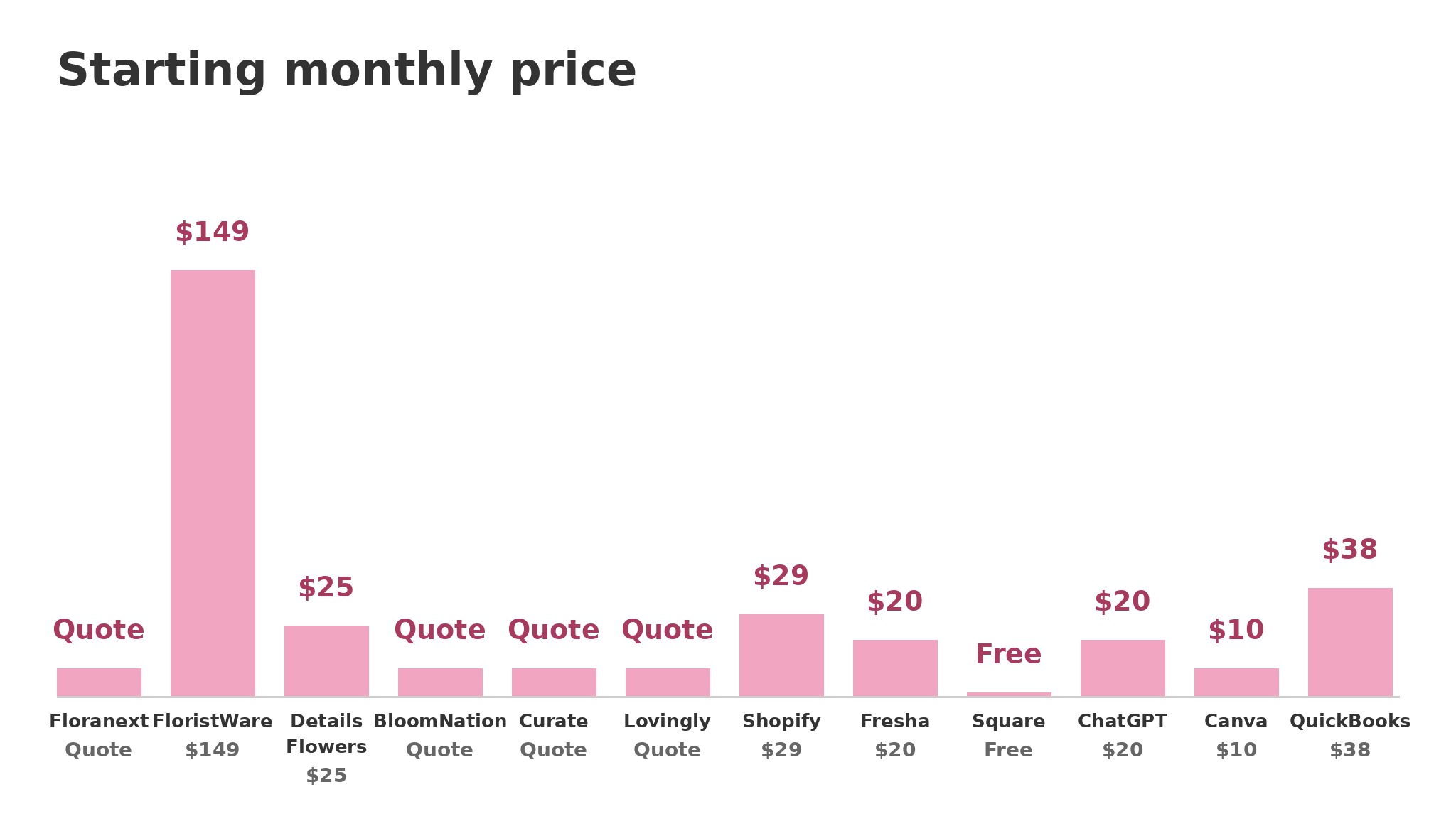
The table below puts the best ai tools for florists side by side on price, best job and free plan, so you can compare the published prices against the quote only tools at a glance.
| Tool | Starting price | Best for | Free plan |
|---|---|---|---|
| Floranext | Pricing on request | All in one shop and weddings | Trial only |
| FloristWare | 149 dollars a month | Retail POS and delivery depth | No |
| Details Flowers | 25 dollars a month | Wedding and event design | Trial only |
| BloomNation | Pricing on request | Marketplace and online orders | No |
| Curate | Pricing on request | Full event operations | No |
| Lovingly | Pricing on request | Website and POS with AI help | Waitlist |
| Shopify | 29 dollars a month | Online store for a growing shop | Trial only |
| Fresha | 19.95 dollars a month | Bookings for workshops | Trial only |
| Square Appointments | Free | Bookings and payments to start | Yes |
| ChatGPT | 20 dollars a month | Bouquet ideas and promo copy | Yes |
| Canva | 10 dollars a month | Social posts and shop graphics | Yes |
| QuickBooks Online | 38 dollars a month | Books, invoices and supplier costs | Trial only |
How to Pick the Right Tool for Your Flower Shop
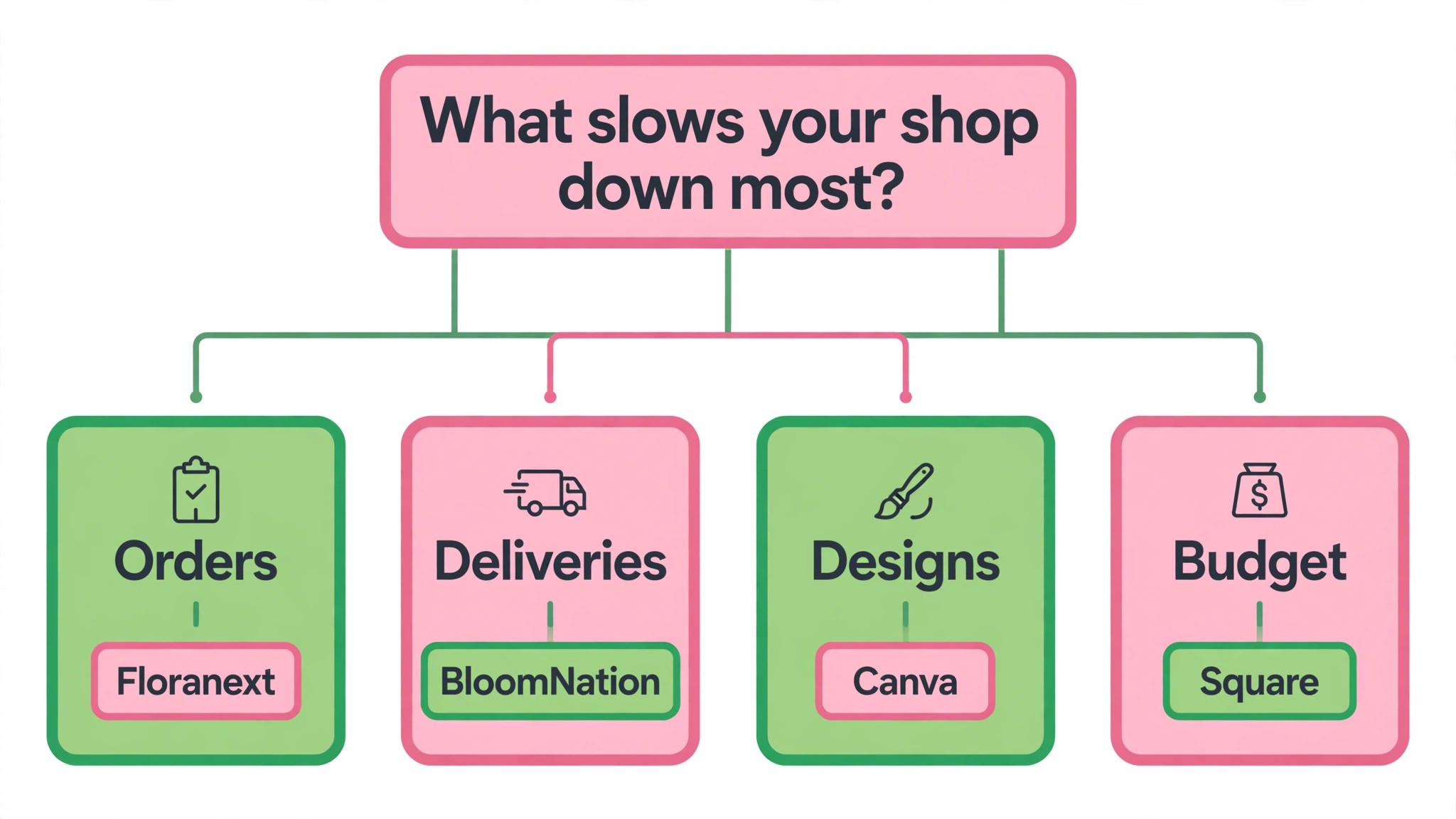
The best ai tools for florists are not the ones with the longest feature list. They are the ones that fix the slowest part of your week. A shop drowning in wedding proposals should buy Details Flowers or Curate. A shop whose deliveries run late should buy FloristWare. A shop that needs online orders should buy Floranext, BloomNation or Shopify. A shop on a tight budget should buy Square and Canva. Start from the slow part, not from the vendor homepage.
Budget the full bill, not the headline price. The table below shows what a solo florist and a busy shop actually pay in year one for the most common combinations, using published starting prices. Quote only pricing and marketplace commissions are the lines that surprise buyers, so get every quote in writing before you sign, and remember that annual billing usually saves about twenty percent against monthly billing.
| Stack for one shop | Monthly cost | What it covers |
|---|---|---|
| Square free plus Canva Pro | About 10 dollars | Bookings plus social graphics |
| ChatGPT Plus plus Details Flowers | About 45 dollars | Promo copy plus wedding proposals |
| Fresha plus Canva Pro | About 30 dollars | Workshop bookings plus graphics |
| Shopify Basic plus ChatGPT Plus | About 49 dollars | Online store plus promo copy |
| FloristWare, one station | 149 dollars | Retail POS and delivery depth |
| FloristWare plus Details Flowers | About 174 dollars | Retail plus weddings |
Frequently Asked Questions
What is the cheapest good AI tool for florists to start with
Square Appointments is the cheapest credible start, with a free plan for bookings and payments. Canva has a free plan and Pro at 10 dollars a month billed annually, and Details Flowers from 25 dollars a month is the cheapest wedding specialist here. Start with the flower job you do most each week, and add a specialist only when the general tool cannot do a job you are paid to do. That is the cheapest way to build a stack from the best ai tools for florists without paying for features you never open.
Will AI tools really save a small flower shop time
They will if they remove a real bottleneck rather than adding a new dashboard. A booking tool that fills workshops while the florist arranges, a proposal tool that prices a wedding in an hour instead of a day, and a graphics tool that makes a social post in minutes are all real savings. A tool that needs an hour of data entry to save ten minutes of work is not. Trial each one on real orders for two weeks and measure the hours before you commit.
Which tool is best for a florist who sells mostly weddings
Details Flowers is the strongest choice for wedding design, because it builds proposals with recipes, stem counts and production planning from 25 dollars a month. Curate is the best pick when the whole event operation needs managing, and Floranext is the best pick when the shop also needs a retail POS and a website. Price the combination at your real event volume, because Details Flowers scales with events, and confirm the current plan limits before you buy, because both Floranext and BloomNation quote rather than publish.
How much should a solo florist budget for AI tools
A realistic year one budget is 10 to 45 dollars a month for one general tool such as Canva Pro plus a specialist such as Details Flowers, and 149 to 175 dollars a month once you add a retail POS such as FloristWare. A shop on Floranext pays a quoted price that needs confirming in writing, while the same shop on Square plus Canva pays about 10 dollars a month. Budget for the stack, not for one tool, and trial each one on real orders before you commit to annual billing.
Our Verdict
If you buy one tool this quarter, buy Details Flowers if weddings are the business and FloristWare if the retail shop is the business. Details Flowers is the best wedding value on this list at 25 dollars a month, with proposals, recipes and stem counts that stop a beautiful wedding from losing money. FloristWare is the deepest retail system here, with delivery routing and reporting that a busy shop will feel every day. The best ai tools for florists earn their keep by giving you back the hours that proposals, deliveries and promo writing used to eat, and both of these do that from the first season.
Whatever you pick, start with the slowest part of your week, trial with real orders and real stem counts, and keep a human check on every AI generated price before it reaches a customer. The tools on this list all work. The difference is whether the tool matches the shop you actually run, and whether you measure the return in weddings won and deliveries on time rather than in features used.