

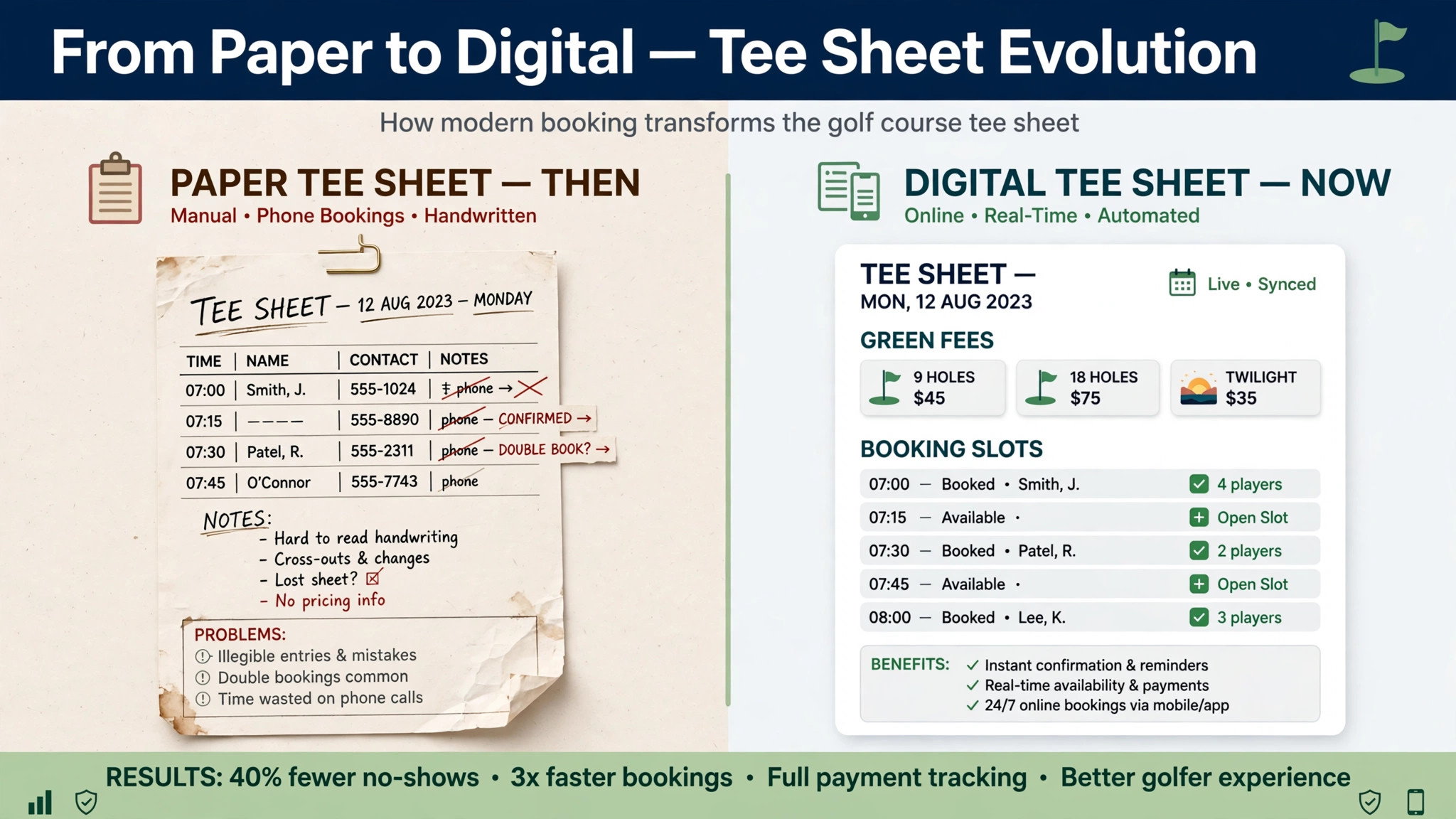
A Saturday tee sheet with 40 empty slots at 8 in the morning is not a marketing problem. It is an operations problem, and it usually means the booking flow, the pricing and the member billing are running on three systems that never talk to each other. The best software for golf courses fixes that gap by putting the tee sheet, online booking, point of sale, memberships and tournaments in one place, so the pro shop stops retyping the same golfer into four different screens.
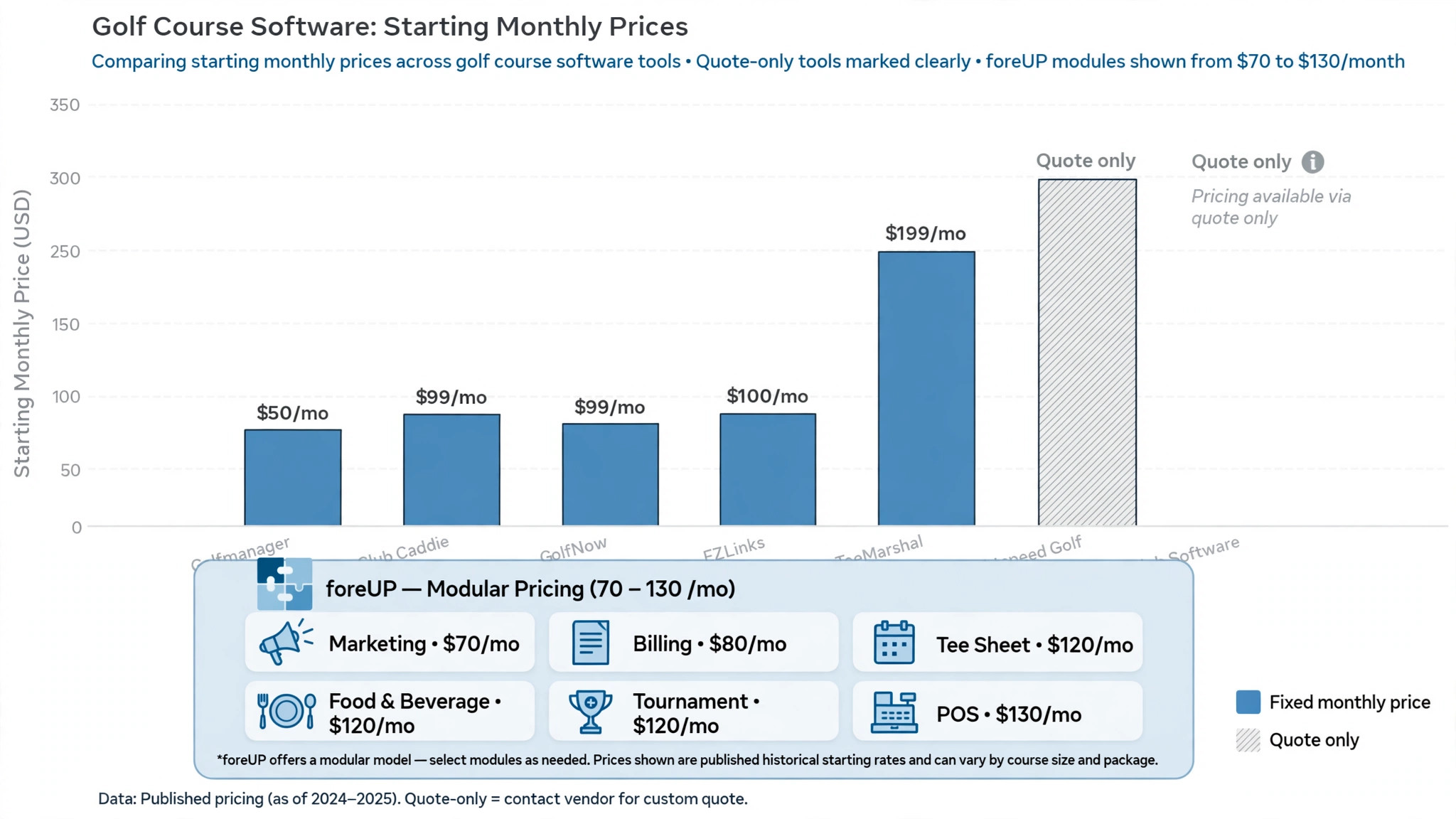
The market is worth about 722 million dollars in 2026, according to Global Market Statistics, and it is crowded with vendors that look alike on a homepage. The real differences show up in pricing, because only one of the twelve vendors in a recent independent comparison published a price at all. Most of the tools below sell by quote, so this guide says so plainly wherever a price is quote only, and gives the published module prices where they exist. Start with the shortlist, then read the reviews that match the job your course feels most.
The Quick Shortlist
The table below matches each common golf course job to the single tool that handles it best. Use it to narrow the best software for golf courses to two or three candidates before you read the full reviews. Prices are monthly list prices unless noted, and quote only means the vendor does not publish a starting price.
| Job | Best tool | Why it wins |
|---|---|---|
| All in one operations for a busy public course | foreUP | Modular pricing from 70 dollars a month per module |
| Online booking and dynamic pricing | Lightspeed Golf | Chronogolf tee sheet with demand based green fees |
| Course and dining in one system | Tee On | One price covering all features, given on request |
| Connected operations with marketing help | Teesnap | Tee sheet, till and campaigns plus hands on support |
| Simple cloud operations for a small club | Club Caddie | Built by golf industry professionals, easy to run |
| Start with bookings and add modules later | Golfmanager | Six plans you can add or drop as the course grows |
| Reach golfers through a booking network | GolfNow | Large golfer audience plus tee sheet and POS |
| Shop and restaurant sales at the counter | Club Prophet | Point of sale depth for pro shop and dining |
| Tournaments and event scoring | Golf Genius | Tournament management used by clubs and tours |
| Member engagement and outings | Gallus Golf | Branded app and outing tools for members |
| Yield and revenue management | Sagacity Golf | Pricing intelligence for tee time revenue |
| Low cost add ons without a subscription | GolfStatus | Published add on prices, no subscription fee |
| Private club depth and back office | Jonas Club Software | Full club accounting and member management |
| Controlled booking rules and tournaments | Supreme Golf | Tournament blocks that protect normal inventory |
| Commerce first booking and pro shop | MyGolfLinks | Online tee sheet with integrated POS and booking network |
How We Judged the Shortlist
A tool earned a place here only if it does a real golf course job in 2026, not if it added a booking button to an old till system. The best software for golf courses was judged on five things that decide whether a course keeps paying after the first season.
First, the tee sheet itself, from real time availability and online booking to rate management across multiple nines and courses, because a tee sheet that double books on a Saturday morning costs more than any subscription. Second, whether the price is published or hidden behind a sales call, including module fees and per transaction charges that change the real bill. Third, point of sale and member billing depth, because a course that sells in the pro shop, the restaurant and the bar needs one till, not three.
Fourth, tournament and event handling, from outing scoring to league play, because events are where a course earns its margin. Fifth, the catch, from quote only pricing that hides the cost until the demo to a booking network that takes a cut of every round it fills.
| Check before you buy | What to ask | Why it matters |
|---|---|---|
| Tee sheet control | Can you block tournament inventory without closing normal play | Protects Saturday revenue during events |
| Price structure | Per module, per facility, or per transaction | Module fees multiply as you add tools |
| Booking network terms | What share or fee applies to network rounds | Network rounds cost more than direct ones |
| POS coverage | One till for pro shop, restaurant and bar | Separate tills mean separate reconciliations |
| Member billing | Does it handle dues, carts and dining minimums | Manual billing eats pro shop hours |
| Data export | Can you take member and booking history with you | Leaving should not mean losing your list |
The 15 Tools, Reviewed One by One
The reviews below follow the same shape for every tool, starting price first, then the job it does best and the catch to check before you sign. The best software for golf courses in this list ranges from a 70 dollar a month module to a full private club system priced by quote, so read the price line as carefully as the feature list.
1. foreUP
Starting price From 70 dollars a month per module. Best for All in one operations for a busy public course. Watch out Modules add up fast, so price the full stack before you commit.
foreUP is a cloud platform built to run a public or semi private course from one place, pairing tee sheet, POS, billing and marketing in a modular system. Published module prices start at 70 dollars a month for email and text marketing, 80 dollars for billing, 120 dollars for the tee sheet, 120 dollars for food and beverage and 130 dollars for golf course point of sale. That menu lets a course buy only what it needs, and it is the clearest published pricing in this category.
The strength is the way the modules share one golfer record. A booking made online shows up at the till, the member billing sees the same round, and the marketing module can target the golfers who played last month but have not booked this one. For a busy public course, that shared record removes the double entry that slows a Saturday morning.
The catch is the total. A course that buys the tee sheet, POS, billing and food and beverage modules pays about 450 dollars a month before marketing, and there is no free trial. Price the stack you will actually run, not the cheapest module, and ask what setup costs before you sign.
2. Lightspeed Golf
Starting price Quote only. Best for Online booking and dynamic pricing. Watch out No published price means the bill depends entirely on the quote.
Lightspeed Golf is a cloud platform built on the Chronogolf tee sheet, combining scheduling, POS, payments, online booking, marketing and analytics. The booking flow is the selling point, with real time availability, a promotional engine, event management, a players database and business intelligence in the package. Dynamic pricing lets a course adjust green fees by demand, so a quiet Tuesday can be priced to fill and a busy Saturday can earn what it is worth.
The catch is price transparency. Lightspeed does not publish a starting price and asks for a personalized quote, so a buyer cannot budget from the website. Get the quote in writing with the modules listed, and compare it against the foreUP module total for the same job.
3. Tee On
Starting price Quote only. Best for Course and dining in one system. Watch out One price sounds simple, but you still need the number in writing.
Tee On is a Canadian platform that covers the tee sheet, point of sale, food and beverage, member profiles and back office work under one price. The appeal is simplicity. Instead of choosing modules, a course gets all features in a single system, which suits a single site or multi course operator that wants one contract and one support line.
The catch is that the single price is given on request through a demo booking, so comparing it with modular rivals takes a sales call. Book the demo, ask for the full price in writing, and check whether payment processing fees sit on top of the subscription.
4. Teesnap
Starting price Quote only for core software. Best for Connected operations with marketing help. Watch out The only published prices are for marketing services, from 700 to 2,100 dollars a month, not for the software itself.
Teesnap is a US built platform covering tee sheet, online booking, POS, payments and reporting, paired with hands on marketing services. The software handles the daily operation, and the marketing team behind it runs campaigns that fill empty tee times. For a course without a marketing person on staff, that pairing is the point.
The tee sheet and booking engine are built for US courses, with a website, an online store and a food and beverage system feeding the same marketing database. A golfer who books online, buys in the pro shop and eats in the restaurant becomes one record the marketing team can reach.
The catch is that no core software price is published, and the marketing services package is a separate cost. A buyer should ask for the software price and the services price as two lines, and decide whether the marketing help is worth paying for separately.
5. Club Caddie
Starting price Quote only, reported at about 249 dollars a month in one comparison. Best for Simple cloud operations for a small club. Watch out The reported figure is from a third party comparison, so confirm it with the vendor.
Club Caddie is a cloud platform built by golf industry professionals for public and private courses, country clubs, resorts and management groups. It covers the tee sheet, POS, member management and reporting in a system that is meant to be easy to run without a large back office. That simplicity is the reason small clubs pick it over heavier private club systems.
The catch is price transparency again. The monthly subscription is quoted by facility type, modules and locations, so a small club and a resort pay different amounts for the same product. Ask for a quote that names the modules included, and check the contract length before you commit.
6. Golfmanager
Starting price Quote only. Best for Start with bookings and add modules later. Watch out Six plans with no published prices mean the budget depends entirely on the quote.
Golfmanager is a cloud golf suite sold as six plans that a course can add or drop as it grows. Start with bookings, then add the pro shop, the restaurant, the academy or marketing when the course is ready. That flexibility suits a course that wants to move in stages rather than buy a full system on day one.
The catch is that none of the six plans carries a published price, and nothing on the pricing page says whether a trial exists. Get a quote for the starting plan and for the plan you expect to need in a year, so the growth path does not surprise you.
7. GolfNow
Starting price Quote only. Best for Reach golfers through a booking network. Watch out Network rounds bring new golfers, but they cost more than direct bookings.
GolfNow is the booking network most golfers already know, and its business platform, GolfNow Pro, pairs that audience with a tee sheet, POS and restaurant management. A course that lists on the network gets seen by golfers who would never find its own website, and the tee sheet fills gaps that direct booking leaves empty.
The catch is the trade. Network distribution has a cost, whether in fees or in the share of the round, and a course that fills too much of its sheet through the network gives away margin it could keep on direct bookings. Use the network to fill quiet times, and protect prime times for direct sales.
8. Club Prophet
Starting price Quote only. Best for Shop and restaurant sales at the counter. Watch out No published price, and the strength is the till, not the tee sheet.
Club Prophet is a golf management system whose revenue is mostly shop and restaurant sales at the counter, and that focus shows in the product. The point of sale handles the pro shop, the restaurant and the bar with the depth a busy counter needs, from inventory to member charging. A course that earns most of its money at the till will feel the difference.
The catch is that a buyer who wants a tee sheet first product with published rates should look elsewhere, because Club Prophet sells by demo request and its published prices do not exist. Ask for a quote that separates the till from the tee sheet, and test the till on a busy Saturday before you sign.
9. Golf Genius
Starting price Quote only. Best for Tournaments and event scoring. Watch out Tournament depth is the point, so a course that rarely runs events will pay for tools it never opens.
Golf Genius is the tournament name in this list, used by clubs and tours to run events, leagues and outings with live scoring. A course that runs a weekly league, a charity outing and a club championship needs software that handles pairings, flights, scoring and results without a spreadsheet, and Golf Genius is built for exactly that work.
The catch is fit. A course that runs two outings a year will not use the tournament depth, and the quote will still reflect it. If events are your margin, this is the pick. If they are an occasional extra, buy a tee sheet first and add tournament tools later.
10. Gallus Golf
Starting price Quote only. Best for Member engagement and outings. Watch out The branded app is the selling point, so check what members actually open.
Gallus Golf builds a branded app and outing tools for members, turning the course into something a golfer carries in a pocket. Members can book, check event details and stay in touch with the club through the app, and the course can promote outings and leagues directly to the people most likely to play them.
The catch is adoption. A branded app only works if members install it and use it, and a course should ask for real usage numbers from a similar club before paying. Get the quote, ask for a reference club, and test the app with a small member group first.
11. Sagacity Golf
Starting price Quote only. Best for Yield and revenue management. Watch out Pricing intelligence only pays if the course acts on it.
Sagacity Golf focuses on the money side of the tee sheet, using pricing intelligence to help a course earn more from the same number of rounds. Instead of a flat green fee all day, the course can price by demand, by time and by channel, so a quiet slot gets cheaper and a prime slot earns its full value.
The catch is that the software does not set prices by itself. Someone on the team has to review the recommendations, set the rates and check the results, or the tool becomes a report nobody reads. Budget staff time beside the subscription, and ask what data the pricing model needs before you buy.
12. GolfStatus
Starting price Published add on prices, no subscription. Best for Low cost add ons without a subscription. Watch out It is an add on layer, not a full tee sheet replacement.
GolfStatus is the only vendor in a recent twelve tool comparison that published a price model on its own site, with add on prices and no subscription fee for access. That transparency is rare in this category, and it makes GolfStatus easy to test without a sales call or a long contract.
The catch is scope. GolfStatus does not replace a tee sheet, a POS or member billing, so a course that needs all three still needs a core system. Use it as a low cost addition to a system you already trust, and price the add ons you will actually use.
13. Jonas Club Software
Starting price Quote only. Best for Private club depth and back office. Watch out Enterprise depth means enterprise setup, so a small course will find it heavy.
Jonas Club Software is the full private club system in this list, covering course and dining together with member profiles and deep back office accounting. A private club that bills dues, dining minimums, cart fees and guest charges needs a system that handles all of it in one ledger, and Jonas is built for that job.
The catch is weight. Jonas is an enterprise product, and a small public course will find the setup, the training and the price more than it needs. It suits a private club with a real back office, and a buyer should ask for the implementation timeline in writing before signing.
14. Supreme Golf
Starting price Quote only. Best for Controlled booking rules and tournaments. Watch out The strength is tournament inventory control, so test it on a real event week.
Supreme Golf is a tee sheet platform built around controlled booking rules that stay consistent across normal play and tournament inventory. Tournament block scheduling isolates event inventory while keeping the regular tee sheet stable, so a charity outing does not wipe out the normal Saturday bookings around it.
The catch is that the product is narrower than an all in one platform, so a course still needs a till and member billing beside it. Ask for a demo on a week with a real tournament, and check how the event inventory behaves when a group cancels.
15. MyGolfLinks
Starting price Quote only. Best for Commerce first booking and pro shop. Watch out The booking network is part of the pitch, so check the terms for network rounds.
MyGolfLinks combines an online tee sheet, integrated POS and a built in booking network in a commerce first platform. A golfer can book online, the pro shop can sell through the same till, and the course can reach new golfers through the network without running a separate listing.
The catch is the same as any network product. Network rounds have terms, and a course should read them before listing prime times. Use the network for quiet slots, keep prime times direct, and ask for the full fee schedule in writing.
Side by Side Comparison
The table below puts the shortlist side by side on price, best job and free plan, so you can compare the published prices against the quote only tools at a glance.
| Tool | Starting price | Best for | Free plan |
|---|---|---|---|
| foreUP | From 70 dollars a month per module | All in one public course operations | No |
| Lightspeed Golf | Quote only | Online booking and dynamic pricing | No |
| Tee On | Quote only | Course and dining in one system | No |
| Teesnap | Quote only | Connected operations with marketing help | No |
| Club Caddie | Quote only, reported about 249 dollars a month | Simple cloud operations | No |
| Golfmanager | Quote only | Start with bookings, add modules later | No |
| GolfNow | Quote only | Reach golfers through a booking network | No |
| Club Prophet | Quote only | Shop and restaurant sales | No |
| Golf Genius | Quote only | Tournaments and event scoring | No |
| Gallus Golf | Quote only | Member engagement and outings | No |
| Sagacity Golf | Quote only | Yield and revenue management | No |
| GolfStatus | Published add ons, no subscription | Low cost add ons | No |
| Jonas Club Software | Quote only | Private club depth | No |
| Supreme Golf | Quote only | Controlled booking rules | No |
| MyGolfLinks | Quote only | Commerce first booking | No |
How to Pick the Right Tool from the Best Software for Golf Courses
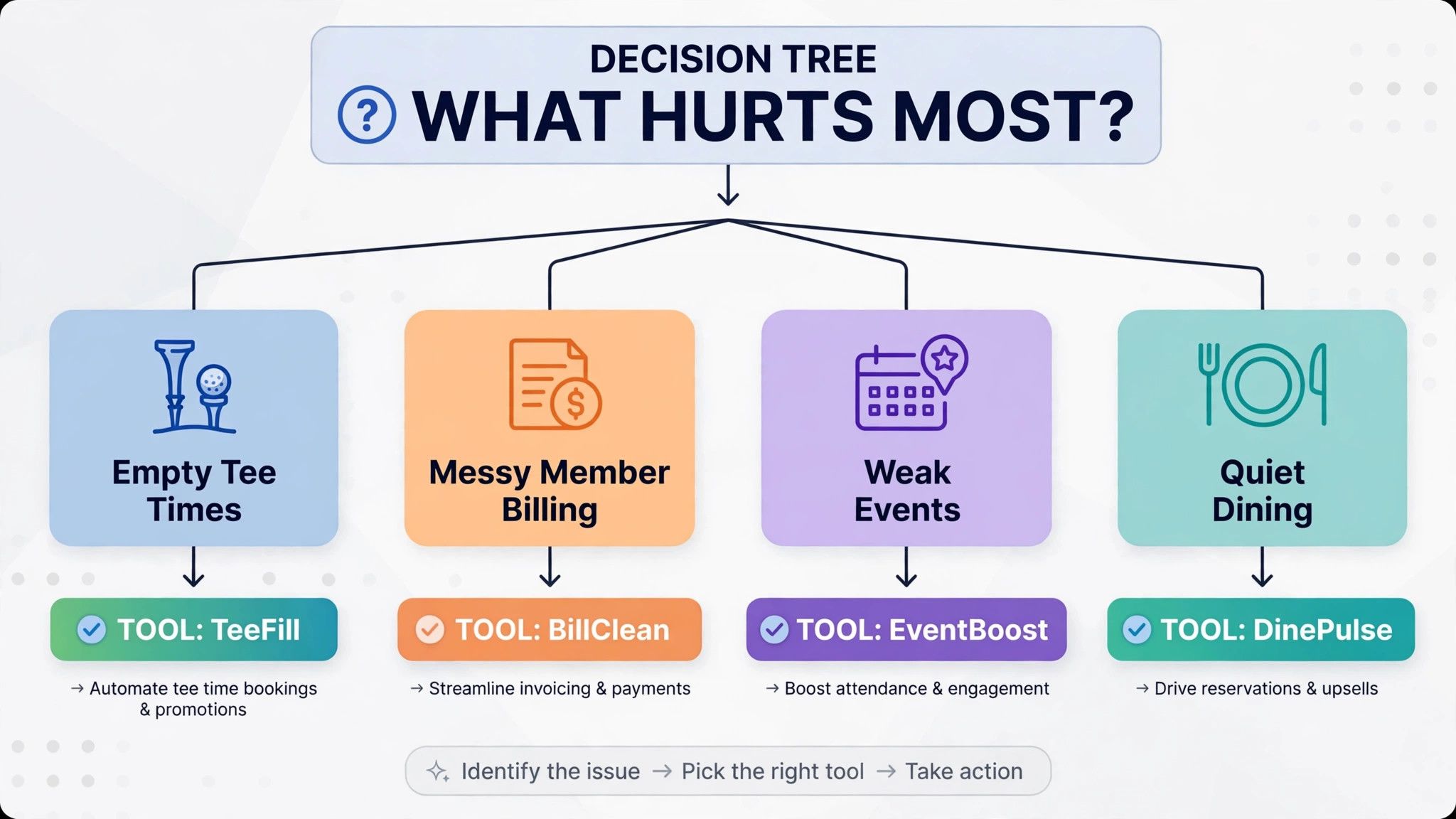
The right pick starts from the job that loses the course the most money, not from the longest feature list. A public course with empty Saturday slots should buy Lightspeed Golf or foreUP, because the booking flow and the pricing decide whether those slots fill. A private club with a busy dining room should buy Tee On or Jonas Club Software, because member billing and dining decide whether the month closes cleanly. A course that runs events every week should buy Golf Genius or Supreme Golf, because tournament inventory decides whether an outing helps or hurts the normal sheet.
Budget the full bill, not the headline price. The table below shows what a small course actually pays in year one for the most common combinations, using published or reported starting prices. Setup fees, payment processing and renewal terms are the lines that surprise buyers, so ask for them in writing before you sign.
| Stack for one course | Monthly cost | What it covers |
|---|---|---|
| foreUP tee sheet plus POS | About 250 dollars | Tee sheet and pro shop till |
| foreUP full stack, four modules | About 450 dollars | Tee sheet, POS, billing and dining |
| Teesnap plus marketing services | Quote plus 700 to 2,100 dollars | Software plus marketing help |
| Club Caddie, reported | About 249 dollars | Cloud operations for a small club |
| GolfStatus add ons | Published add on prices | Events and engagement beside a core system |
Frequently Asked Questions
What is the cheapest golf course software to start with
foreUP at 70 dollars a month for a single module is the cheapest published entry with a real tee sheet behind it, and a course can start with the tee sheet at 120 dollars a month and add modules later. GolfStatus has no subscription and publishes add on prices, so it is the cheapest way to add event and engagement tools to a system you already run. For a full system, Club Caddie is reported at about 249 dollars a month in one third party comparison, but that figure needs confirming with the vendor. Start with the job that loses you the most money, not with the cheapest tool overall.
Why do most golf course software vendors hide their prices
Most vendors in this category sell by quote because the price depends on facility size, module choice, locations and payment processing volume. A small nine hole course and a 36 hole resort buy the same product at very different prices, so a single published number would mislead one of them. The best software for golf courses in this guide includes the published prices where they exist, and marks the rest as quote only, so you can see which vendors will talk price before a demo and which ones will not.
Which golf course software is best for a small public course
foreUP suits a small public course that wants to buy modules one at a time, because the tee sheet at 120 dollars a month and the POS at 130 dollars a month are published and easy to budget. Club Caddie suits a small club that wants one simple cloud system without choosing modules. Lightspeed Golf suits a small course that wants dynamic pricing and a strong online booking flow, but it needs a quote first. Trial the booking flow with real golfers before you sign, because a booking page that confuses players will cost more than the subscription saves.
How much should a small course budget for golf software in year one
A realistic year one budget is 120 to 250 dollars a month for a tee sheet plus a till, and 450 to 700 dollars a month once you add billing, dining and marketing modules. Setup fees, payment processing and marketing services sit on top of the subscription, and Teesnap marketing services alone run 700 to 2,100 dollars a month. The best software for golf courses is not the cheapest one on the list. It is the one that fills empty tee times, closes member billing cleanly and runs tournaments without double booking the sheet.
Our Verdict
If you buy one tool this quarter, buy foreUP. It is the only tool in this list with published module prices, so you can budget the stack before a sales call, and the tee sheet plus POS at about 250 dollars a month covers the two jobs a public course feels every day. The best software for golf courses earns its keep by filling empty slots and removing double entry, and foreUP does both from the first week, whether the win is a Saturday slot that finally books online or a member charge that lands on the right account without retyping.
Whatever you pick, start with the leak, trial the booking flow with real golfers, and keep the old tee sheet beside the new one for the first month. The best software for golf courses on this list all work. The difference is whether the tool matches the job your course actually needs done, and whether you measure the return in rounds filled and hours saved rather than in features used.