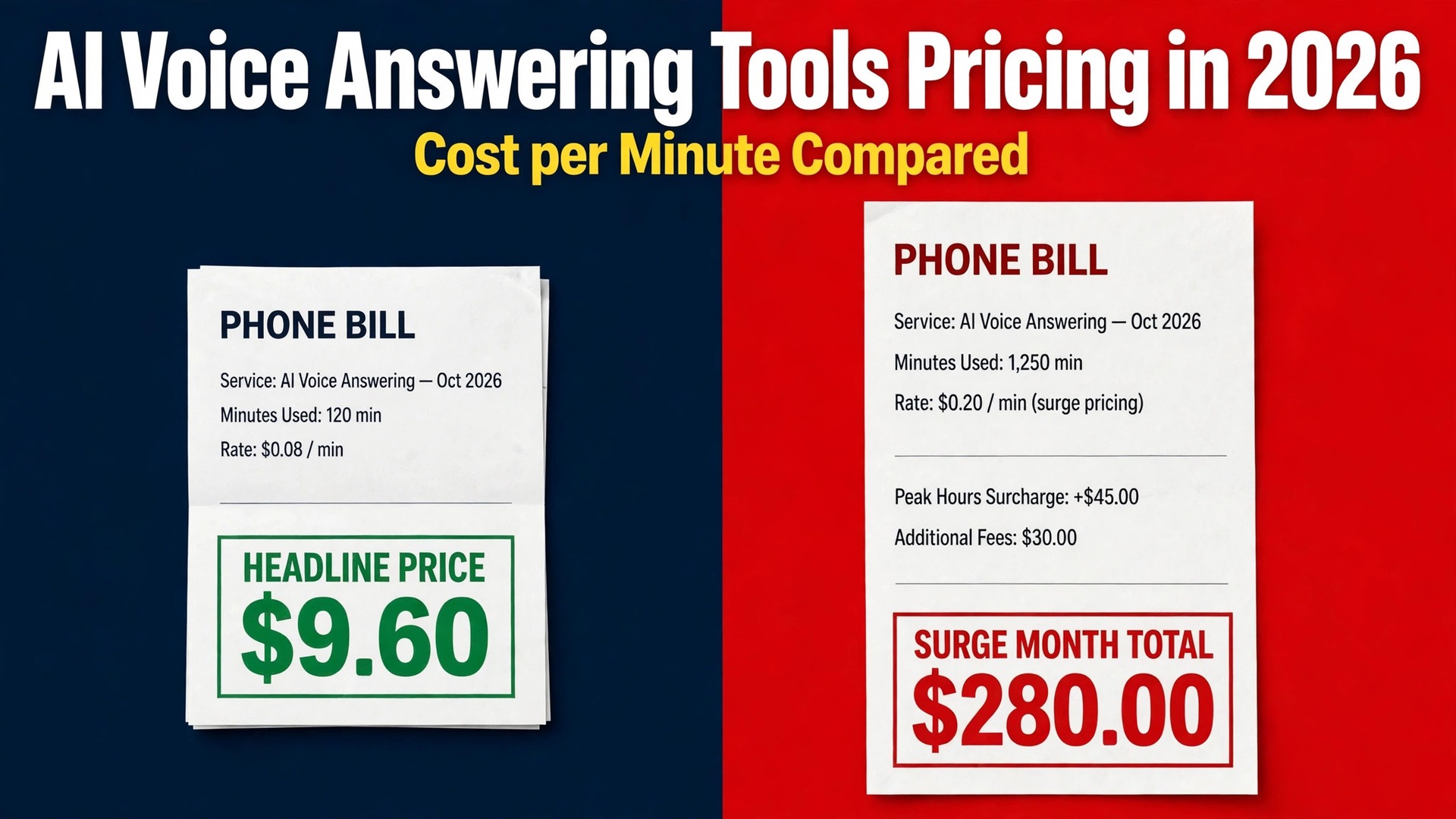
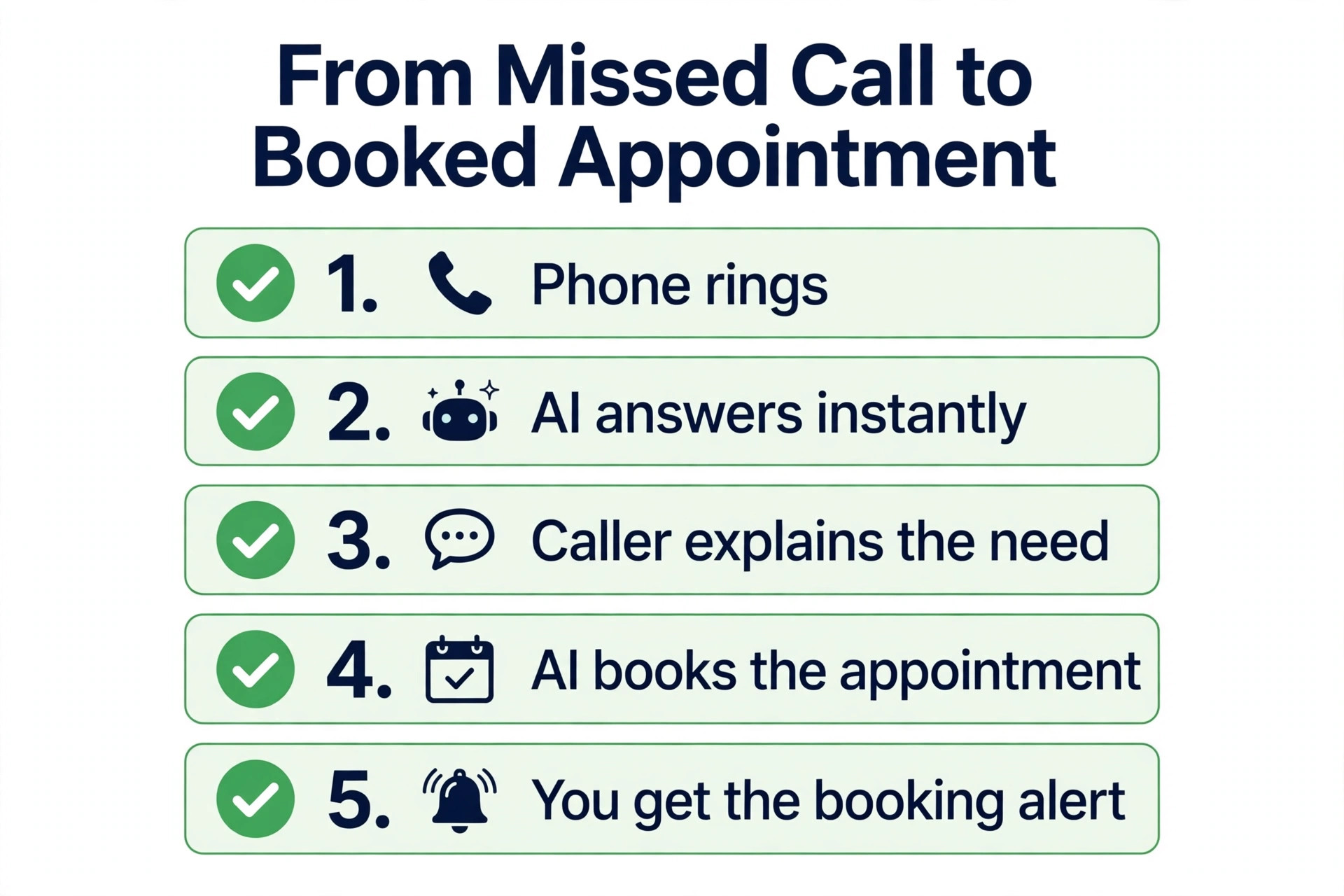
Your phone rings while you are with a customer, and the caller hears voicemail instead of a voice. That missed call is a lost booking, and the usual fix is either a receptionist you cannot afford or an answering service that charges several dollars per call. AI voice answering promises a third option, a voice agent that answers instantly, books appointments and hands callers to a person when it should, for cents per minute or a few dollars per call. The promise is real, but ai voice answering tools pricing is confusing, because vendors meter different things.
One charges by the minute, one charges by the call, one charges by the unique caller, and the cheapest headline price can become the most expensive bill in a busy month. This guide compares ai voice answering tools pricing across 12 tools, converts every plan to a cost per minute, and prices out three real months so you can see what you will actually pay.
The first thing to understand is that there is no single price for AI answering. A ready made service rents you a finished agent, and you pay a monthly fee plus a metered charge. A developer platform rents you the building blocks, and you pay per minute plus the cost of building and maintaining the agent yourself. Both can be cheap, and both can be expensive, and the right choice depends on how many calls you take and how long they last.
Prices in this guide were checked against vendor pricing pages and current 2026 roundups in November 2026. Vendors change prices often, and several list different rates by region or by billing period, so confirm the price on the checkout page before you pay. Where two trusted sources disagreed on a price, we say so in the text and give the figure we found most often.
How AI Voice Answering Tools Pricing Works
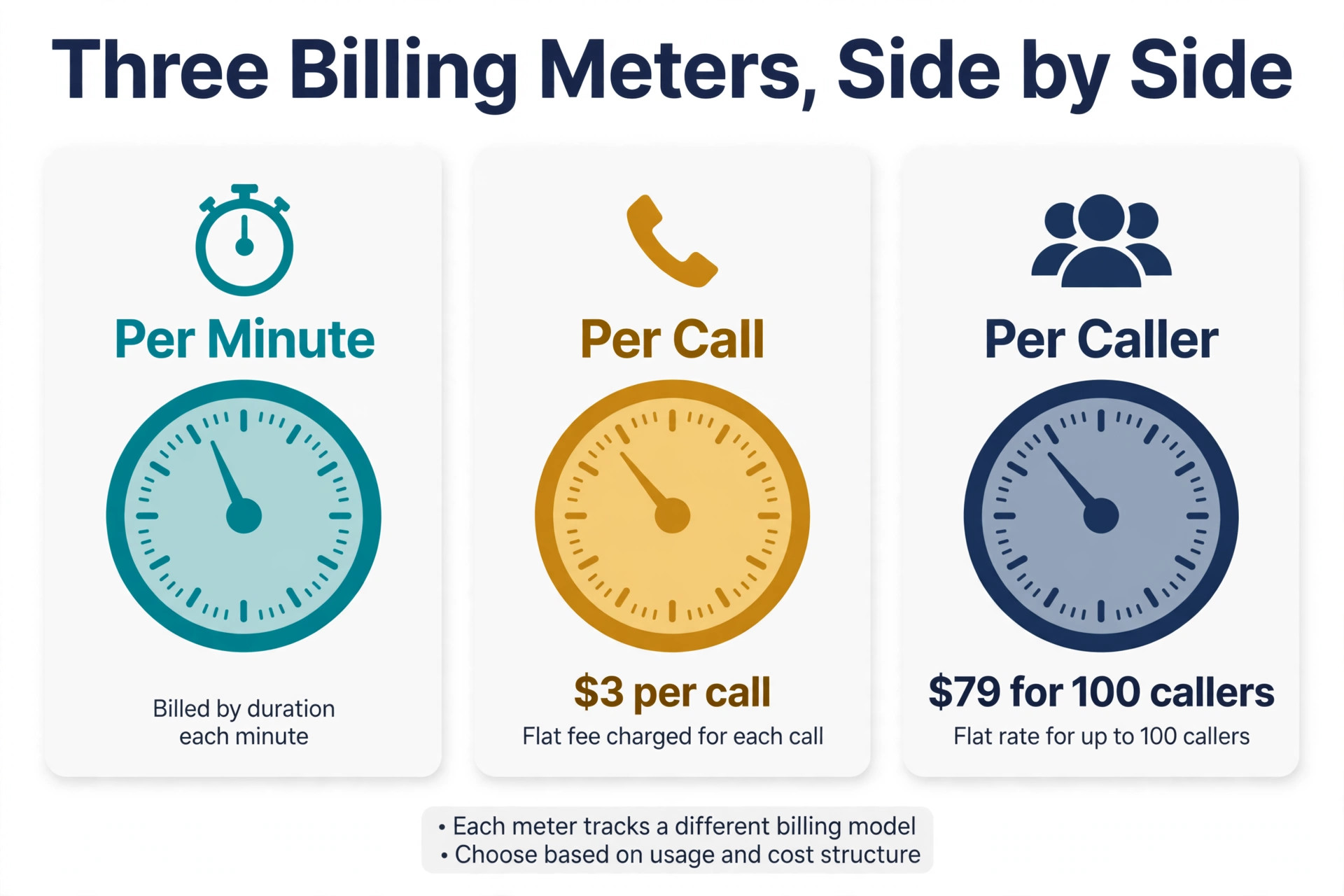
AI answering vendors meter three different things, and the meter decides who wins in your month. Per minute billing charges for the time the agent spends on the phone, so a three minute booking costs three times a one minute message. Per call billing charges a flat rate for each call, whatever its length, so a 12 minute intake costs the same as a 30 second wrong number. Per unique caller billing charges once for each different phone number in a month, so repeat callers cost nothing extra. A vendor that looks expensive per minute can be cheap per call, and a vendor that looks cheap per month can be expensive in a surge.
The second thing to understand is what the headline rate includes. Some per minute rates cover everything, the voice, the language model, the phone number and the call recording, in one number. Others cover only the voice layer, with the language model, the phone carrier and the tools billed separately, so the real cost per minute is two or three times the advertised rate.
Retell AI publishes an all in range of 7 to 31 cents a minute, depending on voice and model, while OpenAI lists its voice layer alone at 5 cents a minute, with backend model and tool usage billed separately. Both numbers are honest, but they are not comparable until you add the missing pieces to the cheaper one.
The third thing to understand is the monthly fee. Most ready made services charge a monthly plan fee that includes a bundle of minutes, calls or callers, with overage charged at a published rate. Smith.ai gives 25 calls a month free, then charges 3 dollars per extra call. Dialzara gives 60 minutes a month for 29 dollars, then charges 48 cents per extra minute. Goodcall gives 100 unique callers a month for 79 dollars, with no minute charges at all. The plan fee is only good value when your volume fits inside the bundle, and the overage rate is what decides the bill in a busy month.
The Cost per Minute Compared
The table below converts the main ready made plans to a cost per minute, using a three minute average call, so you can compare vendors that meter different things on the same basis. The conversion is approximate, because a vendor that bills per call does not care how long the call lasts, but it gives you a fair way to compare the plans side by side. Read the per call and per caller figures alongside the per minute figure, because the cheapest per minute rate is not always the cheapest bill.
| Tool | Billing | Entry plan | Overage | Cost per minute at 3 minute calls |
|---|---|---|---|---|
| Smith.ai AI Receptionist | Per call | Free for 25 calls, then 3.00 dollars per call | 3.00 dollars per call | About 1.00 dollar |
| Goodcall | Per unique caller | 79 dollars a month for 100 callers | 79 cents per extra caller | About 26 cents |
| Rosie | Per minute | 49 dollars a month for 250 minutes | Rate not published | About 20 cents |
| Dialzara | Per minute | 29 dollars a month for 60 minutes | 48 cents per minute | About 48 cents |
| RingCentral AI Receptionist | Per minute | 49 dollars a month with 100 minutes | 50 cents per minute | About 50 cents |
| Prisma Voices | Per minute | 30 dollars a month plus 50 cents per minute | 50 cents per minute | About 50 cents |
| Retell AI | Per minute, all in | 10 dollars free credit to start | 7 to 31 cents per minute | 7 to 31 cents |
| Vapi | Per minute plus model | Pay as you go, model dependent | Varies by model | About 10 to 30 cents |
| OpenAI voice layer | Per second | 5 cents a minute for the voice layer | Backend billed separately | 5 cents plus backend |
| Upfirst | Per call | 24.95 dollars a month for 30 calls | Rate not published | About 83 cents |
| HighLevel Voice AI | Per minute plus plan | 50 dollars a month for 100 minutes | 4.5 cents per minute plus voice rate | About 6 cents plus plan |
| ElevenLabs | Per minute plus plan | Conversational AI plans from 5 dollars a month | Usage based | Varies by plan |
The pattern in the table is clear. Developer platforms like Retell AI and OpenAI charge the lowest per minute rates, from 5 to 31 cents, but you pay for building and maintaining the agent yourself. Ready made services charge more per minute, from about 20 to 50 cents, but the agent arrives finished and the vendor maintains it. Per call services look expensive per minute, near a dollar, but they are cheap for long calls, because a 12 minute intake costs the same as a short message. Goodcall looks cheap per minute at 26 cents, but only when your callers are mostly new, because repeat callers are free and the cost per minute falls as calls get longer.
What Each Tool Charges
The tools below fall into three groups. The first group is ready made services, where you describe your business and the vendor builds the agent. The second group is developer platforms, where you build the agent yourself from voice and language models. The third group is phone system add ons, where AI answering sits inside a phone service you may already use.
1. Smith.ai AI Receptionist
Smith.ai sells two different products, and mixing them up is the most common pricing mistake in this category. The AI Receptionist is a separate product from its human staffed virtual receptionist plans, and the prices sit in different worlds. The AI product has a free tier covering 25 calls a month, then 3 dollars per extra call, with Pro from 150 dollars a month for 75 calls and Enterprise from 500 dollars a month for 300 calls. The human plans start at 300 dollars a month for 30 calls, with extra calls at 11.50 dollars each, so make sure you are on the AI tab of the pricing page before you compare.
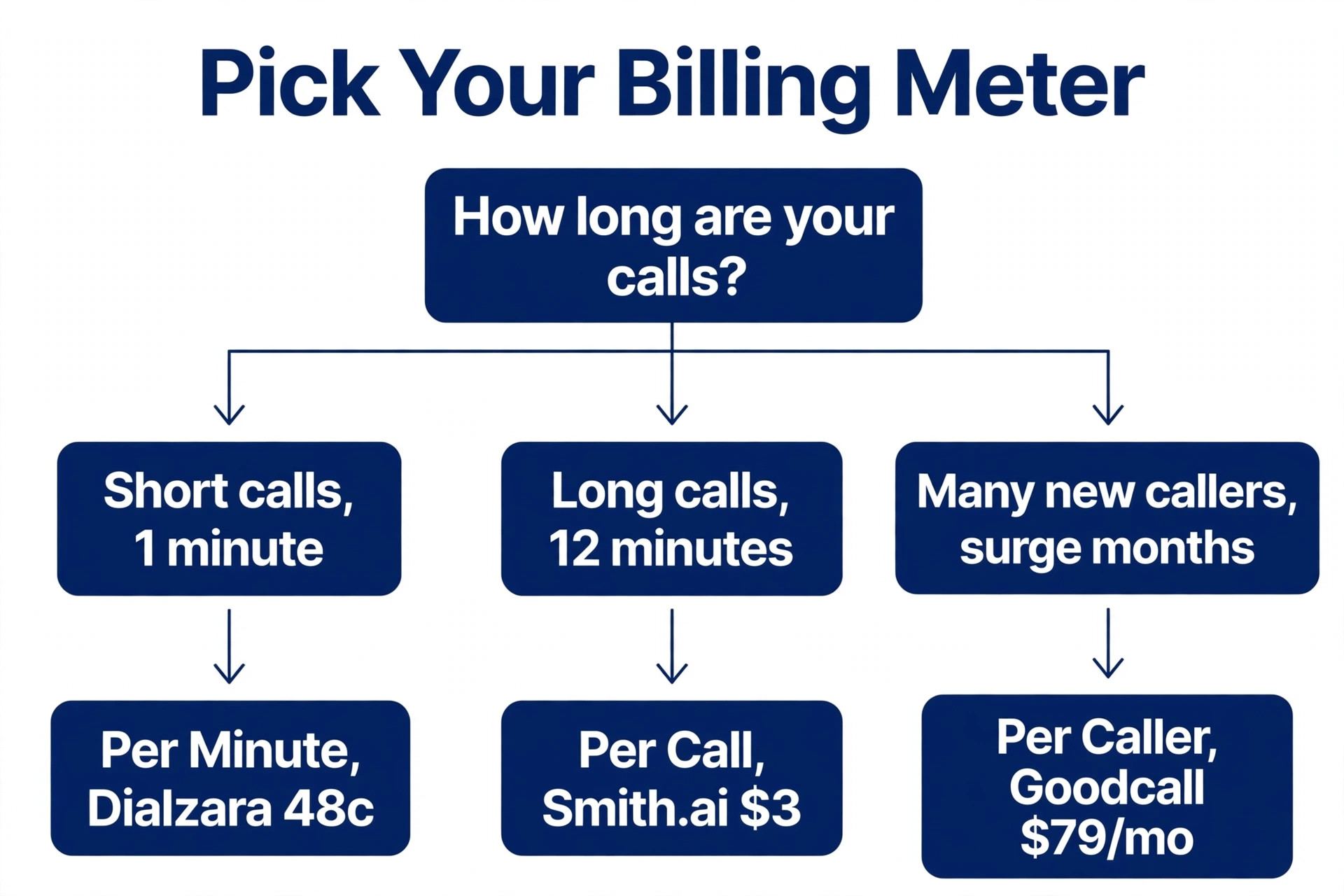
The AI agent books appointments, qualifies leads and can transfer callers to a live North America based receptionist when the call needs a person. The per call model suits a business with long calls, because a 10 minute booking costs the same 3 dollars as a 30 second message, but it punishes a business with many short calls. Smith.ai is the cheapest way to test AI answering, because the free tier costs nothing for 25 calls a month.
2. Goodcall
Goodcall charges per unique caller, not per minute and not per call, and that single choice shapes its whole value. Starter is 79 dollars a month for 100 unique callers, Growth is 129 dollars for 500 callers, and Scale is 299 dollars for 2,000 callers, with extra callers at 79, 26 and 15 cents on each plan. Minutes are unlimited on every plan, which is why Goodcall wins in a surge month, because a 12 minute claim intake call costs the same as a 30 second wrong number.
The setup is built for a non technical owner. A setup assistant builds the agent from a plain English description of the business, and you can test a demo agent free before connecting a number. The trade off is that repeat callers are free, so a business with a small set of regular callers pays for capacity it does not use, while a business with a flood of new callers after a storm gets the best value on the list.
3. Rosie
Rosie charges per minute, with plans built around a monthly minute bundle. Professional is 49 dollars a month for 250 minutes with message taking only, Scale is 149 dollars for 1,000 minutes with direct calendar booking and warm transfers, and Growth is 299 dollars for 2,000 minutes with waterfall transfers. That structure suits a business that wants a predictable monthly bill and knows roughly how many minutes it uses, because the bundle covers the normal month and the overage rate only matters in a busy one.
The catch is that the overage rate is not published, so you cannot work out the cost of a surge month in advance. A quiet month costs 49 dollars for 250 minutes, which works out near 20 cents a minute, but a busy month that doubles your minutes has an unknown cost until the bill arrives. Ask Rosie for the overage rate in writing before you sign up, and compare it with Dialzara at 48 cents and RingCentral at 50 cents, so you know where you stand. Rosie is the cheapest quiet month on this list, and the unknown overage is the price of that cheap entry.
4. Dialzara
Dialzara charges per minute and publishes every overage rate in writing, which makes it the easiest tool on this list to price honestly. Lite is 29 dollars a month for 60 minutes at 48 cents over, Pro is 99 dollars for 220 minutes at 45 cents over, Plus is 199 dollars for 500 minutes at 40 cents over, and Elite is 349 dollars for 1,000 minutes at 35 cents over. Warm transfer arrives from the 99 dollar plan, and a 7 day free trial lets you test the agent with real calls before you pay.
The per minute model suits a business with short calls, because a one minute message costs 48 cents on the Lite plan, while the same call costs 3 dollars on Smith.ai. Dialzara suits a small business that wants every minute priced in advance and does not take many long calls.
5. RingCentral AI Receptionist
RingCentral sells AI answering two ways, as a standalone product and as an add on to its phone system, and the price depends on which route you take. Standalone starts from 49 dollars a month with 100 minutes included, then 50 cents a minute after that, billed in 30 second increments, with a 14 day free trial. The RingEX add on starts from 39 dollars a month, which suits a business that already pays for RingCentral and wants AI answering on top of its existing phone service.
The 30 second billing increment matters, because a 45 second call bills as a full minute, while a platform that bills per second would charge for 45 seconds only. That rounding adds up across hundreds of calls, so the real cost per minute is slightly higher than the headline 50 cents. RingCentral suits a business that already uses its phone system, because the add on price is lower than the standalone price and the integration is already in place. A business that does not use RingCentral should compare the standalone price with Dialzara, which offers a lower entry plan and published overage rates.
6. Retell AI
Retell AI is a developer platform, not a ready made service, and its pricing reflects that difference. The all in rate runs from 7 to 31 cents a minute, depending on the voice and the model you choose, with a 10 dollar free credit to start. The model is the biggest price lever, because a cheaper model at 7 cents a minute and a premium model at 31 cents a minute can quadruple the bill for the same calls. A month of 300 three minute calls costs roughly 65 dollars at the lowest rate and about 281 dollars at the highest rate, so the model choice matters more than the headline rate.
The trade off is that you build the agent yourself, and you pay for design, testing and upkeep on top of the per minute rate. That work suits a business with a developer or an agency, and it suits a business with unusual call flows that a ready made service cannot handle. Retell AI is the cheapest route to a custom voice agent, and it is the wrong route for an owner who wants to describe the business in plain English and have the agent built for them. Compare the per minute saving with the cost of the build before you choose the developer route.
7. Prisma Voices
Prisma Voices charges a small monthly fee plus a per minute rate, which makes it the most transparent pay as you go option on this list. Pay as you go costs 30 dollars a month plus 50 cents per answered minute, with a 4 day free trial. Starter is 99 dollars a month with 250 minutes included, then 40 cents per minute after that. Growth is 249 dollars a month with 700 minutes included, then 35 cents per minute after that. The rate is the same at 3am as it is at 3pm, so night calls cost no more than day calls.
The per minute rate is higher than Retell AI at 7 cents, but Prisma Voices is a ready made service, so the agent arrives built and the vendor maintains it. The pay as you go plan suits a business with unpredictable volume, because there is no large bundle to waste in a quiet month, and the 50 cent rate is easy to work out in advance. Prisma Voices suits a small business that wants a low monthly commitment and a clear per minute price, and it is a fair comparison point for any vendor that hides its overage rate.
8. Vapi and ElevenLabs
Vapi and ElevenLabs sit in the developer platform group, and they suit builders who want control over the voice, the model and the call flow. Vapi bills per minute plus model costs, with rates that vary by model and run roughly from 10 to 30 cents a minute all in for a typical setup. ElevenLabs sells conversational AI plans from 5 dollars a month, with usage billed on top, and its voice quality is one of the best in the category, because the company built its name on voice generation before it added agents.
Both tools need a phone carrier on top of the platform price, and both need someone to build and maintain the agent. That makes them cheaper per minute than a ready made service and more expensive in total effort. Vapi suits a team that wants custom call flows with its own data, and ElevenLabs suits a business that cares most about how natural the voice sounds.
Three Real Months, Priced Out
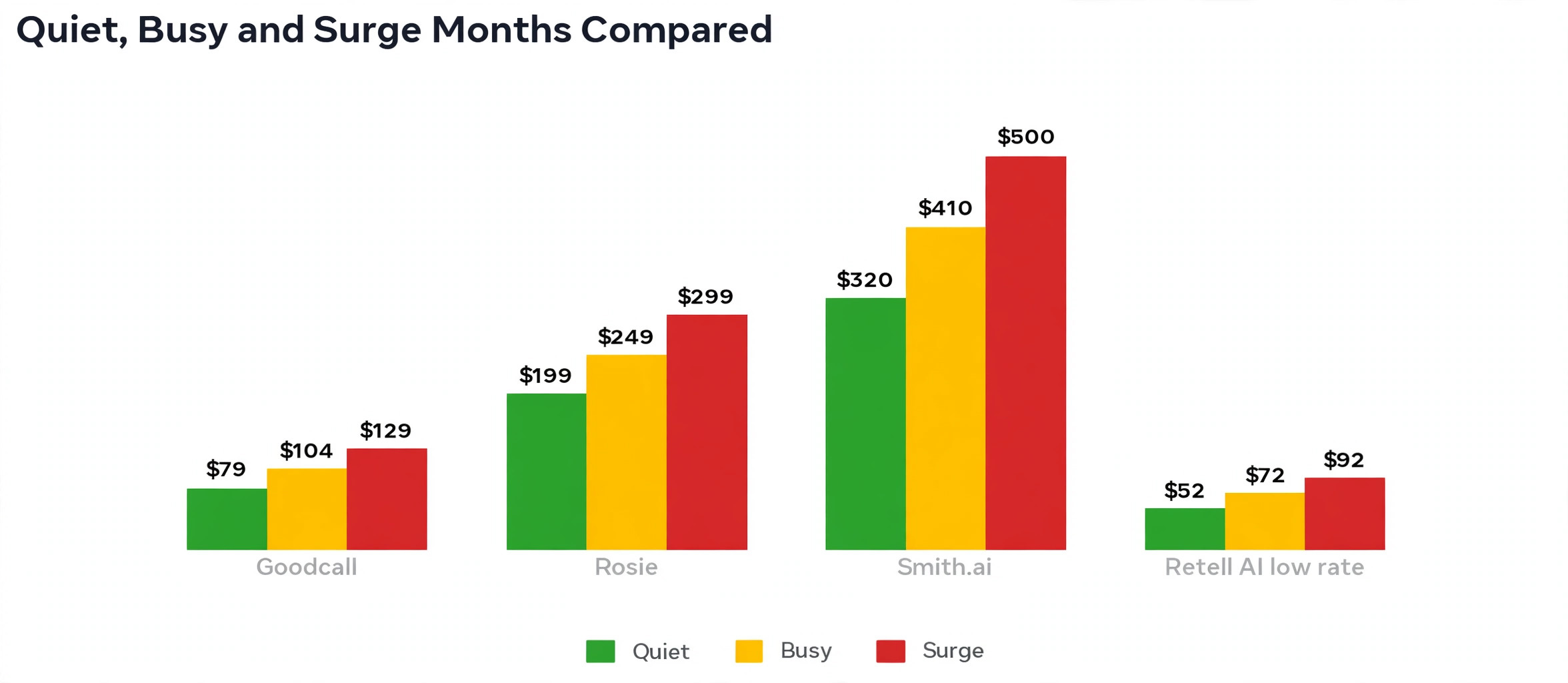
Headline prices hide the truth, so here are three real months priced on the plans above. The quiet month is 45 calls, 225 minutes and 35 unique callers. The busy month is 150 calls, 750 minutes and 120 unique callers. The surge month is 240 calls, 1,320 minutes and 200 unique callers, the kind of month a roofer gets after a hailstorm.
| Tool | Quiet month | Busy month | Surge month |
|---|---|---|---|
| Goodcall | 79 dollars | 129 dollars | 129 dollars |
| Rosie | 49 dollars | 149 dollars | 299 dollars |
| Dialzara | 29 dollars plus overage | 99 dollars plus overage | 199 dollars plus overage |
| Smith.ai AI | 60 dollars | 375 dollars | 500 dollars |
| Prisma Voices | 142 dollars | 330 dollars | 690 dollars |
| Retell AI low rate | 16 dollars | 53 dollars | 92 dollars |
Goodcall wins the surge month, because unlimited minutes and per caller billing mean a flood of long calls costs the same as a quiet week. Rosie wins the quiet month at 49 dollars, because the 250 minute bundle covers the whole month. Smith.ai loses the busy month, because 3 dollars per call punishes volume, and 150 calls cost 375 dollars on the free tier plus overage. Retell AI wins on pure per minute cost in every month, because 7 cents a minute beats every ready made rate, but the table leaves out the build and maintenance cost, which is real money for a business with no developer.
The lesson is to price your worst month, not your average month. A plan that costs 49 dollars in a quiet month and 299 dollars in a surge month is not a 49 dollar plan, it is a plan with a 299 dollar worst case. A plan that costs 79 dollars in every month is easier to budget, even when it costs more in a quiet month. Ask each vendor for the surge month price in writing before you sign up, and budget for that number, not for the entry price.
Hidden Costs That Change the Bill
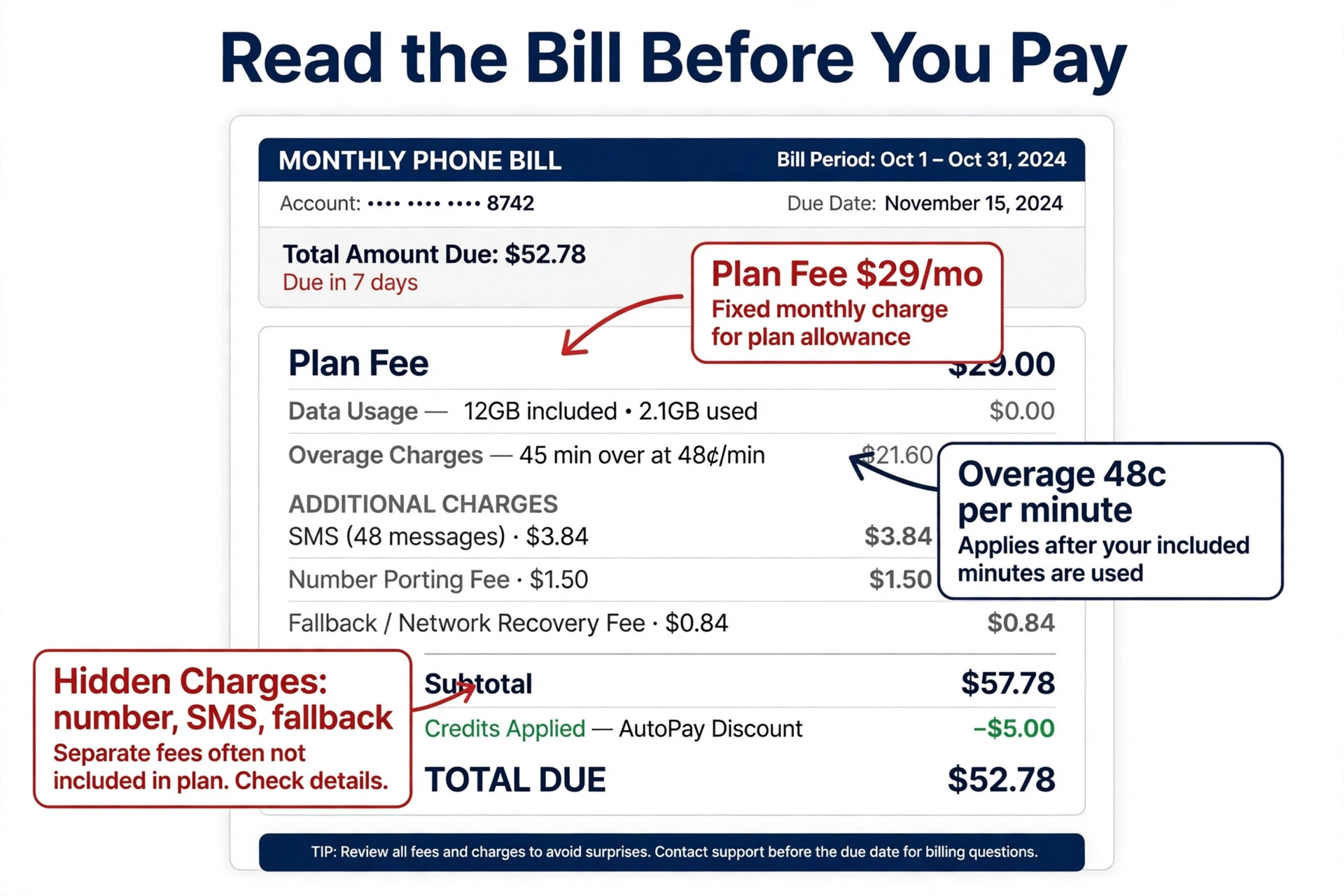
The monthly plan is only part of the bill, and the hidden costs are where most buyers get surprised. Phone numbers cost money, and some vendors include a number while others charge for it. Call recording and transcription are included in some plans and billed separately in others. SMS follow up messages cost extra on most plans.
Setup costs are the next surprise. A ready made service builds the agent from your description, and that setup is usually included. A developer platform charges nothing for setup, because you do the setup yourself, and that work is the hidden cost. Integration costs follow, because connecting the agent to your calendar, your booking system or your CRM takes time, and some vendors charge for the integration while others include it. HighLevel Voice AI adds 4.5 cents a minute for the voice engine plus a voice rate and token charges, on top of a platform plan from 97 dollars a month, so the headline per minute rate is only part of its bill.
The last hidden cost is the human fallback. Smith.ai can transfer callers to a live receptionist, and that transfer is a service with its own price. Check what happens when the AI cannot help a caller, and what that fallback costs, before you sign up. That is why ai voice answering tools pricing only makes sense when you count the extras alongside the plan.
How to Work Out Your True Cost
Start with your call log, not with a pricing page. Count your calls for the last three months, and work out the average call length, the number of unique callers, and the number of calls that arrive outside office hours. Those three numbers decide which meter suits you, and they are the starting point for any honest read of ai voice answering tools pricing.
Next, price the surge month as well as the average month. Take your busiest month in the last year, and price it on each plan using the published overage rate. A vendor that will not publish its overage rate should be treated with caution, because you cannot budget for a number you cannot see.
- Count your calls, minutes and unique callers for the last three months.
- Work out the average call length and the share of calls outside office hours.
- Price your average month and your busiest month on each shortlisted plan.
- Add the phone number, SMS, integration and fallback costs to the plan price.
- Test the cheapest two plans with a free trial and real calls before you pay.
Mistakes That Inflate the Bill
The most common mistake is comparing the headline rate instead of the all in rate, and it is the mistake that makes ai voice answering tools pricing look simpler than it is. OpenAI at 5 cents a minute looks cheaper than Retell AI at 7 cents, until you add the backend model and tool costs to the OpenAI figure, and the real cost rises above the Retell AI rate. A per minute rate that covers only the voice layer is not comparable with an all in rate, and the comparison is meaningless until you add the missing pieces. Ask every vendor what the rate includes, and price the full stack.
The second mistake is buying a per call plan for a business with many short calls. Smith.ai at 3 dollars per call costs 300 dollars for 100 one minute messages, while Dialzara at 48 cents a minute costs 48 dollars for the same calls. The per call model only wins when calls are long, so check your average call length before you choose the meter. A business that takes mostly short messages should never buy a per call plan, whatever the free tier looks like.
The third mistake is ignoring the surge month when you choose a plan. A roofer who picks Rosie for the quiet month price of 49 dollars gets a 299 dollar bill in the first hailstorm, while Goodcall at 129 dollars would have covered the same surge for less. Price the worst month first, and let the surge month decide, because the quiet month takes care of itself. The cheapest plan on a quiet month is rarely the cheapest plan in a busy year.
What the Bill Really Comes To
Goodcall is the pick for most trades and service businesses in ai voice answering tools pricing, because 79 dollars a month for 100 unique callers with unlimited minutes is the easiest bill to predict, and it wins the surge month outright. Dialzara is the pick for a small business with short calls that wants every minute priced in advance, because its published overage rates let you work out the bill before the month starts. Smith.ai is the pick for testing, because 25 free calls a month cost nothing and the transfer to a live receptionist is the best safety net on this list.
Retell AI is the pick for a business with a developer that wants the lowest per minute cost and a custom agent, because 7 cents a minute beats every ready made rate. Rosie is the pick for a quiet month, but ask for the overage rate in writing before you sign up. RingCentral is the pick for a business that already uses its phone system. Start with the free tier of two tools, run real calls through both, and let the surge month price decide.
Frequently Asked Questions
What is ai voice answering tools pricing in 2026?
Entry plans for ready made services run from free to 150 dollars a month, with Smith.ai free for 25 calls, Dialzara from 29 dollars a month for 60 minutes, Rosie from 49 dollars a month for 250 minutes, and Goodcall from 79 dollars a month for 100 callers. Developer platforms charge 5 to 31 cents a minute, with OpenAI at 5 cents for the voice layer alone and Retell AI at 7 to 31 cents all in. The true cost depends on your call volume, call length and the meter the vendor uses.
How much does AI voice answering cost per minute?
Ready made services cost about 20 to 50 cents a minute, with Rosie near 20 cents, Dialzara at 48 cents overage and RingCentral at 50 cents overage. Developer platforms cost 5 to 31 cents a minute, with OpenAI at 5 cents for the voice layer plus backend costs and Retell AI at 7 to 31 cents all in.
Is per minute or per call pricing cheaper?
Per minute pricing is cheaper for short calls, because a one minute message costs 48 cents on Dialzara and 3 dollars on Smith.ai. Per call pricing is cheaper for long calls, because a 12 minute intake costs 3 dollars on Smith.ai and 5.76 dollars on Dialzara at the overage rate. Per caller pricing is cheapest in a surge, because repeat calls are free and minutes are unlimited on Goodcall. Check your average call length before you choose the meter.
What is the cheapest AI voice answering tool?
Retell AI is the cheapest per minute, at 7 cents a minute on its lowest rate, but you build and maintain the agent yourself. Smith.ai is the cheapest way to test, with 25 free calls a month. Rosie is the cheapest ready made quiet month, at 49 dollars a month for 250 minutes. Goodcall is the cheapest surge month, at 129 dollars for up to 500 callers. The cheapest tool depends on your month, so price your real volume before you decide.
Do AI voice answering tools charge for missed calls?
Most ready made services charge only for calls the agent answers, and some do not charge for spam calls when caller ID is passed, as Smith.ai states. Developer platforms charge for the minutes the agent spends on the call, whatever the outcome. Check the vendor terms for spam and wrong numbers, because a business that gets many spam calls can pay for calls it never wanted. Ask the vendor how it handles spam before you connect your number.
Can an AI receptionist book appointments?
Yes. Most ready made services book appointments directly into your calendar, including Smith.ai, Goodcall, Rosie and Dialzara, with warm transfer available on higher plans. Developer platforms can book appointments too, but you build the calendar integration yourself. Test the booking flow with a real calendar before you pay, because a booking that lands in the wrong diary is worse than a missed call.
Price your worst month, not your best month, and let the surge decide. The right plan is the one whose busiest month still fits your budget, and ai voice answering tools pricing only makes sense when you compare the same month across every vendor.