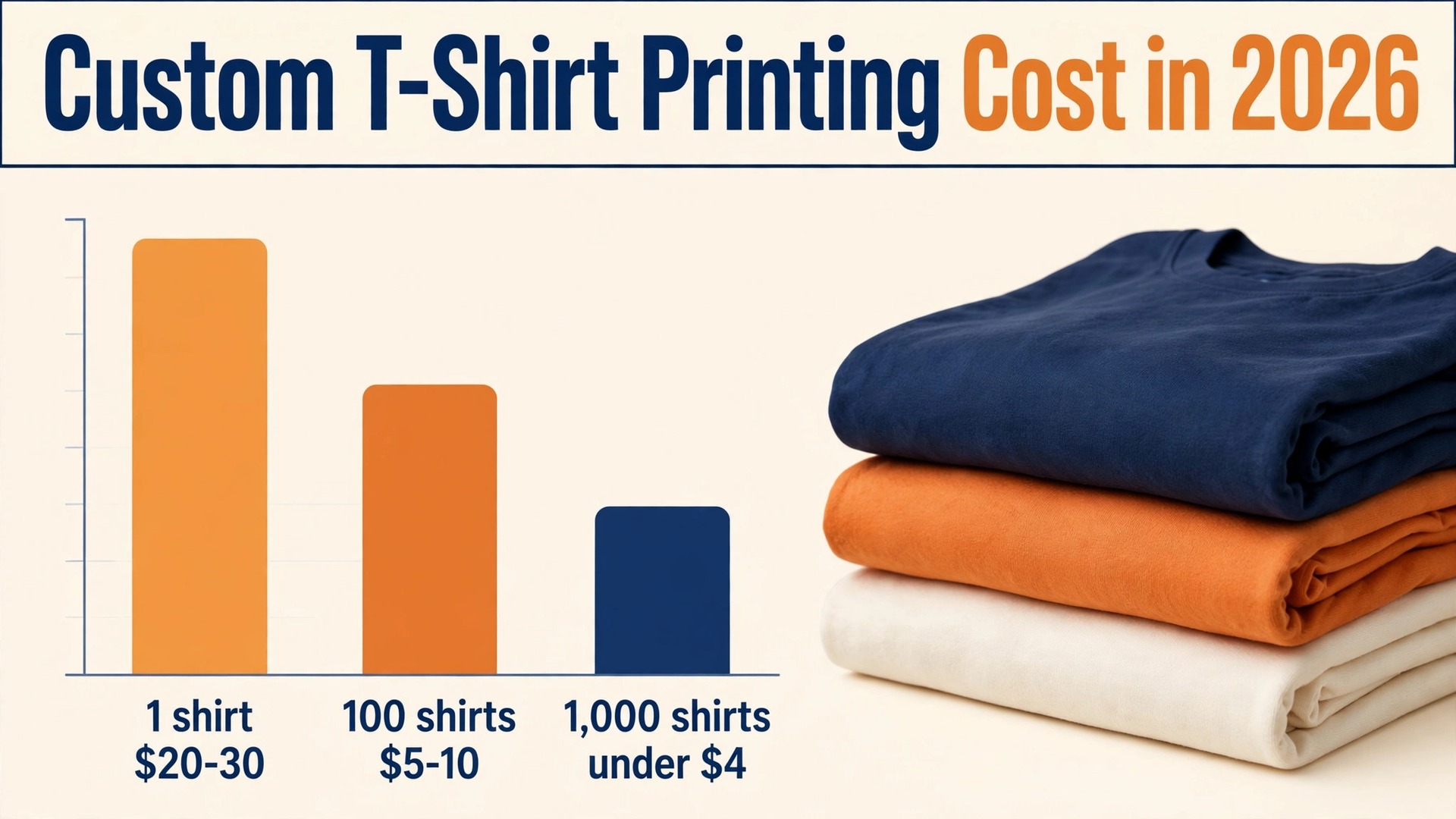
A single custom printed t-shirt costs $20 to $30 all in. Order 100 of the same design and the price drops to $5 to $10 a shirt. Order 1,000 and a one colour screen print can fall under $4 a shirt including the blank. That range is the whole story of custom t-shirt printing cost in 2026. The price is not one number, it is a stack of five costs that move with quantity, method, colours and garment, and the cheapest method at one shirt is the most expensive at one hundred. This guide breaks the stack down line by line, with real 2026 prices for every method.
Custom T-Shirt Printing Cost at a Glance
| Order size | Cheapest method | Typical cost per shirt | What you get |
|---|---|---|---|
| 1 shirt | DTG or print on demand | $20 to $30 | One shirt, full colour, no setup |
| 12 shirts | DTG | $14 to $18 | Full colour, no minimum, soft print |
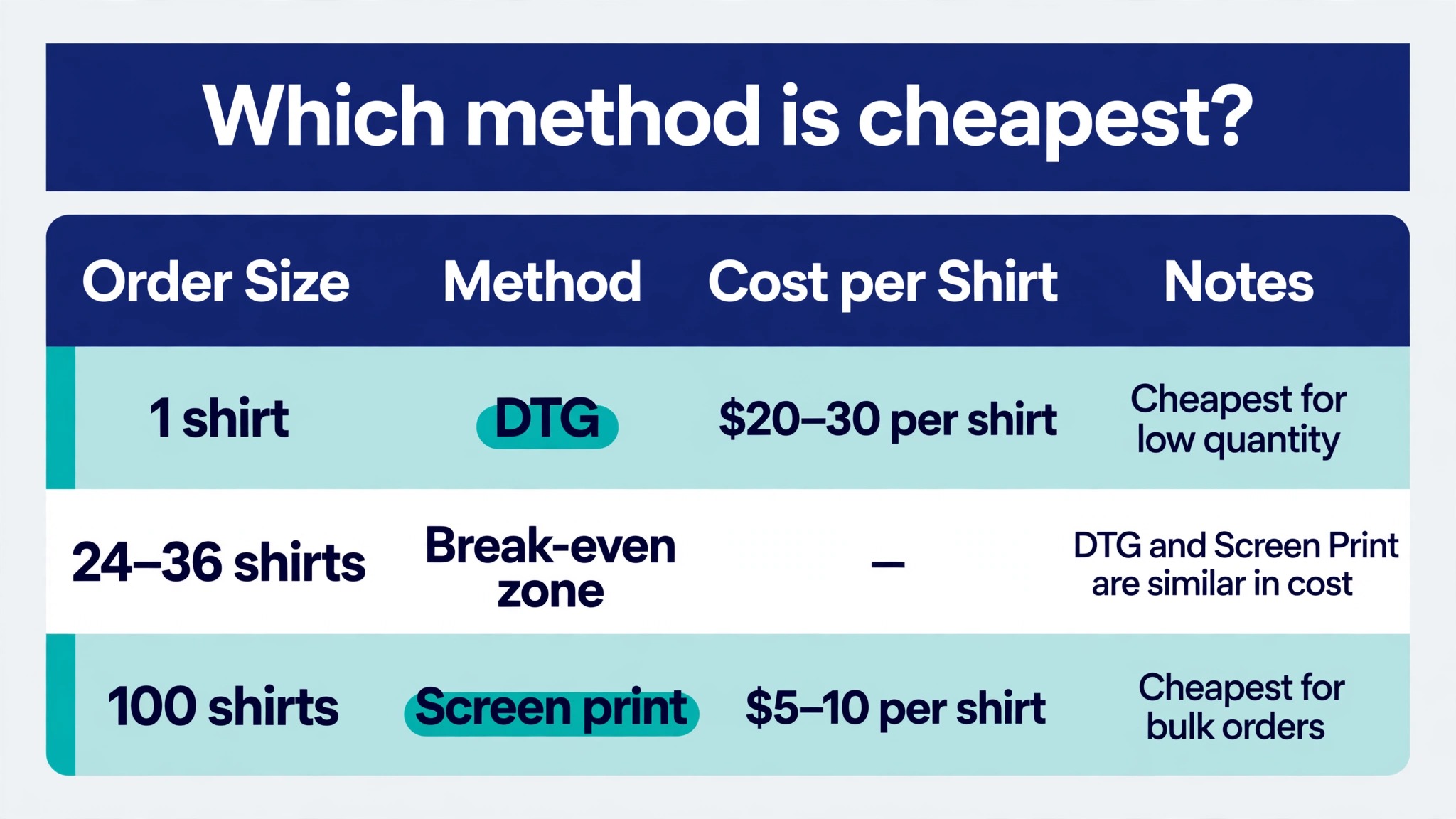
| 24 shirts | DTG or screen print | $11 to $13 | Break even zone between methods |
| 48 shirts | Screen print, 1 colour | $8 to $11 | Durable print, best value for simple art |
| 100 shirts | Screen print, 1 colour | $5 to $10 | Bulk pricing, setup spread thin |
| 500 shirts | Screen print | $4 to $8 | Lowest per shirt cost of any method |
| 1,000 shirts | Screen print | Under $4 to $6 | Best unit economics, simple designs |
These figures include the blank garment, the print and the setup, but not shipping or tax. A premium blank adds $2 to $4 a shirt at any quantity, and a second print location adds $2 to $4. The table assumes a standard cotton tee and a single front print.
What Makes Up the Price
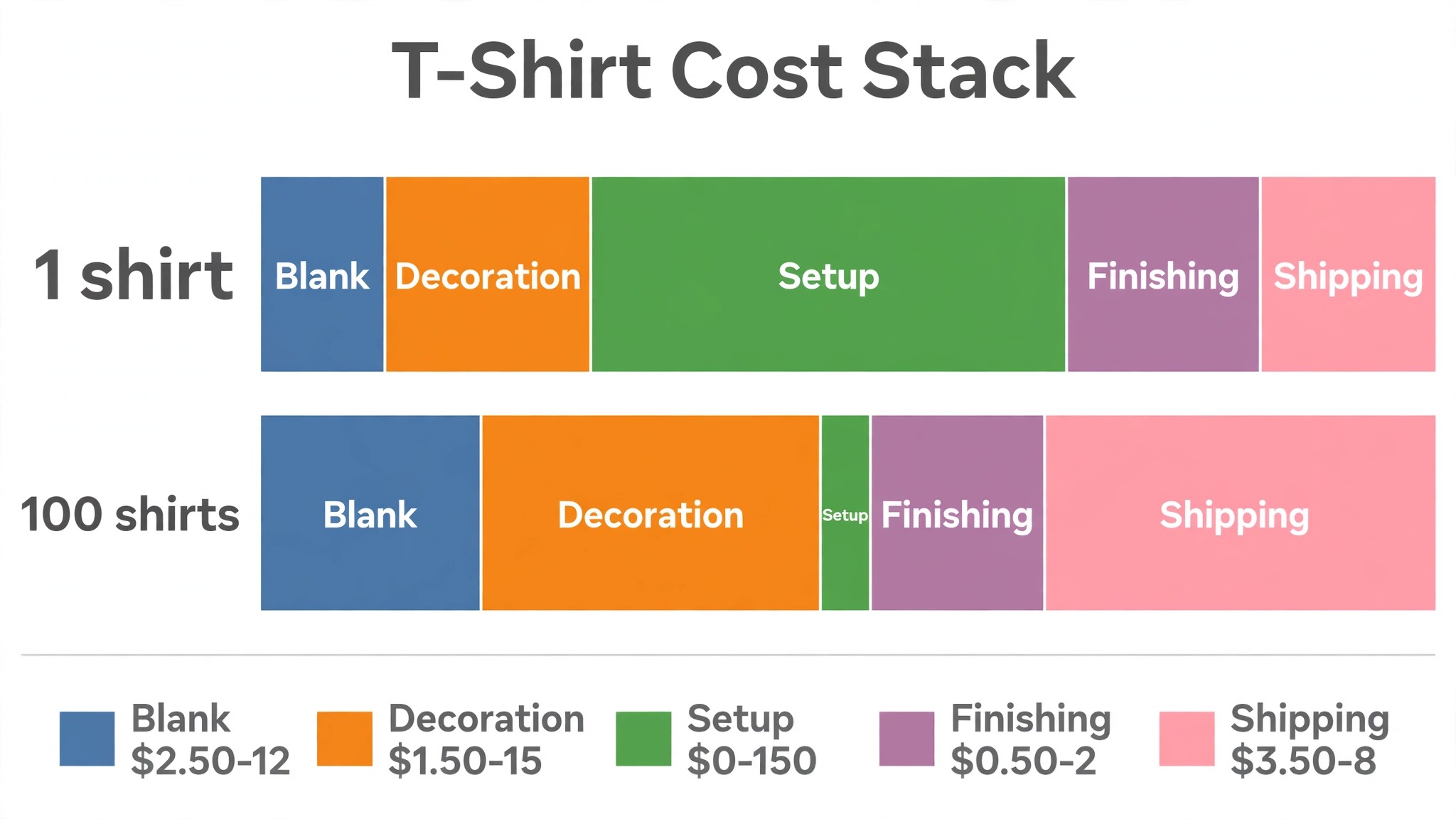
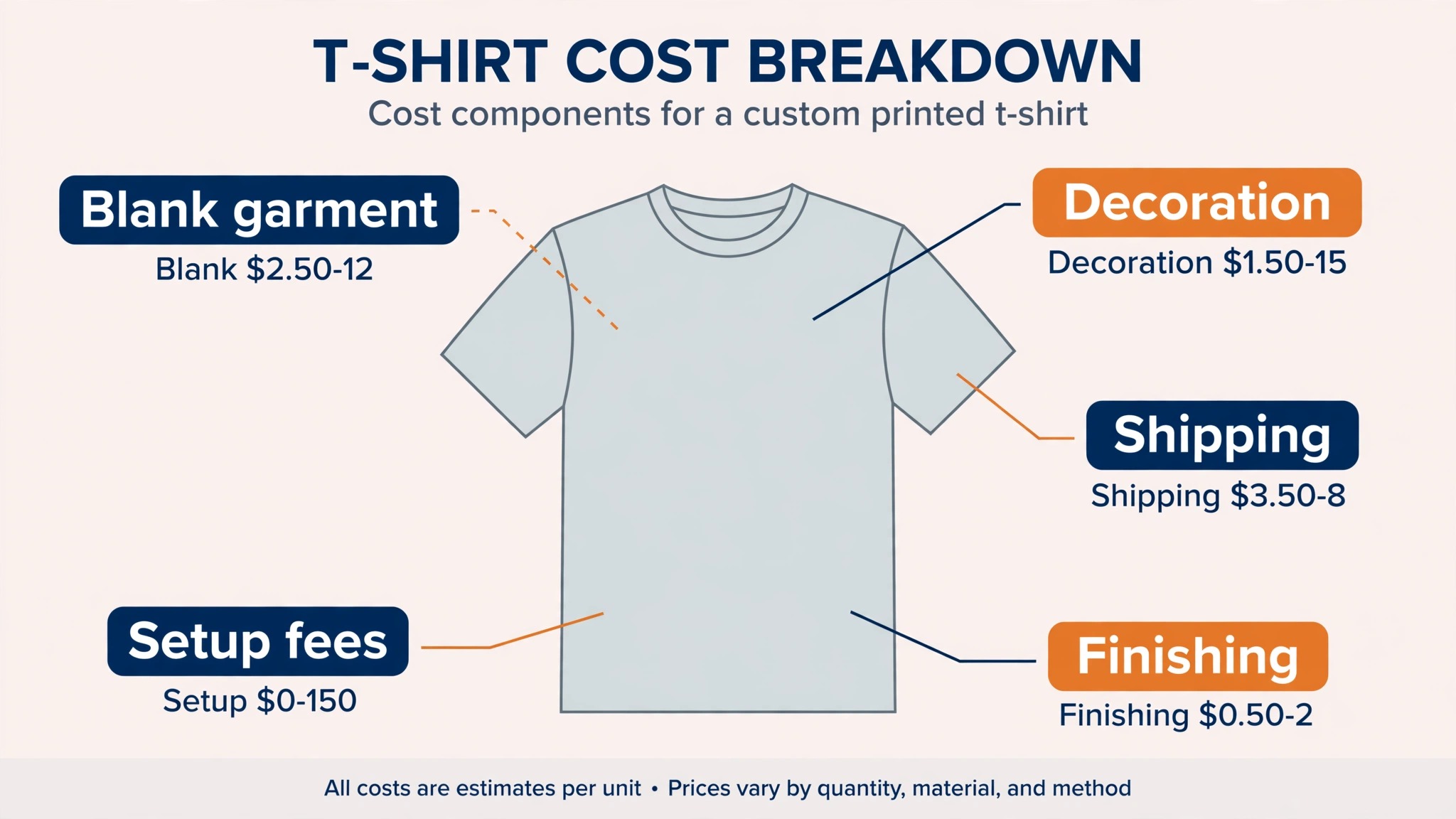
Every custom t-shirt printing cost is a stack of five line items, and understanding the stack is the fastest way to spot a bad quote. The blank garment is the first and largest cost at low quantities. Wholesale blanks run $2.50 to $12 depending on brand and fabric. A basic Gildan 5000 sits at the low end, while a premium Bella and Canvas 3001 runs $4.25 to $5.75 wholesale. Heavyweight and garment dyed blanks cost more, and extended sizes add $2 to $5 per shirt.
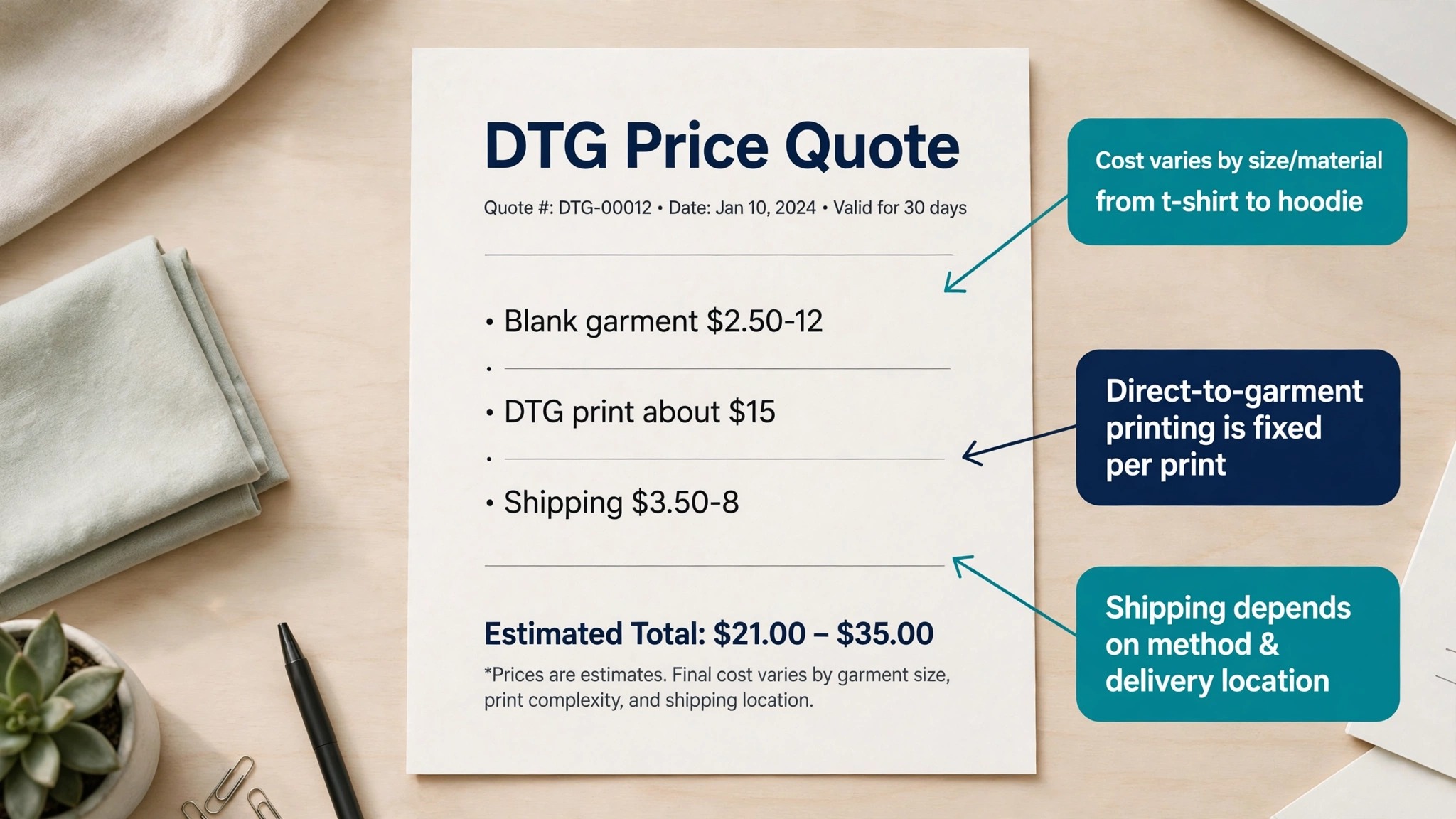
Decoration is the second cost, and it is the one that varies most by method. Screen printing charges per colour, DTG charges per shirt, DTF charges by print area, and embroidery charges per thousand stitches. Setup is the third cost. Screen printing needs a screen for every colour at $15 to $30 each, embroidery needs a digitised file at $30 to $150, and DTG and DTF need no setup at all. Finishing is the fourth cost, and it covers folding, bagging, tagging and any special handling. Shipping is the fifth cost, and it moves with weight, distance and speed. A single shirt shipped across the country can add $4 to $8 to the total.
| Cost component | Typical range | What drives it |
|---|---|---|
| Blank garment | $2.50 to $12 | Brand, fabric weight, colour, size |
| Decoration | $1.50 to $15 | Method, colours, print size, placements |
| Setup fees | $0 to $150 | Screens, digitising, colour separation |
| Finishing | $0.50 to $2 | Folding, bagging, tags, labels |
| Shipping | $3.50 to $8 | Weight, distance, speed, quantity |
The formula is simple. Total per shirt equals the blank plus decoration plus setup divided by quantity plus finishing plus shipping. At one shirt, setup dominates. At one thousand shirts, setup nearly disappears and the blank dominates. That is why the same design can cost $25 a shirt in one order and $5 a shirt in another, with no change to the artwork at all.
Screen Printing Cost
Screen printing is the standard method for bulk orders, and its economics are simple. The setup is expensive and the per shirt cost is low, so the price falls sharply as quantity rises. Each colour in the design needs its own screen, and each screen costs $15 to $30 to prepare. A six colour design needs $90 to $180 in screens before a single shirt is printed. That is why screen printing is a poor choice for one shirt and the best choice for one hundred.
The per shirt ink cost falls with volume. Published 2026 tiers at US decorators run about $3.50 per colour per shirt at 12 to 23 pieces, $2.25 at 48 to 99, $1.25 at 200 to 499, and $0.65 at 1,000 and above. A one colour design on 100 shirts runs roughly $4.50 to $6 a shirt for the print alone, plus the blank. A full colour photo design is a different job, because each colour adds a screen and a per shirt charge, so complex art can cost more in screen printing than in DTG at moderate quantities.
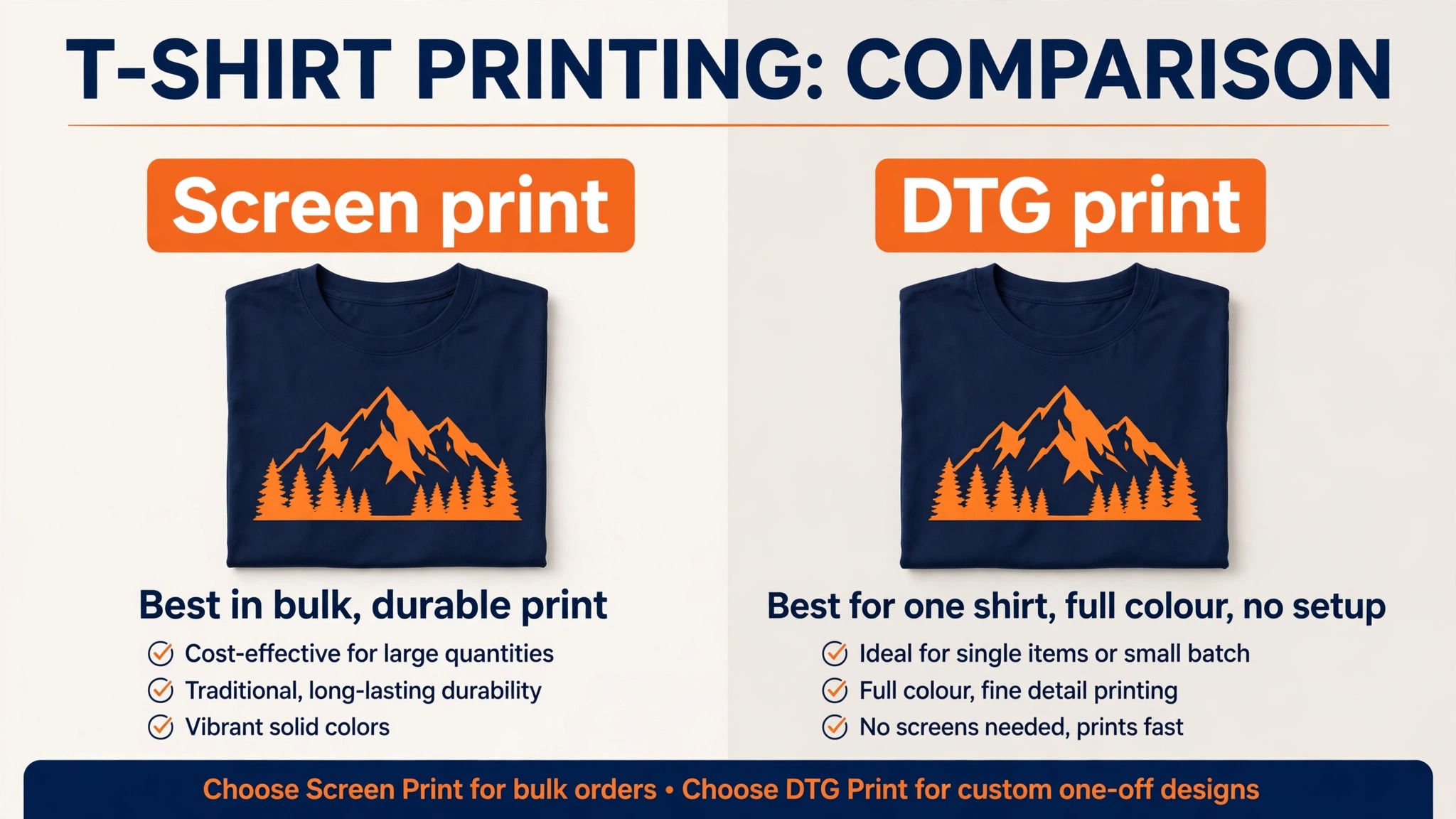
Screen printing wins for simple designs in bulk, for exact brand colours, and for durability. A properly cured plastisol print survives 50 or more washes without visible fading. The limits are real too. Most shops set a minimum of 24 to 72 pieces, gradients and photographic detail are hard to reproduce, and every colour change means a new screen. For a band merch run, a company event or a sports team, screen printing is usually the right call.
DTG Printing Cost
Direct to garment printing, known as DTG, is an inkjet printer for shirts. It prints full colour photographic designs directly onto cotton, with no screens and no minimum order. That makes it the best method for one shirt, for small runs and for designs with many colours or fine detail. The trade off is a nearly flat per shirt price. DTG runs about $15 a shirt on light garments at 1 to 30 pieces, and about $5 a shirt above 251 pieces. The price barely moves between those points, so ordering more does not bring the savings that screen printing delivers.
A 12 shirt order with a full colour DTG print on a Bella and Canvas 3001 runs $14 to $18 a shirt all in. The same 12 shirts in a one colour screen print would cost more per shirt once setup is spread across only 12 pieces. The break even point between DTG and screen printing usually falls between 24 and 36 shirts for a one colour design, and much higher for a full colour design, because each extra colour raises the screen printing cost while DTG charges the same for one colour or twenty.
DTG works best on 100 percent cotton, and it handles blends acceptably. It struggles on high polyester fabrics. Dark garments need a white underbase layer, which adds cost and makes the print feel heavier. The print is soft on light garments and fades faster than screen printing, so DTG suits short runs, samples, personalised gifts and designs that would be too complex or too colourful to screen print.
Screen Printing vs DTG: The Break Even Math
The choice between screen printing and DTG comes down to one question, and that is how many shirts you need. The break even point for a one colour design usually falls between 24 and 36 shirts. Below that point, DTG is cheaper, because screen printing setup costs $15 to $30 per colour and that setup lands on a small number of shirts. Above that point, screen printing is cheaper, because the per shirt ink cost is far lower and the setup spreads thin.
At 100 shirts with a one colour design, screen printing costs roughly $4.50 to $6 a shirt for the print, while DTG costs $9 to $14 a shirt. The gap is about $400 on the order, which is hard to ignore.
Colour count moves the break even point. A six colour design needs six screens, so the setup alone is $90 to $180, and the per shirt cost rises with each colour. DTG charges the same for one colour or twenty, so a full colour design stays cheaper through DTG up to about 500 shirts. That is why photographic designs and complex art usually go DTG at moderate quantities, while simple one or two colour designs go screen printing as early as 24 shirts. The design decides the method as much as the quantity does.
Durability is the second factor in the choice. A screen print survives 50 or more washes when cured correctly, while a DTG print shows wear after 20 to 30 washes, especially on dark garments. For shirts that will be worn weekly, such as staff uniforms or team kits, the longer life of screen printing is worth the setup cost. For a one off event shirt or a sample run, DTG durability is fine.
The third factor is feel. DTG prints feel soft on light garments and heavier on dark ones, because of the white underbase. Screen prints have a detectable ink film, which feels different but lasts longer. Ask for a sample of each method before a large order, and the choice usually makes itself.
DTF, Sublimation, Embroidery and Vinyl
Direct to film, known as DTF, is the fastest growing method in 2026. The design is printed onto a film, powdered, cured and heat pressed onto the shirt. DTF costs $2 to $8 a shirt on a small run, works on cotton and polyester, handles dark shirts well and needs no setup when outsourced. It suits orders of 5 to 500 shirts with full colour art, and it is the method most print on demand providers now use for dark garments. The feel is slightly heavier than DTG, and the durability is good when the transfer is pressed correctly.
Sublimation turns ink into gas that bonds with polyester fibres, which produces a print with no feel at all. It only works on light coloured polyester or polyester coated fabrics, so it is the method for performance shirts, all over prints and sublimated jerseys, not for everyday cotton tees. An all over print tee through a print on demand provider runs about $26 to $30, because the whole garment is printed.
Embroidery is priced by stitch count, at $0.50 to $1.50 per thousand stitches, plus a one time digitising fee of $30 to $150 for a new design. A small left chest logo under 5,000 stitches runs $3.75 to $10.50 a shirt, which is comparable to screen printing and cheaper than DTG at most quantities. Embroidery suits polos, caps and workwear, where a stitched logo looks more professional than a print. It is a poor choice for large designs, because the stitch count and the cost both climb fast.
Heat transfer vinyl, known as HTV, cuts a design from coloured vinyl and presses it onto the shirt. It costs $7 to $12 a shirt for very small runs, and it suits names and numbers on sports jerseys, single colour text and one off personalisation. The vinyl feel is heavier than print, and it cracks over time on large areas, so it is a method for small jobs, not for a full merch line.
Print on Demand Cost
Print on demand means no inventory, no minimum and no setup. You upload a design, a customer orders one shirt, and the provider prints and ships it. The per shirt cost is higher than bulk screen printing, but you never pay for stock you cannot sell. Two providers dominate the market, and their prices are close enough that service and shipping matter as much as the base cost.
Printful charges from $11.92 for a Bella and Canvas 3001 with one DTG print, and from $7.50 for a Gildan 64000. Shipping for the first tee runs $4.95 in the US. Printful is free to start, and the Growth plan costs $24.99 a month and cuts base prices by up to 33 percent on select products. Printful publishes clear per product prices, offers DTG, DTF and embroidery, and handles fulfilment in house.
Printify works differently. It is a marketplace of independent print providers, and each provider sets its own price. A Gildan 5000 starts at $8.80 through Printify, or from $5.92 with Printify Premium, while a Bella and Canvas 3001 starts at $10.98, or from $8.77 with Premium. Domestic US shipping for a single shirt runs $3.50 to $5. Premium costs $24.99 a month on annual billing and cuts base prices by up to 20 percent across the catalogue. The cheapest provider is not always the best one, because quality and shipping speed vary, so read provider reviews before you commit.
| Provider | Bella and Canvas 3001 | Gildan 5000 | US shipping, first tee | Paid plan |
|---|---|---|---|---|
| Printful | From $11.92 | From $7.50 on Gildan 64000 | $4.95 | Growth $24.99 a month |
| Printify | From $10.98, $8.77 with Premium | From $8.80, $5.92 with Premium | $3.50 to $5 | Premium $24.99 a month |
At a $25 retail price, a standard tee leaves roughly $8 to $12 after product and shipping costs, before marketplace fees. A 40 percent profit margin is a solid benchmark for a sustainable custom t-shirt business in 2026, according to Printify’s own pricing guidance. The margin math is the reason most sellers price tees at $25 to $30, not $20. A $20 shirt leaves too little room for fees, returns and ads.
Choosing between the two providers comes down to how you sell. Printful suits sellers who want one partner, clear pricing and in house quality control, and who are happy to pay slightly more per shirt for that simplicity. Printify suits sellers who want the lowest base price and are willing to compare providers, read reviews and manage quality across different fulfilment centres. Either way, order a sample of your own product before you launch, because the shirt your customer receives is the shirt your reviews will describe.
Three Worked Examples
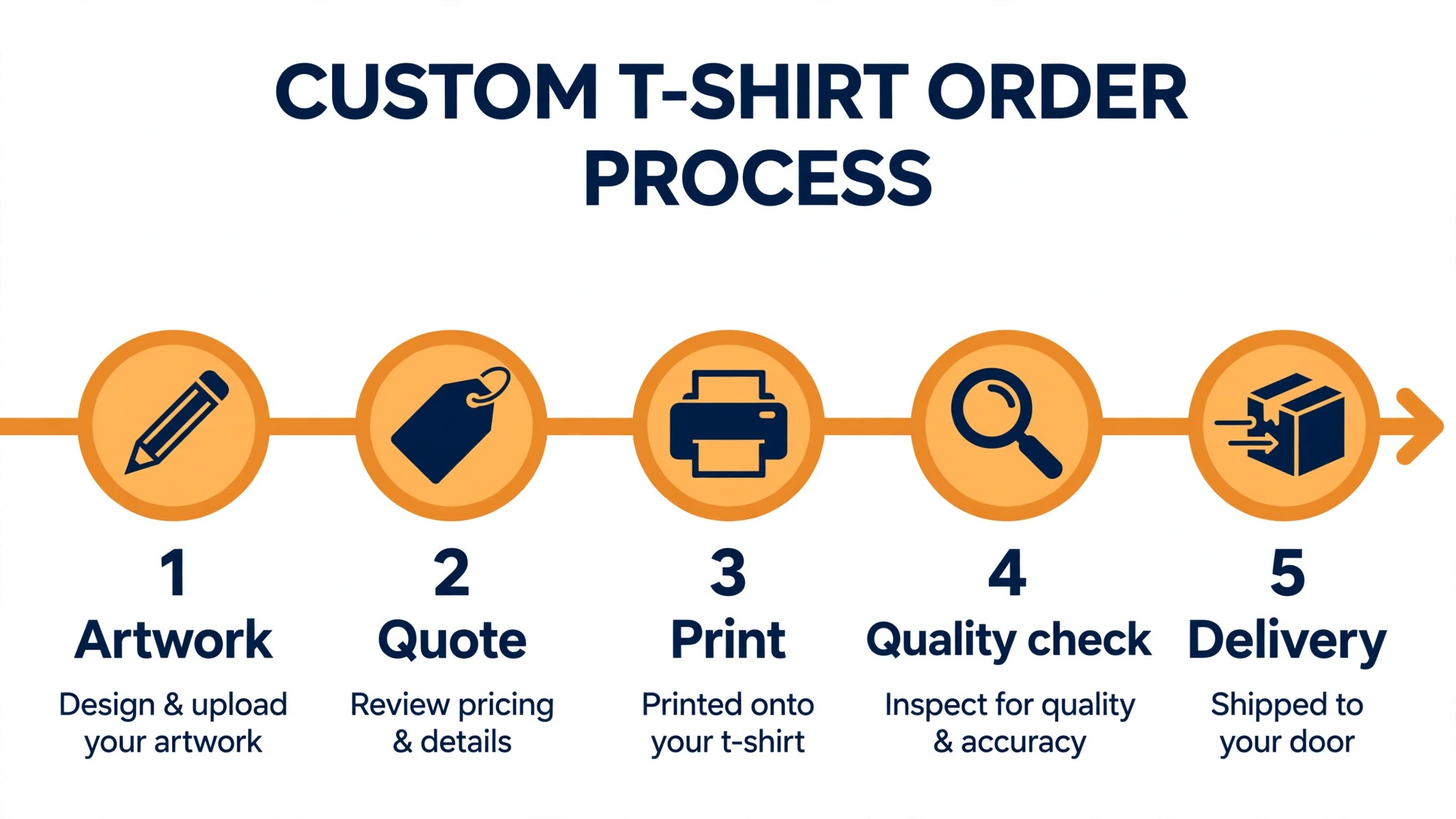
The numbers below show how custom t-shirt printing cost changes with quantity, using a standard cotton tee and a single front print. Each example includes the blank, the print and the setup, but not shipping or tax.
The first example is one shirt for a birthday gift, printed DTG on a Bella and Canvas 3001. The blank and print through a print on demand provider run about $12, shipping adds about $4.50, and the total lands near $20 to $25 delivered. There is no setup, no minimum and no leftover stock. The cost per shirt is high, but the total spend is low, and that is the right trade for a single shirt.
The second example is 24 shirts for a small team, one colour screen print on a Gildan 5000. The blanks run about $3 each, the screen setup is $15 to $30 for one colour, and the print runs about $3.50 a shirt at this quantity. The total is roughly $11.50 to $12.50 a shirt before shipping. DTG would cost about the same at 24 shirts, so the choice comes down to durability and feel. Screen printing lasts longer, DTG handles more colours.
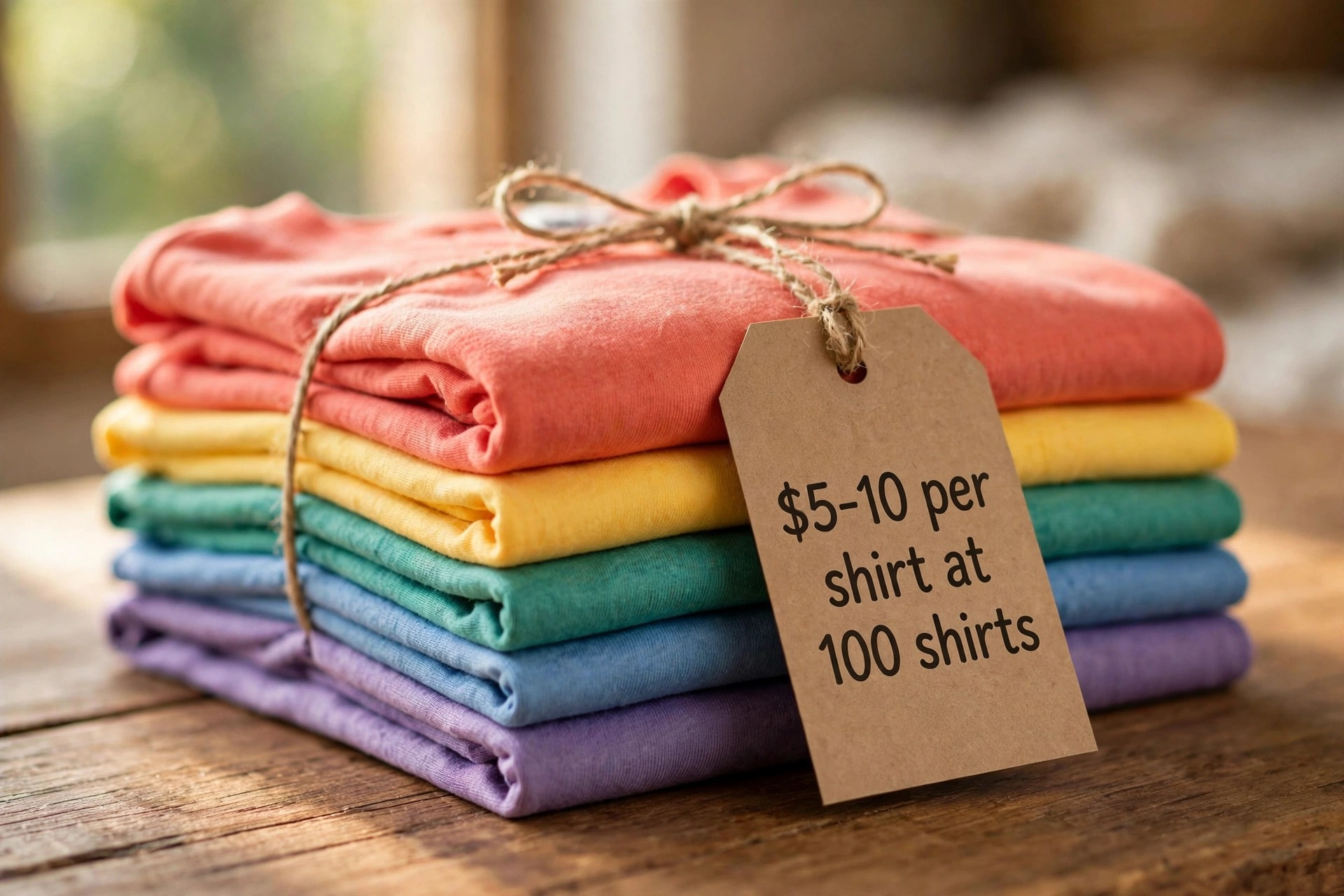
The third example is 100 shirts for a merch run, one colour screen print on a Gildan 5000. The blanks run about $3 each, the setup is $15 to $30 spread across 100 shirts, and the print runs about $2.25 a shirt. The total is roughly $6.50 to $8 a shirt before shipping. The same 100 shirts in DTG would run $9 to $14 a shirt, so screen printing saves about $300 on the order. That saving is why merch runs almost always use screen printing.
Hidden Costs to Budget For
The quote is rarely the total. Rush fees are the most common surprise, and they run 10 to 25 percent of the order when the deadline is under a week. Oversized prints cost more, because a print larger than the standard 12 by 16 inch area needs a bigger screen or a larger transfer. A second print location, such as a back print or a sleeve print, adds $2 to $4 a shirt. Tag printing, where the neck label is replaced with a printed tag, adds about $0.50 to $1 a shirt. Individual bagging and folding adds $0.50 to $1 a shirt, and it is often required for retail ready orders.
Shipping is the hidden cost that catches first time buyers most often. A box of 100 shirts weighs about 50 pounds, and ground shipping across the country can add $1 to $2 a shirt. Splitting an order across sizes also costs money, because extended sizes add $2 to $5 per shirt and some shops charge a fee for size breaks below a minimum per size. Sales tax applies in most states when the shirts are sold rather than given away, and it is charged on the full order value. Ask for an all in quote before you approve the order, with shipping and tax shown separately, so the number you approve is the number you pay.
Reprints are the hidden cost nobody budgets for. A misprint, a wrong size run or a colour that looks different on fabric can force a partial reprint, and most shops charge full price for reprints unless the error was theirs. Order a single sample first when the design is new, check the colours and the placement on the real garment, and only then approve the full run. A $25 sample can save a $500 reprint, and it is the cheapest insurance in the whole process.
How to Cut the Cost Without Cheapening the Shirt
The biggest saving comes from quantity. Moving from 24 to 100 shirts typically drops the per shirt cost by 25 to 35 percent, because the setup spreads thinner and the printer offers a volume discount. If you cannot sell 100 shirts, combine orders. Two designs on the same garment still need separate screens, but two groups ordering the same design together split the setup and both save.
The second saving comes from colours. A one colour design is always cheaper to screen print than a four colour design, because each colour adds a screen and a per shirt charge. Design in one or two colours when the art allows it, and save the full colour work for DTG orders where colour count does not change the price. The third saving comes from the blank. A Gildan 5000 costs about half as much as a premium blank, and for a free giveaway or a staff shirt the difference in feel is smaller than the difference in price. Save the premium blanks for shirts you sell at retail.
The fourth saving comes from timing. Printers offer better prices on orders placed two or three weeks ahead, because rush work disrupts their schedule. The fifth saving comes from print size and placement. A smaller front print uses less ink and sometimes a smaller screen, and a single placement avoids the $2 to $4 second location charge. None of these savings require a cheaper shirt, and together they can cut 20 to 30 percent from a typical order without any visible loss in quality.
The sixth saving is the one most buyers miss, and that is getting the quote in writing from two or three printers. Prices for the same job vary by 20 percent or more between shops, because each shop has different equipment, different minimums and different slow weeks. A written quote that shows the blank, the print, the setup and the shipping separately makes the comparison honest, and it gives you a number to hold the printer to. Never approve an order from a verbal quote alone, because the invoice is where the surprises live.
Custom T-Shirt Printing Cost Checklist
Use this checklist before you approve any order, and the final invoice will hold no surprises.
- Blank brand and fabric confirmed, with the price per shirt in writing.
- Print method chosen for the quantity, not for habit.
- Colour count counted, with the setup fee per colour shown.
- Print size and placement agreed, including any second location charge.
- Quantity confirmed, with the per shirt price at that exact quantity.
- Finishing agreed, including folding, bagging and tags.
- Shipping quoted separately, with the delivery date in writing.
- Rush fee checked, and the deadline realistic.
- Sales tax shown on the quote.
- Sample approved before the full run, when the order is large enough to justify it.
Frequently Asked Questions
How much does it cost to print one custom t-shirt?
A single custom t-shirt costs $20 to $30 all in through DTG or print on demand, including the blank and shipping. A single screen printed shirt costs more, usually $25 to $40, because the setup fee lands on one shirt. Print on demand is the cheapest route for one shirt, and DTG through a local shop is the fastest.
What is the cheapest way to print custom t-shirts?
Screen printing is the cheapest method once the order passes about 50 shirts, because the per shirt cost falls to $5 or less at 100 shirts. Below 50 shirts, DTG or print on demand is cheaper, because there is no setup fee. The cheapest blank is usually a basic Gildan 5000, and a one colour design is always cheaper to screen print than a multi colour design. Combining orders with another group that wants the same design is another easy saving, because the setup fee splits across more shirts.
How much does custom t-shirt printing cost per shirt at 100 shirts?
A 100 shirt order with a one colour screen print on a standard cotton tee runs $5 to $10 a shirt, including the blank, the print and the setup, before shipping and tax. A full colour DTG print on the same 100 shirts runs $9 to $14 a shirt. The exact figure depends on the blank brand, the number of colours and the printer.
Does the number of colours change the price?
Yes, for screen printing. Each colour needs its own screen at $15 to $30, and each colour adds a per shirt ink charge. A four colour design can cost twice as much to screen print as a one colour design at the same quantity. DTG and DTF charge the same for one colour or twenty, so full colour art is cheaper through those methods at low quantities.
Is print on demand cheaper than bulk printing?
No, not per shirt. Print on demand costs about $9 to $13 per shirt for the product alone, while bulk screen printing at 100 shirts costs $5 to $10. Print on demand is cheaper in total spend, because there is no minimum, no setup and no unsold stock. Bulk printing wins when you can sell the whole run, and print on demand wins when you cannot predict demand.
How long do custom printed t-shirts last?
A properly cured screen print lasts 50 or more washes without visible fading. DTG prints fade faster, especially on dark garments, and usually show wear after 20 to 30 washes. DTF prints sit between the two. Wash inside out in cold water and skip the high heat dryer, and any print will last noticeably longer. The blank itself matters too, because a shirt that shrinks or loses shape makes even a good print look old.
Final Verdict
Custom t-shirt printing cost is a quantity story more than a method story. One shirt costs $20 to $30, a dozen costs $14 to $18, and a hundred costs $5 to $10, all for the same design on a standard tee. The method that wins depends on where you sit on that curve. DTG and print on demand win below 50 shirts, screen printing wins above it, and DTF covers the middle ground with full colour art on any fabric. Get the blank, the colour count and the quantity right before you ask for a quote, and the price will take care of itself.
Before you order, run the checklist in this guide against the quote in front of you. Check the blank, the colour count, the setup, the finishing and the shipping, and get the total in writing. A quote that shows every line is a quote you can trust, and a printer who shows every line is a printer worth ordering from again.