
Square Free is the cheapest honest starting point for most small retailers, and it is also the tool most owners outgrow first. That sounds like a contradiction, and it is the whole story of POS software pricing for small retailers in one sentence. You can start taking card payments today for zero dollars a month plus 2.6 percent plus 15 cents per sale, with a 59 dollar reader in your hand.
The moment you need real inventory tracking, purchase orders, or a second location, the free plan stops being enough, and the true cost becomes the monthly plan plus the processing fees plus the hardware plus the add ons. This guide works out that true cost across 10 leading tools, at real sales volumes, so you can see which one is cheapest for your shop, not for a shop in a brochure.
A POS software pricing for small retailers bill has four parts, and owners who compare only the monthly fee get the answer wrong every time. The first part is the software fee, which runs from zero dollars a month on Square Free to 89 dollars a month and up on Lightspeed Retail and Shopify POS Pro.
The second part is the processing fee, the percentage plus the fixed cents taken from every card sale, and this is usually the largest part of the bill for any shop doing more than a few thousand dollars a month. The third part is hardware, a one time cost that runs from 49 dollars for a reader to more than 1,000 dollars for a full register kit. The fourth part is the add ons, loyalty, marketing, online ordering, and advanced reporting, which are included on some plans and billed separately on others.
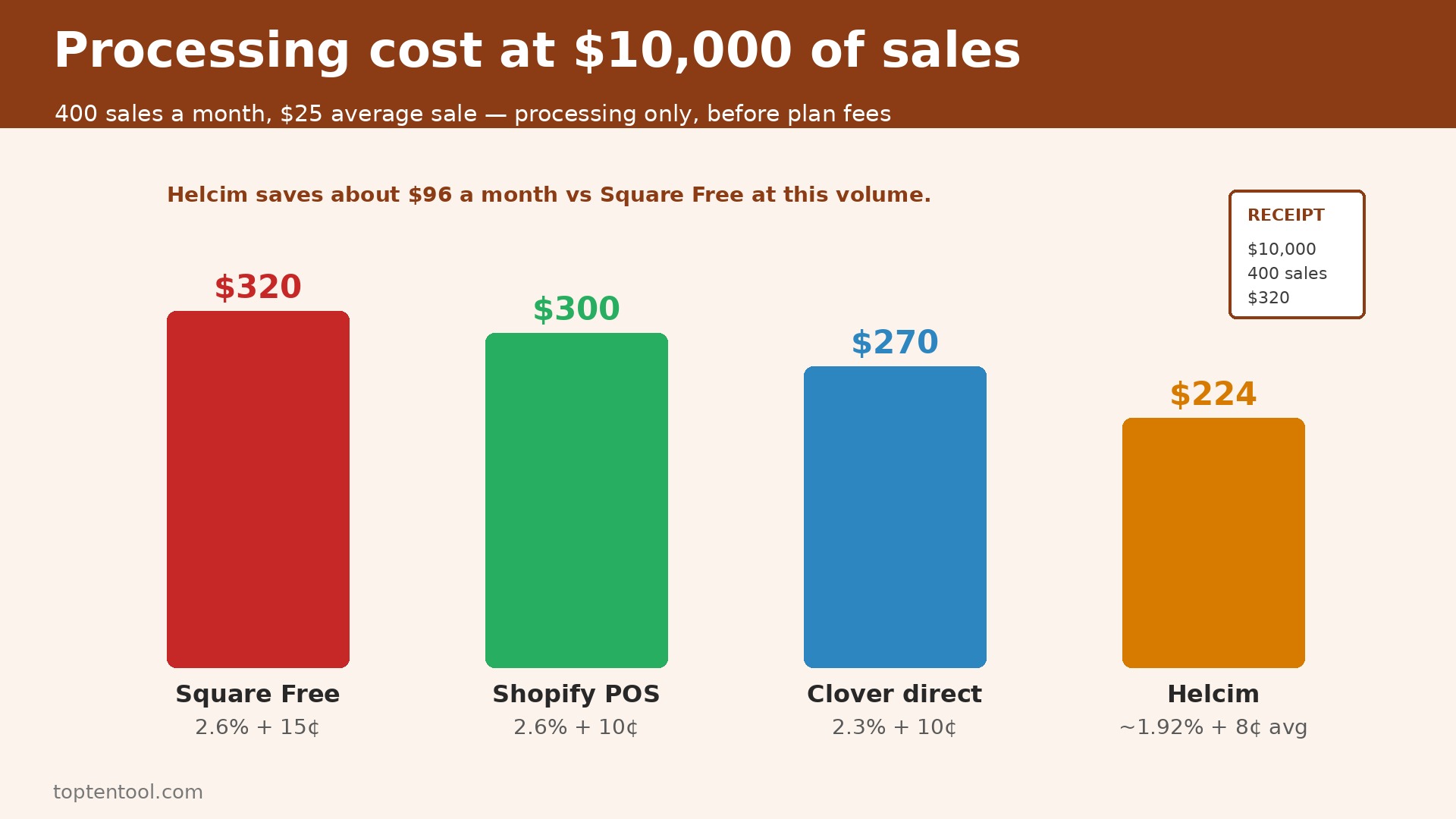
Processing fees deserve a worked example, because percentages hide real money. Take a shop doing 10,000 dollars a month in card sales across 400 transactions, with an average sale of 25 dollars. On Square Free at 2.6 percent plus 15 cents, processing costs 260 dollars plus 60 dollars, or 320 dollars a month. On Square Plus at 2.5 percent plus 15 cents, processing costs 250 dollars plus 60 dollars, or 310 dollars, plus the 49 dollar plan fee, or 359 dollars in total.
The Plus plan costs more at this volume, not less, because the 10 dollar processing saving does not cover the 49 dollar fee. At 30,000 dollars a month across 1,200 transactions, Square Free processing costs 780 dollars plus 180 dollars, or 960 dollars. Square Plus processing costs 750 dollars plus 180 dollars, or 930 dollars, plus 49 dollars, or 979 dollars. The paid plan still loses. The break even point, where the lower rate finally pays for the monthly fee, sits above 40,000 dollars a month for most small retailers, and that is a fact worth knowing before you upgrade for a lower rate.
How POS Software Pricing for Small Retailers Works at Real Volumes
In POS software pricing for small retailers, the monthly fee is the smallest part of the bill for most shops, and the processing rate is the largest. A shop doing 20,000 dollars a month in card sales pays about 550 dollars a month in processing on a typical 2.6 percent plus 15 cent rate, and that dwarfs a 49 dollar plan fee.
A shop doing 5,000 dollars a month pays about 140 dollars in processing, and the plan fee matters more. That is why the right question is never which tool has the lowest monthly fee. The right question is which tool has the lowest total at your volume, with your average sale size, and your mix of in person and online sales.
Average sale size changes the answer, because the fixed cents per transaction punish small sales. A coffee shop with a 5 dollar average sale pays 15 cents per transaction on Square Free, which is 3 percent of the sale before the percentage fee, so the true rate is 5.6 percent. A furniture shop with a 200 dollar average sale pays the same 15 cents, which is 0.075 percent of the sale, so the true rate is 2.675 percent. Small ticket retailers should care far more about the fixed fee than the percentage, and they should look hard at tools with a 10 cent fixed fee, like Shopify POS and Clover, where the fixed fee costs a third less per sale.
Online sales cost more than in person sales on every tool in this guide. Square charges 3.3 percent plus 30 cents online on Free, against 2.6 percent plus 15 cents in person. Shopify charges about 2.9 percent plus 30 cents online on Basic, against 2.6 percent plus 10 cents in person.
A shop that sells half its volume online pays a blended rate well above the headline in person rate, and the online share is the number most owners forget to include. Keyed in payments cost the most of all, at 3.5 percent plus 15 cents on Square across every plan, because a typed card number carries more fraud risk than a tapped one. If your staff type card numbers often, that habit alone can add hundreds of dollars a year.
Contracts are the last pricing trap. Square, Shopify, Lightspeed, and Helcim sell month to month with no long term contract. Toast usually asks for two to three years. Clover bought direct has no contract, but Clover bought through a reseller often carries a 36 to 48 month contract, plus statement fees and PCI fees of 100 to 200 dollars a month that never appear on the headline price. Always ask who you are buying from, what the contract length is, what the early termination fee is, and what monthly fees sit outside the software price. A cheap rate on a four year contract is not cheap.
POS Software Pricing Compared at a Glance
The table below uses published list prices checked in 2026. Rates are US in person card present rates unless stated. Confirm every figure on the vendor pricing page before you sign, because processors change fees without notice, and a rate from last year is not a rate you can buy today.
| Tool | Free plan | Entry paid plan | In person rate | Online rate | Cheapest hardware |
|---|---|---|---|---|---|
| Square | 0 dollars a month | Plus 49 dollars a month per location | 2.6 percent plus 15 cents | 3.3 percent plus 30 cents | Reader 59 dollars |
| Shopify POS | POS Lite included with Shopify plan | POS Pro 89 dollars a month per location | 2.6 percent plus 10 cents | About 2.9 percent plus 30 cents | Reader 49 dollars |
| Lightspeed Retail | No free plan | Lean 89 dollars a month billed annually | 2.6 percent plus 10 cents | 2.9 percent plus 30 cents | iPad plus about 600 dollars peripherals |
| Clover | No free plan | From 14.95 dollars a month direct | 2.3 to 2.6 percent plus 10 cents | 3.5 percent plus 10 cents keyed | Clover Go 49 dollars |
| Toast | Starter 0 dollars a month | Point of Sale 69 dollars a month | 2.49 percent plus 15 cents paid tier | Online ordering extra | Toast Go 3 about 599 dollars |
| Helcim | No monthly fee | Pay as you go, interchange plus pricing | About 1.92 percent plus 8 cents average | Varies, interchange plus | Reader 29 dollars |
| SpotOn | 0 dollars a month tier | 55 dollars a month per station | 2.45 to 2.79 percent plus 15 to 20 cents | Varies | Varies, quote |
| PayPal Zettle | No monthly fee | Pay as you go | 2.29 percent plus 9 cents | 2.29 percent plus 9 cents online | Reader 29 dollars |
| Revel Systems | No free plan | From 99 dollars a month per terminal | Custom, about 2.49 percent plus 15 cents | Varies | Quote, enterprise hardware |
| Epos Now | No free plan | From 39 dollars a month | 2.6 percent plus 10 cents typical | Varies | Terminal bundles from about 449 dollars |
Square
Square Free costs zero dollars a month, with in person processing at 2.6 percent plus 15 cents and online at 3.3 percent plus 30 cents. Plus costs 49 dollars a month per location, with in person at 2.5 percent plus 15 cents and online at 2.9 percent plus 30 cents. Premium costs 149 dollars a month per location, with in person at 2.4 percent plus 15 cents. The October 2025 restructuring collapsed 18 subscriptions into these three plans, and moved inventory tracking, purchase orders, and barcode labels behind the 49 dollar Plus paywall, which is the single most important fact about Square pricing today. A retailer who needs to track stock cannot do it on Free.
Hardware runs from a 59 dollar contactless and chip reader to a 149 dollar Square Stand, a 299 dollar Square Terminal, a 399 dollar Square Handheld, and an 899 dollar Square Register, with a full register kit reaching 1,189 dollars with accessories. Financing is available through Block on purchases from 49 to 10,000 dollars.
Worked cost for a shop doing 10,000 dollars a month across 400 sales, all in person, is 320 dollars a month on Free plus a 59 dollar reader once, or 359 dollars a month on Plus. The same shop doing 1,000 sales a month, with a 10 dollar average sale, pays 410 dollars a month in processing on Free, because the fixed 15 cents per sale bites hard at small tickets, and that shop should look at a 10 cent fixed fee tool instead.
Square processing is mandatory, which means you cannot bring another processor, and you can never negotiate interchange or shop rates later. That is the price of the simplicity. For a new shop, a market stall, or a single location retailer who wants to start today with no contract, Square is still the easiest answer. For a shop doing more than 40,000 dollars a month, a negotiated interchange plus rate from Helcim or a similar provider will usually beat Square, and the saving grows with volume.
Shopify POS
Shopify POS Lite is included with every Shopify plan, and Shopify Basic costs 39 dollars a month, or 29 dollars on annual billing. POS Pro costs 89 dollars a month per location, or 79 dollars on annual billing. In person processing through Shopify Payments is 2.6 percent plus 10 cents on Basic, 2.5 percent on the middle tier, and 2.4 percent on higher tiers. Hardware runs from a 49 dollar Tap and Chip Reader to a 219 dollar countertop kit, a 349 dollar POS Terminal, and a 399 dollar POS Go handheld.
Worked cost for a shop already selling online on Basic, doing 10,000 dollars a month in store across 400 sales, is 39 dollars plus 260 dollars plus 40 dollars, or 339 dollars a month, plus hardware once. Add POS Pro and the bill becomes 128 dollars plus processing, or about 428 dollars a month, and Pro buys unlimited registers, staff roles, smart inventory, and low stock reports.
The honest math is that Shopify POS only makes sense if you already sell online, because the 39 dollar Shopify plan is a second bill for a shop that only sells in person. For an omnichannel retailer, it is the best integrated option in this guide, because online and in store inventory, customers, and orders live in one system, and that saves more staff time than any rate difference.
Lightspeed Retail
Lightspeed Retail starts at 89 dollars a month on annual billing, or 109 dollars month to month, with higher tiers at 189 dollars and 289 dollars a month. In person processing is 2.6 percent plus 10 cents, and online is 2.9 percent plus 30 cents. Hardware is bring your own iPad plus about 600 dollars of peripherals per station, including a scanner, a printer, and a cash drawer. Worked cost for a shop doing 10,000 dollars a month across 400 sales is 89 dollars plus 260 dollars plus 40 dollars, or 389 dollars a month, plus about 600 dollars of hardware once.
Lightspeed wins on inventory depth. It handles thousands of SKUs, variants, purchase orders, vendor catalogs, and multi location stock transfers in a way Square Free and Shopify Lite cannot, and that is why specialty retailers with 200 or more SKUs choose it despite the higher monthly fee. It loses on price for a small catalog, where a 20 dollar a month tool does the same job. Choose Lightspeed when your catalog is the problem. Do not choose it when your catalog fits on one shelf.
Clover
Clover bought direct starts at 14.95 dollars a month for Essentials, with higher tiers at about 69.95 dollars and up, and in person processing from 2.3 percent plus 10 cents on restaurant plans to 2.6 percent plus 10 cents on retail. Hardware runs from a 49 dollar Clover Go reader to an 800 dollar plus Clover Mini and a full station that can exceed 1,500 dollars. Worked cost for a shop doing 10,000 dollars a month across 400 sales on the restaurant rate is about 15 dollars plus 230 dollars plus 40 dollars, or 285 dollars a month, which is the lowest total among the mainstream tools at this volume, and the 2.3 percent rate is the reason.
The warning matters more than the price. Clover bought through a reseller, which is how most Clover hardware is sold, often carries a 36 to 48 month contract, a statement fee, a PCI compliance fee, and a gateway fee that together add 100 to 200 dollars a month. Buy direct from Clover if you buy Clover, get every fee in writing, and walk away from any contract longer than 12 months unless the hardware discount is worth it. The direct price is fair. The reseller price often is not.
Toast
Toast Starter costs zero dollars a month on a pay as you go basis, with processing at 3.09 percent plus 15 cents. The Point of Sale plan costs 69 dollars a month, with processing at 2.49 percent plus 15 cents when hardware is bought upfront. Custom builds run about 110 to 165 dollars a month per terminal. Hardware starts at about 599 dollars for a Toast Go 3 handheld and about 942 dollars for a handheld starter kit, with a countertop kit at about 1,024 dollars. Worked cost for a small restaurant doing 20,000 dollars a month across 1,000 sales is 690 dollars a month in processing on the paid tier, plus 69 dollars, or 759 dollars, plus hardware once.
Toast is built for restaurants, with a kitchen display system, menu management, online ordering, and table management that no general retail POS matches. It is the wrong tool for a clothing shop or a gift shop, and the two to three year contract is the wrong commitment for a new restaurant that has not proven its volume yet. Choose Toast when food is the business and the kitchen workflow is the bottleneck. Do not choose it for retail.
Helcim
Helcim charges no monthly fee and prices on an interchange plus model, with an average all in rate of about 1.92 percent plus 8 cents per transaction reported by merchants, against a flat rate of 2.6 percent plus 15 cents elsewhere. The card reader costs 29 dollars. Worked cost for a shop doing 10,000 dollars a month across 400 sales is about 192 dollars plus 32 dollars, or 224 dollars a month, with no plan fee, which is about 96 dollars a month cheaper than Square Free at the same volume, and the saving grows with volume. A shop doing 30,000 dollars a month saves about 250 dollars a month against Square Free, or 3,000 dollars a year.
The catch is that interchange plus pricing varies by card type. A rewards card costs more to accept than a plain debit card, so your monthly rate moves a little, and the headline average is not a guarantee. Helcim publishes its interchange tables, has no contract, and lets you bring your own hardware in some cases, which makes it the best value for a shop doing more than 15,000 dollars a month that is willing to read a statement with more than one line on it. It is less appealing for a market stall doing 2,000 dollars a month, where the saving is 20 dollars and the simplicity of Square is worth more.
SpotOn
SpotOn offers a zero dollar tier and a paid tier at 55 dollars a month per station, with processing from 2.45 percent to 2.79 percent plus 15 to 20 cents. Worked cost for a shop doing 10,000 dollars a month across 400 sales on the paid tier is about 55 dollars plus 245 dollars plus 60 dollars, or 360 dollars a month.
SpotOn positions itself as a Toast alternative with no long lock in, and it bundles marketing, loyalty, and online ordering in a way that suits restaurants and service businesses. Hardware is quoted, so get the quote in writing, and confirm whether the paid tier carries a contract, because the zero dollar tier has carried a two year term in some quotes.
PayPal Zettle
PayPal Zettle charges no monthly fee and processes at 2.29 percent plus 9 cents per transaction, in person and online, with a reader at 29 dollars. Worked cost for a shop doing 10,000 dollars a month across 400 sales is 229 dollars plus 36 dollars, or 265 dollars a month, with no plan fee, which beats Square Free by 55 dollars a month at this volume.
Zettle suits a mobile seller, a market trader, or a small shop that wants a simple reader and a PayPal account it already has. It does not offer the inventory depth of Lightspeed or the register ecosystem of Square, and a shop that grows past one location will likely move on. For a side business or a first shop, it is one of the cheapest honest options in this guide.
Revel Systems and Epos Now
Revel Systems starts from about 99 dollars a month per terminal, with processing quoted, typically around 2.49 percent plus 15 cents. It is an enterprise grade tool for multi location operators, franchises, and high volume quick service restaurants, and it is priced like one. A single location small retailer should not buy Revel, because the setup, the hardware, and the monthly fee are built for scale the shop does not have.
Epos Now starts from about 39 dollars a month, with processing typically around 2.6 percent plus 10 cents, and terminal bundles from about 449 dollars. It suits a small retailer who wants a full terminal bundle at a lower upfront cost than Square Register, with no long contract, and it is worth a quote alongside Square and Clover for a single location shop.
Total Cost of Ownership Over Three Years
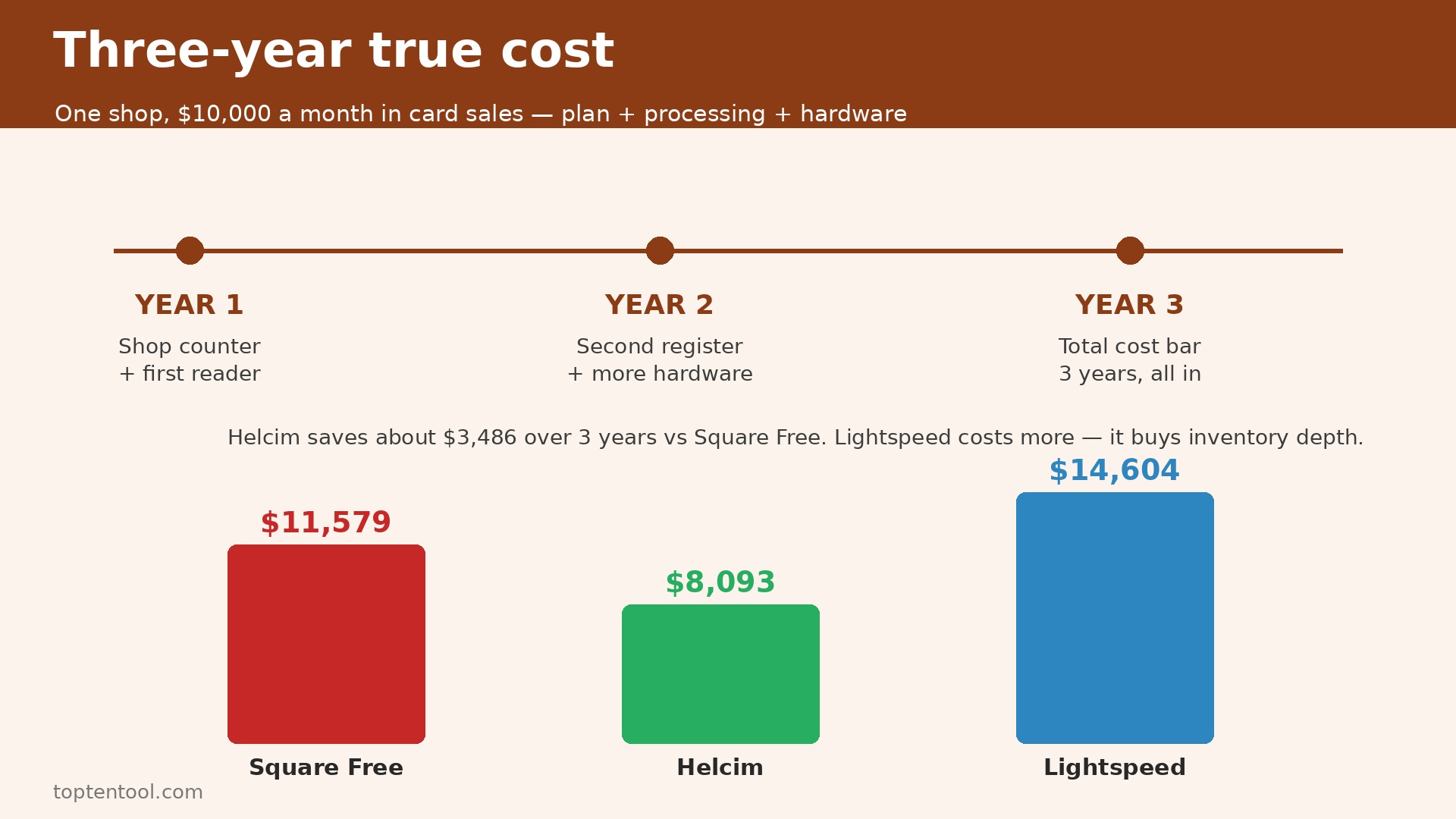
The monthly fee is the smallest part of a three year POS software pricing for small retailers bill, and the processing fees dominate. Take a shop doing 10,000 dollars a month in card sales, or 360,000 dollars over three years, across 400 sales a month. On Square Free, processing over three years is about 11,520 dollars, plus a 59 dollar reader, or about 11,579 dollars in total.
On Helcim at the reported average, processing over three years is about 8,064 dollars, plus a 29 dollar reader, or about 8,093 dollars, a saving of about 3,486 dollars. On Lightspeed at 89 dollars a month, the three year total is about 3,204 dollars in plan fees plus about 10,800 dollars in processing plus about 600 dollars in hardware, or about 14,604 dollars, and the extra cost buys inventory depth, not cheaper payments.
Hardware replacement and add ons fill out the rest of the true cost. A reader lasts years, a register lasts longer, but a printer, a cash drawer, and a scanner each carry a replacement cycle, and a second location doubles the hardware and the per location plan fee. Square Plus and Premium charge per location, Shopify POS Pro charges per location, and Lightspeed charges per location, so a two location shop pays the plan fee twice.
Loyalty and marketing add ons run from free to 50 dollars a month or more, and online ordering on Toast costs about 50 dollars a month extra. Add every line before you compare, because a tool that wins on the monthly fee can lose on the three year total by thousands of dollars.
Cheapest POS Software by Situation
| Situation | Cheapest honest pick | Monthly total at 10,000 dollars sales, 400 sales | Why it wins |
|---|---|---|---|
| Market stall or side business, tiny volume | Square Free or PayPal Zettle | 320 dollars Square, 265 dollars Zettle | No monthly fee, start today |
| Single shop, 10,000 dollars a month, small catalog | Helcim | About 224 dollars | Lowest processing, no plan fee |
| Single shop, low volume, wants inventory | Square Plus | 359 dollars | Inventory and POs behind one 49 dollar fee |
| Shop already selling online | Shopify POS Basic | 339 dollars | Online and in store in one system |
| Specialty shop, 200 plus SKUs | Lightspeed Retail | 389 dollars | Inventory depth no cheaper tool matches |
| Restaurant or cafe | Toast paid tier | About 759 dollars at 20,000 dollars sales | Kitchen display and menu workflow |
| Quick service, wants lowest card rate | Clover direct | About 285 dollars | 2.3 percent rate, buy direct only |
| Multi location operator | Revel or Lightspeed, quoted | Quote | Built for scale and central control |
POS software pricing for small retailers rewards the owner who works out the total at their own volume and average sale size. A 2.6 percent rate sounds close to a 2.3 percent rate until you multiply the 0.3 percent difference by 120,000 dollars a year, when it becomes 360 dollars, and by 360,000 dollars over three years, when it becomes 1,080 dollars. That is the math that should decide the purchase, not the monthly fee on the pricing page.
Frequently Asked Questions
How much is POS software pricing for small retailers per month?
A small retailer doing 10,000 dollars a month in card sales pays about 224 to 389 dollars a month in total, depending on the tool, plus hardware once. Square Free costs about 320 dollars a month at that volume with no plan fee. Helcim costs about 224 dollars. Lightspeed costs about 389 dollars. The processing fees are most of the bill, so the rate matters more than the monthly fee.
Is there a free POS system for small business?
Square Free and PayPal Zettle charge no monthly fee, and Toast and SpotOn offer zero dollar tiers, but none of them is free in total, because processing fees apply to every card sale. Square Free charges 2.6 percent plus 15 cents per in person sale, and Zettle charges 2.29 percent plus 9 cents. The software is free. Taking the payment is not.
What is the cheapest POS for a small shop?
Helcim is the cheapest at most volumes above 10,000 dollars a month, because interchange plus pricing averages about 1.92 percent plus 8 cents with no monthly fee. PayPal Zettle is the cheapest simple option, at 2.29 percent plus 9 cents with no monthly fee and a 29 dollar reader. Square Free is the cheapest to start, because the software and the setup cost nothing beyond the reader.
How much does POS hardware cost?
A card reader costs 29 to 59 dollars. A countertop terminal costs 299 to 349 dollars. A handheld costs 399 dollars. A full register costs 799 to 899 dollars, and a full kit with a printer and a cash drawer reaches 1,189 dollars. A Lightspeed station using your own iPad costs about 600 dollars in peripherals. Budget 500 to 1,200 dollars for a single station, and double it for a second location.
Should I choose Square or Shopify POS?
Choose Square if you sell mainly in person, you want no monthly fee to start, and you want the simplest setup. Choose Shopify POS if you already sell online, because the online and in store inventory, customers, and orders live in one system, and that integration is worth more than the rate difference. A shop that only sells in person should not pay the 39 dollar Shopify plan just for the POS.
Verdict
POS software pricing for small retailers comes down to volume, average sale size, and catalog depth, not to the monthly fee on the pricing page. PayPal Zettle and Square Free are the best starting points for a tiny shop. Helcim is the best value once you pass 10,000 dollars a month, because the lower processing rate saves about 100 dollars a month against Square Free, and the saving grows with volume.
Lightspeed is the best value for a specialty shop with hundreds of SKUs, Shopify POS is the best value for an omnichannel retailer, Toast is the best value for a restaurant, and Clover direct is the best value for a quick service shop that wants the lowest card rate. Work out your total at your volume, get any contract and any reseller fee in writing, and recheck the rate on the vendor page before you sign.