
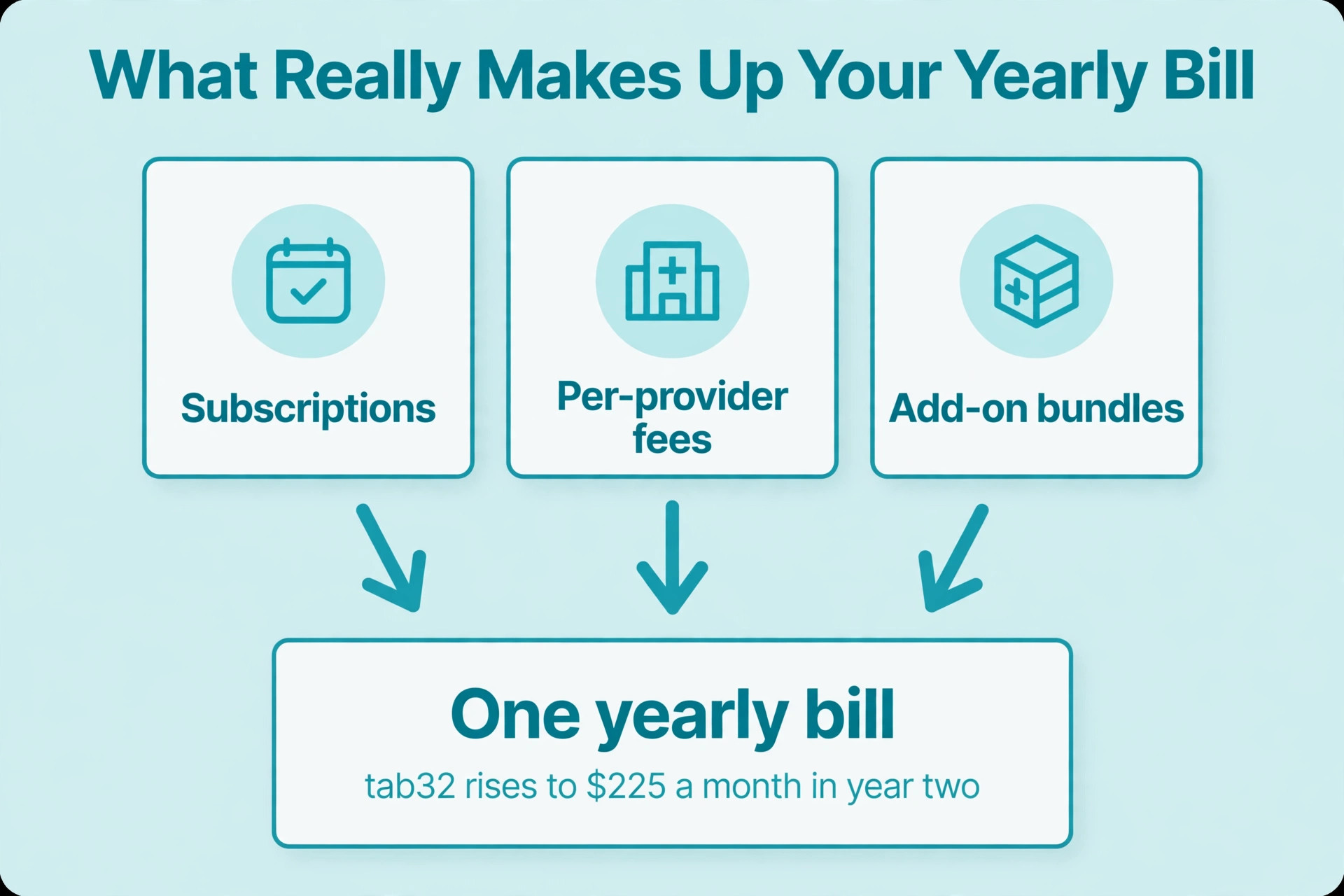
A two provider dental clinic that sees thirty patients a day pays for software in four different ways at once, and the monthly subscription is only the first of them. There is the subscription itself, the per provider or per location charge, the setup fee, and the add ons for patient communication, imaging, e claims and reminders. Dental software pricing for small clinics only makes sense as a yearly total, because a tool that looks cheap at 99 dollars a month can cost more than a tool at 199 dollars a month once the provider count, the location count and the add ons are counted.
The gap between the cheapest and the dearest options is wide, and most vendors hide their numbers behind a quote. A small clinic can pay 99 dollars a month for a cloud system in year one, 149 dollars a month for an open source system with no per seat fees, or 399 dollars a month for an all in one system that bundles phones and practice management, while the big names quote per practice and add imaging, communication and clearinghouse fees on top. What matters is the total cost for your provider count and your location count, not the headline on the pricing page.
This guide breaks down dental software pricing across eight systems in 2026, with prices checked against vendor pages and current roundups in November 2026. Per provider against per location fees, cloud against server costs, imaging, patient communication and add on costs and the real yearly bill for a two provider clinic are all covered, so you can see what a small clinic actually pays before you enter card details.
How Dental Software Charges You
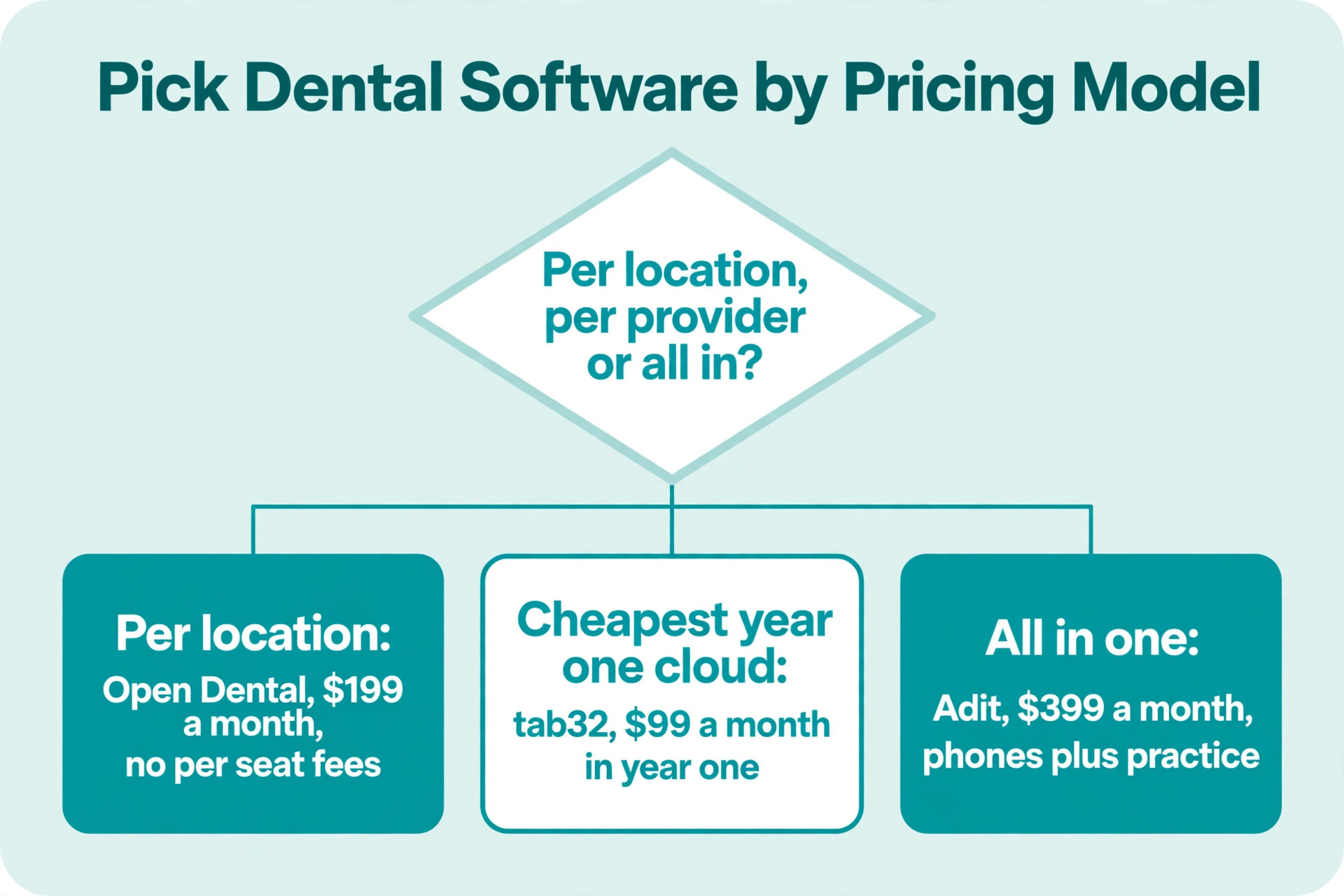
Dental software charges in three different ways, and the model decides the bill more than any feature. Per provider pricing charges for every dentist and hygienist, so a four provider clinic on a 300 dollar per provider plan pays 1,200 dollars a month. Per location pricing charges one flat fee per office, so the same clinic on Open Dental pays 149 to 199 dollars a month no matter how many providers work there. Cloud systems charge a monthly subscription with no server to buy, while server systems charge a licence plus a server, backups and IT support that the clinic manages itself.
Add ons are the second line of the bill, and they are where the cheap plans get expensive. Patient communication, reminders, online scheduling, imaging, e claims and clearinghouse fees are often sold separately, and a system that looks cheap at 99 dollars a month can cost twice as much once the communication bundle is added. Open Dental charges 165 dollars a month for its communication bundle, and Adit bundles phones and practice management for 399 dollars a month, which is the all in price rather than the starting price.
Setup fees are the third line, and they vary widely. Dentrix Ascend charges a one time setup fee of 500 to 1,000 dollars, Curve Dental includes setup at no charge, and Open Dental charges setup for cloud hosting on top of the subscription. Ask for the first year total in writing, including setup, hosting and the add ons you need, before you sign, because a quote that excludes setup is not a quote.
Dental Software Pricing for Small Clinics in 2026 at a Glance
| Tool | Starting price | Best for | Watch out |
|---|---|---|---|
| Open Dental | 199 dollars a month | Lowest flat fee | Needs technical setup |
| tab32 | 99 dollars a month in year one | Cheapest year one cloud | Rises to 225 dollars in year two |
| Dentrix Ascend | quote only, about 399 dollars a month reported | Dentrix users going cloud | Quote only, setup fee |
| Dentrix | quote only, about 500 dollars a month reported | Largest ecosystem | Server model, quote only |
The first five tools cover the most common shop sizes, and the next five cover the cases where a specialist feature or a lower price changes the answer.
| Tool | Starting price | Best for | Watch out |
|---|---|---|---|
| Eaglesoft | quote only, about 200 to 500 dollars a month reported | Patterson supported | Quote only |
| Curve Dental | quote only, about 350 to 600 dollars a month reported | Polished cloud system | Quote only, dearer cloud |
| CareStack | 829 dollars a month | All in consolidation | 829 dollars a month |
| Adit | 399 dollars a month | Phones plus practice | 399 dollars a month |
The 8 Systems, Priced in Full
The eight systems below are ordered by value for a small clinic, starting with the cheapest honest price and ending with the all in one premium option.
1. Open Dental
Open Dental is the cheapest honest price for a clinic that wants flexibility, because the per location fee does not rise as providers are added. It covers scheduling, charting, billing, imaging bridges to more than 200 systems, and reporting, with an open architecture that supports one of the largest third party integration ecosystems in dentistry. The trade off is that the clinic needs some technical resource, because the system is highly configurable and the support is not as polished as the cloud first tools, but for a cost conscious clinic the flat fee is hard to beat.
Pricing starts at 199 dollars a month. Open Dental costs 199 dollars a month for support, dropping to 149 dollars a month after year one, with no per seat fees and up to three providers included. Extra providers cost 20 dollars a month each. Price conflict flagged. One source reports a 399 dollar a month subscription plan and a 9,995 dollar one time licence per provider, while the vendor lists 199 dollars a month dropping to 149 dollars. Confirm the current figure before you budget. Cloud hosting adds 100 to 200 dollars a month.
Pick Open Dental when you want the lowest cost with no per seat fees and the widest integration choice. Skip it when you want a polished cloud system with no technical work, because Open Dental needs setup.
2. tab32
tab32 is the cheapest cloud entry point for a startup or cost sensitive clinic, because the first year costs 99 to 125 dollars a month with native digital imaging and AutoRemind included. It covers scheduling, charting, billing and patient communication in a cloud system with no server to buy, which suits a new practice with no IT staff. The trade off is the year two price, because the bill rises to 225 dollars a month, which is more than Open Dental at 149 dollars, so the first year saving disappears in year two.
Pricing starts at 99 dollars a month in year one. tab32 costs 99 to 125 dollars a month in year one, then 225 dollars a month thereafter, for up to three providers, with engagement add ons sold separately. AutoRemind is included in year one, and the price rise in year two is the fact that matters most when comparing it with Open Dental.
tab32 fits best when you are a startup clinic that wants the cheapest cloud entry in year one. It fits worst when you compare on year two pricing, because the bill rises to 225 dollars a month.
3. Dentrix Ascend
Dentrix Ascend is the cloud answer for a practice already in the Dentrix family, and its pricing reflects a system built for the long term. It covers scheduling, charting, billing, patient communication and imaging in a cloud system with more than 250 API partners, so a practice that already uses Dentrix can move to the cloud without leaving the ecosystem. The trade off is price transparency, because nothing is published and the reported 399 dollar a month figure plus setup makes it one of the dearer options here.
Pricing starts at quote only, about 399 dollars a month reported. Dentrix Ascend does not publish pricing. Third party estimates put it at about 399 dollars a month and up, with a one time setup fee of 500 to 1,000 dollars. It is the cloud platform from the Dentrix family, with built in patient communication, imaging integration and deep insurance billing, and it was among the first dental platforms with SOC 2 Type II compliance.
Pick Dentrix Ascend when you already use Dentrix and want to move to the cloud inside the same ecosystem. Skip it when you need a published price before a sales call, because Dentrix Ascend does not list one.
4. Dentrix
Dentrix is the established on premise system that most dental practices know, and its pricing reflects the largest ecosystem in dentistry. It covers scheduling, charting, billing, imaging and patient communication, with a deep add on catalog that lets a practice add exactly the modules it needs. The trade off is the server model, because the clinic needs a server, backups and IT support, and the reported 500 dollar a month figure plus add ons makes it one of the dearer options for a small clinic starting fresh.
Pricing starts at quote only, about 500 dollars a month reported. Dentrix does not publish pricing. Third party estimates put it at about 500 dollars a month and more, with add on modules for imaging, communication and enterprise features. It is the most widely installed on premise system, with a deep add on and integration catalog and a large ecosystem that other tools cannot match.
Dentrix fits best when you are an established practice that wants the largest ecosystem and deepest add on catalog. It fits worst when you are a small clinic starting fresh, because the server model and the price are both heavy.
5. Eaglesoft
Eaglesoft is the Patterson system for a solo or small practice that wants a vendor relationship with support included. It covers scheduling, charting, billing, imaging and patient communication, with a support club that handles updates and help, and a workflow that Patterson customers know well. The trade off is price transparency, because nothing is published and the reported 200 to 500 dollar a month range is wide, so the real price only comes from a quote, and the system is less cloud native than Curve Dental or tab32.
Pricing starts at quote only, about 200 to 500 dollars a month reported. Eaglesoft does not publish pricing. Third party estimates put it at about 200 to 500 dollars a month and more with the support club. It is the Patterson supported system for solo and small practices, with a support club that covers updates and help.
Pick Eaglesoft when you are a Patterson customer who wants supported software with a familiar workflow. Skip it when you need a published price or a cloud native system, because neither is the strength here.
6. Curve Dental
Curve Dental is the polished cloud pick for a modern practice that wants a clean interface and no server. It covers scheduling, charting, billing, imaging and patient communication in a browser based system, with Curve GRO for patient engagement and multi location support that suits a growing group. The trade off is price, because the reported 350 to 600 dollar a month range makes it one of the dearer cloud options, and the lack of a published price means the real figure only comes from a quote.
Pricing starts at quote only, about 350 to 600 dollars a month reported. Curve Dental does not publish pricing. Third party listings cite roughly 350 dollars a month per provider, with other sources reporting 400 to 600 dollars a month and up as locations and providers grow. It is a cloud native system with a clean modern interface, strong multi location support, and built in patient engagement through Curve GRO.
Curve Dental fits best when you want a polished cloud system with a clean interface and multi location support. It fits worst when you need a published price, because Curve Dental does not list one.
7. CareStack
CareStack is the all in cloud option for a small group that wants scheduling, charting, billing, imaging, patient communication and reporting consolidated in one system. The 829 dollar a month Essentials price is the highest published figure in this list, but it is the whole bill rather than a starting price with add ons, which makes the comparison fairer than it looks. The trade off is scale, because a solo clinic will get better value from Open Dental or tab32 at a fraction of the price, and CareStack only makes sense once the practice needs the full consolidation.
Pricing starts at 829 dollars a month. CareStack Essentials costs 829 dollars a month, which is the all in price for a full featured cloud system. It is the all in option for a small group that wants everything consolidated, though the price is the highest published figure in this list.
Pick CareStack when you run a small group and want everything consolidated in one cloud system. Skip it when you are a solo clinic, because 829 dollars a month is far more than you need.
8. Adit
Adit is the phone plus practice management bundle for a clinic that wants one vendor for both. For 399 dollars a month it covers scheduling, charting, billing, patient communication, reminders and a phone system, with the phones integrated into the patient record so the front desk sees who is calling before answering. The trade off is that the practice management depth is lighter than Dentrix or Open Dental, and the 399 dollar price is higher than the budget tools, but for a clinic that pays for phones separately, the bundle can save money overall.
Pricing starts at 399 dollars a month. Adit costs 399 dollars a month, which bundles phones and practice management in one price. It is the only tool in this list that bundles the phone system with the practice management, which saves the cost of a separate phone service.
Adit fits best when you want phones and practice management bundled in one price. It fits worst when you already have a phone system, because the bundle charges for a feature you do not need.
Best Value by Clinic Size
Clinic size decides the answer, because per provider pricing punishes a clinic with many providers while per location pricing rewards it. Use the table below as the short version of this guide.
| Job | Pick | Why |
|---|---|---|
| Solo provider, tight budget | Open Dental | 149 to 199 dollars a month, no per seat fees |
| Startup clinic, cloud first | tab32 | 99 to 125 dollars a month in year one |
| Dentrix user going cloud | Dentrix Ascend | Cloud inside the Dentrix ecosystem, quote only |
| Modern cloud practice | Curve Dental | Polished cloud system, quote only |
| Small group, all in one | CareStack | 829 dollars a month, everything consolidated |
What a Two Provider Clinic Actually Pays in a Year
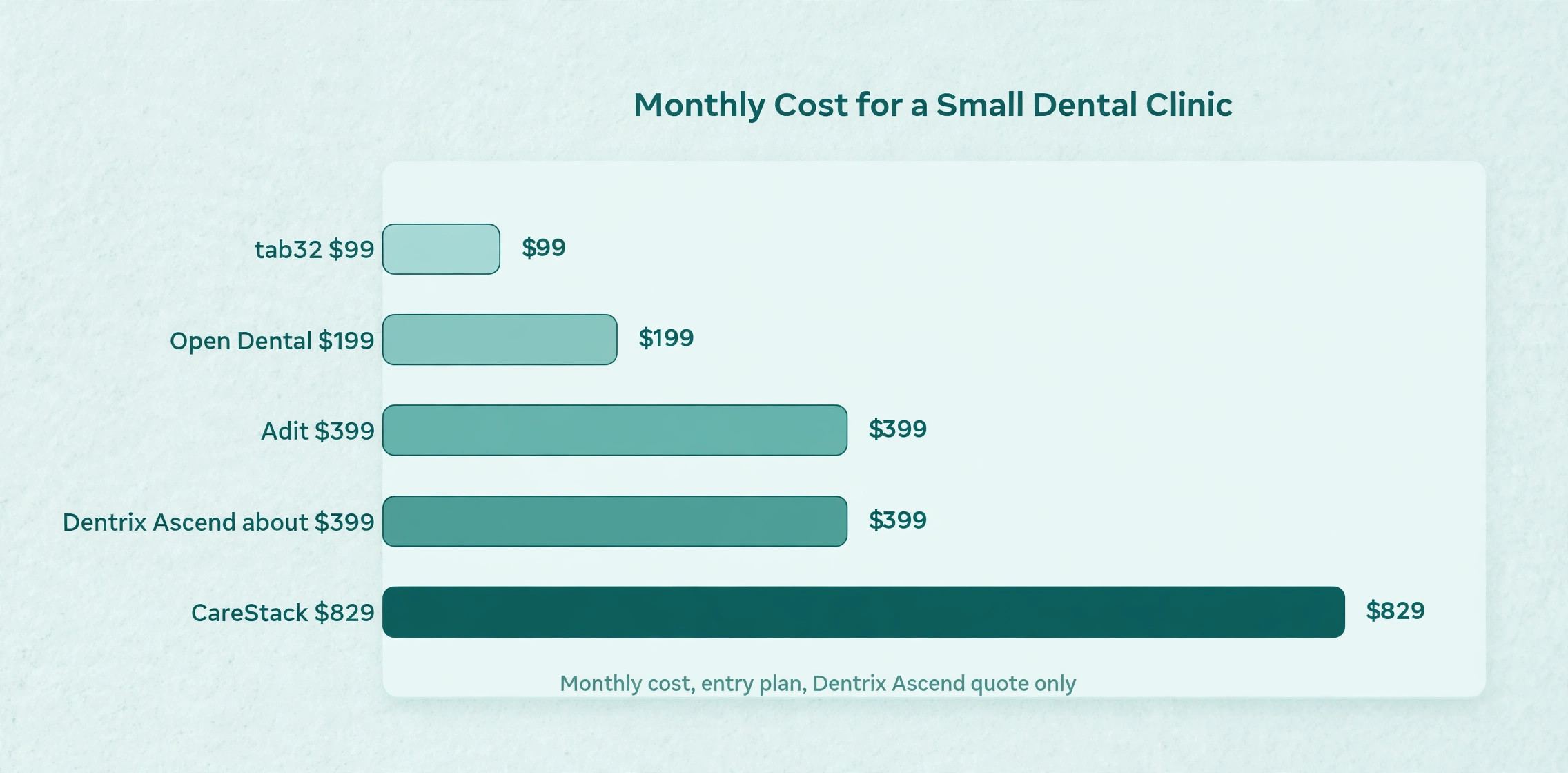
The yearly bill is the number that matters, because the per provider model multiplies fast. The table below shows the yearly subscription for a two provider clinic on the entry plan, before add ons. tab32 costs about 1,188 to 1,500 dollars in year one, Open Dental costs 2,388 dollars in year one and 1,788 dollars thereafter, Adit costs 4,788 dollars, Dentrix Ascend costs about 4,788 dollars at the reported rate, and CareStack costs 9,948 dollars. The gap between the cheapest and the dearest is more than eight times, which is why the provider count matters more than the headline.
| Tool | Monthly | Yearly | What is extra |
|---|---|---|---|
| tab32, year one | 99 to 125 dollars | 1,188 to 1,500 dollars | Rises to 225 in year two |
| Open Dental, after year one | 149 dollars | 1,788 dollars | No per seat fees |
| Adit | 399 dollars | 4,788 dollars | Phones included |
| Dentrix Ascend, reported | 399 dollars | 4,788 dollars | Setup 500 to 1,000 extra |
| CareStack Essentials | 829 dollars | 9,948 dollars | All in price |
The lesson is to compare the yearly total at your real provider count, not the monthly headline. A per provider system that costs 300 dollars a month per provider charges a four provider clinic 1,200 dollars a month, while a per location system charges the same clinic 149 dollars a month. Work out the twelve month cost for your team, add the setup and the communication bundle, and the cheapest tool usually reveals itself in one line of maths. That comparison is the heart of dental software pricing for small clinics.
What the Communication Bundle Really Costs
Take a two provider clinic on Open Dental at 149 dollars a month after year one. The communication bundle costs 165 dollars a month on top, which more than doubles the bill to 314 dollars a month, or 3,768 dollars a year. The bundle covers reminders, online scheduling, two way texting and patient messaging, which are the features that decide the no show rate, so most clinics need it, and the real price of Open Dental is the subscription plus the bundle rather than the subscription alone.
The comparison changes once the bundle is counted. tab32 includes AutoRemind in year one, so the first year bill is lower than it looks, while Adit bundles phones and communication for 399 dollars a month, which is only 85 dollars more than Open Dental with the bundle. A clinic that prices the bundle from the start will find that the cheapest headline is rarely the cheapest bill, and that the all in price is the only number worth comparing.
Hidden Costs to Watch in Dental Software Pricing
The most common hidden cost is the per provider multiplier. A cloud system that costs 300 dollars a month per provider charges a four provider clinic 1,200 dollars a month, while a per location system such as Open Dental charges the same clinic 149 dollars a month. Count your providers, multiply by the per provider rate, and compare the total before you sign, because a quote for one provider is not a quote for four.
The second hidden cost is the communication bundle. Patient communication, reminders, online scheduling and e claims are often sold separately, and Open Dental charges 165 dollars a month for its communication bundle on top of the subscription. A system that looks cheap at 99 dollars a month can cost twice as much once the bundle is added, so price the plan that includes the communication features you need from the start.
The third hidden cost is the year two price rise. tab32 costs 99 to 125 dollars a month in year one and 225 dollars a month thereafter, which is more than Open Dental at 149 dollars a month. A clinic that compares on year one pricing and forgets year two will be surprised by the renewal. Always ask for the price in year two as well as year one, in writing, before you sign.
Our Verdict
Open Dental is the pick for most small dental clinics on price, because 199 dollars a month dropping to 149 dollars a month after year one buys scheduling, charting, billing and imaging with no per seat fees and the widest integration choice in dentistry. It is the tool most likely to still fit the clinic in five years, and the flat fee is the reason it leads this list. That is why it leads this guide on dental software pricing for small clinics.
tab32 is the pick for a startup clinic that wants the cheapest cloud entry in year one, at 99 to 125 dollars a month. Adit is the pick for a clinic that wants phones and practice management bundled, at 399 dollars a month. Work out the yearly total at your real provider count, add the communication bundle, and only pay for the plan whose features you use every day. The provider count is the deciding factor, so count your providers before you choose, price the communication bundle from the start, and ask for the year two price in writing, because the renewal is the cost that surprises most clinics.
Frequently Asked Questions
How much does dental software cost per month for a small clinic?
A small clinic can pay 99 to 125 dollars a month for tab32 in year one, 149 to 199 dollars a month for Open Dental, or 399 dollars a month for Adit with phones included. Quote only systems such as Dentrix Ascend and Curve Dental are reported at about 350 to 600 dollars a month, and CareStack Essentials costs 829 dollars a month. The real monthly bill is higher once the communication bundle and imaging add ons are counted. That is the short answer on dental software pricing for small clinics for most readers.
Is Open Dental really 149 dollars a month?
Open Dental lists 199 dollars a month for support, dropping to 149 dollars a month after year one, with no per seat fees and up to three providers included. One source reports a 399 dollar a month subscription plan and a 9,995 dollar one time licence per provider, which conflicts with the vendor own pricing, so confirm the current figure before you budget. Cloud hosting adds 100 to 200 dollars a month on top of the subscription.
Does dental software charge per provider or per location?
Both, and the difference matters more than any feature. Open Dental charges per location, so a four provider clinic pays 149 dollars a month, while a per provider system at 300 dollars a month per provider charges the same clinic 1,200 dollars a month. tab32 charges per location for up to three providers, while Curve Dental and Dentrix Ascend are reported per provider. Count your providers before you compare the headlines.
What is the cheapest dental software for a small clinic?
tab32 at 99 to 125 dollars a month in year one is the cheapest cloud entry, and Open Dental at 149 dollars a month after year one is the cheapest long term price, because the flat per location fee does not rise as providers are added. The cheapest plan is not always the best value, because tab32 rises to 225 dollars a month in year two, which is more than Open Dental, so compare on year two pricing rather than year one.
Do I need to pay extra for patient communication?
Usually yes, because patient communication is often sold separately. Open Dental charges 165 dollars a month for its communication bundle, and tab32 sells engagement add ons separately. Adit bundles phones and communication for 399 dollars a month, and Curve Dental includes Curve GRO patient engagement in its cloud system. Price the plan that includes reminders, online scheduling and two way texting from the start, because those features decide the no show rate.
Is cloud or server cheaper for a small dental clinic?
Cloud is cheaper in year one, because there is no server to buy, no backups to manage and no IT support to hire. Server systems such as Dentrix and Open Dental on premise charge a licence plus a server, backups and IT support that the clinic manages itself, which can cost more over three years than a cloud subscription. A clinic with no IT staff should price the cloud systems first, because the server model needs someone to maintain it.
Can I switch dental software without losing patient records?
Yes, but the move takes planning. Export patient records, charting, imaging, appointment history and open balances from the old system, then test the import with a small batch of patients before moving the rest. Imaging is the hardest part to move, because every image needs its link to the patient record preserved. Keep the old system running for a month in parallel, and check that charts and images carried across before you cancel.
Work out the yearly total at your real provider count, add the communication bundle, and the cheapest tool will reveal itself in one line of maths, and ask for the year two price in writing.
That is the short answer on dental software pricing for small clinics for most small businesses.
If you only remember one thing about dental software pricing for small clinics, make it the total yearly cost, not the monthly sticker price.