
A small farm runs on records that used to live in a notebook, a spreadsheet, and the farmer memory. Crop rotations, spray dates, calving records, feed costs, and sales invoices all matter at tax time and at market time, and a lost notebook can cost a season of proof. The best farm management software for small farms moves those records into one place a farmer can check from the field, and the difference shows up when a buyer asks for spray records or an accountant asks for a profit figure by enterprise.
Small farms need software that works with dirty hands and patchy signal. The tool must record a field job in under a minute, work offline when the signal drops, and produce a report a farmer can actually read. The 8 tools below were picked because they serve farms that are small by acreage or by herd size, publish prices a small farm can check, and cover the core jobs of crop planning, livestock records, inventory, and costs.
This guide compares the 8 platforms on real 2026 pricing, what each one does well, where each one falls short, and which farm type each one fits. Prices come from vendor pages and current roundups checked in November 2026. Where a vendor hides its price behind a sales call, we say so plainly, because quote only pricing is itself a fact a small farm needs before shortlisting.
How we chose the best farm management software for small farms
We judged every tool on the work a small farm actually does each week. First, the tool must record field jobs, livestock events, and costs quickly, because a system that takes five minutes per entry will be abandoned by the second week. Second, it must work on a phone in the field, with offline access where signal is weak. Third, it must turn records into useful reports, such as cost per acre, profit per enterprise, and spray history, without a spreadsheet export and a evening of manual work.
Pricing transparency counted heavily. Small farms buy software the way they buy seed, on a number they can read before they commit. Vendors that publish a rate card scored better than vendors that insist on a sales call, and vendors that charge per animal or per acre were judged on what a typical small farm actually pays. Free plans and free trials scored higher, because a farm should be able to test a tool through one season before paying.
We also weighted fit by farm type. A crop farm needs field mapping and spray records, a livestock farm needs breeding and health records, and a mixed farm needs both. No single tool wins for every farm type, so this guide states the best fit for each tool plainly. Features such as satellite imagery, weather alerts, and accounting integrations were treated as useful extras, not as reasons to pick a platform on their own.
The best farm management software for small farms at a glance
The table below gives the whole field in one view. Use it to cut the list to three candidates, then read the full reviews of those three before you trial one. Note that per animal and per acre pricing looks cheap until you multiply it by your herd or your acreage, so the starting prices below are the entry point, not the final bill.
| Tool | Starting price | Best for | Watch out |
|---|---|---|---|
| Farmbrite | From $29 a month | Small mixed farms | Full suite costs more than single plans |
| Agrivi | Quote only | Crop farms centralizing operations | No free trial, pricing not published |
| AgriWebb | Quote only, set by animal numbers | Beef, sheep, and mixed livestock farms | Price depends on herd size, no public rate |
| Agworld | From $1,795 to $3,995 a year | Cropping teams working with an agronomist | Annual pricing is high for a small farm |
| FarmKeep | Free plan, Premium $9.99 a month | Homesteads and small ranches | Built around animals, limited crop tools |
| Traction | From $30 a month | Livestock farms wanting financial depth | Complete package costs $75 a month |
| Conservis | From $50 a month | Farms wanting dedicated support | Custom pricing for larger operations |
| Granular | Quote only | Data driven crop operations | No published price, enterprise lean |
The 8 tools, reviewed in detail
Each review below states the price first, then the strengths, then the honest limits. Read the pick it when and skip it when lines as the verdict. If a tool matches your farm type and your budget, it belongs on your shortlist even if it sits low in this list.
1. Farmbrite
Farmbrite prices by farm type. Livestock plans start at $29 a month for Essentials, $49 a month for Performance, and $79 a month for Premium, with annual billing cheaper. Complete plans for farms with crops and livestock start at $59 a month. Some listings show Grower at $35 a month, Rancher at $45, and Plus at $65. A 14 day free trial is available.
Farmbrite is the best all rounder for a small mixed farm. It covers crops, livestock, pasture, inventory, tasks, and basic accounts in one system, and the mobile app is genuinely usable in the field. The plans are split by farm type, so a livestock farm does not pay for crop tools it will never open. Reviewers consistently call it affordable and easy to use, and the 4.7 rating on G2 reflects a product small farms actually enjoy.
The full crop and livestock suite costs more than the single focus plans, so a mixed farm pays the higher Complete price. The accounting tools are basic compared with a dedicated farm accounting product, and the tax reporting is US focused, which matters for farms outside the US. Larger farms may also outgrow the reporting depth.
Pick it when you run a small mixed farm with crops and livestock and want one low cost system for records, tasks, and basic accounts. Skip it when you need deep accounting, non US tax reporting, or advanced analytics for a large operation.
2. Agrivi
Agrivi does not publish pricing and sells by quote. Third party reports put pricing in the $25 to $100 a month range depending on features, but owners should request a written quote before budgeting. There is no free trial, though a demo is available.
Agrivi is a strong crop focused platform that turns farm data into decisions. It covers crop planning, field operations, pest and disease management, input inventory, and weather alerts in one place, with yield analysis that helps a grower compare seasons. For a small to medium crop farm that wants to centralize daily operations, the depth is real. The analytics help a farmer see which fields and which inputs actually earn money.
The quote only pricing and the lack of a free trial make Agrivi hard to evaluate. Reviewers also note that the price can be a barrier for small farmers and that the platform feels complex for beginners. A small farm that only needs simple records will find Agrivi heavier than it needs.
Pick it when you run a crop farm and want detailed planning, pest management, and yield analysis in one centralized system. Skip it when you need a published price, a free trial, or a simple system for a very small farm.
3. AgriWebb
AgriWebb does not publish a rate card and prices by animal numbers, excluding tax. Owners should request a written quote based on their herd size before budgeting. The platform is sold through direct sales rather than self serve signup.
AgriWebb is built for livestock records and does that job better than almost any rival. It tracks individual animals, breeding, movements, treatments, and grazing across paddocks, with records that satisfy audit and assurance schemes. For a beef or sheep farm, the paddock and grazing tools are genuinely useful, and the system is proven on farms in Australia, the UK, and the US. The record keeping is thorough enough to stand up to a buyer or an auditor.
The quote only pricing makes it impossible to compare without a sales conversation, and the price rises with herd size, so a growing herd means a growing bill. AgriWebb is also livestock focused, so a crop farm will find little here. The setup takes longer than the self serve tools on this list.
Pick it when you run a beef, sheep, or mixed livestock farm and need thorough animal and paddock records that satisfy audits. Skip it when you need a published price, or your farm is mainly crops.
4. Agworld
Agworld prices by annual plans for growers, ranging from $1,795 to $3,995 a year as listed in October 2026. That works out to roughly $150 to $333 a month, which is the highest entry price on this list. Owners should confirm the current annual rate before budgeting, because the plans are sold by acreage and features.
Agworld is the strongest tool for a cropping farm that works closely with an agronomist. It covers crop plans, field records, budgets, and recommendations in one shared workspace, so the farmer and the agronomist see the same plan and the same records. The budgeting tools are deeper than the small farm tools, and the record keeping is thorough enough for compliance and assurance schemes.
The annual price is high for a small farm, and the platform is built for cropping teams rather than solo operators. A small mixed farm will pay for depth it does not need, and the livestock tools are minimal. The price alone rules it out for many small farms, even though the product is strong.
Pick it when you run a cropping farm with an agronomist and want shared plans, budgets, and records in one workspace. Skip it when you run a small or mixed farm on a tight budget, or your main work is livestock.
5. FarmKeep
FarmKeep offers a free plan and a Premium tier at $9.99 a month. It is the cheapest paid option on this list, and the free plan is genuinely usable for a small homestead. Owners can start free and upgrade only when they need the premium features.
FarmKeep is built for homesteads, small ranches, and family farms, and it shows in the friendly design. Animal profiles, breeding management, production tracking, finances, and shared task lists cover the daily work of a small livestock farm without complexity. The free plan and the $9.99 premium tier make it the lowest risk starting point on this list, and the interface is easy enough for the whole family to use.
FarmKeep is built around animals, so crop tools are limited. A farm that grows vegetables or grain will need a second tool for field records. The feature set is also thinner than Farmbrite or Agrivi, with less depth in reporting and analytics. It is a homestead tool, not a commercial farm platform.
Pick it when you run a homestead or small ranch, mainly with animals, and want a free or near free system the whole family can use. Skip it when you need serious crop planning, deep reporting, or a platform built for a commercial operation.
6. Traction
Traction starts at $30 a month for basic livestock management, with the complete package including financial integration at $75 a month. Owners should confirm the current plan structure before budgeting, because the tiers are split by features rather than by herd size alone.
Traction is a specialist livestock platform with strong financial tools. It tracks animals, breeding, and health, and the complete package adds financial integration that shows the true cost and profit of the herd. For a farm where animal husbandry is the main revenue, that financial depth matters more than a generic record system. The interface is focused and the livestock workflows are well thought out.
The complete package at $75 a month is a jump from the $30 entry price, and the crop tools are minimal. A mixed farm will need a second tool for fields. Traction is also a smaller vendor than Farmbrite or Agrivi, so the integration list is shorter and the user community is smaller.
Pick it when you run a livestock farm and want financial integration that shows the true profit of your herd. Skip it when you need crop tools, or you want the full feature set on the cheapest plan.
7. Conservis
Conservis starts at $50 a month for small operations, with custom pricing for larger farms. Owners should request a written quote, because the final price depends on acreage, features, and support level. Dedicated customer support is included.
Conservis is a farm management platform with a strong support team behind it. It covers field operations, inventory, and reporting, and the dedicated support means a farmer can get help from someone who understands farm work rather than a generic help desk. For a farm that values a phone call over a help article, that support is a real feature. The platform is proven on commercial operations.
The $50 starting price is higher than Farmbrite or FarmKeep, and larger operations move to custom pricing, which hides the real cost. The feature set is solid but not the deepest on this list, and the platform is less well known among small farms, so there is less public evidence about the small farm experience.
Pick it when you want a farm platform with dedicated human support and are willing to pay $50 a month for it. Skip it when you need the cheapest possible price or a large public user community to learn from.
8. Granular
Granular does not publish pricing and sells by quote. Owners should expect a sales conversation and a written quote before they can compare it against anything else. There is no free plan and no published trial.
Granular is a data driven farm platform with strong tools for crop planning, field records, and profitability analysis. It helps a grower see which fields earn money and which ones lose it, with analytics that go deeper than the small farm tools. For a crop operation that makes decisions from data rather than from habit, the analysis is genuinely useful. The platform is backed by a large agribusiness, which gives it stability.
The quote only pricing and the enterprise lean make Granular a poor fit for a very small farm. A farm with 50 acres will pay for analytics built for a thousand acre operation, and the onboarding is heavier than the self serve tools here. The livestock tools are minimal, so a mixed farm needs a second system.
Pick it when you run a data driven crop operation and want profitability analysis by field. Skip it when you run a small or mixed farm, or you need a published price and a fast setup.
The Right Pick for Your Situation
The best farm management software for small farms depends on what you grow and what you raise. Match your farm type to the pick below and you will shortlist faster than reading every review in order.
| Your job | Best pick | Why it wins |
|---|---|---|
| Small mixed farm, crops plus livestock | Farmbrite | One system for both, from $29 a month |
| Crop farm centralizing operations | Agrivi | Deepest crop planning and pest management |
| Beef or sheep farm | AgriWebb | Best animal and paddock records for audits |
| Homestead or small ranch | FarmKeep | Free plan, Premium $9.99 a month |
| Livestock farm wanting financial depth | Traction | Herd profit tracking from $30 a month |
| Cropping with an agronomist | Agworld | Shared plans and budgets, $1,795 a year and up |
The True Cost Breakdown
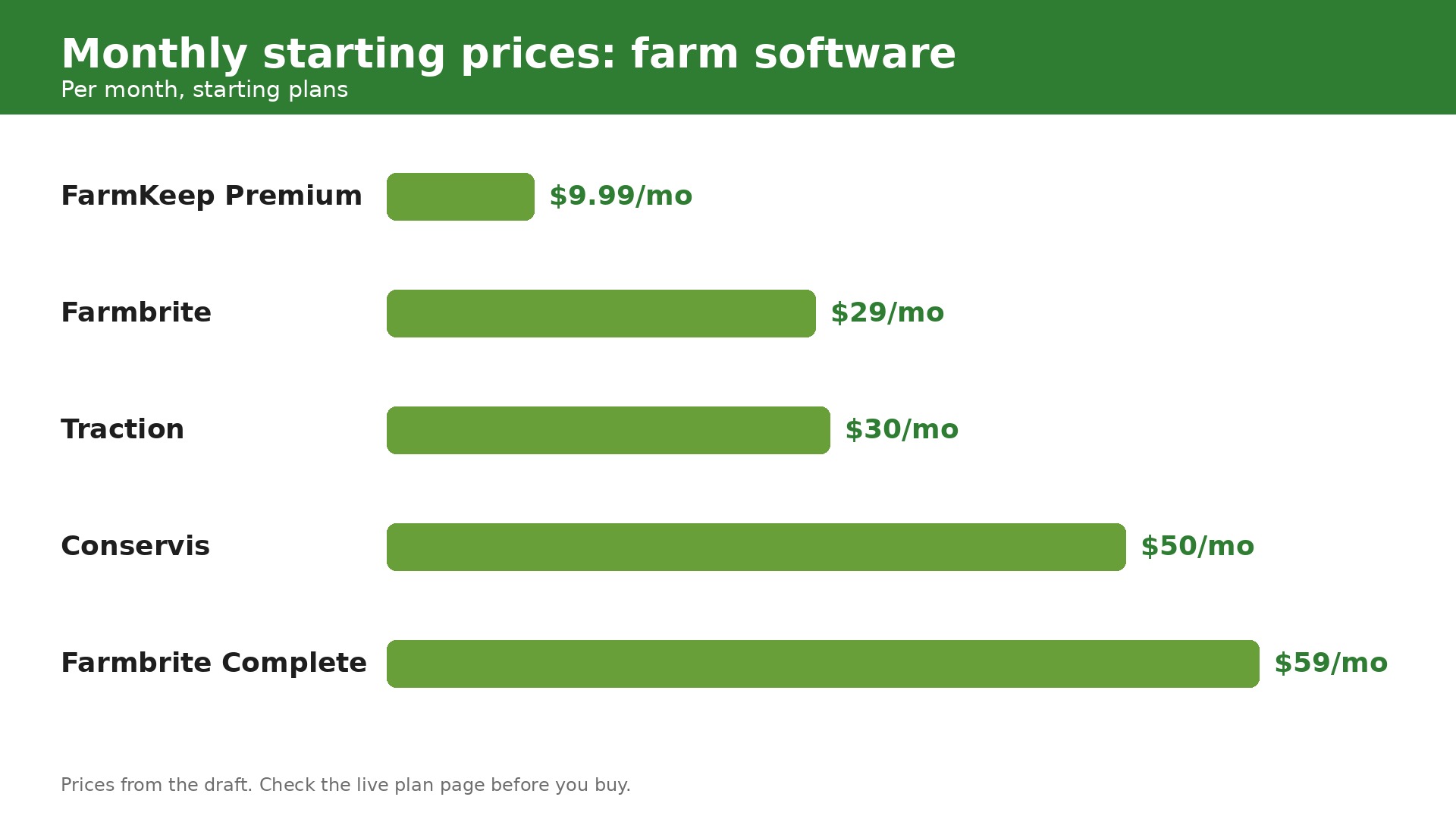
A small farm should budget $10 to $80 a month for software. FarmKeep Premium costs $9.99 a month, Farmbrite livestock plans start at $29 a month, Traction starts at $30 a month, Conservis starts at $50 a month, and Farmbrite Complete starts at $59 a month. Agworld is the outlier at $1,795 to $3,995 a year, which is $150 to $333 a month, and Agrivi, AgriWebb, and Granular are quote only. Always calculate the cost at your real herd size or acreage, because per animal and per acre pricing rises as the farm grows.
The hidden costs are the upgrades. Farmbrite Complete costs more than the single focus plans, Traction Complete costs $75 a month against a $30 entry price, and Agworld annual plans jump between tiers. Check what the entry plan excludes before you commit, because the feature you need most is often on the next tier. Also check whether the price includes the mobile app, offline access, and support, because some vendors charge extra for those.
The math that justifies the spend is the record that saves a sale. A buyer who asks for spray records and gets a clean report buys with confidence, while a farmer who cannot produce the records loses the sale or the premium. A single prevented mistake, such as a double sprayed field or a missed withdrawal period, can cost more than a year of software. Judge the tool on the records it keeps, not on the price alone.
Five Ways Small Operators Overspend
- Buying a crop tool for a livestock farm, or the reverse. Farm type decides the shortlist. A livestock farm needs breeding and health records, a crop farm needs field mapping and spray records, and a mixed farm needs both in one system.
- Choosing a system that needs signal in a dead zone. Test the mobile app in the field, not in the farmhouse. If the app cannot record a job offline and sync later, it will be abandoned within a month.
- Paying for enterprise analytics on 50 acres. Granular and Agworld are strong products, but a small farm pays for depth it will never use. Start with a small farm tool and move up only when the farm actually grows.
- Recording nothing for the first month. Software only helps if the records go in. Commit to recording every job for 30 days before you judge the tool, because a half empty system tells you nothing.
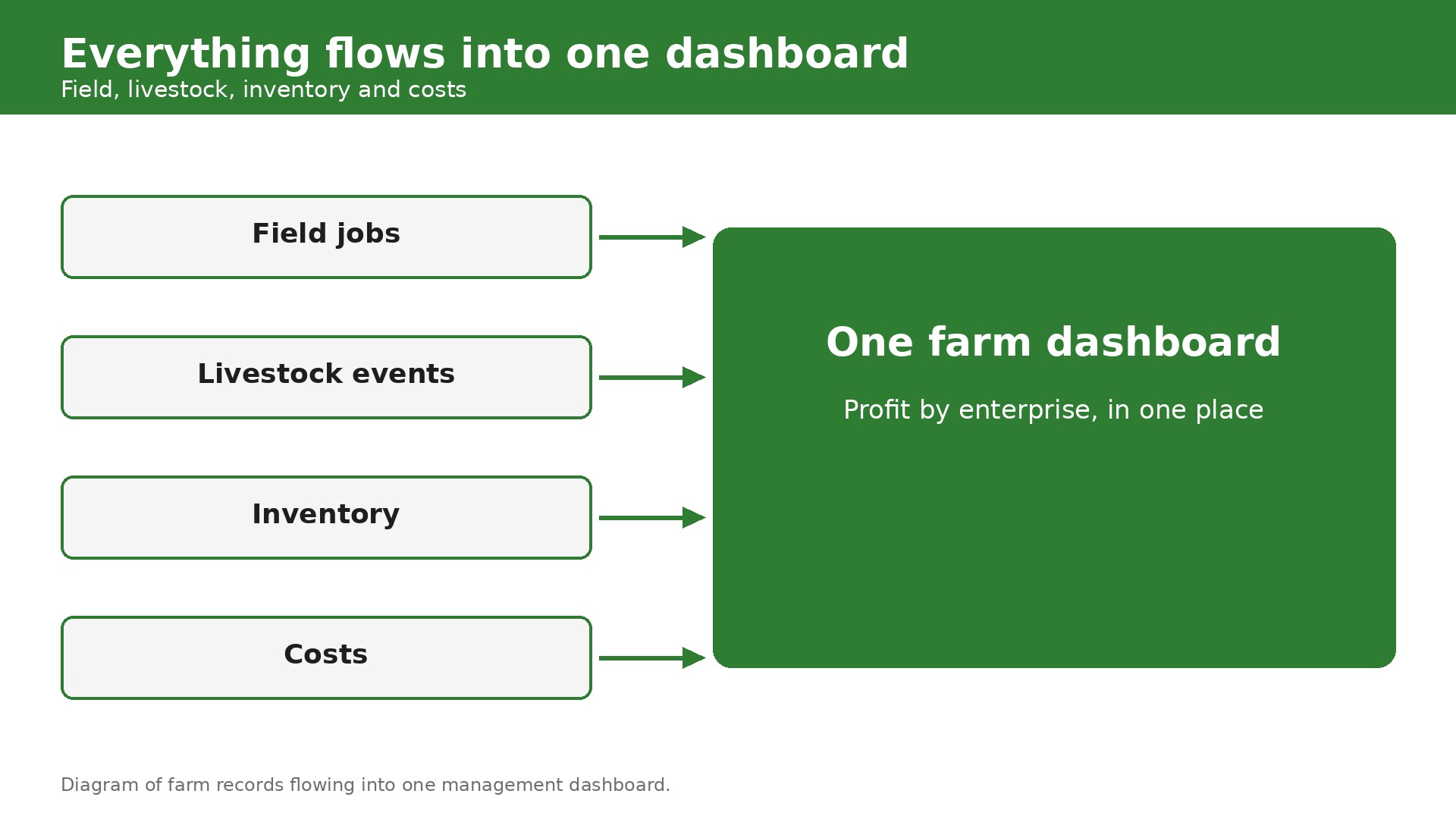
- Ignoring the tax report. A farm system should produce a profit figure by enterprise and a clean record for the accountant. If it cannot, the farmer ends up doing the same work twice, once in the app and once in a spreadsheet.
What good looks like after one season
After one season on the right system, a small farm should be able to answer five questions in under a minute. Which field made money and which one lost it. Which animals are due for treatment and which ones are ready to sell. What was sprayed, when, and at what rate. What the farm spent on feed, seed, and inputs against what it earned. And what the accountant needs for the tax return. If the software cannot answer those questions, it is a diary, not a management system.
The first month is the hardest, because the records are empty and the habit is new. Record every job the day it happens, even if the entry is short. A one line note with a date, a field, and a product beats a perfect entry made a week later from memory. By the second month, the reports start to work, because the data is finally there. By harvest, the farm has a real record of the season, and that record is worth more than the subscription cost many times over.
The best farm management software for small farms earns its keep in the quiet moments, not in the demos. It is the spray record a buyer asks for, the breeding date a vet asks about, and the cost figure an accountant needs. Pick the tool that makes those moments easy, and the rest of the features will take care of themselves. A system that is used every day beats a powerful system that is opened once a month, so choose the one your farm will actually use in the field.
Start with one enterprise, not with the whole farm at once. A livestock farm should record animal events for a month before it adds crop fields, and a crop farm should record field jobs for a month before it adds livestock. The habit matters more than the coverage, because a system with one enterprise recorded well beats a system with five enterprises recorded badly. Once the first enterprise is routine, the second one takes half the effort, because the team already knows how to record a job in under a minute.
Share the records with the people who need them. The accountant needs a profit figure by enterprise, the buyer needs spray and treatment records, and the vet needs breeding and health dates. A system that can produce those three reports without a spreadsheet export is doing its job, and a system that cannot is only a diary. Ask each of those people what format they want before you choose, because their answer decides which tool fits. The farm that shares clean records gets better prices, faster payments, and fewer arguments at audit time. Clean records also make the farm easier to sell one day, because a buyer can see exactly what the land and the herd earned.
Frequently Asked Questions
How much does farm management software cost for a small farm?
Most small farms pay $10 to $80 a month. FarmKeep Premium costs $9.99 a month, Farmbrite starts at $29 a month, Traction starts at $30 a month, Conservis starts at $50 a month, and Farmbrite Complete starts at $59 a month. Agworld costs $1,795 to $3,995 a year, and Agrivi, AgriWebb, and Granular are quote only. Always calculate the cost at your real herd size or acreage before you compare headline prices.
What is the best farm management software for small farms in 2026?
The best farm management software for small farms depends on the farm type. Farmbrite wins for small mixed farms, Agrivi wins for crop farms, AgriWebb wins for beef and sheep farms, and FarmKeep wins for homesteads on a budget. Shortlist three tools that match your farm type, trial them through real field work, and pick the one your farm will actually use every day.
Does farm management software work offline in the field?
Most good tools offer offline access on the mobile app, but not all of them. Farmbrite and AgriWebb both work from a phone in the field, and entries sync when signal returns. Test the app in your worst signal area before you commit, because a system that needs a connection in a dead zone will be abandoned. Ask the vendor directly whether offline recording is included on your plan.
Can small farms use free farm management software?
Yes, for a start. FarmKeep offers a free plan that covers animal records for a homestead, and Farmbrite offers a 14 day free trial. A free plan is enough to test whether the farm will actually record jobs every day, which is the real question. Most commercial farms outgrow free plans within a season and move to a paid tier of $29 to $59 a month, which is a small cost against the value of clean records.
What records should a small farm keep in the software?
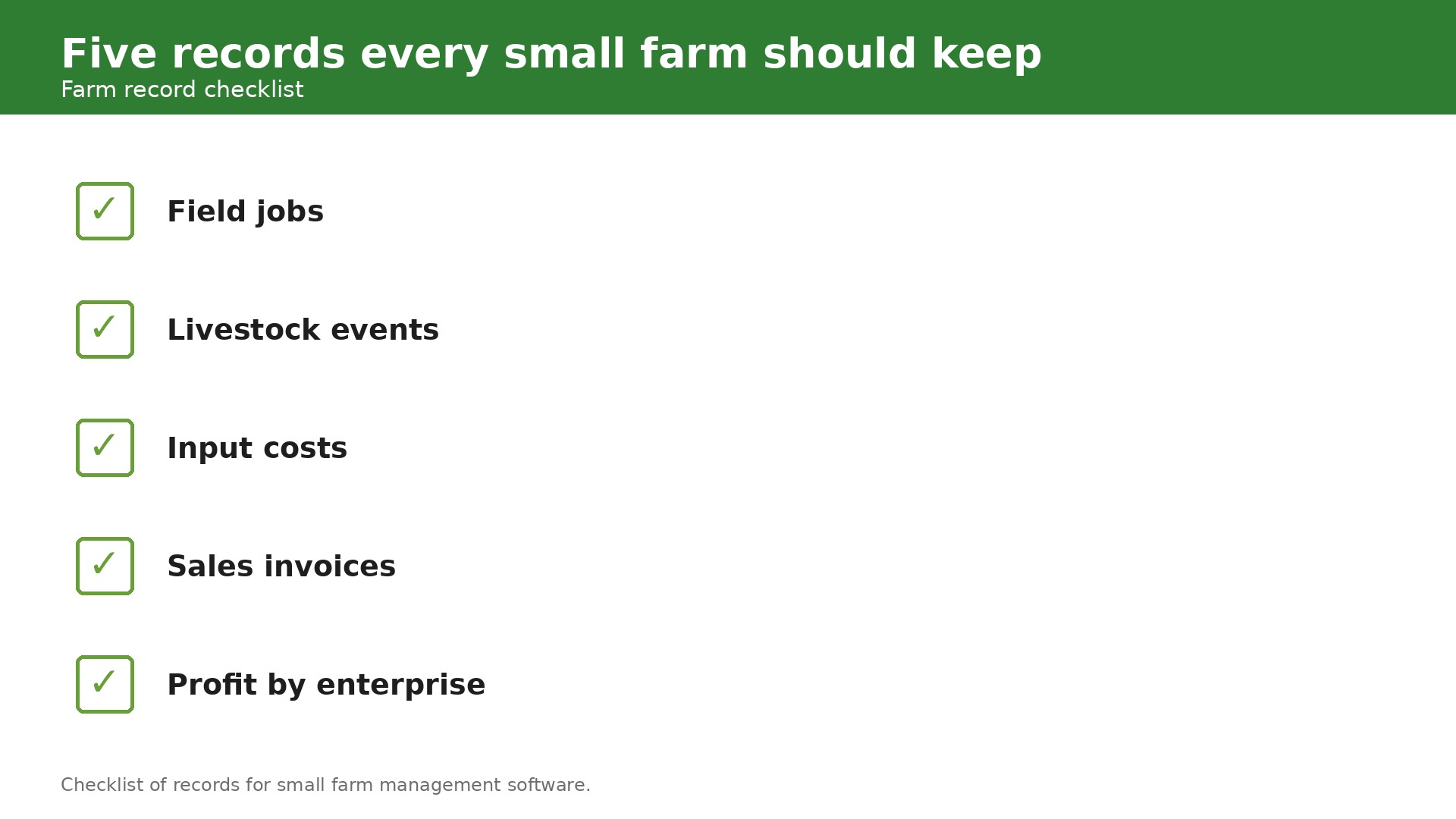
Keep five kinds of records. Field jobs with dates, products, and rates. Livestock events including breeding, births, treatments, and sales. Input inventory and costs for seed, feed, and chemicals. Sales invoices and customer records. And financial records that show profit by enterprise. Those five sets cover tax, audit, buyer, and management needs, and any tool on this list can hold them.
Is farm management software worth it for a farm under 50 acres?
Yes, if the farm sells to buyers who ask for records or if the farmer wants to know which enterprise actually earns money. A 20 acre farm with clean spray and sales records can win a premium buyer, while a farm with no records cannot prove anything. The cost of $10 to $30 a month is small against a single lost sale or a single prevented mistake, such as a missed withdrawal period or a double sprayed field.