The verdict is simple. Most businesses should budget 10 to 150 dollars per slide with a freelancer, and 1,500 to 10,000 dollars or more for a full agency deck, while a clean do it yourself deck in a modern tool costs little more than a subscription and your time. Presentation design cost is not one number, because the same 15 slides can cost 150 dollars or 7,500 dollars depending on who designs them, how much thinking goes into the story, and how high the stakes are. A routine internal update and an investor pitch are different jobs, and they should never be priced the same way.
This guide gives you the real 2026 ranges, the worked examples, and the questions that separate a fair quote from an expensive surprise. You will learn what each tier buys, what drives the price up, where the hidden costs sit, and how to choose between a freelancer, an agency, a subscription studio, and doing it yourself. Every figure comes from published 2026 pricing guides and vendor price lists, and every range is labelled as a range, because no two decks are alike.
Presentation Design Cost at a Glance
The fastest way to budget a deck is to start with the per slide range for your tier, then multiply by the slide count, then add the extras. A 10 slide internal update at 15 dollars a slide is 150 dollars. A 15 slide investor deck at 75 dollars a slide is 1,125 dollars. A 30 slide sales deck at 100 dollars a slide is 3,000 dollars. The maths is easy. The hard part is knowing which tier your deck actually needs, and that is what the rest of this guide answers.
| Provider type | Typical per slide range | Typical project range | Best for |
|---|---|---|---|
| Freelance marketplaces | 5 to 50 dollars | 150 to 1,500 dollars | Simple decks, tight brief |
| Experienced freelancers | 25 to 75 dollars | 500 to 3,000 dollars | One senior designer |
| Senior freelancers | 75 to 100 dollars or more | 1,400 to 3,000 dollars | Investor and board decks |
| Volume and offshore studios | 10 to 40 dollars | 300 to 2,000 dollars | Ready content, team delivery |
| Boutique agencies | 50 to 150 dollars or more | 1,500 to 10,000 dollars or more | Strategy and flagship decks |
| Do it yourself | Subscription only | 0 to 25 dollars a month | Internal decks, fast drafts |
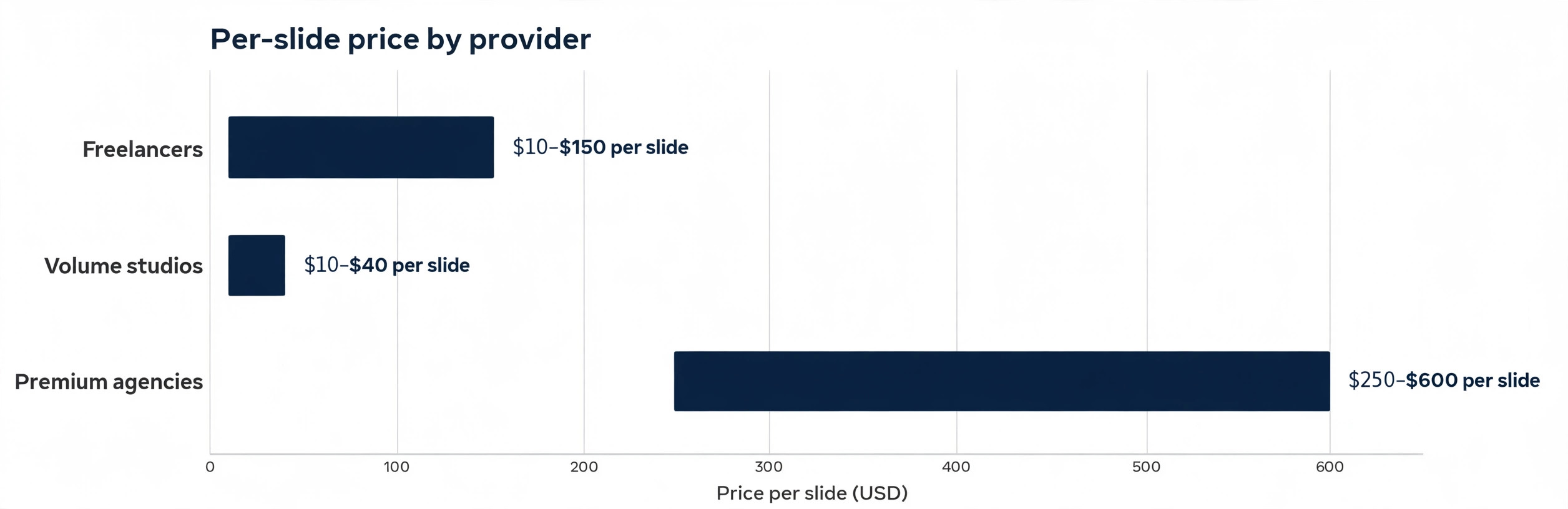
These ranges come from several 2026 pricing guides that agree closely with each other. Whitepage puts freelancers at 15 to 150 dollars an hour or 15 to 100 dollars per slide, and agencies at 1,500 to 10,000 dollars or more per project. Pixel Presentation puts the full spread at about 5 to 150 dollars or more per slide. Nexaflow lands in the same place, with freelancers at 10 to 150 dollars per slide and agency decks starting around 1,500 dollars. When three independent sources agree, the range is worth trusting. Your quote will still vary by region, designer, and complexity, so treat every figure here as a planning range, not a promise.
What Each Per Slide Tier Actually Buys
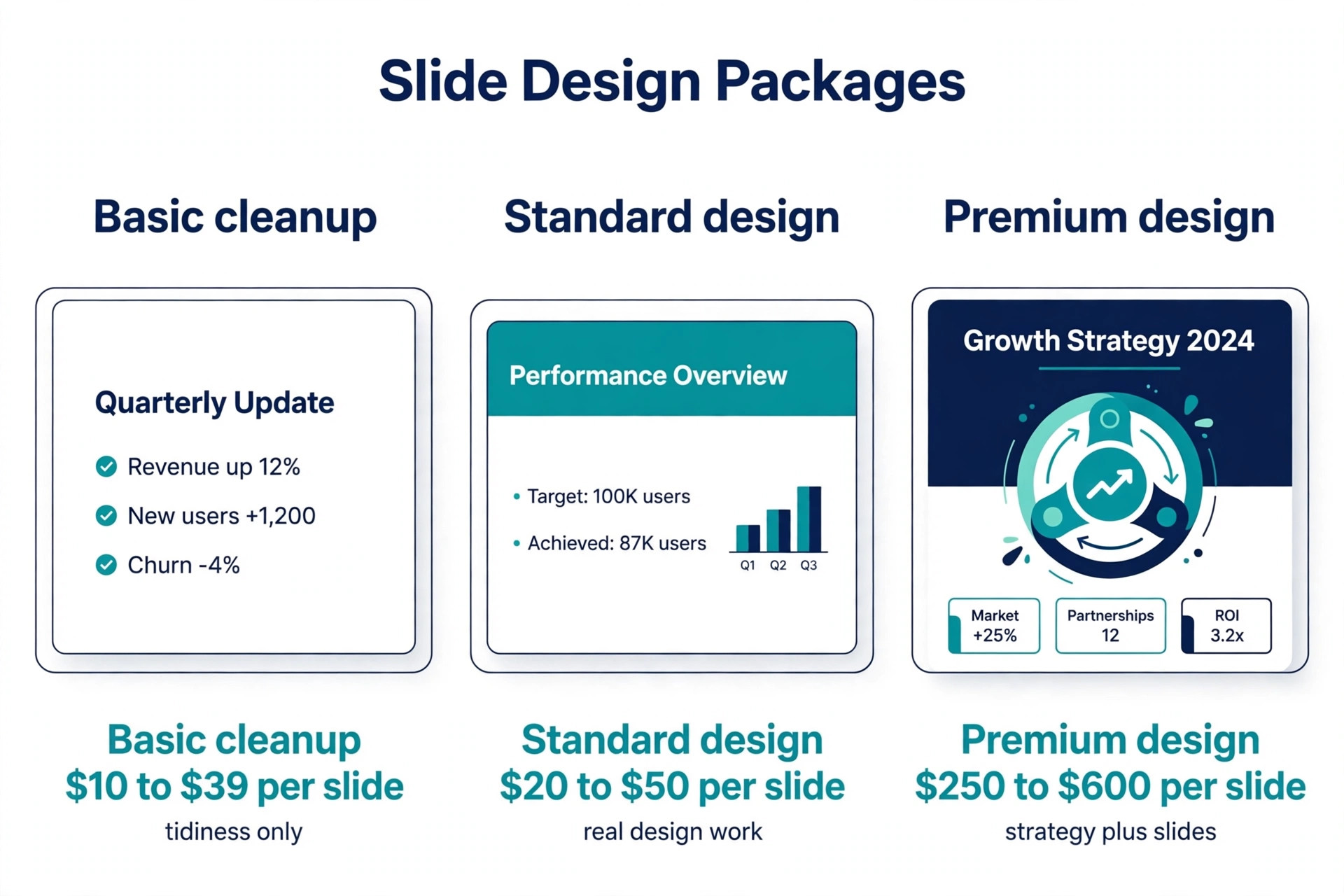
Basic cleanup sits at 10 to 39 dollars per slide, and it buys tidiness, not design. The designer fixes fonts, spacing, alignment, and colour consistency, swaps a few icons, and makes the deck look like one person made it. Your content stays as it is, and no one rewrites your story. This tier fits an internal deck that is already written, a quarterly update, or a set of slides that need to look professional before a team meeting. It does not fit a pitch, because a tidy version of a weak story is still a weak story.
Standard design sits at 20 to 50 dollars per slide, and it buys real design work. The designer builds custom layouts, aligns the deck to your brand, adds moderate graphics, and creates a clean visual hierarchy so the important point on each slide is obvious in seconds. Light animation and simple data charts are usually included. This tier fits sales decks, marketing presentations, webinars, and client facing material, which is where most business decks live. If you only remember one fact about presentation design cost, remember this range, because it is the price most companies actually pay.
Premium design sits at 250 to 600 dollars per slide at the top agencies, and it buys strategy as well as slides. The team shapes the message, restructures the story, builds custom visuals and data visualisations, adds advanced animation, and runs several revision rounds with audience testing in mind. This tier fits investor pitches, board presentations, enterprise proposals, and conference keynotes, where one meeting can be worth millions. The price looks high until you compare it with the value of the meeting it supports, and that comparison is the only one that matters at this level.
Between standard and premium sits the experienced freelance specialist at 25 to 75 dollars per slide. That designer gives you one senior person who owns the whole deck, understands your business after a short brief, and delivers a coherent result without agency overhead. A 10 slide deck from a mid level freelancer typically runs 500 to 1,500 dollars, and a 15 slide deck from a senior freelancer often runs 1,400 to 1,800 dollars. For many companies, this is the sweet spot, because it buys senior thinking at a freelance price.
Freelancer, Agency, Studio, or Tool
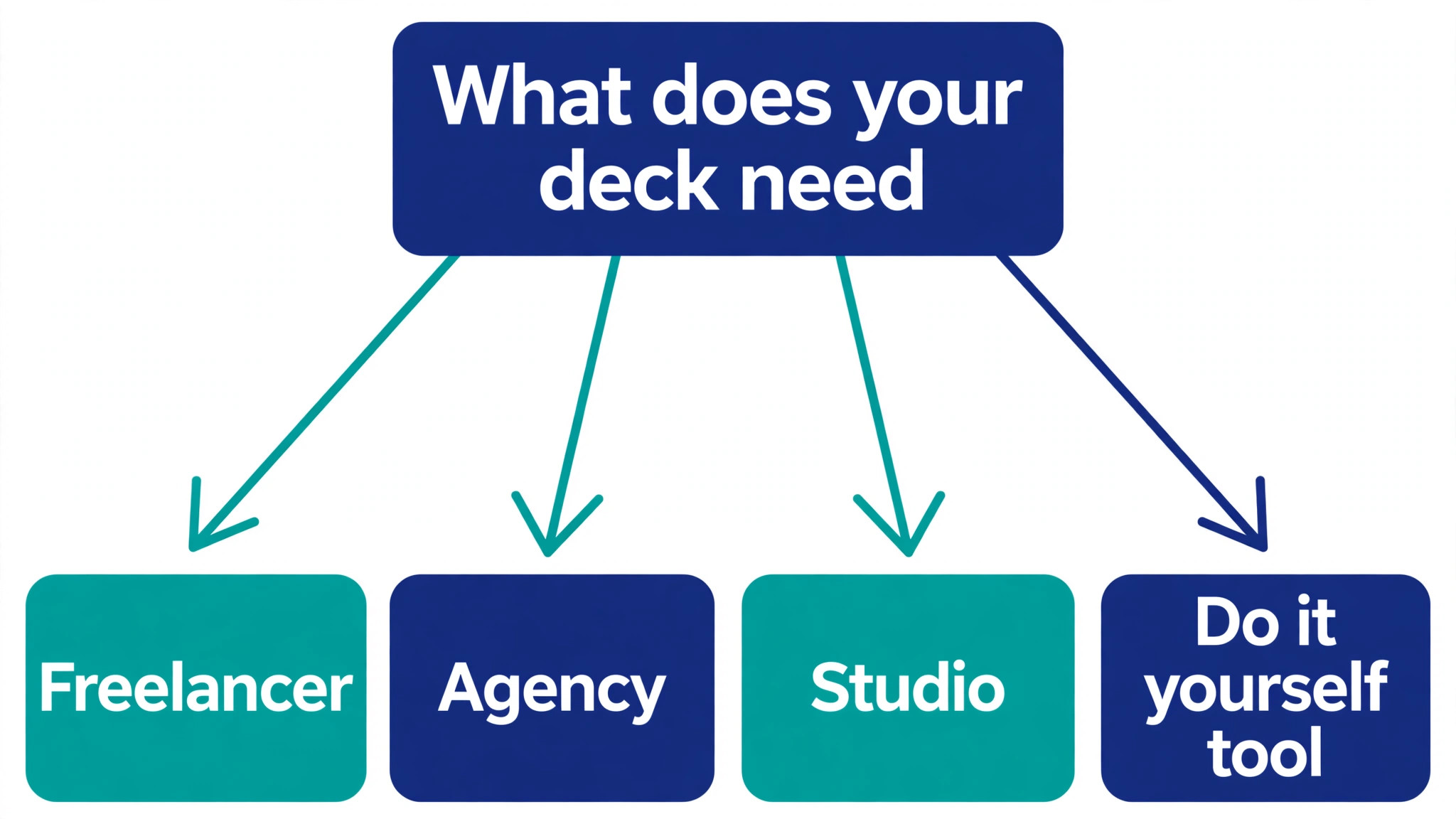
Choosing a provider is a decision about risk, speed, and how much thinking you need, and presentation design cost follows that decision. A freelancer is one person, so you get consistency and a direct line to the designer, but you also get one calendar. If that person is busy the week of your pitch, you have a problem. An agency is a team, so you get strategy, backup, and process, but you also pay for that team, and a small deck can wait in a queue behind a bigger client. A volume studio is a team built for throughput, so you get speed and a low per slide price, but you get less senior thinking on the story.
Ask each provider the same five questions before you compare prices. First, what is included in the per slide price, and what counts as a complex slide. Second, how many revision rounds are included, and what an extra round costs. Third, who writes or edits the content, because content work is often billed separately. Fourth, what the turnaround is, and what a rush fee adds. Fifth, whether you own the source files and the fonts at the end. Two quotes that look 500 dollars apart can be 2,000 dollars apart once revision rounds, content editing, and rush fees are added, so compare the full scope, not the headline rate.
Upwork and Fiverr for Marketplace Freelancers
Upwork and Fiverr are the two largest marketplaces for presentation freelancers, and they are where the widest price spread lives. You will find designers at 10 dollars a slide and designers at 100 dollars a slide on the same search page, which is why vetting matters more than the platform. Look for a portfolio of real decks in your industry, not just single slide samples. Ask for one client reference, and check it. Ask for a paid test of two slides before you commit to a 30 slide deck, because two slides will tell you more about working style than ten portfolio images.
Boutique Agencies for High Stakes Decks
A boutique agency is the right choice when the deck itself is the product, such as an investor pitch, a board presentation, or a flagship product launch. The agency brings a strategist, a writer, and a designer, and the price reflects that team. Expect 1,500 to 3,000 dollars for a small agency deck, 5,000 to 10,000 dollars for a flagship deck, and more when the work includes workshops, messaging, and a reusable template system. The engagement usually runs two to six weeks, which is too slow for a weekly sales deck and exactly right for a deck that decides funding.
Subscription Studios for Ongoing Volume
Subscription studios sell a monthly plan for unlimited or high volume design requests, and they fit teams that need decks every week. Published examples put monthly plans around 1,500 dollars a month for 20 slides, and some studios offer a standard plan near 499 dollars a month for mixed design work at a two day pace. The maths only works if you actually use the volume. A team that needs 70 to 90 slides a month will save money against freelance per slide rates. A team that needs one deck a quarter will not, and should hire per project instead.
Check the queue before you sign. Some subscription studios handle one request at a time, so a second deck waits behind the first. Some cap revisions, some exclude animation, and some charge extra for complex data work. Read the plan terms the way you would read a phone contract, because the headline price is rarely the whole price. A one month trial, paid monthly rather than annually, is the honest way to test whether the volume fits.
Do It Yourself Tools and What They Cost
Doing it yourself changes presentation design cost completely, because it is the cheapest route in cash and the most expensive route in time, and the right choice depends on which one you have less of. PowerPoint and Google Slides cost nothing extra for most businesses, because they are already in the Microsoft 365 or Google Workspace subscription. Keynote is free on Apple devices. Those tools are enough for any internal deck, and they are enough for many client decks when the content is strong and the template is clean.
Canva is the most popular step up from a blank slide deck. Canva Free costs nothing and covers templates, basic design, and 5 gigabytes of storage. Canva Pro costs 18 dollars a month for one person, or 144 dollars a year, and adds brand kits, premium content, background removal, and a content planner. Canva Business costs 25 dollars per person a month, or 250 dollars per person a year, and adds team controls. For a small business that designs weekly, Pro at 18 dollars a month is a fair price, and it is far cheaper than hiring a designer for every routine deck.
Gamma and Beautiful.ai take a different approach, turning a prompt or an outline into a finished deck with AI. Gamma offers a free plan with limited credits and paid plans for heavier use, while Beautiful.ai sells team plans for businesses that want smart templates that stay on brand. These tools are fast, and they are good for a first draft, a brainstorm, or an internal update. They are weaker when the story needs real thinking, when the data needs a custom chart, or when the audience is an investor who has seen a hundred AI decks. Use them to start, then let a human finish the slides that matter.
Adobe Express is the design tool inside the Adobe family, with a free plan and paid plans from 9.99 dollars a month. It suits teams that already live in Adobe products and want quick graphics, photo tools, and brand kits without opening a full design application. It is not a presentation specialist, so it will not write your story or build your charts, but it will make a clean deck faster than starting from a blank slide. Pick the tool that matches the job, and do not pay for a specialist tool to do a generalist job.
What Drives the Price Up or Down
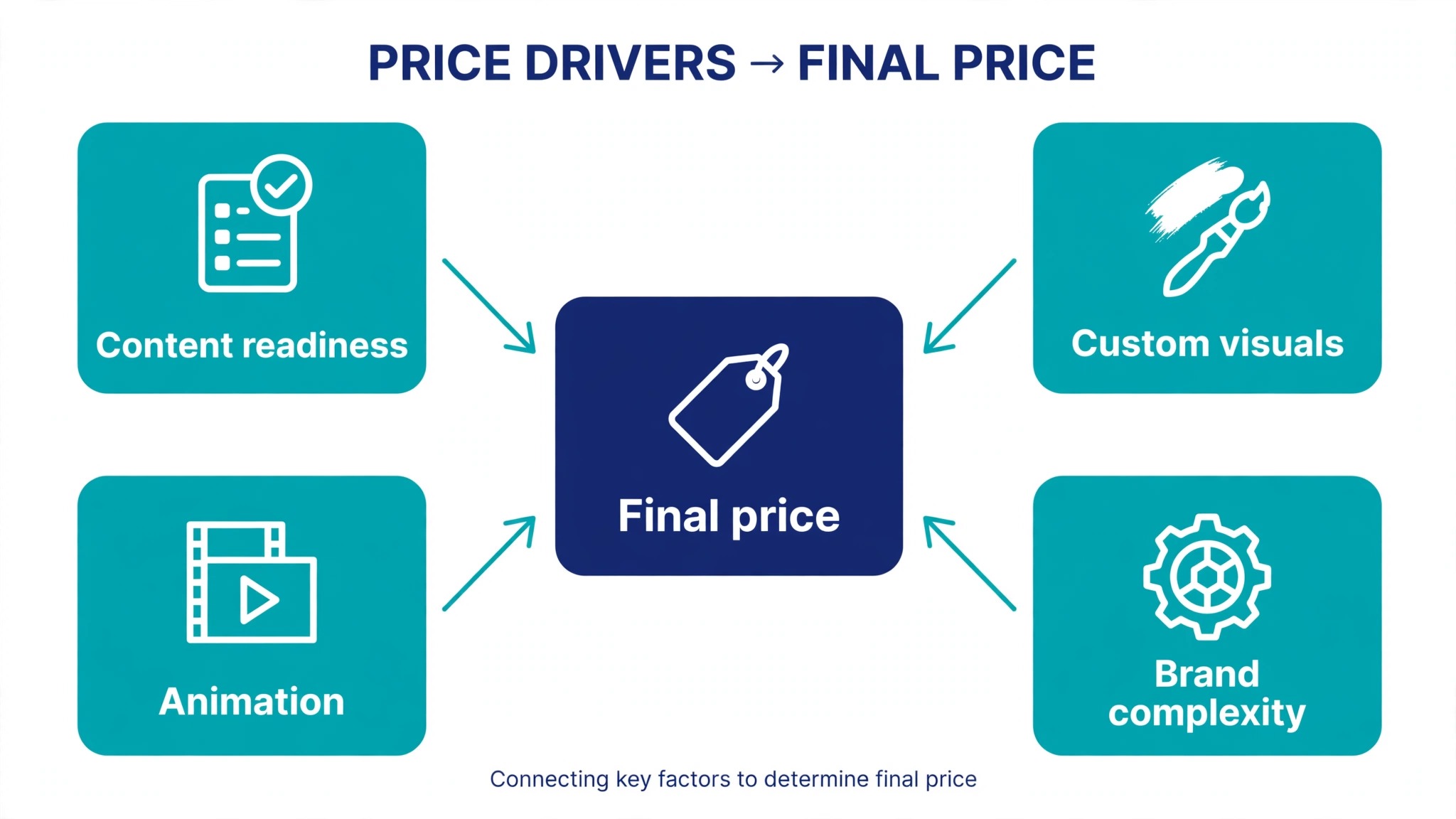
Content readiness is the biggest price driver, and it is the one buyers control most. A deck with final text, final numbers, and final images costs far less to design than a deck with rough notes and missing charts, because the designer is laying out slides instead of writing your presentation. One agency price list shows a light edit at 15 dollars a slide, a redesign at 35 dollars, and a custom visual at 75 dollars. The gap between those three numbers is the gap between ready content and content that needs building. Finish the words before you hire the designer, and the bill will fall.
Custom charts and diagrams are the second driver. A simple bar chart is cheap. A custom diagram that explains a process, a market, or a product architecture takes hours, and it is billed as a custom visual. Count your custom visuals before you ask for a quote, and decide which ones the audience truly needs. A deck with two strong custom diagrams beats a deck with ten average ones, and it costs far less.
Animation, interactivity, and video are the third driver. Light animation, such as a fade or a simple build, is usually included in a standard design. Advanced animation, embedded video, and interactive elements are not, and they can double the time per slide. Ask whether the audience will see the deck live, where animation helps, or as a PDF afterwards, where it does nothing. Pay for animation only when the delivery format can show it.
Brand complexity is the fourth driver. A brand with a clear guideline, a font file, and a logo pack is cheap to design for. A brand with no guideline, three competing logos, and a font the designer cannot license is expensive, because the designer spends hours guessing. Send the brand kit with the brief, and name the one person who can approve brand decisions. That single step saves more money than any negotiation.
Slide count is the fifth driver, and it works in both directions. More slides cost more in total, but the per slide price often falls on larger decks, because the template and the story are built once and reused. A 10 slide deck at 50 dollars a slide is 500 dollars. A 50 slide deck at the same rate is 2,500 dollars, but the designer may offer 35 dollars a slide for the larger job, bringing it to 1,750 dollars. Ask for a volume price on decks over 30 slides, and ask what the minimum project fee is on decks under 10 slides, because many designers charge a minimum even for a tiny job.
Worked Examples You Can Budget From
Example one is a 10 slide internal update. The content is final, the template exists, and the job is cleanup and formatting. At 15 dollars a slide on a marketplace, the cost is 150 dollars. At 35 dollars a slide with a mid level freelancer, the cost is 350 dollars. At an agency, the same job would still carry a minimum project fee, often 500 to 1,000 dollars, which is why an agency is the wrong choice for this deck. The right choice is a freelancer or a do it yourself pass in Canva, and the saving is the agency minimum you never pay.
Example two is a 15 slide investor deck. The story needs work, five slides need custom charts, and the deck needs two revision rounds. At 75 dollars a slide with a senior freelancer, the design cost is 1,125 dollars, plus the chart work already counted in that rate. At a boutique agency, the same deck with strategy included runs 1,500 to 3,000 dollars, and a flagship version with workshops can reach 5,000 dollars. The difference is the story work, and for a pitch that decides funding, the story work is the point. Do not buy the cheapest version of the deck that decides your company future.
Example three is a 30 slide sales deck with a reusable template. The content is ready, ten slides need custom layouts, and the template must work for the whole sales team afterwards. A mid level freelancer at 40 dollars a slide charges 1,200 dollars, plus 500 dollars for the branded template, for a total near 1,700 dollars. An agency would charge 1,500 to 3,000 dollars for the deck and 500 dollars or more for the template, for a total near 2,000 to 3,500 dollars. The template is the asset here, because every future deck built on it is cheaper. Pay for the template once, and pay for it properly.
| Example deck | Slides | Provider | Design cost | Template cost | Total |
|---|---|---|---|---|---|
| Internal update | 10 | Marketplace freelancer | 150 dollars | 0 dollars | 150 dollars |
| Investor pitch | 15 | Senior freelancer | 1,125 dollars | 0 dollars | 1,125 dollars |
| Investor pitch, agency | 15 | Boutique agency | 2,500 dollars | 0 dollars | 2,500 dollars |
| Sales deck plus template | 30 | Mid level freelancer | 1,200 dollars | 500 dollars | 1,700 dollars |
| Sales deck plus template, agency | 30 | Boutique agency | 2,500 dollars | 500 dollars | 3,000 dollars |
These examples show how presentation design cost changes with the provider, not just the slide count. They are planning figures, not quotes. Your deck will differ in content readiness, chart count, and revision needs, so use the examples to set a budget range, then get two written quotes against the same brief. Two quotes against the same brief will tell you more than ten pricing guides, because they reflect your deck, not an average deck.
Hidden Costs Most Budgets Miss
Revision rounds are the most common hidden part of presentation design cost. Many quotes include two revision rounds, and an extra round costs 100 to 300 dollars with a freelancer or 200 to 300 dollars with an agency. A deck that goes through five rounds because the brief was unclear can cost 50 percent more than the quote. Agree the revision count in writing, name the one person who approves each round, and collect feedback in one document instead of five separate emails. Every extra round that comes from a scattered approval process is a cost you chose, not a cost the designer imposed.
Content writing and editing is the second hidden cost. A per slide price usually covers visual work only, turning approved content into finished slides. If the designer has to write the content, edit a rough draft, or build the story from notes, that work is billed separately, often at an hourly rate. One pricing guide puts the split plainly, with a light edit at 15 dollars a slide, a redesign at 35 dollars, and a custom visual at 75 dollars, and none of those prices include writing the story from scratch. Budget for writing separately, or finish the words yourself before you hire.
Stock photos, icons, and fonts are the third hidden cost. Most designers include standard stock in the price, but premium images, licensed fonts, and custom illustrations are extra. A font licence alone can cost hundreds of dollars a year for a commercial font, and a deck that uses it without a licence creates a legal problem, not just a design problem. Ask what is included, ask who owns the licences, and keep the licence receipts with the source files.
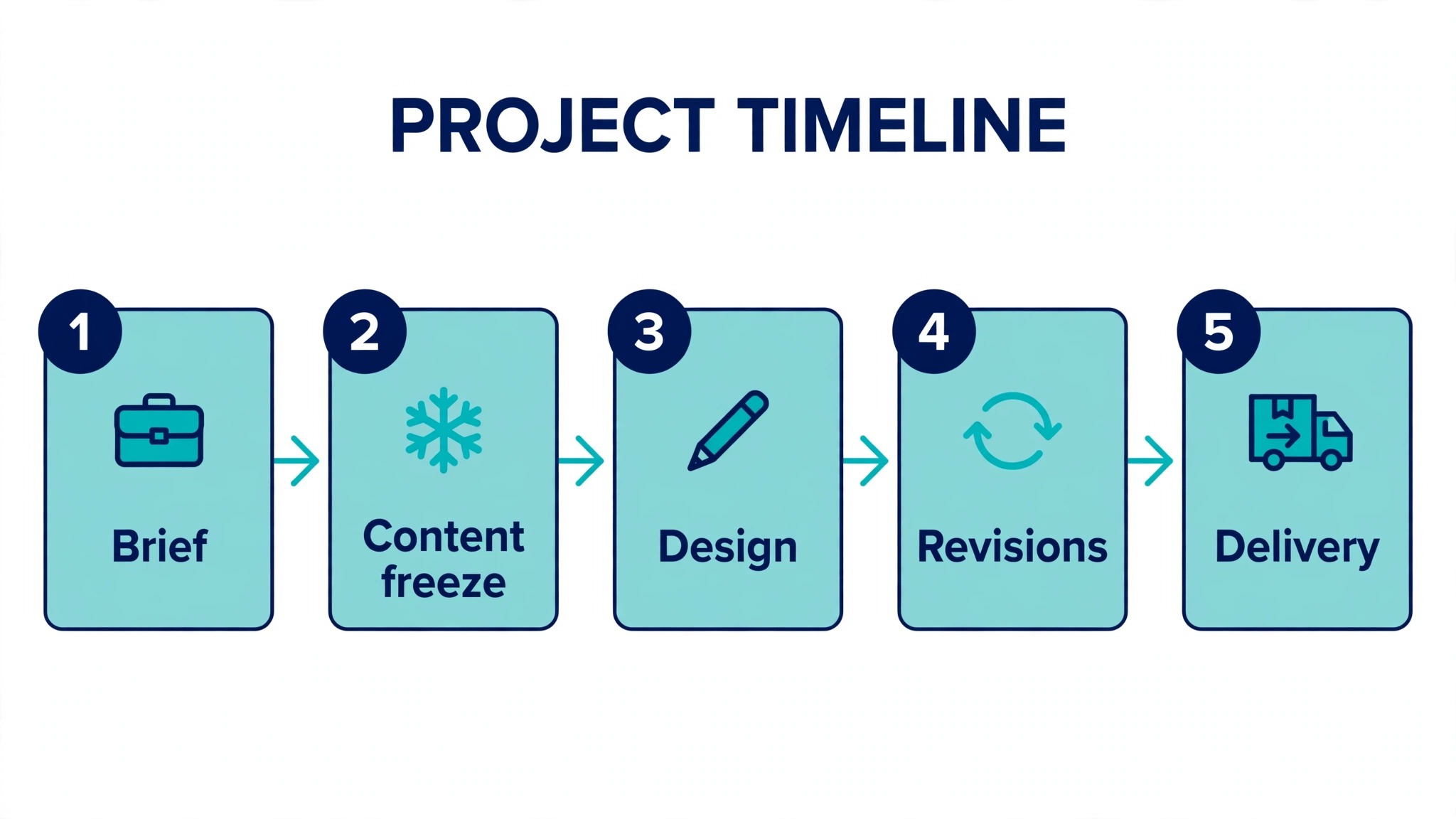
Late changes are the fourth hidden cost. One extra slide added late costs about 100 to 150 dollars with a freelancer and 200 to 300 dollars with an agency, because it breaks the flow, needs a new layout, and often needs a revision round of its own. Freeze the content before design starts, and treat a late slide as a new mini project with its own price. A content freeze is not bureaucracy. It is the cheapest line in the whole budget.
How to Brief a Designer and Get a Fair Quote
A good brief is short, specific, and honest about what is ready and what is not. Start with the audience, the decision the deck must support, and the one action you want the audience to take. Then list the slide count, the deadline, the revision rounds, the file format, and the brand assets you will supply. Then say what is final and what is still rough, because a designer who knows the content is rough will price the writing, and a designer who finds out later will charge for it as a change.
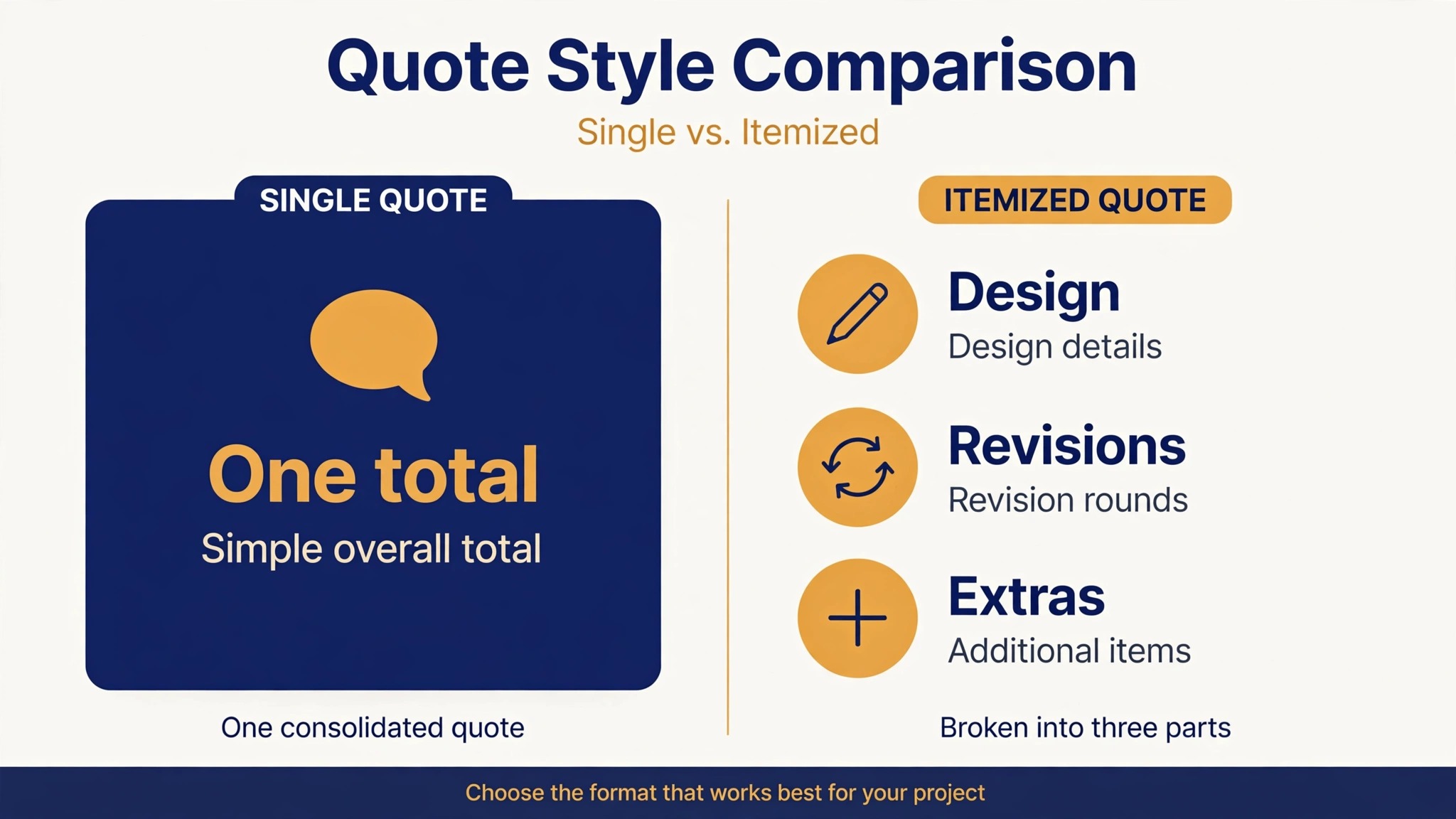
Send the same brief to two or three providers, and ask each one for a written quote that breaks out design, content, charts, revisions, and rush fees separately. A quote that breaks out the parts is a quote you can compare. A quote that gives one number is a quote you cannot challenge, and it is usually the quote that grows. Ask each provider for a sample of a deck in your industry, and ask how they handled a deck where the story was weak. The answer will tell you whether you are hiring a designer or a decorator.
Mistakes That Inflate the Bill
The first mistake is hiring an agency for a routine deck. An agency minimum fee can exceed the entire freelance cost of a 10 slide internal update, and the agency process will take longer than the deck deserves. Match the provider to the stakes, and save the agency budget for the decks that decide money.
The second mistake is starting design before the content is final. Every content change after design starts costs a revision round, and a deck that changes five times costs twice the quote. Freeze the words, freeze the numbers, and then start the design. If the numbers are not final, wait. A late deck with final numbers beats an early deck with wrong ones.
The third mistake is comparing quotes that cover different scopes. A 500 dollar quote with one revision round and no source files is not cheaper than a 900 dollar quote with three rounds and full handover. It is a different product at a different price. Compare the scope line by line, and ask the cheaper provider what the dearer provider includes that they do not. The answer is usually the difference.
The fourth mistake is skipping the test slides. Two paid test slides will show you the designer working style, the communication speed, and the quality of the thinking, before you commit to a full deck. A test costs 50 to 150 dollars, and it can save you a 2,000 dollar mistake. It is the cheapest insurance in the whole process.
Best Pick by Job
Different decks need different providers, so choose by the job, not by the lowest per slide number. The table below matches the common jobs to the provider that fits each one, using the ranges researched for this guide.
| Your job | Best pick | Why it fits | Typical cost |
|---|---|---|---|
| Routine internal update | Canva or PowerPoint | Content final, stakes low | Subscription only |
| One off client deck | Experienced freelancer | Senior thinking, one owner | 25 to 75 dollars a slide |
| Investor or board deck | Agency or senior freelancer | Story and strategy matter | 1,500 to 5,000 dollars |
| Weekly decks at volume | Subscription studio | Volume makes the monthly plan pay | About 500 to 1,500 dollars a month |
| First draft or brainstorm | Gamma or Beautiful.ai | Speed matters more than polish | Free to start, paid plans vary |
| Sales deck plus template | Mid level freelancer | Template becomes a team asset | 1,200 to 1,700 dollars, 30 slides |
Check the price at checkout before you buy a tool, because vendors change list prices during the year and regional prices vary. A provider that fits your workflow at a fair price is worth more than a cheaper provider that fights you on every revision. Get two written quotes against the same brief, and choose the provider whose scope you understand, not the provider whose headline number is lowest.
Frequently Asked Questions
How much does presentation design cost per slide in 2026?
Most freelancers charge 10 to 150 dollars per slide, with the common range for professional work at 20 to 75 dollars per slide. Basic cleanup sits at 10 to 39 dollars a slide, standard design at 20 to 50 dollars, and premium agency work at 250 to 600 dollars a slide. The right range for your deck depends on the tier, the content readiness, and the stakes of the meeting.
How much does a 10 slide deck cost?
A 10 slide deck costs 150 to 500 dollars with a marketplace or mid level freelancer for cleanup or standard design, 500 to 1,500 dollars with a mid level freelancer for a polished client deck, and 1,500 to 3,000 dollars with an agency. A do it yourself deck in Canva or PowerPoint costs little more than the subscription you already pay, plus your time.
What does an agency charge for a pitch deck?
Agency pitch decks usually start around 1,500 dollars and run to 5,000 dollars for a standard investor deck, and to 10,000 dollars or more when the work includes strategy, workshops, messaging, and a reusable template. The price reflects a team, not a single designer, and the story work is the largest part of what you are buying.
Is it cheaper to hire a freelancer or use a design tool?
A design tool is cheaper in cash for routine decks, because Canva Pro costs 18 dollars a month and PowerPoint is already in most office subscriptions. A freelancer is cheaper in time and quality for decks that matter, because a senior designer will finish in hours what takes a non designer days. Use a tool for internal decks, and hire a person for decks that decide money.
What is usually not included in a per slide price?
A per slide price usually covers visual work only, turning approved content into finished slides. Content writing, custom charts, extra revision rounds, rush fees, stock licences, and source file handover are often extra. Ask for a written quote that breaks out each part, so you can see what is included before work starts.
How can I reduce presentation design cost without losing quality?
Finish the content before you hire, freeze the numbers, limit custom charts to the ones the audience truly needs, start a week earlier to avoid rush fees, and use a template for routine decks. Those five steps cut the bill more than any negotiation, because they cut the hours the designer has to spend, and hours are what the price is made of.
The Final Word
Price a deck by its stakes, not by its slide count. A routine update deserves a tool and an hour of your time. A client deck deserves a good freelancer and a clear brief. A pitch that decides funding deserves an agency or a senior specialist, a proper story, and a budget that matches the meeting. Spend where the decision lives, save where it does not, and the money will follow the value instead of the other way round.