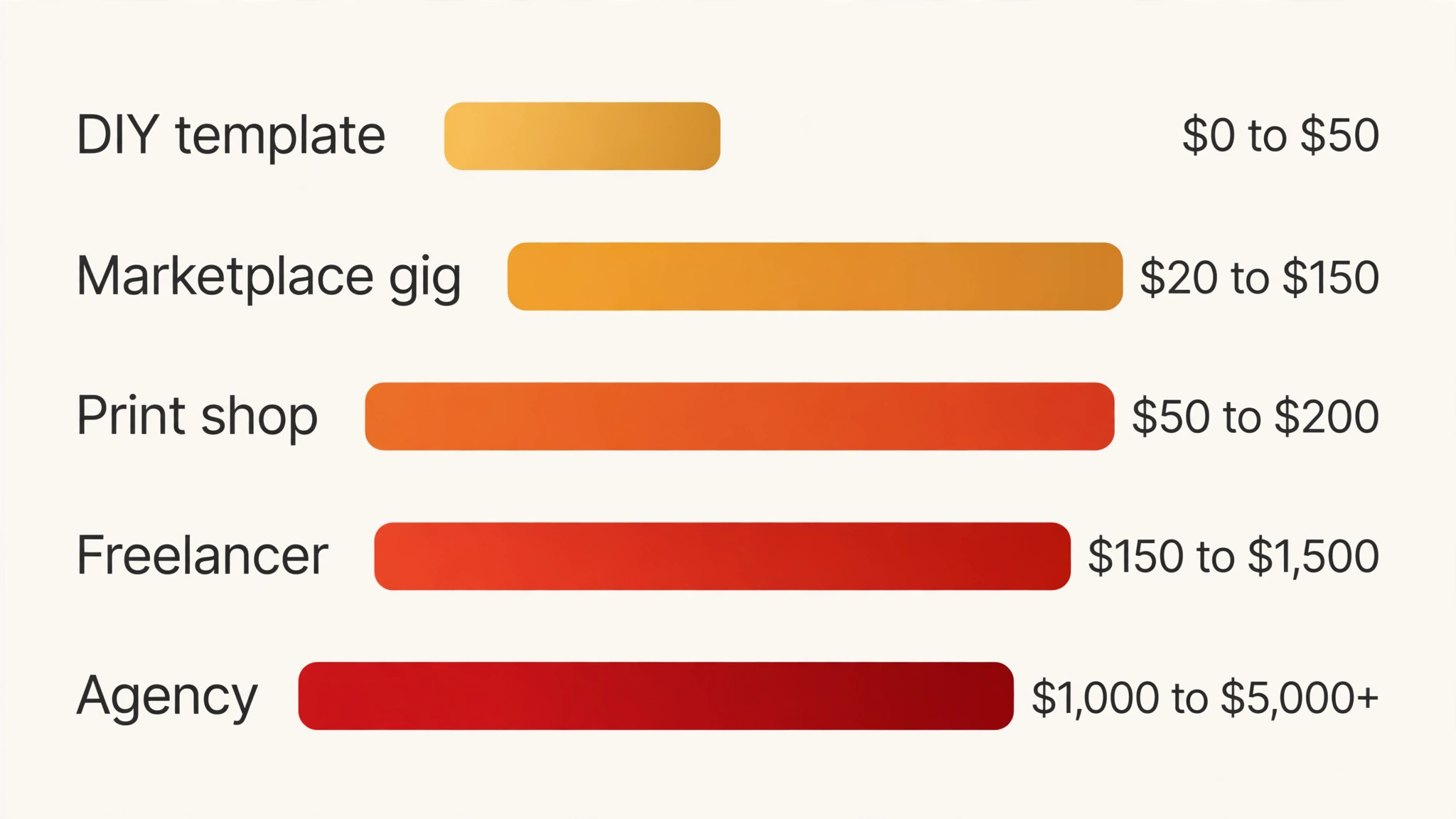
Opening a restaurant, budget 150 to 600 dollars for a one page menu from a freelance designer, and treat anything under 100 dollars as a template job, not a custom design. That range is the honest middle of menu design cost for restaurants in 2026. A template costs only your time, a marketplace gig runs 20 to 150 dollars, and an agency starts near 1,000 dollars and passes 5,000 as part of a full brand job. The first version is only half the bill. Menus change with seasons, prices, and suppliers, so a year of updates often costs as much as the design. This guide breaks down every route, what each one buys, and the budget for the year after.
What to Budget, in Short
Menu design cost for restaurants runs from zero to more than 5,000 dollars, and the spread is real. The price follows the person doing the work, the number of pages, and whether the menu is a single sheet or part of a brand. A cafe with twelve items can open for the price of a template and an afternoon. A fine dining restaurant with a tasting menu, a wine list, and a dessert card needs a designer who thinks about pacing, photography, and print, and that work costs real money. The table below gives the ranges restaurants are commonly quoted in 2026, so you can check any quote against the market before you sign.
| Route | Typical cost | Turnaround | Best for |
|---|---|---|---|
| DIY template | 0 to 50 dollars | Same day | Cafes and food trucks |
| Marketplace gig | 20 to 150 dollars | 2 to 5 days | Simple menus |
| Print shop | 50 to 200 dollars | 2 to 5 days | Menus you print there anyway |
| Freelancer | 150 to 1,500 dollars | 1 to 2 weeks | Openings and refreshes |
| Contest | 159 to 819 pounds | About a week | Many concepts to choose from |
| Agency | 1,000 to 5,000 dollars or more | 2 to 6 weeks | Full brand work |
| Subscription | 499 to 699 dollars a month | 1 to 2 days per request | Frequent changes |
| In-house | 3,500 dollars a month or more | Ongoing | Multi-location groups |
Use these ranges to check a quote, not as a price list. A quote below the range usually means a template with your text dropped in, and a quote above it usually means photography, illustration, or brand work folded into the price. Ask what is included before you compare numbers, because a 300 dollar quote that includes print files and two rounds of revisions is cheaper than a 150 dollar quote that charges extra for both.
Menu Design Cost for Restaurants by Route
There is no single right way to get a menu designed. There are eight common routes, and the right one depends on your budget, your timeline, and how often the menu will change. Each route below gives the price, the turnaround, and the trade off, so you can pick with open eyes.
DIY Template
A do it yourself menu costs nothing but your time if you use a free template, or up to 50 dollars for a premium template and a month of a tool like Canva Pro. Expect 8 to 15 hours for a clean result, including typing dishes, setting prices, and fixing the layout. The result can look good, especially for a short cafe or food truck menu with a handful of items. The limits are your hours, a shared look, and print setup you must get right yourself. If the menu has more than twenty items or must match an existing brand exactly, the template route costs more in time than it saves in money.
Marketplace Gig
Marketplaces like Fiverr list menu design gigs from 5 dollars, with typical finished prices between 20 and 150 dollars for a one page menu. Delivery usually takes 2 to 5 days. What you get is usually an edited template with your dishes and prices dropped in, and the print file and the editable source are often paid add-ons. That is fine when clean and readable is the goal and the budget is tight. It is not fine when you need an original layout, a menu that matches a brand, or a designer you can call back for updates. Read the gig description before you order, and check whether revisions and the source file are included in the price shown.
Print Shop Design
Many print shops offer design for 50 to 200 dollars, often folded into the print order itself. Turnaround is 2 to 5 days, and updates are usually a small fee or free with a reprint. This route makes sense when you print there anyway, because the shop knows its paper, sizes, and bleed settings, and the file will print correctly the first time. The trade off is that design is a side service for a print shop, and the finished file may stay with the shop instead of coming home with you. Ask who owns the editable file before you start, because a file you cannot take elsewhere locks you into that shop for every future update.
Freelance Designer
A freelance designer is the middle path most independent restaurants take. One page menus commonly run 150 to 600 dollars, and a folded or multi-page menu runs 400 to 1,500 dollars. Hourly rates run 25 to 150 dollars by experience and location, and a full menu project usually takes 10 to 30 hours. Turnaround is 1 to 2 weeks, with 2 to 5 revision rounds. Upwork data puts typical menu projects at 200 to 800 dollars, with a single page specials layout at 200 to 400, a standard menu at 400 to 600, and a multi-section digital menu at 600 to 900. Every update is a new quote, so agree on an update rate before the first version ships.
Design Contest
A design contest on 99designs puts your brief in front of many designers at once, and you pick the winning concept. UK pricing lists four tiers at 159, 249, 489, and 819 pounds, with roughly 30 to 50 concepts depending on the tier. You get many directions to choose from, a production ready file in Illustrator, Photoshop, PDF, or EPS format, and full copyright in the design. The contest model suits owners who know what they do not want better than what they do, because seeing thirty approaches makes the choice clear. The cost is higher than a single freelancer for the same pages, and the process takes about a week from brief to final files.
Agency
An agency commonly charges 1,000 to 5,000 dollars or more for menu design, usually as part of brand work rather than a standalone job. The price buys a team, not a person. Strategy, menu engineering, custom illustration, original food photography, and formats for print, digital, and in-store displays can all sit inside one engagement. Turnaround runs 2 to 6 weeks, and updates are billed hourly or on retainer. Agencies make sense for fine dining restaurants, multi-location groups, and brands going through a full visual overhaul. For a single independent restaurant that needs one good menu, an agency is usually more firepower than the job requires.
Design Subscription
Subscription design services charge a flat monthly fee for unlimited requests, and menus are a common job. ManyPixels starts near 699 dollars a month, Penji lists plans from about 499 a month, and Kapa99 lists 499 dollars a month with the first two months at 349. Turnaround is 1 to 2 days per request, and updates are included, which is the real advantage. A menu that changes with the season, plus the boards, posts, and flyers around it, fits this model well. A stable menu that changes once a year does not, because the subscription keeps charging through quiet months. Add up a year of fees before you sign, and compare it with a freelancer plus a few paid updates.
In-House Designer
Hiring a designer in house costs 3,500 dollars a month or more, and salary guides put a full time restaurant group designer at 45,000 to 100,000 dollars a year. That only makes sense for a multi-location group or a restaurant group with constant design needs across menus, packaging, signage, and web. The advantage is a designer who knows your fonts, your food photography style, and your brand without being re-briefed. The cost is a salary, benefits, and management time. For a single restaurant, an in-house designer is the most expensive way to get a menu, and a freelancer or a subscription will serve you better.
What Moves the Price Up or Down
Five factors decide where your menu lands inside the ranges above, and knowing them helps you control the quote instead of just accepting it. These five factors shape menu design cost for restaurants more than the route you pick.
The first factor is page count. A one page menu is a single layout problem. A folded menu is two or three layouts that have to work together, and a multi-page menu with a wine list and a dessert card is a small book. Each added page adds design time, proofreading time, and print cost.
The second factor is photography. Stock photos cost little, and a designer can source them inside the quoted price. Original food photography is a separate shoot, and it can cost as much as the design itself. Photos sell dishes, and research cited by restaurant design services puts the sales lift from a photo next to an item at up to 90 percent, so photography can pay for itself on the right dishes. It is still a separate budget line, and it should be quoted separately.
The third factor is illustration and custom artwork. A hand drawn map, a custom icon set, or an illustrated border takes hours a template never needs. The result is distinctive, and it is the main reason a menu looks designed rather than assembled. Budget for it as a separate line if you want it.
The fourth factor is revisions. Most quotes include 2 to 5 rounds. Each round beyond that is billed, and a menu that goes through eight rounds because the dish list kept changing will cost far more than the quote. Freeze the dish list and the prices before design starts, and the revision count stays inside the quote.
The fifth factor is the designer’s location and experience. A senior designer in a major city charges more than a junior designer in a smaller market, and the difference shows in the work. The cheapest quote is rarely the cheapest outcome, because a menu that needs a redesign in six months costs twice.
Printing Costs: What the Design Does Not Include
Design and printing are two bills inside menu design cost for restaurants, and owners who budget for one and forget the other get a surprise. A design quote usually covers the digital file. Printing covers paper, ink, finishing, and quantity, and it varies so widely that no single number is honest. A short run of laminated single sheets for a cafe costs far less than a run of thick folded menus with a soft touch finish for a fine dining room.
Paper choice drives the price more than most owners expect. Standard coated stock is the cheapest option and works for most menus. Heavier uncoated stock feels better in the hand and costs more. Laminated menus survive spills and daily handling, which is why busy cafes choose them, and lamination adds a per piece cost. A menu cover in leather or linen is a different product entirely, with a price to match.
Quantity changes the unit price sharply. Printing 50 menus costs far more per menu than printing 500, because setup is fixed and paper is the variable part. That creates a trap. Ordering 500 to get the unit price down is only a saving if you use all 500 before the menu changes. A menu that changes every season should be printed in small runs, even at a higher unit price, because the reprint of an outdated menu is pure waste.
Ask your printer for a quote that separates design, paper, finishing, and delivery, and ask for the price at two quantities, such as 100 and 250. The comparison shows where the money goes, and it stops the design fee from hiding inside the print bill. If your designer and your printer are different people, make sure the designer delivers a print ready PDF with bleed and the right color mode, or the printer will charge to fix the file.
Digital Menus and QR Menus: The Extra Budget Line
A printed menu is no longer the only menu. Most restaurants now run a digital menu too, whether it is a PDF behind a QR code, a page on the website, or a screen on the wall. The digital version needs its own budget, and it is smaller than the print budget but not zero.
A QR menu starts with the same design file, exported as a PDF or built as a web page. The design for a digital menu commonly runs 100 to 1,500 dollars, depending on whether it is a simple export of the print file or a separate layout built for phones. The QR code itself is free to generate, and the printing of table tents or stickers is a small extra.
A menu board or a digital screen is a bigger job. Hardware for a screen and a player commonly runs 150 to 3,500 dollars, software runs 10 to 50 dollars a month, and the initial screen design runs 100 to 1,500 dollars. The advantage is updates. Changing a price on a screen takes minutes, while changing a price on a printed menu takes a reprint. Restaurants that change prices often recover the hardware cost in avoided reprints within a year.
The cheapest path is to design once and export twice. Build the print menu first, then export a phone friendly version from the same file, with larger text and a single column layout. A PDF that is a shrunken copy of the print menu is hard to read on a phone, and guests who pinch and zoom are guests who stop reading. Budget a few extra hours for the phone version, or ask the designer to include it in the quote.
The Yearly Cost Nobody Budgets For
A menu is never finished. Food costs move, the season turns, a supplier drops an item, and a dish gets cut. Every change has to reach the dine-in menu, the takeout sheet, the board, and the PDF behind the QR code. Over a year, the updates often cost as much as the design did, which is the part of menu design cost for restaurants that owners forget to budget.
A freelancer commonly charges 25 to 100 dollars per updated version, depending on how much changes. A price change on one page is a small job. A seasonal rewrite with new dishes and new photos is a larger one. An agency bills updates hourly or on retainer. A subscription service includes updates in the monthly fee, which is the main reason a subscription can beat a freelancer for a restaurant that changes its menu monthly.
Plan the update budget before you approve the first design. Set aside the cost of three to four updates in the first year, and agree on an update rate with the designer in writing. The cheapest way to cut update costs is to build the file so prices and items can change without a redesign. Ask for the editable source file, and ask the designer to set the menu up so a price change is a text edit, not a layout rebuild.
Menu Design Cost by Restaurant Type
A cafe with a short menu and a single page can be open for the price of a template or a small marketplace gig, and that is a reasonable choice. The menu has few items, the brand is simple, and the owner can update it in an afternoon. The risk is a menu that looks like every other cafe, which matters less when the coffee is the reason people come.
A casual restaurant with thirty to fifty items across several sections needs a freelancer. The menu has to guide the eye, separate starters from mains, and keep prices readable. Budget 400 to 900 dollars for a multi-section menu from a mid-level freelancer, and expect the design to take one to two weeks.
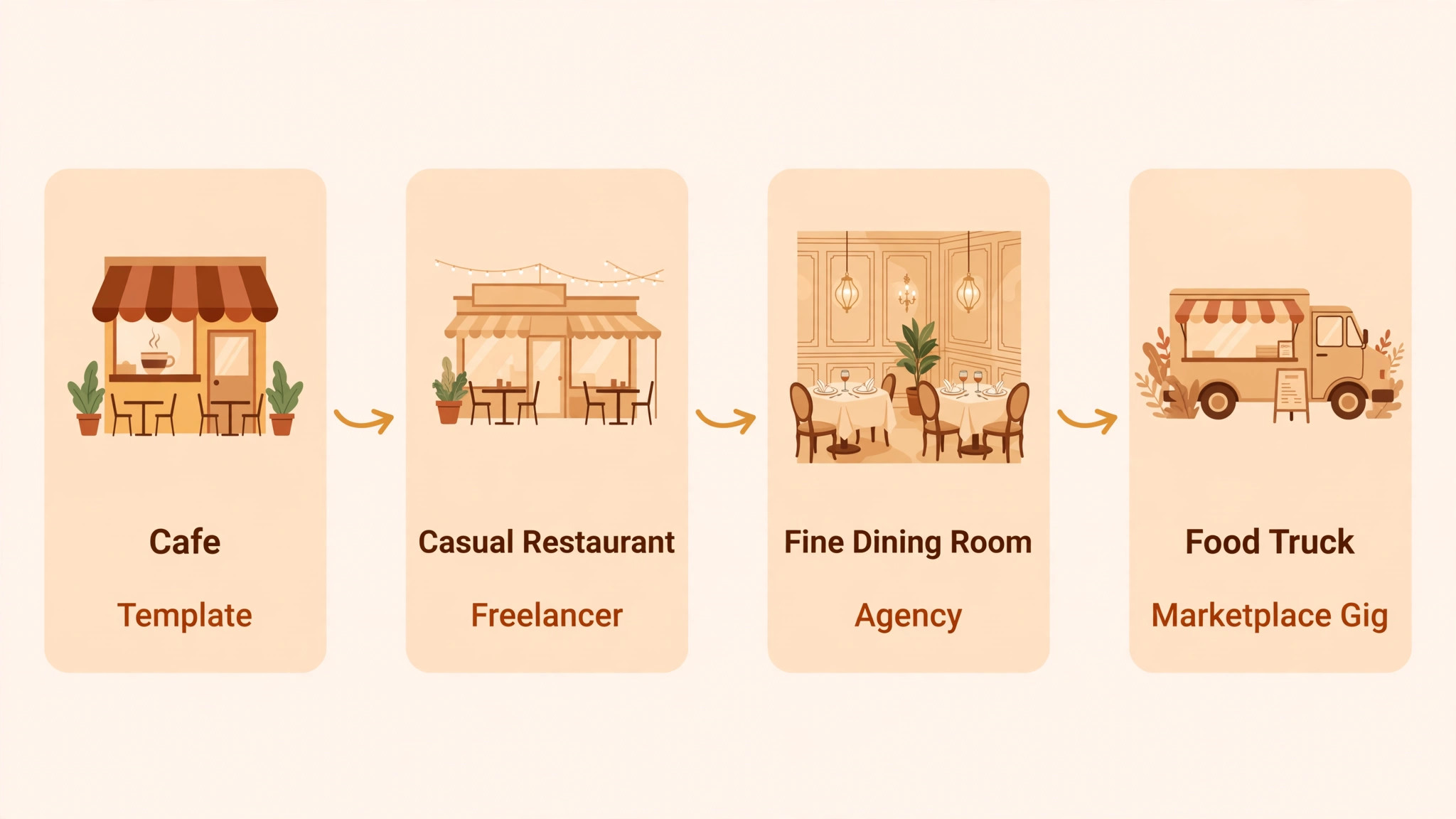
A fine dining restaurant needs an agency or a senior freelancer, because the menu is part of the experience. Tasting menus, wine lists, and dessert cards each need their own treatment, and the paper and finishing matter as much as the layout. Budget 1,500 to 5,000 dollars for design, and budget separately for photography and print.
A food truck needs a short, bold menu that reads from a distance and a digital version for social posts. A template or a marketplace gig covers it, and the money is better spent on the board and the photos than on the layout. A multi-location group needs consistency across sites, which means a brand system and a designer on retainer or in house, because every location must match and every update must roll out everywhere at once.
How to Get a Quote You Can Compare
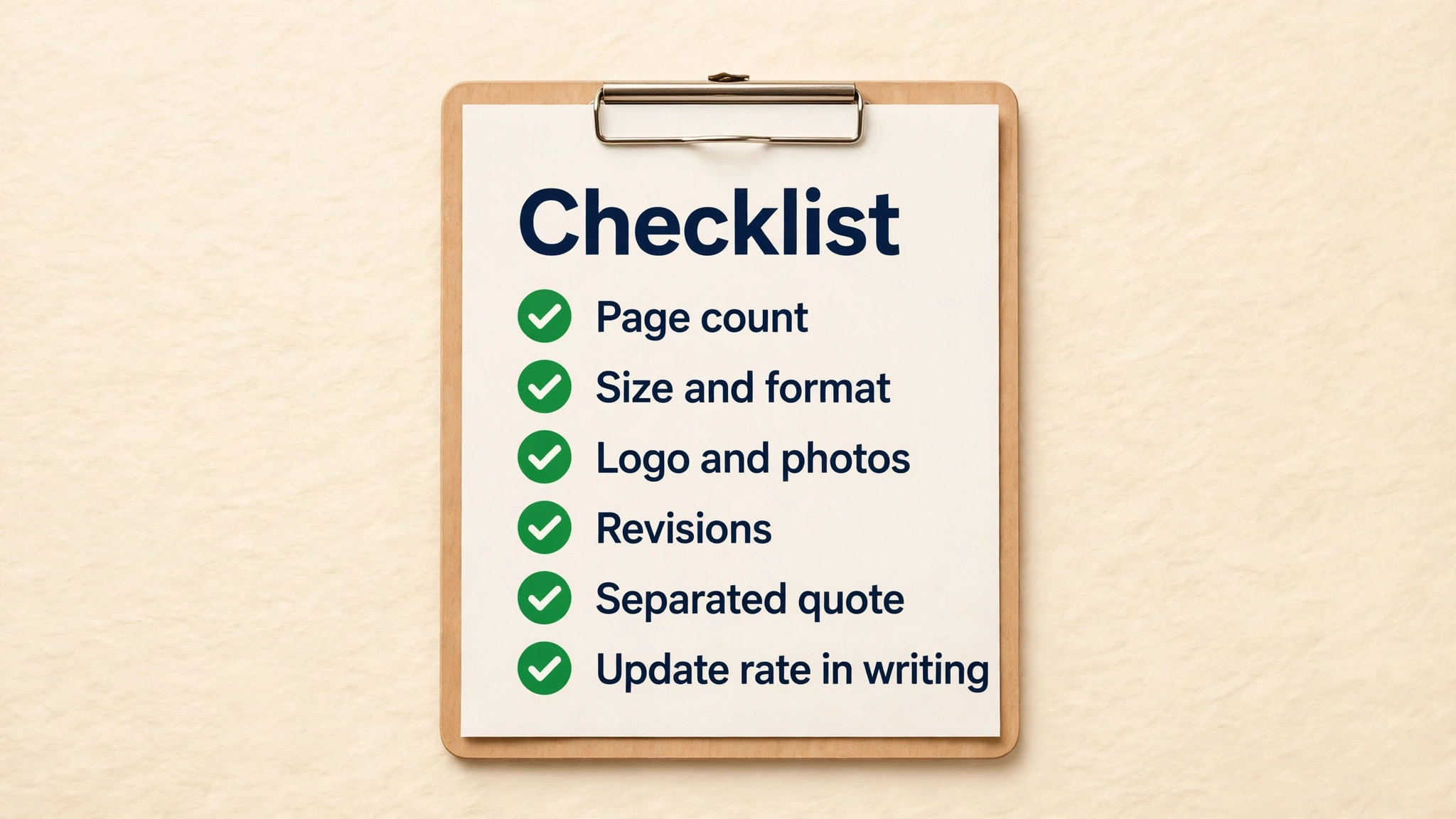
Quotes are only comparable when they describe the same job. Send every designer the same brief, and the quotes will line up. A good brief fits on one page and answers the questions a designer will ask anyway.
- State the menu type, the number of items, and the number of pages, including any wine list, dessert card, or takeout version.
- State the size and the format, such as a single sheet, a folded menu, or a board, and whether you need a print file, a PDF for QR codes, and a phone version.
- Attach your logo, your brand colors, and any photos you want used, and say whether the designer should source stock photos or shoot new ones.
- State how many rounds of revisions you expect, who approves the final version, and the date the menu must be in hand.
- Ask for the quote to separate design, photography, illustration, and print, and ask who owns the editable file when the job is done.
- Ask for the update rate in writing, so the first price change does not become a new negotiation.
Send the brief to three designers, compare the quotes line by line, and call the middle quote to talk through the job. The cheapest quote usually leaves something out, and the most expensive quote usually includes something you did not ask for. The conversation tells you which is which.
Hidden Costs to Watch For
A menu quote can grow after you sign, and the growth usually comes from five extras that were never in the first number. Ask about each one before you agree to anything.
Rush fees are the most common. A designer who normally needs two weeks can often deliver in three days, but the speed costs extra, sometimes 25 to 50 percent on top of the quote. If the opening date is fixed, say so in the brief, and let the designer price the rush honestly instead of discovering it later.
Font and photo licensing is the second extra. A font that looks perfect may need a commercial license, and a stock photo may need an extended license for print runs over a certain size. The designer should flag licensed assets before using them, and the quote should say who pays the license fee.
File ownership is the third. Some low quotes cover the finished PDF only, and the editable source file costs extra or stays with the designer. Without the source file, every future update means going back to the same person at whatever rate they name. Pay for the source file once, and the menu stays yours.
Reprints are the fourth. A typo found after printing means a reprint, and a reprint means paying for paper and press time again. Proofread the menu three times, with a fresh pair of eyes on the last pass, and check every price against the point of sale system before the file goes to print.
Translation is the fifth, for restaurants in multilingual areas. A second language version is a second layout job, not a copy and paste, because text length changes and the layout has to be rebalanced. Budget it as its own line if you need it, and use a translator who knows food terms rather than a machine translation.
What a Good Menu Earns Back
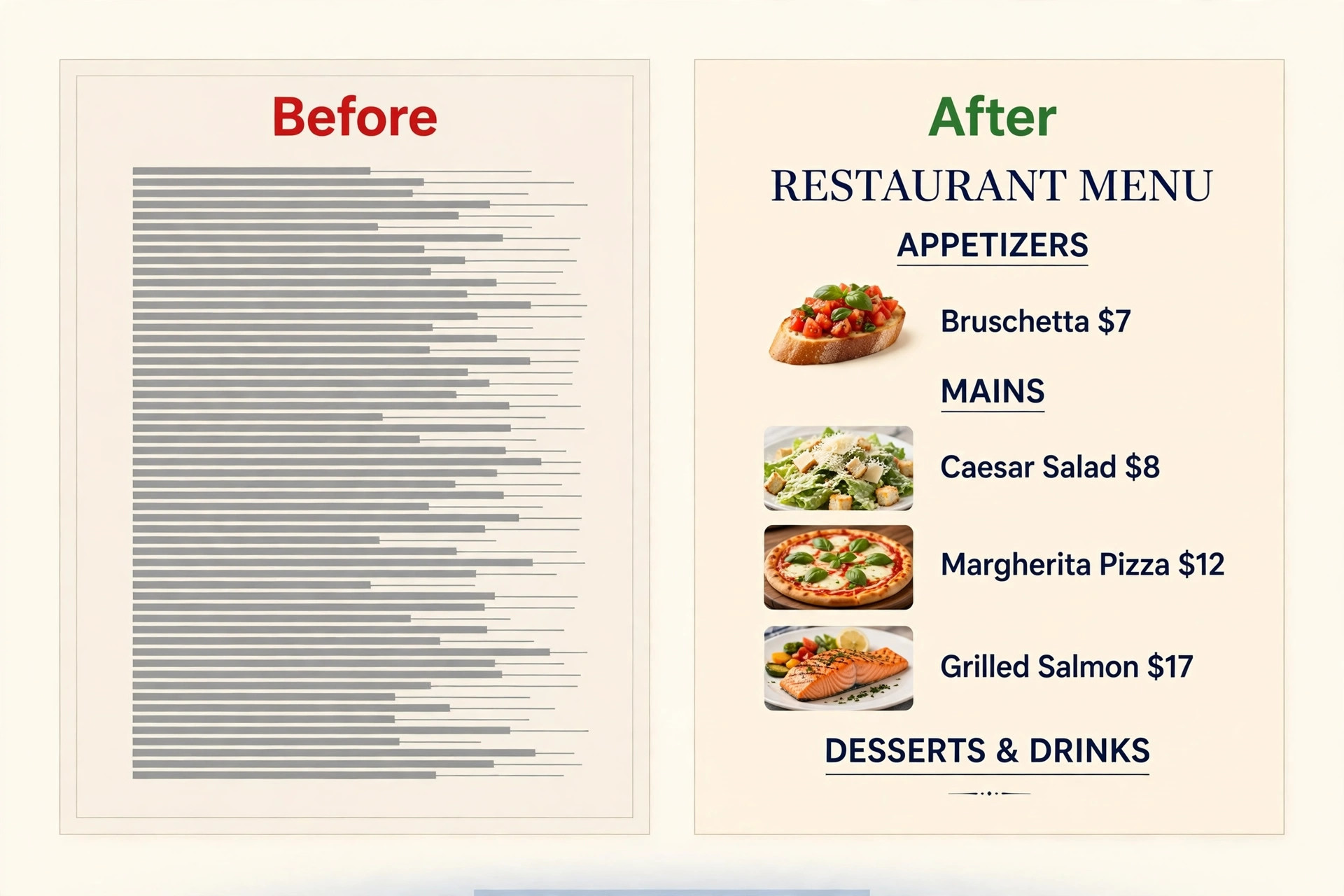
A menu is a sales tool, not a decoration, and the return shows up in the average spend per table. Research on menu psychology has found that removing dollar signs from prices lifts average spend by 8 to 12 percent, a finding from Cornell University that restaurants have used for years. The reason is simple. A price written as 24 reads as a number, while a price written with a dollar sign reads as money leaving the wallet, and guests order more freely when the reminder is gone.
Photos work the same way. A photo next to a dish can lift sales of that item by up to 90 percent, according to research cited by restaurant design services. The effect is strongest on signature dishes and desserts, where the photo does the selling that words cannot. That is why the photography budget deserves its own line. A menu that costs 500 dollars to design and earns an extra 2 dollars per table pays for itself in a few hundred covers.
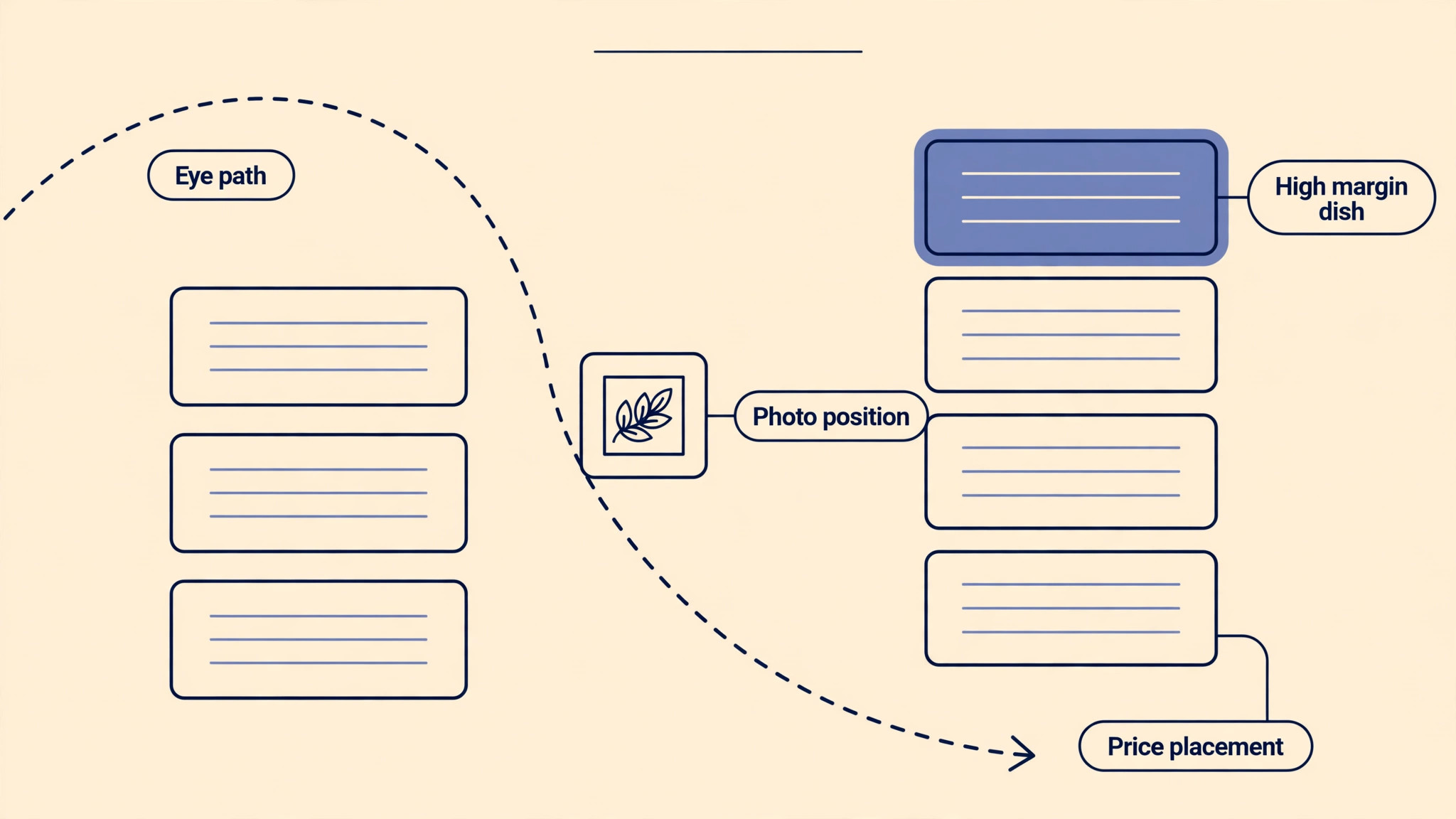
Layout earns money too. The items a restaurant wants to sell most should sit where the eye lands first, which is usually the top right of a page or the top of a column. Grouping dishes into clear sections with short descriptions helps guests decide faster, and faster decisions mean faster table turns at lunch. None of this requires a bigger budget. It requires a designer who thinks about selling, not just about looking good, and a brief that says which dishes matter most. When you weigh menu design cost for restaurants against the extra spend per table, the design stops looking like an expense and starts looking like the cheapest marketing a restaurant can buy.
Best Pick by Budget
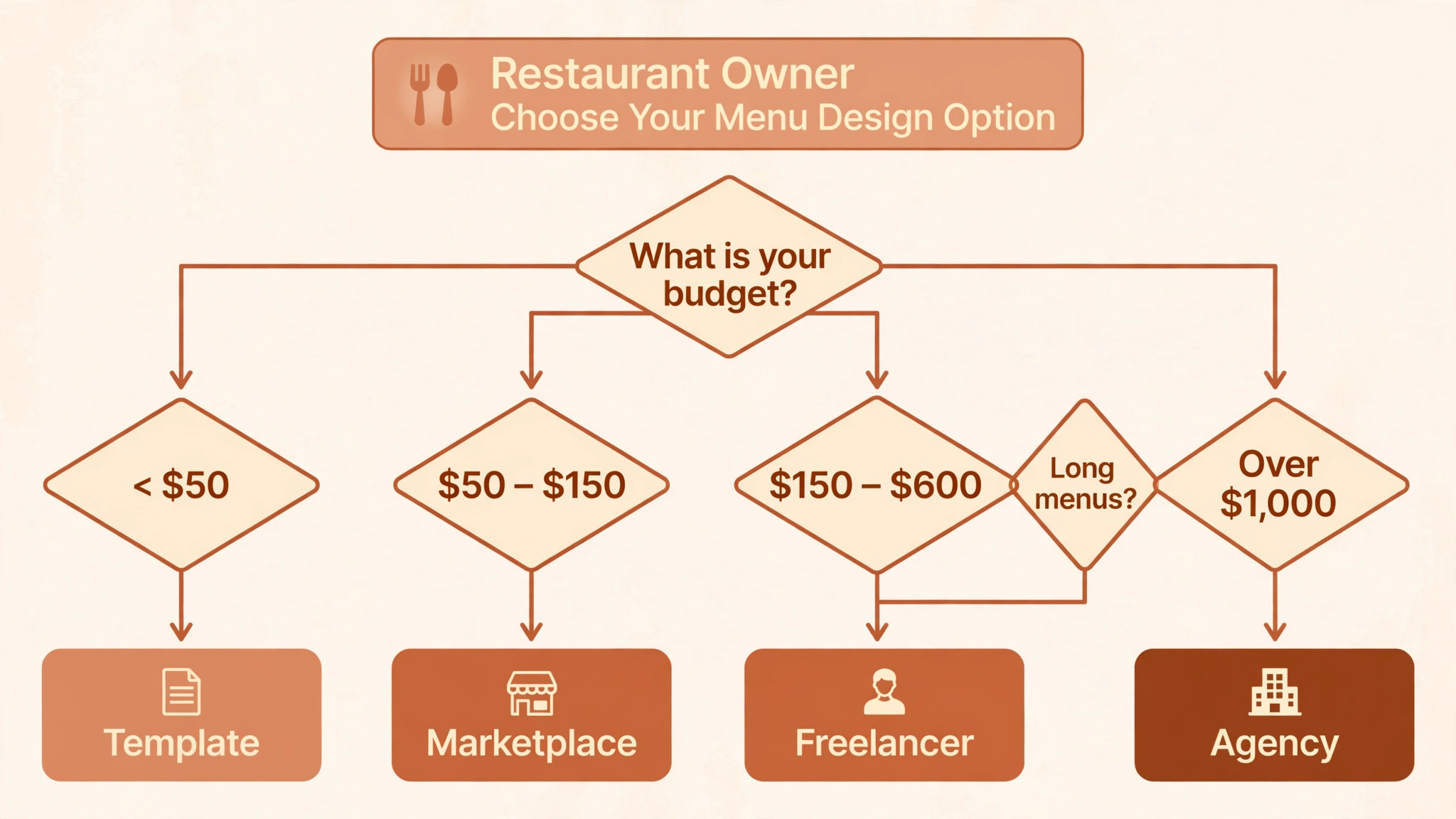
| Budget | Pick | Why it fits |
|---|---|---|
| Under 50 dollars | DIY template | Fast, free, and fine for a short menu |
| 50 to 150 dollars | Marketplace gig | Clean one page menu without doing it yourself |
| 150 to 600 dollars | Freelance designer | Original one page menu for an opening |
| 400 to 1,500 dollars | Freelance designer | Multi-page menu with sections and a wine list |
| 1,000 to 5,000 dollars | Agency | Menu as part of a full brand rebuild |
| 499 to 699 dollars a month | Design subscription | Menus that change monthly plus social and flyers |
| 3,500 dollars a month or more | In-house designer | Multi-location group with constant design needs |
The table above answers the only question that matters, which is what your budget actually buys. Match the route to the menu, not to the cheapest number, and put the update rate in writing before the first version ships. A menu that costs 300 dollars and updates for 25 dollars a version is cheaper over two years than a menu that costs 100 dollars and updates for 150 dollars a version, because the updates are where the real money goes.
Frequently Asked Questions About Menu Design Cost
How much does it cost to design a restaurant menu?
The honest answer to menu design cost for restaurants is that a one page menu from a freelance designer commonly runs 150 to 600 dollars, and a folded or multi-page menu runs 400 to 1,500 dollars. A template costs nothing but your time, a marketplace gig runs 20 to 150 dollars, and an agency starts near 1,000 dollars. Printing, photography, and yearly updates are separate, so budget for those too.
How much does it cost to print restaurant menus?
Printing has no single price inside menu design cost for restaurants, because paper, finish, and quantity decide it. A short run of laminated single sheets for a cafe costs far less than a run of thick folded menus with a soft touch finish. Ask your printer for a quote that separates design, paper, finishing, and delivery, and ask for the price at two quantities, such as 100 and 250, so you can see where the money goes.
Should I hire a freelancer or an agency for my menu?
Hire a freelancer for a single restaurant that needs one good menu. A freelancer gives you an original design at a fair price, and the relationship is simple. Hire an agency when the menu is part of a full brand rebuild, when you need photography and illustration as well as layout, or when several locations must match. The agency costs more because a team does the work, and the result covers every format at once.
What is the cheapest way to design a menu?
The cheapest way is a free template in Canva or a similar tool, which costs nothing but 8 to 15 hours of your time. The next cheapest is a marketplace gig from 20 dollars. Both work for a short menu with few items. The cheapest option stops being cheap when the menu is long, the brand is specific, or the menu changes often, because the time and the update costs add up faster than a freelancer’s fee.
How much should I budget for menu updates each year?
Set aside the cost of three to four updates in the first year. A freelancer commonly charges 25 to 100 dollars per updated version, depending on how much changes, so a year of updates can run 100 to 400 dollars on top of the design. Agree on an update rate in writing before the first version ships, and ask for the editable source file so a price change is a text edit rather than a rebuild.
Does a good menu actually increase sales?
Yes, when the design is built to sell. Removing dollar signs from prices has been linked to an 8 to 12 percent lift in average spend, and a photo next to a dish can lift sales of that item by up to 90 percent. The layout matters too, because the dishes a restaurant wants to sell most should sit where the eye lands first. A menu designed with selling in mind earns its cost back in extra spend per table, often within a few hundred covers.