Threads rewards conversation, not broadcasting, and that is why most small business accounts stall at fifty followers. The app is built for short text posts, quick replies and real talk, and a business that treats it like a billboard gets ignored. A business that treats it like a shop counter, where the owner answers every question in public, gets followed. That is the starting point for any small business threads marketing strategy, and it is the habit this guide builds.
Threads launched in July 2023 as a text-first app from Meta, tied to Instagram, and it passed 100 million users in its first week. Posts run to 500 characters, replies sit at the centre of the feed, and the algorithm shows posts from accounts a user does not follow when the post earns replies. A small business with no budget can reach people it has never met, as long as the posts start conversations instead of pushing offers.
The third thing to know is the pace. Threads moves faster than Instagram and slower than X, and a business that posts once a week disappears. A business that posts once a day and replies to five other accounts a day stays visible, and the whole routine takes about thirty minutes. That is the promise of this guide: a small business threads marketing strategy that fits in half an hour a day, with a weekly plan, post types that work, and numbers that tell the truth.
This guide is written for a business with one owner, one phone and no ad budget. It covers the profile, the first thirty days, the seven moves that build an audience, and the weekly plan that keeps it going. Follow the plan for a month, and the account will have a real audience. Skip the replies, post only offers, and the account will stay at fifty followers.
The Quick Shortlist
The short version first, for a business that wants the plan without the reading. A good small business threads marketing strategy has five parts: a profile that says what the business sells in one line, one post a day, five replies a day, one offer a week, and a weekly check of four numbers. Everything in this guide hangs off those five parts.
| Part | What it means | Time per day |
|---|---|---|
| Profile | One line that says what you sell and who it is for | 10 minutes once |
| Daily post | One short post, one idea, one question at the end | 10 minutes |
| Five replies | Five real replies on other accounts in your niche | 10 minutes |
| Weekly offer | One post a week with a clear offer and a link | 10 minutes a week |
| Weekly check | Four numbers, checked every Friday | 10 minutes a week |
Read the reply row first, because replies are where the growth comes from. Threads shows your replies to the followers of the account you replied to, so five good replies a day put the business in front of five new audiences. A business that only posts and never replies grows slowly, if at all.
Read the offer row second, because one offer a week is enough. Threads users ignore accounts that sell every day, and they buy from accounts that help every day and sell once a week. The ratio is six helpful posts to one selling post, and that ratio is the oldest rule in this guide.
How We Judged a Good Threads Strategy
A good Threads strategy is judged by leads, not likes, because a like never bought anything. This guide scores every move on four tests: does it start a conversation, does it reach people who do not follow the account yet, does it cost nothing but time, and does it lead to a click, a message or a sale. A move that fails two of those tests does not make the plan.
The first test is conversation. Threads is a reply-first app, and the algorithm rewards posts that earn replies, not posts that earn likes. A post that ends with a question earns replies. A post that ends with a link earns nothing. The second test is reach, because a small account needs new eyes more than it needs applause from the same fifty followers. Replies, reposts and quoted posts reach new people. Likes do not.
The third test is cost, because a small business has no ad budget to hide behind. Every move in this guide costs nothing but thirty minutes a day. The fourth test is the lead, because a strategy that builds an audience and never sells is a hobby. One offer a week, one link in the profile, and one clear call to action in every offer post are the minimum. A strategy that passes all four tests is a strategy worth following for a month.
The Playbook, Step by Step
The playbook has seven moves, and they run in order. Do the first two in week one, add the next three in week two, and run all seven from week three onward. Each move takes ten minutes or less, and the whole day takes about thirty minutes.
1. Fix the Profile Before the First Post
Open the profile and rewrite it in one line that says what the business sells and who it is for. A bakery writes “Sourdough and cakes for weddings in Austin, baked fresh every morning.” A plumber writes “Same-day plumbing in Denver, no call-out fee.” Put the town in the profile, because local customers search by town, and put the link in the bio, because Threads shows one link and it should go to the booking page, not the homepage.
Add a profile photo that shows the owner or the product, not a logo on a white background, because faces get followed and logos get scrolled past. Pin one post that explains the offer, so a new visitor sees the best work first. This move takes ten minutes and it is the foundation for everything else, because a visitor who cannot tell what the business sells in three seconds leaves.
2. Post One Short Post a Day, No More and No Less
Write one post a day, under 200 characters, with one idea and one question at the end. A bakery posts “We sold out of sourdough by 9am today. What should we bake more of tomorrow?” A plumber posts “Three call-outs today, all for the same blocked drain. What is the strangest thing you have found in a drain?” The question is the point, because a post without a question gets likes and a post with a question gets replies.
Post in the morning, when the audience is awake and scrolling, and keep the tone like a shop counter, not a press release. No hashtags on every post, no link in every post, and no sales pitch on six days out of seven. One post a day, every day, beats seven posts on a Sunday and silence for the rest of the week.
3. Reply to Five Accounts a Day in Your Niche
Find five accounts a day in the same town or the same trade, and leave a real reply on each one. A real reply adds something, such as a tip, a question or a short story, and it is at least a sentence long. “Great post” is not a reply, and the algorithm knows it. A bakery replies to a local food blogger, a wedding planner and a coffee shop. A plumber replies to a local builder, a property manager and a home tips account.
Replies are the growth engine, because Threads shows your reply to the followers of the account you replied to. Five good replies a day put the business in front of five new audiences, and one in ten of those readers clicks through to the profile. That is the cheapest reach on any social app, and it costs ten minutes a day.
4. Turn One Post a Week into an Offer
Pick one post a week and make it an offer, with a clear price, a clear deadline and a clear link. A bakery posts “Friday only, sourdough and coffee for 8 dollars, order by Thursday at 6pm, link in bio.” A plumber posts “Drain check for 49 dollars this week only, book through the link in bio.” The offer has a price, a deadline and a link, and it runs once a week, not every day.
The offer post should still sound like the owner, not like an advert, because Threads users ignore adverts and buy from people they trust. Put the offer in the middle of the week, when the account has built a week of helpful posts around it, and pin it for the day. One offer a week, done well, beats seven offers a week that nobody reads.
5. Repost the Best Customer Words
Ask one happy customer a week for a sentence about the business, and repost it with a short thank you. A bakery reposts “The wedding cake was the best part of the day” from a customer, and adds “Thank you, Sarah, we baked it at 5am.” A plumber reposts “Fixed in twenty minutes, no mess left behind” and adds “That is the job, every time.”
Customer words sell better than owner words, because a stranger trusts a customer and doubts a seller. Reposting also gives the account a post that costs nothing to write, and it makes the customer feel seen, which is why they come back. One repost a week, with a real name and a real thank you, is enough.
6. Use One Thread a Week to Teach Something
Write one thread a week, three to five posts long, that teaches one useful thing. A bakery writes a thread on how to keep sourdough fresh for three days. A plumber writes a thread on what to do in the first five minutes of a leak. Each post in the thread is short, each one ends with a hook for the next, and the last one ends with a question.
Threads teach better than single posts, because a reader who finishes a thread has spent a minute with the business, and a minute of attention is worth more than a like. A thread also gives the account a post that gets saved and shared, which is how new followers arrive. One thread a week, on a problem the customer actually has, is enough.
7. Measure Four Numbers and Ignore the Rest
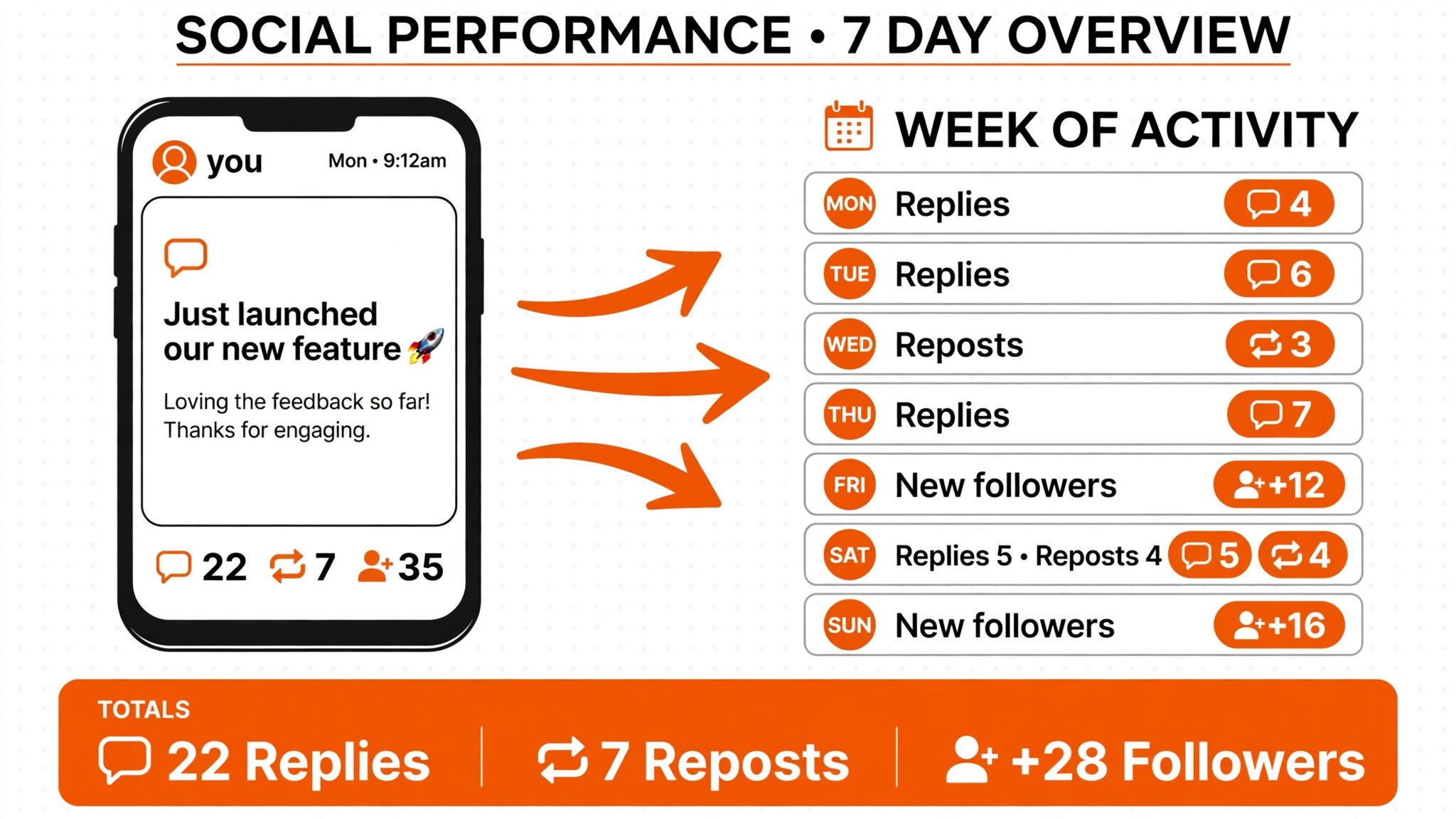
Check four numbers every Friday, and ignore everything else. The numbers are replies per post, profile visits, link clicks and messages or bookings. Replies per post show whether the content starts conversations. Profile visits show whether the replies reach new people. Link clicks show whether the profile turns visitors into traffic. Messages and bookings show whether the traffic turns into money.
Write the four numbers in a notebook every Friday, and compare them with last week, not with a big account. A small account that grows from two replies a post to five replies a post is winning, even if the follower count barely moves. A strategy that is measured weekly gets better weekly, and a strategy that is never measured stays at fifty followers.
Side by Side Comparison
Threads is not the only app a small business can use, and the choice matters. The table below compares Threads with the two apps small businesses use most, on the four tests that matter: cost, reach, conversation and sales.
| Factor | Threads | X | |
|---|---|---|---|
| Cost to start | Free, no ad budget needed | Free, but reach needs reels | Free, but reach needs consistency |
| Reach for a small account | Replies reach new audiences | Reels reach new audiences | Replies reach new audiences |
| Conversation | Built for replies | Built for images | Built for arguments |
| Best post type | Short text with a question | Photo or reel | Short text with a hot take |
| Time per day | About 30 minutes | About 45 minutes | About 30 minutes |
| Sales path | Profile link and messages | Profile link and DMs | Profile link and DMs |
| Local discovery | Town in the profile helps | Location tags help | Lists and searches help |
Threads wins for a business that is good with words and short on time, because a text post takes five minutes and a reel takes an hour. Instagram wins for a business that is visual, because a bakery or a florist sells with photos. X wins for a business that wants to argue in public, which most small businesses do not. Pick the app that matches the owner, not the app that matches the trend.
The Weekly Plan for Your small business threads marketing strategy
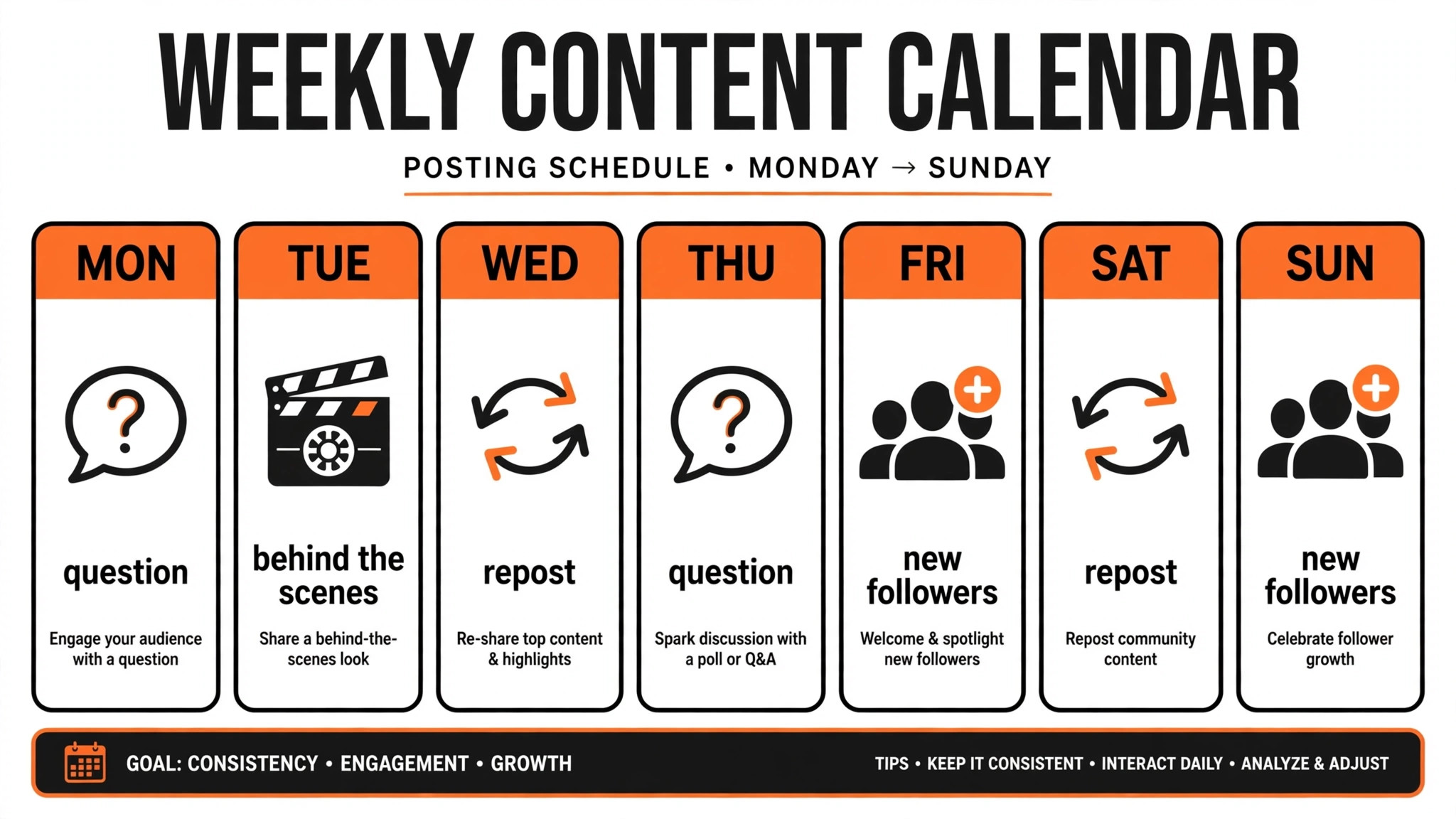
The weekly plan fits on one page, and it runs the same every week. Monday is for the thread, Tuesday to Friday are for daily posts and replies, Saturday is for the offer, and Sunday is for rest. The plan below is the full small business threads marketing strategy in a week, and it takes about three hours in total.
| Day | Post | Replies | Extra |
|---|---|---|---|
| Monday | Thread, 3 to 5 posts, one useful lesson | 5 replies | Pin the thread |
| Tuesday | One short post with a question | 5 replies | None |
| Wednesday | One short post with a question | 5 replies | Ask a customer for a quote |
| Thursday | One short post with a question | 5 replies | None |
| Friday | One short post with a question | 5 replies | Check the four numbers |
| Saturday | One offer post, price and deadline | 5 replies | Pin the offer for the day |
| Sunday | Rest, no post | None | Plan next week in 10 minutes |
Run the plan for four weeks before judging it, because the first week builds the profile and the second week builds the habit. The third week is when the replies start to compound, and the fourth week is when the messages arrive. A plan that is followed for a month works. A plan that is followed for three days does not.
The First 30 Days on Threads
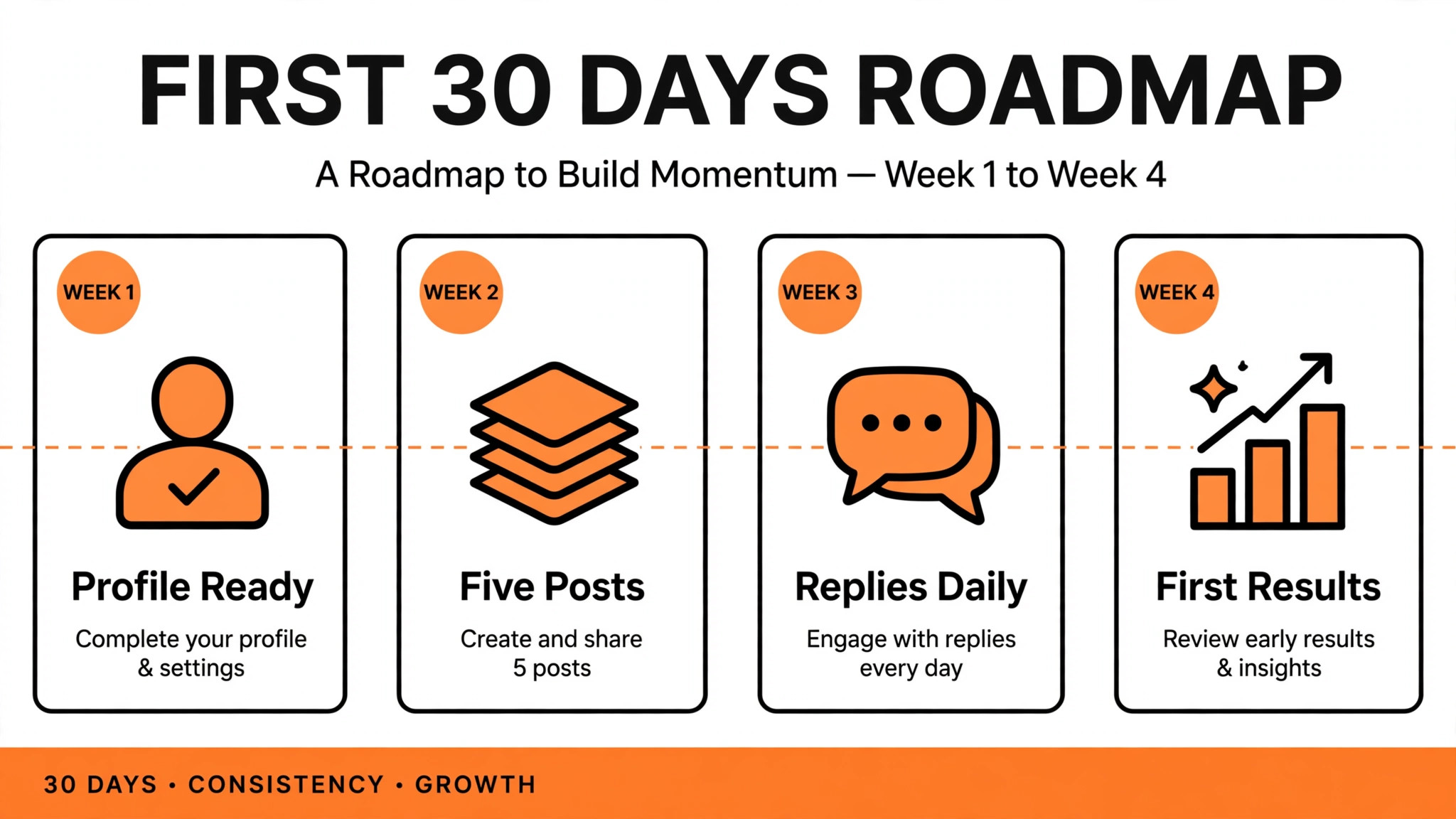
Week one is for the profile and the first posts. Fix the profile, write the pinned post, post once a day, and reply to five accounts a day. Do not worry about the follower count, because week one is about the habit, not the number. End the week by checking the four numbers and writing them down.
Week two is for the thread and the offer. Add one thread on Monday and one offer on Saturday, and keep the daily posts and the replies going. The thread will be the best performing post of the week, and the offer will be the worst, which is normal. End the week by checking the four numbers again and comparing them with week one.
Week three is for the customer voice. Ask a happy customer for a sentence, repost it with a thank you, and keep the daily rhythm going. The repost will bring the first new followers who are not friends, because a customer repost reaches the customer friends. End the week by checking the four numbers and noting which post type earned the most replies.
Week four is for the decision. Look at the four weeks of numbers and decide what to do more of. If question posts earn the most replies, write more of them. If threads earn the most profile visits, write two a week. If the offer earned no clicks, rewrite the offer with a clearer price and a shorter deadline. A small business threads marketing strategy that is measured for a month gets better for a month, and that is the whole point.
What to Do When Growth Stalls
Every Threads account stalls at some point, usually around two hundred followers, and the stall is not a failure. It is the moment when the easy growth ends and the real work starts. A business that knows what to do at the stall keeps growing, and a business that panics and starts posting offers every day loses the audience it built. This section is the stall plan, and it is the part of any small business threads marketing strategy that most guides leave out.
The first thing to check is the reply rate. Open the last ten posts and count the replies on each one. If the average is under two, the content is not starting conversations, and the fix is the question. End every post with a real question, not a rhetorical one, and answer every reply within an hour, because a fast answer keeps the thread alive and the algorithm notices. A post with five replies in the first hour reaches more people than a post with twenty likes and no replies.
The second thing to check is the audience. Open the follower list and count how many followers are customers, how many are other businesses, and how many are strangers. If most followers are friends and family, the account is not reaching new people, and the fix is the replies. Leave five real replies a day on accounts in the same town, not on big accounts with a million followers, because a reply on a local account reaches local people, and a reply on a big account drowns. Local replies bring local followers, and local followers become customers.
The third thing to check is the post type. Look at the last month of posts and sort them by replies. The top three post types are the ones to repeat, and the bottom three are the ones to drop. Most small businesses find that question posts and threads earn the most replies, while offer posts and link posts earn the fewest. That is normal, and it is why the plan runs six helpful posts to one selling post. A business that posts more of what works and less of what does not will see the reply rate rise within two weeks.
The fourth thing to check is the timing. Post in the morning for a week, then post at lunch for a week, and compare the reply counts. Most local audiences scroll in the morning before work and in the evening after dinner, but every town is different, and the only way to know is to test. A business that posts at the wrong time gets half the replies of a business that posts at the right time, and the fix costs nothing.
The fifth thing to check is the profile. Open the profile as a stranger would, and ask whether it says what the business sells in three seconds. If the answer is no, rewrite the one line, change the photo to a face, and pin the best post. A profile that is clear converts visitors into followers, and a profile that is vague converts visitors into nothing. The profile is the front door, and a front door that does not say what is inside stays closed.
There is one more fix for a stall, and it is the simplest: talk to one customer a day on Threads. Find a customer who follows the account, reply to their post, thank them in public, and ask them a question. A public conversation with a real customer is the most trustworthy content a small business can post, because strangers trust customers and doubt sellers. One public conversation a day, for two weeks, will restart growth that has stalled for a month. That is the honest side of this small business threads marketing strategy, and it is the move to make when the numbers stop moving.
Frequently Asked Questions
How often should a small business post on Threads?
Once a day, every day, with five replies a day on top. One post a day keeps the account visible, and five replies a day put the business in front of five new audiences. Posting seven times on a Sunday and going silent for the rest of the week does not work, because the algorithm rewards consistency, not bursts. Thirty minutes a day is enough.
How long does it take to grow on Threads?
About a month to see real movement, and about three months to build a steady audience. The first week builds the habit, the second week builds the content, the third week builds the replies, and the fourth week brings the first messages. A business that follows the plan for a month will see replies per post rise, profile visits rise, and the first bookings arrive. A business that quits after a week will see nothing.
Do Threads posts help a small business get customers?
Yes, through the profile link and the messages, not through the posts themselves. A post earns a reply, a reply earns a profile visit, a profile visit earns a link click, and a link click earns a booking. One offer a week, with a clear price and a deadline, turns the audience into customers. A business that posts offers every day gets ignored, and a business that never posts an offer gets liked and never paid.
How much does Threads marketing cost a small business?
Nothing but time, about thirty minutes a day. Threads is free to use, the posts are free to write, and the replies are free to leave. A business that wants to grow faster can pay for ads, but the plan in this guide needs no budget at all. The only cost is the half hour, and a half hour a day is cheaper than any advert.
What should a small business post on Threads?
Short posts with one idea and one question, replies on other accounts, one thread a week that teaches something, one customer repost a week, and one offer a week. The mix is six helpful posts to one selling post, and that ratio keeps the audience listening. A business that posts only offers gets ignored, and a business that posts only jokes gets followed and never paid.
Our Verdict
Start with the profile, post once a day, reply to five accounts a day, and run one offer a week. That is the whole plan, and it fits in thirty minutes a day. A small business that follows it for a month will have more replies, more profile visits, more link clicks and more messages than it has today. A small business that treats Threads like a billboard will have fifty followers next month, the same as this month.
The app also rewards the business that shows up on the hard days, not just the easy ones. A post written on a quiet Tuesday, a reply left on a slow afternoon, and a thread published when the shop is empty are the posts that build the audience, because consistency on quiet days proves the business is real. The accounts that grow are not the loudest, they are the steadiest, and steadiness costs nothing but a daily habit.
Start tomorrow morning, not next Monday, because a plan that starts tomorrow gets done and a plan that starts next week gets forgotten. Write the profile line tonight, post the first question in the morning, and leave five replies before lunch. By Friday the account will have five posts, twenty-five replies and a first week of numbers to beat.
The app rewards conversation, not broadcasting, and that is good news for a small business, because conversation is free and a billboard is not. The owner who answers every question in public, who teaches one useful thing a week, and who sells once a week will beat the business that buys adverts and never replies. That is the lesson of this small business threads marketing strategy, and it is the plan to follow for the next thirty days.