The customer never visits the website. They search “plumber near me” on Google, see the map, read the stars, and tap Call. The whole decision takes ten seconds, and the business that wins is the one with the best profile, not the best website. That is the starting point for any small business google business profile strategy, and it is the habit this guide builds.
Google Business Profile is free, and it is the single most valuable free tool a local business owns. The profile shows the business on Google Search and Google Maps, with the phone number, the hours, the photos, the reviews and the directions in one place. A business with a complete profile, fresh photos and recent reviews shows up in the local map pack. A business with an empty profile, no photos and three old reviews does not show up at all.
The third thing to know is the pace. Google rewards profiles that change, so a business that posts once a week and answers every review ranks better than a business that set up the profile two years ago and never touched it again. The whole routine takes about thirty minutes a week. That is the promise of this guide: a small business google business profile strategy that fits in half an hour a week, with a weekly plan, post types that work, and numbers that tell the truth.
This guide is written for a business with one owner, one phone and no ad budget. It covers the profile setup, the first thirty days, the seven moves that bring calls and visits, and the weekly plan that keeps it going. Follow the plan for a month, and the phone will ring more. Skip the reviews, post nothing, and the profile will sit invisible.
The Quick Shortlist
The short version first, for a business that wants the plan without the reading. A good small business google business profile strategy has five parts: a complete profile with the right categories, ten good photos, one post a week, an answer to every review, and a weekly check of four numbers. Everything in this guide hangs off those five parts.
| Part | What it means | Time |
|---|---|---|
| Complete profile | Every field filled, right categories, right hours | 1 hour once |
| Ten good photos | Shop front, team, work, products, inside and out | 30 minutes once |
| Weekly post | One short post a week, one offer or one update | 10 minutes a week |
| Every review answered | A reply to every review, good or bad, within a day | 10 minutes a week |
| Weekly check | Four numbers, checked every Friday | 10 minutes a week |
Read the review row first, because reviews are where the ranking comes from. Google shows businesses with more reviews and more recent reviews higher in the map pack, and customers trust a business that answers every review. A business that never answers reviews ranks lower and looks careless, even if the work is good.
Read the photo row second, because photos are what customers look at before they call. A profile with ten real photos of the shop, the team and the work gets more calls than a profile with one stock photo. The photos should be real, recent and taken on a phone, because customers trust real photos and ignore stock images.
How We Judged a Good Google Business Profile Strategy
A good Google Business Profile strategy is judged by calls, directions and visits, not by views, because a view never bought anything. This guide scores every move on four tests: does it help the business show up in the map pack, does it help a customer choose this business over the one next door, does it cost nothing but time, and does it lead to a call, a message or a visit. A move that fails two of those tests does not make the plan.
The first test is the map pack, because the top three map results get most of the calls. The map pack ranks on relevance, distance and prominence, and the profile is where relevance and prominence are built. The right categories, the right services and the right keywords in the description are what make a business relevant to a search. The second test is the choice, because a customer who sees three businesses on the map picks the one with the best stars, the best photos and the most recent reviews.
The third test is cost, because a small business has no ad budget to hide behind. Every move in this guide costs nothing but thirty minutes a week. The fourth test is the call, because a strategy that builds views and never rings the phone is a hobby. One clear phone number, one booking link and one offer a week are the minimum. A strategy that passes all four tests is a strategy worth following for a month.
The Playbook, Step by Step
The playbook has seven moves, and they run in order. Do the first two in week one, add the next three in week two, and run all seven from week three onward. Each move takes ten to thirty minutes, and the whole week takes about thirty minutes once the setup is done.
1. Fill Every Field and Pick the Right Categories
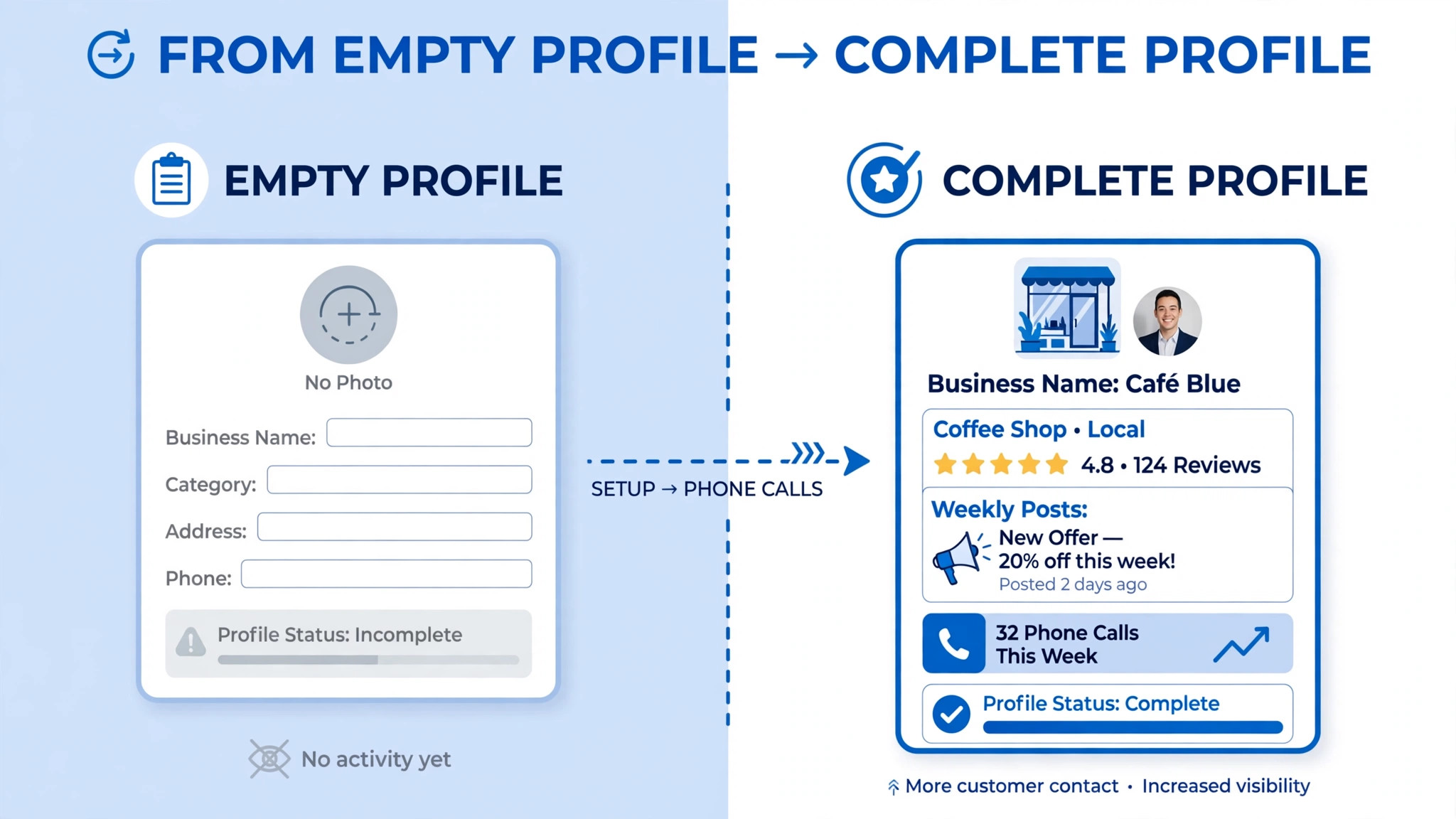
Open the profile and fill every field, because Google ranks complete profiles higher than empty ones. Add the exact business name, the full address, the phone number, the website, the hours including holiday hours, and the services with prices where they fit. Pick one primary category that matches the main service, such as Plumber or Bakery, and add secondary categories for the rest, such as Emergency Plumber or Cake Shop.
Write the description in 750 characters or less, with the town name, the main service and one line about what makes the business different. A plumber writes “Same-day plumbing in Denver, no call-out fee, twenty years in the trade.” A bakery writes “Sourdough and wedding cakes in Austin, baked fresh every morning.” The description should sound like the owner, not like a keyword list, because customers read it and Google reads it too. This move takes an hour and it is the foundation for everything else, because a profile with empty fields ranks like an empty shop.
2. Add Ten Real Photos and One Short Video
Take ten photos on a phone and upload them to the profile: the shop front from the street, the sign, the inside, the team at work, two finished jobs, two products, and one photo of the owner. Add one short video under thirty seconds, such as the oven opening or a tap being fixed, because profiles with video get more calls than profiles without. Name the photo files with the town and the service, such as denver-plumber-tap-repair.jpg, because Google reads file names.
Photos should be real, recent and taken in daylight, because customers trust real photos and ignore stock images. A photo of a clean van, a smiling team and a finished job tells a customer more than a paragraph of text. Update the photos every month, because fresh photos tell Google the business is alive. This move takes thirty minutes and it is the cheapest marketing a local business can buy.
3. Ask Every Happy Customer for a Review
Ask every happy customer for a review, at the moment they are happiest, which is right after the job is done. Hand them the phone with the review link open, or send the link by text within an hour, because a customer who is asked today reviews today and a customer who is asked next week forgets. Aim for one new review a week, because Google rewards recent reviews more than old ones, and a business with a steady flow of new reviews outranks a business with fifty old ones.
Make it easy by printing a small card with a QR code that opens the review page, and put the card on the counter or in the van. Never pay for reviews and never write fake ones, because Google removes them and customers spot them. One honest review a week, from a real customer, beats ten bought reviews that disappear. This move takes ten minutes a week and it is the single most valuable habit in this guide.
4. Answer Every Review Within a Day, Good or Bad
Answer every review within a day, good or bad, because customers read the replies and Google counts them. A good review gets a short thank you with the customer name and one detail from the job, such as “Thank you, Sarah, we loved baking that cake.” A bad review gets a calm reply that apologises, explains what happened, and invites the customer to call, such as “Sorry the wait was long on Saturday, we had a staff shortage, please call us and we will make it right.”
Never argue with a reviewer in public, because the argument is read by every future customer. A calm, honest reply to a bad review earns more trust than ten good reviews, because it shows the business cares. Answering reviews also tells Google the business is active, which helps the ranking. This move takes ten minutes a week and it is the habit that separates a trusted business from an ignored one.
5. Post Once a Week, One Offer or One Update
Post once a week on the profile, with one offer or one update and one photo. An offer post has a price, a deadline and a call to action, such as “Sourdough and coffee for 8 dollars this Friday only, call to order.” An update post has news, such as “New summer menu is out, come and try the lemon cake.” A post with a photo gets more views than a post without one, and a post with a price gets more calls than a post without one.
Posts expire after a while, so a fresh post every week keeps the profile looking alive. Post in the morning, when customers are planning their day, and keep the tone like the owner, not like an advert. One post a week, done well, beats seven posts a week that nobody reads, because Google rewards steady activity, not bursts.
6. Add Products and Services with Prices
Add every product and service to the profile, with a name, a price and a photo. A bakery adds sourdough at 6 dollars, a wedding cake from 200 dollars, and a coffee at 3 dollars. A plumber adds a drain check at 49 dollars, a tap repair from 80 dollars, and an emergency call-out at 120 dollars. Customers who see prices call with confidence, and customers who see no prices call the next business on the list.
Services also help the ranking, because Google matches searches to the services on the profile. A customer who searches “emergency plumber Denver” finds a profile that lists “Emergency call-out” faster than a profile that does not. Add the services once, update the prices twice a year, and the profile works while the owner sleeps. This move takes thirty minutes once and it pays for months.
7. Measure Four Numbers and Ignore the Rest
Check four numbers every Friday, and ignore everything else. The numbers are profile views, calls, direction requests and website clicks. Profile views show whether the business shows up in search. Calls show whether the profile turns views into customers. Direction requests show whether the business turns views into visits. Website clicks show whether the profile turns views into traffic.
Write the four numbers in a notebook every Friday, and compare them with last week, not with a big business. A small business that grows from five calls a week to ten calls a week is winning, even if the views barely move. A strategy that is measured weekly gets better weekly, and a strategy that is never measured stays invisible.
Side by Side Comparison
Google Business Profile is not the only way a local business gets found, and the choice matters. The table below compares the profile with the two other channels small businesses use most, on the four tests that matter: cost, reach, trust and sales.
| Factor | Google Business Profile | Website SEO | Social media |
|---|---|---|---|
| Cost to start | Free | Hosting and time | Free, but time heavy |
| Reach for a local business | Map pack, top of search | Organic results, slower | Followers only, unless viral |
| Trust signal | Stars and reviews | Testimonials on site | Comments and likes |
| Best content type | Photos, reviews, weekly posts | Service pages and blog | Short posts and reels |
| Time per week | About 30 minutes | About 2 hours | About 3 hours |
| Sales path | Call, directions, website | Contact form, phone | DM, profile link |
| Local discovery | Search and maps | Search only | Hashtags and location tags |
Google Business Profile wins for a local business that wants calls this week, because the map pack sits at the top of search and the phone number is one tap away. Website SEO wins for a business that wants to rank for years, because a good service page compounds over time. Social media wins for a business that wants a community, because followers come back. Pick the channel that matches the goal, and run the profile first, because it is free and it works fastest.
The Weekly Plan for Your small business google business profile strategy
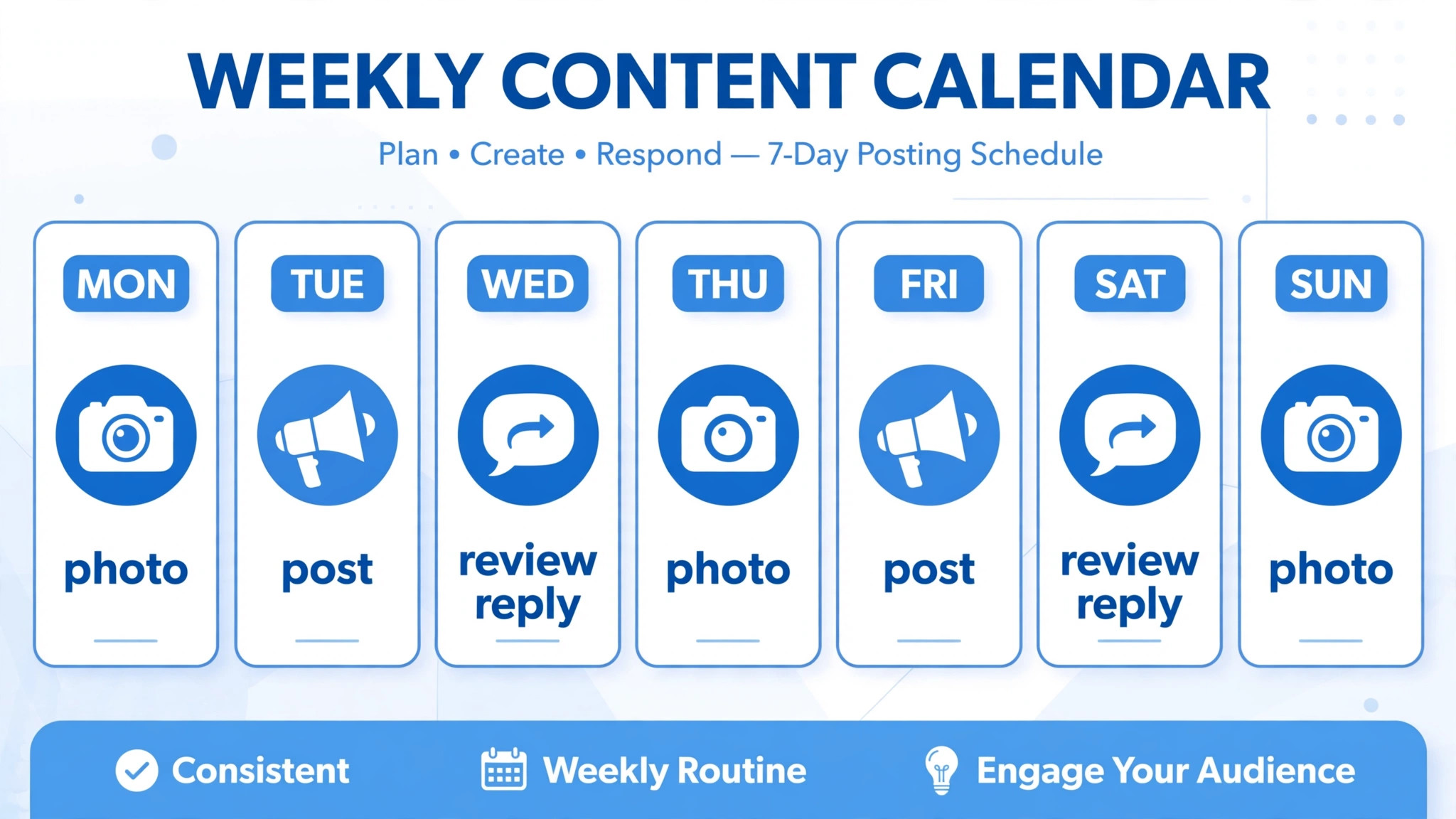
The weekly plan fits on one page, and it runs the same every week. Monday is for the post, Wednesday is for the review replies, Friday is for the numbers, and every day is for asking one customer for a review. The plan below is the full small business google business profile strategy in a week, and it takes about thirty minutes in total.
| Day | Task | Time |
|---|---|---|
| Monday | Publish one post, one offer or one update, with a photo | 10 minutes |
| Tuesday | Ask one happy customer for a review | 5 minutes |
| Wednesday | Answer every new review from the week | 10 minutes |
| Thursday | Ask one happy customer for a review | 5 minutes |
| Friday | Check the four numbers and write them down | 10 minutes |
| Saturday | Add one new photo if something worth showing happened | 5 minutes |
| Sunday | Rest, no profile work | None |
Run the plan for four weeks before judging it, because the first week builds the profile and the second week builds the habit. The third week is when the reviews start to compound, and the fourth week is when the calls rise. A plan that is followed for a month works. A plan that is followed for three days does not.
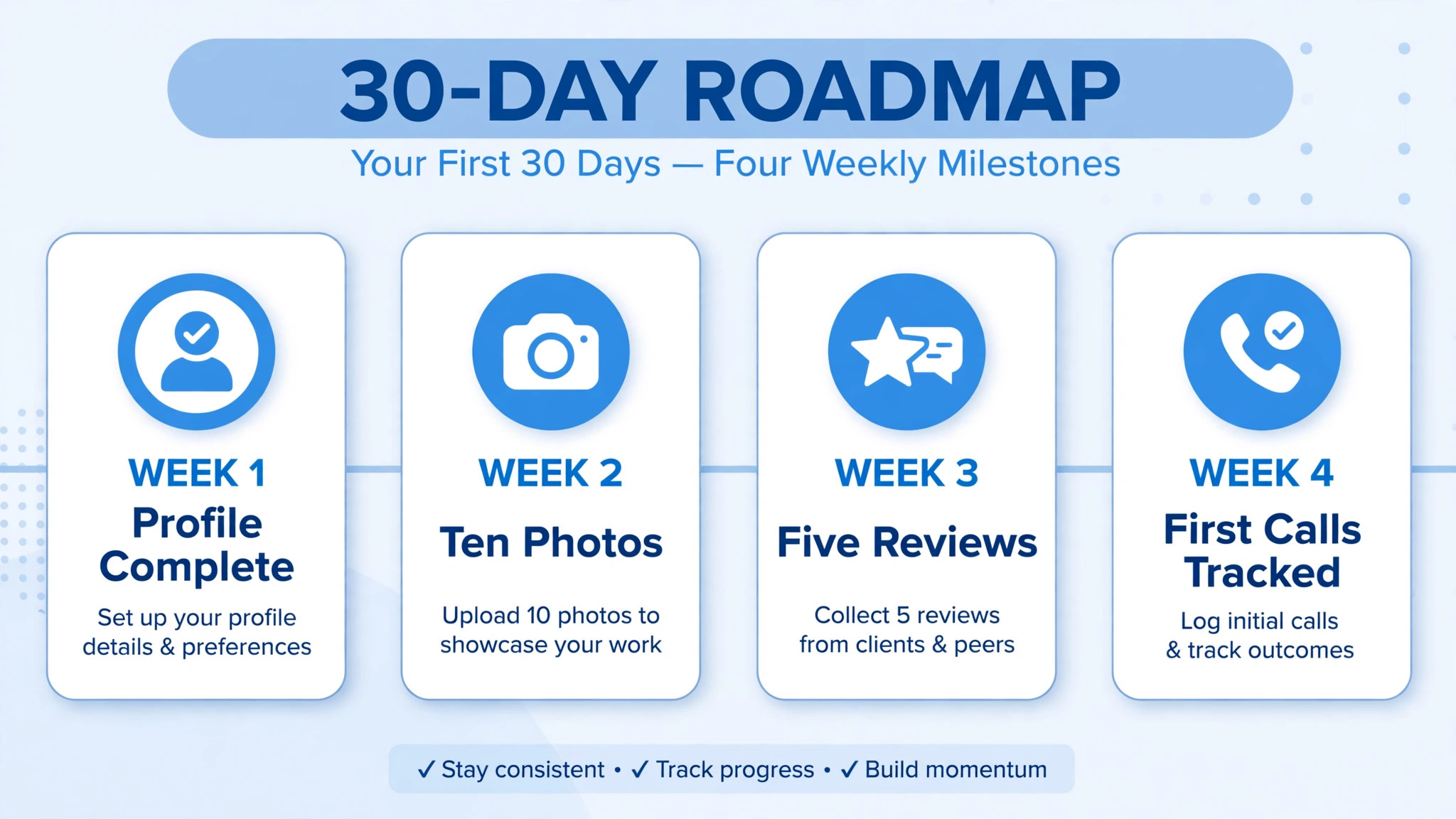
The First 30 Days on Google Business Profile
Week one is for the setup. Fill every field, pick the right categories, write the description, upload ten photos and one video, and add the products and services with prices. Do not worry about the ranking, because week one is about the foundation, not the number. End the week by checking the four numbers and writing them down.
Week two is for the reviews and the first post. Ask three happy customers for a review, answer every review that arrives, and publish the first weekly post. The first review will feel slow, and the first post will feel small, which is normal. End the week by checking the four numbers again and comparing them with week one.
Week three is for the photos and the services. Add three new photos from real jobs, check that the services and prices are right, and keep the daily review habit going. The new photos will bring the first profile views from people who have never heard of the business, because Google shows fresh photos more often. End the week by checking the four numbers and noting which action brought the most calls.
Week four is for the decision. Look at the four weeks of numbers and decide what to do more of. If reviews bring the most calls, ask more customers. If posts bring the most calls, post twice a week. If the photos bring the most views, take more of them. A small business google business profile strategy that is measured for a month gets better for a month, and that is the whole point.
Common Profile Mistakes That Cost Calls
Most Google Business Profiles lose calls for reasons the owner never sees, because the mistakes are small and the cost is silent. A wrong hour, a missing category or an unanswered review each costs a few calls a week, and together they cost a month of work. This section lists the mistakes that matter most, and it is the part of any small business google business profile strategy that saves the most money.
The first mistake is the wrong primary category. A business that picks “Restaurant” when it is a bakery, or “Contractor” when it is a plumber, shows up for the wrong searches and misses the right ones. The primary category should match the main service exactly, because Google uses it to decide which searches the business is relevant for. A bakery that picks “Bakery” ranks for bakery searches. A bakery that picks “Restaurant” ranks for neither. Check the category every quarter, because Google adds new categories and the right one may not have existed last year.
The second mistake is the wrong hours. A business that closes at 5pm but lists 6pm gets calls it cannot answer, and a business that opens at 9am but lists 8am gets visits that find a locked door. Both mistakes cost trust, and trust is what the stars measure. Update the hours for holidays, for summer and for winter, and set special hours a week before a public holiday, because Google shows the hours on the map and customers plan around them.
The third mistake is the missing phone number. A profile with no phone number, or with a number that goes to voicemail during work hours, loses the customers who call first and visit later. The phone number should be the number the owner actually answers, not a head office number that nobody picks up. Test the number once a month by calling it, because a number that rings out is a profile that loses calls silently.
The fourth mistake is the stock photo. A profile with a stock photo of a smiling stranger tells the customer nothing, and customers ignore it. A profile with a real photo of the shop front, the team and the work tells the customer everything. Take the photos on a phone, in daylight, and upload them the same day, because a real photo taken today beats a perfect photo taken two years ago. Update the photos every month, because fresh photos tell Google the business is alive and tell customers the business is open.
The fifth mistake is the unanswered bad review. A bad review with no reply tells every future customer that the business does not care, and a bad review with a calm reply tells them the business does. Answer every bad review within a day, apologise once, explain what happened in one sentence, and invite the customer to call. Never argue, never blame the customer, and never write a long defence, because the reply is read by strangers, not by the reviewer. A calm reply to a bad review earns more trust than ten good reviews, and it is the cheapest trust a business can buy.
There is one more mistake, and it is the most common: the profile that was set up once and never touched again. Google rewards profiles that change, so a profile with no post in six months, no new photo in a year and no new review in three months sinks in the map pack, even if the business is good. One post a week, one new photo a month and one new review a week keep the profile alive, and the whole routine takes thirty minutes a week. That is the honest side of this small business google business profile strategy, and it is the habit that keeps the phone ringing.
Frequently Asked Questions
How often should a small business post on Google Business Profile?
Once a week, every week, with one offer or one update and one photo. One post a week keeps the profile looking alive, and Google rewards steady activity. Posting seven times in one week and going silent for a month does not work, because the posts expire and the profile looks dead. Ten minutes a week is enough.
How long does it take to rank in the Google map pack?
About a month to see movement, and about three months to hold a steady spot. The first week builds the profile, the second week builds the reviews, the third week builds the photos, and the fourth week brings the first calls. A business that follows the plan for a month will see profile views rise, calls rise, and direction requests rise. A business that quits after a week will see nothing.
Do Google reviews help a small business get customers?
Yes, more than anything else on the profile. Customers trust a business with many recent reviews, and Google ranks businesses with more reviews higher in the map pack. One new review a week, answered within a day, beats fifty old reviews that nobody answered. Ask every happy customer, at the moment they are happiest, and the reviews will come.
How much does Google Business Profile cost a small business?
Nothing. The profile is free, the posts are free, the photos are free, and the reviews are free. The only cost is about thirty minutes a week of the owner time. A business that wants to grow faster can pay for Google Ads, but the plan in this guide needs no budget at all. The only cost is the half hour, and a half hour a week is cheaper than any advert.
What should a small business put in its Google Business Profile?
Every field filled, the right categories, ten real photos, one short video, every product and service with a price, one post a week, and an answer to every review. The mix is completeness plus activity, and that combination is what Google rewards. A profile that is complete and active ranks. A profile that is empty and silent does not.
Our Verdict
Fill every field, add ten real photos, ask every happy customer for a review, answer every review within a day, and post once a week. That is the whole plan, and it fits in thirty minutes a week. A small business that follows it for a month will have more profile views, more calls, more direction requests and more visits than it has today. A small business that set up the profile two years ago and never touched it again will stay invisible next month, the same as this month.
The profile also rewards the business that keeps its information honest. A wrong phone number, an old photo of a shop that has changed, or hours that no longer match the door will cost more calls than any competitor, because customers trust what they see and leave when it is wrong. Check the profile once a month, fix what has changed, and the map will keep sending customers who arrive and find exactly what they expected.
Google rewards the business that shows up, and the map pack rewards the business that stays active. The owner who answers every review, who posts one offer a week, and who adds a fresh photo every month will beat the business that buys adverts and never replies. That is the lesson of this small business google business profile strategy, and it is the plan to follow for the next thirty days.